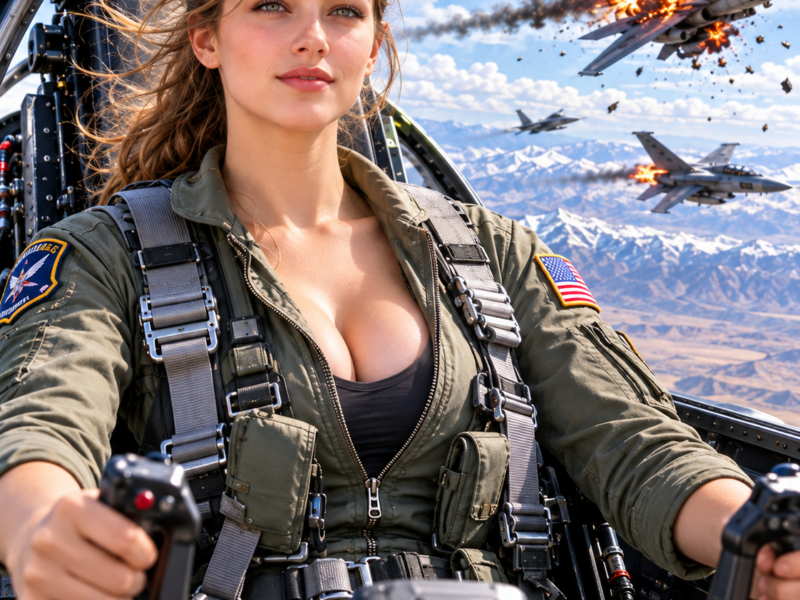
“They called me a glorified bus driver, laughed when they took my fighter wings, and told the entire squadron I belonged on cargo duty
The voice in my headset repeated my name.
“Claire, do you hear me?”
I nearly forgot to breathe.
“Identify yourself.”
A burst of static crackled through the channel.
Then came three words I had not heard in three years.
“Blackbird. Seven. Twelve.”
My hands went cold.
Blackbird Seven Twelve was the emergency authentication phrase assigned to my former wingman, Major Daniel Reeves.
The same man whose aircraft had vanished over the Black Sea.
The same man whose death I had been ordered to confirm.
And the same man I had watched disappear beneath a wall of fire before my own fighter limped back to base.
“Daniel?” I whispered.
“Claire, listen carefully. You have eight hostile aircraft ahead of you, but they’re not your real target.”
My radar warning receiver began screaming.
A missile lock.
I rolled hard to the left.
The world tilted, my shoulder pressed against the harness, and a white warning symbol flashed across my display.
“Break right!” Daniel shouted.
I reacted before I could think.
The interceptor snapped into a sharp turn as a missile streaked through the space where my aircraft had been.
It exploded in the distance.
For one terrifying second, I saw the hostile formation spread across my radar like a closing fist.
Then Daniel spoke again.
“They’re trying to herd you toward the northern ridge. Don’t follow their formation.”
“How are you transmitting on a dead channel?”
“No time.”
“Daniel, I saw your aircraft go down.”
“And I saw the report they wrote about you.”
His voice hardened.
“Neither of us was supposed to survive that mission.”
A new alert flashed on my display.
Two hostile jets were breaking away from the formation.
They were heading toward the airfield.
“Control, I have two contacts moving south toward the installation,” I called. “Request permission to engage.”
The answer came immediately.
“Permission granted. Maintain visual identification and stay within the authorized engagement zone.”
I adjusted my course.
The experimental interceptor responded with a sharp, almost effortless movement.
For three years, I had tried not to think about what I had lost.
My fighter wings.
My combat status.
The people who stopped talking whenever I entered a room.
But the moment I settled into the cockpit, the memories returned with brutal clarity.
The Black Sea.
The broken radio.
Daniel’s final transmission.
And the command that had changed everything.
Withdraw immediately. Do not attempt recovery.
I had obeyed.
I had returned alone.
And someone had made sure I paid for it.
“Claire,” Daniel said, pulling me back to the present. “The lead aircraft is carrying something that must not reach your base.”
“What?”
“An encrypted targeting package. If they transmit it, they’ll expose every defensive position in the region.”
I glanced at the radar.
The two aircraft approaching the airfield were only part of the threat.
The remaining six were turning toward me.
“They’re using me as bait,” I said.
“Exactly.”
“Then why send me up here?”
For the first time, Daniel sounded uncertain.
“I don’t know. But someone wanted you in that aircraft.”
A chill moved through me.
The interceptor had been prepared before the alarm.
Its weapons were loaded.
Its fuel tanks were full.
And Colonel Hayes had known exactly where to find it.
Someone had expected this moment.
Someone had expected me.
“Control,” I said, “who authorized the interceptor’s weapons configuration?”
There was a pause.
“Captain, maintain focus on your mission.”
“That wasn’t my question.”
“Your aircraft was prepared under standing evaluation orders.”
“Whose orders?”
Another pause.
Then the controller’s voice dropped.
“Colonel Hayes.”
Before I could respond, the two hostile jets began their attack run.
I broke away from the ridge and turned toward them.
My warning system sounded again.
I selected the first target and waited for the necessary confirmation.
The lock indicator turned steady.
“Control, hostile aircraft are entering the exclusion zone. I am engaging.”
“Confirmed.”
I launched.
The missile crossed the distance in seconds.
The first jet broke formation, attempting to evade, but the weapon struck before it could escape.
A bright flash appeared against the clouds.
The aircraft disappeared from my radar.
One down.
The second pilot turned sharply toward the airfield.
I followed, forcing him to abandon his attack line.
He fired.
I rolled away as the missile passed beneath me.
My aircraft shuddered in the turbulence.
I recovered, reacquired the target, and launched again.
The second hostile jet erupted into flame.
Two down.
For a moment, the radio was silent.
Then someone at the control tower shouted, “Direct hit! Captain Morgan has neutralized two contacts!”
I didn’t feel victorious.
I felt exposed.
The remaining six aircraft were turning toward me in a coordinated maneuver.
“Daniel, I need more than warnings.”
“You’ll get them. Listen to me. The lead pilot isn’t trying to shoot you down.”
“His wingmen seem pretty committed.”
“He’s trying to make you fire at the wrong target.”
I studied the display.
The lead aircraft was holding just behind the others, never quite entering a position where I could get a clean engagement.
“What am I missing?”
“Their formation is hiding a ninth contact.”
I stared at the radar.
“Ninth?”
“Low altitude. Running dark. Look beneath the eastern group.”
I adjusted the display filters.
At first, I saw nothing.
Then a faint return appeared near the surface.
A small aircraft was moving along the coastline, using the terrain to mask its approach.
It wasn’t part of the visible formation.
It was slipping toward the airfield from below the main radar coverage.
“That’s the real target,” Daniel said.
“If it reaches the installation—”
“They’ll have everything they need.”
I turned toward the low-altitude contact.
The six visible aircraft immediately shifted position.
Two moved to intercept me.
The others widened their formation, creating a wall between me and the hidden target.
“Control, I have an additional hostile contact at low altitude, east of the airfield. Request immediate confirmation.”
The response was delayed.
Too delayed.
“Captain, our radar does not confirm your additional contact.”
“I’m looking directly at it on my systems.”
“Your aircraft’s experimental radar may be producing unreliable returns. Maintain engagement with the confirmed targets.”
I felt my stomach tighten.
The interceptor’s systems were new, but the contact was real.
Daniel’s voice returned.
“They’re feeding your command center a false picture.”
“Can you prove it?”
“I can if you get the targeting package off that lead aircraft.”
“And how exactly am I supposed to do that while six fighters are trying to kill me?”
“You’re the best pilot I ever flew with, Claire.”
His voice softened.
“You always were.”
I swallowed hard.
Three years ago, those words would have meant everything.
Now they were a reminder of how much I had lost.
“Don’t make this personal, Daniel.”
“It became personal when they erased our squadron.”
The six hostile jets began closing in.
My fuel level was dropping.
The interceptor was fast, but I couldn’t keep evading forever.
I needed a plan.
And I needed to know why Daniel had returned now.
“Tell me where you are,” I said.
“I can’t.”
“Are you flying one of those aircraft?”
“No.”
“Are you on the ground?”
A pause.
“Yes.”
“Then how can you see their formation?”
“Because I know what they’re carrying.”
Another warning tone sounded.
One hostile jet had acquired a firing solution.
I broke hard and dropped beneath the attacker’s line.
The aircraft followed.
I pulled through the turn and watched the enemy pilot overshoot.
For one brief moment, he was exposed.
I took the shot.
The third hostile jet vanished from the display.
Three down.
The remaining aircraft scattered.
I had expected them to regroup.
Instead, their formation began to collapse.
The lead jet accelerated toward the coast.
The low-altitude contact changed course.
They were running.
“Captain Morgan,” control called, “disengage immediately. Return to base.”
I looked at the radar.
The hidden aircraft was approaching the airfield’s outer security boundary.
If I turned back, it would get through.
“Negative,” I replied. “I have an unconfirmed hostile contact approaching the installation.”
“That’s a direct order. Disengage.”
I hesitated.
Three years ago, I had followed a direct order.
I had turned away from Daniel’s damaged aircraft.
I had returned to base.
And the official report had called me a coward.
This time, I couldn’t make the same choice.
“Control, I am continuing the intercept.”
The radio went quiet.
Then Colonel Hayes came on the channel.
“Captain Morgan, you will obey my order and return to base immediately.”
I stared at the horizon.
“Sir, there’s another aircraft.”
“Your radar is unreliable.”
“Then authorize ground defenses to cover the eastern approach.”
“They are already covering it.”
“Sir, the contact is beneath their detection envelope.”
“Enough, Captain!”
His voice thundered through my headset.
“You are not authorized to make tactical decisions outside your assigned engagement.”
I looked at the hidden contact.
It was moving faster now.
If it reached the airfield, the consequences could be catastrophic.
“Understood, sir,” I said.
Then I switched channels.
“Daniel, tell me how to identify the targeting package.”
He answered immediately.
“Look for the lead aircraft’s transmission bursts. The package has to authenticate before it can be used.”
“Can you locate the source?”
“I’m trying.”
“Try faster.”
I pushed the interceptor toward the main formation.
The four remaining visible jets reacted at once.
One turned toward me while two moved to block my path.
The lead aircraft continued toward the coast.
I had one chance to get close enough to identify its equipment.
A warning light flashed.
The enemy pilot ahead of me fired.
I broke left, then rolled back toward the target.
The missile missed.
My interceptor shook as I accelerated through the turbulent air.
I could see the lead jet now.
Its markings were unfamiliar, but a small external pod beneath the fuselage matched the outline Daniel had described.
“There,” I said. “I have visual confirmation.”
“That’s it,” Daniel replied. “The pod contains the encrypted package.”
“Then why aren’t they transmitting?”
“Because they’re waiting for a signal from the aircraft below.”
The hidden contact.
Everything was connected.
The ninth aircraft was not merely approaching the base.
It was waiting to receive the package.
“Control, I need authorization to prevent a hostile data transfer.”
Hayes answered without hesitation.
“Negative. Return to base.”
“Sir, if that aircraft transmits—”
“Captain, this is your final warning.”
I felt the old fear rise inside me.
Not fear of dying.
Fear of being blamed again.
Fear of losing everything for a second time.
Then Daniel said something that made the fear disappear.
“Claire, I have the original mission recording.”
My breathing stopped.
“What?”
“The recording from Blackbird. Seven Twelve. I recovered it before they found me.”
“Who is they?”
“The people who ordered us to abandon the extraction team.”
The sky seemed to narrow around me.
Three years earlier, our squadron had been sent to escort a reconnaissance aircraft carrying intelligence from a covert operation.
We had been told the aircraft was carrying routine surveillance data.
Halfway through the mission, its escort formation came under attack.
Daniel’s fighter was damaged.
A second aircraft disappeared.
Then command ordered us to withdraw.
I had asked for permission to recover the downed crew.
The answer had been no.
I had obeyed because the order came from senior command, and because my own aircraft had suffered damage.
When I returned, the report claimed I had abandoned my formation before receiving the withdrawal order.
It said my actions had contributed to the loss of two aircraft.
Daniel was declared dead.
The surviving personnel were transferred.
The report was sealed.
And I was removed from combat duty.
“What does the recording prove?” I asked.
“That the withdrawal order came before the attack. That command knew the route was compromised. And that someone changed the flight data afterward.”
“Who?”
“I don’t have the final name yet.”
I looked toward the lead aircraft.
“Then help me get it.”
“I can give you the authentication sequence. If you capture the transmission, you’ll have proof.”
“Capture it how?”
“Your interceptor has a secure recording system. The same system they used to test the new radar.”
I glanced at the instruments.
The recording system was active.
But the transmission window would be brief.
I needed to stay close to the lead aircraft without letting its wingmen trap me.
“Daniel, I need you to keep talking.”
“Why?”
“Because I need to know I’m not imagining this.”
His answer came quietly.
“You’re not imagining it, Claire. They lied to both of us.”
I closed my eyes for a fraction of a second.
Then I opened them and flew.
The lead aircraft banked toward the coast.
I followed at a distance, forcing the other jets to split their attention.
One attacker moved behind me.
Another climbed above my altitude.
A third dropped low to cut off my escape.
They were trying to box me in.
I recognized the maneuver.
I’d trained against it hundreds of times.
The difference was that this time, I knew the formation’s weakness.
They were protecting the lead aircraft, not each other.
I feinted toward the upper jet.
He reacted.
I dropped beneath him and turned sharply across the formation.
The interceptor’s warning system screamed as another aircraft locked onto me.
I kept moving.
The lead jet transmitted.
A brief burst of encrypted data appeared on my display.
“Recording,” I said. “I’ve got a burst.”
“Not enough,” Daniel replied. “You need the authentication response.”
The low-altitude aircraft was almost at the airfield boundary.
I had seconds.
The lead jet began transmitting again.
I held my position.
A missile warning flashed.
I broke away just as a weapon passed behind my tail.
My aircraft jolted.
The second transmission ended.
“Did you get it?” I asked.
Daniel didn’t answer immediately.
Then he exhaled.
“Yes.”
A wave of relief swept through me.
“What does it say?”
“I don’t know yet. But the source code is coming from a military authorization network.”
“Which one?”
Before he could respond, the control tower interrupted.
“Captain Morgan, your aircraft is being recalled. Return to base immediately. Your combat authorization has been suspended.”
I stared at the message flashing across my display.
Suspended?
In the middle of an active engagement?
“Control, confirm.”
“Your authorization has been revoked by command authority.”
The lead aircraft continued toward the coast.
The hidden contact moved closer to the airfield.
And my weapons system suddenly locked me out.
Someone had just taken away my ability to fight.
Not because I had failed.
Because I had found something they didn’t want me to see.
“Daniel,” I said, “tell me you copied that transmission.”
“I did.”
“Then we’re not finished.”
I looked at the remaining hostile aircraft.
Three had already been destroyed.
The others were repositioning.
The hidden ninth contact was still approaching.
And my aircraft’s weapons controls were now restricted.
I had a choice.
Return to base and obey the recall.
Or stay in the air and risk being treated as a hostile pilot myself.
Three years ago, I had chosen obedience.
I knew what that had cost.
I switched to the emergency channel.
“Control, this is Captain Morgan. I am unable to confirm the additional contact has been neutralized. I am maintaining visual surveillance while attempting to establish communication.”
Hayes responded instantly.
“Captain, you are relieved of command. Turn back now.”
I looked at the airfield in the distance.
Then at the hidden contact.
“Respectfully, sir, I can’t.”
I cut the transmission.
For the first time in three years, I wasn’t flying to prove I deserved my wings.
I was flying because people on the ground were depending on me.
The low-altitude aircraft suddenly climbed.
It emerged from the haze, revealing a compact attack platform with a sensor array beneath its nose.
It wasn’t carrying a conventional bomb.
It was carrying a communications relay.
The targeting package was meant to be transmitted through that aircraft to an external receiver.
If it succeeded, the entire defensive network could be compromised.
I couldn’t use my weapons.
I couldn’t trust my command channel.
But I could still fly.
I pushed the interceptor into a steep climb, drawing the hostile aircraft away from the airfield.
The lead jet turned to follow.
So did two of its wingmen.
They wanted to keep me from interfering.
Good.
Let them follow.
I angled toward a bank of thick clouds rolling in from the west.
The enemy aircraft hesitated.
I didn’t.
I entered the cloud layer and let the weather swallow the interceptor.
My radar picture blurred.
The warning system chirped as the hostile jets moved closer.
I kept my breathing steady.
Wait.
Listen.
Move.
The first enemy aircraft emerged through the clouds ahead of me.
I dropped beneath its flight path.
It overshot.
The second appeared to my right.
I rolled away and climbed through a narrow gap between the clouds.
The third stayed behind, trying to maintain a lock.
My weapon system remained restricted, but the interceptor’s electronic countermeasures were still available.
I activated them.
The lock warning flickered.
Then vanished.
I broke through the cloud layer above the coastline.
The lead aircraft was directly ahead.
For the first time, I had a clear view of its external pod.
And beneath it, painted in small white letters, was a designation I recognized.
Not an enemy designation.
A contractor code.
A code I had seen in the original Black Sea mission briefing.
I felt the blood drain from my face.
The aircraft wasn’t simply carrying stolen intelligence.
It was carrying equipment supplied through a private defense contractor that had been investigated after our mission.
A company that had denied any involvement in the incident.
A company whose executives had testified that no unauthorized flight data had ever been altered.
Daniel’s voice returned.
“Claire, I know what you’re looking at.”
“Then you know this isn’t a foreign operation.”
“Not entirely.”
“Who are we fighting?”
“People using foreign pilots and borrowed aircraft to make the attack look legitimate.”
I stared at the lead jet.
The truth was worse than I had imagined.
Someone had arranged an attack on our own airfield.
And someone inside our command structure was helping them.
“Daniel, where’s the original recording?”
“Secure location. I sent a copy to an independent military investigator as soon as I detected the transmission.”
“You sent it before we had the full package?”
“I sent what I had. The new burst should give them the authorization chain.”
I almost smiled.
For three years, Daniel had been treated as a dead man.
Yet he had been working quietly to expose the truth.
“Why didn’t you contact me?”
“I tried.”
His voice broke slightly.
“Every channel I used was intercepted. Every message I sent was erased. When I learned you were being reassigned, I thought keeping you away from the investigation might protect you.”
“Protect me?”
“I watched what they did to your career, Claire. I didn’t want them to do worse.”
I looked down at the base.
The airfield was now visible beneath the haze.
The ninth aircraft had begun transmitting.
A red indicator flashed on my display.
Data transfer in progress.
I had less than a minute.
“Daniel, can you interrupt the signal?”
“Not from here.”
“Can the tower?”
“They’re not receiving the real transmission. Their system is showing a false feed.”
Of course it was.
Someone had built the deception into the operation.
I searched the cockpit display.
The interceptor’s radar and recording systems were separate from the base network.
That was why the transmission had reached me.
The experimental aircraft had been designed to operate independently during electronic warfare testing.
And that gave me one remaining advantage.
I couldn’t destroy the target.
But I could record it.
I angled the interceptor toward the relay aircraft, keeping the transmission pod in view.
The recording indicator turned green.
“Daniel, I have the full transfer.”
“Keep it running.”
“I am.”
The lead jet suddenly turned toward me.
Its nose dipped.
A missile warning sounded.
The pilot was done trying to herd me.
He was trying to kill me.
I broke hard.
The missile followed.
I rolled, dropped altitude, and pulled into a climbing turn.
The weapon passed close enough to shake my aircraft with its wake.
I felt the interceptor shudder.
A new warning flashed.
Hydraulic pressure falling.
I had taken damage.
The relay aircraft was still transmitting.
The lead jet was turning for another attack.
And the airfield was directly beneath me.
I needed help.
I opened the emergency channel.
“This is Captain Morgan. I have confirmed hostile electronic interference and an active unauthorized data transfer. I am transmitting the recorded evidence now.”
For several seconds, there was no answer.
Then another voice came through.
Not Hayes.
A woman.
“This is Major General Evelyn Shaw, regional operations command. Captain Morgan, we have received your transmission.”
I nearly missed my next breath.
General Shaw was the senior officer responsible for the entire region.
“General, the airfield is at risk. I need ground defenses to cover the eastern approach.”
“Confirmed. Defensive units are being redirected.”
“There’s an unauthorized aircraft transmitting a targeting package. Do not allow it to reach the airfield.”
“We understand.”
Her voice was controlled, but I heard something else beneath it.
Urgency.
“Captain, can you maintain visual contact?”
“Yes, ma’am. My aircraft has sustained damage, but I can continue.”
“Do not pursue beyond your safe operating limits. We are launching additional interceptors.”
“Understood.”
A second voice broke into the channel.
Colonel Hayes.
“General, Captain Morgan is operating outside her authorized orders. Her systems have been compromised, and her judgment cannot be trusted.”
General Shaw didn’t raise her voice.
“Colonel, your authority has been suspended pending review.”
The silence that followed was almost louder than the alarms in my cockpit.
Then Hayes spoke again.
“General, you don’t understand what she’s doing.”
“No,” Shaw replied. “I believe you are the one who will need to explain yourself.”
My chest tightened.
For three years, I had waited for someone in authority to ask the right question.
Now someone finally had.
But the mission wasn’t over.
The relay aircraft suddenly turned away from the airfield.
The data transfer stopped.
For a moment, I thought it was retreating.
Then Daniel shouted through the headset.
“Claire, it’s switching to a backup receiver!”
“Where?”
“Offshore. A ship or another aircraft. I can’t tell.”
I checked the radar.
The lead jet was moving toward the relay aircraft.
The two remaining hostile fighters were breaking away.
They were regrouping for an escape.
I had recorded the transmission, but the evidence wouldn’t matter if they disappeared before the interceptors arrived.
“General Shaw, the hostile aircraft are attempting to withdraw.”
“Maintain observation. Do not take unnecessary risks. Support is two minutes out.”
Two minutes.
The relay aircraft was already turning toward the open sea.
I had no weapons.
My hydraulic pressure was falling.
My interceptor was becoming harder to control.
I could follow and risk losing the aircraft.
Or I could stay near the base and let the targets escape.
I thought of Daniel.
I thought of the sealed report.
I thought of every pilot who had been told to stay silent because speaking up would damage their career.
Then I noticed something on the display.
The lead jet was no longer protecting the relay aircraft.
It was flying ahead of it, transmitting a new burst of data.
The package wasn’t being sent to the offshore receiver.
It was being sent to the lead aircraft.
The relay was a decoy.
The real transmitter was right in front of me.
“Daniel, I have the source.”
“Then keep recording.”
“I can’t get closer without risking a collision.”
“You don’t need to get closer. The interceptor’s passive receiver can capture the signal from here.”
I checked the recording indicator.
Still green.
The signal strength was rising.
The transmission was almost complete.
Then the lead aircraft’s external pod detached.
It dropped away, tumbling toward the sea.
A small parachute opened above it.
The pilot was trying to preserve the equipment.
I watched the pod drift downward.
The aircraft accelerated away.
If it escaped, the pilot might still be able to destroy any remaining evidence.
“General Shaw, the lead aircraft has released its transmission pod. I have recorded the transfer, but the equipment is descending toward the water.”
“Can you recover it?”
“Not safely, ma’am.”
“Then don’t attempt it. Our interceptors are approaching your position.”
I held my course.
The hostile aircraft began to scatter.
A pair of friendly fighters appeared on my radar.
For the first time that afternoon, I wasn’t alone.
They moved to intercept the retreating jets while I maintained observation of the pod’s last known position.
The engagement ended quickly.
The remaining hostile aircraft broke away from the area.
No further attacks were reported.
The airfield was safe.
But as I turned back toward base, I felt no relief.
Not yet.
I had survived the mission.
I had recorded the transmission.
And I had heard Daniel’s voice.
But the truth was still waiting on the ground.
When my damaged interceptor touched down, emergency crews rushed toward the runway.
I shut down the engine and sat still for several seconds.
My hands were shaking.
Not from fear.
From the realization that I had finally returned to the place where everything began.
A crew chief helped me climb from the cockpit.
Across the apron, Colonel Hayes stood beside two security officers.
His face was rigid.
General Shaw was waiting near the operations building.
She approached me as I walked toward her.
“Captain Morgan, you are relieved of flight duty pending a technical inspection.”
“Yes, ma’am.”
She paused.
“Your recording has been secured. The authorization chain is being reviewed by an independent investigative team.”
“Thank you, ma’am.”
“There is one more thing.”
She handed me a sealed envelope.
Inside was a printed photograph.
Daniel Reeves stood in front of a plain concrete building, older and thinner than I remembered, but unmistakably alive.
The photograph had been taken that morning.
My knees nearly gave way.
“Where is he?” I whispered.
“Under protective supervision. He contacted the investigative team after your transmission was received.”
I stared at the photograph.
“Can I see him?”
“Not yet. We need to secure the remaining evidence and establish who was involved. But Captain, he is alive.”
I closed my eyes.
For three years, I had carried the weight of a death that wasn’t mine to explain.
Now I had to learn how to live with the truth.
General Shaw lowered her voice.
“There’s something else you should know. The contractor code on the hostile aircraft matches a company named in the original Black Sea inquiry.”
I looked up.
“So the mission was connected to this attack.”
“We believe so. Your recording may establish the connection.”
“And Colonel Hayes?”
“He is being questioned. His authorization of the interceptor’s preparation, his attempt to recall you, and his role in the initial report are all under investigation.”
I looked across the apron.
Hayes was speaking to the security officers, his expression no longer confident.
For the first time, he looked like a man who understood that the story he had told for years was about to collapse.
“General,” I said, “I want the original mission report reopened.”
“It already has been.”
“And I want every pilot named in it to have their testimony reviewed.”
Shaw nodded.
“That will be part of the investigation.”
I took a breath.
“Then that’s all I ask.”
She studied me for a moment.
“No, Captain. I suspect it’s only the beginning of what you’ll ask for.”
She was right.
The next several days were a blur of interviews, technical examinations, and meetings behind closed doors.
Investigators recovered the interceptor’s recordings and matched them with the encrypted transmission Daniel had preserved.
Together, the files revealed a chain of unauthorized communications linking the hostile aircraft, the defense contractor, and a small group of officials who had manipulated the Black Sea mission report.
The original withdrawal order had been issued before Daniel’s aircraft was hit.
The report had later been altered to make it appear that I had abandoned him.
The truth was worse than a simple mistake.
The mission had exposed an unauthorized weapons transfer, and the people responsible had tried to bury the evidence.
Daniel had survived the crash and spent months recovering under a protected identity.
When he attempted to report what he had seen, the investigation was shut down.
He had remained hidden while quietly preserving the evidence.
The attack on our airfield had been designed to retrieve the final piece of the operation’s encrypted record.
My unexpected flight had disrupted the plan.
And my recording had connected the new attack to the old cover-up.
Colonel Hayes was removed from command while the investigation continued.
Several officials were suspended.
The contractor’s records were seized.
The hostile aircraft and their operators became the subject of an international investigation.
Most importantly, the official report on the Black Sea mission was corrected.
It stated plainly that I had followed the withdrawal order and that no evidence supported the allegation that I had abandoned my squadron.
My combat status was restored.
But the moment I cared about most came three weeks later.
I was standing outside a quiet room at the regional command center when the door opened.
Daniel stepped out.
For a moment, neither of us moved.
He looked older than the man I remembered.
There was a scar near his temple and a slight stiffness in his left leg.
But he was alive.
I crossed the room before I could talk myself out of it.
He held me tightly.
I had imagined this moment a thousand times.
In some versions, I shouted at him.
In others, I cried.
In the worst ones, I woke up before I reached him.
Instead, I stood there with my face against his shoulder, unable to speak.
Finally, he whispered, “You came back for me.”
I pulled away enough to look at him.
“I thought I left you behind.”
“You followed the order they gave you.”
“I should have questioned it.”
“Maybe,” he said gently. “But you were a pilot, Claire. You weren’t supposed to know that the people giving the orders had already betrayed us.”
I looked down.
“For three years, I believed everyone thought I was a coward.”
“Some did.”
He didn’t soften the truth.
“But the people who flew with you knew better. They remembered what happened before the report changed.”
I swallowed.
“Why didn’t anyone speak up?”
“Some were afraid. Some were transferred. And some were told that if they challenged the report, they’d lose their careers too.”
I thought of Harlan and the others who had laughed when I walked past the hangar.
I had wanted them to see me as a fighter pilot again.
Now I wasn’t sure I needed their approval.
Daniel followed my gaze toward the window, where aircraft moved across the distant runway.
“You know what the strangest part is?” he asked.
“What?”
“When I heard your voice on the radio, I knew you’d find a way.”
I gave a tired laugh.
“You didn’t sound very confident when you told me to abort.”
“I was terrified.”
“You could have fooled me.”
“I was terrified you were going to die before I could tell you the truth.”
His expression grew serious.
“I should have found a way to reach you sooner.”
“You tried.”
“Not hard enough.”
I studied him.
For a long time, I had believed that surviving meant carrying every unanswered question alone.
But Daniel had carried his own burden.
Neither of us could recover the years we had lost.
We could only decide what to do with the truth we had finally found.
“I don’t know what happens next,” I admitted.
Daniel smiled faintly.
“Neither do I.”
For once, that answer didn’t frighten me.
The following month, I returned to the flight line.
The jokes had stopped.
Some people apologized.
Others avoided my eyes.
Lieutenant Harlan approached me outside the hangar one morning, his hands awkwardly tucked into his pockets.
“Captain Morgan,” he said. “I owe you an apology.”
I waited.
“I was wrong about you.”
“Yes,” I said. “You were.”
He looked as though he expected me to make the moment easier for him.
I didn’t.
After a few seconds, he nodded and walked away.
I watched him go, then turned toward the aircraft waiting for me.
My restored fighter wings sat pinned to my uniform.
They felt heavier than they had years ago.
Not because they proved I was a good pilot.
Because they reminded me how easily an institution could take someone’s reputation and how hard it could be to get the truth back.
General Shaw had offered me a return to frontline combat.
I accepted.
Not to prove the people who mocked me wrong.
Not to punish the people who had betrayed us.
And not to chase the ghost of the pilot I had been before the Black Sea.
I returned because flying was still the one place where every decision mattered, where courage wasn’t measured by how loudly someone spoke, and where the truth eventually appeared in the instruments.
On my first official flight back, I taxied toward the runway as the tower cleared me for takeoff.
The sun was rising beyond the distant hills.
I pushed the throttle forward.
The aircraft accelerated.
Then the wheels left the ground.
For the first time in three years, I wasn’t escaping a past that someone else had written for me.
I was moving toward a future I had chosen myself.
As the base grew smaller beneath my wings, Daniel’s voice returned to my memory.
Neither of us was supposed to survive that mission.
Maybe we weren’t.
But we had.
And the people who believed they could bury the truth had learned something they should have understood from the beginning.
You can ground a pilot.
You can take away her title.
You can rewrite a report and convince a room full of people to laugh at her.
But you cannot change what happened simply by changing the story.
And when the truth finally gets the chance to fly, even eight enemy jets may not be enough to stop it.
The end.









