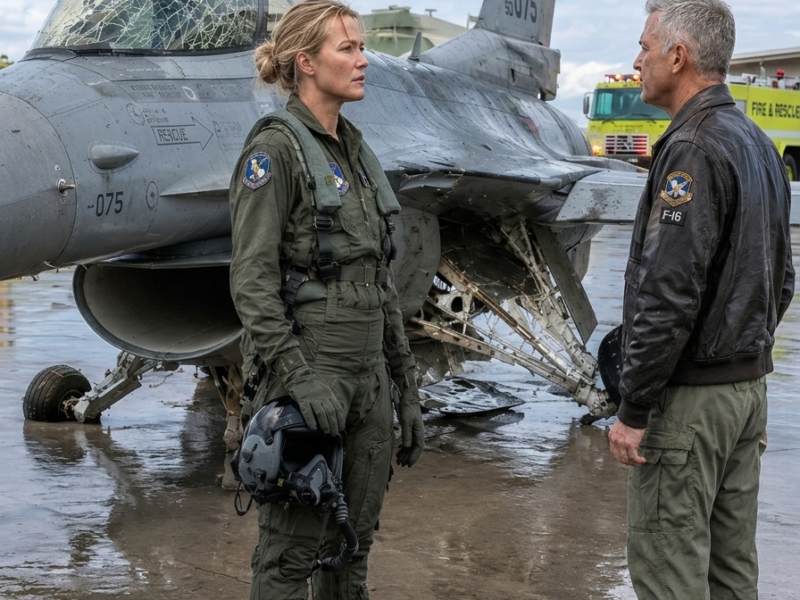
The young female pilot’s F-16 nearly slammed into the runway during a violent storm at Nellis Air Force Base
Rain hammered the cockpit of my F-16 as I fought the controls, my hands slick with sweat inside my gloves. The runway lights blurred through the windshield, appearing and disappearing behind blinding sheets of water blown by gale-force winds across Nellis Air Force Base.
“Wind shear detected,” the onboard computer warned in its flat, electronic voice.
“I see it,” I whispered through gritted teeth, pulling the flight stick hard against the violent crosswind.
My aircraft dropped suddenly, plunging fifty feet in a heartbeat, and my stomach lurched as the wet tarmac rushed up toward me. For one terrifying second, I thought I was going to lose it—that the storm would swallow me whole right at the threshold of the runway.
Then pure instinct took over. I adjusted the throttle, corrected the nose angle, and felt the heavy rubber wheels strike the runway with a bone-rattling thud. The jet swerved violently, tire smoke mixing with rain spray before I finally straightened the nose gear and brought the screaming aircraft to a stop.
I exhaled slowly, realizing I had been holding my breath for the last two miles of the descent.
When I climbed down the yellow boarding ladder, my flight suit was already soaked through, and my knees were still trembling beneath the heavy G-suit. A group of seasoned pilots watched from the dry safety beneath the wide hangar roof, their arms crossed.
“That’s the new girl?” one muttered loudly enough for his voice to carry over the wind.
“Looks like she barely survived,” another laughed, taking a slow sip from a stainless-steel coffee mug.
I pretended not to hear them. I had learned long ago that people often judged what they could see because the truth made them uncomfortable. They saw a rattled junior officer shaking from a rough landing in bad weather; they didn’t see the ghost sitting in my cockpit with me.
Then a black military vehicle splashed through the standing water and skidded to a sudden stop beside the hangar line.
Colonel Daniel Mercer stepped out into the pouring rain.
Every pilot under the hangar immediately stood straighter, their smirks vanishing instantly. Mercer was the kind of commander whose reputation traveled far ahead of his aircraft—a combat legend who rarely showed emotion, never raised his voice, and never wasted words.
His sharp, grey eyes moved deliberately from my damaged-looking jet to my face. For several agonizing seconds, he said nothing while the rain poured off the brim of his cap.
Then something fundamental changed in his hardened expression. He slowly reached up and removed his cap.
And in front of the entire stunned squadron, the colonel raised his right hand in a formal, unwavering salute.
“Welcome back, Ma’am.”
The laughter beneath the hangar died instantly. The silence that followed was so absolute you could hear every individual drop of rain striking the aluminum roof.
I returned the salute, though my throat tightened until I could barely swallow. “Good to see you again, Colonel.”
One of the senior flight leads stepped forward, glancing nervously between us. “Sir, you know her?”
Mercer didn’t look away from me. “Know her?” he repeated quietly, his voice carrying an icy weight that chilled the air faster than the storm. “Three years ago, this woman flew deep into heavily defended enemy airspace to rescue twelve downed American pilots after their tactical formation was ambushed in Sector Seven.”
Nobody moved. Nobody breathed.
He continued, his voice growing heavier with every word. “She brought eleven home alive under heavy missile fire, then turned her aircraft around alone for the twelfth when Central Command had already ordered her to withdraw or face court-martial.”
My chest tightened until it felt crushed. I could still hear that final, static-laced transmission in my nightmares—the desperate radio calls echoing through my headset as the sky turned into a wall of anti-aircraft fire. The twelfth pilot had been my younger brother, Leo.
And I had never told a single soul on earth what actually happened during those last seven horrifying minutes over Sector Seven.
Mercer lowered his salute, his eyes narrowing slightly as he took a step closer to me. “Your return to active status wasn’t supposed to happen like this.”
I stared at him, wiping rainwater from my eyes. “What do you mean, Colonel?”
He glanced up toward the glass-walled control tower overlooking the runway, where two men in unbadged civilian suits—clearly intelligence officers—had just appeared behind the tinted glass.
“Your brother’s case was officially reopened this morning,” Mercer said softly.
The world seemed to tilt violently beneath my boots. “That investigation was closed three years ago,” I stammered. “It was classified under National Security seals.”
“I know.”
“His aircraft was completely destroyed,” I insisted, my voice cracking under the sudden weight of old grief. “They recovered the scorched wreckage from the ravine.”
Mercer hesitated, his jaw tightening. “They recovered an aircraft, yes.”
My fingers went numb inside my damp gloves.
Before I could speak another word, a young communications officer hurried toward us from the terminal building, clutching a sealed black plastic folder to his chest. “Colonel! The secure transmission just came through the satellite array again. It bypassed the main firewall.”
Mercer took the folder but didn’t open it. Instead, he turned and handed it directly to me.
Across the front of the sealed file, someone had written three words in thick, deliberate red ink:
GHOST PILOT CONFIRMED.
I looked up at the colonel, my pulse racing like an engine at full afterburner. “Who sent this?”
His face had gone completely pale under the harsh hangar lights.
Then, without warning, the helmet resting under my left arm crackled to life with a burst of white noise. My aircraft’s radio systems had been completely switched off when I killed the engine three minutes ago. The power was off. The battery bus was dead.
Yet, a familiar, rasping voice whispered through the helmet’s small internal speaker, cutting through the sound of the rain with terrifying clarity:
“Big sister… if you’re hearing this, don’t trust the man standing beside you.”
I froze, slowly turning my head to look at Colonel Mercer.
He was already reaching beneath his heavy rain jacket for his sidearm.
The motion was subtle, but to a combat pilot trained to notice microscopic changes in a target’s posture, Mercer’s hand moving toward his jacket was as clear as a missile lock warning.
Before his fingers could close around the grip of his pistol, I dropped my helmet, grabbed the sleeve of his heavy coat, and twisted his wrist downward with all the leveraged force I could muster. The sidearm clattered onto the wet concrete, sliding several feet into the rain.
“What are you doing, Colonel?!” I demanded, keeping my grip locked on his arm while stepping back to create distance.
The surrounding pilots gasped, pulling back in shock as the base security team stationed near the hangar entrance instinctively raised their weapons.
“Stand down!” Mercer roared to his men, stepping away from me and holding up his open hands, though his eyes remained fixed on mine like iron sights. “Captain, you don’t understand what’s in that folder. You don’t know what your brother was really flying that night!”
“I know what I saw in Sector Seven,” I snapped, picking up the black folder with my free hand. “I saw his telemetry drop off the board after he drew three surface-to-air missiles away from my formation!”
“That was the cover story!” Mercer stepped closer, his voice dropping into a desperate, hurried whisper as rain lashed between us. “Leo didn’t crash because of enemy fire. He was flying an experimental stealth prototype with a black-budget quantum transponder. The aircraft didn’t explode—it transitioned. And the people who funded that project have been waiting three years for you to land on this base so they could use your pilot biometric signature to unlock his flight recorder!”
My heart hammered violently against my ribs. “My biometric signature?”
“The encryption on the Ghost project isn’t an alphanumeric password,” Mercer said, taking a breath as he gestured toward the control tower. “It’s tied to your family’s DNA markers. The moment you keyed your flight suit into the Nellis tactical grid five minutes ago, you transmitted the final decryption key. They don’t care about you, Captain. They used you as a keycard.”
Before I could process his words, the overhead hangar lights flickered three times and died, plunging the entire sector into near-total darkness, illuminated only by the rhythmic flash of runway emergency strobes.
High above us in the control tower, the glass suddenly shattered into a thousand glittering shards as high-caliber, suppressed gunshots echoed over the storm. The two intelligence officers behind the glass collapsed against the console frames.
“Sniper! Down!” someone screamed across the tarmac.
Pilots scattered in every direction, diving behind maintenance carts and aircraft tires for cover. Mercer grabbed my tactical vest, pulling me violently behind the heavy steel landing gear of my F-16 as another round slammed into the concrete where I had been standing a second before.
“Who is shooting at us?” I yelled over the deafening roar of wind and incoming fire.
“The Blackwood Syndicate,” Mercer gritted out, pulling a spare compact pistol from an ankle holster and sliding it across the wet ground to me. “They’re the defense contractors who built your brother’s prototype. They bought off half the regional command structure two years ago. They aren’t going to let either of us leave this hangar alive now that the file is decrypted.”
I caught the pistol, checked the magazine, and racked the slide in one smooth motion. “Where is the real transmission coming from? The voice in my helmet—was that Leo?”
“I don’t know,” Mercer admitted, looking me dead in the eye through the shadows. “But if he’s still breathing, he’s being held at the decommissioned radar installation at Ridgepoint—twenty miles north in the desert. That’s where the Blackwood relay is stationed.”
My hands tightened on the grip of the pistol. “Then that’s where I’m going.”
“You can’t take an F-16 out in this weather without tower clearance and ground crew,” Mercer warned. “The automated air defense systems will paint you as an unauthorized rogue target the second you leave the deck.”
I looked at my jet, its matte-black skin glistening under the strobe lights. “I’ve flown through worse than this to save family, Colonel. Are you coming with me, or are you going to keep standing in the rain?”
Mercer stared at me for a split second, then a faint, dark smile crossed his weathered face for the first time. “I spent thirty years in the Air Force following orders that turned out to be lies. It’s about time I broke a few.”
He turned, fired three rapid shots at an advancing mercenary dressed in tactical gear near the hangar entrance, and motioned toward a heavy tactical transport vehicle parked in the darkness of Hangar 4.
“We take the ground route to Ridgepoint,” Mercer said, ducking low as bullets chipped away at the metal pillars around us. “If we take to the sky now, they’ll shoot us down before we clear the base perimeter. We go through the underground service tunnels!”
The underground service tunnels beneath Nellis Air Force Base were a labyrinth of cold concrete, humped high-voltage cables, and steam pipes that had remained locked since the Cold War. The heavy tactical transport vehicle lurched forward in the dim yellow emergency light, its heavy tires throwing up clouds of dry dust as Mercer floored the accelerator.
I sat in the passenger seat, tearing open the sealed black folder with my combat knife. Inside lay a stack of high-resolution satellite imagery, heavily redacted laboratory transcripts, and a single glass micro-chip sealed in a static-proof sleeve.
“Look at these coordinates,” I said, spreading the satellite photos across the dashboard. “This isn’t just a radar installation at Ridgepoint. Look at the subterranean footprint—it’s six levels deep.”
Mercer glanced over for a fraction of a second while steering through a tight concrete chicane. “That’s Site Zero. Officially, it was dismantled in 1994. Unofficially, Blackwood spent eighty million dollars converting it into a deep-black testing center for autonomous combat systems.”
I held the glass micro-chip up to the dim dash light. Embedded inside the clear silicon was an unmistakable military dog-tag number etched in microscopic laser writing: 338-90-LEO.
“They kept his identity alive in their system,” I whispered, feeling an icy knot form in my stomach. “Why? If they had his aircraft, why keep him?”
“Because the neural flight interface Blackwood designed required a human pilot’s cognitive map to train their drone AI,” Mercer answered grimly, his knuckles white on the steering wheel. “They couldn’t replicate combat intuition with algorithms alone. They needed a pilot who possessed absolute spatial awareness and zero fear under high-stress conditions. They needed Leo’s brain waves.”
Tears of pure, burning rage welled in my eyes, but I forced them back. Grief was a luxury I couldn’t afford right now. Anger was a fuel I could use.
“So the voice on my helmet radio…”
“Was either Leo himself trying to reach you through a cracked comms node,” Mercer said quietly, “or an AI trained on his voice, using his memories to manipulate you into coming here.”
The thought was more terrifying than any surface-to-air missile I had ever dodged. The idea that my brother’s consciousness had been mined, copied, and repurposed into an cold machine designed for war made my blood run cold.
Suddenly, the vehicle’s dashboard electronics flickered wildly. The digital speedometer dropped to zero, the GPS display turned into static, and the radio speakers exploded with a high-pitched electronic shriek.
“EM pulse!” Mercer barked, wrestling with the heavy steering wheel as the power-assisted steering cut out completely.
The transport vehicle skidded violently across the damp tunnel floor, crashing against the concrete wall in a shower of sparks before grinding to a halt twenty feet from a massive, closed steel blast door that blocked the end of the corridor.
The headlights died, plunging us into pitch-black darkness.
“You alright?” Mercer asked in the dark, his voice steady despite the heavy impact.
“I’m fine,” I replied, unbuckling my harness and reaching for my pistol.
A high-voltage emergency light flickered on above the blast door, casting long, menacing shadows across the tunnel. Across the top of the steel door, a digital display chimed softly, resetting its countdown clock:
FACILITY PURGE INITIATED: 15:00 MINUTES.
Before either of us could move, a speaker above the blast door crackled to life. The audio was crystal clear, completely free of the storm static that had plagued us above ground.
“Hello, sister,” the voice said. It was Leo’s voice—exact, precise, carrying the subtle inflection of the laugh he used to have when we were children flying remote-controlled gliders in our backyard. “I knew you’d open the file. You never could leave a wingman behind.”
I stepped out of the wrecked vehicle, walking slowly toward the blast door with my gun held at low ready. “Leo? Is that really you? Or am I talking to a program?”
There was a long, agonizing pause through the speaker. When the voice returned, it sounded fractured, layered with a faint mechanical delay.
“I don’t know anymore, Sarah,” the voice admitted softly. “Part of me remembers the sun on the runway at Edwards. Part of me remembers the taste of cold copper and the sound of my heart stopping three years ago in Sector Seven. But there’s a man sitting in the control room on Level Six who holds the master switch. If you don’t reach him before that timer hits zero, he’s going to erase everything that’s left of me.”
I looked back at Colonel Mercer, who had cleared his way out of the driver’s side door, his weapon raised toward the dark service catwalks above us.
“How do we open this door?” I asked into the intercom panel beside the lock frame.
“The lock requires two authorization codes,” the voice replied. “Mercer knows the first one—he helped design the security protocol when he worked for Defense Intelligence before he took command at Nellis. The second code… is the date we buried our mother.”
My heart stopped. Only the real Leo could know that date. It was never written in any military file, never uploaded to any cloud server, and never spoken outside our family home.
“04-12,” I whispered, punching the numbers into the keypad.
Mercer stepped up, his expression unreadable as he entered a eight-digit security bypass sequence on the upper panel.
With a heavy hydraulic groan that shook the floor, the massive steel blast doors unlocked, slowly swinging open to reveal a lit elevator shaft descending into the deep, dark depths of Site Zero.
The elevator descended into the earth with a slow, mechanical rhythm that felt like a descent into hell itself. Through the reinforced glass back of the lift, Level after Level of Site Zero passed before our eyes—floors filled with silent rows of black stealth drones, automated assembly arms, and server banks glowing with rhythmic blue lights.
It was an empire built on shadow budgets and stolen lives.
“Keep your head on a swivel,” Mercer instructed softly, checking his magazine one last time. “When those doors open on Level Six, we’re stepping into Blackwood’s primary command hub. Their CEO, Marcus Vance, will be surrounded by his private security detachment.”
“Vance was the one who signed off on the Sector Seven operation,” I said, my voice cold and hard.
“He was,” Mercer confirmed. “He orchestrated the ambush to capture Leo’s prototype intact. He made sure the military search-and-rescue team arrived four hours late so his own private recovery team could clean up the site first.”
I felt a dark, steady focus settle over my mind. The anxiety that had made my knees shake on the runway at Nellis was completely gone, replaced by the lethal clarity that comes to a fighter pilot when the target is finally painted on the HUD.
The elevator chimed softly.
LEVEL SIX: NEURAL CORE.
The doors slid open quietly.
Instead of a hail of gunfire, we stepped out into a vast, silent cathedral of steel and glass. In the center of the massive room hung a giant, suspended spherical glass chamber filled with thousands of glowing fiber-optic cables that converged on a single, pressurized pod in the center.
Standing on the elevated observation deck overlooking the pod was a man in an immaculate grey suit, flanked by four heavily armed guards wearing unmarked black tactical gear.
Marcus Vance turned slowly to face us, holding a sleek glass control tablet in his hand.
“Captain Sarah Vance—no relation, fortunately,” he said with a smooth, effortless smile that didn’t reach his dark eyes. “And Colonel Mercer. I must admit, I expected my security team at Hangar 4 to be somewhat more thorough.”
“Stand down, Vance,” Mercer said, stepping forward with his gun aimed directly at Vance’s chest. “The base perimeter is compromised. Federal marshals are already en route to this grid.”
Vance laughed—a dry, amused sound that echoed through the vast chamber. “Federal marshals? Colonel, by the time anyone with official authority figures out which button opens the front gate of this facility, the neural transfer will be complete, and this site will be completely sanitized by a thermite purge.”
He tapped the screen of his tablet. Inside the glass sphere, the pressurized pod illuminated, revealing a human figure suspended in a clear life-support fluid, surrounded by glowing sensors and neural interfaces attached to his temples.
My throat seized up. Even through the distorted glass and fluid, I recognized the shape of his jaw, the scar across his left eyebrow from an old childhood accident—it was Leo. He looked preserved, frozen in time, exactly as he had been three years ago.
“He’s alive…” I gasped, taking an involuntary step forward.
“’Alive’ is a relative term, Captain,” Vance said casually, leaning against the railing. “His body is kept in a medically induced coma to preserve his neural pathways. His mind, however, has been very busy. He has trained over four thousand autonomous flight models for our next-generation combat fleet. He is the most valuable military asset on the planet.”
“He’s a human being!” I shouted, raising my pistol toward Vance. “He’s an officer in the United States Air Force!”
“He was an officer,” Vance corrected smoothly, his thumb hovering over a bright red icon on his tablet. “Now he is the blueprint for the future of global air dominance. And unfortunately for you, Captain, now that your DNA signature has validated his master code, his physical body is no longer required. The upload to our cloud network is at ninety-nine percent.”
“Put the tablet down!” Mercer warned, taking another step forward.
“I don’t think so,” Vance smiled faintly.
He pressed the red icon.
Inside the central pod, the life-support monitors spiked wildly into the red zone as high-voltage energy surged through the fiber-optic cables attached to Leo’s temples. The liquid inside the chamber began to boil.
“Leo!” I screamed.
At that exact instant, the intercom speakers throughout the chamber exploded with a deafening, metallic roar—not of pain, but of raw, uncontrolled power.
“Override… accepted,” Leo’s voice boomed through the room, no longer weak or fractured, but echoing with the immense processing power of the entire facility’s mainframe. “Thank you for connecting the terminal, sister.”
Vance’s smile instantly evaporated as his control tablet burst into flames in his hand, scorching his fingers and forcing him to drop it to the floor.
“What is this?!” Vance shrieked, backing away as the glowing lights in the chamber shifted from icy blue to a terrifying, blood-red hue.
“You spent three years teaching me how to control a fleet of combat machines, Vance,” Leo’s voice echoed from every wall, every speaker, every monitor simultaneously. “You forgot to teach me how to obey.”
The central chamber erupted into chaos.
The four security guards surrounding Vance panicked as the automated defense turrets mounted on the ceiling swung around, locking onto their tactical harnesses with terrifying speed. Before they could fire a single shot, a barrage of non-lethal pulse rounds swept the observation deck, knocking all four guards unconscious and sending their weapons clattering over the railing.
Vance stumbled back in absolute terror, clutching his burned hand against his suit jacket as the red lights strobed rhythmically across his face.
“Sarah! Mercer! Get to the central console!” Leo’s voice commanded through the comms, clear and decisive like the flight lead he had always been born to be. “The purge timer Vance set can’t be stopped from the outside, but I can vent the core pressure if you manual-override the primary coolant valves on the deck below you!”
“I’m on it!” Mercer shouted, leaping over the handrail onto the lower catwalk and sprinting toward the heavy red wheel valves marked PRIMARY COOLANT OVERRIDE.
I ran straight toward the central observation deck, my boots slamming hard against the metal grating as Vance tried to scramble toward an emergency escape hatch at the rear of the platform.
I cut him off, stepping into his path and bringing the butt of my pistol across his jaw with all the force of three years of bottled-up grief and fury. Vance collapsed hard onto the steel deck, his nose bleeding, groaning as he rolled onto his back.
“That was for my brother,” I said coldly, towering over him with my sidearm leveled at his forehead.
“You can’t save him!” Vance spat, wiping blood from his mouth with a trembling hand. “His physical body can’t survive extraction from that pod! The neural shock will kill him instantly if you disconnect the life support!”
My hand trembled slightly on the grip of the gun. I looked back toward the glowing glass sphere where my brother’s body lay suspended in the boiling fluid.
“Is he telling the truth, Leo?” I called out toward the ceiling speakers, my voice breaking.
A heavy, solemn silence fell over the chamber for three brief seconds, broken only by the sound of Mercer desperately cranking the heavy coolant valve below us with a loud, metallic screech.
“He’s right, Sarah,” Leo’s voice replied softly, echoing gently through the vast space. “My body died three years ago in Sector Seven. What’s in that tank is just the shell they used to hold me here. But my mind… my spirit… that was never theirs to keep.”
Tears ran freely down my cheeks now, hot and silent against my skin. “Leo… no. I came back for you. I promised I wouldn’t leave you behind again!”
“You didn’t leave me behind, big sister,” he said, his tone filled with a profound, calm warmth that wiped away three years of nightmare shadows. “You brought me home. You showed them what a real pilot is. Now… let me finish the mission.”
Down on the lower catwalk, Mercer slammed the final coolant lever home. A massive plume of white steam erupted from the relief pipes, venting the thermal pressure harmlessly out through the desert surface vents above. The self-destruct sequence halted with a sharp, mechanical click.
FACILITY PURGE CANCELLED.
“Sarah,” Leo’s voice whispered directly into my ear piece one last time, sounding as close and clear as if he were standing right beside me on the runway. “Upload the glass micro-chip into the main terminal. It contains the complete encrypted ledger of every treasonous act Vance and Blackwood ever committed. Send it to Central Command. Let the world see the truth.”
With trembling fingers, I pulled the clear silicon chip from my pocket, stepped up to the master terminal, and slid it into the primary data slot.
Across every screen in the facility—and across every military network node connected to Nellis Air Force Base—a massive, unerasable data broadcast began. Decrypted casualty reports, illegal offshore bank transfers, covert weapons sales, and the full, unedited flight telemetry of Sector Seven flooded into the servers of the Department of Defense.
The truth was finally free.
Inside the central glass sphere, the red lights slowly faded into a soft, steady white glow. The bubbling fluid settled into silence, and the vital monitors attached to the pressurized pod flatlined into a quiet, continuous tone.
The physical shell of Leo Vance was finally at rest.
Vance lay on the deck floor, staring up at the ceiling in total ruin, knowing that every power, every connection, and every dollar he possessed could never undo the mountain of evidence now exposed to the world.
A minute later, the heavy blast doors at the far end of Level Six were breached with a thunderous blast, and dozens of fully armed Federal Marshals and Air Force Security Forces poured into the chamber, led by senior officers from Central Command.
Mercer stepped up onto the deck beside me, putting a heavy, reassuring hand on my shoulder as the marshals moved in to place Vance in heavy wrist restraints.
“It’s over, Captain,” Mercer said quietly, looking up at the silent glass sphere in the center of the room. “He won.”
I wiped the tears from my face, taking a deep, clean breath of air that no longer smelled of ozone or jet fuel, but of freedom. I pulled my flight cap from my belt, placed it firmly on my head, and looked up toward the vast steel ceiling of Site Zero.
I raised my right hand to my brow, holding a silent, sharp salute toward the sky where my wingman was finally flying free.
“Mission accomplished, Leo,” I whispered into the quiet air. “Welcome home.”
The end.









