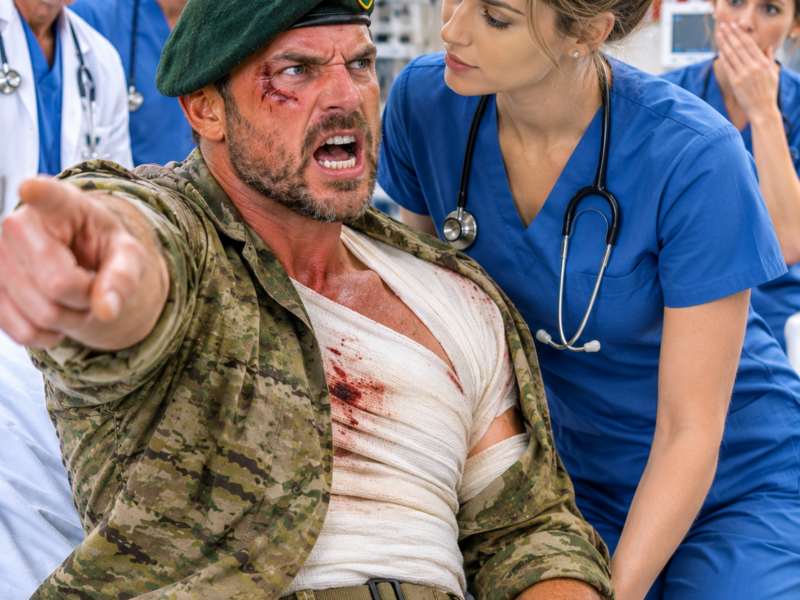
“The wounded Green Beret fought off three nurses, threatened the doctors, and refused every attempt to treat him
I looked at Commander Hayes.
“Where is the recording?”
He didn’t answer immediately.
Instead, he glanced at the hospital staff gathered near the entrance.
“Not here.”
“Daniel, I need to know.”
“Chief Mason is in a secure military medical unit. We can take you there, but I need you to understand something first.”
“What?”
“Someone has been trying to kill him since the moment we recovered him.”
The words seemed to drain the warmth from the afternoon.
I looked at the photograph again.
The man in the hospital bed was older than the Chief Mason I remembered. His face was thinner, his hair nearly white, and there was a deep scar running from his left eyebrow toward his cheek.
But it was him.
I had spent four years imagining what his final moments might have looked like.
Now I was being told he had survived.
And someone wanted to make sure he never spoke.
“Let’s go,” I said.
Hayes took my cardboard box.
One of the SEALs opened the rear door of the nearest SUV.
Before I could climb inside, Patricia Coleman stepped in front of me.
“Claire, you cannot leave with these men.”
I stared at her.
“You fired me.”
“That doesn’t mean you can remove hospital property or confidential records.”
“I have my personal belongings.”
Coleman looked toward Hayes.
“Commander, I expect you to understand that we have procedures.”
Hayes showed her his identification.
“Your hospital is now part of an active federal investigation. Any relevant records must be preserved.”
Her face tightened.
“What investigation?”
“That’s not information I can discuss with you.”
Dr. Hargrove stepped forward.
“This is ridiculous. You can’t turn a hospital into a military operation because a former employee has friends in the Navy.”
The tall SEAL with the scar looked at him.
“Doctor, you should be very careful about what you say next.”
Hargrove scoffed.
“I don’t take orders from you.”
Hayes didn’t raise his voice.
“Neither does she.”
He opened the vehicle door for me.
“Ma’am.”
I climbed inside.
Through the window, I saw Coleman standing beside Hargrove, her arms folded tightly.
For the first time since I had started working at Riverside Memorial, nobody was laughing.
The drive took nearly forty minutes.
Hayes sat beside me while two other SEALs rode in front.
I kept looking at the photograph.
“Why didn’t anyone tell me he was alive?”
Hayes stared through the windshield.
“Because we didn’t know.”
“You said he was recovered six days ago.”
“Six days ago, we found him. Before that, his identity was hidden inside a medical facility operating under a private security contract.”
“What happened to him?”
Hayes exhaled.
“He was moved between locations. Injured, sedated, and kept away from anyone who might recognize him.”
I closed my eyes.
“Who found him?”
“An investigative team following a financial trail connected to the original mission.”
“And the recording?”
Hayes looked at me.
“That’s why we need you.”
I waited.
“Four years ago, you were the only person who had direct contact with Mason after the extraction order was changed.”
My stomach tightened.
“I didn’t change the order.”
“We know.”
“Then why am I being questioned?”
“Because the recording identifies the voice that transmitted the final command. And someone has been telling people it was yours.”
I turned toward him.
“What?”
“An edited version of the recording was sent to several former members of the unit. It made it sound as though you ordered the team to abandon Mason.”
I felt sick.
“That isn’t possible.”
“That’s what we need to prove.”
I remembered the night in Afghanistan.
The heat.
The dust.
The radio crackling in my ear.
Chief Mason lying on a broken concrete floor, blood soaking through his uniform.
I had pressed gauze against his wound while he tried to stay conscious.
“Bennett,” he had whispered.
“Save your strength.”
“Listen to me.”
I leaned closer.
He gripped my wrist.
“Whatever happens, don’t let them take the drive.”
I had asked what drive.
He had tried to answer, but another explosion shook the building.
Then the radio came alive.
“Medical team, prepare for extraction. Immediate withdrawal.”
The voice had sounded like mine.
But it wasn’t.
I had never issued that command.
And I had never abandoned Mason.
“Daniel,” I said, “who sent the edited recording?”
“We’re still tracing it.”
“Who has the original?”
“Chief Mason.”
I looked down at the photograph.
“Then he knows who did it.”
Hayes nodded.
“He says he does.”
The vehicle turned through a security gate.
A military medical facility appeared beyond a line of trees. Two armed guards stood near the entrance.
Hayes showed his credentials, and we were allowed through.
Inside, the hallways smelled of disinfectant and fresh coffee.
A nurse approached us.
“Commander Hayes?”
“Yes.”
“Chief Mason is awake. He’s been asking for Ms. Bennett.”
I stepped forward.
“I’m here.”
The nurse looked at me carefully.
“He asked that you enter alone.”
Hayes frowned.
“That’s not happening.”
I turned toward him.
“If he wants to talk to me alone, I’ll do it.”
“Claire—”
“He’s known me for years. He might not speak if he sees an entire team surrounding him.”
Hayes hesitated.
Then he nodded.
“One person will remain outside the door.”
I followed the nurse down the corridor.
Room 318.
She stopped outside.
“He’s been very weak, so please keep the conversation short.”
I nodded.
Then I opened the door.
Chief Mason was sitting upright in bed.
His left arm rested in a brace. A monitor beside him tracked his heart rate, and a clear tube ran beneath his nose.
He looked at me.
For several seconds, neither of us spoke.
Then he smiled.
“Still walking into trouble, Bennett?”
My eyes filled.
“Still giving orders from a hospital bed, Chief?”
He laughed softly, then winced.
I crossed the room and took his hand.
“I thought you were dead.”
“I know.”
“Four years.”
“I know.”
I swallowed.
“Why didn’t you come home?”
His smile faded.
“Because the people who took me knew what you were carrying.”
“The case?”
He nodded.
“Did you keep it?”
“Yes.”
His eyes closed briefly.
“Good.”
I pulled a chair closer.
“Chief, I need you to tell me what happened that night.”
He stared at the ceiling.
“Which part?”
“The order. The radio transmission. The reason they left you behind.”
He looked at me.
“You remember the extraction command?”
“Yes.”
“Do you remember who gave it?”
“I heard my own voice.”
Mason shook his head.
“You heard someone using your voice.”
I felt my stomach turn.
“Someone had a recording?”
“Not just a recording. They had access to the communications system. They could splice old transmissions into live traffic.”
“Who?”
He looked toward the door.
“Colonel James Whitaker.”
The name hit me like a physical blow.
Whitaker had been our operations commander. He had supervised our training, approved our deployments, and personally signed the report that declared Mason killed in action.
“He was there?”
“Not physically. He was at the command center.”
“Why would he do this?”
Mason shifted painfully.
“Because we found something we weren’t supposed to find.”
He explained that our team had been sent to retrieve a civilian intelligence analyst named Peter Lawson from an abandoned communications compound.
Lawson had uncovered a network that was diverting military supplies through private contractors.
The supplies were being sold to foreign buyers, and some were reaching armed groups that had been attacking American forces.
The operation was supposed to recover Lawson and his encrypted files.
But when we arrived, we found more than a stolen shipment list.
We found evidence that senior officers were receiving payments.
One of those names belonged to Whitaker.
“He knew we had seen the documents,” Mason said. “He wanted the evidence destroyed and everyone who could identify it removed.”
I remembered the black duffel bag I had carried during the mission.
I remembered Mason telling me to keep it safe.
“Where is the original recording?”
“On the encrypted drive.”
I leaned forward.
“Then why did you say they needed me?”
“Because the drive is useless without the second key.”
I stared at him.
“What second key?”
Mason reached toward the bedside table and picked up a small envelope.
He handed it to me.
Inside was a metal identification tag.
My old service number was engraved on one side.
On the other were four words:
Blue Harbor. Seven. Two. Nine.
I looked at him.
“What is this?”
“The recovery phrase.”
“Why is it connected to me?”
“Because I gave you the second encryption key before we were separated.”
I shook my head.
“I don’t remember.”
“You were injured. You were in shock.”
I closed my eyes.
A fragment of memory returned.
A dark corridor.
Mason pressing something into my palm.
His voice.
Remember the harbor.
I opened my eyes.
“I thought that was a code for extraction.”
“It was. But it was also the phrase that unlocks the original archive.”
I stared at the tag.
“Where is the drive?”
Mason’s expression changed.
“I don’t have it.”
“Who does?”
“Whitaker.”
I stood.
“Then the recording is gone.”
“No.”
He caught my wrist.
“Whitaker has the physical drive, but he can’t access the archive without the second key. That’s why he’s been looking for you.”
I felt cold.
“Why didn’t you tell Hayes?”
“Because I don’t know who I can trust.”
I looked toward the door.
“You trust me?”
He held my gaze.
“I trusted you when I was bleeding on that floor. I trust you now.”
My throat tightened.
“What happened after the helicopter left?”
Mason looked down.
“I was taken by men working for Whitaker. They kept me in a private facility and questioned me for months. They wanted the drive, but I didn’t have it.”
“Where was it?”
“I gave it to Lawson.”
I stared at him.
“Peter Lawson survived?”
Mason nodded.
“He escaped the compound during the attack. We thought he had been killed, but he got out.”
“Where is he now?”
“That’s what we need to find out.”
Before I could ask another question, the monitor beside Mason began beeping faster.
The nurse entered immediately.
“Chief, you need to rest.”
Mason shook his head.
“Not yet.”
“Your blood pressure is climbing.”
He looked at me.
“Claire, listen carefully. Whitaker knows you’re here. He knows the SEALs have brought you to this facility.”
“How?”
“Because one of the people helping him works inside the hospital.”
My mind went straight to Riverside.
Dr. Hargrove.
Patricia Coleman.
The restricted medical file.
“Do you know who?”
Mason reached for my hand again.
“I saw the name on a document before they moved me.”
“Whose name?”
He opened his mouth.
A sudden alarm sounded outside the room.
The nurse turned toward the door.
Hayes rushed in.
“Everyone stay back!”
“What happened?” I asked.
“Security cameras just went offline.”
He looked at Mason.
“Chief, we need to move you.”
Mason tried to sit higher.
“No. Not until she knows.”
Hayes stepped toward him.
“Sir, this isn’t negotiable.”
Mason grabbed my wrist.
“Claire, the name is—”
The lights went out.
A crash sounded in the hallway.
Someone shouted.
Then a gunshot echoed through the corridor.
Hayes pulled me behind the bed.
“Stay down!”
The door swung open.
A man in dark clothing entered, holding a suppressed pistol.
Hayes moved before I could breathe.
He struck the man’s arm, drove him into the wall, and forced the weapon away.
The gun skidded across the floor.
Another figure appeared behind him.
I grabbed the metal identification tag and threw it toward Hayes.
He caught it instinctively.
“Get Mason out!” I shouted.
The second attacker raised his weapon.
Hayes fired once.
The man dropped.
The first attacker struggled to reach his gun.
I kicked it beneath the bed.
Hayes pinned him down.
“Medical team!” he shouted into his radio. “We have two intruders in the ward!”
I turned toward Mason.
He was pale, breathing rapidly.
“Chief?”
He tried to answer.
I checked his pulse.
Fast.
Weak.
His monitor showed a dangerous rhythm.
I had no equipment except the basic emergency supplies attached to the wall.
“Hayes, I need the nurse!”
“She’s coming!”
I reached for the oxygen supply and adjusted the mask.
“Stay with me, Chief.”
Mason looked at me.
“Don’t let Whitaker get the drive.”
“I won’t.”
His eyes began to close.
“Promise me.”
“I promise.”
The nurse rushed in with two security personnel.
They took over the emergency response while Hayes and another SEAL secured the hallway.
Mason was stabilized, but the doctor ordered immediate transfer to a higher-level facility.
Before they moved him, he grabbed my hand one more time.
“Blue Harbor,” he whispered.
“I remember.”
“Don’t trust Hargrove.”
My breath caught.
“Dr. Hargrove?”
Mason nodded faintly.
“He was there.”
Then the medical team pushed the bed out.
I stood in the empty room, holding the identification tag.
Hayes approached.
“Did he tell you anything?”
I looked at him.
“He said Dr. Hargrove was involved.”
Hayes’s expression hardened.
“Your former hospital surgeon?”
“Yes.”
“That explains why someone accessed the medical file.”
He took out his phone.
“I’ll have him detained.”
“No.”
Hayes stopped.
“Claire, he may be dangerous.”
“He may also know where the drive is.”
Hayes considered that.
“We can’t let him disappear.”
I looked at the dark hallway.
“Then we need to get to him before Whitaker does.”
We returned to Riverside Memorial just after midnight.
The emergency department was quieter than it had been that morning. A few patients sat in the waiting area. Nurses moved between rooms.
The same building where I had been humiliated now felt like the center of something far more dangerous.
Hayes and two SEALs entered through the staff entrance.
I walked behind them.
A receptionist recognized me.
“Claire?”
I didn’t stop.
“Where’s Dr. Hargrove?”
She looked toward the elevators.
“His shift ended hours ago.”
“Did he leave?”
“I thought he was in his office.”
Hayes turned to the nearest SEAL.
“Check the office.”
The man disappeared down the corridor.
I looked toward the nurses’ station.
Patricia Coleman stood near the medication room.
When she saw me, she froze.
“Claire?”
“Where’s Hargrove?”
Her eyes shifted toward Hayes.
“I don’t know.”
“Did he access Chief Mason’s file?”
“I can’t discuss patient records.”
“Then tell me why he was looking at my military service history.”
Her face changed.
“I have no idea what you’re talking about.”
Hayes stepped forward.
“Ma’am, we’re conducting a federal investigation. You need to cooperate.”
Coleman looked frightened now.
“I didn’t know anything about a military operation.”
I watched her carefully.
“Did someone ask you to access the file?”
She said nothing.
Then a voice came from behind us.
“I did.”
We turned.
Dr. Hargrove stood at the end of the hallway.
He was holding a small black bag.
Hayes moved his hand toward his weapon.
“Doctor, put the bag down.”
Hargrove smiled nervously.
“There’s no need for this.”
“Put it down.”
“I was only trying to help.”
I stepped forward.
“You knew Mason was alive.”
“I didn’t know his identity.”
“You accessed his medical file.”
“I was asked to verify a patient.”
“By whom?”
He looked at me.
“By someone who said he was a government contractor.”
“Whitaker?”
His silence was enough.
Hayes approached.
“Where is the drive?”
Hargrove shook his head.
“I don’t have it.”
“Then what’s in the bag?”
He glanced at the exit.
Hayes noticed.
“Don’t move.”
Hargrove dropped the bag and ran.
The SEALs moved instantly.
One blocked the elevator.
The other chased him toward the emergency exit.
I followed at a distance.
Hargrove pushed through the doors and stumbled into the parking area.
He made it three steps before the second SEAL tackled him.
The bag had fallen open.
Inside was a small laptop, a stack of printed medical records, and a photograph.
I picked up the photograph.
It showed Chief Mason being transferred from a private medical facility.
Standing beside the stretcher was Colonel James Whitaker.
But there was something else.
On the back was a handwritten note:
The medic has the key. Retrieve it before Friday.
I looked at Hayes.
“Friday?”
He checked his watch.
“Tomorrow.”
My stomach dropped.
We had less than twenty-four hours.
Hargrove was taken into custody.
During questioning, he admitted that Whitaker had paid him to identify Mason when he arrived at Riverside under a false name.
He had also been instructed to locate anyone connected to Mason’s original unit.
But he insisted he had never met Whitaker personally.
He claimed all instructions came through an intermediary.
“Who?” Hayes asked.
Hargrove stared at the table.
“Patricia Coleman.”
The room went silent.
I looked at him.
“Patricia?”
He nodded.
“She arranged the file access. She said the payment was for consulting work.”
Hayes immediately ordered investigators to find her.
But she was already gone.
Her office was empty.
Her car remained in the parking lot.
Her phone had been left on her desk.
The only thing missing was a small keycard.
Hayes looked at me.
“She knew we were coming.”
I thought about the way Coleman had treated me that morning.
The firing.
The humiliation.
The security escort.
Had she known who I was?
Had she deliberately removed me from the hospital because she believed I might recognize Mason?
Or had she been trying to make sure I was no longer there when he arrived?
I looked at the photograph again.
There was a small reflection in the window behind Whitaker.
A man standing near the medical facility entrance.
I enlarged the image.
His face was blurry, but I recognized his build.
It was Hargrove.
He had lied about never meeting Whitaker.
Hayes leaned over my shoulder.
“Are you sure?”
“Yes.”
He stared at the photograph.
“Then he’s holding something back.”
I turned toward the interrogation room.
“Let me speak to him.”
Hayes hesitated.
“Claire, you’re not an investigator.”
“No. I’m the person he was paid to identify.”
After a moment, Hayes nodded.
I entered the room alone.
Hargrove looked up.
“You shouldn’t be here.”
“Neither should you.”
He shifted in his chair.
“I already told them everything.”
“No, you didn’t.”
I placed the photograph on the table.
He stared at it.
“You said you never met Whitaker.”
“I didn’t.”
“Then explain this.”
His face went pale.
I leaned forward.
“Dr. Hargrove, you were involved in a criminal operation that endangered American service members. You also tried to access the medical records of a man who was held against his will.”
“I was following instructions.”
“So was I, once.”
He looked at me.
I lowered my voice.
“And I learned what happens when you stop asking questions.”
He swallowed.
“Whitaker said he was protecting national security.”
“Did he tell you why Mason was being held?”
“No.”
“Did he tell you what was on the drive?”
“No.”
“Then why help him?”
Hargrove looked down.
“Because he said if I cooperated, he’d make sure I kept my position.”
I almost laughed.
“You helped him threaten a patient to protect your job?”
He said nothing.
Then he whispered:
“Whitaker has the original recording.”
I went still.
“Where?”
“He’s keeping it at a private hangar outside Norfolk.”
“Why?”
“Because he plans to destroy it tomorrow.”
I stood.
“What’s the address?”
Hargrove shook his head.
“I don’t know the address. I was told to deliver the key.”
“What key?”
He looked at my hand.
The metal identification tag.
“That one.”
My blood ran cold.
I stepped back.
“What?”
“Whitaker said you would bring it to him.”
I looked at the tag.
Blue Harbor. Seven. Two. Nine.
The key wasn’t just a phrase.
It was a physical token used to authenticate the archive.
And Hargrove had been waiting for me to deliver it.
Hayes entered immediately.
“Claire?”
I held up the tag.
“We have a location. A private hangar outside Norfolk.”
“Did he give you an address?”
“No. But he said Whitaker is destroying the recording tomorrow.”
Hayes looked toward Hargrove.
“Who told you to collect the key?”
Hargrove hesitated.
Then he said:
“Patricia.”
Hayes cursed under his breath.
“She’s working directly with Whitaker.”
I looked at the clock.
“We need to find her.”
Hayes nodded.
He contacted the investigation team, and within an hour, they had traced Coleman’s phone to a small private airfield.
The hangar belonged to a company called Atlantic Medical Logistics.
It was the same contractor that had transported Mason between facilities.
A team was assembled.
Hayes asked me to remain at the command center.
I refused.
“You’re not going,” he said.
“I’m the only one who can unlock the archive.”
“We can take the tag.”
“You don’t know how to use it.”
“We’ll figure it out.”
“No time.”
He studied me.
“Claire, this isn’t a hospital.”
“I know.”
“You could get hurt.”
I looked him in the eyes.
“I’ve already been hurt. I spent four years believing I abandoned a man who trusted me.”
His expression softened.
“You didn’t abandon him.”
“Then let me help bring this to an end.”
After a long silence, he nodded.
“You stay behind the entry team. No heroics.”
“Understood.”
We reached the airfield shortly before dawn.
The hangar stood at the far end of the runway. A private jet was parked outside.
Two vehicles sat near the entrance.
The team moved into position.
Hayes gave the signal.
The entry team breached the side door.
“Federal agents! Hands where we can see them!”
Shouting erupted inside.
I stayed behind the armored vehicle, watching the entrance.
Then I saw Patricia Coleman.
She emerged from a side door, carrying a black case.
She looked toward the runway.
I stepped out.
“Patricia!”
She froze.
For a moment, she looked almost relieved.
“Claire.”
“Put the case down.”
She glanced at the SEALs moving behind me.
“You don’t understand what you’re involved in.”
“Then explain it.”
She shook her head.
“Whitaker said this would protect people.”
“Which people?”
She looked away.
“He promised the hospital funding. New equipment. A trauma center.”
“So you sold patient records?”
“I didn’t know what they were for.”
“You knew enough to fire me.”
Her eyes filled.
“I was told you were dangerous.”
I stared at her.
“Because I wouldn’t give a patient a medication that could kill him?”
“No. Because you were the only person who could unlock the archive.”
I felt the last piece fall into place.
She had known exactly who I was.
The firing hadn’t been about insubordination.
It had been about removing me from the hospital and forcing me into a position where Whitaker could approach me.
“Where is he?”
She nodded toward the hangar.
“Inside.”
“Then come with us.”
She shook her head.
“He’ll kill me.”
“Then help us stop him.”
Before she could answer, a gunshot rang out.
The black case fell from her hands.
Hayes shouted my name.
I dropped behind the vehicle.
A second shot struck the pavement.
Inside the hangar, men were moving toward the jet.
Whitaker was trying to escape.
Hayes and the entry team pushed forward.
I looked at Patricia.
She was on the ground, clutching her shoulder.
Blood spread through her sleeve.
I crawled toward her.
“Stay still.”
She looked at me, terrified.
“Don’t let him leave.”
I pressed a clean cloth against her wound.
“I’m not letting anyone leave.”
The sound of boots echoed from the hangar.
Then a familiar voice shouted:
“Whitaker! Drop the weapon!”
A struggle followed.
A moment later, Hayes appeared at the entrance.
“It’s over!”
The colonel was in custody.
But the black case was still on the ground.
I picked it up carefully.
It was heavier than it looked.
Hayes approached.
“Is that the drive?”
I nodded.
He looked at the metal tag in my hand.
“Can you unlock it?”
I turned the case over.
A small biometric reader was built into the side.
I pressed my thumb against it.
Nothing happened.
I tried again.
A red light flashed.
Then a message appeared on the screen.
SECOND AUTHENTICATION REQUIRED.
I looked at Hayes.
“What second authentication?”
He shook his head.
“I thought the tag was enough.”
I stared at the words.
Then I remembered Mason’s voice.
Blue Harbor. Seven. Two. Nine.
The tag contained the recovery phrase.
But the second authentication was something else.
I looked at the photograph of Mason in my pocket.
His hospital wristband.
His patient identification number.
I typed the number into the keypad.
The screen flashed green.
The case unlocked.
Inside was a small encrypted drive, a digital recorder, and a folded sheet of paper.
I unfolded it.
It was a handwritten list of names.
At the top was Colonel Whitaker.
Below him were three contractors, two senior officers, and one civilian administrator.
I recognized the final name.
Patricia Coleman.
I looked toward the ambulance where she was being treated.
She had been involved far more deeply than she had admitted.
Hayes took the paper.
“We’ll preserve all of this.”
I picked up the recorder.
“What’s on it?”
He looked at me.
“The original mission audio.”
I pressed play.
Static filled the hangar.
Then I heard my own voice.
“Chief, stay with me. Extraction is on the way.”
Another voice responded.
“Medical team, prepare for immediate withdrawal.”
The command was followed by a brief pause.
Then a third voice.
Colonel Whitaker.
“Leave Mason. No one comes back for him.”
My hands began shaking.
The recording continued.
“Sir, he’s alive,” my younger voice said.
“I said leave him.”
“That’s our team leader.”
“Your orders are to withdraw.”
Then came the sound of gunfire.
The recording ended.
For four years, I had carried the belief that I had failed Mason.
Now I finally knew what had happened.
I had not abandoned him.
Someone had ordered us to leave him behind.
And when I refused, they had used my voice to make it appear that I had given the order myself.
I closed my eyes.
Hayes placed a hand on my shoulder.
“You did everything you could.”
I nodded.
But I wasn’t ready to cry.
Not yet.
There was still one thing I needed to do.
I took out my phone and called the military hospital.
The nurse answered.
“Medical unit.”
“This is Claire Bennett. How is Chief Mason?”
There was a pause.
“He’s awake, ma’am. His condition is stable.”
“Can you put him on?”
A moment later, his voice came through.
“Bennett?”
I smiled through the tears.
“Chief.”
“Did you find it?”
“Yes.”
“Did you hear the recording?”
“I did.”
He was silent.
Then he asked:
“Do you still blame yourself?”
I looked at the hangar.
At the black case.
At the men who had finally uncovered the truth.
“No, Chief.”
His voice softened.
“Good.”
I swallowed.
“I’m sorry it took so long.”
“Don’t apologize. You came back.”
I closed my eyes.
For the first time in four years, I could breathe.
The investigation lasted several months.
Colonel Whitaker was charged with conspiracy, obstruction of justice, unlawful detention, and multiple offenses related to the theft of military equipment.
Several contractors were arrested.
The evidence from the drive exposed a network that had diverted millions of dollars in supplies and falsified operational reports to hide the activity.
Patricia Coleman cooperated with investigators after receiving treatment for her injury. She admitted that she had accessed confidential records and arranged the transfer of information to Whitaker.
She lost her position and faced criminal charges.
Dr. Hargrove’s medical privileges were suspended. The investigation into his conduct continued, including the circumstances surrounding my dismissal.
Riverside Memorial eventually issued a formal statement acknowledging that I had been terminated after raising a legitimate patient safety concern.
The hospital offered to reinstate me.
I declined.
I didn’t want to return to a place where protecting a patient had once been treated as a threat.
Instead, I accepted a position at a veterans’ medical center.
On my first day, I walked into the treatment room and saw a familiar face sitting beside a window.
Chief Mason.
He was using a cane, but he was standing.
When he saw me, he smiled.
“Thought you were done with me, Bennett?”
I shook my head.
“Not a chance, Chief.”
He reached out and shook my hand.
Then he looked at the other veterans in the room.
“Everyone, this is Petty Officer Claire Bennett.”
I started to correct him.
“Chief, I’m a civilian nurse now.”
He smiled.
“Some things don’t change.”
A week later, Commander Hayes and the team visited the center.
They didn’t arrive with a dramatic escort or a line of black SUVs.
They came quietly.
Hayes found me in the hallway.
“Ma’am.”
I smiled.
“Commander.”
He stood straight.
“On behalf of the team, thank you.”
I looked past him at the men waiting near the entrance.
“I’m glad Mason made it home.”
Hayes nodded.
“So are we.”
The tall SEAL with the scar stepped forward.
“Ma’am, we still owe you.”
I shook my head.
“You don’t owe me anything.”
He smiled.
“Respect, then.”
I looked at them.
Four years earlier, I had walked away from the military believing I had failed the people who trusted me.
Now I understood something I had forgotten.
A uniform didn’t make someone a hero.
A rank didn’t make someone right.
And sometimes the bravest thing a person could do was refuse an order that would hurt someone who couldn’t defend themselves.
I had lost a job because I did exactly that.
But I had also helped save a man who had spent four years waiting for the truth.
As I returned to the treatment room, I heard Hayes speak behind me.
“Take care of yourself, Ma’am.”
I turned.
“You too, Commander.”
Then I went back to work.
I was no longer trying to hide who I had been.
I was no longer ashamed of the past.
And I no longer needed anyone at Riverside Memorial to understand why those SEALs had called me “Ma’am.”
I knew why.
They remembered the medic who refused to leave her people behind.
And so did I.
ideal[The Wounded Green Beret Wouldn’t Let Anyone Touch Him — Until the New Nurse Whispered His Old Cal…
] viết task 1
“The wounded Green Beret fought off three nurses, threatened the doctors, and refused every attempt to treat him—but when the quiet new nurse stepped beside his bed and whispered a call sign nobody had used in seven years, the hardened soldier suddenly stopped fighting and began to cry.”
The first thing I noticed about Staff Sergeant Ryan Mitchell was his hands.
They were shaking.
Not from pain.
From fear.
He was a Green Beret, thirty-four years old, six feet tall, and built like a man who had spent most of his adult life carrying heavy equipment through unforgiving terrain. His uniform was torn, his face bruised, and a deep wound ran along his left shoulder.
Yet none of that explained why four hospital employees were standing outside his room, afraid to enter.
“Get away from me!”
His voice echoed through the emergency department.
A metal tray crashed against the wall.
One of the nurses stepped backward.
“Mr. Mitchell, we’re trying to help you.”
“I said DON’T TOUCH ME!”
Dr. Harris stood near the doorway, holding a chart.
“He’s been like this since the ambulance brought him in,” he explained. “He refuses medication, refuses imaging, and won’t let anyone examine his shoulder.”
“Has he been sedated?”
“Twice. Both times he became violent before we could administer anything.”
I looked through the glass.
Ryan was sitting on the edge of the bed, breathing hard. His right hand gripped the blanket, while his left arm hung awkwardly at his side.
His eyes kept moving toward the corners of the room.
He wasn’t looking at the nurses.
He was watching for something.
“What’s his medical history?” I asked.
Dr. Harris glanced at the chart.
“Active-duty Army. Special Forces. He was brought in after a vehicle rollover during a training exercise.”
“Was anyone else injured?”
“Two soldiers. Both stable.”
I looked at Ryan again.
“Did he lose consciousness?”
“Briefly, according to the paramedics.”
“Any head injury?”
“Possible concussion.”
I nodded.
Then I noticed something unusual.
His hospital wristband had been turned inward, as if he had deliberately hidden the printed name.
“Has anyone asked him about pain?”
Dr. Harris gave me a tired look.
“Every five minutes.”
“No. I mean, has anyone asked him what he’s afraid of?”
The doctor stared at me.
“Claire, this is an emergency department, not a therapy session.”
I didn’t answer.
I had learned a long time ago that fear could make a wounded man more dangerous than any physical injury.
And I recognized that look.
Not from medical school.
From somewhere much farther away.
My name is Claire Morgan. I was thirty-one years old, and I had been working at St. Mary’s Regional Hospital in North Carolina for only three weeks.
I was the newest nurse in the emergency department.
Quiet.
Polite.
Reliable.
At least, that was how my coworkers described me.
They didn’t know that before becoming a civilian nurse, I had served as a combat medic attached to a special operations unit.
I had spent years treating soldiers in places where the nearest hospital was hundreds of miles away.
I had learned to recognize shock, panic, and the strange silence that sometimes followed a traumatic event.
But I never talked about those years.
I had left the military after a mission in Afghanistan that cost me the people I considered family.
Since then, I had tried to build a life where the loudest sound in my day was a monitor alarm.
“Claire?”
Dr. Harris pulled me back.
“Can you try talking to him?”
I looked at him.
“You want me to approach?”
“You seem to think you understand what’s happening.”
“I didn’t say that.”
“Then see if you can get him to cooperate.”
A nurse named Melissa stepped beside me.
“Good luck. He almost broke my wrist.”
I put on gloves and entered the room.
Ryan’s head snapped toward me.
“Who are you?”
“Claire. I’m one of the nurses.”
“Get out.”
“I can do that.”
He seemed surprised.
I stopped near the doorway instead of approaching his bed.
“I just want to check whether you’re bleeding through that bandage.”
“I’m fine.”
“You’re holding your shoulder like it hurts.”
“I’m fine.”
I nodded.
“Okay.”
I turned slightly toward the door.
Then I noticed his breathing change.
It became faster.
His eyes moved toward the ceiling.
He was counting something.
One.
Two.
Three.
Four.
His lips moved without sound.
“Mr. Mitchell?”
“Don’t.”
I stopped.
He stared at the wall.
“Don’t let them close the door.”
I glanced behind me.
The door was still open.
“All right. It stays open.”
“Don’t turn off the lights.”
“They’ll stay on.”
He swallowed.
“And don’t let anyone stand behind me.”
I nodded.
“Understood.”
For the first time, his shoulders relaxed slightly.
I moved a chair into his line of sight and sat down.
“Can I ask you something?”
He didn’t answer.
“Are you afraid we’re going to hurt you?”
His jaw tightened.
“I’m not afraid.”
“Okay.”
“I don’t need a psychologist.”
“I didn’t say you did.”
He looked at me.
I kept my voice calm.
“I’m a nurse. My job is to keep you alive and make sure you don’t have to fight your own body while you’re injured.”
He looked away.
“People keep saying that.”
“Then I’ll show you.”
I placed a clean dressing and a pair of scissors on the nearby table.
“I’m going to leave these here. You can tell me when you’re ready.”
He stared at the supplies.
A minute passed.
Then another.
Finally, he spoke.
“Where’s my team?”
“I’m not sure. I can ask.”
“Two men. They were in the vehicle.”
“I’ll find out.”
“Did they make it?”
I stood.
“I’ll check right now.”
His voice stopped me.
“Don’t lie.”
I turned back.
“I won’t.”
I left the room and spoke with the charge nurse.
The two other soldiers were stable, but one had been transferred for surgery. The other was being evaluated for internal injuries.
I returned and gave Ryan the information.
He closed his eyes.
“Good.”
“Do you want me to call someone?”
“No.”
“Your family?”
“No.”
“Your commanding officer?”
His eyes opened.
“Absolutely not.”
I nodded.
“All right.”
He looked at me for a long time.
Then he said something that made my stomach tighten.
“Have you ever heard a man screaming over a radio after the radio went dead?”
I didn’t move.
“Yes.”
His eyes narrowed.
“How?”
I looked at the floor.
“Because I’ve heard it too.”
For the first time, he seemed to see me.
Not as another nurse.
Not as someone wearing a hospital badge.
As someone who understood the language he couldn’t explain.
He shifted painfully.
“Were you military?”
“Yes.”
“What branch?”
“Army.”
His eyes moved over my face.
“What unit?”
I didn’t answer.
He studied me.
Then he looked toward the door.
“Get out.”
I stood slowly.
“All right.”
As I reached the doorway, he spoke again.
“Wait.”
I turned.
His voice had become quieter.
“Did you ever serve with a medic named Daniel Cross?”
My heart seemed to stop.
Daniel Cross.
Seven years earlier, I had been assigned to a special operations medical team in Afghanistan.
Daniel had been our senior medic.
He was the man who taught me how to treat a casualty while explosions shook the ground around us.
He was also the last person I had seen before our convoy disappeared into a dust storm.
Officially, Daniel Cross had died during that mission.
I had attended a memorial service.
I had received his personal effects.
And I had spent seven years trying not to remember his final radio transmission.
“Why are you asking?” I whispered.
Ryan looked at me.
“Because he told me something before he disappeared.”
I felt the blood drain from my face.
“What did he tell you?”
Ryan gripped the blanket.
“He said if I ever met a nurse named Claire Morgan, I should give her a message.”
My throat tightened.
“What message?”
Ryan looked toward the hallway.
Then he lowered his voice.
“He said the mission report was a lie.”
I couldn’t breathe.
Seven years of believing Daniel was dead.
Seven years of assuming the military had told us everything.
And now a wounded Green Beret was telling me that Daniel had left a message.
A message meant only for me.
I stepped closer.
“What happened to Daniel?”
Ryan’s eyes filled with tears.
“He didn’t die in Afghanistan.”
I stared at him.
“Then where is he?”
Before Ryan could answer, the room’s monitor began beeping rapidly.
He grabbed my wrist.
“Listen to me, Claire. Someone knows I came here.”
The monitor alarm grew louder.
His breathing became ragged.
Then he whispered six words that turned my blood cold.
“THEY’RE COMING TO FINISH THE JOB.”
I looked toward the doorway.
Two men in dark civilian clothes had just entered the emergency department.
And one of them was wearing a military identification badge I recognized from seven years ago.
viết task 2 có kết thúc
The man with the military identification badge stopped three feet from my station.
For one terrible second, I couldn’t move.
I knew that badge.
Not because I had seen it recently, but because I had spent seven years trying to forget the man who wore it.
“Claire Morgan,” he said, reading the name on my badge. “You’ve changed.”
My mouth went dry.
The second man remained near the entrance, watching the emergency department doors. Neither looked like a patient’s relative. Neither carried the anxious expression of someone who had come looking for a loved one.
They looked like men who had come to collect something.
Ryan Mitchell shifted on the stretcher behind me. His injured shoulder was immobilized, his forehead bandaged, and his breathing had become shallow.
“Don’t let him near me,” he whispered.
The man with the badge glanced at him.
“Staff Sergeant Mitchell. You gave us quite a scare.”
Ryan’s face drained of color.
I stepped between them.
“Visiting hours are restricted. If you need to speak with the patient, you’ll have to identify yourselves and explain your business.”
The man smiled without warmth.
“Major Thomas Vance. Military liaison. This is a federal matter.”
He displayed his badge so quickly that I barely had time to read it.
Seven years earlier, Vance had been a captain assigned to the operations coordination office. He had visited our unit before the Afghanistan mission. He had stood beside Daniel Cross during a briefing, correcting our evacuation route and assuring us that our extraction team would be waiting.
I remembered his voice.
I remembered his face.
And I remembered the way he had looked at me when I asked why Daniel’s personal effects had been returned without his medical identification tags.
He had told me to stop asking questions.
“I’m not familiar with your authority over this hospital,” I said.
His smile disappeared.
“Then perhaps you should speak with your administrator.”
“Gladly.”
I reached for the phone at the nursing station.
Vance moved faster than I expected. He caught my wrist before I could lift the receiver.
“Don’t make this difficult.”
Ryan tried to sit up.
“Get your hands off her.”
The movement sent pain across his face. His injured shoulder trembled, but he kept pushing himself forward.
Vance released my wrist.
“Still playing the hero, Mitchell?”
Ryan’s voice was rough. “You should have stayed away.”
I pressed the call button beneath the desk. It connected directly to hospital security.
“Security to emergency, please,” I said, keeping my voice steady. “We have two unauthorized individuals in the treatment area.”
Vance stared at me.
“You have no idea what you’re interfering with.”
“I know you’re frightening an injured patient.”
“An injured patient who stole classified property.”
Ryan let out a bitter laugh.
“That’s what you called it when you buried Daniel?”
The name changed everything.
Vance’s expression tightened. His companion finally moved away from the entrance.
“Take him,” Vance ordered.
The second man approached the stretcher.
I grabbed the metal IV pole and positioned myself in front of Ryan.
“Stop right there.”
“Ma’am,” the man said, “move.”
“I’m a registered nurse. This patient is under my care. You will not remove him without proper authorization.”
Vance leaned closer.
“Claire, this is bigger than your nursing license.”
“Then bring someone with the authority to explain it.”
Footsteps thundered down the corridor.
Two security officers arrived, followed by the charge nurse, Linda Hayes. Linda took one look at the men and immediately positioned herself beside me.
“What’s going on?”
“These men are attempting to remove a patient without hospital authorization,” I said.
Vance produced another identification card.
“Federal security matter. We need the patient transferred.”
Linda studied it, then handed it back.
“Our hospital policy requires verification through our legal department. Until then, nobody is moving anywhere.”
Vance looked at Ryan.
“This is your last chance. Give us the drive.”
Ryan closed his eyes.
“I don’t have it.”
“You expect me to believe that?”
“I expect you to remember what you did.”
Vance’s jaw tightened.
Then, for the first time, he looked genuinely afraid.
Not angry.
Afraid.
He turned toward the second man.
“Call the office.”
The man stepped into the corridor.
Linda ordered security to escort both visitors to the administrative area while their credentials were verified. Vance protested, but the officers stood firm.
As he walked away, he glanced over his shoulder.
“This isn’t over, Morgan.”
I met his eyes.
“No,” I said. “I don’t think it is.”
The emergency department doors closed behind him.
Ryan sagged against the pillow.
I checked his pulse. His heart was racing.
“Ryan, look at me. You’re safe for the moment.”
He opened his eyes.
“You shouldn’t have done that.”
“Probably not.”
“They’ll come back.”
“Then they’ll have to get through security again.”
He looked at me with an exhaustion that seemed much older than his thirty-four years.
“You still don’t understand.”
“Then explain it.”
He swallowed.
“Daniel is alive.”
I had heard those words once already.
The first time, they had felt like a cruel joke.
Now they felt like the floor disappearing beneath me.
“Where is he?”
Ryan looked toward the closed emergency department doors.
“I don’t know where he is now. But I know where he was seven years ago.”
I pulled a chair beside the stretcher.
“Start from the beginning.”
Ryan hesitated, then spoke.
“Our unit was assigned to secure a communications relay outside a remote village. Daniel was attached to us as a combat medic. You were supposed to be on the same convoy, but your evacuation team was reassigned at the last minute.”
I remembered the mission.
The dust storm.
The radio silence.
The frantic hours waiting for word.
“The convoy was hit,” Ryan continued. “Our vehicle overturned. We lost communications. Daniel treated two wounded men while the rest of us tried to establish a defensive position.”
“And then?”
“An extraction team arrived.”
I leaned forward.
“Was it Vance?”
“Not directly. His people were controlling the operation. They told us the route was compromised and that we needed to move immediately. Daniel noticed the coordinates didn’t match the evacuation plan.”
Ryan’s eyes shifted toward the ceiling.
“He checked the transmission log. Someone had redirected our convoy into an exposed corridor.”
My hands went cold.
“Why?”
“Because there was something in the relay station they wanted. A recording. It contained orders from a senior officer authorizing an illegal transfer of intelligence files. Daniel had discovered it before the convoy left.”
I stared at him.
“And the ambush?”
“Wasn’t an accident.”
Ryan’s voice cracked.
“We were supposed to disappear with the evidence.”
I couldn’t speak.
“Daniel figured it out. He hid a copy of the recording and told us to split up. During the chaos, he stayed behind to draw the extraction team away from the wounded.”
“Did you see him die?”
“No.”
“Did anyone?”
Ryan shook his head.
“The official report said his body couldn’t be recovered. Then they declared him dead based on the circumstances.”
I pressed my fingers against my lips.
“They held a memorial.”
“I know.”
“They returned his personal belongings.”
“I know.”
“He was my friend.”
Ryan’s expression softened.
“He knew.”
I looked away.
For seven years, I had carried the memory of Daniel’s last message to me. It had been a simple one, sent the night before the convoy departed.
Don’t let the bad days convince you that the good ones weren’t real.
I had read it so many times that I knew every word.
I had believed he was dead.
Now a wounded soldier was telling me that the man I had mourned might still be breathing somewhere.
“Why didn’t you come forward?” I asked.
“I tried. Twice. The first investigator disappeared from the case. The second told me there was no evidence.”
“And the recording?”
“Daniel made several copies. One was hidden with me. I was supposed to get it to someone outside the command structure.”
“Where is it?”
Ryan looked at me.
“That’s why they attacked my vehicle.”
He explained that the rollover had happened during a training exercise, but the vehicle had been forced off the road after another vehicle approached without warning. He had managed to escape with a small encrypted drive hidden inside the lining of his equipment bag.
“They searched the wreckage,” he said. “They didn’t find it.”
“Where did you hide it?”
Ryan stared at the IV line in his arm.
“I swallowed the memory card.”
I blinked.
“You what?”
“Not the whole drive. A tiny storage card. I wrapped it in protective material and swallowed it before they reached me.”
I stared at him in disbelief.
“That’s dangerous.”
“I know.”
“Have you told the doctors?”
“No.”
“Ryan!”
“I wasn’t going to let them find it.”
I stood immediately.
“You need an examination. We need to tell the physician, and we need to make sure there isn’t an obstruction or any internal injury.”
He grabbed my hand.
“Claire, listen. The card is the only thing that can prove what happened.”
“And you are not going to die trying to protect it.”
He released me.
For a moment, neither of us spoke.
Then he nodded.
“Okay.”
I called the emergency physician and explained the situation. We arranged the appropriate imaging and a careful medical evaluation. I also told Linda what Ryan had disclosed.
The hospital’s legal team contacted federal authorities through an independent channel. They specifically requested investigators who were not connected to Vance’s office.
It took nearly two hours.
During that time, Ryan underwent imaging and was treated for his injuries. The physician confirmed that the storage card was still present and that Ryan needed observation before it could be safely recovered.
I stayed nearby.
Not because I was assigned to him anymore, but because I couldn’t bring myself to leave.
At 11:43 p.m., Linda returned with a serious expression.
“Claire, there’s someone here asking for you.”
“Who?”
She hesitated.
“He says his name is Daniel Cross.”
My legs nearly gave out.
I looked at Ryan.
His eyes filled with tears.
“Tell him to come in,” he whispered.
Linda opened the door.
A man stepped into the room.
He was thinner than I remembered. His hair had turned gray at the temples, and a pale scar ran from his jaw toward his neck. He walked with a slight limp, favoring his left leg.
But his eyes were unmistakable.
Daniel.
For a few seconds, I couldn’t breathe.
He stopped when he saw me.
“Claire.”
That one word broke seven years of silence.
I covered my mouth.
“You’re alive.”
His eyes shone.
“I’m sorry.”
I crossed the room before he could say anything else.
I struck his chest once with my fist, not hard enough to hurt him, then grabbed his jacket and held on.
“You’re alive,” I repeated.
“I know.”
“You let us bury you.”
“I didn’t have a choice.”
I pulled away enough to look at his face.
“Seven years, Daniel.”
He nodded, tears gathering in his eyes.
“I know.”
“You let me think you were dead.”
“I know.”
I wanted to scream. I wanted to ask a thousand questions. I wanted to make him explain every birthday, every anniversary, every night I had spent wondering what his final moments had been like.
Instead, I cried.
He didn’t try to stop me.
He simply stood there, trembling, while I held on to the man I had mourned.
Eventually, Ryan cleared his throat.
“Good to see you, Doc.”
Daniel turned.
“You look terrible.”
Ryan managed a weak smile.
“That’s what happens when you let people drive.”
Daniel approached the stretcher and clasped his shoulder carefully.
“You did good.”
“I almost got killed.”
“You’ve always been dramatic.”
For the first time that night, Ryan laughed.
I wiped my cheeks.
“Someone needs to explain everything. Now.”
Daniel nodded.
He sat beside the window, and his expression became serious.
“After the convoy was attacked, I was captured by the men who had arranged the ambush. They wanted the original recording and the names of everyone who had seen it.”
“Why didn’t you escape?”
“I tried. I was injured, and they moved me between locations. They made sure nobody knew where I was.”
“Who were they?”
“Contractors working through a private intelligence company. They had connections inside the military command structure. Vance was their liaison.”
Daniel paused.
“I managed to escape after several months. But by then, the official report had declared me dead. My name was being used to close the investigation.”
“So why not come home?”
“I tried to contact the people I trusted. Every time I got close, someone found me. One person I contacted was arrested. Another vanished. I realized that returning openly would put everyone connected to me in danger.”
His gaze settled on me.
“That included you.”
I shook my head.
“You should have let me decide whether I wanted to take that risk.”
“You’re right.”
His answer surprised me.
“I can’t give you a good excuse, Claire. I was scared. I was hurt. And I convinced myself that staying away was the only way to protect you.”
“That’s not protection,” I whispered. “That’s leaving someone alone with a grave and no answers.”
Daniel lowered his head.
“I know.”
Ryan shifted uncomfortably.
“Can we get back to the part where the men who tried to kill us are still walking around?”
Daniel nodded.
“The card Ryan is carrying contains a copy of the original recording, along with a set of encrypted transmission logs. It proves that the convoy route was deliberately changed and that the extraction order came from Vance’s office.”
“Will it be enough?”
“It will be a start.”
A knock interrupted us.
Two investigators entered, accompanied by a woman in a dark suit. She introduced herself as Special Agent Rebecca Ellis, assigned to an independent federal task force investigating misconduct in military contracting.
She showed us credentials and explained that she had been monitoring the case for months.
“Major Vance has been under investigation,” she said. “We suspected he was connected to the operation, but we couldn’t establish a direct link to the original attack.”
Daniel studied her.
“Who sent you?”
“An inspector general’s office outside his chain of command. We received an anonymous message tonight identifying the hospital and the patient.”
Ryan frowned.
“From who?”
Ellis looked at Daniel.
“Mr. Cross contacted us.”
I turned toward him.
“You knew?”
Daniel nodded.
“I learned Ryan had survived the rollover. I knew Vance would try to reach him before he could hand over the evidence.”
“So you came here?”
“I was already nearby. I didn’t want to enter until I knew the hospital was secure.”
Agent Ellis explained that the hospital’s security call had triggered a formal response. Vance and his companion had been detained in the administrative wing after their credentials failed verification.
“They’re being questioned,” she said. “But we need the storage card.”
Ryan looked at me.
I nodded.
“Only after the doctor confirms it’s safe.”
Ellis agreed without argument.
For the first time, I believed we might actually have a chance.
The next morning, the medical team safely recovered the storage card. Ryan remained under observation, and the card was transferred directly to the independent investigators with a documented chain of custody.
The contents were worse than I had imagined.
The recording captured a senior officer ordering the convoy’s route changed despite warnings that the corridor was unsafe. It also revealed that the operation was intended to conceal an unauthorized transfer of intelligence material.
Vance’s voice appeared repeatedly in the communications logs.
So did the voices of two senior officials who had signed the original after-action report.
The evidence connected the attack, the disappearance of Daniel, and the subsequent cover-up.
But there was one more file.
A short recording Daniel had made after escaping captivity.
I listened to it in a private conference room at the hospital.
His voice was weak and hoarse.
“If this reaches anyone who knew me, understand that I didn’t abandon the team. I was taken. I tried to get home. I tried to tell the truth. If I never make it back, please don’t let them turn the men we lost into a footnote.”
The recording ended.
I sat with my hands folded in my lap.
Daniel had survived.
He had fought to return.
And somewhere along the way, the truth had become more dangerous than the people who wanted to hide it.
Agent Ellis informed us that the investigation would continue for months, but the evidence was sufficient to support arrests and formal charges. Vance was placed under federal custody. The contracting company was raided, and several officials were suspended pending prosecution.
The official military report was reopened.
This time, Daniel’s disappearance would not be treated as a death without a body.
It would be investigated as an abduction and a deliberate cover-up.
Three days later, I visited Ryan before my shift ended.
He was sitting upright, his shoulder still supported, a cup of coffee balanced on the bedside table.
“You look better,” I said.
“That’s because they stopped trying to take me away.”
I smiled.
“Your imaging looks stable. The doctor thinks you’ll recover well, but you’ll need physical therapy.”
He grimaced.
“I hate physical therapy.”
“Then you’ll hate me, because I’m going to remind you to do it.”
He laughed.
Then his expression changed.
“Claire?”
“Yes?”
“I’m sorry about Daniel.”
I looked at him.
“Why are you apologizing?”
“Because you spent seven years believing he was gone. I knew there was a chance he was alive, and I couldn’t tell you.”
“You were protecting him.”
“I was protecting the evidence.”
I pulled a chair closer.
“You were protecting a lot of people. But you don’t have to carry all of it alone anymore.”
Ryan looked down at his hands.
“I don’t know how to stop.”
“Start by getting better.”
He nodded.
Before I left, he reached for my hand.
“Daniel said you were the one person who could make him feel human when everything else was falling apart.”
I smiled sadly.
“He used to say the same thing about you.”
Ryan looked toward the window.
“Maybe we can all start over.”
“Maybe.”
I didn’t promise him that everything would be easy.
Some things could not be repaired with a medical order or a courtroom verdict. Seven years of grief did not disappear because a man walked through a hospital door. Trust did not return simply because the truth had finally been spoken.
But a beginning was possible.
And that was enough.
Two weeks later, Daniel met me outside the hospital.
He wore ordinary clothes, no uniform, no military insignia. He looked uncomfortable standing in the sunlight, as though he had forgotten what it felt like to be somewhere without watching every exit.
We walked to a small coffee shop across the street.
For a while, we talked about harmless things. The hospital. The weather. People we both remembered.
Then he placed something on the table.
It was a small, worn metal identification tag.
Mine.
I stared at it.
“Where did you get this?”
“Your locker was searched after the mission. I found it among the things they had taken from our equipment. I kept it.”
My fingers trembled as I picked it up.
“Why?”
“Because I wanted to remember the person who kept telling me we were going to make it home.”
I closed my hand around the tag.
“You should have come back.”
“I know.”
“I don’t know if I can forgive you yet.”
He nodded.
“You don’t owe me forgiveness.”
I studied him for a long moment.
“But I don’t want to spend the rest of my life being angry.”
“Neither do I.”
We sat quietly.
Then Daniel asked, “Would you be willing to have dinner sometime? Just dinner. No promises.”
I looked at the man I had once trusted with my life, the man I had mourned, and the stranger who had returned carrying seven years of silence.
“I think we can start with coffee,” I said.
He smiled.
For the first time, it reached his eyes.
Months passed.
The investigation moved forward. The evidence was authenticated, the case expanded, and the officials responsible for the false report faced criminal charges. The military formally corrected Daniel’s record, acknowledged that he had been taken alive, and issued an apology to the families affected by the cover-up.
Ryan completed his rehabilitation and returned to limited duty.
He sent me a photograph of himself standing beside a training field, his arm still in a sling, with a message beneath it:
Still alive. Still stubborn. Still doing my exercises.
I laughed so hard that Linda asked what was wrong.
Daniel began the long process of rebuilding his life. He gave testimony, attended medical appointments, and met with people who had spent years believing they had lost him.
Some welcomed him with open arms.
Others needed time.
He accepted both.
As for me, I remained at St. Mary’s.
I still worked night shifts. I still held frightened patients’ hands and explained procedures when the room felt too bright and the world felt too loud.
But something had changed.
I no longer believed that surviving meant pretending nothing had happened.
One evening, a young soldier arrived in the emergency department after a training accident. He was frightened, defensive, and unwilling to let anyone approach him.
I pulled a chair beside his bed.
“You don’t have to tell me everything right now,” I said. “We’ll take this one step at a time.”
He looked at me.
“Are you going to leave?”
I shook my head.
“Not unless you ask me to.”
His shoulders slowly relaxed.
I thought of Ryan.
I thought of Daniel.
And I thought of the people who had spent years believing that silence was the same thing as safety.
It wasn’t.
The truth had not brought back the years we lost. It had not erased the pain or made every wound disappear.
But it had given the living a chance to stop running.
And when I left the hospital that night, Daniel was waiting outside beneath the streetlights.
He held two cups of coffee.
“Long shift?” he asked.
“Long enough.”
He handed me one.
We started walking.
For the first time in seven years, I didn’t feel as though I was walking away from someone I had lost.
I was walking toward someone who had finally come home.
THe end.









