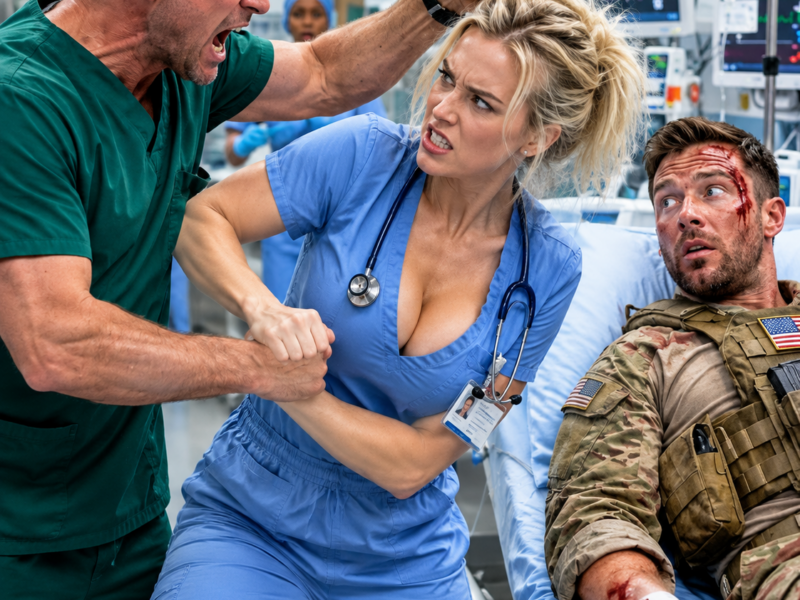
“The surgeon screamed, “GET THE FCK OUT, NURSE!” as he shoved me away from the wounded Navy SEAL
The emergency lights flickered on three seconds later.
By then, the operating room had become chaos.
Someone shouted for backup power. A nurse stumbled into the hallway, carrying a tray of instruments. The anesthesiologist was calling for a portable monitor, while Dr. Whitmore stood beside the operating table, his face pale beneath the harsh red lights.
I should have run.
Every instinct I had developed during my military years told me to get away from that room, find a secure location, and figure out who had just threatened my life.
Instead, I moved toward the doors.
“Ma’am, you need to stay back!” one of the security officers shouted.
I ignored him.
The wounded SEAL was still alive.
I could see his chest rising weakly beneath the surgical drapes. His eyes remained fixed on me, and although he couldn’t speak, I understood the urgency in his expression.
He wasn’t asking for help.
He was warning me.
I reached the door just as a hospital technician rushed past with a portable power unit.
“Clear the entrance!” he yelled.
I stepped aside, then slipped through the opening before security could stop me.
Whitmore spun around.
“What the hell are you doing in here?”
“The patient needs me.”
“He needs a surgeon, not a nurse who thinks she’s in a war movie!”
“Then explain why you’re searching his vest instead of treating him.”
The room went silent.
Whitmore’s face tightened.
For one brief second, I thought he might strike me.
Instead, he pointed at the door.
“Get her out of here!”
Before security could reach me, the SEAL caught Whitmore’s sleeve.
His fingers barely moved, but the surgeon stopped as if someone had pressed a gun against his back.
The patient dragged in a shallow breath.
“Raven,” he whispered.
I moved to his side.
“I’m here.”
His eyes shifted toward Whitmore.
“Not… him.”
The surgeon stepped away.
I leaned closer, trying to hear the next words.
“Locker seventeen,” he breathed. “The original… not the copy.”
His eyes closed.
The monitor continued its steady rhythm.
I looked at Whitmore.
“What does that mean?”
“I have no idea,” he said.
But he answered too quickly.
I had spent years watching men lie under pressure. Some gave themselves away by talking too much. Others became unnaturally calm.
Whitmore did neither.
He simply looked at me with the controlled expression of a man who had already decided how the next few minutes would unfold.
“Security,” he said quietly. “Remove her.”
This time, I didn’t argue.
I let the officers escort me out.
Because now I understood something.
The patient hadn’t come to the hospital by accident.
He had found me.
And someone had been waiting for him.
Within fifteen minutes, the hospital administrator appeared in the corridor with two men wearing dark suits. Neither displayed a badge.
The taller one approached me.
“Claire Bennett?”
“Who wants to know?”
He opened his jacket just enough to reveal a federal identification card.
“Special Agent Marcus Reed. Naval Criminal Investigative Service. We need to speak privately.”
“About the patient?”
“About several things.”
His partner watched me without blinking.
I looked toward the operating room.
“Is he alive?”
“That’s a medical question,” Reed replied. “I’m here because your name has surfaced in an investigation involving classified military equipment, falsified reports, and a missing service member.”
My stomach tightened.
“Then you should talk to my former commanding officer.”
“We did.”
“And?”
Reed held my gaze.
“He died three weeks ago.”
For a moment, the corridor seemed to tilt beneath my feet.
My former commander, Colonel Andrew Hayes, had been the last person to question me about Blackbird.
He had also been the only officer who believed my account of what happened overseas.
“What do you mean, he died?”
“Officially, a heart attack.”
“And unofficially?”
“That’s why we’re here.”
Reed glanced toward the security officers.
“Can we speak somewhere private?”
I followed him into a small consultation room at the end of the corridor.
His partner remained outside.
Reed closed the door but didn’t sit.
“Six years ago, you served as a combat medical specialist attached to a Navy special operations unit. During an operation designated Blackbird, your team encountered unexpected enemy resistance.”
“That’s in my service record.”
“Your report stated that the team received incorrect coordinates.”
“Because we did.”
“Your commanding officer later classified the incident as an intelligence failure.”
“Because someone gave us information that wasn’t true.”
Reed placed a thin folder on the table.
“Three weeks ago, we recovered a damaged communications device from a contractor’s storage facility. It contained a fragment of a transmission recorded shortly before your team entered the kill zone.”
I stared at the folder.
“What did it say?”
“Your unit was ordered to proceed despite a warning that the route had been compromised.”
I felt my throat tighten.
“That warning never reached us.”
“We know.”
“Then why was the report buried?”
“That’s what we’re trying to establish.”
I opened the folder.
Inside was a grainy image of a military communications screen. Beneath it sat a transcript containing several lines of text.
One sentence had been highlighted.
HOLD THE EXTRACTION. TEAM MUST REMAIN ON SITE.
Below it was a timestamp.
The message had been sent eleven minutes before our team was ambushed.
I read it twice.
Then a third time.
“Who sent this?”
“The transmission originated from a command relay. The authorization credentials belonged to an officer who claims he never issued the order.”
“Someone used his credentials.”
“Possibly.”
I closed the folder.
“What does this have to do with the SEAL?”
Reed hesitated.
“The patient is Lieutenant Commander Ethan Shaw. He’s been investigating a series of unauthorized transfers involving military communications equipment.”
The name struck me harder than I expected.
Ethan Shaw.
Six years earlier, I had worked with him during Blackbird.
He had been the communications specialist who kept our team connected when everything else went wrong.
He had also been the man who pulled me behind a concrete barrier after the first explosion.
I’d watched him disappear into the smoke while I treated another wounded operator.
His body had never been recovered.
For years, I had believed he was dead.
“You told me he was a missing service member,” I whispered.
“He was officially declared deceased after a separate operation several years later. Recently, we discovered evidence that he survived Blackbird and continued working under restricted assignments.”
I pushed the folder away.
“Why didn’t he contact me?”
“According to the messages we recovered, he tried.”
“When?”
“Several times over the past two years.”
I stared at Reed.
“Then why didn’t I receive them?”
“We don’t know yet.”
A cold suspicion began to settle over me.
Someone had controlled what I knew about Blackbird.
Someone had kept Ethan’s survival from me.
And now he had arrived at my hospital half dead, carrying a warning about a locker I’d hidden evidence in six years earlier.
“Agent Reed,” I said, “I want to see him.”
“Not until the surgical team clears him.”
“Then tell me what happened in that operating room.”
His expression changed.
“What do you mean?”
“The lights went out. Whitmore was searching Ethan’s vest. Someone called me and threatened me. And when the power returned, the surgeon looked like he’d seen a ghost.”
Reed didn’t answer immediately.
Then he asked, “Did Dr. Whitmore touch the patient’s belongings?”
“Yes.”
“Did you see him remove anything?”
“No.”
Reed pulled out his phone.
“Stay here.”
He stepped into the corridor and made a call.
I couldn’t hear the entire conversation, but I caught enough to understand that something had gone terribly wrong.
“…patient’s personal effects…”
A pause.
“No, secure the room now.”
Another pause.
“I’m coming.”
He returned less than a minute later.
“Dr. Whitmore is no longer in the operating room.”
“Where is he?”
“He left through a restricted staff corridor.”
“Why would a surgeon leave a patient in critical condition?”
“That’s what I’d like to ask him.”
Reed opened the door.
His partner stood outside, speaking into an earpiece.
“Agent,” I said, “you need to understand something. If Ethan mentioned locker seventeen, then whatever is inside it may prove what happened during Blackbird.”
Reed stopped.
“What’s in locker seventeen?”
“Evidence I was told to destroy.”
His eyes sharpened.
“You still have it?”
“I don’t know. The locker was at an old joint operations facility. The building was decommissioned years ago.”
“Did anyone else know you put it there?”
I hesitated.
“One person.”
“Who?”
“Colonel Hayes.”
Reed’s expression hardened.
“Then we need to find out whether the locker still exists.”
He motioned for me to follow him.
We reached the operating wing just as another agent hurried toward us.
“Sir, the patient’s belongings are missing.”
“Everything?”
“His clothing, identification pouch, and a small black case recovered from his vest.”
I looked at Reed.
“The original,” I whispered.
“What?”
“Ethan said the original, not the copy.”
Reed turned toward the agent.
“Lock down the hospital. Nobody enters or leaves without verification. Find Dr. Whitmore.”
The agent nodded and hurried away.
I looked through the glass into the operating room.
Ethan lay motionless beneath the surgical lights, surrounded by medical staff.
His face was pale.
His chest rose and fell.
He was alive, but I had no idea for how long.
I had spent six years trying to forget Blackbird.
Now it was reaching for me again.
And this time, I wasn’t going to let anyone bury the truth.
By dawn, Ethan had survived surgery.
The doctors removed a bullet lodged near his lower ribs and repaired damage caused by internal bleeding. The shoulder wound had missed a major artery, but his blood loss had been severe.
He remained unconscious in the intensive care unit.
NCIS assigned two armed agents to his door.
Dr. Whitmore was still missing.
The hospital claimed he had left during the power interruption, but security footage showed something different.
At 11:42 p.m., he entered a staff elevator carrying a surgical bag.
At 11:46 p.m., the elevator stopped on the underground parking level.
He never appeared on any camera again.
His car remained in the parking garage.
His apartment was empty.
His phone had been switched off.
By sunrise, federal agents were searching his office and home.
I watched the investigation unfold from a chair beside Ethan’s room.
I had changed out of my scrubs, but I still wore the same hospital badge. My hands were clean, yet I couldn’t stop remembering the blood on Ethan’s shirt.
Every time I closed my eyes, I saw the moment he grabbed my wrist.
Raven.
Blackbird is compromised.
Locker seventeen.
The words repeated until they stopped sounding like words and became something closer to a warning siren.
At 7:15 a.m., Agent Reed returned.
“We’ve located the facility.”
“The old operations building?”
“Yes. It was transferred to a federal storage contractor after decommissioning. The locker system was supposedly removed.”
“Supposedly?”
“The contractor’s records show that seventeen metal storage units were transferred to a secondary site. Their inventory lists only sixteen.”
I stared at him.
“Someone erased one.”
“Or deliberately kept it off the books.”
“Can we go there?”
“Not without a warrant and a technical team. The site is secured, and we’re coordinating with the military.”
I stood.
“Then I’ll wait.”
Reed studied me.
“Claire, you were threatened last night. Whoever is behind this knows where you work. You should go somewhere secure.”
“Somewhere secure like this hospital?”
He didn’t answer.
“Agent, if Ethan has been trying to reach me for two years, he didn’t come here to deliver a polite message. He came because he knew he was running out of time.”
“That’s possible.”
“And if someone removed his case during surgery, then they know what he was carrying.”
Reed’s jaw tightened.
“We’re working on it.”
“Then let me help.”
He looked at me for several seconds.
Finally, he said, “There’s something else you should know.”
He handed me a photograph.
It showed a black SUV parked outside the hospital’s emergency entrance.
A man stood beside it, wearing a baseball cap and a dark jacket.
I recognized him immediately.
Not because I’d seen him at the hospital.
Because I’d seen him six years earlier.
He had been standing beside Colonel Hayes during the debriefing after Blackbird.
His name was Victor Sloane.
At the time, he had been a civilian intelligence liaison assigned to our operation.
He was the person who told us our route was clear.
He was also the person who disappeared from the official investigation three days later.
“Why is Sloane here?” I asked.
Reed watched my face.
“You know him?”
“He gave our team the intelligence that sent us into the ambush.”
“According to the original mission file, he was never assigned to Blackbird.”
I felt sick.
“He was standing right there.”
“Then someone altered the file.”
I handed the photograph back.
“Where is he now?”
“We don’t know. The vehicle was registered to a shell company. It left the hospital shortly after the power outage.”
“Did you find the driver?”
“Not yet.”
I turned toward Ethan’s room.
“Then whoever did this is still out there.”
“Yes,” Reed said. “And now we know they were willing to enter a hospital to retrieve evidence.”
I looked at the armed agents outside the door.
“Can you protect him?”
“We’ll do everything we can.”
“That isn’t an answer.”
“No,” Reed admitted. “It isn’t.”
For the first time since the investigation began, I believed him.
He wasn’t pretending to know everything.
He was trying to put the pieces together before someone else destroyed them.
I sat back down.
“Tell me when I can see Ethan.”
Reed nodded.
Then he walked away.
Ethan woke at 10:38 that morning.
I was beside his bed when his eyes opened.
At first, he seemed disoriented. His gaze moved across the ceiling, the medical equipment, and the IV line running into his arm.
Then he saw me.
His entire body stiffened.
“Don’t move,” I said quietly. “You’re in St. Matthew’s. You’ve had surgery. You’re safe for the moment.”
He tried to sit up.
Pain stopped him.
“Easy.”
“Raven?”
The name came out as little more than a breath.
I felt my eyes burn.
“It’s Claire now.”
He stared at me.
For several seconds, neither of us spoke.
Then he gave a weak, humorless smile.
“You always hated that call sign.”
“I hated the reason I got it.”
He closed his eyes briefly.
“I thought you were dead.”
“So did I.”
He looked at me again.
“I’m sorry.”
I shook my head.
“Don’t apologize yet. You have a lot of explaining to do.”
“Fair enough.”
His voice was rough, and every word seemed to cost him something.
I moved closer.
“Who shot you?”
“Men working for Sloane.”
“Why?”
“Because I found the original transfer records.”
“Where are they?”
His gaze shifted toward the door.
“Did they take the case?”
“Yes.”
He swore softly.
“Then they have the access key.”
“What access key?”
He looked back at me.
“The black case contained an encrypted storage device. It holds the original mission authorization, the unedited communications logs, and the records linking Sloane to the equipment transfers.”
I stared at him.
“Why bring it to me?”
“Because the device requires two separate authentication elements. One is a physical key. The other is a verification phrase tied to the original Blackbird medical report.”
“The report I refused to sign.”
“Exactly.”
I felt my pulse quicken.
“Who has the physical key?”
“I did.”
“Had.”
“Had,” he agreed.
“And the verification phrase?”
“You do.”
I leaned back.
“No. I never created a phrase.”
“You did, Claire. You just didn’t know it.”
He took a shallow breath and continued.
“After the operation, you wrote a note describing the last transmission you heard before the ambush. You used a phrase from the medical log because you thought it was a routine observation.”
I searched my memory.
The days after Blackbird were a blur of hospital lights, interviews, and sleepless nights. I’d written pages of notes while trying to reconstruct the order in which our team had been wounded.
One phrase had appeared repeatedly.
The last bird never landed.
It had been a reference to our extraction helicopter, which had been redirected before it reached our position.
“That’s not a password,” I whispered.
“It became one when someone used your report to build the original authentication system.”
I stared at him.
“Who built it?”
“Colonel Hayes.”
The room seemed to grow colder.
“Why would he do that?”
“Because he believed someone inside the command structure was altering the mission records. He needed a way to preserve the truth without putting the entire file on an ordinary server.”
I looked at the doorway.
“Then why didn’t he tell me?”
“He wanted to keep you out of it.”
“By letting me believe you were dead?”
Ethan’s expression tightened.
“He thought that if you knew I survived, you’d be watched. He was trying to protect you.”
“That’s what everyone says when they decide I don’t deserve the truth.”
He looked away.
I took a breath and forced myself to calm down.
“What happened to Hayes?”
Ethan didn’t answer immediately.
“He found out that Sloane was moving restricted communications equipment through private contractors. Some of the equipment had been used to manipulate military transmissions and erase audit trails. When Hayes began asking questions, the pressure started.”
“His death.”
“I don’t know whether it was murder. But he was investigating the same people who tried to kill me.”
I stood and walked to the window.
Outside, the morning traffic moved along the wet streets as though nothing had happened.
People were buying coffee.
Children were being driven to school.
Ambulances were coming and going.
The world continued.
It always did.
“Why didn’t you contact me directly?” I asked.
“I tried. Every message went through an official channel, and every time, someone intercepted it. Eventually, I realized the only way to reach you was to bring the evidence myself.”
“And you came alone?”
“I didn’t have anyone left I could trust.”
I turned back toward him.
“You trusted me.”
“Yes.”
“Then you should have known I wouldn’t run.”
He held my gaze.
“I know that now.”
Before I could respond, Agent Reed entered the room.
“Lieutenant Commander Shaw, I’m glad you’re awake.”
Ethan gave him a tired look.
“Wish I could say the same.”
Reed ignored the sarcasm.
“We have reason to believe Victor Sloane is preparing to destroy the remaining evidence. We need to know where the original storage device can be accessed.”
Ethan nodded toward me.
“She has the phrase.”
Reed looked at me.
“And you know where the physical records were hidden?”
“Locker seventeen,” I said. “But we don’t know if it’s still there.”
“We’ve received authorization to search the storage facility. The team is assembling now.”
I looked at Ethan.
He tried to lift his head.
“You’re not going,” I told him.
“I wasn’t planning to.”
“Good.”
He managed a faint smile.
“You haven’t changed.”
“Neither have you. Still trying to get yourself killed.”
“Occupational hazard.”
For a moment, I almost laughed.
Then Reed’s radio crackled.
He listened, and the color drained from his face.
“What is it?” I asked.
He looked at Ethan, then at me.
“The storage facility has been breached.”
“How?”
“Someone entered before our team arrived.”
“Was the locker taken?”
Reed shook his head.
“No. But the security guard is missing, and the building’s power has been cut.”
Ethan closed his eyes.
“Sloane knows.”
“Knows what?” Reed asked.
Ethan opened his eyes again.
“That we found the original.”
Reed was already moving toward the door.
“I’m going to coordinate the response. Nobody leaves this floor without an escort.”
I followed him into the corridor.
“I’m coming with you.”
“No.”
“Agent Reed—”
“You are a witness and a potential target. You are not an operative on this investigation.”
“I was an operative when the evidence was created.”
“And that was six years ago.”
I stepped closer.
“Then stop treating me like a liability and listen. If Sloane has reached the facility, he may not be looking for the locker. He may be looking for the person who knows how to open it.”
Reed stared at me.
I saw the moment he understood.
The missing security guard wasn’t just a complication.
It was leverage.
Someone might be trying to force the guard to reveal which unit had been concealed from the inventory.
And if that failed, they would come after me.
Reed spoke into his radio.
“Get a protective detail to the hospital entrance. No one enters without clearance. Check all staff credentials again.”
He turned back to me.
“You’re staying here.”
I didn’t argue.
Not because I agreed.
Because I had just noticed something.
The nurse at the far end of the corridor was watching us.
She wore blue scrubs, a surgical mask, and a hospital identification badge.
Her posture was wrong.
Her shoes were military-style tactical boots.
And beneath the cuff of her sleeve, I could see the edge of a dark wristband identical to the one Sloane’s security personnel wore in the photograph.
She met my eyes.
Then she turned toward Ethan’s room.
I moved before I thought.
“Stop!”
The woman ran.
Reed spun around, shouting for security.
She shoved a medication cart into the corridor, sending metal trays crashing across the floor.
A patient screamed.
Two nurses flattened themselves against the wall.
I jumped over the fallen cart and pursued her.
She reached the stairwell door and pulled it open.
I caught her sleeve.
She turned and drove her elbow into my ribs.
Pain flashed through my side.
I stumbled, but I didn’t let go.
We crashed against the railing.
She struck me again, this time across the cheek.
I saw stars.
For a split second, I was back overseas, pinned beneath broken concrete with gunfire cracking above me.
My body remembered before my mind did.
I shifted my weight, caught her arm, and forced her against the wall.
She gasped.
“Who sent you?” I demanded.
She smiled beneath the mask.
“You should have stayed retired.”
Then she drove her knee into my stomach and tore free.
She disappeared down the stairwell.
By the time Reed reached me, she was gone.
He grabbed my shoulders.
“Are you hurt?”
“Not badly.”
“That’s not what I asked.”
“I’ll survive.”
He swore and called for officers to secure the lower floors.
Then he looked at me with a new expression.
“You’ve had training.”
“Enough.”
“More than enough, apparently.”
I glanced toward Ethan’s room.
The two agents assigned to guard him were down.
One was conscious but bleeding from a cut above his eyebrow. The other was beginning to stir.
The door stood open.
Ethan was gone.
For one awful second, I couldn’t breathe.
Then I saw the blood on the floor.
A thin trail led toward the service elevator.
“Claire,” Reed said sharply, “stay here.”
I was already moving.
We found the first clue in the underground parking garage.
Ethan’s hospital gown lay beside a concrete pillar.
There was blood on the fabric, but not enough to suggest he had suffered another serious injury.
A security camera showed a woman pushing a wheelchair toward a service exit. The patient’s face was hidden beneath a blanket.
At the exit, a black SUV waited with its engine running.
The woman opened the passenger door.
The driver turned toward the camera.
Victor Sloane.
Reed stared at the screen.
“Get every available unit on that vehicle.”
An agent hurried away.
I leaned closer to the monitor.
“Wait.”
Reed paused the footage.
“What?”
I pointed to the back window.
A small white symbol had been drawn on the glass: three short lines beneath a circle.
It was the marking used by our old extraction team.
I had seen it on equipment cases and mission maps. Ethan had once drawn it on a coffee cup to remind me that we were supposed to be meeting at the briefing room instead of the cafeteria.
It meant one thing to us.
The route is compromised.
“He’s leaving us a warning,” I said.
Reed studied the symbol.
“Or someone wants us to think he is.”
I looked at the footage again.
The SUV was heading toward the east exit.
But the vehicle’s front wheels were turned slightly left.
The driver had positioned it for a fast turn toward the underground ramp, not the exit shown on the screen.
“Sloane is using the camera angle to misdirect us.”
“How can you tell?”
“The wheels. He’s planning to turn toward the lower service tunnel.”
Reed immediately radioed the team.
“Block the lower tunnel. Do not approach the vehicle without confirmation.”
An officer responded that the tunnel connected to a disused access road behind the hospital.
I knew where it led.
The waterfront.
And beyond it, a network of industrial buildings where military contractors had once stored equipment.
Including the abandoned facility where Blackbird’s original evidence had been concealed.
I looked at Reed.
“He’s taking Ethan to the locker.”
“Then we’re going to intercept him.”
“Not the main entrance.”
Reed frowned.
“Explain.”
“The main access road is visible from three streets. If Sloane wants to get the evidence out, he’ll use the old loading entrance. It runs behind the storage building and connects to the waterfront.”
“Do you know that for certain?”
“I used that route during the original operation.”
Reed considered it for half a second.
Then he turned to his team.
“Two vehicles to the loading entrance. No sirens. We move quietly.”
He looked at me.
“You stay with the second vehicle and follow my instructions.”
I nodded.
It was the closest thing to permission I was going to get.
Within minutes, we were moving through the wet streets of Norfolk.
Rain blurred the windshield.
The city passed in streaks of gray and amber.
I sat in the back seat, staring at the photograph of Sloane that Reed had given me.
He looked ordinary.
That was the thing I remembered most about him.
He didn’t look like a man who could send a team to its death and then spend six years building a career on the lie.
He looked like someone you’d trust to hold a door open.
The SUV turned into an industrial district near the waterfront.
Our vehicles slowed and switched off their headlights before reaching the final intersection.
Ahead, the old storage facility stood behind a chain-link fence topped with rusted wire.
A single security light flickered above the loading entrance.
Reed’s team spread out.
I remained beside the second vehicle until a radio message came through.
“Visual on the suspect vehicle. One subject at the loading door. Possible second subject inside.”
Reed answered quietly.
“Hold position until we confirm the hostage.”
Then another voice broke in.
“Movement at the east entrance.”
I looked through the rain.
A figure emerged from the building.
Ethan.
He was limping, one arm pressed against his side. Sloane stood behind him with a pistol held against his back.
I reached for the door handle.
Reed caught my arm.
“Don’t.”
“Ethan is wounded.”
“And Sloane has a gun.”
“If we wait, he’ll kill him.”
“If you rush him, he’ll kill him faster.”
I forced myself to stay still.
Across the lot, Sloane guided Ethan toward the loading bay.
Then he stopped and looked directly at our vehicle.
He couldn’t possibly see us through the tinted glass.
But he smiled anyway.
He knew we were there.
A loudspeaker crackled from inside the building.
Sloane’s voice carried through the rain.
“Claire Bennett. I know you’re listening.”
My blood turned cold.
“Come inside,” he called. “Bring the phrase, and Lieutenant Commander Shaw walks out alive.”
Reed shook his head.
“Absolutely not.”
Sloane laughed.
“You have ten minutes. After that, I start removing pieces.”
The loudspeaker clicked off.
I stared at the building.
“He knows I have the phrase.”
“Which means someone inside your old unit told him.”
“Or he was the one who designed the system.”
Reed looked at me.
“Either way, we’re not giving him what he wants.”
I glanced at Ethan.
He was barely standing.
Blood darkened the side of his shirt.
If we waited for a perfect tactical opening, he might not survive long enough to see it.
I thought about the years I had spent trying to become someone else.
The nurse who never raised her voice.
The woman who avoided military reunions.
The person who pretended the past was a locked room with no handle.
I had wanted a quiet life.
I had earned one.
But the truth was standing in front of me, bleeding in the rain.
And I was done letting other people decide what I was allowed to know.
I turned to Reed.
“There’s a drainage passage beneath the west wall. It leads into the loading bay.”
“Is it accessible?”
“If the original plans are accurate.”
“And if they’re not?”
“Then we’ll find out the hard way.”
Reed studied me.
He didn’t look pleased.
But he didn’t tell me no.
“Two agents go with you,” he said. “You do exactly what they say.”
“I can live with that.”
We moved along the fence, keeping low as rain soaked through my jacket.
The drainage passage was half concealed by weeds and broken concrete. I found the rusted access cover and pulled.
It resisted.
One of the agents helped me lift it.
Cold air rose from the opening.
I descended first.
The tunnel was narrow, dark, and smelled of stagnant water. We moved slowly, using small lights pointed toward the floor.
After several minutes, we reached a metal grate.
Voices came from the other side.
Sloane was speaking.
“You should have stayed dead, Ethan.”
Ethan answered weakly.
“I tried. You kept sending people to finish the job.”
“You have no idea how much money you’ve cost me.”
“I know exactly how much.”
A sharp impact followed.
I clenched my fists.
Sloane continued.
“The equipment transfers were supposed to be invisible. The records were supposed to be clean. Then Hayes started asking questions, and you decided to become a hero.”
“Hayes knew what you were doing.”
“Hayes was old, tired, and sentimental. He should have accepted the official report.”
“He knew you altered the extraction orders.”
“I altered a transmission. I didn’t pull the trigger.”
“You left us there.”
Sloane laughed softly.
“You were expendable.”
I closed my eyes.
There it was.
The truth I’d spent six years trying to find.
Not a technical failure.
Not a communications error.
A deliberate decision.
Sloane had changed the orders, left our team in the kill zone, and watched the consequences disappear into classified paperwork.
I signaled to the agents.
One moved toward the far side of the grate while the other contacted Reed.
Then Sloane spoke again.
“Now give me the phrase.”
Ethan remained silent.
“Your friend is taking her time,” Sloane said. “Maybe I should make the decision easier for her.”
I heard the unmistakable sound of a pistol being cocked.
I didn’t wait.
I drove my shoulder into the grate.
It buckled outward with a metallic crash.
The agents surged through behind me.
“Federal agents! Drop your weapon!”
Sloane spun.
Ethan dropped to the floor.
The first shot shattered a light above us.
We scattered.
Sloane fired twice toward the doorway, then disappeared behind a row of metal storage cabinets.
One agent moved to cover Ethan.
I crawled toward him.
“Ethan!”
He was conscious, but his face had turned gray.
“Claire,” he whispered.
“Don’t move.”
He grabbed my sleeve.
“The case.”
“Where is it?”
“Locker seventeen.”
I looked toward the cabinets.
A black case sat on a metal table beside the far wall.
Its surface was scratched, and a strip of red tape crossed the latch.
Sloane had already opened it.
The storage device was gone.
My heart sank.
Then I noticed the case’s inner lining.
A small rectangular recess lay beneath the foam padding.
Empty.
“He took the device,” I said.
Ethan shook his head weakly.
“Not the whole device.”
“What?”
“The physical key opens it. The data is encrypted. Without your phrase, he can’t read the original records.”
I stared at him.
“Then why did he bring us here?”
“To make you open it.”
A voice came from behind the cabinets.
“She’s right.”
Sloane stepped into view, holding a small black object between two fingers.
A metal key.
His pistol remained aimed at the agents.
“You’ve spent six years carrying a secret you don’t even understand, Claire. Give me the phrase, and all of this ends.”
“You killed my teammates.”
“I didn’t kill anyone.”
“You changed the extraction orders.”
“I changed a line of text.”
“And you knew what would happen.”
His expression hardened.
“I knew what the mission required.”
I looked at Ethan.
He was watching me, his eyes full of pain.
Then I looked back at Sloane.
“You didn’t just betray a team. You let their families believe they died because of a mistake.”
“People believe whatever the official report tells them.”
“Not anymore.”
Sloane smiled.
“You think a phrase and a storage device will destroy me? The people who signed those orders are retired admirals, intelligence directors, men whose names you couldn’t pronounce without clearance. They’ll deny everything.”
“Maybe.”
“Then why risk your life?”
I took a breath.
“Because the men who died can’t speak for themselves.”
For the first time, his smile vanished.
He raised the pistol toward Ethan.
“Phrase. Now.”
I stepped forward.
“The last bird never landed.”
Sloane’s eyes flickered.
He looked down at the device in his hand.
A small indicator light turned from red to green.
Then a second light came on.
He laughed in disbelief.
“You actually gave it to me.”
“No,” I said. “I gave it to the system.”
The storage device emitted a short electronic tone.
A small screen illuminated with a message.
AUTHENTICATION ACCEPTED. ORIGINAL RECORDS PRESERVED.
Sloane stared at it.
“What did you do?”
“I didn’t create that system. But I remembered the medical protocol.”
I pointed toward the case.
“Hayes built in a preservation trigger. Once the phrase was accepted, the original files were copied to a secure archive and the access event was logged.”
Sloane’s face twisted.
“You’re bluffing.”
“Try deleting them.”
He looked down at the screen.
The device displayed a new message.
REMOTE ARCHIVE CONFIRMED. MULTIPLE RECIPIENTS NOTIFIED.
I hadn’t known the exact wording of the message until that moment.
But I had known Hayes well enough to understand the man he was.
He hadn’t trusted one person to protect the truth.
He had built a system that would protect it even if everyone involved was dead.
Sloane lunged toward the case.
An agent shouted for him to stop.
He fired.
The shot struck the cabinet beside my head.
I ducked as the agents returned fire.
Sloane stumbled backward, dropped the key, and crashed against a storage rack.
His pistol skidded across the floor.
Within seconds, two agents had him pinned.
“Don’t move!”
Sloane fought until they forced his hands behind his back and secured the restraints.
He looked at me with pure hatred.
“You have no idea what you’ve done.”
I stood over him, shaking but upright.
“I know exactly what I’ve done.”
Then I turned away.
Ethan was trying to sit up.
I rushed to his side.
“Don’t even think about it.”
He managed a weak smile.
“You always did have a problem with authority.”
“And you always had a problem with staying alive.”
I pressed a clean cloth against his wound.
“Help is coming.”
He caught my wrist, just as he had in the operating room.
“Raven.”
I looked at him.
“Yeah?”
“You came back.”
I swallowed hard.
“Of course I did.”
His eyes closed.
For one terrible moment, I thought he had lost consciousness again.
Then he squeezed my hand.
“Thank you.”
I stayed beside him until the paramedics arrived.
This time, nobody tried to send me away.
The truth did not come out overnight.
It took weeks of interviews, forensic analysis, and arguments between agencies that had spent years protecting their own reputations.
But the evidence was real.
The original communications logs showed that Sloane had altered the extraction order eleven minutes before Blackbird entered the kill zone.
Financial records linked him to shell companies that had received millions of dollars through unauthorized equipment transfers.
The recovered storage device contained copies of messages between Sloane and several officials who had approved the altered reports.
Some claimed they had been misled.
Others refused to cooperate.
A few tried to deny messages that carried their own signatures.
The archive made denial difficult.
Colonel Hayes’s death was reopened for investigation. Medical records, financial activity, and messages recovered from his private computer revealed that he had been preparing to expose the conspiracy before he died.
The evidence did not establish who had caused his death, and the investigation remained open.
But the official explanation was no longer accepted without question.
Dr. Whitmore was arrested six days after the warehouse raid.
He had been paid to monitor Ethan’s treatment and retrieve the storage case during the hospital blackout. He had also provided Sloane with staff schedules and access information.
The woman who attacked me was identified as a former military contractor working for Sloane’s security company.
She was arrested at an airport outside Washington before she could leave the country.
As for Sloane, his lawyers called the case politically motivated.
They claimed the transmissions had been manipulated and the financial records misunderstood.
But when investigators played the original audio recording in court, his own voice filled the room.
He had ordered the extraction delayed.
He had acknowledged that the team would be left exposed.
And he had discussed the need to keep the official report clean.
I sat in the back row during the hearing.
Ethan sat beside me, still moving carefully because his wounds had not fully healed.
Neither of us spoke as the recording ended.
The courtroom remained silent.
For six years, I had carried the memory of Blackbird like a stone inside my chest.
I had wondered whether I had missed something, whether I could have saved one more person, whether refusing to sign that report had made any difference.
Now I knew.
I hadn’t imagined the betrayal.
I hadn’t misunderstood the orders.
And I hadn’t failed my team by refusing to lie.
The truth had simply taken six years to find its way into the light.
Ethan stayed in Norfolk during his recovery.
The doctors warned him that returning to active duty would take time, and the investigation required him to remain available for interviews.
He complained about the hospital food.
He complained about the physical therapy.
He complained that I visited too often.
I ignored every complaint.
Every morning before my shift, I brought him coffee.
Every evening, I stopped by his room and asked how he was doing.
His answer was always the same.
“Still alive.”
Eventually, I began to believe he might remain that way.
One afternoon, about two months after the raid, I found him sitting outside the rehabilitation wing in a wheelchair.
The sky was clear, and the air smelled of salt from the nearby waterfront.
He looked up as I approached.
“I have a question.”
“That sounds dangerous.”
“Are you still planning to leave nursing?”
I stopped beside him.
“I never said I was leaving.”
“You said you wanted to stop working nights.”
“I do.”
“And you said you were thinking about moving somewhere quiet.”
“I was.”
He tilted his head.
“Are you still?”
I looked out toward the water.
For years, I’d believed that a quiet life meant keeping the past behind a locked door.
I had treated every memory like a threat.
Every uniform in a crowd made me tense.
Every unexpected phone call made me wonder who had found me.
I had built a life around not being noticed.
But that life had never really belonged to me.
“I don’t know,” I admitted.
Ethan nodded.
“That’s fair.”
I glanced at him.
“What about you?”
“What about me?”
“Are you going back?”
He was quiet for a moment.
“Not to the same job.”
“Why?”
“Because I spent too long believing that if I followed the right procedure, the right people would do the right thing.”
He looked at his hands.
“I still believe in the mission. I just don’t believe the mission and the people giving the orders are always the same thing.”
I understood that more than I wanted to.
We sat quietly until a nurse called his name.
Before he rolled away, he reached for my hand.
“Claire?”
“Yeah?”
“I should have told you I was alive.”
I looked at him.
“Yes. You should have.”
“I thought I was protecting you.”
“You were making the decision for me.”
He nodded slowly.
“I know.”
I squeezed his hand.
“Next time, trust me enough to let me decide what risks I’m willing to take.”
He gave me a tired smile.
“Next time, I’ll try.”
I watched him return to therapy.
For the first time in six years, the future didn’t feel like a place I had to escape.
It felt like somewhere I might choose to go.
Six months later, I stood in a federal courtroom and watched Victor Sloane learn that the truth had consequences.
The judge read the charges slowly.
Conspiracy.
Fraud involving restricted military equipment.
Obstruction of a federal investigation.
Tampering with official records.
And charges connected to the deliberate falsification of the Blackbird mission authorization.
The case against him was not simple, and not every allegation resulted in a conviction. Several officials continued to contest their roles, and the investigation into Hayes’s death remained unresolved.
But the evidence established what mattered most.
The ambush had not been an unavoidable accident.
The report had been falsified.
And the people who tried to silence Ethan and me had done so because the original records threatened their power.
When the hearing ended, reporters crowded the courthouse steps.
They shouted questions about the military, corruption, and the men who had died during Blackbird.
I didn’t stop.
I had already given my testimony.
I had already answered the questions that haunted me.
I didn’t owe strangers the details of every nightmare.
Ethan waited beside the car.
He wore a dark jacket over his shirt, and a thin scar ran along his jaw where a fragment of metal had cut him during the raid.
“How do you feel?” he asked.
I considered the question.
“Not happy.”
“Understandable.”
“Not relieved, exactly.”
He nodded.
“Also understandable.”
I looked back at the courthouse.
“For years, I thought the truth would make everything feel right again.”
“And now?”
“Now I know the truth doesn’t bring anyone back.”
Ethan’s expression softened.
“No.”
“But it means their deaths won’t be explained away as a clerical error.”
He opened the passenger door for me.
“That matters.”
“It does.”
I climbed inside.
As we drove away, I watched the courthouse disappear in the rearview mirror.
I thought about the three men who had never made it home.
I thought about Colonel Hayes, who had tried to protect the truth even when it cost him everything.
I thought about Ethan, who had come to my hospital bleeding and frightened, carrying the last piece of a story that had been buried for six years.
And I thought about the woman I had been before all of it happened.
The woman who believed silence was the price of survival.
I wasn’t that woman anymore.
A year after the night Ethan arrived at St. Matthew’s, I returned to work in a different hospital department.
I no longer took every night shift offered to me.
I had started volunteering with a program that helped injured veterans transition into civilian medical care.
Sometimes I taught basic trauma response.
Sometimes I simply listened.
I learned that people didn’t always need someone to fix their lives.
Sometimes they needed someone who believed them when they said something had happened.
Ethan visited occasionally.
His recovery was slow, but he had returned to limited duty in a role that focused on communications security and investigative support.
He still complained about physical therapy.
He still drank terrible coffee.
And he still called me Raven whenever he wanted to annoy me.
One afternoon, he showed up at the hospital with a small envelope.
“What is that?” I asked.
“Something that belongs to you.”
Inside was a photograph.
It showed our Blackbird team standing beside a helicopter, several weeks before the mission.
We looked younger.
Tired, perhaps, but confident.
Three of the faces had been crossed out in the official archive after the ambush.
On the back, someone had written a line in black ink.
THE LAST BIRD NEVER LANDED.
I ran my thumb over the words.
“Where did you get this?”
“From Hayes’s personal effects. His family released the remaining materials after the investigation.”
I looked up at Ethan.
“Why give it to me now?”
“Because you were the one who refused to sign the report.”
He paused.
“And because you deserved to remember them for more than how they died.”
I stared at the photograph until the faces blurred.
Then I folded the envelope carefully and held it against my chest.
For years, I’d believed that remembering meant reliving the worst moment of my life.
Now I understood that memory could hold something else.
The laughter before the mission.
The arguments over bad coffee.
The ridiculous jokes that made exhausted people laugh when nothing else could.
The small acts of courage that never appeared in official reports.
I could remember all of it.
Not just the ambush.
Not just the betrayal.
Not just the blood.
I could remember that we had been a team.
And no falsified report could erase that.
Ethan waited beside me without speaking.
After a while, I took a breath and slipped the photograph back into its envelope.
“Thank you,” I said.
He nodded.
We walked toward the hospital entrance together.
The afternoon sun fell across the pavement, and somewhere beyond the city, helicopters moved through the bright Virginia sky.
For the first time in six years, the sound didn’t make me flinch.
I stopped for a moment and looked up.
Then I kept walking.
I was still Claire Bennett.
I was still a nurse.
And somewhere inside me, Raven would always exist.
But she no longer had to hide.
Because the mission was over.
The truth had survived.
And the wounded SEAL who had spoken my call sign had given me something I thought I’d lost forever.
Not a second chance at the past.
A chance to live without being ruled by it.
The end.









