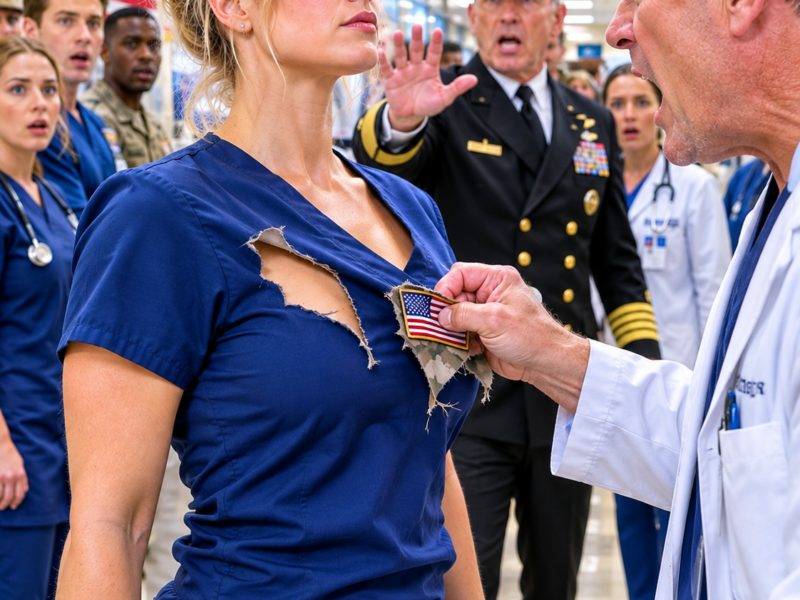
“The surgeon ripped the combat patch off my scrubs in front of twenty patients and called it stolen valor—then an admiral walked into the ER
The person standing outside the trauma bay was wearing a navy-blue suit, a silver tie, and the expression of a man who had just watched a ghost walk into a room.
I knew him.
Not because I had seen him recently.
Because seven years earlier, I had watched him sign a document that was supposed to prove I was dead.
His name was Captain Thomas Rourke.
At the time of Operation Iron Lantern, he had been a Navy commander assigned to our joint operations command. He was responsible for personnel accountability, casualty reports, and the chain of communication between the field team and headquarters.
He had also been the last person to speak to me over the radio before our medical transport exploded.
And now he was standing in the hallway of Harbor Point Medical Center, watching me breathe.
“Commander Mitchell,” the admiral said quietly, “do you know that man?”
I kept my eyes on Rourke.
“Yes, sir.”
“Then I need you to tell me why he signed your death report.”
Before I could answer, a monitor alarm sounded inside the trauma bay.
A nurse called for additional blood.
The wounded sailor on the table was losing pressure.
Every instinct in my body pulled me toward him.
I looked at the admiral.
“Sir, we can discuss my death after we save his life.”
The admiral studied me for a moment.
Then he nodded.
“Understood.”
I turned back toward the trauma room.
Dr. Richard Coleman was standing near the surgical entrance, still holding the combat patch he had ripped from my scrubs.
His face had lost its color.
He looked from the patch to the admiral, then to the man in the hallway.
“Commander?” he whispered.
I didn’t correct him.
I didn’t have time.
“Dr. Coleman, I need you to help stabilize the patient. His pressure is dropping, and we need to identify the source of the internal bleeding.”
Coleman hesitated.
Only for a second.
Then he moved.
“Get me another ultrasound,” he ordered. “Prepare for emergency surgery.”
The room snapped back into motion.
I checked the patient’s airway, reviewed the monitor, and helped the team establish another line. The sailor was young, probably no older than twenty-five. Blood covered the side of his uniform.
His name was Petty Officer First Class Evan Brooks.
He had suffered blast injuries during a training exercise near the coast.
The admiral had arrived because Evan’s unit had requested an update.
I had not known that when he walked in.
I had only seen a wounded sailor who needed help.
That was still all I saw.
“Pressure is sixty over thirty,” the nurse beside me said.
“Keep the blood coming,” I replied. “We need the surgeon now.”
Coleman leaned over the ultrasound screen.
“Possible splenic injury,” he said. “We need to move.”
The patient was rushed toward surgery.
I walked beside the bed until the doors closed behind him.
Only then did I notice my hands were shaking.
Not from fear.
From the memory.
Seven years earlier, I had been standing in a field hospital in a remote desert region, listening to men scream through the smoke.
Operation Iron Lantern had been described as a routine extraction mission.
It was anything but routine.
Our medical transport was supposed to arrive at a designated landing zone at 0210. Three wounded service members were waiting for evacuation. One of them was Lieutenant Daniel Hayes, the admiral’s son.
I was the senior medical officer assigned to the recovery team.
At 0203, our route was changed.
The new landing zone was supposedly safer.
I questioned the order.
The response came from headquarters.
Proceed immediately.
We did.
At 0217, the transport was hit by an explosive device before it reached the extraction point.
The blast killed two crew members and destroyed the aircraft.
The three wounded men were still alive.
I found them beneath a collapsed section of a concrete structure.
One had a severe abdominal injury.
Another had a broken leg and a head wound.
Daniel Hayes was barely conscious, with shrapnel lodged near his shoulder and chest.
I had enough medical supplies for one emergency evacuation.
There was no way to move all three men safely.
So I made a decision.
I used the transport’s remaining emergency beacon to signal for a second extraction while my team and I moved the wounded men into a drainage tunnel.
We stayed there for nearly four hours.
When the second helicopter finally arrived, I loaded the three men first.
The last thing I remembered before the tunnel entrance collapsed was the sound of another explosion.
Then darkness.
I woke up in a military hospital eleven days later.
I was told the mission had been compromised.
I was told two men from my team were dead.
I was told that I had been officially declared missing and presumed dead.
I was also told that the surviving men had been transferred to another facility.
When I asked about Daniel Hayes, the answer was that he had survived.
That was enough for me.
I had spent months recovering from my injuries. My left shoulder required surgery. My ribs had been fractured, and the damage to my hearing never fully healed.
But the worst part was what happened afterward.
My personnel file had been sealed.
My name disappeared from the active command roster.
I was told there was an administrative investigation and that I should not discuss the mission with anyone.
Then, one morning, I received a letter informing me that my service record had been closed.
I had not understood why.
I had been alive.
I had been treated.
I had spoken to military doctors.
Yet the official record said I was dead.
I appealed.
The appeal disappeared.
I requested a review.
The request was denied.
Eventually, I left the service under a medical separation arrangement.
I moved to Virginia, completed civilian nursing credentials, and started over.
I never removed the small combat patch from my belongings.
It was the only thing I had kept from Iron Lantern.
Until Dr. Coleman tore it from my scrubs.
“Sarah?”
The voice pulled me back.
It was the admiral.
He was standing near the nurses’ station.
His expression had changed. The anger was still there, but beneath it was something more personal.
Grief.
“Your patient is in surgery,” I said.
“I know. The surgical team is giving me updates.”
“Then we should wait.”
He glanced toward the hallway.
“Rourke is gone.”
My stomach tightened.
“What?”
“He left the building about two minutes ago.”
I looked toward the emergency department entrance.
“Did anyone stop him?”
“Security tried. He said he had an urgent call from the Department of the Navy.”
The admiral’s jaw tightened.
“He shouldn’t have been able to leave.”
“Why?”
“Because he was supposed to be under investigation.”
I stared at him.
The hallway seemed to grow quieter.
“Sir, what investigation?”
The admiral lowered his voice.
“Three months ago, I requested a formal review of the Iron Lantern casualty records. My son had started asking questions about why your name appeared in two different versions of the same report.”
“Two versions?”
“Yes. One stated you died during the transport explosion. The other listed you as an unidentified survivor transferred to a medical facility outside the original chain of command.”
I felt cold.
“Where was that facility?”
“The report didn’t say.”
“Who approved it?”
“Captain Rourke.”
I closed my eyes.
For seven years, I had believed that the military bureaucracy had simply made a mistake.
Now I was beginning to understand that someone had deliberately created two versions of my life.
The admiral continued.
“My son remembered you. He remembered the woman who carried him through that tunnel. When he found the conflicting records, he contacted me.”
“Why didn’t anyone tell me?”
“Because the review was classified, and we didn’t know whether the original chain of command was compromised.”
I looked at him.
“Do you know who changed the extraction coordinates?”
“We have a strong suspicion.”
“Who?”
“Rourke wasn’t acting alone.”
A door opened behind us.
Dr. Coleman stepped out of the surgical corridor, still wearing his gloves.
“The patient is stable,” he said. “The surgeons found a ruptured spleen and controlled the bleeding. He’s going to survive.”
The admiral exhaled.
For the first time since entering the hospital, he looked relieved.
“Thank you, Doctor.”
Coleman nodded, then turned toward me.
“Commander Mitchell, I owe you an apology.”
I glanced at the patch in his hand.
He held it out.
“I was wrong to question your service in front of the staff. I was wrong to tear this off your uniform. I had no right to do either.”
I accepted the patch.
“Thank you.”
He looked down.
“I thought I was enforcing hospital policy.”
“You were enforcing your assumptions.”
His face tightened.
“I know.”
I placed the patch in my pocket.
“Then make sure you never do it to another nurse.”
He nodded.
“I will.”
The admiral waited until Coleman had returned inside.
Then he handed me a small envelope.
“My son asked me to give you this if we ever found you.”
I recognized the handwriting immediately.
Daniel Hayes.
Inside was a folded letter and a photograph.
The picture showed three men standing beside a helicopter. They were thin, bruised, and covered in dust.
Behind them stood a woman in a medical vest.
Me.
I looked younger.
My hair was shorter.
My face was covered in dirt.
But I was smiling.
On the back, Daniel had written:
We made it because you refused to leave us. I hope one day we can tell you that in person.
I read the sentence twice.
Then I opened the letter.
Commander Mitchell,
I don’t know whether this letter will ever reach you. I have tried to find you through the official channels, but every request comes back with the same answer. You died during Iron Lantern.
I know that’s not true.
I remember your voice in that tunnel. I remember you telling me to keep my eyes open. I remember you giving your own water to the man beside me because he was slipping away.
I remember waking up in the helicopter and asking where you were.
They told me you hadn’t made it.
I never believed them.
I am alive because you carried me out. I have a family now. A daughter who thinks her father is invincible, and a wife who knows better.
If you’re alive somewhere, I hope you found peace.
If you aren’t, then I hope somebody tells your story properly.
Daniel.
I lowered the letter.
For a moment, the hospital disappeared.
I could almost hear Daniel’s voice from the tunnel.
Stay with me, Commander.
Don’t you dare quit.
I had kept him alive.
And for seven years, he had kept looking for me.
“Where is he now?” I asked.
The admiral smiled faintly.
“Virginia Beach. He’s retired from active duty. He works with a veterans’ recovery program.”
“I’d like to see him.”
“I think he’d like that too.”
Before I could say anything else, the admiral’s phone rang.
He answered.
Listened.
Then his expression hardened.
“What do you mean, the file was accessed?”
He turned away from me.
“How recently?”
A pause.
“Send me the name.”
He ended the call.
“What happened?” I asked.
“Someone accessed the original Iron Lantern casualty archive less than an hour ago.”
“Rourke?”
“We don’t know.”
“Where is the archive?”
“Naval records facility in Norfolk.”
I stared at him.
“Then we need to go there.”
He shook his head.
“You are not going anywhere near that investigation without protection.”
“Sir, I spent seven years being told I was dead. I think I’ve earned the right to know why.”
His expression softened.
“I agree. But we do this correctly.”
He made another call.
Within twenty minutes, two officers from Naval Criminal Investigative Service arrived at the hospital.
One was Special Agent Laura Bennett, a woman in her early forties with a calm voice and a notebook she rarely looked at.
The other was a younger investigator named Marcus Reed.
They asked me to describe everything I remembered about Iron Lantern.
The changed coordinates.
The damaged transport.
The drainage tunnel.
The casualty evacuation.
The hospital where I woke up.
The administrative separation.
They listened without interrupting.
When I finished, Agent Bennett closed her notebook.
“Commander, there is something you should know.”
“What?”
“Your death report was not filed by the medical team that recovered you.”
“I know Captain Rourke signed it.”
“He signed the final certification. But the original report was submitted by someone else.”
“Who?”
She looked at the admiral.
Then back at me.
“Lieutenant Colonel Peter Voss. He was the operations intelligence officer assigned to Iron Lantern.”
I remembered him.
Voss had been responsible for coordinating the mission’s intelligence package.
He had briefed our team before deployment.
He had also insisted the revised landing zone was secure.
“Where is he now?” I asked.
“Retired. Lives outside Richmond.”
“Is he being investigated?”
“He has been questioned twice. Both times, he denied knowing anything about the route change.”
I shook my head.
“He knew.”
Agent Bennett did not argue.
“We found evidence that the original extraction coordinates were changed using a command authorization code assigned to Voss.”
The admiral stepped closer.
“Then we have our answer.”
“Not yet,” Bennett said. “We have a connection. We still need to establish intent.”
I looked at her.
“What about the second medical record?”
She opened a folder and showed me a copy.
It listed me as an unidentified patient with severe blast injuries, transferred to a military treatment facility under a restricted identity.
The date was the same as the transport explosion.
The medical findings matched my injuries.
At the bottom was a signature.
Captain Thomas Rourke.
“He knew I survived,” I whispered.
“Yes,” Bennett said.
“Then why declare me dead?”
“That is what we’re trying to establish.”
The next morning, I met Daniel Hayes.
He arrived at Harbor Point with a cane, a slight limp, and the same steady eyes I remembered from the tunnel.
For a few seconds, neither of us spoke.
Then he smiled.
“Commander.”
I felt my throat tighten.
“Lieutenant.”
He laughed softly.
“I’m retired. You don’t have to call me that.”
“I know.”
He looked at my face.
“I thought I was going to spend the rest of my life wondering whether you made it out.”
“I spent a long time wondering the same thing about you.”
He stepped forward and hugged me.
I hadn’t expected that.
Neither had he.
We stood there for a moment, two people who had survived the same explosion but had been separated by a lie.
When he finally stepped back, his eyes were wet.
“My daughter is seven,” he said. “She knows your name.”
I smiled.
“Why?”
“Because I told her about the woman who wouldn’t leave three injured men behind.”
I looked down.
“I’m glad you made it home.”
“I’m glad you did too.”
He handed me a photograph.
It showed him with his wife and daughter on a beach.
On the back, his little girl had written in uneven letters:
Thank you for saving my dad.
I had to look away.
Daniel waited.
Then he said, “I want to help you find out what happened.”
“You’ve already done enough.”
“No,” he replied. “I survived. That doesn’t mean I stopped being part of it.”
He told Agent Bennett everything he remembered.
He confirmed that the extraction coordinates had changed without explanation. He remembered hearing a second radio transmission just before the blast. He also remembered Rourke arriving at the temporary field hospital several hours after the evacuation.
“He asked about the medical team,” Daniel said. “Not the wounded. Not the pilots. The medical team.”
“Did he ask about Sarah?” Bennett asked.
Daniel nodded.
“He asked whether Commander Mitchell had been recovered.”
“And what did they tell him?”
“That I didn’t know.”
Daniel paused.
“But I remember something else. Rourke said, ‘If she’s alive, this becomes a much bigger problem.’”
The room went silent.
Agent Bennett wrote the sentence down.
That was the first time we had something more than conflicting records.
It was evidence of motive.
Over the next two weeks, the investigation moved quickly.
NCIS recovered the original mission communications from a backup server. The audio showed that Voss had authorized the route change using an emergency override.
But the override had been requested by a private defense contractor called Meridian Tactical.
Meridian had supplied intelligence support for the operation.
Its regional director at the time was a man named Victor Sloane.
The company had been awarded a major contract to secure the extraction corridor.
If the corridor was declared unsafe, the contract would have been suspended.
If the mission failed, the company could argue that the failure resulted from inaccurate field intelligence rather than its own security assessments.
That was the first piece of the motive.
The second came from financial records.
Meridian had made payments to a consulting company controlled by Voss’s brother.
The payments began six weeks before Iron Lantern and continued for nearly a year afterward.
Rourke had received no direct payment.
But he had approved several restricted transfers connected to the post-operation medical records.
He had also signed the document that classified me as deceased.
The question was why.
Agent Bennett found the answer in an email recovered from an archived command account.
It was sent three days after the explosion.
The message was brief.
The surviving medical officer must remain outside the official chain until the review is complete. Her testimony could expose the authorization failure. Close the personnel record as fatality pending final confirmation.
The sender was Voss.
The recipient was Rourke.
Rourke had replied:
Understood. I will handle the record.
The words made me feel sick.
They hadn’t believed I was dead.
They had decided it was more convenient to make me dead.
The investigators later discovered that my restricted medical identity had been created to protect the investigation from public scrutiny. But once the original mission failure became a political and financial problem, the temporary measure became permanent.
My name was removed from the casualty list.
My military benefits were closed.
My service record was sealed.
The medical separation paperwork was altered to make it appear that I had been processed through an administrative channel after death.
Rourke had told investigators he believed he was following a lawful order.
But the emails showed that he had received medical confirmation that I was alive.
He had also received my written request for a records review.
He never forwarded it.
He never responded.
He had simply allowed the lie to continue.
When Agent Bennett told me, I sat in the hospital’s quiet family room for a long time.
I had imagined many explanations.
A clerical error.
A lost file.
A bureaucratic failure.
I had not imagined that someone could read a letter from a living person asking to have her life restored and choose to ignore it.
The next day, Rourke was located.
He had been staying at a private residence outside the city.
NCIS investigators interviewed him under formal authority.
At first, he denied everything.
Then they showed him the emails.
They showed him the transfer records.
They showed him the medical report with my fingerprints attached.
Finally, they played the recording of Daniel’s statement.
Rourke stopped speaking.
He admitted that he knew I was alive.
He admitted that Voss had asked him to keep my identity restricted.
He claimed he believed the arrangement would last only a few weeks.
He said he was afraid that exposing the route change would damage his career and destroy the command structure.
When asked why he had signed the final death certification, he said he had been pressured.
When asked why he had ignored my appeals, he had no answer.
The investigators charged him with offenses related to falsifying official records and obstructing the investigation.
Voss was arrested two days later.
Victor Sloane and Meridian Tactical became the focus of a separate federal inquiry.
The company lost its government contracts pending the investigation.
For the first time in seven years, the truth was no longer buried in a classified file.
But the truth did not immediately repair my life.
There were still records to correct.
Benefits to restore.
Years of lost service credit to review.
Medical documentation to reconcile.
And questions no investigation could answer.
Why had I been left to rebuild my life without knowing what had been taken from me?
Why had nobody checked whether I was alive before closing my record?
Why had the system accepted a death certificate when the same system had evidence of my survival?
I didn’t expect an apology to answer those questions.
Still, I wanted one.
Three months after the investigation began, I was invited to a formal hearing at Naval Station Norfolk.
The room was filled with officers, investigators, and representatives from the military records review board.
I wore my hospital scrubs beneath a dark jacket.
The combat patch had been carefully repaired and sewn back onto my uniform.
The admiral sat near the front.
Daniel was beside him.
Agent Bennett stood along the back wall.
I was asked to describe the consequences of the falsified record.
I told them about the appeals that disappeared.
The benefits that stopped.
The medical separation I never understood.
The years spent believing my service had been erased by an administrative mistake.
I also told them about the day Dr. Coleman tore the patch from my scrubs.
Not because he was part of the original wrongdoing.
He wasn’t.
But because it showed how a false record could follow a person into every room.
“I didn’t wear that patch to impress anyone,” I said. “I wore it because it reminded me of three men who came home alive. I didn’t need the hospital to know who I had been. I only needed them to let me do my job.”
The room was silent.
Then the board chair asked whether I wanted my service record formally restored.
I looked at the admiral.
He nodded.
“Yes,” I said. “I want the record corrected. I want the three men who survived Iron Lantern properly recognized. And I want the people who altered those records held accountable.”
The board approved a formal review of my service history.
They restored my rank and corrected the casualty entry.
My record now stated that I had survived Operation Iron Lantern and had been medically separated after recovering from my injuries.
It also acknowledged my actions during the evacuation.
The military could not give me back seven years.
But it could stop pretending they had never happened.
A week later, I received a sealed envelope from the Department of the Navy.
Inside was a corrected service record and a letter of commendation.
I read it once.
Then I folded it carefully and placed it in the same drawer as Daniel’s letter.
I didn’t need to hang it on a wall.
I knew what I had done.
The men I had saved knew.
That was enough.
Dr. Coleman approached me a few days later.
He had requested a meeting after the hospital completed its internal review.
“I’ve been thinking about what you said,” he began.
“Which part?”
“That I was enforcing my assumptions.”
He looked uncomfortable.
“I reviewed the hospital’s policies on military insignia and identification. We had a procedure for verifying credentials. I didn’t follow it. I made a public accusation instead.”
I waited.
“I’ve apologized to the staff who witnessed it. I also asked the hospital to create a better process so no one else is humiliated over something they haven’t even investigated.”
“That would be a good start.”
He nodded.
“I know I can’t undo what I did.”
“No,” I said. “But you can decide what you do next.”
He offered me his hand.
I shook it.
We didn’t become friends.
We didn’t need to.
Respect, I had learned, did not require pretending that nothing had happened.
It required doing better after the truth was known.
Several months later, Evan Brooks returned to Harbor Point for a follow-up appointment.
He was walking without assistance, though he still had a long recovery ahead of him.
When he saw me at the nurses’ station, he stopped.
“Are you Commander Mitchell?”
I smiled.
“I’m Sarah.”
He hesitated.
“My admiral told me what happened.”
I looked toward the hallway.
“Then I hope he also told you to finish your physical therapy.”
Evan laughed.
“Yes, ma’am.”
He shook my hand.
“Thank you for helping me.”
“You did the hard part. You made it through surgery.”
He looked at the patch on my scrubs.
“That’s the one?”
I touched it lightly.
“Yes.”
“I’m glad you kept it.”
“So am I.”
That evening, I drove to Virginia Beach to visit Daniel and his family.
His daughter, Lily, opened the door.
She was small, with dark hair tied into two uneven ponytails.
She looked at me for a long moment.
Then she said, “You’re the lady who saved my dad.”
Daniel appeared behind her.
“Lily, this is Sarah.”
She stepped aside to let me in.
On the living room wall was a framed photograph from Iron Lantern.
The same one Daniel had given me.
Three wounded men beside the helicopter.
And me, standing behind them.
Underneath it was a small plaque.
Three lives carried home. One truth worth remembering.
I stared at it.
Daniel came to stand beside me.
“My wife thought it should be somewhere everyone could see.”
I smiled.
“It’s a good place.”
He handed me a small box.
Inside was a new patch.
Not a replacement for the one I wore.
A second one.
It had been made from the same design, with the words IRON LANTERN embroidered beneath the insignia.
“I thought you might want this,” he said.
I ran my fingers over the stitching.
“Thank you.”
He looked at me.
“You know, I spent years thinking I owed you my life.”
“You don’t owe me anything.”
“I know.”
He paused.
“But I wanted you to know that I didn’t forget.”
I looked around the room.
His wife was setting dinner on the table.
Lily was showing me a drawing she had made of a helicopter.
Daniel was home.
His family was whole.
For the first time, I understood that the mission had not ended in that tunnel.
It had continued in every ordinary day he got to live afterward.
And I had been part of that.
Later, when I returned to my apartment, I placed the new patch beside the old one.
One had survived the explosion.
The other had been made by someone who remembered.
I kept both.
The following Monday, I arrived at Harbor Point before sunrise.
The emergency department was already busy.
A child had fallen from a bicycle.
An elderly man was struggling to breathe.
A young woman was crying beside a stretcher.
I tied my hair back, checked the patient board, and started my shift.
There was no ceremony.
No admiral waiting in the hallway.
No line of officers standing at attention.
Just another day in a hospital.
And that was exactly where I wanted to be.
At 8:15, a new nurse approached me.
She was young, nervous, and holding a clipboard too tightly.
“Sarah? I’m supposed to shadow you today.”
“Then you’re in luck,” I said. “We have plenty to do.”
She glanced at the patch on my scrubs.
“Can I ask about that?”
I looked down at it.
For a moment, I remembered the sound of fabric tearing beneath Dr. Coleman’s hands.
I remembered the admiral’s voice.
I remembered Daniel in the tunnel.
I remembered the seven years when an official document insisted I did not exist.
Then I smiled.
“It’s a reminder,” I said.
“Of what?”
“That the truth can take a long time to reach the surface. But you should never let someone else’s paperwork decide who you are.”
The new nurse nodded.
Then the emergency department doors opened.
A paramedic called for help.
I turned toward the sound.
“Come on,” I told her. “Let’s go.”
And we ran.
The patch stayed exactly where it belonged.
Not because an admiral had saluted me.
Not because a board had restored my rank.
Not because the people who had tried to erase me had finally been exposed.
It stayed because I had earned it.
Seven years earlier, I had carried three wounded men toward a helicopter while the world collapsed around us.
One of those men had grown up to become a father.
Another had gone home to his family.
And the third had finally found the truth.
I had never needed to be remembered as a hero.
I had only wanted the people I saved to have the chance to live.
Now they did.
And so did I.
THE ENd.









