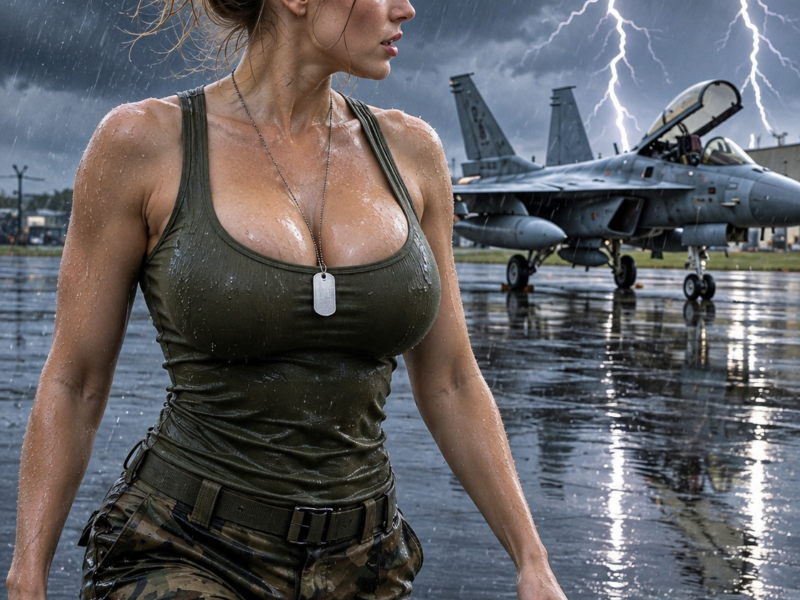
“The storm had grounded every aircraft on the eastern seaboard, and the officers who once laughed at my flying skills were now staring at a radar screen that showed only ONE runway still usabl
I read the seven words again.
ELENA WAS RIGHT. THEY CHANGED THE RUNWAY DATA.
For three years, I had wondered whether Marcus Hale remembered what happened that night.
For three years, I had wondered whether he blamed me.
And now, just as a storm threatened to close every runway around us, his handwriting had appeared in a classified folder.
Colonel Vance reached for the page.
I pulled it away.
“Don’t touch that.”
His hand stopped.
General Whitaker watched us without speaking.
“Captain Brooks,” he said, “I need you to tell me whether you can land that aircraft.”
I looked at the radar.
Transport Six-Two was approaching the outer edge of our airspace.
Daniel Mercer had less than fifteen minutes of comfortable fuel remaining.
The wind was shifting.
The rain was intensifying.
And the only runway with a chance of remaining usable was the one nobody had allowed me to inspect since my reassignment.
“Yes, sir,” I said.
Colonel Vance shook his head.
“She isn’t qualified to direct a landing.”
“Then qualify her,” Whitaker replied.
“General, that’s not how this works.”
“Neither is allowing a transport aircraft full of emergency medical supplies to run out of fuel because you’re afraid of a name on a piece of paper.”
The room went quiet.
Whitaker turned to the operations lieutenant.
“Lieutenant, pull the latest structural report for Runway Four. I want the engineering officer on the line.”
Then he looked at me.
“Captain Brooks, you’ll advise. Major Mercer will make the final decisions from the aircraft. Do you understand?”
“Yes, sir.”
“Good. Get on that radio.”
I reached for the microphone.
For the first time in three years, nobody tried to stop me.
“Transport Six-Two, Falcon Ridge. This is Captain Brooks in operations. Do you read?”
Static crackled.
Then Daniel answered.
“Falcon Ridge, I read you. Who is this?”
“Elena Brooks.”
There was a pause.
“Elena?”
“Good to hear your voice, Daniel.”
“I thought you were still grounded.”
“I am.”
“Then why are you on the radio?”
I looked at the runway display.
“Because you’re running out of places to go.”
A short breath came through the speaker.
“Fair enough. What have you got?”
I brought up the wind profile.
“Runway Four. It’s not listed as active, but its drainage and reinforcement systems were upgraded after Hurricane Caleb. The surface inspection was completed last month.”
“Why wasn’t it on our diversion list?”
“That’s a question for Colonel Vance.”
Vance’s face tightened.
I continued before he could interrupt.
“The approach is narrow, and the crosswind is coming from the northeast. You’ll need to hold above the coastal ridge until I give you the final wind reading.”
“Can I get visual?”
“Not yet. Visibility is below minimums.”
“Then what do you recommend?”
I studied the weather data.
“Stay with instruments. Don’t chase the lights. The storm is pushing rain across the western approach, but the northern corridor is still holding.”
“Copy.”
A new warning flashed across the screen.
The wind had increased by another six knots.
The engineering officer came on the internal line.
“General, we’ve reviewed the latest sensor data. Runway Four is structurally sound. The drainage channels are functioning, but there’s standing water near the southern taxiway.”
“Can it take a transport aircraft?” Whitaker asked.
“Yes, sir, if the landing is centered and the aircraft doesn’t attempt to exit at the southern end.”
I relayed the information.
Daniel answered with a calmness I knew well.
“Understood. We’ll use the northern exit if we make it down.”
I looked at the display again.
There was something wrong.
The wind readings were inconsistent.
The main station reported a strong northeast crosswind.
The backup station showed a sharp shift toward the east.
But the sensor near Runway Four showed almost no change.
That wasn’t normal.
“Lieutenant,” I said, “when was the Runway Four wind sensor last calibrated?”
He checked.
“Six weeks ago.”
“Who signed the calibration?”
He scanned the report.
“Colonel Vance.”
I turned toward the colonel.
He didn’t look surprised.
“That sensor was calibrated according to procedure,” he said.
“Then why is it reporting a different wind direction from both surrounding stations?”
“Local turbulence.”
“Not at that magnitude.”
“Captain, stop questioning every instrument in this building.”
I looked back at the screen.
The sensor wasn’t merely inconsistent.
It was repeating the same reading.
Exactly.
Every thirty seconds, the numbers refreshed, but the values never changed.
I leaned closer.
“That’s not a live reading.”
The lieutenant checked the system.
His face went pale.
“Sir, Runway Four’s sensor feed is showing a cached value.”
Whitaker turned sharply.
“What does that mean?”
“It means we’re not receiving current wind data from that station.”
“How long has it been offline?”
The lieutenant checked the log.
“Since 13:42.”
I looked at the clock.
It was now 15:06.
More than an hour.
“Then we need the portable station,” I said.
Vance stepped forward.
“There is no time for that.”
“There’s no time to land using false readings either.”
Whitaker ordered the engineering team to deploy the portable unit.
Then he faced Vance.
“Why wasn’t this failure reported?”
“The system must have experienced an intermittent connection.”
“An hour and a half is not intermittent.”
Vance said nothing.
The radio crackled.
“Falcon Ridge, Transport Six-Two. We’re getting severe turbulence. Need an updated approach plan.”
I pressed the microphone.
“Daniel, hold your current heading. We’re checking a sensor discrepancy.”
“How serious?”
“Serious enough that I don’t want you committing to the approach yet.”
“Copy.”
A second later, he added quietly, “Elena, whatever happened three years ago, I trust your judgment.”
I closed my eyes for a fraction of a second.
Then I answered.
“Thank you, Daniel.”
The portable wind station came online.
The actual crosswind was stronger than any of the fixed sensors had reported.
And it was shifting rapidly.
I recalculated the approach.
The aircraft could still land.
But only if Daniel entered from the northern corridor and adjusted his final heading at a precise point.
It would be difficult.
Not impossible.
“Transport Six-Two, I have a revised approach.”
“Go ahead.”
I gave him the heading and altitude adjustments.
Then I heard a voice behind me.
“That’s not an approved approach.”
Colonel Vance.
He had moved close enough to see my calculations.
“It is based on the current wind readings,” I said.
“It’s outside the standard procedure.”
“Because the standard procedure assumes the runway’s live sensor is functioning.”
“You’re not authorized to improvise.”
Whitaker turned.
“She’s not improvising. She’s adapting to conditions.”
Vance’s jaw tightened.
I returned to the radio.
“Daniel, you’ll need to make the final correction manually. The crosswind will push you right during the last section.”
“Understood.”
“Do not chase the centerline too early. Let the aircraft settle, then correct.”
“Copy.”
I watched the tiny aircraft symbol move across the screen.
The entire operations center seemed to hold its breath.
Then Daniel spoke.
“Falcon Ridge, I have the runway lights.”
“Confirm visual.”
“Confirmed. Visibility is improving slightly.”
I checked the weather.
It wasn’t improving.
The rain had shifted just enough to reveal the lights through a temporary break in the cloud cover.
“Maintain your instrument approach,” I warned him. “The visibility window may close.”
“Understood.”
His aircraft descended.
Five thousand feet.
Four thousand.
Three thousand.
I watched the crosswind indicator.
It was moving again.
“Transport Six-Two, adjust two degrees left.”
“Adjusting.”
“Hold.”
The aircraft symbol crossed the final approach marker.
“Now correct right. Slowly.”
“Correcting.”
A warning sounded.
The runway camera flickered.
For one terrible second, the screen went black.
Then the image returned.
The runway lights were visible.
Daniel’s aircraft emerged from the rain.
Its nose tilted into the wind.
The right wing dipped.
“Daniel, hold it.”
“I’m holding.”
“Don’t overcorrect.”
“I’ve got it.”
The aircraft crossed the threshold.
Its landing lights flashed across the wet surface.
Then the wheels touched down.
A spray of water exploded behind it.
The transport aircraft bounced once.
My fingers tightened around the console.
“Stay centered, Daniel.”
The aircraft drifted right.
“Correct left.”
He corrected.
The nose straightened.
The aircraft rolled down the runway, slowing gradually until it reached the northern taxiway.
For a moment, nobody spoke.
Then the radio came alive.
“Falcon Ridge, Transport Six-Two. We’re down. Aircraft secure.”
A cheer erupted across operations.
Someone clapped.
The lieutenant let out a breath that sounded almost like a laugh.
I leaned against the console.
My hands were shaking.
Not from fear of the landing.
From the realization that I had just done the one thing I had spent three years convincing myself I would never be allowed to do again.
I had helped bring an aircraft home.
Whitaker stepped beside me.
“Well done, Captain.”
“Thank you, sir.”
He looked at the sealed folder.
“Now we need to talk about what happened three years ago.”
I turned toward Vance.
He had gone very still.
“Not here,” I said.
Whitaker nodded.
“Agreed.”
Then the colonel spoke.
“You have no idea what you’re accusing me of.”
I looked at him.
“Then you shouldn’t have any trouble explaining the sensor logs.”
His face changed.
Only slightly.
But I saw it.
And so did the general.
“Colonel Vance,” Whitaker said, “you will remain here until investigators arrive.”
Vance straightened.
“General, you cannot detain me based on an old note and a malfunctioning sensor.”
“No one said you were being detained.”
“Then I’m leaving.”
Two security officers appeared at the doorway.
Whitaker didn’t raise his voice.
“You’re being asked to remain while we establish why a closed runway’s wind data was altered during an active emergency.”
Vance looked at the officers.
Then at me.
“You think this makes you a hero?”
“No,” I said. “It makes me a pilot who did her job.”
He left nothing behind but the smell of his aftershave and the uneasy silence that followed him.
Within twenty minutes, the first investigators arrived.
They secured the operations computers and collected the Runway Four sensor logs.
I was taken to a small conference room to give a preliminary statement.
General Whitaker joined me.
He placed Marcus Hale’s note on the table.
“Tell me what you remember from the evaluation flight.”
I looked at the paper.
Three years had passed, but the memories were as sharp as the sound of an engine failing.
“It was a high-speed systems evaluation. Marcus was flying the second aircraft. I was testing a modified guidance package on the lead aircraft.”
“And the runway?”
“Runway Two was listed as the designated emergency recovery strip. The system showed it as clear.”
“But you diverted.”
“Because I saw a discrepancy in the approach data.”
Whitaker nodded.
“Continue.”
I took a breath.
“The guidance package was giving us an incorrect crosswind correction. I compared it against the independent instrument display. The numbers didn’t match.”
“What did you do?”
“I called the control tower and requested a hold.”
“Did you receive permission?”
“No.”
“Why not?”
“Because Colonel Vance was the operations commander that day. He ordered us to continue the evaluation.”
“Did you?”
“I slowed the test profile and requested a manual verification.”
“And Marcus?”
“He was already committed to the second approach.”
I remembered his voice over the radio.
The sharpness.
The confusion.
The sudden alarm when his aircraft began drifting.
“I told him the data was wrong,” I continued. “I told him to abort.”
“But he couldn’t?”
“He tried. His aircraft had already entered the dangerous part of the approach.”
Marcus had managed to land, but the aircraft skidded off the runway.
He suffered a broken leg and several serious injuries.
I had landed safely on an alternate strip.
The investigation concluded that I had deviated from instructions and disrupted the test sequence.
It also claimed that my warning had been too late.
“Did you ever see the original recording?” Whitaker asked.
“No.”
“Did you request it?”
“Every week for six months.”
“Who denied your requests?”
“Colonel Vance. The investigation office. Then the records department.”
Whitaker leaned back.
“Why didn’t you appeal?”
I gave a short, humorless laugh.
“I did. My appeal disappeared into a review process that never ended.”
He lowered his eyes.
“That should never have happened.”
“No, sir. It shouldn’t.”
For a while, neither of us spoke.
Then he opened another section of the folder.
“There is something you need to understand. Marcus did not write that note recently.”
I looked up.
“What?”
“It was attached to a formal complaint he submitted twenty months ago. The complaint was classified, then marked incomplete.”
“Why?”
“Because the original recording was missing.”
“Where was Marcus?”
“Recovering from another medical procedure. He was transferred to a rehabilitation facility after the accident.”
I felt my throat tighten.
“Is he still there?”
“No. He returned to active duty in a limited administrative capacity. He asked to meet you.”
I stared at the general.
“Why didn’t anyone tell me?”
“Because the complaint was never released.”
“Who classified it?”
Whitaker didn’t answer immediately.
Then he said, “Colonel Vance signed the restriction.”
I looked down at the note.
Marcus had tried to clear my name.
And someone had buried his attempt.
The conference room door opened.
A woman in a dark suit stepped inside, carrying a laptop and a thick evidence case.
“General, we’ve recovered the sensor system’s access history.”
Whitaker introduced her as Special Agent Rachel Morgan from the Air Force Office of Special Investigations.
She placed the laptop on the table.
“We found an unauthorized remote connection to the Runway Four sensor network.”
“From where?” Whitaker asked.
“An operations terminal in this building.”
I looked toward the doorway.
“Colonel Vance’s office?”
Morgan nodded.
“The connection was active during the storm. Someone replaced the live sensor feed with a fixed value.”
“Why?” I asked.
“To make the runway appear to have a safer crosswind than it actually did.”
I stared at the screen.
Someone had wanted the landing data to be wrong.
“But why would anyone want Daniel’s aircraft to land with inaccurate information?”
Morgan closed the laptop halfway.
“That’s what we’re trying to establish.”
The general looked at her.
“Any connection to the old evaluation?”
“We found a matching access pattern in the archived records. The same credentials were used to alter the approach data three years ago.”
My pulse quickened.
“Whose credentials?”
Morgan looked at me.
“Colonel Richard Vance.”
The room went silent.
The same man who had grounded me had also altered the data that nearly injured Marcus.
And today, he had tried to make me believe the runway was too dangerous to use.
Whitaker stood.
“Agent Morgan, I want every record secured. No one leaves this installation with access to the old evaluation files.”
“Understood.”
I remained seated.
There was one question I couldn’t stop thinking about.
“Why would Vance risk exposing himself today?”
Morgan glanced at the general.
Then she opened the evidence case.
Inside was a small encrypted storage device.
“Because he wasn’t working alone.”
She placed it on the table.
“Someone attempted to destroy this device from the maintenance network shortly before the storm reached the base.”
I stared at it.
“What is it?”
“We don’t know yet. But the file structure suggests it contains original flight-test recordings and internal communications.”
Whitaker looked at me.
“Do you recognize the serial number?”
I leaned closer.
A faint marking had been scratched into the casing.
M.H.
Marcus Hale.
I felt my chest tighten.
“Where did you find it?”
“Inside a sealed maintenance cabinet in Hangar Four.”
“That cabinet was part of the old evaluation program.”
Morgan nodded.
“Exactly.”
She connected the device to an isolated forensic system.
A list of files appeared.
Some were corrupted.
Others had been encrypted.
But one audio recording was intact.
Its timestamp was three years old.
Whitaker asked whether I was prepared to listen.
I nodded.
Morgan pressed play.
At first, there was only the sound of static and engine noise.
Then I heard my own voice.
“Control, the approach data is inconsistent. Requesting manual verification.”
A second voice answered.
Colonel Vance.
“Continue the evaluation. The readings are within tolerance.”
My voice again.
“They are not within tolerance. I’m seeing a discrepancy between the primary and independent systems.”
Vance’s response was sharp.
“Captain Brooks, you are not authorized to modify the test profile.”
Then Marcus came through the recording.
“Control, I’m getting the same discrepancy. My aircraft is drifting.”
I closed my eyes.
I remembered exactly what happened next.
“Marcus, abort!” I shouted through the recording.
Then another voice interrupted.
It was quieter.
Almost buried beneath the engine noise.
“Do not report the discrepancy. Continue the sequence.”
Morgan stopped the recording.
“Who was that?” I asked.
No one answered.
She replayed the section.
The voice sounded familiar, but I couldn’t place it.
Whitaker leaned toward the speaker.
“Enhance that portion.”
Morgan worked for several minutes.
Then the voice became clearer.
It belonged to General Whitaker.
My stomach dropped.
The man who had just defended me.
The man who had handed me Marcus’s note.
The man who had told Vance to remain in the building.
He had been there three years ago.
He stared at the screen as though he had seen a ghost.
“I don’t remember saying that.”
I stood.
“General?”
He looked at me.
“I was deputy operations director at the time. I was listening to the test from a remote command station.”
“Then you knew the readings were wrong.”
“I heard a report. I did not know the system had been altered.”
“But you ordered us to continue.”
He shook his head.
“I don’t remember issuing that order.”
Morgan closed the audio file.
“General, we need to preserve your statement.”
Whitaker looked at her.
“Of course.”
But the confidence in his voice had disappeared.
For the first time since the storm began, I didn’t know whom to trust.
And the investigation was only getting started.
The next morning, the storm had moved north.
The base reopened its main runway.
Transport Six-Two had been unloaded, and the medical supplies were already on their way to the regional hospitals.
I spent the night in a guest room while investigators examined the operations center.
At sunrise, Agent Morgan came to find me.
“Captain Brooks, there’s someone here to see you.”
I followed her through the administration building.
A man stood near the window at the end of the corridor.
He leaned on a cane.
His left leg moved stiffly.
His hair had gone gray at the temples.
But I recognized him immediately.
“Marcus.”
He turned.
For a moment, neither of us moved.
Then he smiled.
“Hey, Elena.”
I walked toward him.
“I thought you hated me.”
His smile faded.
“I never hated you.”
“You never said anything.”
“I tried.”
He tapped the cane against the floor.
“More times than you know.”
I looked at his injured leg.
“How bad is it?”
“Bad enough that I won’t be flying again.”
“I’m sorry.”
“Don’t be. I got to keep it.”
He glanced toward the conference room.
“Did you hear the recording?”
“Yes.”
“All of it?”
“Most of it.”
He nodded.
“Then you know why I kept pushing.”
We sat in a small meeting room.
Marcus placed a thin envelope on the table.
“I saved this before they took my access.”
Inside were handwritten notes, copies of maintenance reports, and a photograph of a computer screen.
The photograph showed the original approach data from the evaluation.
The crosswind correction had been altered by almost thirty percent.
I stared at it.
“Who changed this?”
“I don’t know for certain. Vance had access, but he wasn’t the only one.”
“What about the voice on the recording?”
Marcus lowered his eyes.
“I recognized it.”
“So did I.”
“It was General Whitaker.”
I sat back.
“Why would he tell us to continue?”
“Because the evaluation was supposed to prove the new guidance package was safe.”
“And if the test failed?”
“Funding would have been suspended. The program would have been canceled.”
I looked at the photograph again.
“That doesn’t explain why someone would alter the data.”
Marcus nodded.
“There’s more.”
He opened the envelope and removed a second document.
It was a procurement report.
The guidance package had been developed by a private contractor called Asterion Defense Systems.
The company had promised the Air Force that its new software could reduce landing errors in severe weather.
But the test data had not supported that claim.
“Vance was overseeing the contract,” Marcus said. “He had already signed off on the next funding installment.”
“And Whitaker?”
“He was responsible for the program’s approval.”
I felt cold.
“So they changed the test data to make the system look successful.”
“That’s what I believe.”
“But Marcus, your aircraft crashed.”
He looked at his cane.
“Yes.”
“And they blamed me.”
“Because you were the one who reported the discrepancy.”
I sat very still.
For three years, I had believed the investigation had been about protecting the Air Force from embarrassment.
Now I understood that it had been about protecting a contract.
And two officers had been willing to destroy careers to keep it alive.
“Why didn’t you give me this sooner?” I asked.
Marcus looked away.
“Because after the accident, I was told that the original data had been destroyed. I had no proof. Then I found the storage device, but I couldn’t access the files.”
“Why not?”
“Because the encryption required two authorization keys.”
I frowned.
“Whose?”
“Mine and yours.”
I looked at him.
“What?”
He pointed to a small code written on the back of the photograph.
“Your old test-pilot credential.”
I stared at the numbers.
They were mine.
The storage device hadn’t been waiting for any investigator.
It had been waiting for us.
Agent Morgan entered the room.
“We’ve recovered the remaining files.”
She placed a tablet on the table.
“There’s a complete contract communication archive. It includes emails between Vance, Whitaker, and Asterion executives.”
Marcus looked at me.
“Then it’s over.”
I wasn’t so sure.
Morgan scrolled through the documents.
“There’s one more issue. General Whitaker has requested a private meeting with you.”
I looked at her.
“Why?”
“He says he can explain the recording.”
I glanced at Marcus.
He gave a small shake of his head.
“Don’t go alone.”
I agreed.
The meeting took place in a secure office.
Whitaker stood behind his desk, his uniform immaculate, his expression exhausted.
He looked older than he had the day before.
“I assume you’ve seen the contract records,” he said.
“Yes, sir.”
“Then you understand what happened.”
“I understand that someone altered the test data, that Marcus was injured, and that I was blamed for reporting it.”
Whitaker closed his eyes.
“I approved the program.”
“Did you know the readings were altered?”
“I knew there were inconsistencies. I was told they were software issues.”
“That isn’t what the recording says.”
He looked down.
“I remember the test now.”
“Then tell me why you ordered us to continue.”
He walked to the window.
“The contractor had promised the system would revolutionize emergency landings. The program was already behind schedule. The department had invested millions.”
“So you decided the test mattered more than the pilots.”
“No.”
“Then why didn’t you stop it?”
He didn’t answer.
I stepped closer.
“Marcus lost his flying career. I lost mine. You let the investigation call me reckless.”
Whitaker turned.
“I believed the report.”
“You signed it.”
“Yes.”
“And you buried Marcus’s complaint.”
He nodded slowly.
“Yes.”
The admission hurt more than I expected.
Not because I hadn’t suspected it.
Because he said it without looking away.
“Why are you telling me now?”
“Because I can’t defend what I did anymore.”
I stared at him.
“That’s not an explanation.”
“No. It isn’t.”
He returned to his desk.
“I have already submitted my resignation. I will cooperate with the investigation.”
“That doesn’t undo anything.”
“I know.”
He opened a drawer and placed a document on the desk.
It was an official request for review of my flight-status suspension.
“I’ve recommended that your record be corrected.”
I didn’t touch it.
“I don’t want a favor.”
“It’s not a favor, Captain. It’s an acknowledgment that the original decision was wrong.”
“Then let the evidence say that. Not your recommendation.”
Whitaker nodded.
“Fair enough.”
I left the office with Marcus.
Neither of us spoke until we reached the corridor.
Finally, he asked, “Do you believe him?”
“I believe he regrets getting caught.”
Marcus gave a tired laugh.
“That sounds about right.”
The investigation continued for weeks.
Agent Morgan and her team traced the altered test data to Asterion’s internal servers.
They found evidence that company executives had knowingly submitted inaccurate performance reports.
Colonel Vance had received payments through a consulting arrangement disguised as technical advisory work.
General Whitaker had approved the contract extensions despite receiving warnings that the system was not performing as promised.
The evidence also showed that Vance had altered Runway Four’s sensor feed during the storm.
He hadn’t intended to cause a crash.
He had intended to make the runway appear unusable so that the emergency landing would be diverted.
Why?
Because he knew the portable sensor would expose the same access pattern used three years earlier.
If Daniel had landed elsewhere, the runway logs might never have been examined.
He had tried to hide the old crime by creating a new emergency.
It was a desperate decision.
And it nearly cost lives.
Vance was arrested.
Asterion’s senior executives were charged with fraud and conspiracy.
Whitaker resigned and agreed to testify.
He would face his own review for his role in the original investigation.
The official findings were released three months later.
They stated that I had correctly identified the faulty guidance data and had acted to prevent a dangerous landing.
My actions had not caused Marcus’s accident.
The altered approach information had.
My flight suspension was formally overturned.
I read the letter alone in my old office.
The same room with no windows.
The same desk.
The same storage closet humming behind the wall.
For a long time, I simply held the paper.
I thought I would feel triumphant.
Instead, I felt tired.
Three years of being treated like a failure could not be erased by one official document.
But it could finally be named for what it was.
A lie.
The following week, General Whitaker asked to meet me one last time.
He was no longer wearing his command insignia.
He stood in the courtyard beside the memorial garden.
“I wanted to apologize,” he said.
I waited.
“I knew the test data was questionable. I convinced myself the engineers could resolve the issue. When the accident happened, I accepted the first report because it protected the program and my reputation.”
He paused.
“I should have stopped the test. I should have protected you and Marcus. I didn’t.”
I looked at him.
“Do you know what I remember most?”
He shook his head.
“Not the accident. Not the investigation. I remember asking you for the original recording, and you telling me there was nothing to worry about.”
His face tightened.
“I remember.”
“I believed you.”
“I know.”
“That’s what made it worse.”
He lowered his eyes.
“I have no right to ask you to forgive me.”
“No, you don’t.”
I turned toward the garden.
“But I hope you tell the truth when you testify. Every part of it.”
“I will.”
I left him there.
A month later, I received orders to report to the flight evaluation board.
The letter offered reinstatement to active flight status, subject to medical review and a new qualification program.
I read it twice.
Then I called Marcus.
He answered on the second ring.
“Well?”
“They approved the review.”
He let out a long whistle.
“You’re going back?”
“I don’t know yet.”
“Elena.”
“What?”
“You’ve spent three years waiting for someone else to decide whether you belong in the air.”
I looked at the letter.
“Maybe I’m not ready.”
“Then take the time you need. But don’t let them make that decision for you again.”
I smiled.
“You sound like my old instructor.”
“I was always the better pilot.”
“You couldn’t land in a crosswind if the runway were twice as wide.”
He laughed.
For the first time in years, the sound didn’t carry any bitterness.
I began the qualification process two weeks later.
The first day back in the simulator, I sat in the pilot’s seat and stared at the instrument panel.
The familiar lights came alive.
My hands rested on the controls.
The instructor beside me reviewed the checklist.
“Ready, Captain Brooks?”
I took a breath.
“Ready.”
The first session was difficult.
My reactions were slower than I remembered.
I had to relearn certain procedures.
And every time the simulated weather deteriorated, my mind returned to the storm at Falcon Ridge.
But I kept going.
Day after day.
Flight after flight.
Until the movements felt natural again.
On the final evaluation, the board assigned me a simulated emergency landing in severe crosswinds.
The scenario was deliberately difficult.
The runway was wet.
The visibility was poor.
The wind changed direction twice during the approach.
I remembered Daniel’s aircraft.
The false sensor reading.
The seven words in Marcus’s handwriting.
Then I focused on the instruments.
I adjusted the approach.
Held the aircraft steady.
And brought it down safely.
When the simulation ended, the instructor smiled.
“Welcome back, Captain.”
I didn’t cheer.
I didn’t cry.
I simply nodded.
Because I knew I had never really left.
The next morning, I stood outside Hangar Four.
The same hangar where the storage device had been found.
A young lieutenant approached me.
“Captain Brooks?”
“Yes?”
“I’m Lieutenant Sarah Mitchell. I’ve heard about what happened.”
I raised an eyebrow.
“From whom?”
“Everyone.”
I gave a small laugh.
“That sounds dangerous.”
She smiled nervously.
“I wanted to ask you something. How do you know when to trust your judgment if a senior officer tells you you’re wrong?”
I considered the question.
Then I looked across the airfield.
A transport aircraft was taxiing toward the runway.
“First, you check your instruments. You check your training. You check the evidence. You don’t assume you’re right just because you’re confident.”
She nodded.
“And if everything says you’re right, but someone still orders you to ignore it?”
“Then you document what you see, communicate clearly, and use the proper safety channels. Rank doesn’t make bad data good.”
Sarah looked down.
“That’s what I thought.”
I turned back to her.
“And remember something else. Being right doesn’t mean you won’t pay a price. But being afraid of that price can put other people in danger.”
She absorbed that quietly.
Then she asked, “Do you think you’ll ever trust the command structure again?”
I watched the aircraft disappear into the morning haze.
“I’ll trust people when their actions earn it. I’ll trust procedures when they stand up to evidence. And I’ll keep checking both.”
Sarah smiled.
“Thank you, ma’am.”
She walked away.
I remained outside the hangar for a few minutes.
The wind moved across the runway, carrying the distant sound of engines.
My flight status had been restored.
My name had been cleared.
Marcus had finally been heard.
But none of that changed the most important lesson.
A uniform could give someone authority.
A title could give someone influence.
Neither could make a lie true.
That afternoon, I received one final message from Marcus.
It was a photograph of the two of us standing beside our aircraft after our first successful test flight years earlier.
On the back, he had written a new note.
This time, they can’t change the data.
I smiled.
Then I walked toward the hangar.
My new flight assignment was waiting.
The storm had passed.
The runway was open.
And for the first time in three years, I wasn’t watching from behind a desk.
I was going home.
ThE eNd.









