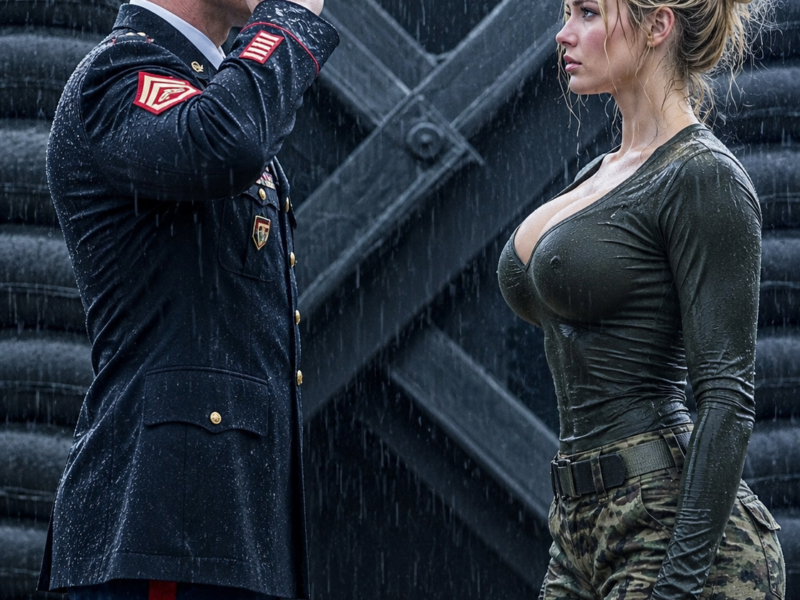
“The recruits laughed as they ordered me to stand alone in the freezing rain, convinced I was just another helpless woma
Thomas stared at the general as if he had just heard a sentence that could change the rest of his life.
General Hayes didn’t take his eyes off Sergeant Miller.
“I asked you a question, Sergeant. Why does this recruit have a medical wristband when your records say it was removed six days ago?”
Miller straightened his back.
“Probably an administrative oversight, sir.”
“An oversight?”
“Yes, sir. We process dozens of medical reports every week.”
The general glanced at the wristband.
“Then you won’t mind explaining why the hospital has no record of his discharge.”
Miller’s lips parted.
For the first time that morning, he had nothing ready to say.
I stepped closer to Thomas.
“Private Reed, when did you last receive medical attention?”
He looked at Miller before answering.
That small movement told me more than his words could have.
“Six days ago, ma’am.”
“What happened?”
Miller interrupted.
“He’s already been treated. This is a training matter, not a medical matter.”
General Hayes turned toward him.
“Nobody asked you, Sergeant.”
Miller fell silent.
Thomas swallowed.
“I injured my wrist during the obstacle course, ma’am. They sent me to the clinic, but I was told to return to training the next morning.”
“Who told you that?”
Thomas hesitated.
“Sergeant Miller.”
The general’s expression tightened.
“Continue.”
Thomas looked down at his boots.
“My wrist was swollen. I couldn’t grip the rope properly. I fell during the second obstacle, and Sergeant Miller said I was pretending because I didn’t want to finish.”
Miller shook his head.
“That’s not what happened.”
Thomas continued, his voice barely above the rain.
“He ordered me to repeat the obstacle. When I couldn’t climb, he made me hold my equipment overhead until the rest of the platoon finished.”
One of the officers accompanying the general took out a small notebook.
“How long?”
Thomas looked toward the ground.
“About forty minutes.”
Miller laughed nervously.
“Sir, that’s a gross exaggeration. We use standard corrective exercises. Nobody was forced to do anything unsafe.”
I looked at Thomas’s right hand.
His fingers were still trembling.
“Can you move your wrist?”
He tried.
A sharp expression crossed his face, and he stopped.
General Hayes turned to the officer beside him.
“Captain Lewis, get medical personnel here. Immediately.”
“Yes, sir.”
Miller stepped forward.
“General, I can assure you this is being blown out of proportion.”
Hayes raised one hand.
“Not another word.”
The captain hurried toward the administration building.
The recruits stood in formation, but nobody seemed interested in the formation anymore.
They were watching Miller.
And for the first time, he seemed to realize that his authority over them was no longer protecting him.
My name is Claire Bennett, and I had spent fourteen years in military service before moving into a civilian oversight position with the Department of Defense.
I had commanded personnel, investigated misconduct, and sat across from families who had received the worst phone call of their lives.
I knew what happened when people in positions of authority confused obedience with silence.
I also knew that one accusation wasn’t enough to destroy someone’s career.
Evidence mattered.
Records mattered.
And the people who had been afraid to speak needed to be heard without being pressured into changing their stories.
“General,” I said quietly, “I’d like to speak with the recruits individually.”
Hayes nodded.
“Of course.”
Miller immediately objected.
“Ma’am, these men are under my command. Any interviews should go through their chain of command.”
I turned toward him.
“That’s precisely why we’re conducting an independent inquiry.”
His eyes narrowed.
Hayes stepped between us.
“Sergeant Miller, effective immediately, you’re relieved of your training duties pending investigation.”
Miller stared at him.
“Sir?”
“You heard me.”
“With respect, General, I’ve served this installation for eleven years. My training record is exemplary.”
“Then the investigation should establish that.”
Miller looked around the yard.
The recruits were still watching.
His face flushed.
“These young men don’t understand what real military discipline requires.”
Thomas lowered his head.
I noticed.
So did the general.
“Sergeant,” Hayes said, “report to the administration building. Captain Lewis will arrange for your statement.”
Miller hesitated.
Then he turned sharply and walked away.
His boots splashed through the water.
Nobody spoke until he disappeared behind the building.
General Hayes looked at me.
“Claire, are you all right?”
I glanced down at my soaked jacket.
“I’ve been in worse weather.”
He almost smiled.
“That wasn’t what I meant.”
“I know.”
He looked toward the recruits.
“How much have you found?”
“Not enough.”
I opened my leather folder and removed the three anonymous reports.
“There are allegations of medical neglect, unauthorized punishment, falsified training records, and retaliation against anyone who files a complaint.”
Hayes read the first page.
His expression grew increasingly serious.
“Why didn’t you tell me you were coming?”
“Because I wanted to see what happened when nobody knew an inspection was underway.”
He looked back toward the building where Miller had gone.
“Well, you’ve seen it.”
“Yes. But I think there’s more.”
I glanced at Thomas.
He was still standing in formation, his injured wrist held close to his chest.
“Much more.”
Within twenty minutes, medical personnel arrived.
A young Army physician examined Thomas under the covered walkway.
After checking his wrist, she asked him to follow her to the clinic for imaging.
Thomas looked uncertain.
“Am I going to get in trouble?”
The physician paused.
“No, Private. You’re going to get treated.”
He nodded, but his eyes remained fixed on the ground.
I stepped closer.
“Thomas, nobody can punish you for telling the truth during this investigation.”
He looked at me.
“That’s what they said last time.”
The words landed harder than I expected.
“What happened last time?”
He glanced toward the administration building.
Then he looked at the other recruits.
“I wasn’t the first one.”
I waited.
He took a breath.
“There’s another soldier. Private Marcus Hill. He reported Sergeant Miller two months ago.”
“Where is he now?”
“He’s gone.”
“Transferred?”
Thomas shook his head.
“They said he was discharged for failing to meet training standards.”
“Do you know why he filed a complaint?”
Thomas hesitated.
Then he reached into the pocket of his uniform and pulled out a small folded piece of paper.
The paper was damp around the edges.
“I kept this because I thought nobody would believe me.”
I unfolded it carefully.
It was a photocopy of a handwritten medical appointment slip.
At the bottom was a date and a signature.
The appointment had been scheduled for the morning after the incident Thomas had just described.
But someone had crossed it out in red ink.
Beside the cancellation was a handwritten note:
“NOT AUTHORIZED. RETURN TO TRAINING.”
I recognized the signature.
It belonged to Miller.
“Where did you get this?”
“Marcus gave it to me before he left.”
“Why didn’t you report it?”
Thomas looked at me with exhausted eyes.
“Because Marcus reported it. And then he disappeared.”
I folded the paper and placed it inside my folder.
“Thank you for showing me this.”
Thomas shook his head.
“You don’t understand, ma’am.”
“Then help me understand.”
He looked toward the barracks.
“Marcus told me he had proof. He said if anything happened to him, I should find the blue locker.”
“What blue locker?”
“Storage room behind the old equipment shed. Locker seventeen.”
Before I could ask another question, a voice interrupted us.
“Private Reed.”
We turned.
It was Captain Lewis.
He had returned from the administration building, carrying a tablet.
“Ma’am, General Hayes would like you to see something.”
I glanced at Thomas.
“Go with the doctor. We’ll speak again.”
Thomas nodded and followed the medical personnel.
I walked with Captain Lewis toward the command building.
The general was waiting inside a conference room.
A large monitor displayed several personnel records.
“Claire,” he said, “we checked the preliminary information Thomas provided.”
He pointed at the screen.
“Private Marcus Hill was officially discharged seven weeks ago. The stated reason was repeated failure to meet physical training requirements.”
“Was there a medical review?”
“According to the file, yes.”
“By whom?”
“An officer named Lieutenant Colonel James Parker.”
I frowned.
“Where is Parker now?”
“Still assigned here. He’s currently the deputy training commander.”
I looked at the documents.
Something didn’t add up.
Marcus had supposedly been discharged for failing physical requirements, but the medical appointment slip suggested that he had been denied treatment before the discharge.
I examined the dates.
The discharge paperwork had been filed only two days after his last medical appointment was canceled.
“Who approved this?”
General Hayes enlarged the document.
At the bottom were two signatures.
The first belonged to Lieutenant Colonel Parker.
The second belonged to the installation’s administrative officer.
Neither signature belonged to Miller.
“Sergeant Miller couldn’t have done this alone,” I said.
Hayes nodded.
“That’s what I’m beginning to suspect.”
I leaned closer to the screen.
“Do we have the original records?”
“Some are electronic. Others are archived.”
“Then I want the archive secured before anyone has an opportunity to alter it.”
Hayes immediately turned to Captain Lewis.
“Contact the records office. Restrict access to all medical and disciplinary files from the past six months.”
Lewis nodded and left.
I looked at the general.
“There’s something else. Thomas mentioned a blue locker, number seventeen.”
Hayes frowned.
“At the equipment shed?”
“That’s what he said.”
“Then we’ll need to check it.”
We left the building with two security personnel.
The rain had finally weakened, leaving the training yard covered in shallow puddles.
As we approached the old equipment shed, I noticed that the recruits had returned to their barracks.
Only one person remained outside.
A young corporal stood near the door, pretending to organize a stack of training equipment.
When he saw us, he immediately straightened.
“General, sir.”
Hayes nodded.
“Carry on, Corporal.”
The corporal looked at me.
His eyes lingered for a second before he lowered his head.
I recognized the expression.
Another person who wanted to say something but didn’t know whether it was safe.
The storage room was at the rear of the shed.
It smelled of wet canvas, dust, and old metal.
A row of blue lockers stood against the far wall.
Numbers had been painted on their doors.
We found seventeen near the end.
It was locked.
“Do you have the key?” I asked the corporal.
He shook his head.
“Not officially, ma’am.”
“Who does?”
He hesitated.
“Sergeant Miller.”
General Hayes looked at the security personnel.
“Have the lock opened and document everything.”
One of them used an authorized tool to remove the padlock.
The door creaked.
Inside were a pair of worn running shoes, a folded training shirt, several envelopes, and a small black flash drive.
I picked up the envelopes first.
Each contained a handwritten statement.
Some described being denied medical appointments.
Others described punishment exercises that had never appeared in official training schedules.
There were seven names.
Seven separate accounts.
And several mentioned the same officer.
Lieutenant Colonel Parker.
I looked at the black flash drive.
“Can we examine this securely?”
Captain Lewis had arrived behind us.
“We have an isolated system in the command office.”
I placed the drive into an evidence bag.
Then I noticed something written inside the locker door.
A short sentence in black marker:
“IF THEY SAY I QUIT, THEY’RE LYING.”
I read it twice.
Marcus Hill hadn’t simply left behind evidence.
He had expected someone to look for him.
And he had expected the institution to deny that he had ever asked for help.
That evening, I sat in the conference room with General Hayes and two investigators.
The flash drive contained photographs, scanned documents, and several audio recordings.
The first recording was dated two months earlier.
A young man’s voice came through the speakers.
“This is Private Marcus Hill. I’m making this recording because my previous complaint was never entered into the official system.”
A second voice interrupted.
It was older.
Calm.
Almost bored.
“Private, you need to understand that paperwork doesn’t make you right.”
Marcus replied, “Sir, I have a medical restriction. I was told not to participate in physical training.”
“Your restriction has been reviewed.”
“The doctor said I needed another evaluation.”
“Then the doctor can explain that to me.”
There was a brief silence.
Then the older voice said something that made me sit forward.
“Your future in this Army depends on whether you learn to follow instructions.”
The recording ended.
Captain Lewis checked the file information.
“That voice belongs to Lieutenant Colonel Parker.”
General Hayes slowly removed his glasses.
“Good Lord.”
I looked at the remaining recordings.
“Play the next one.”
The second recording was shorter.
It contained a conversation between Miller and Parker.
Miller sounded nervous.
“Sir, Hill keeps asking about the medical paperwork.”
Parker replied, “Then make sure he has something else to worry about.”
“What if he files another complaint?”
“Nobody will believe a recruit with a failing training record.”
The recording stopped.
Nobody spoke for several seconds.
It was not proof of every allegation, but it was enough to justify a full investigation.
The next morning, General Hayes ordered Parker removed from his position pending an independent review.
Miller was placed under formal investigation.
The medical and personnel records were secured.
And for the first time in months, the recruits were invited to speak privately with investigators who did not report through their training chain of command.
But there was still one question I couldn’t answer.
Where was Marcus Hill?
The discharge record listed a forwarding address in Georgia.
We contacted the number attached to his file.
It had been disconnected.
His emergency contact was his older sister, Emily.
I called her that afternoon.
She answered on the fourth ring.
“Hello?”
“Ms. Hill, my name is Claire Bennett. I’m calling regarding your brother, Marcus.”
There was a long silence.
Then her voice changed.
“Is he in trouble?”
“No. I just want to speak with him.”
She let out a shaky breath.
“He’s not here.”
“Do you know where he is?”
“I think so.”
“Can you help us contact him?”
Another silence.
Then she said something I hadn’t expected.
“He’s been afraid to answer military phone calls.”
I closed my eyes briefly.
“Ms. Hill, I understand. But I need you to know that we’re investigating what happened at Fort Jackson.”
Her voice cracked.
“Are you really investigating, or are you just trying to make this go away?”
I didn’t answer immediately.
I thought of Thomas standing in the rain.
I thought of the seven statements in the locker.
And I thought of Marcus recording his own complaint because he no longer trusted anyone to preserve it.
“We’re going to follow the evidence,” I said. “And I won’t ask your brother to trust us before we earn it.”
She gave me an address.
Marcus was staying with her in a small town outside Augusta.
The following morning, General Hayes and I drove there.
The house was modest, with a narrow porch and a white wooden fence that needed repainting.
A young woman opened the door.
She looked tired.
Behind her, a man sat at the kitchen table.
He was thinner than in his military photograph.
His left leg was supported by a brace.
When he saw our uniforms, he stood abruptly.
“No.”
His sister touched his arm.
“Marcus, wait.”
“I told you I don’t want anything to do with them.”
General Hayes removed his cap.
“Private Hill, I’m General Robert Hayes.”
Marcus gave a bitter laugh.
“Congratulations, sir.”
Hayes didn’t react.
“We came because your records may have been falsified, and we want to hear what happened.”
Marcus looked at me.
“Are you another investigator who needs me to sign something?”
“No,” I said. “I’m Claire Bennett. I found your locker.”
His face changed.
For the first time, he looked uncertain rather than angry.
“You found it?”
“Yes.”
He looked toward his sister.
Then he slowly sat down.
“I thought they’d throw everything away.”
“We secured the contents.”
Marcus rubbed his hands together.
“Then you found the recordings.”
“We did.”
He stared at the table.
“I tried to report Parker. I went through the proper channels. I submitted medical documents. I asked for a review.”
“What happened?” I asked.
“They told me I was confused. Then they said I had a discipline problem. Miller started making my life miserable.”
He looked up.
“Do you know what it’s like to be injured and have someone tell you that pain is proof you’re weak?”
I didn’t interrupt.
“At first, I thought I just needed to work harder. I thought if I kept my head down, I’d graduate and go home.”
His sister sat beside him.
“But your leg got worse,” she said quietly.
Marcus nodded.
“During one training exercise, I fell. I couldn’t get back up. The doctor said I needed surgery and months of rehabilitation.”
I glanced at the medical documents.
The diagnosis was more serious than the original reports had suggested.
“Why didn’t you tell your family?” I asked.
Marcus looked toward the window.
“Because I was embarrassed. I had promised my mother I’d finish training. She passed away two years ago, and joining the Army was the last thing I ever promised her I’d do.”
His sister reached for his hand.
He didn’t pull away.
“I didn’t want everyone thinking I’d failed.”
The room was quiet.
General Hayes leaned forward.
“Marcus, you didn’t fail.”
Marcus looked at him.
“That’s easy to say now.”
“You’re right,” Hayes replied. “And I won’t pretend that an apology can undo what happened.”
It was the first time I’d heard a general speak without trying to defend the institution he represented.
Marcus’s eyes filled, but he quickly looked away.
“I don’t want anybody fired just because I complained.”
“That’s not your responsibility,” I told him. “Our responsibility is to establish what happened and ensure the people affected receive proper treatment.”
He nodded slowly.
Then he reached into a drawer and removed a folded sheet of paper.
“I kept this too.”
It was a letter from Parker.
The letter stated that Marcus had voluntarily requested separation from service and declined further medical assistance.
At the bottom was a signature.
Marcus looked at me.
“I never signed this.”
I examined the document.
The handwriting was not his.
“Do you have the original?”
“No. They gave me a copy after I asked why my discharge record said I refused treatment.”
I photographed the document and added it to the evidence record.
Then I asked one more question.
“Did Parker ever tell you why he wanted you discharged?”
Marcus looked toward his sister.
She nodded slightly.
He took a breath.
“Because I saw something.”
“What?”
He hesitated.
“An accident report.”
He explained that several weeks before his injury, a recruit had collapsed during an extended training exercise.
The soldier had been transported to the hospital.
But the official report classified the incident as a minor heat-related event.
Marcus had been assigned to help clean the training area afterward.
He had found a discarded copy of the original medical transport form.
It showed that the recruit had suffered a serious cardiac emergency.
The incident had never appeared in the training safety report.
“Why would they hide that?” I asked.
Marcus shook his head.
“I don’t know. But Parker told Miller that if the incident became public, the entire training program would be reviewed.”
General Hayes looked at me.
The case had just grown larger.
We returned to Fort Jackson with Marcus’s permission to include his statement in the investigation.
Over the next several days, the investigators uncovered more discrepancies.
Training logs had been altered.
Medical appointments had been canceled without proper authorization.
Several disciplinary reports had been entered after recruits submitted complaints.
And the incident Marcus described had been recorded under an incorrect classification.
The most troubling discovery came from the financial records.
A private training contractor had received additional payments for maintaining unusually high graduation rates.
Parker had been the officer responsible for certifying the program’s performance.
There was no evidence that the contractor had directly ordered anyone to mistreat recruits.
But the payment structure created pressure to avoid medical removals, failed training evaluations, and delays in graduation.
Miller had used that pressure as an excuse.
Parker had turned it into a system.
And young soldiers had paid the price.
The investigation took four months.
Miller was formally charged with multiple violations of military regulations, including maltreatment and disobedience of lawful medical restrictions.
Parker faced separate proceedings related to falsified records, obstruction, and abuse of authority.
The contractor’s agreement was suspended pending review.
Several officers who had ignored complaints were reassigned.
Not every allegation was substantiated, and not every person named in the reports was found responsible.
But enough evidence existed to establish a pattern that could no longer be dismissed as a few isolated incidents.
Thomas’s wrist required surgery.
When I visited him at the medical center, he was sitting beside a window with a paperback book resting on his lap.
His uniform had been replaced by a hospital shirt.
He looked healthier than he had that rainy morning.
“How’s the wrist?” I asked.
“Better, ma’am.”
“Are you getting the treatment you need?”
He smiled faintly.
“Yes.”
I pulled a chair beside his bed.
“Have you decided what you want to do?”
He looked down at his injured hand.
“I still want to serve.”
I nodded.
“But I don’t want to go back to that platoon.”
“You won’t have to.”
He looked relieved.
Then he asked, “Did you find Marcus?”
“Yes.”
His face brightened.
“Is he okay?”
“He’s recovering. And he knows you kept his evidence safe.”
Thomas smiled for the first time since I’d met him.
“I thought nobody would believe him.”
I looked at the young soldier.
“Sometimes the hardest part of telling the truth is believing that it deserves to be heard.”
He considered that.
Then he turned toward the window.
“Do you think I’ll ever be able to finish training?”
“That’s a decision you can make when you’re ready. You don’t owe anyone a graduation ceremony.”
He nodded.
A few weeks later, Thomas requested to continue his service after completing rehabilitation.
Marcus, meanwhile, chose not to return to active duty.
The Army reviewed his discharge and corrected the false entries in his record.
He received the medical benefits he had originally been denied and began physical therapy near his sister’s home.
He also agreed to speak with an independent review board about the conditions at Fort Jackson.
His testimony became one of the most important pieces of evidence in the case.
I received a letter from him several months later.
It was handwritten, folded neatly inside a plain envelope.
“Ms. Bennett,
I used to think that leaving the Army meant I had broken my promise to my mother.
Now I understand that I didn’t make that promise to be hurt or humiliated.
I made it because I wanted to serve something bigger than myself.
I still believe in that.
I just don’t believe I have to destroy myself to prove it.
Thank you for finding the locker.
Marcus.”
I read the letter twice.
Then I placed it inside my desk drawer.
The following spring, I returned to Fort Jackson for a formal review of the corrective measures.
The rain had stopped before I arrived.
The training yard looked different in the morning sunlight.
New medical reporting procedures were posted outside the barracks.
Recruits had access to an independent reporting office.
And every training instructor had been required to complete additional leadership and safety training.
General Hayes met me near the same administration building where Miller had first confronted me.
“Looks better,” he said.
“Better isn’t the same as fixed.”
He nodded.
“Fair enough.”
We walked toward the training field.
A new group of recruits was practicing an obstacle course.
One young soldier struggled to climb the rope.
His instructor approached, but instead of shouting, he offered a hand.
“Take your time. Check your grip first.”
The recruit nodded and tried again.
I watched until he reached the platform.
Then I noticed a familiar face near the edge of the field.
Thomas Reed.
His wrist was fully healed.
He wore his uniform again, and his posture was stronger than before.
He saw me and approached.
“Ma’am!”
I smiled.
“Private Reed.”
He shook my hand.
“I graduated last week.”
“Congratulations.”
“Thank you.”
He looked toward the training field.
“I almost didn’t come back.”
“I know.”
He hesitated.
“Can I ask you something?”
“Of course.”
“That day in the rain, why didn’t you just show Sergeant Miller your identification?”
I looked across the yard.
I remembered the cold water running down my sleeves, the laughter from beneath the shelter, and the way Thomas had looked at the ground when Miller spoke.
“Because I wanted to see how he treated someone he thought couldn’t challenge him.”
Thomas considered that.
“Did you already know who I was?”
“No. But I knew something was happening here that people were afraid to talk about.”
He nodded slowly.
Then he said, “I’m glad you stayed.”
I looked at him.
“So am I.”
General Hayes joined us a moment later.
He glanced at Thomas’s uniform.
“How’s the new assignment?”
“Good, sir.”
“Good. Keep looking after the people beside you.”
Thomas smiled.
“Yes, sir.”
As we stood there, a light rain began falling over the far end of the field.
The recruits continued training.
Nobody was ordered to stand alone in it.
I watched the drops gather on the leaves beside the walkway.
For months, I had thought the most important moment of that investigation was when General Hayes saluted me in front of Sergeant Miller.
It wasn’t.
The salute had stopped one man from humiliating me.
It had opened a door.
But the real victory came later, when a frightened young soldier finally believed he could speak without losing everything.
Rank can command attention.
Authority can demand obedience.
But neither one automatically earns respect.
That has to be built, one decision at a time, especially when the person standing in front of you has no power to make you behave better.
And as I watched Thomas return to his fellow soldiers, I realized that the strongest thing we had restored at Fort Jackson wasn’t a training program or a set of regulations.
It was the belief that a soldier could ask for help without being treated like a failure.
THe End.









