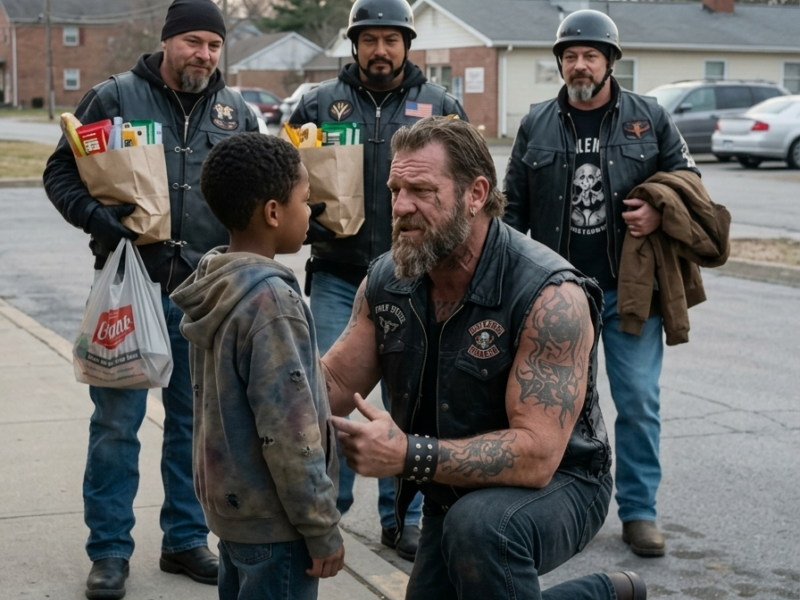
The poor Black boy spent his last $10 helping a bleeding Hells Angel outside a Texas gas station
The summer of my twelfth year was defined by the relentless, suffocating heat of East Texas and the sharp, hollow ache of an empty stomach. We lived in a small, weathered frame house on the outskirts of Tyler, a neighborhood where the pavement cracked under the sun and the streetlights flickered more often than they worked. In our house, poverty wasn’t just a lack of money; it was a quiet, heavy shadow that sat at the dinner table every night, turning every grocery bill into a crisis and every broken appliance into a disaster.
My mother, Clara, worked as a certified nursing assistant at a long-term care facility twenty miles away. Her days were spent lifting bedridden patients, changing soiled linens, and offering gentle smiles to elderly folks whose own families had forgotten them. She worked double shifts, fourteen hours at a time, coming home with swollen ankles, smelling of antiseptic and cheap lavender soap. Despite her exhaustion, she never complained. She would sit at our oilcloth-covered kitchen table, balance her checkbook with a stubby pencil, and whisper, “God provides, Marcus. We just have to keep our hearts clean.”
That Friday in late July, I had accumulated ten dollars. It was a fortune to me. I had earned it five cents at a time over three weeks, collecting discarded aluminum cans from the ditches along Highway 69 and dragging them to the scrap yard in a canvas sack. My mother had promised that when she got off her shift on Friday afternoon, we would take my ten dollars, combine it with the last twenty from her paycheck, and walk down to the Piggly Wiggly to buy real groceries—ground beef, a block of cheddar, canned beans, and maybe even a box of sweet cereal.
I walked down to the Texaco station on the corner of Martin Luther King Boulevard around three o’clock, waiting for my mother’s battered Buick to pull up. The air was thick with the smell of asphalt and exhaust. That was when I saw him.
He was slouched on the concrete apron behind the air compressor, wedged between a rusted oil display and a soda vending machine. Even doubled over, he was terrifyingly huge. He wore a heavy leather vest—a “cut”—crawling with embroidered patches, including the iconic winged skull logo of the Hells Angels. His arms were covered in faded blue tattoos, his graying beard was matted with sweat, and his face was slick with a ghastly, gray pale. Blood, thick and dark, trickled from a jagged gash above his left eyebrow, pooling in the collar of his torn black shirt. One of his massive, calloused hands was pressed tight against his ribs, his breath coming in ragged, whistling gasps.
Cars pulled up to the pumps, fueled, and drove away. People looked at him through their tinted glass—some with disgust, some with fear, most with cold indifference. A man in a clean white button-down shirt stopped to pay for his gas, glanced at the bleeding biker, shook his head in disdain, and muttered, “Drunk trash,” before driving off in his shiny pickup.
I stood by the ice icebox, my ten-dollar bill crumpled tight in my sweaty palm. I was terrified. Everything I had ever heard about outlaw motorcycle clubs told me to run the other way. They were violent, dangerous, men outside the law. But as I watched him, I saw his heavy shoulders shudder. His eyes—pale blue and rimmed with pain—flickered toward me for a second before his eyelids drooped, heavy with agony.
My mom says you don’t leave people alone when they’re hurting. Her voice echoed in my head, clear and unyielding.
I took a deep breath, swallowed the lump in my throat, and walked over.
“Sir?” My voice was thin, barely audible over the hum of the gas station’s air conditioning unit. “Sir, are you okay?”
The giant shifted. He tried to push himself upright against the metal casing of the air compressor, but his boots slipped on an oil stain, and he collapsed back onto the concrete with a strained, choked groan. “Just… need a minute, kid,” he rasped. His voice sounded like dry gravel dragged across iron, but I noticed his huge, tattooed hands were trembling violently.
“Hold on,” I said.
I ran inside the air-conditioned store. The clerk behind the counter, a middle-aged man named Sal who spent his days staring at a small television, barely looked up. “Sal, there’s a man bleeding outside by the air pump! You need to call 911!”
Sal sneered, looking out the window. “That’s a biker, kid. Probably got in a bar fight over at the county line. I ain’t calling nobody to bring trouble to my store.”
“He’s hurting!” I yelled, my voice cracking.
“Not my problem, Marcus. Buy something or get out.”
I looked down at the crumpled ten-dollar bill in my hand. It was my mother’s dinner. It was our weekend groceries. It was the milk and ground beef we hadn’t had in two weeks. I looked back through the glass door at the big man slouched against the pump, his head resting against the dirty metal, completely alone.
“I need a gallon of bottled water,” I said, slapping the bill onto the counter. “And that roll of paper towels. And… and that turkey sandwich from the cooler.”
Sal shrugged, rang up the items, and tossed three quarters back across the counter. “Your money, kid. Don’t come crying to me if he bites your head off.”
I carried the plastic bag outside. Kneeling in the dirt next to the giant, I opened the water bottle, wet a handful of paper towels, and held them out. “Here. Press this against your head.”
He opened one eye, staring at me in sheer bewilderment. Slowly, awkwardly, he took the wet towels and held them to his bleeding forehead. “What are you doing, boy?”
“Helping,” I said simply. I opened the bottle of water and handed it to him, then unwrapped the turkey sandwich and set it on his lap. “You look like you’re gonna pass out. Eat.”
He looked down at the plastic-wrapped sandwich, then back at me. His heavy brow furrowed. “I ain’t hungry, kid.”
“You’re lying,” I said, sitting down on the curb next to him. “My mom says when people get gray like that, their sugar’s low or they’re in shock. Eat it.”
The big man let out a sound that was half-laugh, half-cough, wincing as it pulled at his broken ribs. He took a slow sip of the water, then picked up the sandwich with fingers that looked like steel thickets. He ate slowly, deliberately, as if processing the simple reality of what was happening.
When he finished the last bite, he set the plastic wrapper aside and wiped his face with the towel. The bleeding had slowed to a dark smear. He looked down at me, his pale blue eyes searching my face, taking in my faded hand-me-down shirt, my worn-out shoes with the split soles, and the three quarters sitting in my palm.
“That was your money, wasn’t it?” he asked softly.
I shrugged, looking down at my shoes, suddenly embarrassed. “It’s fine.”
“Don’t lie to me, son. What were you gonna buy with ten bucks?”
“Groceries,” I admitted, my voice dropping. “My mom and me. But… my mom says you don’t leave people alone when they’re hurting. It doesn’t matter if you know ’em or not.”
For a long moment, the hum of the gas station pumps and the distant sound of highway traffic were the only noises between us. The giant sat motionless. Then, to my absolute astonishment, I saw tears welling in the corners of his weathered eyes, cutting clean tracks through the dust and blood on his cheeks.
He reached out a massive, scarred hand and gripped mine. His skin was rough as sandpaper, but his hold was remarkably soft. “What’s your name, son?”
“Marcus. Marcus Vance.”
He repeated the name under his breath, his eyes widening slightly before a look of profound, solemn recognition settled over his face. “Marcus,” he whispered, his voice trembling. “I’m Ray. And I swear to you on my life… I won’t forget this.”
Just then, the wail of an ambulance siren echoed in the distance—Sal must have called despite his grumbling, or someone at the stoplight had flagged them down. Two paramedics pulled into the lot a minute later, rolling a stretcher toward us.
Ray refused to lie on the gurney. He pushed himself up with a grunt of agonizing effort, keeping one hand clamped over his ribs and the other resting briefly on my shoulder. As the paramedics guided him into the back of the rig, he looked back at me over his shoulder.
“Go home to your mama, Marcus,” Ray called out. “Tell her she raised a man.”
I watched the red lights of the ambulance fade down the boulevard. Then I turned and walked the mile and a half back to our little frame house, my hands buried deep in my empty pockets.
When my mother arrived home an hour later, her eyes were dark with exhaustion, but her face lit up when she saw me sitting on the front steps. “Ready to go to the store, baby?” she asked, reaching into her purse for her thin vinyl wallet.
I stood up, swallowed hard, and told her everything. I told her about the big man, the blood, the cold looks from the people in their air-conditioned cars, and how I spent my ten dollars on water and a sandwich.
She stood on the porch, listening silently. I waited for the disappointment, for the scolding about how we wouldn’t have meat for the week, or how I shouldn’t have approached a dangerous stranger. But as I finished speaking, her lips trembled. She stepped forward, pulled me into her arms, and held me so tightly I could feel the rapid, frantic beat of her heart against my cheek.
“Oh, Marcus,” she sobbed softly into my hair. “My sweet, brave boy. You did right. You did exactly right.”
That night, we sat together at the small kitchen table. There was no beef, no cheese, no sweet cereal. We shared a sleeve of saltine crackers and two glasses of ice water. But as I looked at my mother’s face under the dim yellow light of the kitchen bulb, I didn’t feel poor. I felt like I had done the only thing that made sense in a world that was far too cold.
Three days passed in our usual rhythm of quiet survival. Saturday brought a stifling humidity that turned the house into an oven, and Sunday was spent in the cool wooden pews of Greater St. John Baptist Church, where my mother prayed with her eyes closed so tight that small lines formed around her temples. By Monday morning, our cupboard was down to three cans of green beans and a half-filled box of quick oats.
Tuesday morning broke gray and heavy with unreleased rain. I was sitting on the front porch steps around six-thirty, tying the frayed laces of my sneakers, getting ready to walk down to the community center where they served free summer breakfasts for neighborhood kids. My mother was inside, frying our last two eggs in a iron skillet.
Suddenly, the floorboards beneath my feet began to vibrate.
At first, it was a low, imperceptible hum, like the deep bass of a thunderous storm rolling in from the West Texas plains. But within ten seconds, the hum deepened into a guttural, earth-shaking roar that rattled the chain-link fence bordering our yard. The windowpanes in our small house buzzed violently in their wooden frames.
I stood up, my heart hammering against my ribs. Up and down our quiet street, neighbors stepped out onto their porches. Old Mr. Henderson from across the road shielded his eyes, looking toward the main intersection.
Then they turned the corner.
A wall of chrome, black steel, and roaring iron flooded into our narrow residential street. Motorcycles—dozens of them, riding two abreast in flawless, disciplined tactical formation. The thunder of their v-twin engines echoed off the small houses, drowning out the sounds of the morning, vibrating straight through the dirt and into the soles of my shoes.
They kept coming. Five bikes, ten, twenty, fifty. They turned off MLK Boulevard and stretched all the way down our block until the entire street was choked with gleaming metal, leather, and dark exhaust plumes. I lost count after eighty, but there had to be nearly a hundred of them.
Every rider wore the heavy leather cut of the Hells Angels. They were men built like brick walls, with long beards, braided hair, scarred arms, and heavy boots. To a twelve-year-old Black boy in East Texas, it looked like an invading army had descended directly onto our lawn.
My mother burst through the screen door, her iron skillet still in her hand, her eyes wide with unadulterated terror. She grabbed my collar and yanked me violently behind her, holding her body as a shield between me and the roaring wall of iron.
“Marcus, get inside!” she hissed, her voice trembling. “Get inside the house right now!”
“Mom, wait,” I whispered, staring through the gap between her waist and arm.
The lead motorcycle—a massive, matte-black Harley-Davidson with high handlebars—pulled up right to the edge of our patchy grass lawn. The engine gave one final, deafening rev before the rider turned off the ignition. A sudden, heavy silence fell over the neighborhood, broken only by the ticking of hot exhaust pipes cooling in the humid morning air.
The lead rider swung his heavy leg over the seat and stepped down. He wore a clean white bandage taped neatly over his left eyebrow. His leather vest was brushed clean, and beneath his thick gray beard was a wide, warm smile.
He pulled off his heavy leather riding gloves, tucked them into his belt, and took three slow steps toward our porch.
“Marcus?” a familiar gravelly voice called out.
My heart soared. “Ray!” I yelled, slipping out from behind my mother’s grip despite her frightened gasp. I stepped to the edge of the porch steps. “Are you okay? Did your ribs heal?”
Ray laughed softly, a deep, booming sound that seemed to ease the tension hanging over the street. “Because of you, kid, I’m doing just fine. Paramedics said if I hadn’t gotten that water and sugar in me when I did, my blood pressure would’ve dropped through the floor right there on the concrete.”
He stopped at the foot of our steps and looked at my mother, taking off his black leather cap out of respect. “Ma’am. I’m sorry to cause a scene on your street. My name is Ray. I’m the vice president of the Lone Star chapter.”
My mother stood frozen, her hands still clutching the skillet, her eyes darting from Ray’s scarred face to the ninety-plus men standing silently behind him on her street. “What… what is all this?” she managed to ask, her voice tight with caution.
Ray turned back toward his brothers, gesturing with a broad, sweep of his tattooed arm. “Three days ago, I was broke down, bleeding, and passing out beside a pump at the Texaco down the road. Dozens of folks drove past me. Men in expensive suits, men I’ve known for years—they all looked straight through me like I was garbage on the curb.”
He looked back up at me, his blue eyes fierce and shining with emotion. “And then this boy came along. He didn’t know me. He was scared half to death of me. But he spent his last ten dollars—the money he and his mama needed for food—to buy me water, a towel, and a sandwich. Because his mama taught him that you don’t leave people alone when they’re hurting.”
A low murmur of agreement passed through the crowd of bikers lining our street. Heavy leather-clad shoulders nodded in unison.
“And today,” Ray said, his voice carrying clearly down the entire block, “we’re here because nobody who raises a boy like that should ever have to go hungry. Today, we make sure this house knows it ain’t alone.”
Ray raised his hand and snapped his fingers.
Instantly, the men behind him sprang into motion. The saddlebags of nearly a hundred motorcycles were popped open. The side-cases of three support vans that had pulled up at the rear of the procession were thrown wide.
What followed was a disciplined, frantic brigade of generosity.
Big, bearded men began marching up our walkway in a steady line, their arms loaded with wooden crates and heavy cardboard boxes. They didn’t just bring groceries; they brought a feast.
Boxes of fresh fruit—apples, oranges, peaches, grapes. Crates of fresh vegetables, sacks of potatoes, forty-pound bags of rice and flour. Coolers packed with ice and premium cuts of meat—flank steaks, whole chickens, pork chops, ground beef, and thick slabs of bacon. They brought boxes of cereal, gallons of milk, dozen-packs of eggs, butter, cheese, canned goods, and dry pasta stacked so high it looked like a supermarket shipment had been rerouted to our living room.
My mother dropped her skillet onto the porch floorboards with a dull clack. She covered her mouth with both hands, her chest heaving as silent tears began to spill over her dark eyelashes.
Four bikers walked up carrying heavy winter coats in my size and hers, brand-new insulated boots, and three backpacks stuffed to bursting with notebooks, pens, colored pencils, and school supplies. Another two men carried in four large cases of laundry detergent, paper towels, toilet paper, and soaps.
“Where… where do you want these, ma’am?” a massive biker with a braided beard named “Bear” asked politely, holding two heavy boxes of canned peaches as if they were made of delicate glass.
“In… in the kitchen,” my mother choked out, pointing blindly into the house. “On… on the table. Oh, Lord… on the table…”
She sank down onto the wooden porch chair, burying her face in her apron, sobbing hysterically. It wasn’t the quiet, suppressed crying she did at night when she thought I was asleep; it was a deep, cathartic release of years of fear, exhaustion, and hopeless struggle.
I stood on the porch, my eyes wide, watching these giant, intimidating men step carefully around our small house, placing food on our counters, stacking cans in our empty cupboards, filling our small refrigerator until it couldn’t hold another item, and placing boxes along the walls of our hallway.
Neighbors stood on their lawns in absolute awe. Old Mr. Henderson was wiping his eyes with a handkerchief.
Ray stepped up onto the porch and stood beside my mother. He didn’t touch her, respecting her space, but he waited patiently until her weeping slowed to soft sniffling.
“Mrs. Vance,” Ray said softly, pulling a thick white envelope from his inner vest pocket. “Food lasts a few months. But you raised a king, and a king’s mother shouldn’t have to break her back working double shifts for pennies.”
He handed her the envelope.
With trembling fingers, my mother opened it. Inside was a formal letter printed on heavy stock paper from Miller’s Automotive & Industrial Services—one of the largest diesel repair facilities in East Texas.
“The owner, Dan Miller, rides with us,” Ray explained quietly. “He heard about Marcus. He knows you’re a certified nursing assistant, but he also knows you used to handle inventory and logistics at the medical supply depot before it closed down five years ago. He’s offering you a full-time position as his fleet inventory manager. Starting Monday.”
My mother blinked at the paper through her tears. “I… I don’t…”
“It pays twenty-two dollars an hour,” Ray said flatly. “Full medical, dental, and vision for you and Marcus. Monday through Friday, eight to four. No more double shifts at the nursing home, ma’am. You get to be home to make your boy dinner.”
My mother let out a strangled cry and threw her arms around Ray’s neck. The giant biker stood stiffly for a second, startled, before wrapping his massive, tattooed arms around her, holding her gently as she wept against his leather vest.
For the first time in my life, I saw my mother cry without fear in her eyes. I saw the crushing weight of six years of solitary desperation lift off her thin shoulders in a single, beautiful morning.
When my mother finally stepped inside the house with two of the bikers to figure out where to store the remaining crates of food, Ray turned toward me. The warm, triumphant smile on his face slowly subsided, replaced by a deep, quiet gravity that made my chest tighten.
He knelt down on the wooden porch floor, bringing his pale blue eyes level with mine.
From his pocket, he pulled a small, square box covered in dark navy velvet. He held it out on his open palm. “There’s one more thing, Marcus. This isn’t from the club. This is from me.”
I reached out with trembling fingers and flipped the brass latch of the velvet box.
Resting inside on a bed of white satin was a heavy, circular medal crafted from polished sterling silver. Suspended from a dark blue ribbon, the silver caught the morning sunlight, gleaming brightly. In the center was an intricate carving of a shield crossed by a wrench and a winged wheel.
I turned the heavy silver coin over in my hand. Engraved on the back in bold, clear block letters were five words:
YOU REMINDED US WHO WE ARE.
“Where I come from,” Ray said, his voice dropping into a raspy whisper that carried only to my ears, “we get used to the world being ugly. We see the worst of people, and after a while, we start acting like the worst of people. We forget that there’s good out there that ain’t looking for a payoff.”
He touched the edge of the medal with his thumb. “You gave up your dinner for a bloody old man on the pavement because your heart was clean. You gave us back something we lost a long time ago, Marcus.”
I clutched the silver medal tightly in my fist, feeling its smooth, cool weight against my skin. I looked out at the street filled with nearly a hundred outlaw bikers—men with tattoos on their necks, scars across their faces, men the world deemed irredeemable—and realized that beneath the leather and the loud engines were human beings capable of a grace deeper than anything I had ever witnessed.
“Thank you, Ray,” I whispered, my eyes stinging with fresh tears.
Ray patted my shoulder, his large hand warm and reassuring. Then he looked over his shoulder toward the open front door of our house, where my mother’s laughter could be heard coming from the kitchen as she talked with Bear about a recipe for peach cobbler.
Ray leaned in closer to me, his expression shifting from soft gratitude to something razor-sharp and intensely secretive.
“Marcus,” he whispered, his voice dropping so low it was swallowed by the rustle of the oak trees in our yard. “There’s something else. Something your father asked me to tell you if I ever found you.”
My heart stopped beating in my chest.
The air in my lungs froze. The silver medal felt like a hot coal in my palm.
My father.
His name was Thomas Vance. In my mind, he was little more than a ghost—a collection of three faded photographs in my mother’s nightstand drawer and a lingering memory of a deep laugh that used to rumble against my cheek when I was six years old.
Six years ago, he had walked out the door one rainy Tuesday night and never come back. The police had found his abandoned sedan parked near the Sabine River bridge three days later, its driver-side door standing open, his wallet and keys left sitting on the dashboard. There were no signs of struggle, no body ever recovered from the muddy water.
The town whispered that Thomas Vance had cracked under the pressure of poor wages and a sick child, that he had abandoned his family and run off to start a new life somewhere in Mexico or California. My mother had never spoken ill of him, but whenever his name was mentioned, her face would turn into a mask of silent, devastating grief. She had spent six years carrying the quiet shame of a woman whose husband had deemed her and her son not worth staying for.
“My… my dad?” I stammered, my voice barely a squeak. “He… he abandoned us, Ray. He ran away.”
Ray’s jaw hardened, his pale blue eyes flashing with a sudden, fierce anger—not at me, but at the memory of a lie.
He glanced toward the doorway, where my mother had just walked into the living room, holding a box of cereal. Her eyes caught Ray looking at her, and instantly, the color drained entirely from her face. The box of cereal slipped from her hands, spilling colorful loops across the hardwood floor. She stood frozen in the hallway, staring at Ray with an expression of pure, unadulterated shock.
Ray didn’t break eye contact with her as he leaned down to my ear.
“Your dad didn’t abandon you, son,” Ray whispered, every word carved out of cold, hard truth. “Thomas Vance was the bravest man I ever met. He saved my life in a burning warehouse off Route 80 six years ago, and he died doing it. And it’s time you and your mama knew what really happened that night.”
My mother walked out onto the porch, her steps slow, measured, and trembling. The joy that had filled her face five minutes ago had been completely wiped clean, replaced by an ancient, buried terror that made her look ten years older.
“Ray,” she whispered, her voice barely carrying over the breeze. “Please. Not here. Not in front of the boy.”
Ray stood up slowly, his tall frame blocking the sunlight. “He’s twelve, Clara. He’s been carrying the weight of a ghost for six years thinking his daddy didn’t love him. He deserves the truth. And so do you.”
My mother covered her face with her hands, letting out a small, ragged gasp. She sat down heavily on the top porch step, her body shivering despite the thick Texas heat.
Ray looked out at his men standing in the street. He raised a hand and gave a small gesture. Instantly, Bear and the other senior riders signaled the rest of the club. The bikers mounted their machines, brought their engines to a quiet idle, and began slowly rolling down the street in an orderly line, clearing the road, leaving only Ray’s matte-black Harley parked at the curb.
Ray sat down on the porch steps beside my mother and me. The silence that settled over our small lawn was heavy, pregnant with six years of buried history.
“Six years ago,” Ray began, his gravelly voice dropping into a low, measured rhythm, “our chapter was locked in a brutal land war with a syndicate out of Houston—men who dealt in heavy drugs and human trafficking. We were trying to keep ’em out of Tyler. We were sloppy, young, and angry.”
He pulled a dark leather pouch from his pocket, rolled a pinch of tobacco into a paper, and lit it with a battered Zippo lighter, exhaling a thin stream of gray smoke into the humid air.
“Thomas wasn’t a club member,” Ray continued, looking at me. “Your dad was a night mechanic for the city transit authority. He worked the graveyard shift at the maintenance yards near the river. A quiet man. Loved his tools, loved his church, and worshipped the ground you and your mama walked on.”
I gripped my silver medal tightly, my chest aching.
“That night in October,” Ray said, “I was ambushed outside an old textile warehouse near the river by four men from the Houston syndicate. They shot me twice—once in the leg, once in the ribs. They dragged me inside the warehouse, tied me to a steel pillar, and set the building on fire with three gallons of diesel. They wanted to send a message to my club.”
My mother closed her eyes, tears leaking silently down her cheeks.
“I was trapped in there,” Ray whispered, his eyes staring blankly at the patchy grass of our yard as if seeing the flames again. “The smoke was so thick I couldn’t breathe. The wooden rafters were collapsing all around me. I was twenty seconds away from burning to death. And then… the side emergency door got kicked off its hinges.”
Ray looked at me, his eyes burning with intense reverence. “It was your daddy. He had been working on a city bus down the street, saw the smoke, heard the gunshots, and ran straight into a burning building carrying an iron pry-bar.”
My breath caught in my throat.
“Thomas didn’t know me,” Ray said softly. “He didn’t know I was an outlaw biker. He just saw a man tied to a post in a burning room. He used that pry-bar to snap the chains holding me to the pillar. He dragged my two-hundred-and-fifty-pound bleeding tail through two hundred feet of roaring fire and collapsing beams, throwing me out the loading dock door into the mud.”
“If he got you out…” I choked out, my voice breaking, “why… why didn’t he come home?”
Ray let out a long, ragged exhale of smoke. “Because when Thomas turned back to get his tool bag off the dock, the main roof support gave way. Three tons of burning pine and slate collapsed right over the loading bay door.”
A sharp, painful sob burst from my mother’s throat. She buried her face in her knees, her body rocking back and forth on the wooden step.
“I tried to dig him out with my bare hands,” Ray said, his voice cracking for the first time. “I burned my hands down to the bone trying to pull those beams off him. But the whole building went up like a torch. By the time my club brothers found me half-dead in the mud, there was nothing left of that warehouse but white ash and twisted steel.”
“Why didn’t you tell the police?” I demanded, standing up, my small hands clenched into fists, tears streaming freely down my face. “Why did you let everyone say he abandoned us? Why did you let the town call him a coward?”
Ray looked up at me, his face filled with an agonizing, profound remorse.
“Because the men who set that fire were still out there, Marcus,” Ray said quietly. “The Houston syndicate had eyes inside the county sheriff’s department back then. If they found out a city mechanic had interfered with their hit, or if they knew Thomas had a wife and a six-year-old boy living in a frame house on MLK Boulevard… they would have come here to finish the job. They would have burned this house down with you and your mama inside it.”
My mother looked up, her face pale, her eyes wide with the realization of six years of hidden danger.
“I took Thomas’s car,” Ray whispered, looking at my mother. “I drove it down to the river bridge, left the door open and his keys on the dash to make it look like he’d fled the state or jumped. I did it to protect you, Clara. To make sure nobody ever looked for Thomas Vance’s family. We spent the next eighteen months hunting down every single man involved in that fire until the syndicate was wiped out of East Texas for good.”
Ray reached into his leather vest and pulled out a worn, heat-singed silver pocket watch. The glass face was cracked, and the metal casing was blackened by fire, but engraved on the front were the faint initials: T.V.
He held it out to me on his palm.
“Your daddy didn’t run, Marcus,” Ray said, his voice breaking completely as tears rolled into his gray beard. “He was a hero. He died saving my life so I could go home to my family. And I spent six years looking for you two, searching every state registry, but your mama had moved three times and changed her maiden name on the utility bills to stay hidden.”
Ray set the singed pocket watch gently into my hand, resting it right beside the silver medal.
“Until three days ago,” Ray whispered, smiling through his tears, “when a brave twelve-year-old boy spent his last ten dollars to buy a water and a sandwich for a bloody old stranger at a Texaco station. And told me his name was Marcus Vance.”
The Texas sun climbed high into the sky, burning away the morning haze and bathing our small house in a warm, golden light.
For a long time, nobody spoke. The only sound on the porch was the quiet rustle of the wind through the oak trees and the steady, rhythmic ticking of the ancient pocket watch I held cupped in my hands. I pressed the small button at the top of the watch. The cracked silver latch popped open, revealing the small photograph tucked inside the lid.
It was a picture of my mother, young and laughing, holding a tiny six-month-old baby in a yellow blanket. Me.
My mother pulled me close to her side, wrapping her arm around my shoulders. We sat together on the top step, staring down at the cracked face of my father’s watch, feeling the heavy, cold shame that had hung over our lives for six years melt away into the hot Texas air. My father hadn’t abandoned us. He hadn’t been weak, or cowardly, or selfish. He had been a man of terrifying, selfless courage—a man who ran into burning buildings to save strangers, a man whose blood ran thick and true in my own veins.
Ray stood up from the steps, brushing the dust from his heavy leather jeans. He looked at my mother with a quiet, profound respect.
“Mrs. Vance,” Ray said softly. “The job at Miller’s Automotive is real. Dan Miller is expecting you on Monday at eight in the morning. Your back rent is paid for the next year through our club’s charity foundation. Nobody in this town will ever bother you or Marcus again. You have my word on the honor of my colors.”
My mother stood up, wiped her eyes with the hem of her apron, and stepped toward the giant biker. She didn’t weep this time. She stood tall, her posture straight, her chin raised high, looking him dead in the eye.
“Thank you, Ray,” she said, her voice clear, strong, and steady for the first time in six years. “Thank you for bringing my husband back to me.”
Ray nodded once, a deep, respectful gesture. Then he turned to me.
He reached down, picked up his heavy leather riding gloves, and pulled them over his massive hands. “You keep that watch ticking, Marcus. And you wear that medal when you feel like the world’s getting too dark to see straight.”
“I will, Ray,” I said, holding the silver medal tight in my fist. “Are you coming back?”
Ray smiled beneath his gray beard, his pale blue eyes twinkling in the sunlight. He walked down the steps, swung his heavy leg over his matte-black Harley-Davidson, and thumbed the starter button. The powerful v-twin engine roared to life with a deep, thunderous pulse that vibrated through the earth beneath my feet.
He looked over his shoulder at me, lowering his black visor. “Kid, you’ve got ninety-four uncles riding with the Lone Star chapter now. You couldn’t get rid of us if you tried.”
With a roar of iron and exhaust, Ray pulled out onto the street, acceleration sending his machine gliding smoothly down MLK Boulevard until he vanished around the corner, leaving behind only the fading thunder of his engine in the summer air.
My mother and I stood on the porch for a long time, listening to the silence return to our neighborhood.
We walked inside our house together. The small, dark living room that had felt so cold and empty for six years was now transformed. Boxes of fresh food, bright red apples, sacks of flour, and winter coats lined the hallway. The kitchen counters were stacked high with canned goods, and the refrigerator hummed happily, packed to capacity with fresh meat and milk.
I walked over to the kitchen table, set my silver medal down in the center of the clean oilcloth cover, and placed my father’s singed pocket watch right beside it.
My mother sat down in her chair, pulled out a notepad, and began writing down her schedule for Monday morning at her new job. There was no fatigue in her posture, no shadow of fear behind her dark eyes. She looked like a woman who had finally stepped out of a long, freezing night into the morning sun.
I walked back out onto the front porch, sitting down on the top step where I had sat three days ago with ten empty dollars in my pocket.
I looked down the quiet asphalt street toward the Texaco station a mile away. I thought about the man in the clean white shirt who had driven past a bleeding stranger, and I thought about Ray, Bear, and the hundred roaring motorcycles that had filled our world with grace.
I reached into my pocket, touched the three quarters Sal had given me in change three days ago, and smiled.
I was twelve years old, living in a small frame house on the edge of Tyler, Texas. We were no longer poor. We were no longer forgotten. And as I looked up at the vast, endless blue sky above us, I knew that wherever my father was resting, he was watching his son—a boy who knew that no matter how dark the world became, you never, ever leave people alone when they’re hurting.
The end.









