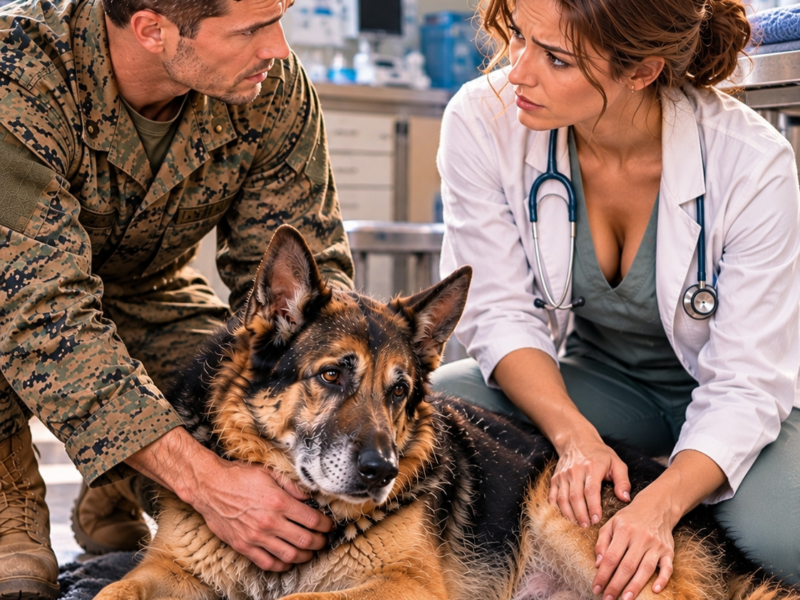
“The old Marine K9 refused to take another step, and his handler thought he was watching his best friend give up on life
Daniel nearly dropped the phone.
For one terrible second, he simply stared at the screen as if the words coming through it had knocked every thought out of his head.
Then he pressed the phone hard against his ear.
“What do you mean, missing?”
I watched his face change while Mia’s mother spoke.
His shoulders stiffened.
His jaw tightened.
The color drained from his cheeks until he looked like a man standing in the snow without a coat.
“No,” he said. “No, when did you last see her?”
A pause.
“Did you call the police?”
Another pause.
“Sarah, listen to me. I’m coming.”
He ended the call and stood frozen in the middle of the examination room.
Sergeant Major was beside his boots, the blue training glove still lying between his paws.
Only a few minutes earlier, the old German Shepherd had taken his first determined steps in days.
Daniel had laughed through tears.
He had looked at me as though the world had finally offered him something worth believing in again.
Now that hope was disappearing from his face.
“Daniel,” I said carefully. “Tell me what happened.”
He swallowed.
“Mia was supposed to be at school. Her mother dropped her off this morning, but the school called an hour later. She never made it to class.”
“Could she have gone somewhere with a friend?”
“That’s what Sarah thought at first. She called her friends. Nobody’s seen her.”
He dragged one hand through his hair.
“She’s twelve, Emily. She knows better than to leave without telling somebody.”
His voice cracked on the last word.
I glanced at Sergeant Major.
The dog had lifted his head.
Although his hips trembled when he shifted his weight, his eyes were fixed on Daniel with the familiar intensity of a working animal waiting for an order.
“Where was she last seen?” I asked.
“Outside the school. Her mother said she got out of the car, waved, and walked toward the main entrance.”
“Did anyone see her leave?”
“Not yet.”
Daniel reached for his jacket with shaking hands.
Sergeant Major struggled to stand.
His hind legs wobbled, and he sank back onto the rubber mat with a low, frustrated whine.
Daniel stopped.
For a moment, I saw the impossible choice in his face.
His daughter was missing.
His oldest friend could barely stand.
And Daniel looked as though he blamed himself for both.
“Stay here, buddy,” he whispered.
Sergeant Major stared at him.
Daniel bent down and pressed his forehead against the dog’s.
“I need you to stay.”
The dog licked his cheek.
Daniel closed his eyes.
“I’ll come back. I promise.”
The words hung between them.
I remembered the photograph Daniel had shown me, the little girl in the yellow dress sitting beside a much younger Sergeant Major.
I remembered what he had told me about the promises he had made after the explosion, and all the years he had spent believing he had already failed his family.
This time, he was terrified of making another promise he couldn’t keep.
I grabbed my coat.
“I’m coming with you.”
He looked at me sharply.
“You’re a veterinarian.”
“And you’re about to drive into a panic without thinking straight. You can use someone who knows how to ask questions.”
He opened his mouth to argue.
I pointed toward the dog.
“Besides, Sergeant Major is staying here. I’ll ask my technician to watch him, make sure he has his medication, and call me if anything changes. We’re not abandoning him.”
Daniel looked down at the dog.
Then he nodded.
“Thank you.”
We were out the door in less than a minute.
The drive to Mia’s school took twelve minutes.
Daniel made it in nine.
He kept both hands on the steering wheel, gripping it so tightly that his knuckles turned white.
I called the clinic on speaker and explained what was happening.
My technician, Rosa, promised she would stay with Sergeant Major and contact the emergency veterinary hospital if his pain suddenly worsened.
Then I called the county sheriff’s office to make sure someone was responding to the missing-child report.
They were.
A deputy had already arrived at the school.
“Daniel,” I said, putting my phone away, “the best thing we can do is give them accurate information. When we get there, tell them everything you know about Mia. Don’t assume something is unimportant.”
He nodded without looking at me.
“I should’ve been there.”
“Where?”
“In her life.”
The words came out so quietly I almost missed them.
“I should’ve called her more. I should’ve shown up. I kept telling myself I needed to get better first, that she deserved a father who could look her in the eye without seeing what happened overseas.”
He swallowed hard.
“And now the first time I’m ready to call her, she disappears.”
“Daniel, you don’t know what happened yet.”
“I know I wasn’t there.”
I wanted to tell him that guilt wasn’t proof of responsibility.
I wanted to explain that grief could turn a person’s past into a courtroom where every memory became evidence against them.
But we were pulling into the school parking lot, and a woman in a dark coat was hurrying toward the entrance.
Daniel recognized her immediately.
“Sarah.”
His former wife ran to him.
For a heartbeat, they stood face-to-face without touching.
Then she grabbed his arm.
“Daniel, I don’t know what to do.”
Her eyes were red, her hair pulled back carelessly, and one hand trembled against his sleeve.
He steadied her.
“Tell me what you know.”
She explained that she had dropped Mia at the curb at 7:42 that morning.
Mia had been wearing jeans, white sneakers, and a yellow rain jacket.
She had carried her purple backpack.
The school’s attendance system had marked her absent at first period.
By the time the office called Sarah, nearly an hour had passed.
The school had reviewed the exterior camera footage.
Mia had walked away from the entrance.
Not toward the building.
Away from it.
Daniel went very still.
“Why would she do that?”
Sarah pressed her fingers to her lips.
“I don’t know.”
A uniformed deputy approached us.
He introduced himself as Deputy Harris and asked Daniel and Sarah to follow him inside.
The footage showed Mia crossing the parking lot, walking along the sidewalk, and disappearing behind a row of parked cars.
A second camera caught her near the bus stop at the corner.
She had stopped there.
A person in a gray hoodie stood several feet away.
The image was too grainy to identify the individual, and the angle didn’t show what happened next.
When the bus arrived, several people boarded.
Mia did not.
The gray-hooded figure walked in the opposite direction.
Mia was gone.
Daniel leaned toward the monitor.
“Can you zoom in?”
Deputy Harris shook his head.
“That’s the clearest image we have right now. We’re requesting footage from nearby businesses.”
“Was she approached by that person?”
“We don’t know.”
“Did they touch her? Speak to her?”
“We don’t know that either, Mr. Brooks. We’re working on it.”
Daniel stared at the screen.
His face had become frighteningly blank.
I had seen that expression before on people who were trying not to fall apart in public.
Sarah sank into a chair.
“She wouldn’t just leave. Mia knows how dangerous it is to get into a car with strangers.”
“Did she take her phone?” I asked.
Sarah looked up.
“Yes. But it goes straight to voicemail.”
“Does she have a favorite place? Somewhere she might go when she’s upset?”
Sarah hesitated.
Daniel noticed.
“What?”
“Nothing.”
“Sarah.”
She squeezed her hands together.
“She’s been having a difficult time lately. At school. With friends.”
“What kind of difficult time?”
“She didn’t want me to make a big deal of it.”
“Sarah, our daughter is missing.”
“I know!”
Her voice broke, and she covered her mouth.
After a moment, she continued.
“Some girls have been making fun of her. Saying things about you. About what happened when you came home from the Marines.”
Daniel flinched.
“What things?”
“That you were unstable. That you couldn’t hold your family together. Someone found an old photograph online and started sharing it.”
“What photograph?”
“The one of you in the hospital.”
For a moment, Daniel looked as though he had been struck.
I could almost hear the thought forming in his head.
Mia had been ashamed of him.
She had been hiding him.
She had run away because she couldn’t bear to have him in her life.
Then Sarah spoke again.
“She defended you, Daniel. That’s what started the argument.”
He looked at her.
“She defended me?”
“She told those girls they had no idea what you had survived. She said you were the bravest person she knew.”
Sarah wiped her eyes.
“She came home crying two nights ago. I asked if she wanted to talk to you, but she said she didn’t know how. She was afraid you’d think she only wanted you when things were bad.”
Daniel looked down.
His hands shook.
For years, he had imagined his daughter forgetting him.
He had never considered that she might be protecting him.
Deputy Harris interrupted gently.
“We need to focus on finding her. Does Mia have any friends or relatives she might contact?”
Sarah named two friends, an aunt, and a neighbor.
The deputy began making calls.
Daniel asked for a map of the area.
He marked the bus stop, the school, and the streets nearby, then traced several possible routes.
He was thinking like a Marine again, but fear kept breaking through the discipline.
I stayed beside him while the search expanded.
Officers checked nearby shops, parks, and the public library.
Volunteers began gathering at the school.
A patrol car drove toward the shopping center.
Every few minutes, Daniel called Mia’s phone.
Every time, voicemail.
At 10:18, Sarah received a text from an unknown number.
Her phone chimed.
She read the message and made a small, strangled sound.
Daniel was beside her instantly.
“What is it?”
She turned the screen toward us.
The message read: STOP LOOKING FOR ME. I NEED SPACE.
No name.
No explanation.
No proof that Mia had sent it.
Daniel stared at the words.
“Call the number.”
Sarah did.
It rang once, then went to voicemail.
Deputy Harris took a photograph of the message and asked the communications team to investigate the number.
“Could be her,” he said. “Could be someone else. We’re not going to assume either way.”
Daniel walked to the far end of the office.
He pressed both palms against the wall and bowed his head.
I followed him, leaving Sarah with the deputy.
“Daniel.”
He didn’t turn around.
“She’s alive.”
“We don’t know that yet.”
“She sent a message.”
“We don’t know who sent it.”
He let out a sharp breath.
“I spent years telling myself she was better off without me. Now I finally decide to call her, and she sends a message telling us to stop looking.”
“Or someone wants you to believe she did.”
He turned.
His eyes were wet, but there was anger in them now.
“What if she really does want me to leave her alone?”
“Then you can respect that when you know she’s safe. Right now, she’s a missing child.”
He looked at me for a long moment.
Then his shoulders sagged.
“I don’t know how to be her father anymore.”
“You don’t have to know everything today. You just have to keep showing up.”
He looked away.
The words seemed to hurt him because they were so simple.
He had spent years waiting to become a better man before allowing himself to return to the people who loved him.
But no one had asked him to become perfect.
They had only needed him to be present.
My phone rang.
It was Rosa.
“Emily, I think you need to come back to the clinic.”
My stomach tightened.
“Is Sergeant Major worse?”
“Not exactly. He’s restless. He keeps getting up, walking to the door, and coming back to the blue glove. He won’t settle down.”
I glanced at Daniel.
“Has he taken his medication?”
“Yes. He’s comfortable enough, but he keeps looking toward the parking lot. I think he knows something is wrong.”
I lowered my voice.
“Rosa, keep him comfortable. Don’t push him to walk. I’ll come back as soon as I can.”
When I ended the call, Daniel was watching me.
“What?”
“Sergeant Major.”
His expression changed.
“I can’t think about him right now.”
“You don’t have to. Rosa’s with him.”
Daniel shook his head.
“No, I mean I can’t keep thinking about how I’ve failed everyone. Not him. Not Mia. I need to do something.”
He walked back to Deputy Harris.
“What else can we search?”
The deputy studied the map.
“We’re expanding the area. We have officers checking the transit stations and parks. If you can think of anything specific about Mia’s habits or interests, tell us.”
Daniel was quiet.
Then he looked at Sarah.
“Does she still go to the old rail trail?”
Sarah frowned.
“Sometimes. Why?”
“When she was little, she used to walk there with Sergeant Major. She called it their secret trail.”
His voice softened at the memory.
“She’d hide a tennis ball under a bridge, and he’d find it. We did it so often that the dog started checking the spot even when she didn’t hide anything.”
Sarah’s face changed.
“She hasn’t been there in years.”
“Maybe.”
Daniel looked at Deputy Harris.
“I want someone to check it.”
The deputy nodded and radioed the information.
Then Daniel turned to me.
“I need to go back to the clinic.”
I stared at him.
“Now?”
“I need Sergeant Major.”
“Daniel, you can’t take him searching all over town. His hips—”
“I know his hips.”
His voice was sharp, but he caught himself.
He closed his eyes.
“I’m sorry. I know what you’ve been doing for him. I’m not asking him to run. I just need to see him.”
I understood.
The dog was more than a companion.
He was a link between the man Daniel had been and the man he was trying to become.
But I had to be honest.
“If you take him out, it needs to be somewhere controlled. No long walks, no stairs, no forcing him to follow a trail. He gets tired, you stop.”
Daniel nodded immediately.
“Agreed.”
Deputy Harris arranged for an officer to meet us at the clinic and help transport Sergeant Major if the search team needed him.
We returned to find the old dog standing beside the front door.
Rosa had placed his orthopedic bed nearby, but he hadn’t settled on it.
The blue glove lay in his mouth.
When Daniel stepped inside, Sergeant Major’s ears rose.
He gave a low whine.
Daniel dropped to his knees.
“Hey, old man.”
Sergeant Major pushed his head against Daniel’s chest.
Daniel wrapped both arms around him and held on.
“I need you,” he whispered.
The dog licked his chin.
“I need you to help me find my girl.”
I watched Daniel’s face.
He had spoken to Sergeant Major as if the dog could understand every word.
Maybe he couldn’t understand the words.
But he understood the tone.
The urgency.
The familiar bond that had survived years of separation.
Sergeant Major backed away and lowered his nose to the blue glove.
Then he looked toward the door.
Daniel went still.
“Do you think…?”
“No,” I said gently. “We can’t assume he knows where Mia is. But we can let him do what he’s comfortable doing.”
I fitted Sergeant Major with a supportive harness.
His arthritis made every movement difficult, and I watched his gait carefully as he crossed the parking lot.
We did not take him toward the old rail trail.
Deputy Harris had already dispatched officers there.
Instead, we moved to a shaded patch beside the clinic where he could sniff the grass without strain.
Daniel crouched nearby.
“Find it, Sergeant Major.”
He placed the blue glove on the ground.
The dog sniffed it, then turned toward Daniel.
“Find what, buddy?” I asked softly.
Sergeant Major moved his nose along the grass.
He sniffed the edge of the pavement, then paused beside the fence.
A moment later, he turned back and nosed the glove toward Daniel’s boot.
It wasn’t tracking.
It wasn’t a miracle.
It was a familiar training game with a dog who knew how to search for something he had seen before.
Daniel stroked his head.
“Good boy.”
Then Sergeant Major lifted his nose and looked down the street.
A delivery truck rattled past.
The dog’s ears pricked.
He took three steps toward the road, stopped, and sniffed the air.
His body trembled.
“Easy,” I said, supporting his harness.
He leaned forward again.
Daniel looked at me.
“What is he doing?”
“Smelling something. Hearing something. It could be anything.”
Sergeant Major whined.
Then he turned toward the clinic entrance and pulled gently.
Daniel followed him.
Inside, the dog went straight to the front desk.
He sniffed the floor beneath a chair where Mia had sat six days earlier, when Daniel first brought him in for his examination.
I remembered the yellow rain jacket she had worn that day.
Mia had come with Sarah to sign a few forms because Daniel had been too nervous to bring the dog in alone.
She had stayed quiet, mostly watching Sergeant Major.
When I asked whether she wanted to give him a treat, she had smiled for the first time.
She had also worn a purple backpack.
I looked at Daniel.
“Was Mia here this morning?”
He shook his head.
“No. She hasn’t been here since that first appointment.”
Sergeant Major sniffed the chair again.
Then he lowered his nose to the floor and moved toward the side door.
I followed, my heart beating faster.
The side door opened onto a narrow service lane.
Rosa had taken trash out earlier, and the scent of disinfectant mixed with the smells of wet leaves and exhaust.
Sergeant Major sniffed along the threshold.
Then he stopped.
His head turned toward the alley behind the building.
He let out a low, uncertain whine.
Daniel gripped the harness.
“Easy, buddy.”
The dog took a few steps into the alley.
Then his back legs trembled so badly that he nearly fell.
I caught his harness while Daniel supported his chest.
“That’s enough,” I said.
Daniel looked toward the end of the alley, where it opened onto a residential street.
For a long moment, neither of us spoke.
Then my phone rang again.
Deputy Harris.
“We found something at the rail trail,” he said. “A purple backpack near the old footbridge.”
Daniel went white.
“Is it hers?”
“We’re checking it now. There’s no child at the scene.”
I heard him take a breath.
“Can you come here?”
“We’re on our way.”
The line went dead.
Daniel stood motionless, one hand on Sergeant Major’s back.
The dog leaned against him, panting softly.
I checked his gums, his breathing, and his gait.
He was exhausted.
“We need to get him inside.”
Daniel nodded, but he didn’t move.
“Her backpack,” he whispered.
I held his gaze.
“We don’t know what it means yet.”
He looked down at the dog.
“Every time I think I can handle this, something else happens.”
I wanted to reassure him.
Instead, I told him the truth.
“Then we handle the next thing when it happens.”
We settled Sergeant Major on his bed and gave him water.
He drank a little, then rested his chin on the blue glove.
Daniel sat on the floor beside him.
I left them alone for a few minutes while I checked in with the sheriff’s office.
When I returned, Daniel was holding the old photograph of Mia in her yellow dress.
He must have carried it in his jacket.
His thumb moved over the little girl’s face.
“I kept this with me overseas,” he said. “I used to look at it before every patrol.”
He laughed without humor.
“I told myself I was doing it for her. Every mission, every risk. I thought if I kept coming home, that would be enough.”
He looked at the dog.
“Then I came home, and I couldn’t be the father she needed.”
I sat beside him.
“You were injured.”
“I was angry. I was scared. I couldn’t sleep. Every sound made me think I was back there.”
He pressed his lips together.
“Sarah tried. Mia tried. I kept pushing them away because I thought they deserved better.”
“Maybe they deserved honesty.”
He looked at me.
I continued gently.
“You don’t have to pretend you’re fine. You don’t have to promise you’ll never struggle again. But if you want Mia to trust you, she needs to know you’re willing to let her see the real you.”
Daniel looked down at the photograph.
“I don’t know if I can fix what I broke.”
“You can’t go back and fix the past. You can only decide what you do next.”
He was quiet for a long time.
Then he nodded.
At 1:37 p.m., Deputy Harris called.
The backpack belonged to Mia.
Her schoolbooks were inside.
There was no sign of blood, no obvious damage, and no note.
The officers had also found a small plastic keychain shaped like a yellow star several feet from the bridge.
Sarah confirmed it belonged to Mia.
Daniel’s face tightened.
“Someone took her.”
“We don’t know that yet,” the deputy said. “We found no clear evidence of a struggle. We’re treating this seriously, but we have to follow the evidence.”
“Then what do we do?”
“We keep looking.”
The deputy asked Daniel to stay available in case investigators needed more information.
Sarah had gone home to search Mia’s room and speak with relatives.
I stayed at the clinic with Daniel.
For the next hour, he did not speak much.
He sat beside Sergeant Major, rubbing the dog’s ears and checking his phone every few seconds.
At 2:51, a message arrived from an unknown number.
This time, it was a photograph.
Mia sat on a bench in what looked like a bus shelter.
Her yellow rain jacket was visible.
Her face was turned toward the camera.
Beneath the image were four words.
I NEED MY DAD.
Daniel made a sound I had never heard from him before.
It was half a sob and half a gasp.
He pressed the photograph against his chest.
“She’s alive.”
I grabbed my phone and called Deputy Harris.
He arrived within minutes.
The photograph was forwarded to investigators, who began tracing the message and examining the background for recognizable landmarks.
The bus shelter had a faded blue sign.
A timetable.
A poster advertising a fall festival.
The image was not clear enough to identify the exact location, but it gave them new leads.
Daniel stared at the photo.
“Why would she send it from an unknown number?”
“She may not have access to her phone,” I said. “Or she may be using someone else’s.”
He enlarged the picture with trembling fingers.
I noticed something in the corner.
A brick wall.
A painted white number.
And what looked like the edge of a green metal door.
“Daniel, look.”
He leaned closer.
“Do you recognize that?”
He shook his head.
Then his eyes widened.
“Wait.”
He took the phone and studied the image.
“That poster. The fall festival.”
He turned to Deputy Harris.
“There’s an old community center near the rail trail. It hosts a fall festival every year. The building has a green service door and a brick wall with painted numbers.”
The deputy immediately called the search team.
A patrol unit was already nearby.
Daniel stood.
“I’m going.”
“We’ll take you,” Harris said. “You need to stay with us and follow instructions.”
Daniel nodded.
Then he looked at Sergeant Major.
The dog had lifted his head.
Daniel crouched beside him.
“I’ll be back.”
Sergeant Major gave a quiet whine.
Daniel rested his forehead against the dog’s.
“I’m coming back for both of you.”
He stood and followed the deputy outside.
I remained with Sergeant Major, my hand resting on his neck.
The old dog watched the door long after it closed.
I knew how badly Daniel wanted to be there when they found Mia.
I also knew that rushing into an uncertain situation could make things worse.
So I waited.
Ten minutes passed.
Then twenty.
Rosa brought me coffee that went cold untouched.
At 3:29, my phone rang.
Daniel.
I answered immediately.
“Did you find her?”
For a moment, I heard only breathing.
Then Daniel said, “We found the shelter.”
My heart leaped.
“Is she there?”
“No.”
His voice was thin.
“But there was a woman nearby who recognized her. She said Mia had been sitting there earlier. A man came to speak to her.”
“Did she get into a car?”
“We don’t know. The woman thought they walked toward the community center.”
I closed my eyes.
“Daniel, keep talking to the deputy. Let them investigate.”
“I am.”
He sounded different now.
Still afraid.
Still hurting.
But focused.
“The woman said Mia looked upset. The man wasn’t forcing her. He was carrying a paper bag, and she followed him.”
“Did she know him?”
“She thought so. She said Mia looked like she recognized him.”
I gripped the phone.
“Could it be a relative?”
“I don’t know.”
Then he added, “Emily, there’s something I need to tell you.”
I waited.
“Before I left the Marines, I had a friend named Marcus. We served together. He was at the hospital after my injury. He tried to help me get back on my feet, but I cut him off too.”
Daniel paused.
“Mia used to call him Uncle Marcus. He visited her a few times after Sarah and I separated. I thought he’d moved away.”
“Could he be the man?”
“Maybe.”
He sounded as though he was afraid to hope.
“I’m going to ask Sarah if she knows where he is.”
I heard the deputy speaking in the background.
Then Daniel said, “I have to go.”
The call ended.
I looked down at Sergeant Major.
He had managed to rise onto his front legs, his back end supported by the padded harness resting beside him.
He stared at the door again.
“Your boy is doing his best,” I whispered.
The dog leaned his head against my hand.
At 4:06 p.m., Sarah called the clinic.
Her voice was shaking, but there was something new in it.
“Daniel found Marcus.”
“What happened?”
“He’s at the community center. He was helping at a youth program. Mia called him yesterday.”
I stood.
“Why didn’t she tell you?”
“She was embarrassed. She didn’t want me to worry. Marcus said she’d been crying because of the girls at school. He offered to let her talk somewhere private.”
“Did he take her?”
“He walked with her to the bus shelter. He said he was trying to help her calm down, but when he got a call from the program coordinator, he had to leave for a few minutes. When he came back, Mia was gone.”
I felt a chill.
“Did he contact the police?”
“He didn’t realize she was missing until Daniel and the deputy showed up. He thought she had gone home.”
“So he didn’t send the messages?”
“No. But he knows who might have.”
“Who?”
Sarah hesitated.
“Mia’s friend Olivia. She was supposed to meet Mia after school. She sent a message to Marcus asking him to help Mia because she was scared to go home.”
“Scared of what?”
“Not Daniel. Not me. The girls at school had threatened to post more pictures. They told Mia they would humiliate her in front of everyone.”
Sarah’s voice broke.
“She thought if she disappeared for a day, they’d stop.”
I felt a mixture of relief and dread.
Mia might have left voluntarily, but she was still a missing twelve-year-old whose fear had driven her into a dangerous situation.
“Where is she now?” I asked.
“We don’t know.”
“Then we keep looking.”
Sarah went silent.
Then she said, “Daniel thinks it’s his fault.”
“Daniel thinks a lot of things are his fault.”
“I should have told him sooner. About the bullying. About how much Mia missed him.”
“Both of you were trying to protect her in your own ways,” I said. “But now she needs you to work together.”
Sarah let out a shaky breath.
“I know.”
When we ended the call, I looked at the clock.
The afternoon light had begun to fade.
I thought about Mia sitting somewhere alone, frightened and ashamed.
I thought about Daniel searching for her with the same fierce determination he had once brought to the battlefield.
And I thought about Sergeant Major, who had spent years waiting for his handler to come back.
Maybe love was sometimes nothing more than continuing to look for someone when fear told you to stop.
At 4:42, Daniel returned to the clinic.
He looked exhausted.
His jacket was dirty, his hair damp with sweat, and there was a fresh scrape on his hand.
But he was standing straight.
“Any news?” I asked.
He shook his head.
“Marcus gave the investigators everything he knew. Mia left the shelter on foot. A traffic camera caught her heading east, toward the old rail trail.”
“The trail?”
Daniel nodded.
“The place where she and Sergeant Major used to play.”
He looked at the dog.
“I think she went back there.”
“Deputy Harris knows?”
“He has officers searching it. I came here to get Sergeant Major.”
I hesitated.
“Daniel, his hips are hurting. He’s already exhausted.”
“I know.”
He crouched beside the dog.
“I’m not asking him to walk the trail. I just want him with me when we get there.”
I examined Sergeant Major carefully.
His breathing was steady.
His gums were healthy.
His pain was controlled, though he was clearly tired.
If we transported him in the vehicle and kept him on a blanket, I could monitor him.
“All right,” I said. “But he stays with me if he shows signs of distress.”
Daniel nodded.
“Deal.”
We loaded the dog into the back of Daniel’s SUV with help from Rosa.
He lay on a thick blanket, his head resting on Daniel’s old military jacket.
The blue glove sat beside him.
As we drove toward the rail trail, the sky darkened.
Deputy Harris met us near the entrance.
Officers were searching the path, the wooded edges, and the drainage ditch that ran alongside the old bridge.
Daniel stepped out and scanned the area.
“Mia!” he called.
His voice echoed through the trees.
No answer.
He called again.
Sergeant Major lifted his head inside the vehicle.
His ears twitched.
Daniel walked to the back and opened the hatch.
The dog stared toward the bridge.
Then he let out a soft whine.
I knelt beside him.
“Easy, old boy.”
He pushed himself upright.
I helped him into the supportive harness, then guided him down to the ground.
He stood, trembling, and sniffed the air.
Daniel crouched beside him.
“Do you remember this place?”
Sergeant Major turned toward the path.
He took a few steps.
Then stopped and looked back.
Daniel followed slowly.
I stayed on the dog’s other side, supporting him as needed.
We moved no more than a few yards at a time.
Every step was difficult, but Sergeant Major continued to investigate the ground, pausing to sniff leaves and the base of trees.
We were not following a trained scent.
We were searching together, using the dog’s familiarity with the place and the hope that Mia might have left some sign.
Near the old footbridge, Sergeant Major stopped.
He sniffed the wooden railing.
Then he turned toward a narrow opening between two bushes.
Daniel’s face tightened.
“Mia used to hide in there when she played.”
The opening led to a small clearing beside the creek.
An officer started toward it.
Then a faint sound came from beyond the bushes.
A child’s voice.
“Dad?”
Daniel froze.
The world seemed to stop around him.
“Mia?”
He pushed through the bushes, then stopped abruptly.
A little girl sat beneath the low branches of a cedar tree, her knees pulled to her chest.
Her yellow jacket was dirty.
Her cheeks were streaked with tears.
Her purple backpack lay beside her.
For one terrible second, Daniel didn’t move.
He looked as if he was afraid she might vanish if he stepped closer.
Then Mia lifted her head.
“Dad?”
Daniel dropped to his knees.
“Oh, sweetheart.”
Mia scrambled toward him.
He caught her in his arms and held her so tightly that she buried her face against his shoulder.
“I’m sorry,” she sobbed. “I’m so sorry.”
Daniel closed his eyes.
“You’re here. You’re here. That’s all I care about.”
“I didn’t know what to do.”
“You don’t have to explain anything right now.”
“I thought you wouldn’t come.”
Daniel’s face crumpled.
He pulled back just enough to look at her.
“Mia, I would cross every ocean in the world to come for you.”
She stared at him through tears.
“Even if I messed everything up?”
“Especially then.”
She broke down again, clutching his jacket.
Daniel held her and rocked her gently, whispering that she was safe.
I stood several feet away, tears burning my eyes.
Deputy Harris approached carefully and checked that Mia was not injured.
She had a few scratches on her hands and appeared cold and dehydrated, but she was alert.
An ambulance crew was called to evaluate her.
As the officers spoke with her, Mia looked past them toward the path.
“Where is he?”
Daniel wiped his face.
“Who, sweetheart?”
“Sergeant Major.”
The dog had reached the clearing with my help, but he was tired.
He stood near the bushes, his hind legs shaking, his nose raised.
When he heard Mia’s voice, his ears lifted.
Mia let out a small cry.
“Sergeant Major!”
She tried to stand too quickly, and Daniel steadied her.
“Slow down. He’s not going anywhere.”
I guided the dog closer.
Mia sank to her knees and wrapped her arms around his neck.
The old German Shepherd leaned into her, licking her cheek.
For the first time since the morning began, he looked completely at peace.
Mia laughed through her tears.
“You found me.”
Daniel watched them, his hand covering his mouth.
The image of the little girl in the yellow dress had returned to life in front of him.
But this was not the child he remembered.
She was older.
She was frightened.
She had made a terrible decision because she felt trapped by shame and pressure she didn’t know how to explain.
And she had come back to the one place where she remembered feeling safe.
The ambulance crew examined Mia and recommended that she be taken to the hospital for a more complete evaluation.
Daniel went with her.
Before he climbed into the ambulance, he turned to me.
“Thank you.”
I shook my head.
“You found her.”
“We found her.”
He glanced at Sergeant Major, who was resting against my leg.
Then he looked back at Mia.
“And I almost didn’t believe I could be the man she needed.”
I squeezed his shoulder.
“You don’t have to be the man you were before the explosion. You have to be the man who shows up now.”
He nodded slowly.
Then he climbed inside.
I drove Sergeant Major back to the clinic, where Rosa had prepared his bed and medication.
The dog settled with a deep sigh.
His body was exhausted, but his eyes remained bright.
I sat beside him for a long time, rubbing the soft fur behind his ears.
“You did good, old boy.”
He closed his eyes.
For the first time in days, he seemed willing to rest.
The following morning, Daniel called me from the hospital.
Mia had been examined and cleared of any serious injuries.
She was dehydrated, exhausted, and shaken, but she would be all right.
The sheriff’s office was still investigating the messages and the circumstances surrounding her disappearance.
It turned out that Olivia, frightened by the threats against Mia, had sent the first message from a borrowed phone, hoping to buy Mia time. She had also sent the photograph after Mia reached out to her from the bus shelter. She had meant to protect her friend, but she had not understood how much danger Mia could be in while her parents and the authorities had no idea where she was.
The school had contacted Mia’s family and begun an investigation into the bullying.
Sarah had stayed beside her daughter throughout the night.
Daniel had barely left the chair next to Mia’s bed.
“I told her everything,” he said over the phone.
“What do you mean?”
“That I was scared. That I thought staying away would protect her. That I missed her every day, and I was wrong to make her guess how I felt.”
His voice softened.
“She told me she used to wait by the window on my birthday because she thought maybe I’d come home.”
I closed my eyes.
“Oh, Daniel.”
“I can’t change that. But I told her I won’t disappear again without talking to her. I told her I’ll get help when I need it, and I won’t make her responsible for making me feel better.”
“That sounds like a good place to start.”
“She asked if Sergeant Major could come home with us.”
I smiled.
“What did you say?”
“I told her we’d have to talk about his care with you. His arthritis isn’t going to disappear just because we’re happy.”
“Good answer.”
He laughed softly.
Then his voice grew serious.
“Emily, I used to think being strong meant not letting anyone see how much I was hurting. I thought if I couldn’t carry everything alone, I had failed.”
“And now?”
“Now I think strength might mean letting people help you carry it.”
I looked through the clinic window at Sergeant Major, sleeping with his blue glove tucked beneath one paw.
“I think you’re learning something important.”
After Mia was discharged, Daniel and Sarah brought her to the clinic.
Mia walked slowly into the examination room, holding her father’s hand.
When Sergeant Major saw her, his tail began to thump against the floor.
She knelt beside him.
“Hi, Sergeant Major.”
He nudged her palm.
Mia smiled.
Then she looked at me.
“Dr. Carter?”
“Yes?”
“Is he going to get better?”
I sat beside her.
“His arthritis is serious. We can manage his pain and help him move more comfortably, but he won’t become a young dog again.”
Her smile faded a little.
“Does that mean he can’t do anything?”
“No. It means we have to choose the right things. Short walks, gentle exercises, comfortable places to rest, and lots of time with the people he loves.”
She looked at Sergeant Major.
“Could he still find things?”
“Sometimes. If he feels comfortable and the game doesn’t make him hurt, we can keep his mind busy.”
Mia glanced at the blue glove.
“Could I hide it for him?”
“I think he’d like that.”
She looked at her father.
“Can we do it together?”
Daniel’s eyes filled with tears.
“Of course.”
We made a plan for Sergeant Major’s care.
I adjusted his medication, showed Daniel and Sarah how to help him stand without putting extra strain on his hips, and recommended short, controlled activity sessions.
Daniel listened to every instruction.
He wrote everything down.
He asked questions.
He promised not to push the dog when he was tired.
For the first time, he was not trying to prove that he could handle everything alone.
He was learning how to accept help.
When they were ready to leave, Mia took the blue glove and hid it behind a chair.
Then she returned to Sergeant Major.
“Find it, buddy.”
The dog sniffed the air.
He took a few careful steps.
His back legs trembled, but he kept going until his nose touched the chair.
Mia clapped softly.
“You found it!”
Sergeant Major picked up the glove and carried it to Daniel.
Daniel laughed.
A real laugh.
The kind that came from somewhere deep inside him, somewhere that pain had not managed to destroy.
Mia wrapped her arms around his waist.
“Dad?”
He looked down.
“Yeah, sweetheart?”
“Will you come to my school when they call you?”
Daniel swallowed.
“Yes.”
“Even if I’m in trouble?”
“Especially then.”
“Even if you’re having a bad day?”
He knelt in front of her.
“Even then.”
Mia studied his face, searching for something she could trust.
Daniel didn’t promise he would never struggle again.
He didn’t promise that everything would suddenly become easy.
He promised to tell her when he was struggling.
He promised to listen when she was scared.
He promised to keep showing up.
Mia leaned forward and hugged him.
“Okay.”
Months later, Sergeant Major was still old.
His hips still hurt on damp mornings, and he sometimes needed help getting to his feet.
But he had a comfortable bed beside Daniel’s couch, a soft blanket near Mia’s homework table, and a daily routine that gave him something to look forward to.
He no longer had to move from place to place wondering who would take him next.
He had a home.
Daniel began attending counseling again.
He found a veterans’ support group and reconnected with Marcus.
He and Sarah learned how to speak to each other without turning every difficult conversation into an argument about the past.
They did not magically become a family that never struggled.
They became a family that talked.
Mia returned to school with support from her parents and the staff who were investigating the bullying.
Some days were hard.
Some days she came home quiet and went straight to her room.
But she no longer believed she had to disappear to make her pain easier for everyone else.
And Daniel stopped believing he had to be perfectly healed before he could be a father.
One cool afternoon, I visited their house to check Sergeant Major’s progress.
I found Mia in the backyard, hiding the blue training glove beneath a wooden bench.
Daniel stood nearby with a cup of coffee, watching her with a softness I had not seen in him during those first desperate days.
“Ready?” Mia asked the dog.
Sergeant Major rose slowly from his bed on the porch.
Daniel moved closer, ready to support him, but did not hurry him.
The dog took one careful step.
Then another.
He sniffed the grass and followed Mia’s voice toward the bench.
When he found the glove, his tail thumped against the ground.
Mia laughed and threw her arms around him.
Daniel looked at me.
“Six months ago, I thought losing his ability to walk meant losing him.”
He watched his daughter press her forehead against the old dog’s head.
“I thought the same thing about myself.”
I waited.
He smiled faintly.
“But I was wrong. We didn’t need to go back to who we used to be. We needed to learn how to live with what happened and still make room for what comes next.”
Sergeant Major carried the glove back to Daniel.
The dog’s muzzle had gone gray, his movements were slower, and his body would never be free of pain.
But he had found a reason to get up that morning.
And Daniel had found one too.
Mia slipped her hand into her father’s.
Together, they walked beside the old dog as the afternoon sunlight stretched across the yard.
I watched them from the porch, thinking about how easily we mistake strength for standing alone.
Sometimes strength is a tired Marine admitting that he needs help.
Sometimes it is a little girl trusting her father with the truth.
And sometimes it is an aging dog, whose body has carried him through more than anyone should have to endure, taking one careful step toward the people who never stopped loving him.
Sergeant Major had refused to walk because the world had become too heavy for his old body.
Daniel had nearly stopped reaching for his daughter because shame had become too heavy for his heart.
Neither of them needed to become young again.
Neither needed to erase the past.
They only needed a reason to take the next step.
And, at last, they had found one another.
The EnD.









