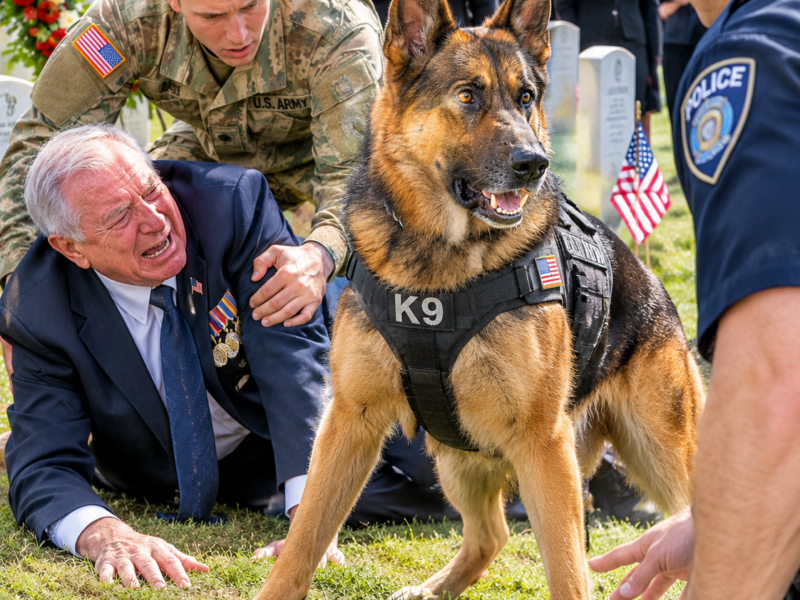
“The officer’s Taser was still crackling beside my wife’s coffin when he ordered me to the ground
I couldn’t hear anything except the words on that tag.
SHE DIDN’T DIE.
I looked at Jack Mercer.
“What does that mean?”
He didn’t answer immediately. Instead, he turned toward the second officer.
“Secure the scene. Get medical assistance for him, and make sure nobody touches that tag until it’s photographed.”
The first officer stepped forward.
“You’re interfering with an active investigation.”
Jack remained calm.
“Then you should have no problem explaining why a military identification tag belonging to this man was in your pocket.”
The second officer picked it up with a gloved hand.
“Sir, step back.”
For the first time, the officer who had tased me looked uncertain.
Daniel rushed to my side.
“Uncle Tom, can you stand?”
“I think so.”
He helped me sit up, but the pain in my back made me gasp.
Jack motioned toward the ambulance arriving near the entrance.
“Let them check you out.”
“I need to know what that tag means.”
“I understand. But you won’t get answers if you collapse before we find them.”
Scout stayed beside me as the paramedics examined my arms.
The dog kept glancing toward the officer.
He seemed to recognize something about him that none of us could see.
While one paramedic checked my blood pressure, Jack spoke quietly with the second officer.
I caught pieces of the conversation.
“Preserve the body-camera footage.”
“Request the cemetery security recording.”
“Don’t let him leave until his supervisor arrives.”
Then Jack came back.
“Mr. Reed, I need to tell you something about Sarah.”
I gripped the edge of the ambulance stretcher.
“How do you know my wife?”
“I didn’t. But I know the name she gave me.”
He pulled a folded photograph from his jacket.
It showed a younger Sarah standing outside a military hospital.
Beside her was a woman in uniform, and behind them stood a man wearing a Navy working-dog handler’s vest.
I recognized Sarah immediately.
She looked to be about thirty.
The date printed in the corner was from twenty-two years earlier.
“Where did you get that?”
“From a former military investigator who contacted me last month.”
Jack turned the photograph over.
There was a handwritten message.
“If anything happens to me, find Thomas Reed. He deserves to know what happened to his brother.”
I stared at the words.
“My brother?”
Jack nodded.
“Did Sarah ever tell you that your brother served in a military medical research unit?”
I shook my head.
“My brother died before I joined the Army.”
“What’s his name?”
“Michael.”
Jack studied my face.
“Michael Reed?”
“Yes.”
He looked toward Scout.
The dog had stopped watching the officer.
Now he was staring at the photograph.
Jack crouched beside him.
“Scout, find.”
The Shepherd sniffed the picture carefully.
Then he moved toward the ambulance doors and began whining.
Jack’s expression hardened.
“That’s what I was afraid of.”
I looked between them.
“What?”
“Scout worked with a Navy investigator named Lieutenant Michael Reed.”
My mouth went dry.
“That’s impossible.”
Jack didn’t argue.
Instead, he handed me the photograph.
“Your wife was involved in something that began long before you met her.”
The paramedic finished checking my pulse.
“He’s stable, but I want him evaluated at the hospital.”
I nodded without really hearing.
The silver tag had been placed in an evidence bag.
The first officer was being questioned near the cemetery office.
Daniel stood beside me, his face pale.
“Uncle Tom, who was Michael?”
I looked at him.
“My older brother. He died when I was nineteen. At least, that’s what my parents told me.”
Jack turned sharply.
“What do you mean, that’s what they told you?”
I rubbed my forehead.
“Car accident. His body was badly burned. They said identification was difficult, but the military handled everything.”
Jack was silent.
Then he asked, “Did you attend the funeral?”
“No.”
“Why not?”
I swallowed.
“My parents told me there had been a problem with the remains. They said it was better if I remembered him as he was.”
Jack looked at the photograph again.
“Thomas, I think your family may have buried someone else.”
I wanted to reject the idea.
I wanted to tell him that he was wrong, that he had confused my brother with another man.
But then I remembered Sarah’s final months.
The late-night phone calls she never answered in front of me.
The locked drawer in her desk.
The way she’d asked whether I still had Michael’s old service photograph.
And her final warning about someone asking questions.
I had thought she was confused by medication.
Now I wondered how much she’d been trying to tell me.
The ambulance took me to the hospital.
Jack followed in his own vehicle with Scout.
Daniel rode beside me.
The doctor diagnosed several electrical burns and muscle spasms from the Taser.
He also ordered a scan to make sure I hadn’t suffered a more serious injury when I fell.
While we waited, Jack finally explained why he had been at the cemetery.
“Sarah contacted me six weeks ago,” he said.
I stared at him.
“Six weeks?”
“She found my name through a former handler I served with. She wanted to meet, but she changed the appointment twice.”
“Why?”
“She said she was being watched.”
I looked toward the hospital window.
“Why didn’t she tell me?”
“She believed someone close to you might be reporting your movements.”
The room seemed suddenly too small.
“Who?”
“I don’t know.”
Jack rested his hands on his knees.
“Sarah told me she had found evidence connected to a classified military program. She said the program had been used to conceal the identities of service members who were officially listed as dead.”
I thought of Michael.
“What kind of program?”
“She didn’t give me the details. She said she wanted to bring me something first.”
“What?”
“A file. She called it the original roster.”
I looked down at my hands.
“Did she bring it?”
“No.”
Jack’s voice softened.
“She died before we could meet.”
For a while, neither of us spoke.
Then I asked, “Why did you come to the funeral?”
“I received a message that morning.”
He pulled out his phone and showed me an email.
It had been sent from an address I didn’t recognize.
The subject line read:
THE MAN WITH THE BLUE SCARF.
The message contained only one sentence.
“If Thomas Reed goes to Sarah’s grave, make sure he leaves with Scout.”
I looked up.
“Who sent that?”
“An account that was deleted shortly afterward.”
I glanced toward the German Shepherd lying beside the hospital bed.
“Why does the message mention him?”
Jack looked at Scout.
“Because he’s been trained to find something Sarah hid.”
I felt the room tilt.
“Something where?”
Jack shook his head.
“That’s what we need to figure out.”
A nurse entered to tell us my scans were clear enough for discharge later that evening.
She also handed me a plastic bag containing my belongings.
My phone.
My wallet.
Sarah’s blue scarf.
I reached for the scarf.
Something hard pressed against the fabric.
I unfolded it.
A small brass button fell into my palm.
It had a tiny engraved symbol on the back: a crescent surrounding the number seven.
Jack leaned forward.
“Where did that come from?”
“Sarah’s coat. I must have picked it up when I was folding her things.”
He took a closer look without touching it.
“That’s not a clothing button.”
“What is it?”
“A storage key.”
He turned it over.
“Or part of one.”
I looked at the crescent symbol.
Sarah had worn that coat during her final hospital stay.
I remembered fastening it for her one cold morning when she’d insisted on sitting outside.
She had reached into the pocket and pressed something into my hand.
I’d been distracted by a phone call.
When I looked again, she had taken it back.
At the time, I thought it was a tissue.
Now I wondered if it had been this.
Jack stood.
“We need to find out where it belongs.”
Daniel looked at the clock.
“It’s getting late. We should go home first.”
Jack shook his head.
“Not yet.”
He showed us a second message.
This one had arrived less than five minutes earlier.
“The funeral was supposed to end quietly. You should have let the officer finish his job.”
I read it twice.
Then I looked at Jack.
“Someone knows we’re here.”
He nodded.
“And they know we found the key.”
Scout suddenly stood.
His nose lifted toward the hallway.
A low growl rolled through his chest.
Jack reached for his leash.
“Stay behind me.”
The hospital door opened.
A man in a gray jacket stepped inside.
He looked at me, then at the blue scarf in my hands.
“Mr. Reed,” he said politely. “I’m here to collect something that belongs to my employer.”
Jack moved between us.
“You’re going to have to identify yourself.”
The man smiled.
“Of course.”
He reached into his jacket.
Scout lunged forward, barking so sharply that the man stumbled backward.
A security guard rushed in from the corridor.
The man froze.
His hand was empty.
He had been reaching for a hospital identification badge.
But when the guard checked his credentials, the photograph didn’t match the name.
He was escorted away.
Before leaving, he looked directly at me.
“Your wife made a mistake trusting you.”
Then the door closed.
Jack watched the hallway until the security guard disappeared.
“That’s enough,” he said. “We’re not staying here.”
He arranged for us to leave through a different entrance.
At his insistence, Daniel drove my truck while Jack followed with Scout.
We went to a small house outside Fredericksburg.
It belonged to a retired Navy chief named Paul Bennett, who had worked with Jack years earlier.
Paul opened the door wearing reading glasses and a faded sweatshirt.
He took one look at my face.
“Mercer, what did you get yourself into?”
Jack gestured toward me.
“Thomas Reed. He needs help.”
Paul stepped aside.
“Then get inside.”
His home office was filled with old military photographs, maps, and boxes of documents.
Scout immediately walked to a wooden cabinet in the corner.
He sniffed the bottom drawer, then sat.
Paul noticed.
“That dog doesn’t usually do that.”
Jack looked at the drawer.
“What’s in there?”
“Old case files. Some of them should have been destroyed years ago.”
Paul opened it.
Inside were several folders marked with dates and project codes.
One folder carried the same crescent-and-seven symbol engraved on Sarah’s button.
Paul went still.
“Where did you get that?”
I held out the button.
He didn’t take it.
Instead, he opened a locked box and removed a thick folder.
On the cover was a name.
OPERATION NIGHT HARBOR.
Beneath it was a list of service members.
I scanned the names.
Then I found Michael Reed.
His status was marked:
DECEASED — 2004.
But a second notation had been added in red ink.
TRANSFERRED — 2004.
I looked at Paul.
“What does that mean?”
He sat down slowly.
“It means someone changed his status after the official report was filed.”
“Where was he transferred?”
Paul turned several pages.
“That’s the problem. The destination was removed from the record.”
Jack leaned over the desk.
“Who authorized it?”
Paul pointed to the bottom of the page.
The signature belonged to a senior officer named Admiral Charles Whitaker.
I recognized the name.
He had been the officer who attended my parents’ funeral service.
He had personally presented the flag.
I felt my stomach tighten.
“Why would an admiral lie about my brother?”
Paul closed the folder.
“Because Operation Night Harbor wasn’t a normal military program.”
He looked at Jack.
“How much do you know?”
“Only what Sarah told me.”
Paul rubbed his face.
“Night Harbor was created to move certain service members into protected identities after operations that couldn’t be publicly acknowledged. Some were injured. Some were intelligence assets. Some were witnesses.”
“Then why declare them dead?”
“Because a new identity doesn’t work if the old one can be traced.”
I stared at the page.
“You’re saying Michael was alive?”
Paul didn’t answer immediately.
“I believe he was.”
I gripped the edge of the desk.
“Where is he now?”
Paul opened another file.
There was a photograph of a military medical facility in Maryland.
The caption read:
NORTHGATE ANNEX — RESTRICTED PATIENT UNIT.
A handwritten note underneath said:
SUBJECT 07 — LONG-TERM PROTECTION.
Jack studied the photograph.
“That’s where the original records were stored.”
Paul nodded.
“Before the facility was shut down.”
I turned toward him.
“Was Michael there?”
Paul hesitated.
“According to the last roster, yes.”
My chest tightened.
“Is he still alive?”
Paul looked at me with an expression I couldn’t read.
“There’s only one way to find out.”
He reached into the folder and removed a small envelope.
It contained a recent photograph.
The man in it was older, thinner, and had a white beard.
But his eyes were unmistakable.
Michael.
Standing outside a building.
Alive.
The date on the photograph was six months earlier.
I sat down.
For twenty-eight years, I had believed my brother was dead.
Now I was looking at proof that he had survived.
I couldn’t speak.
Daniel placed a hand on my shoulder.
Jack stood quietly near the door.
Scout walked over and rested his head on my knee.
I touched the top of his head.
“How did Sarah get this?”
Paul looked at the photograph.
“She was helping an independent investigator track down the people connected to Night Harbor. She found evidence that the program had been used to hide witnesses and protect senior officers from prosecution.”
“And she found Michael?”
“She found the record that he was alive. I don’t think she knew where he was being kept.”
I looked at the photograph again.
“Why would someone target Sarah?”
Paul opened a second folder.
“Because she discovered that the program was being used for something else.”
He slid a document across the desk.
It listed payments made to a private security company over several years.
The payments had been authorized through a federal contractor.
One of the names appeared repeatedly.
Robert Hale.
I didn’t know the name.
Jack did.
“Former deputy director of the program.”
Paul nodded.
“He was the person who turned Night Harbor into a private operation.”
I looked at the document.
“Was he involved in Sarah’s death?”
Paul didn’t answer.
Instead, he turned to a medical report.
It showed Sarah’s final hospital admission.
At the bottom, a medication order had been added two days before she died.
The dosage was significantly higher than the previous prescription.
My hands began to shake.
“She was receiving treatment for cancer.”
“Yes,” Paul said carefully. “But this order wasn’t part of her oncology plan.”
I looked at him.
“Are you saying someone changed her medication?”
“I’m saying the record deserves an independent review.”
Jack leaned forward.
“Who signed the order?”
Paul pointed to a name.
Dr. Alan Pierce.
I knew him.
He had been Sarah’s attending physician during her final week.
I had thanked him at the funeral.
I had shaken his hand.
I felt sick.
“Did he know?”
Paul looked at me.
“We don’t know yet.”
I stood.
“We’re going to find him.”
Jack stepped in front of me.
“Not tonight.”
“That’s the man who treated my wife.”
“And if he was involved, he may be watching for you to show up.”
“I don’t care.”
“I do.”
Jack’s voice was firm but not unkind.
“Sarah didn’t spend her final weeks trying to protect you so you could walk into a trap.”
That stopped me.
I looked down at the blue scarf.
For the first time, I noticed a small seam near the edge.
The stitching was different from the rest.
I pulled at it gently.
A narrow strip of paper slid out.
Sarah’s handwriting covered both sides.
I recognized it instantly.
My name was written at the top.
Tom,
If you’re reading this, then I didn’t get the chance to explain everything.
I sat down.
The letter continued.
I found Michael. He’s alive. He has been living under another name because he witnessed something that powerful people wanted buried.
My eyes blurred.
I didn’t tell you because I was afraid you would try to find him before it was safe.
I kept reading.
The man who has been helping me is Jack Mercer. He is one of the few people I trust. If he is with you, listen to him.
Jack lowered his head.
The final paragraph was written more heavily, as if she’d been in a hurry.
The original Night Harbor roster is hidden where Michael and I first met. The place has a blue door. The number is 17. Don’t trust the doctor who told you I was dying.
I read the last sentence again.
Then I looked at Paul.
“Where did Michael and Sarah first meet?”
Paul searched through the file.
“Northgate Annex.”
“Is there a blue door?”
He nodded slowly.
“Room 17.”
Jack took the letter.
“That’s not possible. Northgate was shut down years ago.”
Paul looked at him.
“Officially.”
The room went silent.
Scout stood and walked toward the front window.
His ears were pointed forward.
Jack moved to the curtain and looked outside.
A dark sedan was parked across the street.
The headlights were off.
Paul turned off the office light.
“Looks like they found us.”
Daniel whispered, “Who?”
Jack didn’t answer.
He was watching the car.
Then the driver’s door opened.
A man stepped out and walked toward the house.
He wasn’t carrying a weapon.
He wasn’t hiding his face.
He simply approached the front door and knocked three times.
Paul looked through the small glass panel.
His face went pale.
“That’s Robert Hale.”
Jack moved toward the door.
“Nobody opens it.”
But the man outside spoke before anyone could move.
“Thomas Reed,” he called. “I knew Sarah. And I can take you to your brother.”
I stepped forward.
Jack caught my arm.
“Don’t.”
The man outside lifted both hands.
“I know what she wrote in that scarf. I know about Northgate. And I know why Michael has been hidden all these years.”
I looked at the photograph on the desk.
My brother’s face.
The brother I’d mourned for twenty-eight years.
“How do I know you’re telling the truth?” I called.
Hale lowered his hands.
“Because your brother asked me to give you something.”
He reached into his coat and held up a small object against the glass.
A silver wedding ring.
Sarah’s ring.
The one I had placed in the velvet box beside her coffin.
My breath caught.
Hale looked directly at me.
“Your wife didn’t die knowing she had failed to find Michael.”
He paused.
“She died knowing he was waiting for you.”
Scout began barking.
Jack tightened his grip on my arm.
And then Hale said the one thing that made me step toward the door despite Jack’s warning.
“Michael wants to know if you’ll forgive him for staying away.”
THE END.









