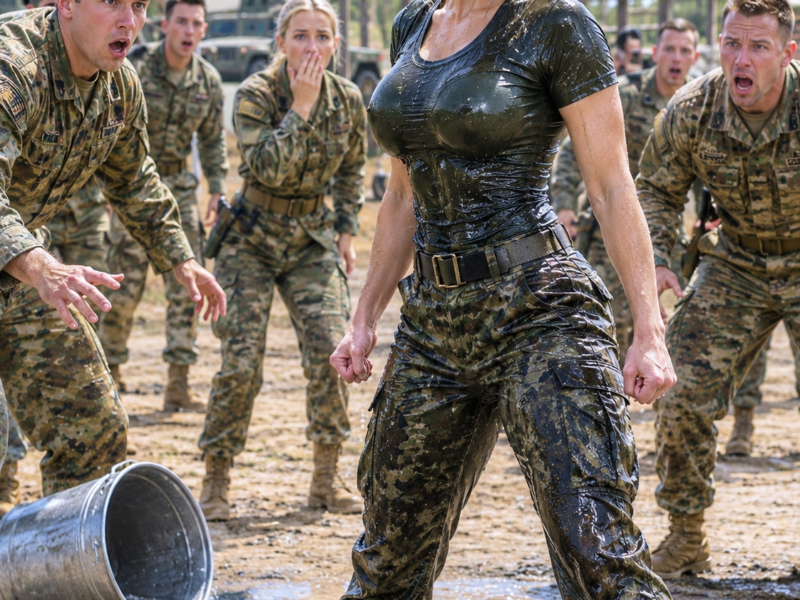
“The officer dumped an entire bucket of freezing water over my head in front of thirty recruits, then laughed and told me to clean up the mess
The rain had not stopped falling when Lieutenant Colonel Richard Hayes hit the pavement.
For several seconds, nobody moved.
The recruits stood frozen beneath the gray sky, their faces caught between shock and fear. Hayes lay on his side, one hand pressed against the wet concrete, staring up at me as if he couldn’t believe what had just happened.
I could hear the rain striking the metal roof of the training building.
I could hear someone breathing hard behind me.
And I could see the tiny red light on Hayes’s body camera still blinking.
“Everybody stay where you are,” I said.
My voice wasn’t loud, but it carried across the courtyard.
Hayes pushed himself onto one elbow.
“You just assaulted a superior officer.”
I looked down at him.
“You poured a bucket of water over a civilian investigator, then grabbed her shoulder.”
His expression changed.
Only for a fraction of a second.
But I saw it.
He knew.
He knew exactly who I was now.
“Investigator?” one of the recruits whispered.
I didn’t answer.
Instead, I turned toward the young man standing near the equipment shed.
Ethan Cole.
His left arm was still held close to his body. His uniform sleeve was soaked, and his face had gone pale.
“Ethan,” I said gently. “You told me not to let them erase the recording. What recording?”
He glanced at Hayes.
The lieutenant colonel gave him a look that could have frozen the rain.
“Don’t answer her,” Hayes snapped.
Ethan lowered his eyes.
That was all I needed to understand how deeply the fear had settled into this place.
“Hayes,” I said, “you’re going to remain where you are. No one touches that camera, its storage device, or any other recording equipment.”
“You have no authority to give orders here.”
I reached into my jacket and pulled out my federal credentials.
“Rachel Morgan. Department of Defense Inspector General’s Office. I’m conducting an authorized investigation into allegations of abuse, retaliation, and destruction of evidence at this installation.”
I held the badge where everyone could see it.
The courtyard went silent.
Hayes stared at it.
Then he slowly stood.
“You should have identified yourself before interfering with my training.”
“I tried to observe your training without influencing it. You made that impossible.”
He looked toward the building.
“Captain Lewis!”
A door opened.
A captain stepped out, followed by two staff members.
“Sir?”
“Get this woman off the training grounds.”
The captain looked at me.
Then at my credentials.
Then at Hayes, whose uniform was dripping and whose face had turned an unhealthy shade of red.
“Sir, perhaps we should—”
“Now!”
I stepped between him and the recruits.
“No one is being removed until the evidence is secured.”
Hayes laughed once.
It wasn’t a happy sound.
“You think a badge makes you untouchable?”
“No,” I replied. “It makes the investigation official.”
I turned to Captain Lewis.
“I need you to secure the courtyard, preserve all body-camera footage from today’s training, and identify every person who witnessed what happened.”
The captain hesitated.
Hayes took a step toward him.
“Do what I told you.”
For a moment, I thought Lewis would obey.
Then he looked at Ethan.
Something passed across his face.
Shame, perhaps.
Or recognition.
“Understood,” he said quietly.
That was the first crack in Hayes’s control.
And I knew there would be more.
Within twenty minutes, the courtyard had been secured.
A medic examined Ethan’s arm while another staff member checked the recruits for injuries. Hayes was escorted to an administrative office, where he was instructed not to contact witnesses or access training records until the initial review was complete.
He protested every step of the way.
He demanded to speak with the installation commander.
He accused me of embarrassing the unit.
He said the recruits needed discipline, not protection.
But he never explained why he had poured water over me.
And he never explained why Ethan had begged me to preserve a recording.
I sat with Ethan in a small medical examination room.
His arm had been wrapped, and a medic had recommended further imaging.
He kept looking at the door.
“You’re safe to speak here,” I told him.
He shook his head.
“That’s what they said last time.”
I put my notebook down.
“Tell me what happened.”
Ethan stared at his bandaged arm.
“Three weeks ago, a recruit named Jordan Price got hurt during night training. His ankle was badly twisted. He couldn’t put weight on it.”
“What did the instructors do?”
“They told him to finish the course.”
“Did he?”
“No. He fell.”
Ethan swallowed.
“Then they said he was pretending. Sergeant Brooks made him crawl across the gravel to prove he wasn’t injured.”
I felt my jaw tighten.
“Was medical personnel notified?”
“Eventually. But the report said he had suffered the injury during an unsupervised break.”
“Who changed the report?”
Ethan hesitated.
“I don’t know who typed it. But Lieutenant Colonel Hayes approved it.”
I wrote that down.
“What does this have to do with the recording?”
Ethan looked at the medic.
The medic quietly stepped outside and closed the door.
Ethan leaned closer.
“Someone recorded what happened to Jordan. It was on a training camera near the obstacle course.”
“Who recorded it?”
“I’m not sure. The camera was supposed to be used for reviewing exercises. But it caught everything.”
“And where is that footage now?”
“They deleted the original file.”
“Are you certain?”
Ethan nodded.
“But I made a copy.”
I kept my expression neutral.
“Where?”
“In a storage room beneath the old communications building.”
“Why there?”
“Because the system in the main office was being monitored. I didn’t trust anyone with access to it.”
He looked down again.
“I thought if I kept the footage, someone might finally believe us.”
I waited.
Then he added something that changed the direction of the entire investigation.
“There are other videos.”
“How many?”
“Six. Maybe seven.”
“Videos of what?”
“Different incidents. People being punished for reporting injuries. Recruits being forced to train while sick. One guy was made to stand outside overnight in freezing weather because he asked to call his family.”
My pen stopped moving.
“Who ordered those punishments?”
Ethan’s eyes lifted.
“Hayes didn’t always give the orders himself. Sometimes he just watched. Sometimes he told the instructors to make sure nobody complained.”
“Did anyone else know about the recordings?”
“Sergeant Brooks did. He threatened me when he found out I had copied them.”
“Threatened you how?”
Ethan pulled his injured arm closer.
“He said I could leave this place with a broken arm, or leave with a dishonorable discharge. He said nobody would believe a recruit over a lieutenant colonel.”
I let the silence sit for a moment.
Then I asked, “Why didn’t you report it?”
“I did.”
His voice cracked.
“Twice.”
“What happened?”
“The first complaint disappeared. The second time, I was called into Hayes’s office. He told me I was damaging the unit’s reputation.”
Ethan rubbed his forehead.
“He said if I kept making accusations, he’d make sure I never wore this uniform again.”
I closed my notebook.
“Ethan, I can’t promise you what the final outcome will be. But I can promise that your complaint won’t be handled by the people you’re accusing.”
He looked at me carefully.
“Do you really believe that?”
“I do.”
For the first time, he seemed to breathe normally.
I contacted the investigative team and requested an evidence-preservation order covering all relevant training cameras, access logs, medical records, personnel files, and internal communications.
I also requested that the storage room Ethan described be secured before anyone could enter it.
The team arrived shortly afterward.
Two investigators accompanied me to the old communications building.
It was a squat concrete structure at the far edge of the installation. Most of its windows were covered, and a faded sign near the entrance identified it as a facility that had been decommissioned years earlier.
Ethan had given me the access code.
But I didn’t use it until the evidence team had documented the door and confirmed the area was safe.
Inside, the air smelled of dust and old wiring.
A narrow staircase led down to a basement.
At the bottom stood a row of metal cabinets.
Ethan had described the third cabinet from the left.
One of the investigators opened it under the team’s evidence procedures.
Inside was a small external drive wrapped in a plastic bag.
There was also a handwritten notebook.
I recognized the handwriting from Ethan’s statement.
The drive was photographed, sealed, and transferred to a secure evidence container.
The notebook contained dates, names, training locations, and brief descriptions of incidents.
Some entries were written in a hurry.
Others had been underlined several times.
On one page, Ethan had written:
“Jordan — obstacle course — original footage deleted.”
Below it was another note:
“Medical reports changed after command review.”
And beneath that:
“Brooks knows. Hayes approved.”
I turned the page.
There was a list of seven names.
Six were recruits.
The seventh was an instructor.
I recognized the name.
Staff Sergeant David Brooks.
“Is he still assigned here?” I asked.
One of the investigators checked the personnel records on his tablet.
“Yes. Training division.”
“Bring him in for a voluntary interview. Make sure he understands he is not to contact the recruits about this investigation.”
As we left the building, my phone vibrated.
An unknown number.
I answered.
“Rachel Morgan.”
A man’s voice came through.
“You need to stop digging.”
I looked toward the investigator walking beside me.
“Who is this?”
“You know exactly what you’re doing.”
“No, I don’t. Tell me who you are.”
A pause.
Then:
“Those files aren’t going to help you. They’re incomplete.”
“Then you should have no problem explaining why.”
The caller gave a short, humorless laugh.
“You think this is about one lieutenant colonel? You’re looking at a whole command structure.”
The line went dead.
I stood still for a moment.
The investigator turned toward me.
“Everything okay?”
I showed him the call log.
“Preserve this. We’ll request the relevant records and examine the source through the proper channels.”
He nodded.
I looked back at the old communications building.
The investigation had just become much bigger.
That afternoon, I interviewed Sergeant Brooks.
He entered the room with his shoulders squared and his chin raised.
He was in his forties, with close-cropped hair and a face that seemed permanently set in a frown.
He sat down without being asked.
“I don’t know why I’m here,” he said.
“Then this should be a short interview.”
I placed a copy of the evidence-preservation notice on the table.
“We’re investigating allegations of physical abuse, retaliation against recruits who reported injuries, and improper alteration of training and medical records.”
Brooks glanced at the notice.
“I follow orders.”
“That doesn’t answer my question.”
“I’m a training instructor. I maintain standards.”
“Did you threaten Ethan Cole?”
His eyes flickered.
“No.”
“Did you tell him he could leave with a broken arm or a dishonorable discharge?”
“That sounds like something a frightened recruit would invent.”
I slid a photograph of the handwritten notebook across the table.
Brooks looked at it.
Then he leaned back.
“Where did you get that?”
“That’s not relevant to whether the contents are accurate.”
He rubbed his mouth.
“I didn’t write it.”
“I didn’t say you did.”
For the first time, his confidence seemed to falter.
I asked about Jordan Price.
Brooks claimed the injury had been minor.
He said the recruit had been careless.
He said the training exercise had been properly supervised.
But when I asked why the medical report listed an unsupervised break as the location of the injury, he stopped speaking.
“Who gave you that wording?” I asked.
“No one.”
“Did you speak with Lieutenant Colonel Hayes about the incident?”
“Everyone speaks with the lieutenant colonel.”
“Did he instruct you to change the report?”
Brooks stared at the table.
“I don’t want to answer that.”
“That’s your right. But I need you to understand that the evidence will be examined independently.”
He looked up.
“Do you know what happens when an instructor loses the confidence of command?”
I didn’t respond.
“They make an example of you. They strip your authority. They move you somewhere nobody wants to be.”
“Is that what happened to the recruits?”
He looked away.
That was the moment I understood that Brooks was afraid.
Not innocent.
Not necessarily willing to cooperate.
But afraid.
I ended the interview without forcing an answer.
Later, I received confirmation that the evidence team had successfully recovered six video files from Ethan’s drive.
The seventh file was damaged.
The footage was disturbing.
It showed Jordan Price falling during the obstacle course.
It showed him clutching his ankle while two instructors stood over him.
It showed Brooks ordering him to get back up.
And it showed another man standing near the observation platform.
Hayes.
He watched the scene.
He said something to Brooks.
Then he walked away.
There was no sound on the recording, but the sequence was clear.
In another video, a recruit named Marcus Bell was forced to continue a long-distance run after vomiting and collapsing.
In a third, an instructor ordered a recruit to stand outside in the cold for refusing to sign a statement that he had been injured during personal exercise.
The footage didn’t prove every allegation.
But it established a pattern that could no longer be dismissed as rumor.
We matched the dates against medical records.
Several records had been altered after the incidents.
In two cases, the original injury descriptions had been replaced with vague language.
In one case, the date had been changed.
And in every instance, the revised report had passed through the same administrative office.
The office of Lieutenant Colonel Hayes.
By the end of the week, the installation commander had received a preliminary briefing.
Hayes was removed from direct training authority pending the investigation.
Brooks was reassigned to administrative duties.
The recruits involved were given access to independent medical evaluations and confidential interviews.
But I knew the hardest part was still ahead.
Because evidence could establish what had happened.
It couldn’t guarantee that the people responsible would tell the truth.
And it couldn’t undo the damage done to the young men and women who had learned that asking for help could make them targets.
Two days later, I received a message from Ethan.
He wanted to speak with me.
I met him in a quiet room near the medical center.
His arm was still in a sling.
He looked exhausted.
“I heard Hayes was removed,” he said.
“That’s correct.”
“Is he going to prison?”
“I can’t predict the outcome. The investigation is ongoing, and any disciplinary or legal decisions will depend on the evidence and the appropriate authorities.”
Ethan nodded.
“I just want people to know what happened.”
“They will have the opportunity to tell their stories.”
He looked down at his hands.
“There’s something else.”
I waited.
“Brooks wasn’t the only one who knew.”
“Who else?”
“Captain Lewis.”
I remembered the captain’s hesitation in the courtyard.
“What did he know?”
“He saw Jordan fall. He saw the reports afterward. He tried to get the medical team involved, but Hayes told him to stay out of training matters.”
“Did he ever report it?”
Ethan shook his head.
“He said he couldn’t risk his career.”
I wrote down the information.
“Did he threaten you?”
“No. But he told me to stop asking questions.”
That distinction mattered.
It didn’t make Lewis blameless, but it meant his role needed to be examined separately.
I asked Ethan if he would be willing to provide a supplemental statement.
He agreed.
The following morning, Captain Lewis requested an interview.
He came in without his uniform jacket.
His face looked older than it had in the courtyard.
“I should have said something,” he began.
I let him continue.
“Jordan Price was injured. I saw it. I told Hayes that the recruit needed medical attention.”
“What did Hayes say?”
“He said the training staff could handle it.”
“Did you disagree?”
“Yes.”
“What happened?”
“He told me I was undermining his authority.”
Lewis folded his hands.
“I thought if I kept my head down, I could protect the recruits in other ways. I thought I could make small changes without challenging him directly.”
“Did that work?”
“No.”
His answer came quickly.
“Things got worse.”
He told me that he had seen reports altered and complaints delayed. He had also witnessed Brooks humiliating recruits during training.
He admitted that he had not filed a formal report.
“Why are you speaking now?” I asked.
He looked at me.
“Because when you stood in that courtyard, those recruits saw someone finally tell Hayes no.”
I didn’t respond immediately.
Lewis continued.
“I saw their faces. They weren’t shocked because you hit him. They were shocked because someone with authority finally refused to obey him.”
That stayed with me.
Not because it excused Lewis’s silence.
But because it explained something about the culture we were investigating.
Hayes’s power had not come only from his rank.
It had come from everyone around him learning to look away.
Over the next several weeks, the investigation expanded.
We reviewed more than a hundred training records.
We interviewed recruits, former instructors, medical personnel, and administrative staff.
The recovered footage was authenticated and compared with the original camera logs.
The altered reports were traced through the records system.
A separate review examined why earlier complaints had not reached independent oversight.
The results were difficult to ignore.
Several complaints had been closed without meaningful interviews.
One had been marked resolved even though the recruit who submitted it had never been contacted.
Another had been returned to the same chain of command accused in the complaint.
Hayes had not personally carried out every act of mistreatment.
But the evidence showed that he had tolerated abusive conduct, discouraged reporting, and approved or accepted inaccurate records.
Brooks had directly participated in several incidents and had threatened a recruit who tried to preserve evidence.
Other staff members had failed to intervene when they had a duty to do so.
The findings were sent to the appropriate military authorities.
Hayes was formally relieved of command responsibilities.
Brooks faced administrative and disciplinary proceedings.
The medical records were corrected where the evidence supported doing so.
And the installation implemented independent reporting procedures so recruits would no longer have to send complaints through the very command structure they were accusing.
The most important change, however, came from the recruits themselves.
They began speaking.
One after another.
Not because they were ordered to.
Because they finally believed someone would listen.
Jordan Price provided a detailed statement about his injury.
Marcus Bell described the run that had ended with him collapsing.
Several others confirmed incidents that had previously been dismissed as isolated misunderstandings.
Their accounts did not match in every detail.
They didn’t need to.
The central pattern was consistent.
People had been hurt.
They had asked for help.
And instead of receiving it, they had been punished for speaking.
Months later, I returned to the installation.
The rain had stopped.
The courtyard looked exactly as it had on the day Hayes poured that bucket over me.
Same concrete.
Same training building.
Same flag moving in the wind.
But the atmosphere had changed.
A new training officer stood with the recruits.
His name was Major Daniel Foster.
He wasn’t trying to impress anyone.
He wasn’t shouting.
He was explaining the day’s exercises and reminding the recruits that injuries had to be reported immediately.
I watched from the edge of the courtyard.
Ethan approached me.
His arm had healed, though he still moved it carefully.
“Ma’am.”
“Ethan.”
He smiled faintly.
“I finished the course.”
“I heard.”
“Jordan’s doing better, too. He’s in rehabilitation.”
“That’s good news.”
Ethan looked toward the training group.
“Some people said we were weak for speaking up.”
“What do you think now?”
He considered the question.
“I think it took more courage to tell the truth than it did to pretend nothing happened.”
I nodded.
He was right.
Before I left, he handed me a folded sheet of paper.
“What is this?”
“A copy of something I wrote. I thought you should have it.”
I unfolded it.
It was a short statement.
At the top, he had written:
“Leadership is not the ability to make people afraid of you. It’s the responsibility to make sure they are safe enough to do their jobs.”
I read it twice.
Then I folded the paper carefully and placed it inside my notebook.
“Keep writing things like this,” I told him.
He smiled.
“I plan to.”
I walked back toward the parking area.
For months, I had thought about the moment in the courtyard.
The bucket.
The laughter.
The sudden movement.
The single strike that sent Hayes to the ground.
Some people would always focus on that part.
They would say I should have walked away.
They would say I should have waited for security.
They would say an investigator should never let anger influence a decision.
And there were parts of that criticism I could understand.
I had a responsibility to remain professional.
I had a responsibility to protect the integrity of the investigation.
But the story had never really been about one punch.
It was about a system in which people had learned to fear the consequences of telling the truth.
It was about a recruit who had risked his future to preserve evidence.
It was about a captain who finally admitted that silence had protected the wrong person.
And it was about the difference between authority and leadership.
Hayes had believed his rank made him untouchable.
He had believed the recruits would stay quiet.
He had believed the records could be changed and the cameras could be erased.
He was wrong.
As I reached my vehicle, I looked back one last time.
The recruits were beginning their training.
No one was standing in the rain as punishment.
No one was being forced to hide an injury.
And when one young recruit raised his hand to ask a question, the instructor stopped and listened.
It was a small moment.
But sometimes, that’s where change begins.
The end.









