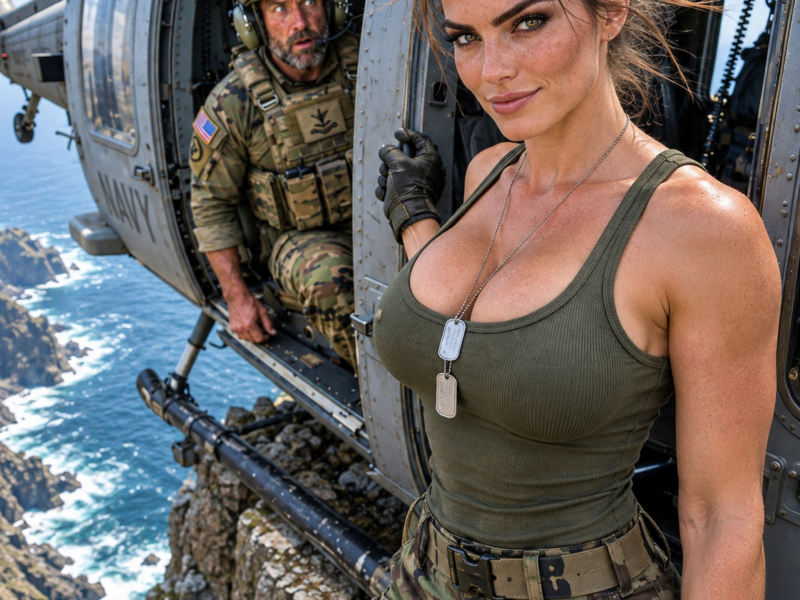
“The Navy SEAL laughed when I told him I could land his helicopter in that storm, then challenged me in front of his entire team
The first thing I did after receiving the authorization was ask who had signed it.
The second was ask why.
Nobody answered either question.
The operations commander, Captain James Holloway, handed the document to the communications officer and ordered the rescue helicopter prepared.
“Lieutenant Commander Hayes, you’ll have a flight crew assigned. Your emergency authorization is valid for this mission only.”
“Understood.”
“You’ll operate under my direct command. If conditions exceed your limits, you abort.”
I nodded.
“Agreed.”
He studied me for another moment.
“Do you understand what you’re volunteering for?”
I looked at the screen.
Six people were stranded on a mountain.
One was bleeding badly.
The storm was moving toward them.
“Yes, sir.”
“Then let’s get them home.”
The helicopter waiting in Hangar Three was an MH-60R, modified for the mission with additional rescue equipment and a medical team.
Its pilot, Lieutenant Daniel Price, approached me as I checked the aircraft records.
“I’ve heard about you,” he said.
“Hopefully nothing too interesting.”
He gave a nervous smile.
“Mostly that you were one of the best mountain pilots in the squadron.”
“That’s generous.”
“And that your last mission ended badly.”
I looked at him.
“That’s also generous.”
He understood the warning and didn’t ask more.
Our crew included Chief Petty Officer Aaron Mills, a flight mechanic with twenty years of experience, and Petty Officer Jenna Cole, a combat rescue medic.
Jenna was already checking the medical equipment.
“How many injured?”
“One critical. The others are reportedly mobile.”
“Then let’s hope the report is accurate.”
I climbed into the cockpit.
For a moment, my hands rested on the controls without moving.
Three years.
Three years since I’d sat in this seat.
I could hear the hangar around me.
Tools being moved.
Ground crew calling out checks.
The low rumble of the engine starting.
The familiar smell of hydraulic fluid and aviation fuel.
I closed my eyes.
I wasn’t afraid of flying.
I was afraid of discovering that the person I’d been before the suspension no longer existed.
Then Daniel’s voice came through my headset.
“Preflight complete, Commander.”
I opened my eyes.
“Let’s go.”
The helicopter lifted into the storm.
Rain struck the windshield in thick sheets.
The coastline disappeared behind us.
We climbed toward the mountains, following the southern corridor I’d identified on the map.
The turbulence began almost immediately.
Daniel glanced at me.
“Not exactly a pleasant evening.”
“Keep your speed steady.”
“Copy.”
I checked the weather radar.
The storm was moving faster than predicted.
The western valley was already filled with heavy precipitation.
The northern ridge was worse.
But the southern corridor still showed a narrow gap.
I contacted operations.
“Falcon Rescue One, airborne. Request updated wind conditions.”
Captain Holloway responded.
“Rescue One, surface readings indicate gusts up to forty knots along the western ridge. Conditions are deteriorating.”
“Copy. We’re using the southern approach.”
A second voice interrupted.
It was Marcus Reed.
“Rescue One, this is Team Four. Can you hear me?”
I pressed the transmit button.
“Go ahead, Marcus.”
“Visibility is almost zero. We have the casualty sheltered beneath the rock shelf. His condition is getting worse.”
“How long has he been bleeding?”
“Approximately forty minutes.”
Jenna leaned toward the radio.
“Team Four, this is the rescue medic. Is the casualty conscious?”
“Intermittently.”
“Any pressure dressing applied?”
“Yes.”
“Keep direct pressure. Don’t remove the existing dressing. We’ll take over when we reach you.”
Marcus acknowledged.
Then he asked, “Who’s flying?”
I didn’t answer immediately.
Daniel glanced at me.
“Tell him.”
I pressed the microphone.
“Rachel Hayes.”
There was a long silence.
Then Marcus said, “I thought your authorization was temporary.”
“It is.”
“Then don’t waste it.”
I smiled despite myself.
“Still giving orders from a mountain, Lieutenant?”
“Only when people refuse to listen.”
“Then we’re even.”
We approached the first ridge.
The wind pushed the helicopter sideways.
Daniel corrected.
“Crosswind is stronger than the forecast.”
“I see it.”
The aircraft shuddered as we passed over a narrow ravine.
I studied the terrain.
The old emergency platform was still beyond the eastern ridge, but the route was almost completely obscured by rain.
“Can you see the shelf?” Daniel asked.
“Not yet.”
“Then we’re flying blind.”
“Not entirely.”
I switched the display to terrain mapping.
The old survey data appeared.
The platform was marked in faded blue.
A steep rock face rose to the north.
A lower ridge protected the southern edge.
That was our approach.
“Follow the southern contour,” I said. “We’ll descend below the ridge, then climb into the wind.”
Daniel frowned.
“That’s a tight turn.”
“Yes.”
“How tight?”
“Exactly as tight as it needs to be.”
He didn’t laugh.
The helicopter descended.
The instruments showed our altitude dropping.
Rain blurred the windshield.
A sudden gust hit the aircraft from the left.
The nose swung.
Daniel corrected, but the helicopter drifted toward the ridge.
“Easy,” I said.
“I’m correcting.”
“Not enough. Reduce forward pressure.”
He adjusted.
The aircraft stabilized.
We continued.
Then the radar altimeter began fluctuating.
“That’s strange,” Daniel said.
“Check the terrain return.”
He looked down.
“Interference.”
I studied the map.
The rock face was close.
Too close for comfort.
“Hold altitude.”
“Rachel, we’re approaching the ridge.”
“I know.”
The helicopter slipped into the pocket behind the southern wall.
For one brief moment, the turbulence disappeared.
The aircraft felt almost weightless.
“There’s our window,” I said.
I took the controls.
Daniel released them without hesitation.
I brought the helicopter around the ridge, descending toward the abandoned platform.
It was smaller than I remembered.
The outer edge was cracked.
Rainwater ran across the concrete.
And a fallen tree had blocked part of the eastern side.
There was barely enough room to touch down.
“Can you make it?” Daniel asked.
“Yes.”
“You’re sure?”
“No.”
He looked at me.
I smiled.
“But I’m going to.”
I lowered the helicopter.
The landing gear approached the platform.
A gust struck us from behind.
The aircraft shifted.
I corrected.
The rear landing gear touched first.
Then the front.
The helicopter settled.
“Contact,” Aaron called.
I kept the rotors turning.
“Nobody moves until I say.”
Jenna was already unbuckling.
I looked through the side window.
Figures emerged from the darkness.
Six people.
One was being carried between two teammates.
Marcus stood at the front, rain pouring down his helmet.
He looked up at the cockpit.
Then he saw me.
For a second, his expression changed.
The man who had mocked me in the hangar had no words.
I opened the side door.
“Move! Medical first!”
Jenna jumped down with her kit.
Aaron helped secure the stretcher.
Marcus approached me.
“Commander.”
“Lieutenant.”
He glanced at the aircraft.
“That was an insane landing.”
“It was a calculated landing.”
“Looked insane from here.”
“Then you should try staying in the cockpit next time.”
He gave a short laugh.
The injured sailor was placed aboard.
Jenna immediately began treatment.
“Severe blood loss,” she called. “We need to move.”
I checked the helicopter.
The platform was shaking under the rotor wash.
The wind had changed.
The protected pocket was disappearing.
“We have ninety seconds,” I said.
Marcus looked at the remaining team.
“Everyone aboard.”
One of his men hesitated.
“Lieutenant, there’s another problem.”
Marcus turned.
“What?”
The sailor pointed toward the northern slope.
A small emergency beacon blinked through the rain.
“There was a second team.”
I stared at him.
“How many?”
“Two. They were monitoring the surveillance station when the helicopter went down.”
Marcus’s face tightened.
“They were supposed to evacuate before the storm.”
“Did they?”
He shook his head.
“No radio contact since the first impact.”
The operations center had reported six stranded personnel.
There were now eight.
And the two missing men were somewhere beyond the ridge.
I looked at the weather display.
The storm had closed the southern corridor.
Our safe window was almost gone.
Daniel leaned toward me.
“Rachel, we need to lift now.”
Jenna looked up from the casualty.
“If we leave him here, he won’t survive.”
I glanced toward Marcus.
He was already staring at the beacon.
“Can you reach them?” he asked.
I didn’t answer.
The landing platform could barely support the helicopter.
The approach route was becoming more dangerous by the second.
But the two missing sailors were alive somewhere in that storm.
“Give me their last known position.”
Marcus pointed to the map.
“North of the ridge. Near an abandoned weather station.”
I studied the coordinates.
Then I saw something.
The weather station sat on the opposite side of a narrow mountain pass.
A ground route connected it to the platform.
It was too dangerous for the helicopter.
But there might be another way.
“Marcus, how many people can you move on foot?”
“Four, if I leave two here.”
“Your injured man needs medical care.”
“Then I’ll stay.”
I looked at him.
“You just said you wanted to get your team out.”
“I do.”
“Then listen carefully.”
I pointed to the southern ridge.
“There’s a maintenance path running beneath that rock shelf. It connects to the weather station access road.”
Marcus examined the map.
“That’s not on our route.”
“It was built for the old survey crew.”
“Is it still passable?”
“I don’t know.”
He stared at me.
“You want us to hike into that storm?”
“I want you to reach the two missing men while we stabilize the aircraft.”
Daniel interrupted.
“Rachel, the wind is already outside our safe limits.”
“I know.”
“We cannot wait long.”
I looked at the casualty.
Jenna had stopped the bleeding, but his condition remained critical.
If we left now, he might not survive the flight.
If we stayed, the platform might become unusable.
And if Marcus went alone, he could lose two more people.
I made a decision.
“Daniel, keep the aircraft powered. Aaron, check the platform anchors and the rotor clearance.”
Then I turned to Marcus.
“Take two people. Follow the maintenance path. Do not cross the northern ridge. If the wind changes again, turn back.”
Marcus nodded.
“And you?”
“I’ll keep the aircraft here as long as I can.”
He hesitated.
“Rachel—”
“That’s an order.”
He looked at me.
Then he smiled faintly.
“Yes, ma’am.”
He disappeared into the rain with two teammates.
I returned to the cockpit.
The wind had increased.
The platform was no longer sheltered.
Daniel checked the engine instruments.
“Fuel is fine. But we’re getting a vibration warning.”
“Where?”
“Tail rotor assembly.”
Aaron came over the intercom.
“Possible debris strike. I need to inspect it.”
“Do it quickly.”
He climbed down and moved around the rear of the aircraft.
A moment later, he called out.
“There’s damage to the tail rotor guard. Nothing catastrophic yet, but I wouldn’t want to fly through another major gust.”
I looked at the weather.
We had maybe five minutes.
Then the radio crackled.
“Rescue One, this is Team Four.”
Marcus.
His voice was faint.
“Go ahead.”
“We found them.”
I felt a rush of relief.
“Condition?”
“One injured. The other is mobile. But there’s a problem.”
“What problem?”
“The injured man says someone else was here before us.”
I frowned.
“Who?”
“He doesn’t know. He heard a helicopter before the storm hit.”
I looked at Daniel.
“That’s impossible. All aircraft were grounded.”
Marcus continued.
“He says they were carrying equipment from the weather station. They left when the storm started.”
I stared at the map.
The surveillance team had been monitoring a classified site.
There was no reason for another helicopter to be there.
“Can he identify the aircraft?”
“Not yet.”
“Bring them back. We need to leave.”
Then a second transmission came through.
It wasn’t Marcus.
It was a man’s voice.
Calm.
Clear.
And very close to the microphone.
“Rachel Hayes.”
My blood went cold.
I knew that voice.
I hadn’t heard it in three years.
But I would have recognized it anywhere.
“Rachel, if you can hear me, don’t bring that aircraft back to base.”
I stared at the radio.
Daniel turned toward me.
“Who is that?”
The voice continued.
“They’re waiting for you.”
I pressed the transmit button.
“Identify yourself.”
A pause.
Then the answer came.
“Call sign Ghostbird.”
My hand tightened around the microphone.
Ghostbird was the call sign of Lieutenant Commander James Carter.
The pilot who had disappeared during Blackwater Seven.
The man the Navy had officially declared dead.
The man whose loss had ended my career.
“James?” I whispered.
The radio crackled.
“Rachel, you need to listen. The mission three years ago wasn’t an accident.”
I couldn’t breathe.
“Where are you?”
“Close enough to know you’re flying again.”
“James, where are you?”
“Don’t trust the command team. They knew the aircraft was compromised before we took off.”
The transmission broke into static.
Then it returned.
“Rachel, the person who grounded you is not the person who ordered the mission.”
I stared at the radio.
“Who was it?”
A burst of interference swallowed the answer.
Then the channel went dead.
For several seconds, I couldn’t move.
Daniel touched my shoulder.
“Rachel?”
I looked at him.
“We’re leaving.”
“But Marcus is still out there.”
“I know.”
I called Marcus.
“Team Four, return to the aircraft immediately.”
His voice came back through the storm.
“We’re almost there.”
“Change of plan. We have a compromised mission.”
“What’s going on?”
“I’ll explain when you’re aboard.”
“Rachel, we have two injured personnel.”
“Bring them.”
We waited.
Every second felt longer than the last.
Then three figures emerged from the darkness.
Marcus was carrying one injured sailor over his shoulder.
The other teammate supported the second man.
They moved as quickly as the terrain allowed.
Jenna rushed to help.
“Get them inside!”
The first casualty was already strapped in.
The second was placed beside him.
The third man was conscious but shivering violently.
Marcus climbed aboard last.
I looked at him.
“Did you hear the transmission?”
He nodded.
“Yes.”
“Do you know who it was?”
“Ghostbird.”
His expression changed.
“You know that call sign?”
“I flew with him.”
“He’s supposed to be dead.”
“So was I, apparently.”
Marcus stared at me.
Then he looked toward the dark mountains.
“We need to leave.”
I turned to Daniel.
“Prepare for immediate departure.”
He checked the controls.
“Tail rotor warning is still active.”
“Can we fly?”
“Maybe.”
“That’s not an answer.”
“It’s the only one I’ve got.”
I studied the platform.
The wind was pushing rain sideways.
The helicopter was heavy with passengers.
The rotor guard was damaged.
And the route back to base had become almost impossible.
But there was no other option.
“Let’s go.”
I took the controls.
The helicopter lifted.
For a moment, it hovered above the platform.
Then a gust struck from the north.
The aircraft yawed sharply.
Daniel shouted.
“Tail rotor vibration!”
I corrected.
The helicopter began moving sideways.
The mountain wall was approaching.
“Rachel!”
“I see it.”
I lowered the nose and increased power.
The aircraft climbed through the wind.
The ridge disappeared beneath us.
We were airborne.
But the vibration warning grew louder.
Aaron called from the rear.
“Tail rotor guard is breaking apart!”
I checked the instruments.
We could not maintain the same flight profile.
The storm had closed the southern route.
The western valley was full of turbulence.
The northern corridor was the only path that might remain open.
But it led directly over the abandoned weather station.
The place Ghostbird had mentioned.
I looked at the radar.
A faint signal blinked near the station.
Not a weather beacon.
An aircraft transponder.
Someone else was flying out there.
“Daniel, do you see that?”
He checked the display.
“Unidentified aircraft. No flight plan.”
Marcus leaned forward.
“Is that the helicopter the injured man heard?”
“Possibly.”
I contacted operations.
“Falcon Rescue One, we have an unidentified aircraft near the northern ridge. Request identification.”
Static.
Then Captain Holloway answered.
“Rescue One, stand by.”
I waited.
The signal moved closer.
“Operations, we need an immediate response.”
Holloway returned.
“Rachel, do not approach the northern ridge.”
“Why?”
“That aircraft is not on our system.”
“Then identify it.”
A pause.
“Return to base. That’s an order.”
I looked at the unidentified signal.
It was moving in the same direction as us.
Then the radio crackled again.
Ghostbird’s voice returned.
“Rachel, they’re trying to intercept you.”
I looked at Marcus.
He had heard it too.
“Who are they?” I asked.
“People who don’t want the Blackwater Seven recording recovered.”
“Where is it?”
“At the weather station.”
The signal moved closer.
A second aircraft appeared on the radar.
Then a third.
Daniel’s voice tightened.
“Rachel, we’ve got company.”
I looked through the windshield.
A dark helicopter emerged from the rain.
It had no visible markings.
Its lights were off.
It was flying directly toward us.
“Rescue One, break left!” Marcus shouted.
I pulled the controls.
The helicopter banked.
A bright flash appeared behind us.
Then a loud impact shook the aircraft.
Aaron shouted.
“Something hit the tail!”
The vibration warning turned red.
Daniel grabbed the secondary controls.
“Rachel, we’ve lost stability!”
I looked at the damaged helicopter.
The mountain ridge was approaching.
The aircraft behind us was still following.
And the two injured sailors were strapped in the rear.
There was no room for another mistake.
I pushed the nose down.
“Hold on!”
The helicopter dropped beneath the ridge line.
The dark aircraft followed.
Then I saw the old weather station below.
Its landing pad was surrounded by trees.
A narrow strip of concrete extended toward the cliff.
No pilot would attempt a landing there.
Not in a storm.
Not with a damaged tail rotor.
But I had no choice.
I looked at Daniel.
“Prepare for an emergency landing.”
He stared at the platform.
“That’s not a landing zone.”
“It is now.”
“Rachel, we can’t—”
“We’re not going to make it back to base.”
I lowered the helicopter toward the station.
The tail rotor vibration became violent.
The aircraft began spinning.
I fought the controls.
The platform rushed toward us.
I aimed for the narrow concrete strip.
The left skid touched first.
The helicopter bounced.
The right skid struck hard.
The aircraft slid sideways.
Then the tail hit a metal support.
A shower of sparks exploded behind us.
The helicopter stopped inches from the cliff edge.
For a moment, the only sound was rain hitting the cockpit.
Then Marcus shouted.
“Everyone out!”
I released my harness.
Daniel was already moving.
Jenna helped the injured sailors.
Aaron climbed out through the rear door.
I looked toward the dark helicopter.
It had circled above the station.
Now it was descending.
Marcus grabbed my arm.
“Rachel, move!”
I climbed out.
We ran toward the weather station building as the aircraft touched down on the opposite side of the platform.
Three men emerged.
They wore dark flight suits.
No insignia.
No visible weapons.
But they moved like people who had trained together for years.
Marcus pulled his sidearm.
“Stay behind me.”
I looked at the station door.
It was locked.
Then I saw a familiar symbol scratched into the metal.
A small black bird.
Below it were two words.
BLACKWATER SEVEN.
I touched the marking.
And the door opened.
Inside, the station was dark.
A single emergency light glowed above a desk.
On the desk sat an old flight recorder.
Beside it was a photograph.
James Carter.
Alive.
Standing next to me three years earlier.
And on the back of the photograph, in his handwriting, were six words.
You were never supposed to survive.
I heard footsteps outside.
Marcus moved toward the door.
“Rachel, we need to go.”
I picked up the recorder.
Then a voice came from the far end of the room.
“Put it down.”
I turned.
A man stepped into the light.
His face was older.
His hair was longer.
A scar ran from his forehead to his jaw.
But his eyes were unmistakable.
James Carter.
He was alive.
I stared at him.
“Where have you been?”
He looked at the recorder in my hands.
“Trying to keep you alive.”
I stepped toward him.
“You let them blame me.”
“I know.”
“You let them take my wings.”
“I know.”
“Three years, James.”
His expression broke.
“I had no choice.”
I laughed once, bitterly.
“Everyone says that when they want you to forgive them.”
He lowered his weapon.
“I didn’t come here to ask for forgiveness.”
“Then why did you call me?”
“Because the people who destroyed Blackwater Seven have finally found the last recording.”
He looked toward the door.
“And they’re not leaving without it.”
A loud crash shook the building.
Marcus shouted from the entrance.
“Rachel! We’ve got company!”
James moved toward the back wall.
“There is another exit.”
I held the recorder tighter.
“Then start explaining.”
He looked at me.
“Not here.”
I stepped in front of him.
“You’re not disappearing again.”
For the first time, James looked afraid.
Not of the men outside.
Of what he was about to tell me.
“Rachel,” he said quietly, “the order to abandon Blackwater Seven came from someone you trusted.”
Before I could ask who, the lights went out.
A gunshot echoed through the station.
And someone screamed my name.
I ran toward the sound.
Marcus was on the floor, clutching his shoulder.
The front door had been forced open.
And James Carter was gone.
I looked down at the recorder in my hand.
Then at the dark doorway.
Three years earlier, I’d lost my career because I refused to abandon my crew.
Now I had a choice.
Run with the only evidence that could clear my name.
Or go back into the storm for the man who had disappeared and left me to carry the blame.
I heard Marcus struggling to breathe.
I made my decision.
“Jenna, get him behind cover!”
Then I turned toward the open doorway.
Because I was done letting other people decide who deserved to come home.
The end.









