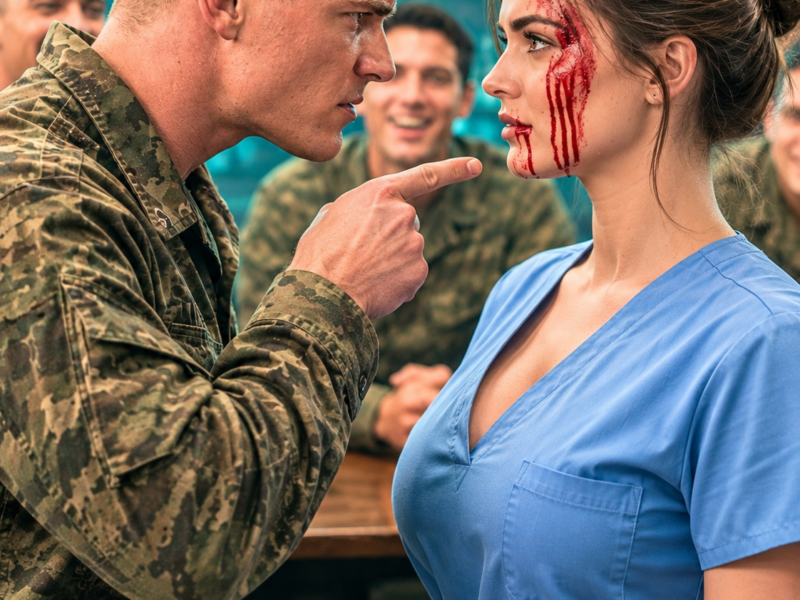
“The moment Sergeant Blake struck me across the face in front of thirty patients at Fort Liberty Medical Center
For several seconds, nobody moved.
Sergeant Blake stood in the doorway, staring at the photograph as though the dead man inside it had suddenly stepped into the room.
Colonel Reed broke the silence.
“Who is still alive, Sergeant?”
Blake looked at me.
His eyes moved from my face to the old photograph, then back to the black identification card in the colonel’s hand.
“Staff Sergeant Daniel Hayes.”
The name struck me harder than Blake’s slap.
Daniel.
I remembered his crooked smile, the scar above his eyebrow, and the way he used to tap twice on my helmet before every mission.
He had been my team leader.
He had also been the man who pulled me out of a burning helicopter in Afghanistan.
According to the official report, he had died during the same operation that ended my special operations career.
I had attended a memorial service.
I had stood beside his empty coffin.
I had even written a letter to his mother explaining that her son had been the bravest man I had ever known.
Now Sergeant Blake was telling me he was alive.
“That’s impossible,” I whispered.
Blake lowered his eyes.
“I saw him.”
“When?”
“Three weeks ago.”
My throat tightened.
“Where?”
He hesitated.
“At a military medical facility in Germany. He was being transferred under a different identity.”
I took a step toward him.
“Why didn’t you report it?”
Blake looked at Colonel Reed.
“Because I was ordered not to.”
The colonel’s expression hardened.
“By whom?”
Blake didn’t answer.
Instead, he reached into his uniform pocket and pulled out a folded sheet of paper.
“I was told to find out whether Nurse Carter still had her old identification card.”
I stared at him.
“Who told you?”
He looked directly at me.
“Someone who knew you would recognize the photograph.”
Colonel Reed took the paper.
It contained a name, a date, and a handwritten instruction.
At the bottom was a signature.
Colonel Andrew Mercer.
I recognized it immediately.
Mercer had been the operations officer who approved our Afghanistan deployment.
He had also signed the report declaring Daniel Hayes dead.
My hands began to shake.
“Why would Mercer want to know about my identification card?”
Blake rubbed his injured shoulder.
“Because he believes you kept something from that mission.”
I looked at the photograph again.
Four soldiers.
One helicopter.
A mountain ridge disappearing into smoke.
And a memory I had spent two years trying not to revisit.
The mission had begun on a cold October morning.
Our unit had been sent to recover a wounded intelligence officer from an abandoned communications station in eastern Afghanistan.
The briefing described it as a routine extraction.
It wasn’t.
The moment we reached the landing zone, our helicopter came under fire.
The pilot managed to set us down in a narrow clearing, but the aircraft was damaged beyond immediate repair.
Daniel ordered everyone to move toward the station.
I was the team’s combat medic.
My responsibility was to keep the men alive long enough to get them home.
We reached the building with two wounded soldiers and an intelligence officer who could barely walk.
Then we discovered that the station contained something nobody had mentioned during the briefing.
A locked server room.
Inside were files documenting unauthorized transfers of military equipment, falsified casualty reports, and payments made to individuals connected to an enemy network.
Daniel read the first few pages.
Then he looked at me.
“Emily, take photographs of everything.”
I remember the expression on his face.
It wasn’t fear.
It was recognition.
He had suspected something before we arrived.
I asked him what was happening.
He only said, “We were never supposed to find this.”
Minutes later, the building came under attack.
We were forced to retreat through a rear corridor.
Daniel stayed behind to help the intelligence officer.
I went back for a wounded soldier named Marcus Bell.
By the time I returned, the hallway was filled with smoke.
I found Daniel near the server room, bleeding from his side.
He handed me a small encrypted storage device.
“Keep this safe.”
I tried to lift him.
“We’re leaving together.”
He shook his head.
“Listen to me, Emily. If they ask what happened here, tell them we never found anything.”
I didn’t understand.
Then he pushed me toward the exit.
A second explosion shook the building.
I was thrown against the wall.
When I woke up, the roof had partially collapsed.
Daniel was gone.
So was the intelligence officer.
Marcus and I were recovered by another unit several hours later.
The official report stated that Daniel and the intelligence officer had been killed in the explosion.
It also stated that the server room had contained no recoverable intelligence.
But there was one thing the report didn’t mention.
I still had the storage device.
I had hidden it inside the lining of my medical bag before the rescue helicopter arrived.
I never told anyone.
Not because I wanted to protect myself.
Because Daniel had asked me to.
For two years, I had believed the device was nothing more than evidence from a mission that had gone wrong.
Now I understood that someone had been looking for it.
And Sergeant Blake had just confirmed that the search was still happening.
Colonel Reed closed the locker-room door.
“Sergeant, I want every detail of your contact with Colonel Mercer.”
Blake looked uncomfortable.
“I don’t think you understand what you’re getting into.”
The colonel’s voice became colder.
“Try me.”
Blake exhaled.
“Mercer contacted me after I returned from a medical evaluation in Germany. He told me Staff Sergeant Hayes had survived the operation but was being held somewhere under military protection.”
“Why would he be held?”
“Mercer said Daniel had suffered a head injury and was no longer fit for duty.”
I shook my head.
“Daniel wasn’t injured badly enough to lose his memory.”
Blake glanced at me.
“You don’t know what happened after you left.”
“Then tell me.”
He looked down at his hands.
“I was the last person to see him before the extraction team arrived.”
The room became quiet.
“What?” I whispered.
Blake swallowed.
“After the second explosion, I found him in a maintenance tunnel beneath the station. He was alive, but he couldn’t stand.”
“Why didn’t you bring him out?”
“I tried.”
His voice cracked.
“Two men arrived before I could get him to the landing zone. They said they were sent by command. They took Daniel away in a vehicle.”
“Did you see their identification?”
“Yes.”
“Whose?”
He hesitated.
“Colonel Mercer’s security detail.”
I felt the floor shift beneath my feet.
For two years, I had imagined Daniel dying alone in that building.
I had blamed myself for leaving him.
I had replayed the moment he pushed me toward the exit, wondering whether I could have made a different choice.
Now I was being told that he had survived.
And someone had deliberately taken him.
“Why didn’t you tell me?” I asked.
Blake looked ashamed.
“Because Mercer told me that if I spoke, my family would pay for it.”
I stared at him.
He continued.
“I believed him. I still do.”
Colonel Reed stepped between us.
“You’re going to provide a written statement, Sergeant.”
Blake nodded.
Then he looked at me.
“I know I have no right to ask you for anything, but I need you to understand something.”
I waited.
“When I saw you at the hospital, I recognized your name. I thought Mercer had sent you there to retrieve the device.”
I frowned.
“What?”
“That’s why I kept questioning you. I thought you were working with him.”
I looked at his face.
“That doesn’t explain hitting me.”
His jaw tightened.
“No. It doesn’t.”
For the first time, his voice carried no authority.
Only shame.
“I’m sorry.”
I didn’t accept his apology.
Not yet.
I wasn’t sure I ever would.
Colonel Reed ordered a security lockdown and contacted the military investigative division.
The next several hours passed in a blur of interviews, statements, and phone calls.
My cheek had begun to bruise badly.
A doctor examined me and recommended that I go home.
I refused.
I wanted answers.
More importantly, I wanted to know whether Daniel was alive.
At 8:40 that evening, Colonel Reed returned to the conference room.
He placed a sealed folder on the table.
“We found a transfer record.”
I leaned forward.
“Where?”
“An off-base rehabilitation facility in Maryland. The patient was admitted under a restricted identity two years ago.”
My breath caught.
“Is it Daniel?”
“The physical description matches. So does the date of birth.”
I stood up.
“When can we go?”
The colonel didn’t answer immediately.
“There’s a problem.”
Of course there was.
“The facility is operated by a private contractor. The transfer authorization carries Colonel Mercer’s approval.”
I stared at the folder.
“Then we get a warrant.”
“We’re working on it.”
“He’s been missing for two years, sir.”
“I know.”
“No, you don’t.”
My voice shook.
“You don’t know what it’s like to sit at someone’s memorial and listen to people tell you how brave he was when you know you left him behind.”
Colonel Reed remained silent.
Then he closed the folder.
“We’re going to find him, Emily. But I need you to let the investigators do their jobs.”
I looked away.
I had spent two years following orders.
I wasn’t going to lose Daniel again because somebody wanted me to wait.
The following morning, I returned to the hospital.
My cheek was still bruised.
The nurses tried not to stare, but I could see the questions in their eyes.
Dr. Collins, the emergency physician who had treated me, approached the nurses’ station.
“Are you sure you should be working?”
“I’m fine.”
He glanced at the bruise.
“That doesn’t look fine.”
I appreciated that he didn’t ask for details.
Then he handed me a cup of coffee.
“Someone left this for you.”
I looked at the label.
There was no name.
Just a small handwritten message.
You were right to stay quiet.
I turned the cup over.
A folded note was taped beneath it.
My fingers went cold as I read the words.
The device is no longer safe where you hid it. Mercer knows.
I looked toward the hallway.
Nobody was standing there.
But someone had been inside the staff area.
Someone who knew about the storage device.
And someone who knew I had kept it.
I immediately called Colonel Reed.
He arrived twenty minutes later with two investigators.
We went to my apartment under security escort.
The storage device was hidden inside a small metal case beneath a loose floorboard in my bedroom closet.
I hadn’t touched it since the day I returned from Afghanistan.
When I lifted the floorboard, the case was still there.
But the lock had been scratched.
Someone had tried to open it.
I carefully removed the device.
There was a tiny strip of paper beneath it.
I recognized Daniel’s handwriting.
If you are reading this, do not trust the first person who offers to help you.
I stared at the words.
Then I remembered the coffee.
The message had not been a warning from someone trying to protect me.
It might have been bait.
The investigators transported the device to a secure facility.
For hours, technicians attempted to access its contents.
The encryption was old but complicated.
At first, nothing worked.
Then one of the analysts noticed a sequence of numbers hidden in the file names.
They weren’t random.
They were the coordinates of the communications station where our mission had taken place.
The analyst entered them into a secure system.
A folder opened.
Inside were dozens of documents.
Financial transfers.
Equipment inventories.
Flight records.
And a series of recorded conversations.
The room went silent as the first recording played.
Colonel Mercer was speaking to someone whose face we couldn’t see.
“The extraction team cannot be allowed to return with those files.”
Another voice responded.
“What about the medic?”
Mercer paused.
“She won’t know what she has.”
Then came a sentence that made my stomach turn.
“Hayes is the only problem. If he survives, we’ll have to keep him somewhere he can’t speak.”
I covered my mouth.
The room seemed to shrink around me.
Daniel hadn’t been an accidental casualty.
He had been deliberately silenced because he had discovered a criminal operation involving stolen military equipment and falsified intelligence reports.
The files showed that Mercer had used unauthorized contractors to divert equipment through overseas supply routes.
Some of that equipment had ended up in the hands of hostile groups.
The same operation had caused several missions to fail.
Men had died because someone wanted to make money.
And Daniel had found the evidence.
The analyst stopped the recording.
“There’s more.”
He opened another file.
It contained a list of names.
Some belonged to officers.
Others belonged to civilian contractors.
One name appeared repeatedly.
Sergeant Blake.
I turned toward him.
He was sitting at the far end of the room, his face drained of color.
“Why is your name here?”
He looked at the screen.
“I don’t know.”
The analyst opened the attached statement.
It was a signed witness report dated two years earlier.
It claimed Blake had voluntarily surrendered the storage device to Colonel Mercer’s team.
Blake stood up.
“That’s not my signature.”
The investigator examined it.
“Are you certain?”
“Absolutely.”
Blake looked at me.
“Mercer forged my statement.”
I believed him.
Not because I trusted him.
Because the recording had just revealed that Mercer had been controlling the narrative from the beginning.
Then another file appeared.
It was a medical transfer authorization.
Daniel’s name was listed under a false identity.
The destination was the Maryland facility.
But the last page contained something none of us expected.
A handwritten note.
Patient has begun asking for his sister. Increase restrictions.
I couldn’t breathe.
Daniel remembered me.
He had been asking for me all along.
The investigation moved quickly after that.
Federal investigators secured the rehabilitation facility and obtained the records necessary to identify the patient.
Colonel Mercer was ordered to report for questioning.
He did not appear.
His office was empty.
His government vehicle was found abandoned near a highway outside Baltimore.
For the first time, I wondered whether he was planning to disappear before anyone could arrest him.
Colonel Reed arranged for a medical team and investigators to accompany us to Maryland.
I rode in the back of the transport vehicle with Sergeant Blake.
Neither of us spoke for most of the drive.
Finally, he turned toward me.
“I know you don’t forgive me.”
I looked out the window.
“You’re right.”
He nodded.
“I thought you were part of Mercer’s operation. When I realized who you were, I didn’t know what to do.”
“You could have asked.”
“I know.”
“You could have told the truth.”
“I know.”
I turned toward him.
“And you could have kept your hands to yourself.”
He lowered his head.
“There’s no excuse for that.”
For a moment, I saw the wounded soldier beneath the uniform.
But I also remembered the sound of my head striking the metal cabinet after he hit me.
His fear didn’t erase what he had done.
“I hope you tell investigators everything,” I said.
“I will.”
“Then start by telling them why you let two years pass.”
He looked at his hands.
“Because I was afraid.”
I didn’t respond.
Fear explained many things.
It didn’t make all of them forgivable.
The rehabilitation facility sat outside a quiet Maryland town, surrounded by trees and a high security fence.
From the road, it looked like an ordinary medical center.
Inside, it felt more like a place designed to make people disappear.
A nurse met us at the entrance.
She reviewed the authorization papers and led us down a long corridor.
“His condition has improved over the past year,” she explained. “But he has difficulty remembering certain events.”
I gripped the strap of my bag.
“Does he know his name?”
She hesitated.
“Sometimes.”
We stopped outside a room at the end of the hallway.
The nurse opened the door.
A man sat beside the window in a wheelchair.
His hair was shorter than I remembered.
There was a pale scar running along his jaw.
His right hand rested on a blanket.
For several seconds, I couldn’t move.
He looked older.
Thinner.
But I knew him.
“Daniel?”
The man slowly turned.
His eyes searched my face.
I stepped closer.
“It’s Emily.”
He stared at me.
Then his expression changed.
“Em?”
My knees weakened.
I covered my mouth.
He reached toward me with a trembling hand.
I crossed the room and held it.
For two years, I had imagined every possible way I might see him again.
None of those imagined moments had prepared me for this one.
I pressed my forehead against his hand.
“You’re alive.”
He tried to smile.
“You’re late.”
A broken laugh escaped me.
Then I began crying.
He squeezed my fingers.
“I thought you forgot about me.”
I pulled back.
“Never.”
He looked at my bruised cheek.
“What happened?”
I wiped my face.
“Someone made a mistake.”
Daniel’s expression changed.
“Who?”
I didn’t answer immediately.
Behind me, Sergeant Blake had entered the room.
Daniel saw him.
His hand tightened around mine.
“Get him out.”
Blake stopped.
“Daniel, I need to explain.”
“Get him out.”
Colonel Reed signaled the investigators to move Blake into the corridor.
I sat beside Daniel.
He watched the door close.
“Why don’t you trust him?” I asked.
Daniel took a slow breath.
“Because he was there when they took me.”
I felt my stomach tighten.
“He told us Mercer’s men took you.”
Daniel nodded.
“They did.”
“Then why are you angry with him?”
Daniel looked toward the window.
“Because he knew I was alive. He knew where they took me. And he signed the statement saying I had died.”
I stared at him.
“He says Mercer forged his signature.”
Daniel shook his head.
“Not that one.”
The room became very quiet.
I looked at the door.
“Are you saying Blake helped them?”
Daniel closed his eyes.
“He didn’t plan it. But he made a choice.”
The investigators returned to the room.
Colonel Reed asked Daniel whether he was able to provide a formal statement.
Daniel nodded.
But before he spoke, he asked me to retrieve the photograph from my bag.
I handed it to him.
He studied the four men standing beside the helicopter.
Then he pointed to the man at the far right.
“That’s Marcus Bell.”
I remembered Marcus.
He had been the wounded soldier I went back to retrieve during the explosion.
“He’s alive?” I asked.
Daniel shook his head.
“Not anymore.”
I felt my chest tighten.
“What happened?”
Daniel explained that Marcus had survived the operation but had later died in a vehicle accident during his recovery transfer.
The official report had called it an unfortunate accident.
But Daniel believed Marcus had been killed because he knew about the stolen equipment.
“Did Mercer order it?”
Daniel looked at Colonel Reed.
“I heard him give the order.”
The colonel asked quietly, “Did you hear anyone else?”
Daniel nodded.
“Blake.”
My thoughts began racing.
The investigator turned toward the corridor.
“Bring Sergeant Blake back.”
A few minutes later, Blake entered.
His expression was exhausted.
Daniel looked at him for a long time.
Then he asked one question.
“Why did you sign it?”
Blake’s shoulders dropped.
“I was told you were dead.”
“You saw me alive.”
“I know.”
“You watched them take me.”
Blake looked down.
“I thought they were taking you to a hospital.”
“You knew I was asking for help.”
Blake’s eyes filled.
“I did.”
Daniel turned away.
That answer seemed to hurt him more than anything else.
Blake stepped closer.
“Mercer told me if I helped him, my family would be protected. He said you would be treated and eventually released.”
Daniel looked back.
“And you believed him?”
Blake nodded.
“I wanted to.”
Daniel’s voice was quiet.
“That was the problem.”
Nobody spoke.
Then Blake pulled a folded document from his pocket.
It was a copy of the original transfer order.
“I kept this because I knew one day someone would ask what happened.”
The investigators took it.
Daniel closed his eyes.
“Then tell them everything.”
Blake nodded.
“I will.”
The next several weeks were difficult.
Daniel was transferred to a military rehabilitation hospital where he received treatment for his injuries.
His memory returned in fragments.
Some mornings he remembered every detail of our old missions.
Other days he struggled to remember what year it was.
I visited whenever my shifts allowed.
Sometimes we talked.
Sometimes we sat together without saying anything.
I brought him coffee from the hospital cafeteria, even though he complained that it tasted like burnt cardboard.
He still hated hospital food.
He still tapped twice on the table when he wanted my attention.
And sometimes, when the pain became too much, he would close his eyes and whisper the names of the men who hadn’t come home.
I listened.
I never told him to stop.
Meanwhile, the investigation uncovered the full extent of Mercer’s operation.
The stolen equipment had been routed through civilian contractors and sold through intermediaries.
Several mission reports had been altered to hide the transfers.
Men who questioned the operation were reassigned, threatened, or quietly removed from their units.
Mercer was eventually arrested at a private property outside Baltimore.
He was charged with multiple federal offenses related to fraud, conspiracy, and obstruction.
The recordings from the storage device became central evidence.
Blake cooperated fully with investigators.
His own role in the cover-up was reviewed separately.
He was removed from active duty while the military completed its disciplinary proceedings.
He later sent Daniel a letter.
I never read it.
Daniel didn’t ask me to.
One afternoon, I found him holding the old photograph.
“Do you remember what you told me before the mission?” he asked.
I sat beside him.
“Which part?”
“You said you were tired of being the person everyone expected to save.”
I looked at him.
“I don’t remember saying that.”
“You did.”
He smiled faintly.
“You told me you wanted a normal life.”
I looked down at my hands.
“I still do.”
Daniel nodded.
“Then have one.”
I laughed softly.
“It’s not that simple.”
“It should be.”
He placed the photograph on the blanket.
“You spent two years believing you left me behind.”
I swallowed.
“I did leave you.”
“You went back for Marcus. You tried to reach me. You were injured in the explosion.”
“But I survived.”
“So did I.”
His voice became firmer.
“Neither of us was supposed to carry the guilt for what Mercer did.”
I looked away.
For a long time, I had treated survival like a debt.
Every ordinary morning felt borrowed.
Every peaceful evening felt like something I hadn’t earned.
Daniel reached for my hand.
“You saved the men you could save, Em.”
I squeezed his fingers.
“I wish I had saved all of you.”
“So do I.”
He paused.
“But wishing doesn’t change what happened.”
I finally let myself cry without apologizing for it.
Three months later, Daniel attended the first official hearing connected to the investigation.
He walked into the courtroom using a cane.
I sat behind him.
For the first time since Afghanistan, he was able to speak publicly about what had happened.
He described the server room, the stolen equipment, and the orders Mercer had given.
He also described the night he was taken from the maintenance tunnel.
His testimony was calm.
He didn’t raise his voice.
He didn’t ask anyone to feel sorry for him.
When the prosecutor asked whether he believed Sergeant Blake had deliberately helped Mercer conceal the operation, Daniel paused.
“I believe he made a cowardly decision when a brave one was required.”
The courtroom remained silent.
Then Daniel continued.
“But I also believe he eventually chose to tell the truth.”
The prosecutor asked whether he wanted Blake punished.
Daniel looked toward the defense table.
“I want the truth recorded. Whatever consequences follow should be based on that truth.”
It wasn’t forgiveness.
Not yet.
But it was the first time Daniel had spoken about Blake without anger.
After the hearing, Blake approached us outside the courthouse.
He was no longer wearing his uniform.
He looked smaller without it.
“Daniel.”
Daniel stopped walking.
Blake swallowed.
“I don’t expect you to forgive me.”
“Good.”
Blake nodded.
“I just wanted you to know I gave investigators everything. Every name. Every order. Everything I remembered.”
Daniel studied him.
“Then keep doing that.”
Blake looked toward me.
“And Emily, I’m sorry.”
I touched the fading mark on my cheek.
“I hope you understand that saying sorry doesn’t make what you did disappear.”
“I do.”
I believed he meant it.
But belief wasn’t the same as forgiveness.
We walked away without another word.
A year after the day Blake struck me in the hospital corridor, I returned to work.
My old locker had been replaced.
The security footage from the assault had become part of the disciplinary investigation.
The hospital had also changed its reporting procedures for staff assaults and patient misconduct.
Some of the nurses still called me brave.
I never knew what to say.
I wasn’t brave that morning.
I had simply refused to let someone else’s anger decide who I was.
Daniel continued his rehabilitation.
He would probably never return to active duty, but he had started volunteering with a program that helped injured veterans transition into civilian life.
He was learning to live without the uniform.
I was learning that I didn’t need to hide my past to deserve a peaceful future.
One Friday afternoon, I found him waiting outside the hospital with two cups of coffee.
He handed me one.
“Still terrible,” I said after the first sip.
“Some traditions deserve to survive.”
We sat on a bench overlooking the parking lot.
For a while, neither of us spoke.
Then Daniel reached into his jacket and pulled out the old photograph.
The four of us stood beside the helicopter, young and certain that courage could protect us from almost anything.
He placed the photograph between us.
“I’ve been thinking,” he said.
“About what?”
“Maybe it’s time we stopped keeping this picture because of the people we lost.”
I looked at the faces.
Marcus.
Daniel.
The other two men.
And me, standing at the edge of the frame with my medical bag.
“What should we keep it for?”
Daniel smiled.
“Because we were there. Because we mattered. And because we made it home in whatever way we could.”
I rested my hand over his.
For two years, I had believed that the worst thing that happened in Afghanistan was losing my team.
I was wrong.
The worst thing was allowing someone else’s lie to convince me that I had abandoned them.
That evening, I returned to my apartment and took the black military identification card out of its case.
I no longer needed to hide it beneath folded clothes.
I placed it beside the photograph on my desk.
The next morning, I put on my nursing uniform and walked into the hospital.
A young soldier was waiting near the reception desk.
He looked nervous and kept rubbing his palms against his trousers.
When I introduced myself, he glanced at the small photograph clipped inside my locker.
“Ma’am, is that you with the special operations team?”
I looked at the picture.
“Yes.”
He hesitated.
“I heard you used to be a combat medic.”
I smiled.
“A long time ago.”
He nodded toward the hospital corridor.
“My friend is in there. He doesn’t want anyone treating him because he thinks needing help makes him weak.”
I set down my clipboard.
“What’s his name?”
The soldier told me.
I started walking toward the room.
Before I entered, I glanced once more at the old photograph.
Daniel had been right.
The past didn’t have to be something I carried like a punishment.
Sometimes it could simply remind me why I had chosen to stay.
And when I stepped into that room, I wasn’t a former special operations medic trying to prove she still belonged.
I was a nurse.
That was enough.
The End.









