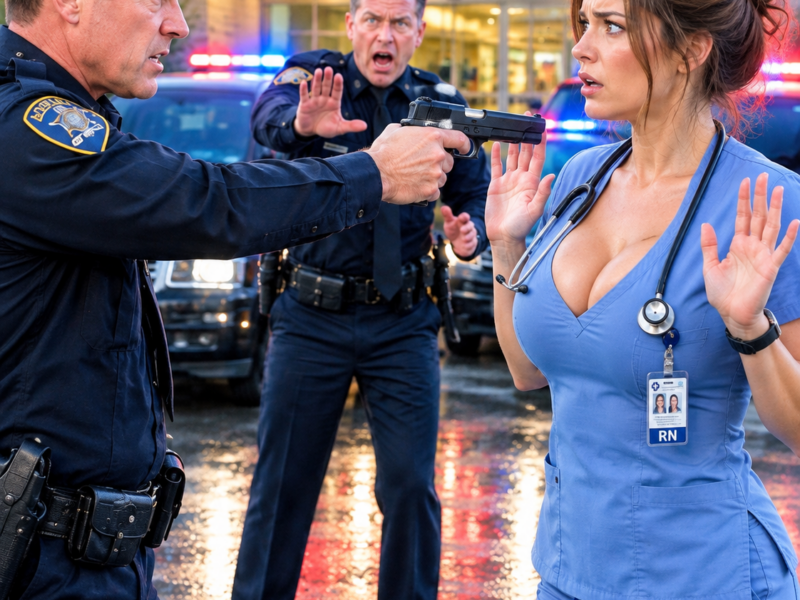
“The moment Officer Derek Collins pressed his gun against my chest in the middle of the emergency room
My phone was still in my hand when Chief Walker asked, “Who sent that message?”
I stared at the screen, my pulse hammering against my ribs. The unknown number had sent only seven words: *Rachel, don’t trust the police chief.*
“I don’t know,” I said.
Walker’s expression changed—not dramatically, not enough for anyone else to notice, but enough for me. His eyes flicked toward the officers gathering outside the trauma bay, then back to my phone.
“Don’t respond,” he said quietly.
“Why?”
“Because if the person who sent that message is watching this hospital, I need to know what they want.”
I took a step away from him.
“You just told me Officer Collins might be connected to a missing nurse. Now I get a warning about you, and your first concern is who sent it?”
His jaw tightened.
“Rachel, I know how this looks.”
“No. You know how it feels to be the person holding all the information while everyone else is expected to obey.”
For a moment, neither of us spoke.
Then the patient in Trauma Two began to convulse.
I ran.
Whatever else was happening, I was still a nurse, and a man’s life was slipping away in front of me.
His name was Michael Turner, according to the temporary identification tag attached by the paramedics. He was in his early forties, with a gunshot wound to the side and bruising around both wrists. His blood pressure had been unstable since his arrival, and the stress of the confrontation had pushed him dangerously close to another collapse.
“Get me another unit of blood,” I ordered. “And call Dr. Patel back in here.”
A nurse hurried toward the supply room while I adjusted Michael’s oxygen.
His eyes fluttered open.
“She’s safe?” he rasped.
“Who?”
“My daughter.”
I leaned closer.
“We’re trying to find her, Michael. I need you to tell me where she is.”
His fingers closed around my wrist with surprising strength.
“Locker twelve.”
“I heard you before. What is in locker twelve?”
“Proof.”
His breathing hitched. The monitor alarmed.
“Michael, stay with me.”
He looked past me toward the doorway, where Chief Walker stood watching.
“Not him,” Michael whispered.
My stomach tightened.
“Not the chief?”
Michael gave the smallest nod.
Then his grip loosened, and his eyes rolled back.
We spent the next several minutes fighting to stabilize him. When his heart rhythm finally settled, I stepped into the corridor with trembling hands and found Walker waiting beside the nurses’ station.
“Your patient has made it clear he doesn’t trust you,” I said.
“I gathered that.”
“Then why should I?”
He glanced toward the trauma bay.
“Because I came here to stop Collins from hurting you. And because the missing nurse you’re asking about was my niece.”
That stopped me cold.
“Your niece?”
“Sarah Walker. Twenty-nine years old. Worked nights at this hospital until six months ago.”
I knew the name. Everyone in the emergency department knew it. Sarah had been the kind of nurse who remembered the names of patients who returned months later. She had covered shifts when people were sick, brought groceries to a coworker recovering from surgery, and once stayed three hours after her shift to sit with the frightened wife of a dying man.
Then, one Monday morning, she simply didn’t show up.
Her apartment was empty. Her car was found near the river. Her phone was turned off.
The department had been told she was taking personal leave.
Nobody believed it, but nobody had proof of anything else.
“You let us believe she abandoned her job,” I said.
“I was told to keep the investigation quiet.”
“By whom?”
Walker looked at me for a long moment.
“People who had access to information I couldn’t obtain through normal channels.”
“That sounds convenient.”
“It was a mistake,” he admitted. “And I have spent six months trying to correct it.”
Before I could answer, my phone vibrated again.
A second message appeared.
*Locker 12. Old courthouse parking garage. Go alone if you want the girl alive.*
I showed it to Walker.
He read it twice.
“The courthouse garage is three blocks from the old municipal building,” he said. “There are storage lockers in the basement. The department used them years ago for evidence overflow.”
“Then we go there.”
“No.”
I stared at him.
“Michael’s daughter may be in danger.”
“And someone is trying to draw you into a place they control.”
“Then call for backup.”
“I will. But you will not go alone.”
I almost laughed.
“You expect me to trust you because you finally told me your niece is missing?”
“No,” he said. “I expect you to trust your instincts. Mine are telling me that whoever sent that message wants you frightened enough to make a mistake.”
He reached into his coat and removed a business card. On the back, he wrote a number.
“My personal line. If anything happens, call it. Not the station. Not dispatch. Me.”
I took the card but didn’t promise anything.
Across the corridor, two uniformed officers escorted Derek Collins toward the administrative wing. His hands were cuffed in front of him now. As he passed, he turned his head and looked straight at me.
“You don’t know what you’re doing, Nurse.”
I held his gaze.
“Then explain it.”
He smiled without warmth.
“You think Walker is the good guy because he showed up at the right moment? Ask him what happened to Sarah after she found the first file.”
The officers pushed him forward.
Walker had heard every word. His face had gone pale.
“What file?” I demanded.
He didn’t answer.
That was the moment I decided I would not wait for him to tell me the truth.
I called my charge nurse, explained that I needed to step away for a personal emergency, and handed over Michael’s care. Then I went to the locker room, changed out of my bloodstained scrubs, and put on the plain dark jacket I kept in my car.
I didn’t go alone.
I called my older brother, Ben, who worked as a public defender in Richmond. He answered on the second ring.
“Rachel? It’s almost midnight. What’s wrong?”
“I need you to do something without asking too many questions.”
“That’s never a good opening.”
“Can you get to the old courthouse parking garage? And can you bring your work phone?”
His voice changed immediately.
“Are you in danger?”
“I don’t know.”
“Then stay where you are.”
“I can’t.”
“Rachel—”
“Please, Ben. A little girl might be missing.”
He went silent.
“Send me your location,” he said. “And don’t enter any building until I get there.”
I agreed, knowing I had no intention of obeying the second part.
The old courthouse garage smelled of damp concrete and motor oil. Most of the overhead lights still worked, but several flickered, leaving long strips of shadow between the parked vehicles.
Ben arrived eight minutes after me, carrying his phone and the heavy flashlight he kept in his truck.
“You look terrible,” he said.
“Thank you.”
“I mean it.”
“So do I.”
I showed him the messages, the photo Collins had displayed, and the card Walker had given me. Ben read everything without interrupting.
“Did the chief explain why his niece disappeared?”
“Not enough.”
“Then we don’t trust him. We also don’t assume Collins is telling the truth. We find the locker, document whatever is inside, and leave.”
We found a row of old metal lockers behind a locked service door. A security guard had left the door secured with a simple combination padlock, but the building’s maintenance desk was still staffed. Ben showed his identification, claimed he was checking on a matter involving a missing person, and persuaded the tired attendant to accompany us.
Locker twelve sat at the end of the row.
It was unlocked.
Inside lay a small canvas backpack, a plastic envelope, and a child’s yellow raincoat.
I recognized the raincoat from Collins’s photograph.
Ben put on a pair of gloves and opened the envelope carefully. Inside were printed bank transfers, photographs of officers meeting with men outside a warehouse, and a thin notebook filled with names and dates.
Several names appeared more than once.
Derek Collins.
Two other officers.
A private security contractor.
And, on three separate pages, the initials T.W.
“Thomas Walker,” Ben murmured.
My throat tightened.
“Maybe someone used his initials to frame him.”
“Maybe,” Ben said. “But we’re not going to decide that based on hope.”
The notebook also contained a list of addresses. One was circled in red: a brick building on the edge of the city, near an abandoned textile warehouse.
I knew that building.
It was the one I had recognized in Collins’s photograph.
At the bottom of the envelope was a folded note written in blue ink.
*If anything happens to me, find Lily. Sarah knows where she is. Don’t trust the people who say they’re trying to help.*
There was no signature.
Ben photographed every page, then sent copies to a secure folder he used for legal casework.
“We need to get this to someone outside the Richmond Police Department,” he said. “A prosecutor, maybe state investigators.”
A sound echoed from the garage entrance.
Footsteps.
Ben switched off his flashlight.
A shadow crossed the narrow strip of light beneath the service door.
Then a phone rang.
Mine.
The sound was so loud in the stillness that I nearly dropped it.
Unknown number.
I answered without speaking.
“Rachel,” a woman’s voice whispered. “Are you at the lockers?”
My breath caught.
“Who is this?”
“My name is Sarah Walker.”
Ben looked at me sharply.
“Sarah? Where are you?”
“I can’t tell you that yet. Is Ben with you?”
I froze.
“How do you know my brother’s name?”
“Because Michael Turner told me about you. And because I’ve been watching the hospital from a distance for weeks, waiting for someone who wouldn’t hand him straight back to Collins.”
“Where is Lily?”
“Alive. For now.”
My knees nearly gave way.
“Where?”
“Listen to me. You found the notebook. That means they’ll know someone opened locker twelve.”
“Who will?”
“Collins and the people paying him. They’re not working alone.”
“Your uncle?”
Silence.
Then Sarah spoke again.
“I don’t know what my uncle is anymore.”
The footsteps outside the door stopped.
Ben leaned toward me and mouthed, *We need to go.*
Sarah’s voice grew urgent.
“Rachel, don’t let Thomas Walker take you to the station. He’ll say he can protect you, and he may even believe it. But the department has been compromised for a long time.”
“Why should I believe you?”
“Because I left the evidence in that locker. Because I have been hiding with Michael’s daughter for six months. And because the last person who tried to bring this to the authorities ended up dead.”
My hand tightened around the phone.
“Who?”
“My partner. Officer James Holloway. He found out Collins was using police intelligence to help a group that trafficked stolen identities and moved vulnerable witnesses between properties. He planned to report it. Two days later, his car went into the river.”
A cold wave moved through me.
“Was Sarah—was your disappearance connected to that?”
“I found records showing that people who should have been protected were being identified and sold out. Michael was one of the men who kept those records. His daughter saw something she shouldn’t have. Collins wanted the girl because he believed she could identify one of the men involved.”
“And you took her?”
“I got her out before they could.”
“Why didn’t you go to the FBI?”
“I tried. The first agent I contacted was suddenly transferred, and someone broke into the safe house that same night. After that, I stopped trusting official channels.”
A heavy knock struck the service door.
Ben grabbed my arm and pulled me behind a concrete pillar.
A man’s voice called from the other side.
“Police. Open the door.”
Sarah whispered, “They’re there, aren’t they?”
“Yes.”
“Get out through the ramp. Now. There’s a second exit on the east side.”
The call disconnected.
Ben and I ran.
We reached the east ramp just as a dark sedan swung into the garage below us. Two men got out. One wore a jacket with a badge clipped to his belt; the other kept his hands in his pockets and watched the stairs.
Ben pulled me behind a parked van.
“Don’t run toward the street,” he whispered. “They’ll see you.”
We waited until the men split up, then moved along the wall and slipped through an emergency exit into a narrow alley.
The night air felt painfully cold.
Ben called a contact at the state attorney general’s office, someone he had worked with on a wrongful conviction case. He gave no names at first, only enough information to make clear that we had evidence of a potential criminal conspiracy involving local law enforcement.
The contact told us to preserve everything and meet at a secure location.
Before we could leave, headlights swept across the alley.
A police cruiser stopped at the curb.
Chief Walker stepped out.
For a second, neither Ben nor I moved.
Walker raised both hands.
“I came alone,” he said.
Ben laughed bitterly.
“That’s what everyone says right before the other cars arrive.”
“Check the street,” Walker replied. “There are no units behind me.”
I looked past him. The street was empty.
“Why are you here?” I asked.
“Because Collins was released from the administrative room by two officers who were supposed to be guarding him. One of those officers is on the list you found.”
He looked at the envelope under Ben’s arm.
“You opened the locker.”
“We did,” Ben said. “And we copied everything.”
“Good.”
“Your initials are in that notebook.”
Walker’s face tightened.
“I know.”
The answer stunned me more than a denial would have.
“Explain.”
“Six months ago, Sarah came to me with evidence that Collins was passing information to people outside the department. I started an internal investigation. I used a small team, but one member leaked our movements. Sarah disappeared before I could get her somewhere safe.”
“You told the hospital she was on personal leave.”
“I was trying to keep the people searching for her from realizing how much we knew.”
“You made everyone think she had simply walked away.”
“I thought silence would buy time.” His voice broke slightly. “Instead, it isolated her. And it left her without the help she deserved.”
I wanted to hate him. Part of me did.
“But the initials?”
“Transfers through an account I controlled as part of the investigation. I moved money to track the contractor Collins was using. I couldn’t put the operation into the official system without exposing the people we were trying to identify.”
Ben folded his arms.
“Convenient explanation.”
“Then don’t take my word for it. Give the copies to your contact. Ask them to verify the transactions independently.”
He looked at me.
“I didn’t send you that warning.”
“Then who did?”
“I don’t know. But Sarah has been using disposable phones. She may have contacted you because she saw the same danger I did.”
“Why did you arrive at the hospital at the exact moment Collins pulled his gun?”
Walker’s eyes lowered.
“Because a nurse called dispatch after she heard Collins threatening you in the corridor. The call was rerouted to my office because Collins had already been flagged in our investigation. I drove straight there.”
“Then why didn’t you tell me all this earlier?”
“Because I didn’t know who in the hospital was involved. And because I didn’t know whether you were already being watched.”
The explanation made sense. It did not make him trustworthy.
“Where is Sarah now?” I asked.
“I don’t know.”
“Then you can’t help us.”
“I can help you keep Collins from reaching Michael.”
At the sound of the patient’s name, I remembered why this had started.
“Michael is still in the hospital. If Collins gets there before state investigators do, he’ll be in danger.”
Walker nodded.
“I have two officers I trust. They’re already securing the hospital’s entrances. No one will be allowed into Michael’s room without verification.”
Ben studied him for several seconds.
“We’re taking the evidence to the state attorney general’s office. You can come, but you don’t get to control it.”
“Agreed.”
We drove separately, with Ben following Walker’s cruiser at a distance. At the meeting point, a state investigator named Elena Ruiz met us in a small office above a closed legal clinic. She checked our identities, took the digital copies, and arranged for the physical evidence to be transferred under documented custody.
She did not promise us anything.
That was the first thing about her I trusted.
By dawn, she had confirmed that the bank transfers were real and that several names in the notebook were connected to an ongoing investigation involving stolen identities, witness intimidation, and the unlawful movement of people across state lines. She also found a discrepancy in the department’s records: the report claiming James Holloway had died in an accidental crash had been altered after the original filing.
“It’s enough to open a formal inquiry,” Ruiz said. “It isn’t enough to convict anyone. We need witnesses who can testify, and we need to find the child.”
“Sarah has her,” I said.
“Then we need Sarah.”
My phone rang again.
This time, the caller ID displayed a blocked number.
I answered.
“Rachel?” Sarah said.
“Where are you?”
“I can meet you. But only if the chief isn’t there.”
Walker stood across the room, listening without trying to take the phone.
“I’m not asking you to trust him,” I said. “I’m asking you to trust me enough to tell me where Lily is.”
Sarah gave me an address near the old textile warehouse.
“Come to the building with the red door. Don’t bring uniforms. If I see a marked car, I’ll leave.”
Ruiz arranged for plainclothes state agents to watch the surrounding streets without approaching the building. Ben and I went inside together.
The red door opened into a narrow hallway that smelled of dust and old plaster. A small lamp glowed in the back room.
Sarah stood beside a mattress on the floor, thinner than I remembered from the hospital photographs, her dark hair cut unevenly around her jaw. One hand rested on the shoulder of a little girl in a yellow raincoat.
Lily looked about eight years old. Her eyes were huge and guarded.
When she saw me, she moved behind Sarah.
“It’s okay,” Sarah told her softly. “Rachel is a nurse. She’s here to help.”
Lily studied me.
“Are you going to take me away?”
“No,” I said, lowering myself to one knee. “I’m going to help you get somewhere safe. You can ask questions, and you don’t have to decide everything right now.”
She looked at Sarah, who nodded.
Then Lily stepped forward and put her small hand in mine.
The simple trust of it nearly broke me.
Sarah explained that Michael had been keeping a record of people whose identities were being stolen and used to conceal financial transactions and move vulnerable witnesses. When Lily had been visiting him at a storage office, she had seen Collins and another man arguing over a file. The other man had struck Michael and threatened the girl.
Michael had managed to get Lily out through a rear entrance. Sarah, who had been investigating the same network, found them before Collins did. She moved them between safe locations while she tried to find someone outside the local department who could protect them.
“Why didn’t you tell your uncle?” I asked.
“I did, at first. I thought he could help. Then I saw a copy of a message sent from his office warning Collins that a search was coming. I couldn’t tell whether he had been compromised or whether someone was using his credentials.”
Sarah’s eyes filled with exhaustion.
“I didn’t know what to believe. So I ran.”
Walker had been right about one thing: fear had made every silence look like betrayal.
“Did you send me the message?” I asked.
“No. I sent the first one to warn you not to trust anyone blindly. But the message telling you to go to the lockers wasn’t mine. I didn’t know who had sent it until I heard your voice.”
“Then who knew about locker twelve?”
Sarah looked at Ben.
“Michael did. And Collins. The locker was supposed to be a dead drop. Michael had arranged it before he was shot. He wanted the evidence to survive even if he didn’t.”
A car door slammed outside.
Sarah went still.
Ben moved toward the window, peered through a narrow gap in the curtain, and swore under his breath.
A man was crossing the street toward the red door.
Derek Collins.
He had changed clothes, but I recognized his walk immediately.
Behind him was another officer, one of the names from the notebook.
Sarah pulled Lily toward the back room.
“There’s an exit through the courtyard,” she whispered. “Go.”
I followed them down a narrow passage, Ben close behind. We reached a metal gate just as voices rose in the hallway.
“Police!” Collins shouted. “Nobody move!”
A sharp crash followed.
Then a woman’s voice called out from the front of the building.
“State investigators! Put your hands where I can see them!”
The next few seconds were a confusion of shouting, footsteps, and the metallic clatter of a weapon hitting the floor.
Ben pushed Lily behind him and kept his hands visible as we stepped into the courtyard.
A state agent guided us behind an armored vehicle parked around the corner. Two more agents entered the building. Collins was brought out in handcuffs, his face flushed with fury.
“This is a setup!” he yelled. “Walker arranged the whole thing!”
Chief Walker appeared at the end of the street, escorted by Investigator Ruiz. He did not approach Collins.
He simply watched as the officer who had served under him was placed in the back of a state vehicle.
For the first time, Collins looked afraid.
The investigation moved quickly after that, though not as quickly as I wanted. Michael survived surgery and was placed under protective supervision. Lily was reunited with him in a secure location after doctors confirmed he was stable enough to see her.
When she entered his room, she ran to his bedside and buried her face against his shoulder.
Michael cried openly.
I stood near the doorway, pretending to check his monitor until I could trust myself to look away.
Sarah gave a formal statement to Investigator Ruiz. She identified the men in the photographs, described the threats she had received, and explained how she had hidden Lily while trying to preserve the evidence.
Walker cooperated with the state inquiry. His decision to conceal Sarah’s disappearance came under scrutiny, and he was placed on administrative leave while investigators reviewed his actions. He did not protest. When I saw him outside the hearing room, he looked older than he had in the hospital.
“I thought keeping the investigation quiet would protect her,” he told me.
“Keeping her safe and keeping your department safe aren’t the same thing,” I replied.
“I know that now.”
“I hope you do.”
He nodded and walked away.
Collins was charged with assault, obstruction, evidence tampering, and conspiracy-related offenses. The other officers named in the notebook were investigated, and the state prosecutor announced that additional charges would follow as the evidence was reviewed. James Holloway’s death was reopened as a suspicious case.
Sarah did not return to the hospital immediately. She needed time, and nobody asked her to explain why.
A few weeks later, she came to see me during my break. She looked healthier, though she still checked the door whenever footsteps passed in the corridor.
“I owe you an apology,” she said.
“For what?”
“For sending you into this without knowing whether you could trust anyone.”
“You didn’t send me to the lockers.”
“No, but I sent the warning. I knew you were in danger, and I still asked you to make a choice without giving you enough information.”
I thought about that for a moment.
“You were trying to survive.”
“So were you.”
She gave me a small, tired smile.
“Lily wants to thank you.”
“I didn’t do anything special.”
“You listened when she was afraid. You didn’t grab her, demand answers, or tell her everything would be fine. You let her choose to trust you.”
I looked down at my hands.
“I think that’s the only thing I knew how to do.”
“Sometimes that’s the thing people need most.”
Before she left, Sarah placed a folded piece of paper on the table. It was a drawing Lily had made: a little girl in a yellow raincoat standing between three adults. One had long dark hair, one wore a nurse’s badge, and one was drawn with a huge smile.
At the top, in uneven letters, Lily had written: *The people who stayed.*
I kept the drawing in my locker at work.
Months later, when I returned to a normal night shift, the emergency department seemed almost painfully ordinary. The monitors beeped, the automatic doors slid open and shut, and a man in the waiting room complained about the coffee.
I welcomed the familiar noise.
I still thought about the night Collins pointed a gun at me. I thought about how close I had come to believing that a badge automatically meant safety, or that a warning automatically meant truth. The people who tried to protect us had made mistakes. The people who claimed to protect us had sometimes been the danger. And the only way through it had been to keep asking questions, even when the answers frightened me.
One evening, I found a sealed envelope tucked beneath the drawing in my locker.
There was no return address.
Inside was a short note in Sarah’s handwriting.
*Lily is safe. Michael is recovering. The case is moving forward. You helped us get to the other side of the night.*
At the bottom, she had added one more sentence.
*You were right not to trust anyone blindly—not even the people who wanted you to.*
I folded the note and placed it beside Lily’s drawing.
Then I went back to work, where another patient was waiting, another family was frightened, and another person needed someone to stay beside them long enough to hear the truth.
The end.









