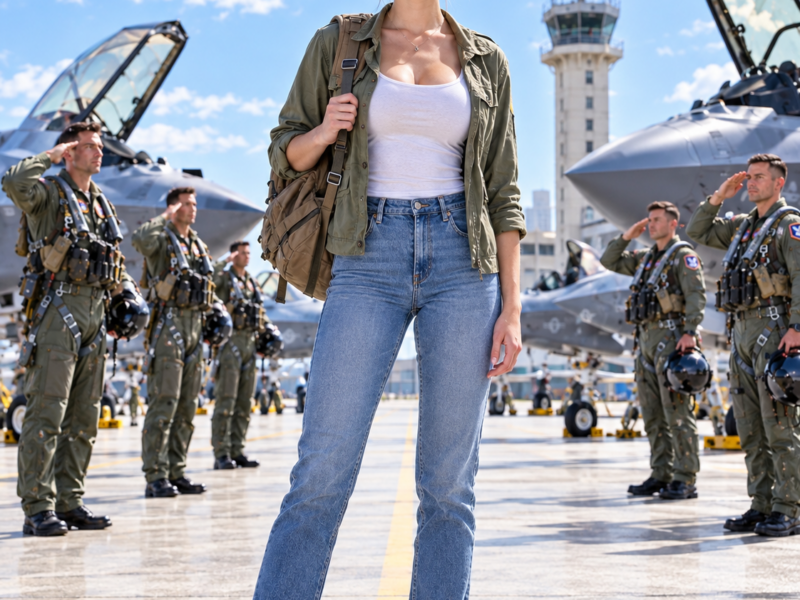
“The moment I walked into the crowded airport terminal wearing faded jeans and carrying a paper coffee cup
The youngest pilot took one step backward.
It was barely noticeable, but I saw it.
His eyes moved from my phone to Jake, then toward the airport entrance.
“What’s your name?” I asked.
He hesitated.
“Lieutenant Ryan Cole, ma’am.”
“How long have you known about Major Reeves?”
Jake turned toward him.
“Ryan?”
The young pilot swallowed.
“I don’t know what you’re talking about.”
I placed my phone on the table.
“Then explain why you recognized the handwriting.”
Nobody spoke.
The airport announcement system repeated the boarding call for my flight.
A family hurried past us, dragging two suitcases and arguing about a missing passport.
Ordinary life continued around us.
But I had just discovered that a man I’d mourned for five years might be alive, and one of the pilots standing in front of me was hiding something.
“Ryan,” Jake said quietly. “Tell her.”
The young lieutenant shook his head.
“Not here.”
I picked up Daniel’s identification tag.
“Then we’re going somewhere else.”
Jake nodded toward a small restaurant near the far end of the terminal.
We found a table in the corner.
I didn’t order anything.
Neither did Ryan.
For almost a minute, he stared at his hands.
Finally, he reached into his flight suit and removed a folded piece of paper.
“I got this three days ago,” he said.
He slid it across the table.
It was a handwritten note.
Emily,
If you’re reading this, the truth has finally started moving.
Don’t trust the official report about Northern Shield.
Find Carter before they do.
And whatever happens, don’t let anyone access the original flight recorder.
The signature at the bottom was unmistakable.
Daniel Reeves.
I read it twice.
“Where did you get this?”
Ryan looked at Jake.
“From my father.”
Jake frowned.
“Your father?”
Ryan nodded.
“Colonel Robert Cole. He was the operations officer at the command center during Northern Shield.”
I leaned back.
I remembered Colonel Cole.
He had been the officer who approved the flight plan.
He’d also been the man who called me three days after the mission and told me there was no point asking questions.
“Your father gave you this?”
“Not exactly.”
Ryan rubbed his forehead.
“He died six months ago. I found it in a locked drawer while my mother was clearing his office.”
I looked at the note again.
“Why didn’t you turn it over to your commander?”
“I tried.”
His voice became quieter.
“Two days later, someone entered my apartment while I was on duty.”
Jake’s expression hardened.
“Why didn’t you tell me?”
“Because I found the same symbol on my father’s old files.”
Ryan pulled a small photograph from his pocket.
It showed a black folder with a silver insignia stamped on the cover.
Three intersecting lines formed a triangle.
I recognized it immediately.
I’d seen that symbol on documents at the command center five years earlier.
It belonged to a restricted operations group known as Project Nightfall.
I looked at Ryan.
“Where did you get this?”
“From my father’s office.”
“Did you open the folder?”
He nodded.
“Most of it was empty. But there was one page with your name on it.”
He handed it to me.
The page contained a list of personnel involved in Northern Shield.
My name appeared near the top.
Beside it was a classification I had never seen before.
SUBJECT 07 — RECOVERY STATUS: UNCONFIRMED.
Below that was another entry.
SUBJECT 08 — REEVES, DANIEL — LOCATION: RESTRICTED.
I stared at the page.
“Subject seven?”
Ryan nodded.
“That’s you.”
Jake looked at me.
“Captain, what does that mean?”
I folded the paper.
“I don’t know yet.”
But that wasn’t entirely true.
Five years earlier, I had been the lead electronic warfare officer attached to a special flight support unit.
My official job had been coordinating aircraft navigation, emergency communications, and mission recovery.
What very few people knew was that I had also helped develop an experimental system capable of intercepting and reconstructing encrypted military flight transmissions.
It was called the Nightfall Relay.
The project was supposed to improve aircraft recovery during communications blackouts.
But during Northern Shield, I discovered that someone had used it for something else.
I had reported unusual transmissions coming from our own command network.
The following night, our aircraft were sent into a severe storm with altered navigation coordinates.
I remembered questioning the order.
I remembered Daniel telling me to trust his judgment.
And I remembered the last message he sent before his aircraft disappeared.
“Emily, if anything happens, don’t let them recover the recorder.”
At the time, I thought he meant the black box from his aircraft.
Now I wondered whether he’d been talking about something much more important.
I looked at Jake.
“Do you know where the original flight recorder is?”
He shook his head.
Ryan answered.
“My father kept a storage key.”
He placed a small envelope on the table.
Inside was a brass key with a handwritten number.
“Storage facility outside Colorado Springs,” he explained. “Unit 214.”
I looked at the key.
“Why didn’t your father take this to investigators?”
Ryan’s eyes lowered.
“Because he was afraid of what was inside.”
I studied him.
“Did he ever tell you anything about that night?”
Ryan hesitated.
Then he said something I wasn’t expecting.
“He told me he made a mistake.”
“What kind of mistake?”
“He said he signed the order that sent your squadron into the storm.”
Jake stared at him.
“Your father approved the flight?”
Ryan nodded.
“But he said the coordinates had been changed after his authorization. He didn’t know who did it.”
I felt my jaw tighten.
“Did he say anything else?”
Ryan looked at me.
“He said Major Reeves tried to stop it.”
For a moment, I couldn’t speak.
Daniel had questioned the flight plan.
He had warned me.
And I’d spent five years believing he’d abandoned us in the storm.
I stood.
“Where’s your luggage?”
Jake blinked.
“What?”
“You’re coming with me.”
Ryan looked startled.
“Ma’am?”
I picked up my bag.
“We’re going to Colorado Springs.”
We didn’t board my flight.
Jake contacted his squadron commander and reported a family emergency.
Ryan turned off his phone.
I called my brother Ethan and told him I’d miss the rehearsal dinner.
He was understandably furious.
“Emily, Mom has spent three weeks planning this.”
“I know.”
“You promised.”
“I know, Ethan.”
There was a long pause.
“Are you in trouble?”
I looked through the windshield at the airport traffic.
“I don’t know yet.”
He sighed.
“That’s not an answer.”
“It’s the only one I have.”
He went quiet.
Then he said, “Just don’t disappear on us again.”
I closed my eyes.
“I won’t.”
It was a promise I wasn’t sure I could keep.
Jake drove us toward Colorado Springs in a rented SUV.
For most of the journey, nobody spoke.
Ryan sat in the back, studying the papers his father had left behind.
I watched the highway signs pass.
The mountains gradually appeared in the distance.
I hadn’t been back to Colorado Springs in almost five years.
I’d left after the military investigation closed.
I rented a small apartment, changed careers, and tried to convince myself that the woman who once coordinated combat missions no longer existed.
But every time a thunderstorm rolled across the plains, I still found myself checking the weather radar.
Some habits don’t leave just because the uniform does.
The storage facility was located behind a row of commercial warehouses.
It was a private property with security cameras, a keypad entrance, and a small office.
Jake stayed outside while Ryan and I entered.
Unit 214 was at the end of the second corridor.
The brass key turned with a dry click.
Inside were several cardboard boxes, a metal cabinet, and a black equipment case.
Ryan opened the cabinet.
Most of the folders were marked with his father’s name.
I searched through them until I found a thin envelope labeled NORTHERN SHIELD.
Inside were flight manifests, weather reports, and printed communication logs.
I spread them across the floor.
At first, everything looked familiar.
Then I noticed something.
The coordinates in the official flight plan were different from the ones in the original communications log.
I checked the timestamps.
The alteration had occurred seventeen minutes after the authorization was signed.
Someone had accessed the command network and changed our route.
I looked at Ryan.
“Your father was telling the truth.”
He stared at the documents.
“Then who changed it?”
I turned to the black equipment case.
It was locked.
A small keypad sat on the side.
I tried the date of the mission.
Nothing.
Then I tried Daniel’s service number.
The case opened.
Inside was a portable flight data recorder.
Its exterior was scratched, and one corner was badly damaged.
But the label was clear.
F-17 FLIGHT RECORDER — AIRCRAFT 03.
Daniel’s aircraft.
I carefully lifted it.
A small envelope was taped underneath.
My name was written across the front.
I sat down on the concrete floor.
For several seconds, I couldn’t bring myself to open it.
Then I tore the envelope.
Emily,
If you found this, it means Cole finally decided to tell someone the truth.
I’m sorry I couldn’t come back.
I tried.
The recorder contains the original transmission from command.
Listen to the final seven minutes.
And remember something I told you before our first deployment:
The person who gives the order isn’t always the person who wants it carried out.
Daniel.
I read the final sentence again.
Jake appeared at the unit entrance.
“Everything okay?”
I shook my head.
“No.”
He looked at the recorder.
“Is that it?”
“Yes.”
Ryan came closer.
“Can we listen?”
I connected the recorder to a small laptop from the equipment case.
The file directory appeared.
There were several recordings.
Most were routine.
One was labeled FINAL APPROACH.
I clicked it.
Static filled the speakers.
Then I heard Daniel’s voice.
“Command, this is Reeves. We’re approaching the assigned coordinates. Confirming the storm system has moved east.”
A second voice responded.
“Confirmed. Continue on the planned route.”
Daniel paused.
“Negative. Our instruments show the weather system directly ahead. Request alternate coordinates.”
The response came immediately.
“Maintain course.”
I leaned closer.
Daniel spoke again.
“Command, the coordinates in our navigation system do not match the original flight plan.”
Static.
Then a different voice.
“Reeves, you are ordered to continue.”
I recognized that voice.
Colonel Robert Cole.
Ryan went pale.
“My father.”
The recording continued.
Daniel’s voice became sharper.
“Colonel, someone has altered our flight route.”
“Maintain course, Major.”
“With respect, sir, that order puts three aircraft at risk.”
There was a pause.
Then Cole said something that made my hands go cold.
“Your job is to follow the mission, not question its purpose.”
Daniel lowered his voice.
“Who is the real target?”
Nobody answered.
Then another voice entered the transmission.
A voice I recognized immediately.
General Thomas Harlan.
The senior officer who had personally overseen the Northern Shield briefing.
He said, “Reeves, you have been informed of the operational parameters. Do not compromise the objective.”
Daniel responded.
“The objective was an extraction mission.”
Harlan’s voice became colder.
“The objective has changed.”
The recording ended abruptly.
I sat staring at the laptop.
Jake looked at me.
“What does that mean?”
I slowly closed the file.
“It means we weren’t sent into that storm to rescue anyone.”
Ryan swallowed.
“Then what were you sent to do?”
I looked at the damaged recorder.
“To destroy something.”
The next morning, I went to the Air Force base outside Colorado Springs.
I hadn’t planned to.
But after hearing the recording, I knew I couldn’t keep pretending this was simply a matter of finding Daniel.
We needed to understand why our aircraft had been sent into the storm.
Jake arranged a meeting with a former intelligence officer who had retired two years earlier.
His name was Major Samuel Price.
He had worked with Daniel during the original investigation.
When I entered his office, he stood immediately.
“Emily Carter.”
“Major.”
He looked at me for a long moment.
“I thought you were dead.”
“Apparently, that makes two of us.”
He didn’t smile.
Instead, he closed the office door.
“How much do you know?”
I placed the recorder on his desk.
“Enough to know the official report was fabricated.”
Price examined the device.
Then he looked at Jake and Ryan.
“Where did you get this?”
Ryan answered.
“My father kept it.”
Price closed his eyes.
“Robert Cole.”
“You knew him?”
“I did.”
“Then you know he didn’t change those coordinates.”
Price was silent.
I stepped closer.
“Major, five years ago, I reported unusual transmissions coming from our command network. I was told there was nothing to investigate.”
He looked at me.
“Because the investigation was stopped before it began.”
“By whom?”
“General Harlan.”
I felt the old anger returning.
“Why?”
Price pulled a chair toward the desk.
“Because Northern Shield was connected to an intelligence operation called Project Nightfall. The program was originally designed to test a new encrypted navigation system. But someone inside the project discovered that it could also manipulate flight data.”
I nodded.
“I helped build part of the recovery system.”
“Yes. You were one of the few people who understood how it worked.”
“Then why did they send us into the storm?”
Price took a long breath.
“Because Daniel found out that Nightfall had been used to redirect aircraft without the knowledge of their pilots.”
“Where?”
“During several classified operations overseas.”
I looked at the recorder.
“And what were we carrying?”
Price opened a locked drawer and removed a folder.
He slid it toward me.
Inside was a list of encrypted data transfers.
Each one corresponded to an aircraft mission.
One entry was marked NORTHERN SHIELD.
Beside it was a destination code.
I recognized the location.
It was a remote communications facility in the mountains.
“What was there?”
“A server containing the original Nightfall navigation records.”
I looked up.
“Why would we need to destroy it?”
“Because those records proved that senior officers had authorized unauthorized aircraft rerouting.”
Jake leaned forward.
“People could have died.”
Price nodded.
“They did.”
I turned the page.
A second document contained a list of officers who had accessed the system.
One name appeared repeatedly.
General Thomas Harlan.
But there was another name.
Colonel Robert Cole.
I looked at Ryan.
He stared at the paper.
“My father?”
Price spoke gently.
“Your father was part of the operations chain. He signed the initial flight authorization, but he didn’t know the coordinates had been altered.”
Ryan shook his head.
“He spent the last six months of his life believing he’d sent people to die.”
Price nodded.
“He knew he’d made a mistake. He also knew he had been used.”
I looked at the list again.
“Why didn’t he come forward?”
“Because Harlan threatened to expose his involvement in the project. Cole was afraid he’d lose his career, his pension, and his family.”
Ryan lowered his head.
I understood that fear.
Not because I agreed with it.
But because I’d seen what happened when people with power decided to protect themselves.
“Where is Harlan now?”
Price looked toward the window.
“Retired. Living outside Washington.”
“Then we’re going to see him.”
Price shook his head.
“You can’t just walk into his house.”
“I know.”
“He’s dangerous.”
I looked at him.
“So was the storm.”
For the first time, Price smiled faintly.
“Daniel used to say the same thing about you.”
I turned toward him.
“You knew he was alive?”
Price hesitated.
“Not until two years ago.”
My jaw tightened.
“Another person who knew.”
“I’m sorry.”
“Why didn’t you tell me?”
“Because Daniel asked me not to.”
“That was his decision, not yours.”
Price accepted that.
Then he opened another folder.
“There is something else.”
He placed a photograph on the desk.
It showed a military hangar.
Several aircraft stood outside.
A group of officers were gathered near the entrance.
One of them was General Harlan.
Beside him stood a man in civilian clothes.
I recognized the face.
Dr. Alan Mercer.
He had been the technical director of Project Nightfall.
And he was the man who had personally assured us that our navigation systems were secure.
Price pointed to him.
“Mercer was the one who developed the unauthorized rerouting capability.”
I stared at the photograph.
“Where is he?”
Price hesitated.
“Dead.”
“When?”
“Three years ago.”
“How?”
“Car accident.”
I looked at the photograph again.
Something about the date bothered me.
“Three years ago?”
Price nodded.
“Why?”
I pointed to the corner of the image.
There was a handwritten note.
A date.
Three weeks after Daniel’s aircraft disappeared.
I felt my stomach tighten.
“That photograph was taken after the mission.”
Price looked at it more carefully.
Then his expression changed.
“That’s impossible.”
“Apparently not.”
I turned the photograph over.
There was a second note.
A location.
A small airfield in Nevada.
And beneath it, three words.
RECORDING TRANSFER COMPLETE.
I looked at Price.
“Did anyone ever recover the original Nightfall server?”
He nodded slowly.
“Officially, it was destroyed.”
“And unofficially?”
He didn’t answer.
I knew enough by then to recognize silence.
Someone had kept the server.
Someone had preserved the evidence.
And someone had spent five years making sure nobody could find it.
Two days later, I stood on the edge of a small airfield in Nevada.
Jake and Ryan were with me.
Major Price had arranged a meeting with a retired technician who had worked on Nightfall.
His name was Peter Lawson.
He was seventy-two years old, with a stiff left leg and a habit of checking the sky before speaking.
He met us inside a small hangar.
“I wondered when someone would come looking,” he said.
I studied him.
“You knew about the recorder?”
He nodded.
“I helped Daniel hide it.”
“Why?”
“Because he knew the command network had been compromised.”
Lawson walked toward a metal cabinet.
He unlocked it.
Inside was a sealed equipment container.
He placed a hand on the lid.
“The original server is in here.”
I stared at it.
“Why didn’t you give it to investigators?”
“Because the first investigator who asked for it was working for Harlan.”
He opened the container.
A compact server unit sat inside.
Its casing was scratched, but the serial number was intact.
I felt a strange sense of recognition.
I’d worked with this model during the early development of Nightfall.
Lawson looked at me.
“There’s something you should know before we open it.”
I waited.
“Daniel didn’t disappear because his aircraft crashed.”
I stared at him.
“What?”
“His aircraft was forced to divert after the system malfunctioned. He managed to eject before it went down.”
“Then where did he go?”
“To a small rescue facility in the mountains.”
I looked at Jake.
He looked equally stunned.
Lawson continued.
“He was injured, but alive. He was taken into custody by people who had been monitoring the operation.”
“Who?”
“Military intelligence.”
I felt anger rising.
“Why would they hide him?”
“Because he had the original transmission logs. And because he knew the Nightfall system had been used to manipulate military flight routes.”
I looked at the server.
“Where is Daniel now?”
Lawson gave me a sad smile.
“He’s closer than you think.”
Before I could ask what that meant, a voice came from the hangar entrance.
“That’s enough, Peter.”
I turned.
A man stood in the doorway.
He was older than the man in my memories.
His hair had turned gray.
He walked with a slight limp.
But I knew him.
Daniel Reeves.
For several seconds, I couldn’t move.
Then he looked at me.
“Hello, Emily.”
My throat tightened.
“You’re alive.”
He nodded.
“Yes.”
I wanted to run toward him.
I wanted to hit him.
I wanted to ask why he’d allowed me to believe he was dead.
Instead, I stood there with my hands at my sides.
“Five years.”
His eyes lowered.
“I know.”
“Five years, Daniel.”
“I know.”
“You let me mourn you.”
He took a breath.
“I was ordered to remain in protective custody while the investigation continued. I believed it was temporary.”
“And when it wasn’t?”
He looked at me.
“I tried to contact you twice.”
“Then why didn’t you?”
“Because the people protecting me told me your name had appeared in another threat report.”
I shook my head.
“You don’t get to make that decision for me.”
“I know.”
His voice was quiet.
“I was wrong.”
I looked away.
For a moment, I could hear the wind moving through the hangar.
Then he said, “I’m sorry, Emily.”
I finally stepped forward.
I didn’t embrace him.
Not yet.
But I took his hand.
He squeezed mine.
It was enough for that moment.
The server changed everything.
Its contents included the original navigation software, command authorizations, and encrypted messages exchanged between Harlan and Mercer.
More importantly, it contained a complete record of the flight-route alterations during Northern Shield.
The evidence showed that Harlan had ordered the squadron into the storm to destroy the server’s original backup at the remote communications facility.
He believed the weather would prevent anyone from recovering the wreckage.
He had also assumed that all three aircraft would be lost.
But he had underestimated two people.
Daniel, who refused to obey the final order.
And me, who had noticed that the navigation data didn’t match the original flight plan.
I had managed to guide two aircraft away from the worst of the storm.
The third had been lost.
Michael Sullivan had died trying to stabilize his damaged aircraft.
For five years, I’d carried the memory of his final transmission.
Now I understood that his death had not been an unavoidable accident.
It had been the consequence of a decision made by men who never had to sit beside a grieving family.
Daniel had been trying to expose that decision ever since.
And he’d been protecting me from the people who wanted the evidence destroyed.
The investigation began within days.
This time, it was handled by an independent federal team with direct oversight from the Department of Justice.
General Harlan was questioned.
His communications were authenticated.
His signature appeared on the original order.
The evidence was too extensive to bury.
Within weeks, he was formally charged with conspiracy, obstruction of justice, and offenses connected to the falsification of military operational records.
Several other officers were investigated.
Peter Lawson testified.
Major Price provided the original command logs.
Ryan submitted his father’s documents.
And Daniel finally gave a complete account of what happened after his aircraft went down.
I was asked to testify as well.
I agreed.
Not because I wanted to return to the life I’d left behind.
But because Michael Sullivan deserved to have his death understood honestly.
His family deserved the truth.
The hardest testimony came three months later.
I stood in a federal hearing room and looked across the table at General Harlan.
He was smaller than I remembered.
His hair was white.
His face had deep lines around the mouth.
He looked like someone’s grandfather.
Not like the man who had sent three aircraft into a storm.
His attorney asked whether I had personally witnessed him alter the coordinates.
“No,” I answered.
“Then you cannot say he personally changed the flight plan, correct?”
“I can say the command authorization came from his office.”
“That isn’t the same thing.”
“No,” I said. “But the original recordings, the system logs, and his communications with Dr. Mercer establish what happened.”
The attorney glanced at the papers.
I continued.
“You’re asking whether I saw him touch a computer. I didn’t. But I heard him order my commanding officer to maintain a route that he knew had been changed.”
The room went quiet.
I looked directly at Harlan.
“Three men were sent into that storm. One of them never came home. And for five years, their families were told it was simply an accident.”
Harlan looked down.
I didn’t feel triumphant.
I felt tired.
But I also felt something I hadn’t felt since that night.
I felt that the truth had finally been allowed into the room.
The case continued for months.
Eventually, Harlan pleaded guilty to multiple federal offenses.
The military also issued a formal correction to the Northern Shield report.
The mission was no longer described as an unavoidable weather-related accident.
The official record acknowledged unauthorized flight-route manipulation and deliberate concealment of evidence.
Michael Sullivan’s family received a full briefing.
I attended the meeting with Jake.
His mother sat across from us, holding a photograph of her son in his flight suit.
She listened without interrupting.
When I finished, she reached across the table and took my hand.
“I always wondered whether he was scared.”
I swallowed.
“He was scared. But he kept helping the others.”
She nodded.
“That sounds like Michael.”
Jake looked down.
His mother turned toward him.
“Your brother would be proud of you.”
Jake wiped his eyes.
Then she looked back at me.
“Thank you for remembering him as a person, not just a name on a report.”
I carried those words with me for a long time.
Six months later, I finally attended Ethan’s wedding.
My mother cried when she saw me.
She hugged me so tightly that I nearly dropped the gift bag.
“You made it.”
“I promised.”
She pulled back and studied my face.
“You look different.”
I smiled.
“Maybe I am.”
Ethan came over wearing his wedding suit.
“Emily Carter. The woman who finally remembered she has a family.”
I laughed.
“Don’t start.”
He hugged me.
Then he whispered, “I’m glad you’re here.”
For years, I’d kept the truth from him because I thought it was safer.
I had convinced myself that protecting people meant keeping them outside the parts of my life that hurt.
But when I looked at my brother, I realized how much of our relationship had been shaped by what I hadn’t told him.
Later that evening, we sat outside beneath strings of warm lights.
I told him the truth.
Not every classified detail.
Not every technical explanation.
But enough for him to understand why I had left the military, why I avoided airports, and why thunderstorms sometimes made me sit awake until morning.
He listened.
When I finished, he didn’t ask why I hadn’t told him sooner.
He simply said, “You don’t have to carry all of that by yourself anymore.”
I looked across the yard.
Daniel was standing near the reception tent.
He had come as my guest.
We were not officially together.
We hadn’t decided what we were.
Five years had created too much distance for a simple reunion to erase.
But we were talking again.
Slowly.
Honestly.
Sometimes that was harder than flying through a storm.
After the wedding, I returned to Colorado Springs.
I didn’t go back to my old military career.
I didn’t want to.
Instead, I accepted a position training emergency aviation teams in navigation safety and crisis communications.
I taught young pilots how to recognize when an order didn’t match the information in front of them.
I taught them how to question a system without losing confidence in their own judgment.
And sometimes, when the weather was clear, I stood near the runway and watched the aircraft take off.
One afternoon, Jake and Ryan visited my training center.
Ryan carried a framed photograph.
It showed his father standing beside a younger version of himself.
He placed it on my desk.
“My mother wanted you to have this.”
I looked at the picture.
“Thank you.”
Ryan hesitated.
“She also wanted me to tell you something.”
“What?”
“She said my father spent his final months trying to make sure the people he had failed would eventually receive the truth.”
I looked at the photograph again.
“That matters.”
Ryan nodded.
“I think so, too.”
After they left, I noticed a small envelope tucked beneath the frame.
Inside was a handwritten note from Colonel Cole.
Captain Carter,
I don’t expect forgiveness.
I only hope that one day you understand I was afraid, and that fear made me choose silence when I should have chosen courage.
I am sorry.
Robert Cole.
I folded the letter and placed it in my desk drawer.
I wasn’t ready to forgive him.
Maybe I never would be.
But I no longer needed to spend my life wondering what had happened.
The truth was there.
It belonged to the families.
It belonged to the people who had served.
And it belonged to the young pilots who would someday be asked to make decisions in the sky.
On the anniversary of Northern Shield, the Air Force held a small memorial ceremony.
I stood near the front beside Jake, Ryan, and Daniel.
The names of the fallen were read aloud.
When they reached Michael Sullivan, Jake lowered his head.
I placed a hand on his shoulder.
After the ceremony, the three pilots approached me.
Jake stood straight.
“Captain Carter.”
I looked at him.
“Lieutenant.”
He smiled.
“Thank you for bringing us home.”
I shook my head.
“You brought yourselves home. I just helped you find the way.”
Ryan glanced toward the memorial.
“My father used to say the best pilots know when to follow instructions.”
I raised an eyebrow.
“And?”
He smiled faintly.
“The best ones also know when to ask why.”
I nodded.
“Your father learned that lesson too late. But you don’t have to.”
The three men stood quietly for a moment.
Then Jake saluted.
This time, I didn’t ask him to stop.
I returned the salute.
Not because I needed recognition.
Not because I wanted people to know what I’d done five years earlier.
But because I finally understood what that gesture meant.
It wasn’t about the uniform.
It was about the people who had trusted one another when everything else failed.
As the pilots walked away, Daniel stepped beside me.
“Ready to go?”
I looked once more at the names engraved on the memorial.
Then I took his hand.
“Yes.”
We walked toward the parking lot beneath a clear Colorado sky.
For five years, I’d believed my story ended in that storm.
I had been wrong.
The storm had taken a friend, stolen years from the people who survived, and hidden the truth behind official signatures.
But it hadn’t taken away the one thing I still had the power to choose.
What I did with the life that remained.
And this time, when someone called my name, I didn’t turn away.
The end.









