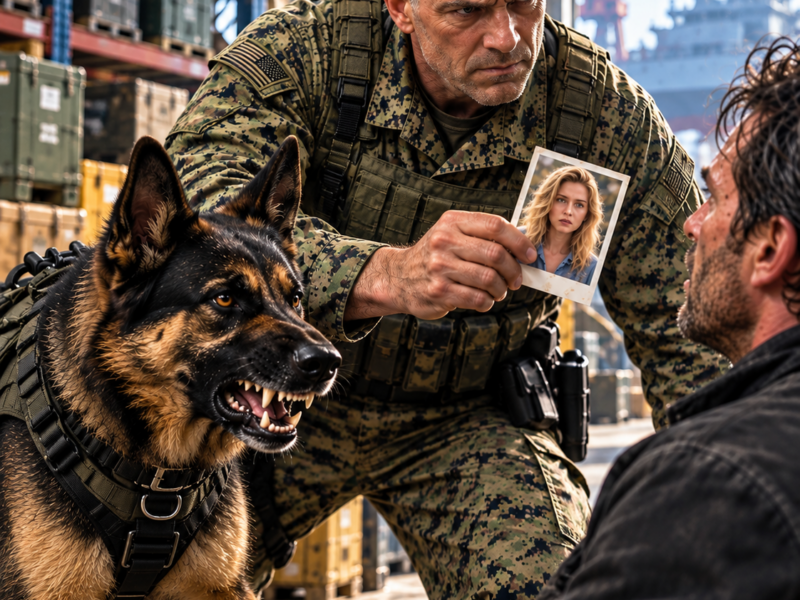
“The moment I saw my eight-year-old daughter being dragged toward a stranger’s yacht at a Florida marina, I heard her scream my name
The man on the yacht lowered the photograph, and for one terrible second, I forgot how to breathe.
It was Rachel.
Not Lily.
Rachel.
My wife stood in the picture wearing the blue dress she’d chosen for her last family photograph, her dark hair tucked behind one ear, her smile soft and a little tired. I recognized the white flowers behind her, the stone chapel, the narrow strip of sunlight cutting across the cemetery.
Her funeral.
The man holding the photograph had been there.
I was certain of it.
I had seen hundreds of faces that day, most of them blurred by grief, but I remembered one detail about every person who had approached Rachel’s grave.
A silver ring shaped like a compass.
The man on the yacht wore it on his right hand.
“Lily,” I said quietly, “get behind me.”
She grabbed the back of my shirt with both hands.
The woman in the cream blouse stood beside the SUV, her face drained of color. She looked from me to the yacht, then toward the road leading out of the marina.
“You need to leave,” she whispered.
I kept my eyes on the man above us.
“Who is he?”
“I can’t tell you here.”
“Try.”
Her mouth tightened.
“His name is Adrian Cross. He runs the organization that arranged the placement.”
“Placement?”
She flinched at the word.
“That’s what they call it.”
Behind me, Lily began to cry silently.
I felt every tear as if it were falling down my own face.
“You have ten seconds to explain why two men tried to drag my daughter onto that boat.”
“I didn’t order them to take her.”
“You brought them here.”
“I brought you here because I thought I could get her away from Cross before he arrived.”
I turned toward her.
“You used my daughter as bait?”
“No.” Her voice cracked. “I thought I could make a deal before he knew you were here.”
A low engine rumbled from the yacht.
Cross was moving toward the gangway.
The two men who had grabbed Lily spread apart, one heading toward the dock entrance, the other moving along the side of the boat.
They weren’t ordinary kidnappers.
They were controlling exits.
I had spent fifteen years in the Navy learning how to read movement, recognize a coordinated threat, and keep panic from making decisions for me.
But no training had prepared me for the sight of my eight-year-old daughter trembling behind my legs.
I crouched in front of her.
“Lily, listen to me. I need you to stay right beside me. If I tell you to run, you run toward the marina office and tell the people inside to call 911. Do you understand?”
She nodded, struggling to breathe.
“Will you come with me?”
“I will do everything I can to get back to you.”
It wasn’t the promise I wanted to make.
It was the one I could honestly keep.
I took her hand and began walking toward the marina office.
The woman stepped in front of us.
“Wait. Cross won’t let you leave.”
I stared at her.
“Then he can explain that to the police.”
She shook her head.
“You don’t understand. He has people in law enforcement. He has people in the courts. He has people who can make a father look unstable and a child look unsafe.”
“What’s your name?”
She hesitated.
“Evelyn Shaw.”
“Are you law enforcement?”
“No.”
“Social services?”
“No.”
“Then you’re going to explain everything to the police, Evelyn.”
A voice called from behind us.
“Jack.”
Cross had reached the dock.
He was taller than he had looked from the yacht, with neatly combed gray hair and the relaxed posture of a man who had never needed to raise his voice to get what he wanted.
His eyes moved to Lily.
For a fraction of a second, something like recognition passed across his face.
Then he smiled.
“She’s grown.”
Lily made a small sound and pressed herself against me.
I stepped between them.
“You don’t get to look at her.”
Cross stopped several feet away.
“I knew her mother.”
“You were at her funeral.”
“I was.”
“Who are you?”
“Someone who made a promise to Rachel.”
I almost hit him.
The only thing that stopped me was Lily’s hand gripping mine.
“My wife is dead,” I said. “Whatever promises you made to her died with her.”
“Not this one.”
He reached inside his jacket.
I shifted my stance, ready to move Lily behind the nearest concrete piling.
Instead of a weapon, he produced an envelope.
“I believe you’ll want to read this.”
“I want you to put your hands where I can see them.”
He gave a faint, humorless smile.
“You’ve been trained well.”
“Hands.”
He raised them slowly, holding the envelope between two fingers.
“I know what you think this is. A kidnapping. A trafficking attempt. An operation targeting the daughter of an active-duty sailor.”
“That’s exactly what it looks like.”
“And you’d be right about the first two.”
His admission chilled me more than a denial would have.
Cross glanced at Lily.
“But the target was never supposed to be your daughter.”
I felt my pulse hammer in my throat.
“Then why did you bring her here?”
“Because someone stole a file from me. A file your wife hid before she died. Your daughter was the only person I knew could lead me to it.”
Evelyn whispered, “You told me this was about protecting her.”
“I told you what you needed to believe.”
I looked at her.
For the first time, she appeared genuinely horrified.
Cross continued as though we were discussing a business dispute.
“Rachel worked for an organization that identified vulnerable children and placed them with families willing to pay for access. Some placements were legal adoptions. Others were not. The distinction became inconvenient for people who preferred not to ask questions.”
Lily lifted her head.
“My mommy would never do that.”
Cross looked at her, and for a moment, the smile vanished.
“No, sweetheart. Your mother was the reason some of those children came home.”
The words landed between us.
I wanted to believe him.
I wanted to reject everything he said.
But he had known Rachel, and I had spent four years wondering whether I had truly known every part of my wife.
“What did she do?” I asked.
“Rachel was an accountant for a charitable foundation that claimed to help children in crisis. She discovered that the foundation was being used to move money and falsify guardianship records. When she tried to expose it, the people running the operation realized she had copied their records.”
“And you were one of them.”
“I was involved in the financial side.”
“So you helped them.”
“Yes.”
He said it without hesitation.
That honesty didn’t make him better.
It made him more dangerous.
Cross glanced at the envelope.
“Rachel gave me a choice. Help her get the children out, or watch the organization destroy the evidence and everyone connected to it. I helped her with a few transfers. I never told her how far the operation went.”
“Why should I believe any of this?”
“You shouldn’t.”
His answer caught me off guard.
“Not until you see what she left behind.”
A siren sounded somewhere beyond the marina entrance.
Cross looked toward the road.
Evelyn had called someone.
I hadn’t heard her do it, but I saw her phone still in her hand.
“Good,” I said. “Now we’ll have witnesses.”
Cross’s expression hardened.
“You have no idea how much time you’ve just lost.”
One of his men started toward us.
I raised my voice.
“Stay where you are!”
He stopped, but his hand slipped beneath his jacket.
I moved Lily behind the concrete piling and shouted for the marina staff to get inside.
Then everything happened at once.
A second vehicle screeched into the parking area. Two men in dark clothes jumped out, neither wearing a uniform. One pointed toward Cross. The other ran for the yacht.
Cross swore under his breath.
“They weren’t supposed to be here yet.”
“Who?”
He didn’t answer.
The man running for the yacht pulled a compact pistol from his waistband.
That was enough.
I shoved Lily down behind the piling and covered her with my body as a shot cracked across the water.
People screamed.
A second shot struck the metal railing above us.
I didn’t draw a weapon. I didn’t have one. I had my daughter, a concrete barrier, and a narrow route to the marina office.
“Lily, go!”
She scrambled up and ran.
I followed close behind, keeping my body between her and the gunfire.
Evelyn appeared at the corner of the building and waved us toward the office door.
“Inside! Now!”
I pushed Lily through it and turned back.
Cross was still on the dock.
He could have run for the yacht.
Instead, he was dragging an injured marina worker behind a fuel cabinet while the two armed men moved toward him.
For one confusing instant, I saw the man from the cemetery not as a mastermind but as someone who had just risked his own life to pull a stranger out of a shooting.
Then he looked up and caught my eye.
“Get her out of here!”
A third shot shattered a window.
I pulled the door shut and locked it.
Inside, the marina manager was already calling emergency services. Two terrified customers crouched beside the counter.
Lily had wedged herself beneath a desk.
I dropped to my knees.
“Baby, look at me.”
Her face was white.
“Daddy, are they going to take me?”
“No.”
The word came out so fiercely that she flinched.
I softened my voice.
“No one’s taking you. I’m right here.”
She reached for me, and I held her while the dispatcher spoke through the manager’s phone.
Outside, the gunfire stopped.
Seconds stretched into minutes.
Then sirens flooded the marina.
I gave the responding officers my name, my service identification, and a concise account of what I had witnessed. I told them about the armed men, the attempted abduction, Evelyn, and Cross.
I didn’t leave anything out.
I also didn’t let Lily out of my sight.
The officers secured the docks and moved the injured marina worker to an ambulance. One of the armed men was caught behind a storage building. The other disappeared before the perimeter closed.
Cross was found sitting on the yacht’s lower deck with his hands visible and blood soaking one sleeve.
Evelyn surrendered without resistance.
When an officer approached me with questions, I asked for a supervisor and a child-protection specialist who was independent of any agency Evelyn claimed to represent.
The officer gave me a guarded look.
“Sir, we’re going to need you to come down to the station.”
“I’ll cooperate. My daughter stays with me until a verified guardian or qualified child specialist says otherwise.”
He started to object.
Then Lily stepped out from behind my leg and showed him the red-circled photograph.
“Someone left this in Daddy’s truck,” she said. “They knew when he was going away.”
The officer’s expression changed.
He took the photograph carefully, using the edge of a glove.
“Who found this?”
“I did.”
“Did you touch anything else?”
“No.”
He nodded to another officer.
“Get the evidence team. And I want the school contacted through the district office, not through any number on this paper.”
That was the first sensible thing I’d heard all afternoon.
At the station, Lily was interviewed by a trained child specialist with me nearby. She told the story in small pieces: a woman at school who said she was arranging a special trip, a man who had known her mother’s name, and a stranger who’d asked whether her father would be leaving soon.
She remembered a silver compass ring.
She remembered being told that her mother had left her a surprise.
She remembered refusing to go with the men until one of them grabbed her arm.
Then she remembered me.
“I knew Daddy would come,” she said.
I had to look away.
A detective named Alvarez took my statement after Lily was settled with a victim advocate. She was in her forties, with tired eyes and the calm, deliberate manner of someone who had learned not to believe the first version of any story.
“Cross says he can explain your wife’s involvement,” she told me.
“Then let him.”
“He also says your wife left behind evidence of a child-trafficking network operating through several nonprofit organizations and private placement agencies.”
“Was my wife part of it?”
Alvarez folded her hands.
“We don’t know yet.”
The answer hurt because it was honest.
“Was she killed because of it?”
“We’re reopening the investigation into her death.”
My chair seemed to shift beneath me.
“You mean it wasn’t properly investigated?”
“I mean the original report classified the crash as accidental. Some records were missing from the case file, and the financial investigation was never completed.”
I stared at her.
Rachel had died on a rainy Tuesday four years earlier. Her car had left a rural road outside St. Augustine and struck a stand of trees. The police said she had lost control on a slick bend.
I had buried her believing it was an accident.
I had spent years trying to accept that no one could have prevented it.
Now a detective was telling me the investigation had holes.
“Why didn’t anyone tell me?”
“Because the records that should have raised questions were never included in the original file.”
“Who removed them?”
“We’re working on that.”
She slid a clear evidence sleeve across the table.
Inside was a small brass key.
“Cross says this belonged to Rachel. He claims he found it among papers she left with him shortly before she died.”
I didn’t touch it.
“What does it open?”
“He says he doesn’t know.”
I looked at the key.
I recognized the small notch cut into its bow.
Rachel used to keep it on a blue ribbon inside a wooden jewelry box. I had seen it years ago, but she told me it opened an old storage cabinet belonging to her mother.
Her mother had died long before Lily was born.
I told Alvarez that.
She wrote it down, then asked me to wait while she verified the detail.
A few minutes later, she returned with a sealed property bag.
“Your wife’s mother owned a small storage unit near the old railway depot,” she said. “The account was paid through an automatic bank transfer until four years ago. The payments stopped the month Rachel died.”
My mouth went dry.
“Does the unit still exist?”
“It does. We’re getting a warrant.”
I leaned forward.
“Then let me go with you.”
“No.”
“Detective—”
“Your daughter was nearly abducted today. You are an eyewitness in an active investigation, and we have reason to believe the people who tried to take her may have access to information about your military schedule. You’re not going anywhere until we’ve secured your home and established who has been following your family.”
I hated every word of it.
But she was right.
Someone had known when I would be away.
Someone had known Lily’s school, our address, and my duty schedule.
Someone had watched my daughter long enough to photograph her.
The thought made my skin crawl.
A Navy security officer arrived that evening. He confirmed that my deployment schedule had been accessed through an internal system by someone whose credentials were being investigated.
That didn’t mean the Navy itself was involved.
It meant someone had found a way to get information they had no right to see.
My command placed temporary restrictions on my movements while the security team worked with the civilian investigators.
I didn’t argue.
I wanted whoever had done this caught.
At midnight, Lily finally fell asleep in a secure room at the station, her head resting against my side.
I watched her chest rise and fall.
Then my phone vibrated.
An unknown number.
The message contained six words.
Rachel didn’t trust Cross. Check the blue book.
I stared at the screen.
Alvarez, who had been reviewing surveillance footage across the room, noticed my expression.
“What is it?”
I handed her the phone.
She photographed the message and instructed the technical team to preserve it.
“Do you know what the blue book means?” she asked.
I did.
Rachel had kept a blue notebook in the kitchen drawer where we stored batteries, spare keys, and takeout menus. She called it her household book. It held insurance numbers, school contacts, birthdays, and reminders.
After her death, I had moved it to a box in the garage.
I had never opened it.
I had been unable to touch most of her things for months, and by the time I could, I convinced myself there was nothing inside I needed.
I told Alvarez about it.
She immediately arranged for officers to retrieve the notebook from my house, with evidence technicians documenting the search.
They returned before dawn.
The book looked ordinary. The first pages held grocery lists, pediatric appointments, and notes about Lily’s favorite foods.
But near the back, Rachel had written a series of dates beside short strings of letters and numbers.
There were also names.
Some were crossed out.
Others were circled.
One name appeared several times.
Adrian Cross.
Another was unfamiliar.
Mara Voss.
Alvarez checked the name against the initial records from the marina.
Mara Voss was a director of the charitable foundation Cross had mentioned. She had publicly presented herself as a child-welfare advocate and had served on several advisory boards.
According to Cross, she had run the operation.
“Why would Rachel write her name here?” I asked.
“Because she wanted to remember it,” Alvarez said. “Or because she wanted someone else to find it.”
She examined the notebook under a magnifier.
A small section of the back cover had been glued down and resealed. The evidence technician carefully lifted the edge.
Inside was a memory card wrapped in waxed paper.
No letter.
No explanation.
Just the card.
The investigators made a forensic copy before opening any files.
There were scanned financial records, messages, spreadsheets, and photographs. Some showed payments routed through shell companies. Others documented falsified guardianship petitions and children transferred between agencies without proper oversight.
The records did not prove that every placement was criminal, but they showed a deliberate pattern of concealing payments, altering paperwork, and moving children when investigators began asking questions.
And there was a folder marked L.S.
Lily Sullivan.
My hands turned cold.
Alvarez stopped the technician before the folder was opened.
“Let me be clear,” she said. “We are going to handle this carefully. We won’t show your daughter anything, and we won’t make assumptions about what these records mean until they’re verified.”
I nodded, unable to speak.
The folder contained an application bearing Lily’s name, a forged signature, and a request for an emergency change of guardianship.
The stated reason was that her father was expected to deploy for an extended period and that no suitable caregiver had been identified.
It described me as emotionally unstable following my wife’s death.
It claimed I had failed to maintain a safe home.
Every allegation was false.
Attached to the application was a photograph of Lily taken outside her school.
The date matched the one on the paper found in my truck.
At the bottom of the page was an authorization code and the initials M.V.
Mara Voss.
The application had been submitted through a private family-services contractor that no longer appeared on any official registry.
The request had been rejected before it reached a judge, but someone had retained the paperwork.
Someone had decided to obtain Lily outside the legal system.
I forced myself to keep reading.
A message chain showed Rachel had discovered the false applications and confronted Voss. She had threatened to give the records to federal investigators.
Voss’s reply was brief.
You have no idea how many people depend on this system staying quiet.
Rachel’s final message was dated three days before her death.
If anything happens to me, Lily must never be left alone with anyone who says they knew me through the foundation.
I read it twice.
Then a third time.
The words blurred.
Rachel had been afraid.
She had been trying to protect our daughter, and I hadn’t known.
The next file was an audio recording.
Alvarez asked whether I wanted to listen.
I said yes.
Rachel’s voice filled the room.
It was softer than I remembered, but unmistakably hers.
“If you’re hearing this, I wasn’t able to explain everything in person. Jack, I need you to know that I never helped them take children. I helped reconcile the accounts because I thought the foundation was doing legitimate work. When I discovered what was happening, I tried to stop it.”
I closed my eyes.
“I should have told you earlier,” she continued. “I was afraid that if I told you, they would use your service against you. They knew your deployment history. They knew where we lived. They knew about Lily before she was born.”
There was a long pause.
“I trusted Adrian because he helped me move some of the records. But I don’t trust him completely. He has done terrible things, even if he now says he wants to make them right. If he comes to you, don’t believe him without proof.”
I opened my eyes.
The recording continued.
“Mara Voss is the person you need to find. She can make a lie look official. She can make a child disappear on paper before anyone notices the child is missing in real life. She told me that if I exposed her, she’d make sure Lily was taken from us legally, and if that didn’t work, she’d find another way.”
Rachel took a shaky breath.
“I don’t know whether she means to hurt Lily or simply use her to get what I have. I don’t know which possibility is worse.”
The recording ended.
For several seconds, nobody spoke.
Then I asked the question that had haunted me since the marina.
“Was my wife murdered?”
Alvarez looked at the evidence technician, then back at me.
“We have enough to reopen the case as a suspected homicide. The timing, the threats, and the missing records all warrant a new investigation. But we don’t yet have proof of who caused the crash.”
I wanted a name.
I wanted certainty.
I wanted to turn back four years and tell Rachel she didn’t have to carry this alone.
Instead, I sat in a cold room and listened to the last message my wife had left for us.
By morning, federal agents had joined the investigation.
Cross was cooperating, though no one trusted him enough to grant him anything beyond the standard protections available to a witness. His records connected Voss to shell companies, falsified documents, and a network of intermediaries who arranged illegal transfers.
He admitted that he had helped Rachel preserve some of the evidence.
He also admitted that he had withheld information when investigators first questioned him after her death.
He claimed he had been afraid Voss would target other witnesses.
It was a reason, not an excuse.
His cooperation helped identify two men from the marina as paid operatives who had been hired to take Lily to a second vehicle if the yacht transfer became impossible. They had been told that a forged guardianship order would protect them from scrutiny.
There was no valid order.
There had never been one.
Voss had counted on confusion, speed, and the assumption that an ordinary father wouldn’t know how to challenge a carefully prepared stack of official-looking papers.
She had almost been right.
But the investigation was far from over.
Voss had disappeared from her home before sunrise.
Her phone had been switched off.
Her office had been emptied.
A search warrant recovered shredded documents, a backup drive, and evidence that someone had attempted to access the Navy personnel system used to view my schedule.
The drive also contained an appointment calendar.
One entry was circled in red.
Sullivan child — final collection.
The date was the day of the marina incident.
Beneath it was a note.
Mother’s archive must be secured first.
They hadn’t just wanted Lily.
They wanted the evidence Rachel had hidden, and they believed my daughter could lead them to it.
The brass key from Cross’s envelope opened a narrow cabinet inside the storage unit near the railway depot.
The unit smelled of dust, damp cardboard, and old wood.
Inside were boxes of tax records, a few family photographs, and a small metal case.
The case held no money or jewelry.
It held children’s drawings.
Dozens of them.
Each drawing had a child’s name and a date written on the back.
Some showed families.
Others showed houses, trees, and stick figures holding hands.
Several had been made with crayons so worn that the colors barely showed.
At the bottom of the case lay a stack of handwritten letters.
They were from children Rachel had helped after the foundation’s records revealed that their placements had been falsified.
One letter came from a teenager named Noah, who wrote that Rachel had helped him contact his grandmother after an agency claimed no relatives could be found.
Another was from a girl who had spent months being moved between temporary homes while adults argued over paperwork.
The letters weren’t proof of every allegation, but they showed what Rachel had been doing when she wasn’t working at the foundation.
She had been helping children find people who wanted them back.
I sat on an overturned crate and read until the words became difficult to see.
My wife hadn’t been living a secret life because she didn’t trust me.
She had been trying to protect our family while protecting other families, too.
And she had been doing it with far less help than she deserved.
At the bottom of the case was an envelope addressed to me.
My name was written in Rachel’s careful handwriting.
I waited until the investigators had photographed and catalogued it before opening it.
Inside was a letter dated two weeks before her death.
Jack,
If you’re reading this, I ran out of time.
I know how much you hate secrets. I hate keeping this from you, too. But the people involved have access to records they shouldn’t have, and I don’t know who can be trusted. I thought I could fix the problem before it reached our door.
I was wrong about how much time I had.
You have always believed that protecting someone means standing between them and danger. Sometimes it does. Sometimes it means listening when they tell you what the danger looks like.
If Lily ever asks why I kept things from you, tell her I was trying to give her the childhood every child deserves. Tell her I loved her enough to be frightened, but not enough to stop fighting.
And tell her that none of this is her fault.
I love you. I am sorry I didn’t find a way to tell you everything.
Rachel
I folded the letter carefully.
For four years, I had believed that the worst thing Rachel left behind was an empty side of the bed and a little girl’s unanswered questions.
Now I understood that she had left us something else.
A responsibility.
The investigation moved quickly after the storage unit was searched.
Voss was located two days later at a private airfield outside Jacksonville. She had false identification, a large amount of cash, and a passport issued under another name. Agents arrested her before she boarded a chartered aircraft.
She denied everything at first.
Then investigators showed her the financial records, the forged guardianship application, the communications about my deployment, and the evidence recovered from the marina.
Her lawyer advised her to stop talking.
She did not listen.
She claimed Cross had been the real mastermind and that she had merely handled administrative matters.
The records contradicted her.
Cross had helped move evidence out of the foundation, but Voss had controlled the false paperwork, the payments, and the people who arranged the transfers.
The two men who grabbed Lily eventually admitted that they had been paid to deliver her to a waiting vehicle. They had been told that the father had abandoned his parental responsibilities and that the child was being transferred under a confidential emergency arrangement.
They knew there was no valid court order.
They had counted on nobody asking for one.
Voss was charged with conspiracy, attempted kidnapping, fraud, and offenses connected to the illegal child-placement network. Additional charges followed as investigators identified other victims and traced the money.
Cross faced charges for his own role in the operation. His cooperation did not erase what he had done, but it helped investigators locate records and witnesses that might otherwise have disappeared.
The case concerning Rachel’s death took longer.
Forensic specialists reexamined the crash evidence and found signs that her car had been tampered with before the accident. Investigators identified a former contractor who had been paid through one of Voss’s shell companies shortly before Rachel died.
He denied involvement.
The evidence did not establish every detail of what happened on that road, but it was enough for prosecutors to pursue the case as a deliberate killing rather than an accident.
For the first time in four years, Rachel’s death was being investigated with the seriousness it deserved.
I couldn’t make the past right.
I couldn’t give Lily back the mother she had lost.
But I could stop pretending that the truth was too painful to face.
Three weeks after the marina incident, Lily and I returned home.
The front door looked the same. Her backpack was still hanging from the hook beside the kitchen. A drawing of a purple dolphin remained taped to the refrigerator.
The ordinary things hurt most.
They reminded me how easily our lives could have been taken apart by people who saw a child as a file number and a father as an obstacle.
Lily stood in the kitchen doorway while I put Rachel’s letter inside a small wooden box.
“Is Mommy in trouble?” she asked.
I turned toward her.
“No, sweetheart.”
“But those people said she knew them.”
“She did. She discovered they were hurting children, and she tried to stop them.”
“Did she keep secrets from you?”
The question cut deeper than anything the investigators had asked.
“Yes,” I said. “She did.”
Lily’s eyes filled.
“Why?”
“Because she was scared. She thought she could protect us by handling everything herself. She was trying to do the right thing, but she shouldn’t have had to do it alone.”
“Was she a good mommy?”
I crossed the kitchen and knelt in front of her.
“She was the best mommy you could have asked for.”
“Then why didn’t she tell you?”
“Sometimes good people make mistakes when they’re afraid. That doesn’t mean their love wasn’t real.”
Lily thought about that for a long time.
“Would Mommy be mad that I told you about the man?”
“No.” I pulled her into my arms. “She would be proud of you.”
She held me tightly.
“I was scared.”
“I know.”
“I thought you wouldn’t find me.”
I pressed my cheek against her hair.
“I will always do everything I can to find you.”
This time, the promise didn’t feel like a boast.
It felt like a responsibility I would carry every day.
Over the following months, our lives slowly became ours again.
The Navy security investigation found that a contractor with unauthorized access had copied deployment information and passed it to an intermediary connected to Voss. The contractor was removed from duty and referred for prosecution. My command reviewed its procedures for protecting personnel records.
I remained on restricted duties until the investigation cleared me to return to my normal assignment.
Lily went back to school with a safety plan developed by people who actually had authority to make one. Her teachers were instructed not to release information about her schedule or family without verification. We changed our routines, tightened our privacy, and learned to ask questions even when the person offering help wore a polished badge or carried official paperwork.
At night, Lily sometimes woke from dreams about the marina.
I would sit beside her until her breathing steadied.
Sometimes she asked about Rachel.
I answered what I could.
Sometimes we watched old videos together, and Lily laughed at the way her mother danced while cooking dinner.
Those moments reminded me that Rachel was more than the investigation surrounding her death.
She was the woman who sang off-key, burned pancakes, and kept spare crayons in every bag she owned.
She was the mother who could turn a bad day into a game and make a frightened child feel safe.
The people who had tried to take Lily had never understood that.
They saw children as leverage.
Rachel had seen them as people.
Months later, when the first major hearing began, I sat in the courtroom with Lily’s small hand wrapped around two of my fingers.
Voss stood at the defense table, looking smaller without her expensive clothes and carefully arranged confidence.
She did not look at us.
Cross testified about the financial records and the role he had played. His testimony was difficult to hear because he admitted how long he had known about the wrongdoing before choosing to act.
He did not ask for forgiveness.
I respected him more for that than I would have respected an apology.
The court proceedings would continue for a long time. More victims came forward, more records were examined, and the investigation into Rachel’s death remained active.
There were still questions without answers.
But the truth was no longer buried in a forgotten file.
One afternoon, after a meeting with the prosecutor, Lily and I drove to the cemetery.
The sky was clear, and the grass moved gently in the wind.
Lily carried a small bouquet of white flowers.
She placed them beside Rachel’s headstone and crouched to straighten the ribbon.
“I told Daddy everything,” she whispered.
I stood a few steps behind her.
“I know you wanted to protect us, Mommy. But you don’t have to be scared anymore.”
She rose and took my hand.
As we walked back toward the car, she looked up at me.
“Do you think Mommy knew you would save me?”
I considered the question.
“I think she knew I’d never stop trying.”
Lily nodded, as if that was enough.
Then she slipped her hand into mine and began telling me about a science project she wanted to build.
A model lighthouse.
It would have a working light, a little dock, and a tiny boat that could find its way home.
I listened as she described every detail.
For the first time since the marina, I could imagine a future that wasn’t shaped entirely by fear.
I still served my country.
I still trained for the possibility that someone might one day need me to move toward danger instead of away from it.
But I had learned something I should have understood long before the day those men reached for my daughter.
Being strong didn’t mean carrying every burden alone.
It meant knowing when to ask for help, when to trust the evidence, and when to stand beside the people you loved instead of deciding for them what they could bear.
Rachel had tried to fight a dangerous organization by herself.
She had protected children, preserved evidence, and left us a path toward the truth.
I wished she had trusted me enough to walk that path with her.
I wished she had come home that night.
I wished I could tell her that Lily was safe, that the people who tried to take her would answer for what they had done, and that the little girl she loved was growing braver every day.
But wishes could not change the past.
So I carried Rachel’s letter home, helped Lily build her lighthouse, and made sure its small light worked before bedtime.
When Lily switched it on, the beam swept across her bedroom wall and settled over a picture of her mother.
“Look, Daddy,” she said. “It can help people find their way.”
I stood beside her and watched the light turn.
“Yes,” I said softly. “That’s exactly what it’s for.”
THE END.









