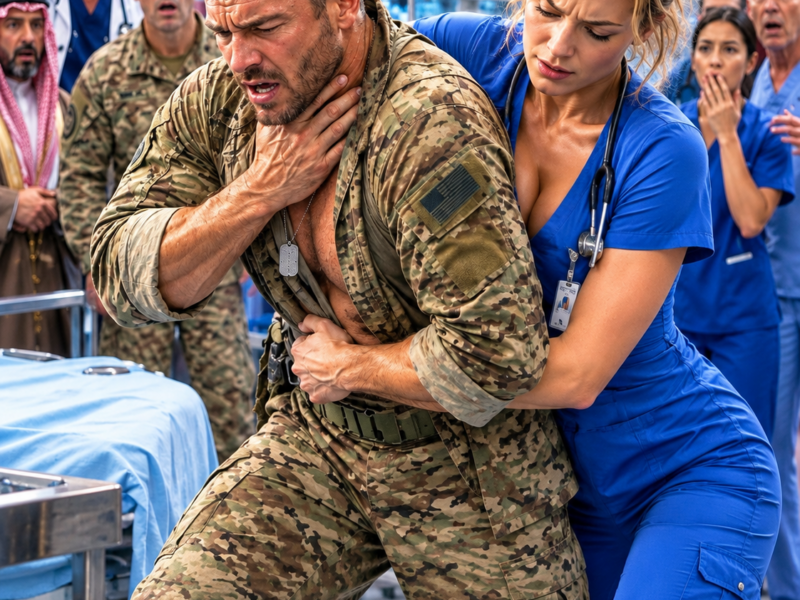
“The moment a wounded soldier heard my voice in the emergency room, he stopped screaming, grabbed my wrist
The footsteps outside the door didn’t move.
I stared at the narrow glass window, waiting for whoever stood on the other side to knock.
Daniel’s fingers tightened around mine.
“Don’t let them take that photograph.”
I slipped it into the pocket of my scrubs.
“Who is outside?”
He shook his head.
“I don’t know. But if they’re here because of what Marcus found, you need to leave before they realize you’ve seen it.”
“Daniel, I’m not leaving you.”
“That’s what you said eleven years ago.”
His words landed harder than he could have known.
Before I could answer, someone knocked.
Three measured taps.
Dr. Harris opened the door.
Behind him stood two men in dark civilian jackets. Both wore military identification badges clipped to their belts.
“Ms. Bennett?” the taller one asked.
“Yes.”
“I’m Special Agent Robert Hayes. This is Agent Miller. We’d like to ask you a few questions about the patient.”
“He’s recovering from surgery.”
“We understand. This concerns a previous military operation.”
I glanced at Daniel.
He had turned his face toward the window.
Agent Hayes noticed the movement.
“Mr. Reeves, we’ll speak with you later.”
Daniel didn’t respond.
Hayes looked back at me.
“Ms. Bennett, could we have a moment?”
I stepped into the hallway and pulled the door almost closed.
“What is this about?”
He opened a small folder.
“We’re reviewing an incident involving a military medical evacuation unit stationed overseas eleven years ago. Your name appears in the original personnel records.”
“I left the military.”
“We know.”
“Then you know I have nothing to add.”
He studied me for a moment.
“That’s interesting. Because someone recently submitted a request to reopen the investigation.”
I felt my jaw tighten.
“Who?”
“An individual claiming to have evidence that the original report was falsified.”
I thought of the photograph in my pocket.
“Did that person provide a name?”
Agent Hayes closed the folder.
“Marcus Cole.”
For several seconds, the hallway seemed to narrow around me.
Marcus.
Not a rumor.
Not a memory.
A name attached to an official request.
“Is he alive?” I asked.
Hayes didn’t answer immediately.
“We don’t know.”
“Then why are you asking me?”
“Because the request included a statement that only someone from your unit could verify.”
“What statement?”
He looked directly at me.
“That the evacuation order was deliberately altered.”
I swallowed.
“I don’t know anything about that.”
“Ms. Bennett, your signature appears on the medical evacuation log.”
“I know what I signed.”
“Do you?”
His tone wasn’t threatening, but it carried something worse: certainty that I was withholding information.
Before I could answer, Dr. Harris appeared beside us.
“She’s on shift, Agent. If you need a formal interview, arrange it through administration.”
Hayes nodded.
“We’ll be in touch.”
As the two men walked away, I noticed Agent Miller turn back.
His eyes weren’t on me.
They were on Daniel’s door.
I waited until they disappeared around the corner before returning to the room.
Daniel was sitting more upright.
“Who were they?”
“Military investigators.”
He closed his eyes.
“Then it’s started.”
“What’s started?”
He looked at the photograph in my pocket.
“The part they were afraid of.”
I pulled the chair beside his bed closer.
“You’re going to tell me everything. Starting with Marcus.”
Daniel took a long breath.
“Do you remember the convoy?”
I nodded.
Of course I remembered.
Some memories don’t fade. They simply become harder to approach.
Eleven years earlier, our unit had been operating near a small village in Afghanistan.
We were assigned to a forward medical station, treating wounded soldiers and civilians while coordinating evacuations with nearby units.
Marcus Cole was our communications specialist.
He was twenty-nine, funny in a dry, irritating way, and the kind of man who remembered everyone’s birthday.
He used to leave terrible coffee beside my cot and claim it was medicinal.
He also had a habit of checking on me after difficult shifts.
Not because I was incapable of handling things, but because he knew I never asked for help.
Our team had six members.
Marcus.
Daniel.
Me.
Sergeant Thomas Reed.
Corporal James Walker.
And Lieutenant Nathan Pierce, our commanding officer.
We weren’t a perfect team, but we trusted each other.
At least, I thought we did.
The night everything happened, we received an emergency evacuation request.
A convoy carrying wounded personnel had been hit outside the village.
Our orders were to reach the location, stabilize survivors, and bring them back to the forward station.
We were told the route was clear.
Marcus questioned that information.
He had intercepted a brief radio transmission suggesting the main road was compromised.
Lieutenant Pierce dismissed his concern.
“We have confirmation from command,” he said. “We move in ten minutes.”
Marcus pulled me aside.
“Claire, something doesn’t add up.”
“What?”
“The coordinates changed twice. And the last transmission came through a channel that shouldn’t have been active.”
“Have you told Pierce?”
“Yes.”
“And?”
“He told me to stop asking questions.”
I remember looking toward the command tent.
Pierce was standing there, calmly reviewing a map.
I should have trusted Marcus.
Instead, I told him we’d follow the orders and deal with anything unexpected when we got there.
That was the last normal conversation we had.
The convoy never reached the designated extraction point.
We were ambushed less than a mile from the village.
The first explosion threw our vehicle sideways.
Glass shattered.
Someone shouted for cover.
I remember crawling across the floor to reach Walker, who had been thrown against the side door.
Daniel was shouting into the radio.
Marcus was trying to establish contact with the command post.
Then the transmission came.
“Raven Six, abort extraction. Repeat, abort extraction. All units withdraw immediately.”
I had a wounded soldier bleeding beside me.
There were civilians trapped near the road.
And I knew that if we left, some of them would not survive.
I asked Pierce to confirm the order.
He repeated it.
“Withdraw. That’s direct command.”
I looked at Marcus.
He was staring at his radio as if he had just heard something impossible.
Then he leaned toward me.
“Claire, that isn’t the original order.”
“What?”
“Someone changed the transmission.”
A second explosion shook the ground.
The radio crackled again.
Pierce shouted for everyone to retreat.
I refused.
Not because I thought I was invincible, but because I could see a wounded soldier trying to crawl behind a damaged vehicle.
I moved toward him.
Daniel followed.
Walker was already unconscious.
Marcus stayed near the communications equipment.
The last thing I heard from him was a shout through the radio.
“Raven Six, get out! They’re not coming back for us!”
Then the signal disappeared.
I remembered the rest in pieces.
A helicopter.
A flash of light.
Daniel pulling me away from the wreckage.
Someone screaming.
And a report, days later, stating that Marcus Cole had died during the attack.
I was told our evacuation had failed because of inaccurate intelligence.
I was also told the original communications logs had been destroyed.
I had signed the medical record documenting the casualties.
But I had never signed the operational report.
And I had never been allowed to see it.
When I finished telling Daniel what I remembered, he watched me quietly.
“You left something out,” he said.
“What?”
“The order.”
I frowned.
“What about it?”
“You said Pierce repeated the withdrawal order.”
“He did.”
Daniel shook his head.
“He didn’t repeat it. He gave it.”
I stared at him.
“That makes no sense.”
“I was beside him when it happened. I heard his radio.”
“You were on the other side of the vehicle.”
“I heard him say the words before the command post transmission came through.”
I felt a chill move down my arms.
“Are you saying Pierce issued the order himself?”
“I’m saying he knew what was coming.”
I leaned back.
“Why didn’t you tell anyone?”
Daniel looked toward the ceiling.
“Because I was told the same thing you were. That Marcus was dead, the communications equipment was destroyed, and the investigation was closed.”
“Who told you?”
“Pierce.”
I looked down at the photograph.
“Why bring this to me now?”
Daniel hesitated.
“Because three weeks ago, I received a package.”
He reached toward the bedside cabinet.
I opened the drawer and found a small plastic evidence envelope.
Inside was a black USB drive.
“Where did this come from?”
“An address in Virginia. No return name.”
“What’s on it?”
“An audio recording. And part of the original transmission.”
“Have you listened to it?”
“Twice.”
“What does it say?”
Daniel looked at me.
“It says your team was never supposed to come back.”
The room seemed to lose its air.
I stared at the USB drive.
“That’s impossible.”
“I wish it were.”
He took a breath, wincing at the movement.
“There’s something else. The package included a note.”
“What note?”
Daniel reached under the pillow and pulled out a folded piece of paper.
I recognized the handwriting before I even read the words.
Marcus.
I knew it from the notes he used to leave beside my coffee.
The message was short.
**If Raven Six is still alive, tell her I kept my promise.**
I sat down slowly.
“What promise?”
Daniel shook his head.
“He didn’t explain.”
I read the sentence again.
I could almost hear Marcus’s voice.
I could picture him leaning against the ambulance, smiling as if the world had never given him a reason to be afraid.
Then I remembered something.
The night before the convoy, Marcus had asked me to keep a sealed medical pouch in my locker.
He said it contained backup medical records in case the communications system failed.
I had forgotten about it.
Or perhaps I had spent eleven years trying not to remember.
“Daniel, did Marcus ever mention a medical pouch?”
His eyes widened.
“Yes.”
“What was in it?”
“I don’t know. He told me it was something you would understand.”
I stood.
“I need to go home.”
“Claire—”
“I have something to look for.”
Daniel caught my hand.
“Don’t go alone.”
I looked at him.
“Who else can I trust?”
He didn’t answer.
And that silence told me more than anything he had said so far.
I finished my shift, spoke to the charge nurse, and told Dr. Harris I had a family emergency.
He offered to drive me.
I declined.
I didn’t want anyone else involved until I knew what I was looking for.
My apartment was quiet when I arrived.
Scout greeted me at the door, his tail moving so hard his entire body seemed to sway.
I knelt and rubbed his ears.
“Hey, buddy.”
He pressed his head against my chest.
For a moment, I considered forgetting everything.
I could feed him, take a shower, sleep, and return to the hospital in the morning.
I could pretend that eleven years had not just opened like an old wound.
Then I remembered Marcus’s handwriting.
I went to my bedroom closet.
At the back, behind two winter coats and a box of old nursing textbooks, sat a battered military duffel bag.
I hadn’t opened it in years.
The zipper caught halfway.
I pulled harder.
Inside were old photographs, a folded uniform, a few medals, and a small notebook.
At the bottom was a metal medical pouch.
My hands shook as I lifted it.
The clasp was stiff.
I had to press it twice before it opened.
Inside were several folded sheets of paper, a compact recorder, and a small envelope with my name written across the front.
Claire.
I sat on the floor.
The envelope was sealed.
I opened it carefully.
There was a single page inside.
**Raven Six,**
**If you’re reading this, I didn’t make it back, or someone has finally decided the truth is worth more than their career.**
**I need you to know that the evacuation coordinates were changed before we left. The command post never approved the route we were given.**
**I found the original transmission. It was not an equipment failure. Someone deliberately replaced the recording.**
**I tried to tell you, but I couldn’t risk putting you in the middle of it without proof.**
**The proof is in the medical log. Look at the last page, where you signed for the casualties. There is a second timestamp beneath your signature.**
**I know you remember what happened. I also know you’ve blamed yourself for leaving. Don’t. You didn’t abandon us. Someone made sure we couldn’t get home.**
**If I disappear, find the original file.**
**Marcus.**
I read the letter three times.
Then I opened the notebook.
The first pages contained routine medical notes.
Blood types.
Treatment dates.
Medication inventories.
Names of wounded personnel.
Then I reached the final section.
A list of timestamps.
Coordinates.
Radio frequencies.
And a name written repeatedly in the margins.
Nathan Pierce.
I turned to the final page.
There was a reference number beside a note:
**Original transmission — archive copy — medical channel backup.**
Below it was a storage location and an authorization code.
I recognized the format.
It was the kind of reference used by the military medical records division.
The recorder in the pouch had an old memory card inside.
I connected it to my laptop.
A single audio file appeared.
Its date matched the night of the convoy.
I pressed play.
Static filled the room.
Then a voice.
“Evacuation team, hold position. Do not proceed to the designated route.”
I leaned closer.
Another voice interrupted.
“Command, confirm coordinates.”
Then a third voice spoke.
Calm.
Familiar.
Nathan Pierce.
“Proceed as planned. We have authorization.”
A pause followed.
Then the first voice returned.
“Negative. Those coordinates are compromised.”
Pierce’s answer came without hesitation.
“That order is no longer valid. Move.”
I stopped the recording.
My fingers had gone numb.
There was no mistaking his voice.
But I needed more than an audio file.
I needed to know what happened after the convoy was abandoned.
And I needed to know whether Marcus had survived.
The following morning, I returned to the hospital.
Daniel was awake when I entered.
I placed the notebook on his bedside table.
“I found it.”
He looked at the familiar handwriting.
“Marcus’s?”
I nodded.
“And I found the original recording.”
Daniel closed his eyes.
“Then it’s real.”
“Yes.”
He was quiet for a moment.
“Claire, there’s something I haven’t told you.”
I waited.
“After the attack, I woke up in a field hospital. Pierce visited me.”
“What did he say?”
“He told me Marcus had been recovered. He said he was alive but being transferred for questioning.”
My fingers tightened around the notebook.
“Why didn’t you tell me?”
“Because two days later, Pierce came back. He told me Marcus had died during transport.”
“Did you see a body?”
“No.”
“Did you see a death certificate?”
“No.”
“Then why believe him?”
Daniel looked ashamed.
“Because I was twenty-six, Claire. I had a head injury, three broken ribs, and no idea who I could trust. Pierce told me the investigation was over. He said if I kept asking questions, I’d lose my pension and face disciplinary action.”
I sat beside him.
“I believed him too.”
Daniel looked at me.
“I know.”
For the first time since seeing him in the ER, I saw something other than fear in his expression.
I saw the same guilt I had carried for eleven years.
“We were both told to stop looking,” I said.
He nodded.
“And we did.”
Before I could respond, someone knocked.
Dr. Harris entered with a concerned expression.
“Claire, there’s someone downstairs asking for you.”
“Who?”
“He says his name is Thomas Reed.”
I stood so quickly the chair scraped against the floor.
“Thomas?”
Dr. Harris nodded.
“He says you served together.”
I looked at Daniel.
His face had gone pale.
“Don’t let him in,” he whispered.
I turned.
“Why?”
Daniel swallowed.
“Because Thomas was the one who told me Marcus was dead.”
A few minutes later, I found Thomas in the hospital cafeteria.
He looked older, heavier, and tired around the eyes.
But I recognized him immediately.
He stood when he saw me.
“Claire.”
I didn’t hug him.
I didn’t shake his hand.
I simply asked, “Why are you here?”
He glanced at the table.
“Can we talk?”
“We are talking.”
He lowered his voice.
“I heard Daniel was brought in.”
“How?”
“Military contacts.”
“That’s not an answer.”
He rubbed his forehead.
“Claire, I know about the photograph.”
My stomach tightened.
“Then you know what it says.”
He nodded.
“I also know you found Marcus’s medical pouch.”
I stared at him.
“How could you possibly know that?”
Thomas looked toward the cafeteria entrance.
“Because I was the one who put it in your locker.”
The room seemed to tilt.
“You?”
“Marcus asked me to make sure you got it if something happened.”
“Why didn’t you tell me?”
“Because Pierce was watching everyone. I was afraid.”
I laughed once, without humor.
“Eleven years, Thomas.”
“I know.”
“No, you don’t. You don’t know what it was like to wake up every morning believing you were responsible for leaving people behind.”
His eyes filled.
“I was responsible for part of it.”
I leaned forward.
“Explain.”
Thomas took a long breath.
“After the convoy was hit, Pierce ordered me to report that Marcus had died at the scene. I knew it wasn’t true. I had seen him being loaded into another vehicle.”
I stared at him.
“You saw him alive?”
“Yes.”
“And you signed the report?”
Thomas looked down.
“Yes.”
I stood.
“Get out.”
“Claire, please.”
“Get out.”
He didn’t move.
“I was threatened. Pierce told me he had evidence that I had violated orders during the mission. He said he could end my career and have me prosecuted.”
“That doesn’t excuse what you did.”
“I know.”
His voice broke.
“I have spent eleven years knowing that.”
I sat back down, more from exhaustion than forgiveness.
“Where is Marcus?”
Thomas looked at me for a long time.
“That’s what I’ve been trying to find out.”
“Why now?”
“Because Pierce contacted me last month.”
My stomach tightened.
“What did he want?”
“He asked whether I still had copies of the original reports.”
“And?”
“I told him no.”
Thomas looked at me.
“He didn’t believe me.”
I thought of the two investigators.
The photograph.
The USB drive.
“Where is Pierce now?”
“Retired. Living in Virginia.”
“Does he know about the audio recording?”
Thomas nodded.
“He knows someone has it.”
I felt a cold certainty settle over me.
“Then we need to get the original file to the investigators.”
Thomas shook his head.
“Not yet.”
“Why?”
“Because the recording proves the order was changed, but it doesn’t prove who changed it. Pierce can claim the voice was taken out of context. He can say the recording was edited.”
“Then what do we need?”
Thomas hesitated.
“The original mission report. The one that disappeared.”
I looked at the notebook.
“Marcus left a reference number.”
Thomas leaned closer.
“Then he found it.”
“Found what?”
“The backup archive.”
Thomas explained that every medical evacuation mission had a separate casualty record. Those records were stored independently from operational communications.
If the main report was altered, the medical archive could still contain the original timeline.
But accessing it required authorization.
And the only person whose credentials were recorded as the medical officer for our unit was me.
I stared at him.
“You’re saying I have to request it?”
“Yes.”
“Then why didn’t you do that years ago?”
“Because Pierce had access to the same archive. He could have destroyed anything that connected him to the operation.”
I thought about the timestamp beneath my signature.
Marcus hadn’t hidden the evidence because he expected me to solve everything.
He had hidden it because he knew I was the one person whose records could still lead to the truth.
That afternoon, I contacted the military records office.
I gave them my former service number, the unit designation, and the reference code from Marcus’s notebook.
The woman on the phone asked me to hold.
When she returned, her voice had changed.
“Ms. Bennett, I can confirm that an archive entry exists under that reference.”
“Can you send me a copy?”
“I’m afraid not. The file is restricted pending an investigation.”
“Who placed the restriction?”
There was a pause.
“Colonel Nathan Pierce.”
I closed my eyes.
“He’s retired.”
“Yes, ma’am. But the restriction was entered while he was still serving.”
“Can you tell me when?”
“Eleven years ago. Three days after the incident.”
Three days.
The same date written on the back of the photograph.
I thanked her and ended the call.
Daniel was waiting when I returned to his room.
“What happened?”
I told him.
He listened without interrupting.
When I finished, he said, “Then we have to get that archive.”
“We can’t access it without authorization.”
“Maybe not through the normal process.”
I looked at him.
“Daniel, I’m not breaking into a military records system.”
He gave a weak smile.
“I wasn’t suggesting that.”
He reached for his phone.
“There’s someone you should speak to.”
He called a former military attorney named Sarah Mitchell, who had represented several veterans in cases involving falsified service records.
She agreed to meet us the following morning.
Sarah was in her early forties, with short brown hair and a direct way of speaking.
She listened to everything.
The photograph.
The audio.
Marcus’s letter.
Thomas’s confession.
She examined the documents without making promises.
When she finished, she looked at me.
“You understand that this could become a federal investigation?”
“I understand.”
“Your statement may be challenged. Your signature is on the casualty report. If the original records contradict your account, investigators will ask why you didn’t report the discrepancy earlier.”
“Because I didn’t know.”
Sarah nodded.
“Then we need to establish what you knew, what you were told, and what you were denied access to.”
She turned to Daniel.
“And you need to be prepared to explain why you waited eleven years.”
Daniel lowered his eyes.
“I will.”
Sarah placed the photograph in a folder.
“I can submit a formal request for preservation of the records and notify the appropriate oversight office. But I need one thing.”
“What?”
“An independent witness who can authenticate the original recording.”
Thomas agreed to provide a sworn statement.
Daniel agreed to testify.
I agreed to give a full account of the convoy.
For the first time in eleven years, we were no longer trying to solve the mystery alone.
But the truth was still missing one person.
Marcus.
Two days later, Sarah called.
She had received confirmation that the archive had been located and placed under preservation order.
She also had news about the name attached to the original transfer record.
It wasn’t a military transport unit.
It was a private medical contractor operating under a government agreement.
The transfer had taken place less than an hour after the convoy attack.
The receiving facility was listed as a rehabilitation center in Virginia.
I read the address twice.
“Is it still operating?” I asked.
Sarah hesitated.
“Yes. But the name has changed.”
“Can we contact them?”
“Not without going through the investigators. We need to be careful.”
I understood.
For eleven years, people had been careful.
Careful enough to let a man disappear.
Careful enough to let a false report become the official truth.
I was tired of careful.
The next morning, Sarah accompanied me to a federal investigative office.
Daniel was still recovering, so he joined by video call.
Thomas sat beside me.
We submitted the photograph, the letter, the notebook, and the audio recording.
An investigator listened to the file twice.
Then he asked me to describe the moment the withdrawal order came through.
I told him everything.
He asked whether I recognized the voice.
“Yes.”
“Whose voice?”
“Lieutenant Nathan Pierce.”
He wrote something down.
“Are you certain?”
“I’ve heard that voice every day for two years. I don’t need a recording to recognize it.”
He looked up.
“Why didn’t you report this sooner?”
I took a breath.
“Because I believed the official report. Because I was told the communications system had been destroyed. Because I thought Marcus was dead. And because I blamed myself for not saving him.”
The investigator closed his notebook.
“Thank you, Ms. Bennett.”
Then he turned to Thomas.
“Mr. Reed, you stated that you saw Marcus Cole being transferred alive?”
Thomas nodded.
“Yes.”
“Can you identify the person who ordered the transfer?”
Thomas hesitated.
“I can.”
“Who?”
“Nathan Pierce.”
The investigator exchanged a glance with his colleague.
“That is significant.”
He gathered the documents.
“We’ll need to verify the contractor records and interview the individuals involved. I can’t promise you a timeline.”
I nodded.
“Just don’t let the records disappear.”
He looked at me.
“We won’t.”
Three days later, the first breakthrough came.
Sarah called while I was walking Scout near the park.
“Claire, they found a second transfer record.”
I stopped beside a bench.
“What does it say?”
“It confirms Marcus was alive when he arrived at the rehabilitation facility.”
My hand tightened around the leash.
“How long did he stay there?”
“According to the records, nearly eighteen months.”
I sat down.
“Then where did he go?”
“That’s the problem. His file was closed under a different identity.”
I stared at the grass.
“Why?”
“That’s what the investigators are trying to determine.”
I looked toward the playground.
A father was pushing his daughter on a swing.
She was laughing, her shoes flashing in the sunlight.
Ordinary life continued around me.
And somewhere, a man I had mourned for eleven years might still be breathing.
That evening, Daniel called.
“Sarah told me.”
“Yes.”
He was quiet.
“Claire, do you think he’s alive?”
I looked at Marcus’s letter on my kitchen table.
“I don’t know.”
“But you hope so.”
I swallowed.
“Yes.”
A week passed.
Then another.
The investigation widened.
Pierce was interviewed.
His attorney issued a statement denying wrongdoing.
He claimed the withdrawal order had been necessary to protect the remaining unit and that the medical transfer records had been misinterpreted.
But the original archive told a different story.
The coordinates had been changed before the convoy departed.
The command post had issued a warning that the route was compromised.
And Pierce had acknowledged that warning before ordering the team forward.
The records also showed that Marcus had been transferred alive.
Thomas’s statement confirmed it.
Daniel’s testimony supported the communications timeline.
And the audio recording matched the backup archive.
The investigators finally obtained a warrant for the contractor’s archived personnel records.
Then, on a Thursday morning, Sarah called me at 6:17.
“Claire, sit down.”
I was standing in my kitchen, making coffee.
“What happened?”
“They found him.”
I stopped moving.
“Who?”
“Marcus.”
I gripped the counter.
“Is he alive?”
“Yes.”
The word came so quietly that I almost didn’t hear it.
I sat down.
“Where is he?”
“He’s living outside Richmond, Virginia. He has been using his middle name and a different surname.”
“Why?”
“That’s something you’ll need to ask him.”
I covered my mouth with my hand.
For eleven years, I had imagined Marcus in the final moments of that convoy.
I had remembered his voice, his smile, and the way he used to leave terrible coffee beside my bed.
I had attended a memorial service.
I had written a letter to his mother.
I had spent years believing I had left him behind.
And now someone was telling me he was alive.
“Does he know about the investigation?”
“Yes. He has agreed to speak with you.”
I couldn’t answer.
Sarah continued gently.
“Claire, he knows you’re looking for him.”
I looked down at the photograph.
Six people beside an ambulance.
Three were still alive and accounted for.
One had spent years under another name.
Two had never made it home.
I wiped my face.
“When can I see him?”
“Tomorrow, if you’re willing to travel.”
“I’ll be there.”
The drive to Virginia took most of the day.
Sarah accompanied me, though she stayed at the hotel while I went to meet Marcus.
I had imagined the reunion a hundred different ways.
I thought he might run toward me.
I thought he might cry.
I thought he might be angry.
I thought I might have something meaningful to say.
But when I arrived at the small house outside Richmond, I found myself sitting in the car for nearly ten minutes.
The front yard was ordinary.
A wooden porch.
Two flowerpots.
A bicycle leaning against the fence.
A wind chime moving gently in the afternoon breeze.
Nothing about the place suggested that someone had spent eleven years hiding from a past he never chose.
I finally got out.
A man opened the door before I knocked.
He was older.
His hair was shorter, his face thinner, and there was a scar running from his left temple toward his cheek.
But his eyes were the same.
Marcus.
For a long moment, neither of us spoke.
Then he looked at me and said, “You cut your hair.”
I laughed.
It came out broken.
“That’s what you notice?”
He stepped onto the porch.
“I didn’t know what else to say.”
I looked at him.
“I thought you were dead.”
His expression changed.
“I know.”
“Eleven years, Marcus.”
“I know.”
“Do you have any idea what that did to me?”
He looked down.
“I’ve imagined it every day.”
I wanted to hit him.
I wanted to hug him.
I wanted to ask why he hadn’t found me.
Instead, I stood there, unable to choose between all the things I had carried.
Marcus opened his arms.
I stepped forward.
When he held me, I felt the years between us more than I felt his embrace.
He smelled faintly of coffee and laundry detergent.
The same familiar scent.
I closed my eyes.
For the first time since the convoy, I allowed myself to cry.
Inside, we sat at a small kitchen table.
Marcus poured coffee.
It was terrible.
I took one sip and stared at him.
“Still can’t make decent coffee.”
He smiled faintly.
“Some things survive.”
Then the smile disappeared.
“Claire, I owe you the truth.”
I nodded.
“Start at the beginning.”
He told me what happened after the convoy.
He had been injured in the attack but remained conscious long enough to hear Pierce instruct another unit to transport him separately.
At first, he believed he was being taken to another medical facility.
Then he realized his radio, identification, and personal belongings were gone.
He was told that the convoy had been destroyed and that the surviving members had been reassigned.
When he asked to contact me, the answer was always the same.
“Later.”
Weeks passed.
Then months.
He was transferred to a contractor-run rehabilitation facility under an administrative hold.
He eventually discovered that his name had been removed from the active casualty records.
He was still alive, but officially, he no longer existed.
“Why didn’t you escape?” I asked.
Marcus looked at his hands.
“I tried.”
He told me about a nurse who had helped him send one letter.
It never reached its destination.
The facility was under contract with the government, and his case had been marked as a sensitive operational matter.
He was warned that contacting anyone from the unit could expose them to investigation.
He was also told that his medical treatment and continued care could be terminated if he violated the restrictions.
“I thought if I waited, someone would come for me,” he said.
“Did they?”
He shook his head.
“Not until I managed to get a message to Thomas.”
I leaned forward.
“How?”
“Through a former contractor employee who had kept copies of the transfer paperwork.”
Marcus explained that the employee had contacted him after leaving the facility.
Together, they assembled enough documentation to prove he had been transferred alive.
But Marcus had one condition.
He wanted the original evacuation records preserved before he revealed himself.
He knew Pierce still had influence.
He feared that if he appeared too early, the evidence would disappear and the people who had helped him would be exposed.
“That’s why the package went to Daniel,” I said.
Marcus nodded.
“He was the only person I knew who might still be able to reach you.”
I looked at him.
“Why didn’t you send it directly to me?”
He gave me a tired smile.
“Because I didn’t know whether you wanted to hear from a ghost.”
I looked away.
“That’s not fair.”
“No. It isn’t.”
He reached into a drawer and placed a small envelope on the table.
Inside was a photograph.
It showed the two of us sitting beside the ambulance, laughing at something outside the frame.
On the back, he had written:
**You don’t leave your people behind.**
I stared at the words.
“Marcus…”
“I know what happened to the others,” he said quietly.
I looked up.
“Walker?”
He lowered his eyes.
“James died during the attack.”
I nodded slowly.
I had known that.
I had read his name on the official casualty report.
“And Sergeant Reed?”
“Thomas survived.”
I looked at him.
“He’s been helping us.”
Marcus nodded.
“Good.”
Then I asked the question I had avoided since arriving.
“Why did you let me believe you were dead?”
He took a long breath.
“I didn’t choose that, Claire.”
“But you could have found me eventually.”
“Maybe.”
His voice cracked.
“I spent years believing you had moved on. Then I spent years believing that if I contacted you, I’d bring the people responsible straight to your door.”
I shook my head.
“You don’t get to make that decision for me.”
“I know.”
He looked directly at me.
“I’m not asking you to forgive me for being gone. I’m asking you to understand why I was afraid.”
I looked at the photograph.
For the first time, I understood that the silence had not been simple.
He had been trapped by fear, just as I had.
But understanding did not erase the years.
“I don’t know how to get those years back,” I said.
Marcus shook his head.
“Neither do I.”
We sat quietly.
Outside, a car passed.
Somewhere down the street, a dog barked.
Life continued in the ordinary way.
Eventually, I asked him what happened to Pierce.
Marcus told me he had given a formal statement to the investigators.
The original records, the transfer documents, and the testimony from Daniel and Thomas had established that Pierce had knowingly sent the convoy along a compromised route.
They also showed that he had concealed Marcus’s survival and interfered with the investigation.
The case was no longer simply about a bad military decision.
It was about deliberate falsification and the disappearance of a living service member.
Several months later, the investigation resulted in criminal charges against Pierce for offenses related to the falsified records and obstruction.
He pleaded not guilty.
The case moved through the legal system, and the full details became public.
The contractor also faced scrutiny over its handling of Marcus’s detention and medical records.
There were hearings.
There were statements.
There were difficult questions.
And there were people who had to explain why they had signed documents they knew were false.
Thomas testified.
Daniel testified after completing his recovery.
I testified too.
I described the convoy, the warning, the withdrawal order, and the years I spent believing that I had failed my team.
When the prosecutor asked whether I still blamed myself, I took a moment before answering.
“I blame the people who made the decision to send us into danger and then concealed what happened. I won’t carry their responsibility anymore.”
I looked toward the courtroom gallery.
Marcus was sitting beside Sarah.
He gave me a small nod.
For the first time, I felt that my words belonged to me.
Not to the military.
Not to an old report.
Not to the people who had spent eleven years deciding what I was allowed to know.
To me.
The case did not bring James Walker back.
It did not return the years Marcus had lost.
And it did not make the nightmares disappear overnight.
But it gave the families answers.
It corrected the official record.
It restored Marcus’s name.
And it gave all of us something we had been denied for too long: the right to tell the truth.
A year later, Daniel visited me at St. Mary’s.
He had completed rehabilitation and was walking without assistance.
He brought a paper bag containing two coffees.
I took one sip and made a face.
“Daniel, this is terrible.”
He laughed.
“Marcus said you’d complain.”
“Marcus has always had questionable taste.”
Daniel sat in the chair beside my desk.
For a while, we talked about ordinary things.
His physical therapy.
My new apartment.
The dog.
The weather.
Then he looked at the photograph I had placed beside my computer.
It was the same old picture of our team.
Six people beside a military ambulance.
“Do you still look at it?” he asked.
“Every day.”
“Does it hurt?”
I considered the question.
“Sometimes.”
He nodded.
“Me too.”
I touched the edge of the photograph.
“But it doesn’t feel like a grave anymore.”
Daniel smiled.
Before he left, he placed something on my desk.
A small black patch.
The embroidered words were faded, but still readable.
RAVEN SIX.
I looked at him.
“Where did you get this?”
“Marcus kept it.”
I ran my thumb over the stitching.
“I thought I’d lost it.”
“He said you should have it back.”
I held the patch for a long moment.
For years, I had believed that becoming Claire Bennett, the emergency room nurse, meant leaving Raven Six behind.
I thought the only way to survive was to forget the person I had been.
But I had been wrong about one thing.
I hadn’t needed to forget her.
I had needed to stop blaming her.
That evening, I went home and placed the patch in a small wooden box beside the photograph.
Scout settled at my feet while I sat on the living room floor.
My phone buzzed.
A message from Marcus.
**Coffee tomorrow? I’ll try to make it better this time.**
I smiled and typed back.
**Don’t make promises you can’t keep.**
A few seconds later, he replied.
**Some promises take eleven years.**
I looked at the old photograph again.
Six people.
One ambulance.
One night that had divided our lives into before and after.
I couldn’t change what happened on that road.
I couldn’t bring James home.
But I could finally remember Marcus without mourning him.
And I could walk into the emergency room the next morning without feeling that some part of me had been left behind in the desert.
The next time a wounded soldier grabbed my wrist and asked for Raven Six, I wouldn’t pretend I didn’t know who he meant.
Because that name had never been the thing I needed to bury.
It was the part of me that had kept showing up, even when the world gave me every reason to stop.
The end.









