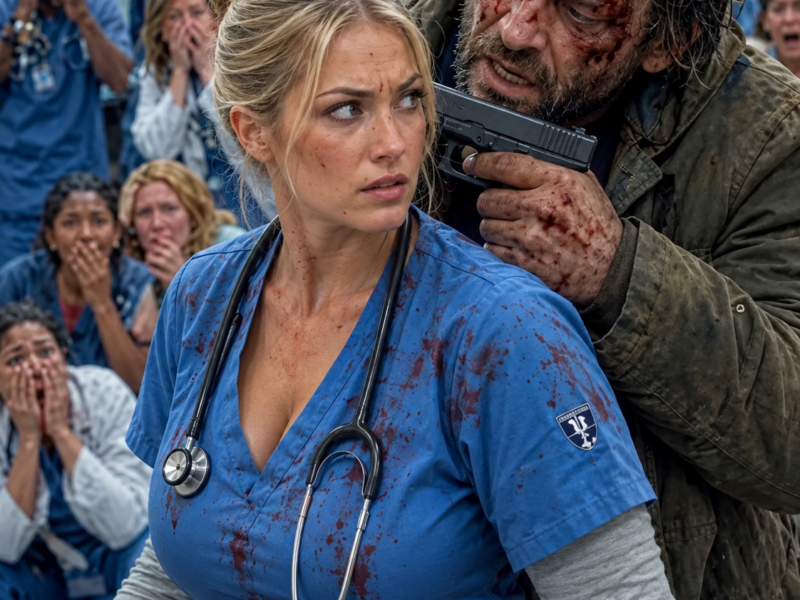
“The man who grabbed me by the throat in the hospital parking garage laughed when I told him to let go
I read Daniel’s handwriting three times, hoping the words would rearrange themselves into something less devastating.
“Claire, if you’re reading this, don’t trust Marcus.”
Behind me, the doorbell rang again.
Marcus reached for the photograph, but I pulled it against my chest.
“Don’t,” I said.
He stopped.
For six years, I had trusted this man with information that could have destroyed careers, operations, and lives. He had taught me how to recognize a tail, how to read a room, and how to keep breathing when every instinct told me to run.
Now I was standing in his office with a loaded pistol in my hand, wondering whether everything he had taught me had been designed to make me easier to control.
“Claire, listen to me,” he said quietly. “Whatever that note says, you cannot assume Daniel wrote it.”
“I know his handwriting.”
“So do the people who might be trying to manipulate you.”
The doorbell stopped.
A moment later, someone knocked three times.
Marcus glanced toward the hallway.
“They know we’re here.”
I looked at the photograph again. Daniel wore a gray jacket I remembered buying him for his twenty-fifth birthday. Victor Hale stood beside him, one hand resting casually on my brother’s shoulder.
But it wasn’t the date that made my fingers tighten around the paper.
It was the background.
Behind them stood a white building with a blue metal door, a security camera mounted above the entrance, and a faded sign that read MERIDIAN.
I had seen that building before.
Not overseas, as I first suspected.
In Baltimore, on the outskirts of the industrial district, where abandoned warehouses sat between the freight yards and the river.
Three months earlier, I had driven past it on my way to work.
The place had looked deserted.
“What’s Meridian?” I asked.
Marcus closed his eyes briefly.
“An old intelligence facility.”
“You told me the operation that killed Daniel happened overseas.”
“It did.”
“Then why is he standing in front of a facility here?”
Marcus didn’t answer quickly enough.
That was all I needed.
I backed toward the side door.
“Claire, if you walk out of here alone, you’ll be doing exactly what they want.”
“Who is they?”
He looked at the photograph in my hand.
“People who have spent years making sure nobody asks what happened to your brother.”
I wanted to believe him.
That was the worst part.
Even with Daniel’s warning between us, some part of me still remembered the man who had sat beside me at the funeral and stayed until the last guest had gone.
But grief had made me desperate for certainty, and desperate people were easy to lead.
“I’ll decide who to trust after I know the truth,” I said.
Then I left through the back door.
I drove for nearly forty minutes, changing routes twice and checking my mirrors at every red light.
Nobody followed me that I could see.
At a twenty-four-hour diner near the harbor, I locked myself in a bathroom stall and examined the photograph beneath the harsh fluorescent light.
The paper was old, but not six years old.
The edges had been handled too many times, and a shallow crease ran through Daniel’s face.
Someone had carried it around.
On the back, beneath his message, I found a second line written in smaller letters.
The blue door. Midnight. Come alone.
There was no signature.
I checked the time.
It was 9:17 p.m.
For the next two hours, I sat in my car with the engine off, trying to find a reason not to go.
If the message was a trap, I had no idea who had arranged it.
If it was real, Daniel might still be alive.
Every sensible argument I could make ended at the same place: I could not spend another six years wondering whether I had abandoned my brother without even trying to find him.
At 11:38, I drove toward the industrial district.
The streets were nearly empty. Sodium lights cast long orange shadows across the pavement, and the harbor wind carried the smell of salt, diesel, and wet concrete.
Meridian stood behind a chain-link fence topped with rusted wire.
A faded security sign hung crookedly beside the gate.
The building looked abandoned, but the camera above the entrance moved as my headlights swept across it.
I parked two blocks away and approached on foot.
The gate was unlocked.
That frightened me more than a locked gate would have.
I followed the fence until I reached the blue metal door from the photograph. A keypad had been installed beside it, but the lock itself hung open.
Someone wanted me inside.
I pressed my palm against the door and eased it inward.
A narrow corridor stretched into darkness.
Then a voice came from somewhere beyond the first doorway.
“You’re late, Claire.”
I knew that voice.
I had heard it through a hospital mask, beneath the steady rhythm of a cardiac monitor.
Victor Hale stepped into the light.
He wore no bandage, and he moved without the slightest trace of the injury I had treated.
“You look surprised,” he said.
“You were bleeding through your shirt three weeks ago.”
“I’ve had worse.”
“You lied about your injury.”
“I lied about several things.”
He looked older in the dim light, but his eyes were just as sharp.
I kept my hands where he could see them.
“Where’s Daniel?”
Victor tilted his head.
“You came all this way, and that’s your first question?”
“It’s the only one that matters.”
For a moment, the amusement left his face.
Then he stepped aside.
“Come and see.”
I followed him into a room containing a steel table, several old computer terminals, and a bank of monitors. Most of the screens were dark. One displayed a live feed of the corridor outside.
On another was a photograph of Daniel.
This one had been taken recently.
He was thinner than I remembered, his hair shorter, and a small scar crossed his left eyebrow. But he was unmistakably my brother.
I reached for the monitor before I realized what I was doing.
“When was this taken?”
“Yesterday.”
I gripped the edge of the table.
“Where is he?”
“Safe, for the moment.”
“Don’t give me that.”
Victor studied me, then nodded toward a chair.
“Your brother discovered that a mission report had been falsified. The operation was supposed to intercept a shipment of weapons. Instead, his team was directed into an ambush.”
I remembered the official report. A compromised route. Enemy fire. No survivors.
“Daniel survived?”
“Yes.”
The word landed with such force that I had to sit down.
Victor continued speaking, but I could barely hear him over the blood rushing in my ears.
“Three members of the team died at the scene. Daniel was recovered by a separate unit and transferred to a secure facility. He’d identified the people responsible for changing the mission parameters, and those people had powerful friends.”
“So you faked his death.”
“We made his death official.”
“You let me bury an empty coffin?”
Victor looked away.
“The government needed everyone to believe Daniel was dead. That included the people closest to him.”
“His sister.”
“Yes.”
I stood so abruptly that the chair scraped backward across the floor.
“You don’t get to say that as if it were a necessary detail in a report.”
“I didn’t make that decision.”
“But you helped keep it alive.”
He didn’t deny it.
For six years, I had imagined Daniel’s last moments in a dozen different ways. I had wondered whether he had been frightened, whether he had called for me, whether he had known he wasn’t coming home.
Now I learned that he had been alive somewhere while I sat through birthdays, holidays, and sleepless nights believing I had lost him.
I pressed my fingertips against my mouth.
“Why now?”
“Because the people who arranged the ambush are preparing to eliminate the remaining evidence. Daniel escaped custody two weeks ago. He has been trying to reach you ever since.”
“And Marcus?”
Victor hesitated.
That hesitation was more revealing than any answer.
“What did Marcus do?”
“He authorized the original mission.”
The room seemed to tilt.
“No.”
“He believed the intelligence was reliable. By the time he learned the target information had been changed, the team was already in the field.”
“You said the people responsible had powerful friends.”
“They did. Some still do.”
“Was Marcus involved in the cover-up?”
Victor rubbed a hand across his jaw.
“He signed the documents that classified Daniel’s death. He told himself it was the only way to protect the survivors.”
“Daniel was the survivor.”
“Yes.”
“And I was the person left behind.”
Victor lowered his eyes.
For the first time, he seemed to understand that the truth was not making anything better.
A noise came from the corridor.
Victor turned toward the monitor.
The camera showed a man entering through the blue door.
Marcus.
He was alone.
Victor swore under his breath and reached for a drawer.
I drew my pistol.
“Don’t move.”
He looked at me, then at the weapon.
“Your brother told me you’d be difficult.”
“You’ve spoken to him?”
“Yes.”
“When?”
“Yesterday.”
My grip tightened.
“Then why didn’t you bring him here?”
“Because he didn’t trust me enough to come himself.”
The words stung, though I couldn’t have explained why.
Before I could answer, Marcus entered the room.
His gaze went immediately to the pistol in my hand.
Then he saw Daniel’s photograph on the monitor.
His face changed.
“Claire,” he said. “Put the gun down.”
“Tell me what happened.”
He glanced at Victor.
“Not here.”
“You don’t get to choose where I hear the truth.”
Marcus took a slow breath.
“I approved the mission. I believed the intelligence we were given. When the operation went wrong, I discovered that the target coordinates had been altered by someone with access to our command system.”
“Who?”
“I never proved it.”
“You signed Daniel’s death certificate.”
“I signed the classification order.”
“You let me believe he was dead.”
“I was ordered to keep the operation buried.”
“You could have refused.”
“Yes.”
The answer was so quiet that it took the anger out of me for a second.
Marcus didn’t try to defend himself.
“I could have refused,” he repeated. “I could have resigned, gone public, or spent the rest of my life trying to expose the people who did it. Instead, I told myself that keeping Daniel hidden would protect him and prevent another operation like that from happening.”
“And what did it protect?”
He looked at me.
“My career. My reputation. And my own cowardice.”
I had expected excuses.
I hadn’t expected him to hand me the one accusation I could have made against him and leave it sitting between us.
“Why did Daniel tell me not to trust you?”
Marcus’s expression tightened.
“Because he has reason to believe I knew more about the ambush than I admitted.”
“Did you?”
“I knew the operation had been compromised. I didn’t know who had changed the orders, and I didn’t know Daniel had survived until months later.”
Victor stepped toward the table.
“That’s not the whole truth.”
Marcus turned on him.
“Don’t.”
“You’re still doing it,” Victor said. “Still deciding which pieces of the truth other people are allowed to hear.”
I moved between them.
“If either of you has another secret, now is the time.”
Marcus looked at the floor.
“Daniel sent me evidence six months after the operation. He believed one of our own analysts had deliberately redirected his team.”
“Did you investigate?”
“I did.”
“And?”
“The analyst was dead before I could question him.”
“Convenient.”
“Yes.”
The word came out like a confession.
I lowered the pistol slightly, though I didn’t put it away.
“What happened to Daniel after he escaped?”
Victor returned to the computer and brought up another image.
It showed a loading dock, a black SUV, and three men standing near a stack of wooden crates.
One of them was Daniel.
Another wore a security badge bearing the name of a private defense contractor.
The third man was partly obscured by the vehicle.
“Daniel found a connection between the original mission and a series of illegal weapons transfers,” Victor said. “He believes the same network is preparing another shipment. The evidence could expose everyone involved, including officials who are still in office.”
“Then why hasn’t he gone to the FBI?”
“Because the evidence includes records from classified operations, and some of the people involved have access to law enforcement channels.”
“That doesn’t mean every federal agent is compromised.”
“No,” Victor said. “It means we need evidence that can’t quietly disappear.”
He opened a folder on the computer.
Inside were copies of financial transfers, shipping records, and encrypted messages. Several names appeared repeatedly, including the name of a senior security official who had signed the original operation authorization.
At the bottom of the list was Marcus’s name.
I turned toward him.
He didn’t look away.
“My authorization was used to move money through an account I never controlled,” he said. “I have spent years trying to prove it.”
“Why didn’t you tell me?”
“Because I was afraid you’d become a target.”
“You made that decision for me.”
“Yes.”
I thought of Daniel’s message on the photograph.
Don’t trust Marcus.
Perhaps my brother had meant that Marcus was guilty. Perhaps he had meant that the man who once protected him had become too frightened to tell the truth.
Either way, trust was no longer something I could give him simply because of our history.
“Where is Daniel now?” I asked.
Victor looked at the monitor again.
“He should have contacted us by now.”
The screen flickered.
A new message appeared on the terminal.
THE TRANSFER HAS MOVED. MIDNIGHT TOMORROW. NO POLICE.
Below it was a set of coordinates.
Victor leaned closer.
“That isn’t Daniel’s usual encryption.”
Marcus took a step toward the screen.
“Someone has his access key.”
I stared at the message.
“Could it be him?”
“Possibly,” Victor said. “Or someone who wants us to believe it is.”
The three of us stood in silence while the cursor blinked at the end of the message.
Then my phone vibrated.
Unknown number.
A photograph appeared on the screen.
Daniel sat in a chair beneath a bare overhead bulb, his wrists bound behind him. His face was bruised, but his eyes were open.
A second message arrived.
BRING THE ORIGINAL FILES TO THE TRANSFER. COME ALONE, OR HE DIES.
I read it twice.
“It’s a trap,” Marcus said.
“Obviously,” I replied.
“You can’t go.”
I turned to him.
“Six years ago, you made a decision that took my brother away from me. You don’t get to make this one for me, too.”
“Claire, listen—”
“No. You listen. I’m not walking into a room full of armed men because someone told me to. But I’m also not abandoning Daniel because you’re afraid of what happens if the truth comes out.”
Victor nodded toward the terminal.
“The transfer records give us a way to identify the people behind this. If we can authenticate the files and get them to someone outside the network, we may be able to force their hand.”
“Someone outside the network,” I repeated. “Who?”
Marcus looked at me.
“I know a federal prosecutor who investigated the contractor two years ago. Her name is Elaine Porter. She was removed from the case after a sealed complaint accused her of mishandling evidence.”
“Was the complaint legitimate?”
“No.”
“How do you know?”
“Because I was the one who supplied the evidence that disproved it. Her superiors refused to reopen the investigation.”
“Can she be trusted?”
Marcus took a moment before answering.
“I think so.”
I almost laughed.
After everything, the best he could offer me was a belief.
But belief was all any of us had left.
We spent the next several hours building a plan that didn’t depend on a single person knowing everything.
Victor copied the records to two encrypted drives. Marcus contacted Elaine through a secure channel and arranged a meeting at a location she chose. I memorized the transfer coordinates and studied the loading-dock photographs until I could picture the layout without looking at the screen.
At dawn, Elaine called back.
She agreed to examine the files, but she wouldn’t authorize a rescue operation without independent confirmation that Daniel was alive and that the transfer was connected to the original case.
“She wants proof,” I said.
“She wants something that will survive a courtroom,” Marcus replied.
“That’s not the same thing as getting my brother out.”
“No,” he said. “It isn’t.”
For the first time, I saw the difference between the kind of courage I’d learned in the field and the kind required to expose people who could rewrite the record afterward.
One could save a person in a room.
The other had to make sure the room couldn’t be erased.
That afternoon, we received a short audio message.
Daniel’s voice came through the speaker, thin and strained but unmistakable.
“Claire, if you hear this, don’t bring the files. They want the original authorization record. Marcus knows where it is.”
The recording ended.
I looked at Marcus.
His face had gone pale.
“What authorization record?”
He sat down slowly.
“The original mission order. The one issued before the coordinates were changed.”
“Where is it?”
“In a secure archive.”
“Can we get it?”
“Not without triggering an alert.”
I leaned over the table.
“Then tell me why Daniel thinks you have it.”
Marcus rubbed both hands over his face.
“Because I made a copy before the original was sealed.”
He stood and went to the steel cabinet in the corner of the room.
From behind a loose interior panel, he removed a small envelope.
Inside was a thin storage device and a handwritten note.
“I kept it because I couldn’t prove what happened,” he said. “Every time I tried to get the investigation reopened, someone blocked it. I thought if I held on to the original record, I could eventually use it.”
“You held on to it for six years.”
“Yes.”
“And never told Daniel?”
“He knew I had evidence. He didn’t know I had this.”
I looked at the device.
“You’ve had the thing that could clear him all this time?”
“I didn’t know whether it would clear him. It could also prove that my authorization was used to move the team into the ambush.”
“Then why keep it?”
“Because I was afraid of what it would prove.”
The room was quiet except for the hum of the computer.
I thought of the years I’d spent waking from dreams in which Daniel called my name. I thought of Marcus sitting beside me at the funeral, letting me believe that the loss was final because admitting uncertainty would have forced him to face his own part in it.
“Give it to Elaine,” I said.
Marcus handed me the envelope.
“Once she authenticates it, there’s no taking it back.”
I met his eyes.
“That’s the point.”
By midnight, we were at the industrial transfer site.
We had given Elaine the encrypted records, the original authorization copy, and the coordinates of the planned meeting. She had arranged for a small team of federal agents she personally trusted to remain outside the immediate area until they received a confirmation signal.
No one could promise the plan would work.
But this time, the evidence wouldn’t rest in one person’s hands.
I approached the loading dock alone, carrying a decoy case.
Marcus and Victor remained at a distance, monitoring the approach.
The warehouse doors stood open.
Inside, several men moved between crates marked with the logo of a legitimate shipping company. A black SUV waited beside the loading platform.
Then I saw Daniel.
He stood near the center of the room, his hands bound, his face bruised.
For one breath, I was twenty-eight again, standing at his funeral with my fingers pressed against a closed coffin.
Then he looked up.
“Claire?”
My name came out rough and disbelieving.
I took one step forward before a man appeared behind him and pressed a gun against the side of his head.
“Another step, and he dies.”
I stopped.
The man was in his fifties, neatly dressed, with silver hair and the kind of calm expression that made his threat more frightening than a shout.
I recognized him from the records.
Deputy Director Thomas Kessler.
The official who had signed the mission authorization.
“You’ve caused a great deal of trouble,” he said.
“I’ve been told that before.”
His eyes moved to the case in my hand.
“Put it on the floor.”
I lowered it carefully.
“Let my brother go.”
“Give me the original record.”
“You have the decoy.”
Kessler smiled faintly.
“Then you understand why this meeting is going to end badly.”
He nodded to one of the men beside him.
The man opened the case and examined the contents.
A moment later, he shook his head.
Kessler’s expression hardened.
“Where is it?”
“Somewhere you can’t quietly bury it.”
For the first time, his composure slipped.
He looked toward the warehouse entrance.
I knew then that he wasn’t only worried about the record.
He was worried about who might already have it.
“You think a prosecutor can protect you?” he asked. “You think the public will believe a disgraced officer and a woman who spent six years pretending to be an ordinary nurse?”
I held his gaze.
“I don’t need the public to believe me. I need the evidence to speak for itself.”
Kessler laughed softly.
“You have no idea how many people signed those orders.”
“Then perhaps we should find out.”
He motioned for his men to move.
The first shot came from outside.
A window shattered above the loading dock, and the warehouse erupted into confusion. Men shouted. Crates toppled. Someone killed the overhead lights.
I dropped behind a stack of pallets as gunfire cracked across the concrete.
I had spent six years convincing myself that the person I used to be no longer existed.
But when Daniel stumbled away from Kessler, I moved without thinking.
I reached him, cut the restraints around his wrists, and pulled him behind the pallets.
“Can you stand?”
He nodded, though pain tightened his face.
“I thought you’d never find me.”
I pressed my forehead against his for one brief second.
“I thought I’d buried you.”
His eyes filled, but he looked away before the tears could fall.
“I’m sorry.”
“Later,” I whispered. “We have to get you out.”
A man rounded the end of the pallets.
I moved to intercept him, but Daniel caught my arm.
“Claire, wait.”
The man lowered his weapon.
It was Victor.
“Exit’s clear,” he said. “Move.”
We crossed the loading bay while federal agents entered through the opposite doors.
Kessler was trying to reach a side exit when Elaine Porter stepped into his path.
“Deputy Director Kessler,” she called, holding up her credentials. “Put your hands where I can see them.”
He looked at her badge, then at the agents behind her.
For the first time that night, he appeared genuinely uncertain.
“You have no idea what you’re interfering with.”
Elaine didn’t lower her weapon.
“Then you’ll have plenty of time to explain it.”
Kessler was taken into custody.
The others were detained as the agents secured the warehouse and seized the shipping records. One man tried to destroy a laptop, but the drive had already been copied.
By sunrise, the evidence had been transferred to a separate federal team, and Daniel was in a hospital room with a physician examining the bruises on his ribs.
I sat beside his bed, holding a paper cup of coffee I had forgotten to drink.
For a long time, neither of us spoke.
Finally, Daniel said, “You look tired.”
I laughed, and the sound came out broken.
“You’ve been dead for six years. I think I’m allowed to be tired.”
He lowered his eyes.
“I wanted to come home.”
“Why didn’t you?”
“Because they told me that if I contacted you, they’d use you to get to me. At first, I believed them. Later, I thought staying away was the only way to keep you safe.”
“And the photograph?”
“I left it with someone I trusted. I thought if I ever got out, it would lead you to the truth.”
“Someone gave it to me with a message telling me not to trust Marcus.”
Daniel looked toward the window.
“That wasn’t my message.”
I stared at him.
“What?”
“I wrote the warning, but I didn’t put it on the photograph. Someone added it later.”
The room seemed to quiet around us.
“Who?”
“I don’t know. But whoever did it wanted you to distrust Marcus before you knew what he’d done.”
I thought of the way the photograph had been handled, the fresh crease across Daniel’s face, and the note that had appeared beneath my windshield wiper.
Someone had known exactly which wound to press.
“Do you think Marcus was part of it?”
Daniel took a long breath.
“I think Marcus made terrible choices. I think he let fear turn into an excuse. But I don’t think he arranged the ambush.”
It wasn’t forgiveness.
It wasn’t absolution.
It was the first honest distinction anyone had offered me between a man who had failed and a man who had deliberately betrayed us.
Marcus came to the hospital that afternoon.
He stood in the doorway, looking older than he had the night before.
Daniel watched him without speaking.
Marcus took two steps into the room.
“I don’t expect either of you to forgive me,” he said. “I wanted you to know that I gave Elaine everything I had. The original records, the correspondence, all of it.”
Daniel’s jaw tightened.
“You could have done that six years ago.”
“Yes.”
“You could have told Claire I was alive.”
“Yes.”
Marcus swallowed.
“I can’t give you those years back.”
“No,” Daniel said. “You can’t.”
For a moment, I thought Marcus might try to explain himself again.
Instead, he nodded and turned toward the door.
“I’m sorry.”
He left without asking for anything in return.
I watched him disappear down the hallway.
Part of me wanted to follow him, to tell him that regret didn’t undo what he’d done. Another part understood that he had finally stopped asking his intentions to count for more than his actions.
I stayed beside my brother.
The investigation lasted eleven months.
Kessler and several members of the defense contractor’s leadership were indicted on charges connected to the weapons transfers, the falsified mission records, and the obstruction of the original investigation. The evidence also exposed a wider network of officials who had used classified operations to conceal illegal transactions.
Not everyone was convicted, and not every question received an answer.
But Daniel’s death was officially reexamined, his service record corrected, and the false report withdrawn.
The government issued a statement acknowledging that he had survived the operation and had been kept under a classified identity for his protection.
It was a neat paragraph for six years of silence.
I read it once, folded the paper, and put it away.
Daniel needed time to recover, and I needed time to learn how to live with a brother who was no longer a memory.
We argued over ordinary things.
He complained that I still checked the locks twice before bed. I complained that he left every cabinet open. He insisted that my coffee tasted like burnt dirt, and I told him his opinion didn’t count because he’d spent years drinking whatever was available in secure facilities.
Sometimes he woke from nightmares and sat in the kitchen until dawn.
Sometimes I found him standing in the hallway, staring at the framed photograph from his twenty-fifth birthday.
Neither of us asked the other to recover on a schedule.
One Sunday morning, we drove to the cemetery.
The grass was wet from overnight rain, and a thin layer of fog rested between the headstones.
Daniel carried a small bunch of yellow flowers.
We stopped at the grave bearing his name.
For a long time, he stood without moving.
“I used to imagine what you’d say if you knew I was alive,” he said.
“What did you imagine?”
“That you’d be angry.”
“I am angry.”
He nodded.
“I thought so.”
I took his hand.
“I’m also glad you’re here.”
His fingers tightened around mine.
We placed the flowers beside the stone, then stood together while the wind moved through the trees.
There was no speech that could account for six lost years, no apology that could make the past fair, and no promise that either of us would ever be entirely free of what had happened.
But Daniel was standing beside me, breathing in the cold morning air.
For that day, it was enough.
A few weeks later, I returned to St. Mary’s for my first full shift.
My coworkers welcomed me with coffee, questions, and the kind of careful kindness people offer when they know something terrible has happened but don’t know how much they’re allowed to ask.
I slipped my old identification badge into my locker and tied my hair back.
A new patient arrived just before noon, a frightened young woman whose hands trembled as she tried to explain that she had fallen on a broken glass.
I pulled up a chair beside her.
“You don’t have to tell me everything at once,” I said. “Let’s start with what hurts.”
As I reached for the bandages, the scar beneath my watch caught the light.
For years, I had thought leaving my old life meant pretending it had never existed.
Now I understood that I didn’t have to become the woman I had been before Daniel died, and I didn’t have to remain the woman grief had made me.
I could carry both lives without allowing either one to decide what came next.
That evening, I found a message from Marcus.
It contained no explanation and no request for forgiveness.
Only a scanned copy of the original mission order, now declassified, with one handwritten sentence in the margin that had never appeared in the official report.
If the target survives, recover him. If recovery fails, deny all knowledge of the operation.
I read it twice, then closed the file.
The words explained the machinery that had swallowed my brother’s life, but they didn’t tell me how to feel about the man who had helped keep it running.
Perhaps I would forgive Marcus one day.
Perhaps I wouldn’t.
For the first time, I understood that the decision didn’t need to be made that night.
I turned off the kitchen light and listened as Daniel moved around the apartment upstairs, opening cabinets and complaining to himself about the lack of decent coffee.
I smiled before I could stop myself.
For six years, I had lived in a world where every silence meant loss and every unanswered question led back to a grave.
Now, for the first time, the quiet in my home meant someone was there.
The End.









