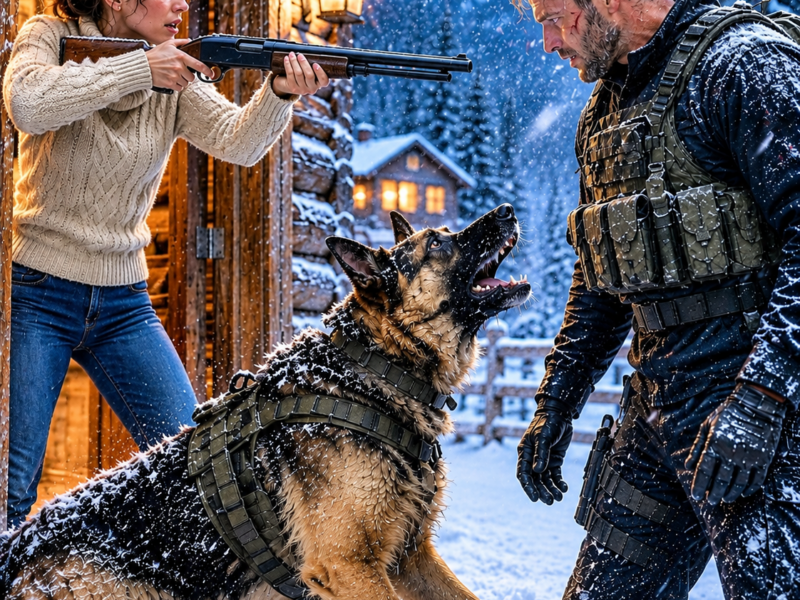
The knock came at 11:47 p.m., just as I was about to turn off the lights. Three hard knocks.
“Daniel Hayes, we know you’re in there. Step away from the dog.”
The pounding on my cabin door grew louder.
I stood frozen beside the fireplace, clutching the small metal identification tag Daniel had given me. Outside, two vehicles blocked the driveway. Their headlights cut through the snow, illuminating the silhouettes of several men moving toward the porch.
Daniel was barely able to stand. His face had gone pale, and one hand pressed against the wound near his waist.
But Ranger was different.
The dog stood between Daniel and the entrance, his ears raised, his body rigid. His lips curled slightly, revealing teeth I had never seen him show anyone since I adopted him.
“Don’t open that door,” Daniel whispered.
I looked at him. “They say they’re federal security.”
“They aren’t.”
“How do you know?”
Daniel glanced at Ranger.
“Because real federal agents wouldn’t tell me to step away from my own dog.”
Another violent knock shook the door.
“Open up! We have authorization!”
I moved toward the kitchen, where my phone was charging. Daniel caught my wrist.
“Listen carefully. If they get inside, they’ll take Ranger. They’ll tell you he’s dangerous. They’ll tell you I’m unstable. And they’ll show you paperwork proving they have authority.”
“Then what do we do?”
He looked at me with exhausted eyes.
“We make sure they never get what they came for.”
I looked down at the metal tag.
The engraved number seemed suddenly much more important than I had realized.
Before I could ask another question, Ranger barked four times.
Daniel immediately turned toward him.
“Easy, boy.”
The dog repeated the signal.
Four barks. A pause. Four more.
Daniel’s expression changed.
“He’s telling us someone is behind the house.”
My stomach dropped.
I hurried to the back window and pulled the curtain aside.
A third vehicle was parked near the woods. A man stood beside it, holding something that looked like a long case.
He wasn’t watching the front door.
He was watching my kitchen window.
I stepped away.
“Daniel, there are more of them.”
Daniel nodded.
“They’ve surrounded the cabin.”
For the first time since he arrived, he looked genuinely afraid.
Not for himself.
For Ranger.
The dog who remembered everything
I had adopted Ranger six months earlier because I couldn’t stand the thought of another military dog spending his final years inside a kennel.
My younger brother, Ethan, had served as an Army medic before dying in an accident overseas. He had always loved working dogs. After his death, I began volunteering at an animal rehabilitation center.
That was where I met Ranger.
The staff described him as a failed military K9. He had been returned from service after displaying unpredictable aggression. His original handler was listed as missing, and his medical history was incomplete.
He had a scar across his shoulder, an old fracture in his front leg, and a deep fear of metal doors.
The first time I approached his kennel, he backed into the corner and refused to look at me.
I didn’t force him.
I simply sat outside for an hour and talked.
The next day, I returned.
And the next.
Eventually, he began eating when I was nearby. Later, he allowed me to touch his neck. When the rehabilitation center asked whether I could provide him with a quiet home, I agreed.
I never expected him to become affectionate.
I never expected him to trust me.
But over time, he started following me around the cabin. He would sit outside the bathroom while I showered and wait beside the door when I went to chop wood.
Sometimes he woke in the middle of the night, trembling and panting. I would sit beside him until he calmed down.
I had believed his nightmares were memories of combat.
Now I wondered whether they were memories of something much worse.
“Why did they take him?” I asked Daniel.
He lowered himself into a chair.
“Because Ranger witnessed something during our final mission.”
“What?”
Daniel looked at the dog.
“Something that was never supposed to happen.”
He explained that his unit had been assigned to protect a military intelligence officer named Victor Hale. Hale had uncovered evidence of illegal weapons shipments involving a private defense contractor.
The shipments were being moved through military supply channels. Equipment listed as destroyed was being sold to unauthorized groups, and money was being transferred through shell companies.
Hale had copied the records.
He was supposed to meet Daniel’s team at a remote facility in the mountains.
But before they reached him, their route was changed.
Their communications went down.
And their extraction aircraft never arrived.
Daniel and Ranger were separated during the explosion.
Daniel was captured and taken to a temporary detention site. He escaped several weeks later with help from a local medic, but by then his unit had officially reported him missing and presumed dead.
He had tried to find Ranger.
He had searched military databases, contacted former handlers, and followed every possible lead.
Then he discovered something strange.
Ranger had been recovered and transferred to a rehabilitation center under a different identification number.
His medical records had been altered.
His original service history had disappeared.
And the person who signed the transfer paperwork was the same officer who had approved the mission that supposedly killed Daniel.
“Who?” I asked.
Daniel looked toward the front door.
“Colonel Adrian Mercer.”
I recognized the name.
Mercer was a senior officer who had appeared in several military news reports. He had been praised for improving working-dog programs and supporting injured service animals.
I remembered reading about his charity work.
“You’re saying he was involved?”
Daniel nodded.
“He was the person who ordered the transfer. He wanted Ranger under his control.”
“Why not simply destroy the records?”
“Because Ranger was carrying something.”
Daniel pointed to the metal tag in my hand.
“That number is connected to a hidden recording.”
I turned it over.
The number was stamped beneath the unit initials.
“Where is it?”
Daniel leaned forward.
“Not on the tag. The tag tells us where to find it.”
Before he could explain, the cabin lights went out.
A heavy thud sounded against the front porch.
Then a voice shouted:
“Last warning! Open the door!”
Ranger moved closer to Daniel.
I grabbed the flashlight and a first-aid kit.
“There’s a cellar entrance through the pantry,” I said. “It leads to the old storage shed.”
Daniel shook his head.
“They’ll be watching it.”
“Then what?”
He looked at Ranger.
“We need to let him lead us.”
The message hidden in the collar
Daniel carefully removed Ranger’s old harness.
Beneath the chest strap was a small stitched pocket I had never noticed before. It was almost completely hidden by the worn fabric.
He opened it with his fingers.
Inside was a thin piece of waterproof material.
I leaned closer.
It contained several lines of numbers and letters.
“Is that the information?” I asked.
Daniel shook his head.
“No. It’s a key.”
He held the paper beside the metal tag.
The numbers matched.
I realized the tag wasn’t simply an identification plate. It was part of a coded reference system Daniel had used during the mission.
“What does it unlock?”
“A recording stored in a military evidence archive.”
“Then why didn’t you retrieve it?”
“Because the archive was accessed by the same people who wanted me dead.”
Daniel explained that the recording had been created by a communications specialist named Lucas Reed. Lucas had discovered that someone was intercepting mission updates and replacing coordinates before they reached field units.
He had recorded a conversation between two senior officers discussing the weapons shipments.
The recording also captured the moment one of them ordered the extraction to be canceled.
Daniel had been trying to recover that evidence ever since he escaped.
But there was a problem.
The archive had been sealed.
And the only person who could authorize access was Victor Hale, the intelligence officer who had disappeared during the mission.
“Is Hale alive?” I asked.
Daniel looked at me.
“I believe so.”
The sound of glass breaking interrupted him.
A window shattered in the living room.
Ranger sprang forward, barking.
Daniel grabbed my arm.
“Get behind me!”
I pulled him toward the hallway, but he stumbled. His injury was worse than he had admitted.
A flashlight beam swept across the room.
“Daniel! We know you’re inside!”
Then a second voice spoke.
“Forget the man. Secure the dog.”
Ranger lunged toward the living room entrance.
Daniel shouted a command.
“Ranger! Stay!”
The dog stopped instantly.
It was the first time I had heard him obey a military command so precisely.
Daniel crouched beside him.
“Good boy.”
He looked at me.
“There’s something you need to understand. Ranger isn’t dangerous because he wants to hurt people. He was trained to protect a specific person. When he believes that person is in danger, he doesn’t think about anything else.”
I looked at Daniel.
“And that person is you.”
He nodded.
“Always has been.”
The flashlight beam moved closer.
I grabbed a heavy wooden chair and pushed it against the hallway door.
Daniel pointed toward the pantry.
“There’s another way out. Behind the shelves.”
We moved quickly.
Ranger stayed close, occasionally looking back toward the living room.
Behind the pantry shelves was a narrow access door leading into the old root cellar. I had used it only twice since moving into the cabin.
The passage was cold and smelled of damp earth.
Daniel struggled down the steps.
I helped him while Ranger followed.
At the bottom, we found a small exterior hatch.
I opened it carefully.
Snow covered the ground outside.
The men at the front of the cabin hadn’t noticed us leaving.
We crossed the narrow path toward my detached storage shed and slipped inside.
There was an old landline telephone mounted on the wall. I picked it up.
No signal.
Daniel shook his head.
“They’ve probably cut the connection.”
I looked at him.
“Then how do we contact anyone?”
He reached into his jacket and pulled out a small satellite communicator.
The screen flickered.
He pressed a button and sent a short message.
I didn’t recognize the recipient.
“Who are you contacting?”
“Someone I should have trusted a long time ago.”
The man who had never stopped searching
Twenty minutes later, a vehicle appeared on the road beyond the trees.
It was a dark military SUV.
I expected more armed men.
Instead, an older woman stepped out.
She wore a winter coat over a uniform and carried a small medical bag.
Daniel opened the shed door.
“Commander Brooks.”
The woman stared at him.
Then she covered her mouth.
“Daniel Hayes.”
She approached slowly, as if afraid he might disappear.
“I thought you were dead.”
“So did everyone else.”
Commander Sarah Brooks had served as Daniel’s former operations supervisor. According to him, she had been one of the few officers who questioned the official report after the mountain mission.
But her investigation had been shut down.
She looked at Ranger.
“Oh, my goodness.”
The dog approached her cautiously.
Brooks knelt.
“Hello, Ranger.”
The dog sniffed her hand, then looked at Daniel.
“It’s okay,” he said.
Ranger allowed her to touch his head.
Brooks looked at me.
“Who are you?”
I introduced myself and explained how I had adopted Ranger.
She listened without interrupting.
When I finished, she shook her head.
“You may have saved both of their lives.”
Daniel showed her the tag and the coded paper.
Her expression hardened.
“Where did you get this?”
“Ranger was carrying it when I found him.”
Brooks looked at the dog.
“Then they were right. He kept it all this time.”
I asked what she meant.
She explained that after the operation, she had received an anonymous message claiming that the missing K9 had been used to transport evidence.
At first, she dismissed it.
But then she discovered that Ranger’s transfer paperwork had been altered.
She tried to investigate.
Someone removed her access to the case.
Two weeks later, she was reassigned.
“I should have done more,” she said.
Daniel shook his head.
“You were the only one who tried.”
Brooks looked at him.
“Do you know who is outside your cabin?”
“Mercer’s people.”
She nodded.
“They’re private contractors. They’ve been following you since you entered the state.”
“Why now?”
“Because somebody reported that Ranger had been adopted by a civilian.”
I felt a chill.
“They knew where he was?”
“Not at first. But your adoption paperwork included the original handler’s name. Somebody inside the rehabilitation system accessed it.”
I looked down.
I had believed the adoption process was simply paperwork.
I had never imagined that someone could use it to find us.
Brooks turned toward Daniel.
“There’s something else you need to know.”
“What?”
“Victor Hale is alive.”
Daniel went completely still.
“Where?”
“Under protective custody. He has been hiding under a different identity since the operation.”
Daniel stared at her.
“Why didn’t he contact me?”
“Because he believed you were dead. And because the people involved were still monitoring anyone connected to the case.”
Brooks looked at the coded paper.
“This may be the last piece we need.”
She took out her phone and sent a secure message.
Then she looked at me.
“You should understand something. Once we move forward, your life will become part of this investigation.”
I looked at Ranger.
Six months earlier, I had adopted a dog nobody else wanted.
Now armed men were searching my cabin because of something he had carried for years.
I could have walked away.
I could have told them to take the dog and leave me out of it.
But I remembered the first night Ranger slept beside my fireplace.
I remembered his frightened eyes.
I remembered how he had slowly learned that my hands would never hurt him.
“No,” I said.
Brooks looked at me.
“No, what?”
“I’m not walking away from him.”
Daniel looked at me.
For the first time that night, he smiled.
The truth in the recording
Commander Brooks arranged for us to travel to a secure facility several hours away.
The trip was difficult. Daniel needed medical attention, and Ranger refused to settle unless he could see his handler.
At the facility, Daniel was examined by a military doctor. The wound near his waist had become infected, and he needed treatment immediately.
Ranger stayed outside the medical room with me.
He paced for several minutes, then lay down against the door.
I sat beside him.
“You know,” I whispered, “I thought I was helping you.”
He lifted his head.
“But I think you’ve been helping us all along.”
He placed his chin on my knee.
It was the first time since Daniel’s arrival that I felt the dog was truly relaxed.
The following morning, Commander Brooks brought us to a secure interview room.
A man was waiting there.
He was older than the photograph Daniel had shown me. His hair was mostly gray, and he walked with a slight limp.
But Daniel recognized him immediately.
“Victor.”
The man stood.
“Daniel.”
They stared at each other for several seconds.
Then they embraced.
I watched as Daniel held onto him, his shoulders shaking.
“I thought you were gone,” Daniel whispered.
Victor stepped back.
“I thought the same about you.”
Brooks placed the coded paper on the table.
“We need the archive reference.”
Victor studied the numbers.
Then he looked at Ranger.
“So that’s where it ended up.”
He explained that the evidence had been stored in a restricted military archive before the mission. Lucas Reed had created a backup recording and hidden the access reference inside Ranger’s identification system.
The dog had been chosen because he was trained to remain with Daniel under almost any circumstances.
The plan was simple.
If the mission went wrong, Daniel would know where to find the evidence.
But the ambush had happened before they could recover it.
And the people responsible had taken control of the operation records.
Victor provided the authorization needed to access the archive.
Within hours, investigators recovered the recording.
The audio was clear.
Two senior officers discussed the weapons shipments. A contractor described payments made to military personnel. Then Colonel Adrian Mercer spoke.
He confirmed that the extraction would be canceled and that the intelligence source would be classified as lost during combat.
The recording also revealed something even worse.
The order to remove Ranger from Daniel’s custody had been issued before the mission.
They hadn’t planned to recover the dog because he was injured.
They had planned to take him because they believed the evidence was hidden in his equipment.
When they couldn’t find the recording, they changed his identification and transferred him through several facilities.
They had tried to make him disappear.
But Ranger had survived.
And eventually, he had ended up in my cabin.
The knock at the cabin door
The investigation moved quickly after the recording was authenticated.
Colonel Mercer was arrested, along with two contractors and several officials connected to the weapons network.
But one question remained.
Who had sent the men to my cabin?
Investigators traced the vehicles to a private security company operating under a government contract.
The company had been hired to recover Daniel and Ranger before the evidence could be presented.
The men who knocked on my door had never been federal agents.
They had simply hoped I would believe them.
A week later, Daniel was released from medical care and placed under protection while the investigation continued.
He came back to my cabin with Ranger.
The first thing he did was stand on the porch and look at the front door.
“Not exactly how I imagined returning,” he said.
I smiled.
“Next time, try knocking during daylight.”
He laughed.
Ranger walked past us and went straight to the fireplace.
He circled twice before lying down on his old blanket.
I watched him settle.
For six months, that had been his safe place.
And now he had brought his original handler home with him.
Daniel stayed for several days.
During that time, I learned more about Ranger than I had during all the months before.
Daniel showed me the commands Ranger had learned during training. He explained the dog’s habits, the way he reacted to certain sounds, and the small movements that meant he was uncomfortable.
He also told me about the first time Ranger had saved his life.
During a patrol, Daniel had stepped into a hidden explosive trap. Ranger had refused to move forward, pulling him backward by his harness until another operator noticed the wire.
“He was always smarter than me,” Daniel said.
I laughed.
“He certainly knows how to get what he wants.”
Daniel smiled.
“That’s because he knows you’re going to give it to him.”
One evening, while we sat beside the fireplace, Daniel asked me something unexpected.
“Would you be willing to keep him?”
I looked at him.
“What?”
“I mean it. I want him to have a home here.”
“But he’s your dog.”
“He’s my partner. That will never change. But he trusts you too.”
I looked down at Ranger, who was sleeping between us.
“I don’t want to take him away from you.”
“You wouldn’t be.”
Daniel explained that his injuries would prevent him from returning to active field duty. He would be spending the next several months recovering and working with investigators.
He didn’t want Ranger to be moved again.
He wanted the dog to stay in the place where he had finally learned to feel safe.
I looked at the dog.
Then at Daniel.
“Only if you visit.”
Daniel smiled.
“That’s a deal.”
The dog who finally stopped waiting
Months passed.
The investigation uncovered the full extent of the weapons network. Several families received official corrections to records that had wrongly classified their loved ones as missing or dead. Victor Hale and other witnesses gave testimony, and the officers involved faced military and civilian charges.
Daniel slowly recovered.
He visited the cabin regularly, sometimes staying for days.
Ranger always knew when he was coming.
The dog would sit by the front window, ears raised, waiting for the sound of his truck.
And every time Daniel stepped onto the porch, Ranger greeted him with the same four barks.
Four barks.
A pause.
Four more.
The signal that had once been used to warn his handler of danger had become their private greeting.
One afternoon, I found Daniel sitting on the porch while Ranger rested his head on his knee.
“You ever regret coming here?” he asked.
I shook my head.
“Not once.”
He looked at the dog.
“I still can’t believe he found his way to you.”
I smiled.
“I think he found us both.”
Daniel was quiet for a while.
Then he said, “When I disappeared, I thought the hardest part would be leaving my team behind. I never imagined I’d spend years wondering whether my dog believed I had abandoned him.”
I looked at Ranger.
“He never stopped looking for you.”
Daniel’s eyes filled.
“I know.”
He rubbed the dog’s ears.
“And now he doesn’t have to.”
That night, a snowstorm covered the cabin again.
The same kind of storm that had surrounded us on the night Daniel first appeared.
But this time, there were no strange vehicles outside.
No men demanding that we hand over the dog.
No secrets hidden beneath his collar.
Just a warm fire, two cups of coffee, and a tired military K9 sleeping peacefully between the people he loved.
Before going to bed, I checked the front door.
Ranger followed me and sat beside it.
For a moment, I remembered the first night he had arrived at my cabin. His frightened eyes. His injured leg. The way he had refused to come inside.
I knelt and scratched his head.
“You’re safe now.”
He looked at me.
Then he walked to Daniel, rested his head against his knee, and closed his eyes.
Daniel looked up at me.
“He knows.”
I turned off the lights.
And for the first time since I adopted him, Ranger didn’t sleep facing the door.
He slept with his back to it.
Because he no longer needed to guard against the past.
His handler had come home.
And the woman who had given him a second chance had become part of his family too.
I had once adopted a broken military K9 because I believed every loyal dog deserved a safe place to live.
I never imagined that dog would lead me to a man the world had declared dead, expose a military conspiracy, and bring home a truth that had been buried for years.
But I learned something from Ranger.
Sometimes the most damaged souls aren’t waiting for someone to fix them.
They’re waiting for someone to stop giving up on them.
And sometimes, the dog everyone else calls broken is the one who knows exactly how to lead the way home.
THE ENd.









