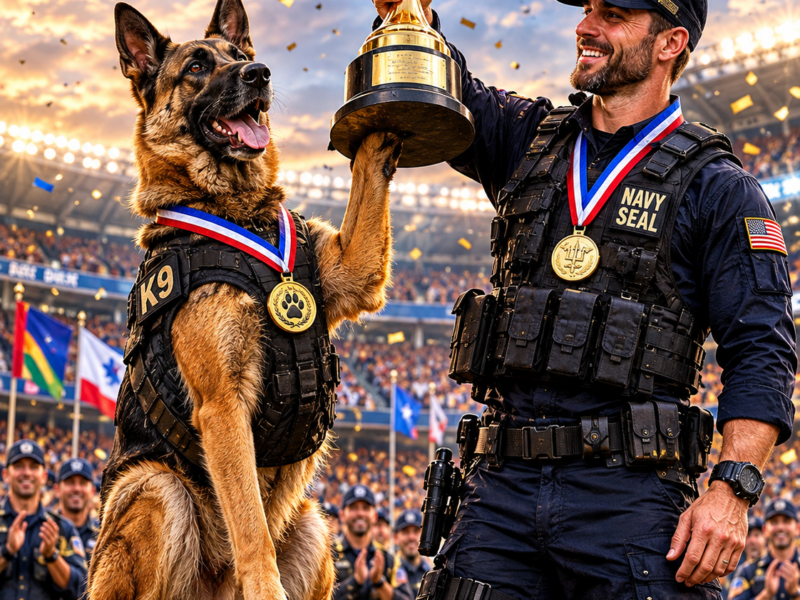
“The judges laughed when I entered the national police K9 championship with a dog nobody in our department wanted
The judge turned the tablet toward me and zoomed in on the photograph.
“Look at the ground behind him,” he said.
I leaned closer.
At first, all I could see was the familiar training field, a wooden platform, and several orange cones.
Then I noticed a dark shape near the maintenance fence.
It was a man.
He was lying on his side, partially hidden behind a stack of equipment.
I frowned.
“Who is that?”
The judge looked at me.
“That’s what we’re trying to establish.”
He enlarged the image again.
The man appeared to be wearing a maintenance uniform.
One arm was stretched toward the training area.
“Was this photograph taken during Duke’s first evaluation?” he asked.
“Yes. About two months before I took over his training.”
The judge nodded slowly.
“Your dog repeatedly stopped responding to commands during that evaluation. According to the report, he refused to complete the obstacle course and kept moving toward the fence.”
I remembered the report.
I had read it several times.
It described Duke as distracted, disobedient, and unsuitable for advanced police work.
But the photograph showed something different.
“Was somebody hurt that day?” I asked.
The judge didn’t answer immediately.
Instead, he opened another file.
It contained a short incident report from our department.
My eyes moved across the page.
A maintenance employee had suffered a medical emergency near the training grounds on the same afternoon.
He had been discovered by another employee and transported to the hospital.
The incident had been classified as unrelated to the K9 evaluation.
I stared at the screen.
“Wait. Are you telling me Duke was trying to get to that man?”
The judge nodded.
“Possibly. We need to verify the timeline and speak with the people who were present.”
I thought about all those training sessions.
All those times Duke had stopped in the middle of an exercise.
All those moments when I had assumed he was simply being difficult.
Maybe he hadn’t been ignoring commands.
Maybe he had been responding to something the rest of us couldn’t detect.
The judge returned the tablet to his side.
“Officer Hayes, we’re not accusing anyone of anything. But your dog’s behavior deserves a closer look.”
I glanced down.
Duke was sitting beside me, watching the arena.
His crooked ear tilted slightly when he heard his name.
I rubbed his neck.
“Looks like you’ve been trying to tell us something, buddy.”
He wagged his tail.
The judge gave us permission to continue competing, pending further review of the footage.
But I couldn’t stop thinking about that photograph.
For the first time, I wondered whether Duke’s greatest strength had been mistaken for his greatest weakness.
And the championship was about to give us another opportunity to find out.
The second event was obedience.
It was usually one of the most straightforward competitions.
Handlers guided their dogs through a series of commands: sit, stay, heel, down, recall, and controlled movement around distractions.
The judges expected precision.
Every delayed response cost points.
Duke had improved considerably, but obedience had never been his strongest category.
I knew we needed a clean performance.
Before we entered the arena, I crouched beside him.
“Just you and me, okay?”
He looked at me.
“No pressure.”
A few feet away, Officer Miller was preparing Titan.
The Malinois sat perfectly straight, eyes fixed on his handler.
Miller noticed me watching.
“Still feeling confident?”
I smiled.
“Ask me after the scores.”
He chuckled.
“Fair enough.”
The announcer called our number.
I walked Duke onto the field.
The first commands went well.
He sat.
He stayed.
He followed me through the cones.
Then came the recall exercise.
I placed him at one end of the arena and walked to the opposite marker.
The judge raised his hand.
I gave the command.
“Duke, here!”
He started toward me.
Then suddenly stopped.
His head turned toward the spectator stands.
I tightened my jaw.
“Duke, here!”
He didn’t move.
A few people in the audience began whispering.
I could feel the judges watching.
Then I heard a child crying.
It wasn’t loud.
It was the kind of frightened, exhausted cry that could easily disappear beneath the noise of a crowded stadium.
Duke’s ears lifted.
He turned away from me.
The judge raised his clipboard.
“Handler, maintain control of your dog.”
I looked toward the stands.
A little boy was standing beside a woman in a wheelchair.
His mother was trying to calm him, but he had dropped his hearing aid.
He was pointing toward the floor beneath the seating section.
Duke began pulling toward him.
I looked at the judge.
“May I check something?”
“This is an active competition.”
“I understand, but my dog has alerted.”
The judge hesitated.
Then Duke barked once.
Not aggressively.
Urgently.
I followed him toward the stands.
A security officer stepped in front of us.
“Sir, you can’t bring the dog over here.”
“Please, just give me a moment.”
I looked beneath the seats.
At first, I saw nothing.
Then I noticed a small hand moving between two metal supports.
A little girl was trapped in the narrow space beneath the lower seating platform.
She had apparently slipped away from her father and fallen through a gap between the steps and the support structure.
Her leg was caught.
She was crying quietly, too frightened to shout.
I called for the medical team.
The security officers helped lift the loose panel, and within minutes the child was free.
Her father rushed toward her, dropped to his knees, and wrapped both arms around her.
“Thank you,” he kept saying.
“Thank you.”
The little girl reached toward Duke.
He lowered his head so she could touch his nose.
I looked at him.
He wagged his tail.
Behind me, the obedience judge had stopped writing.
The announcer’s voice came through the speakers.
“Ladies and gentlemen, we have a brief interruption while medical staff assist a spectator.”
I knew our obedience score would suffer.
We had missed the recall command.
We had left the course.
But I didn’t regret it.
When we returned to the handler area, the senior judge approached.
“Officer Hayes.”
“Yes, sir?”
He looked down at Duke.
“Your dog has an unusual tendency to redirect his attention toward people in distress.”
I nodded.
“I’ve noticed.”
“Has he been trained for search and rescue?”
“No. Only standard police K9 work.”
The judge studied Duke for a moment.
“Interesting.”
He walked away.
I knelt beside my partner.
“You’ve got a talent for making my life complicated.”
Duke licked my hand.
I laughed.
“Yeah. I know.”
By the end of the second event, our score had dropped.
We were no longer among the highest-ranked teams.
Miller and Titan were near the top.
The crowd had already begun treating them as favorites.
During the break, I found myself sitting alone behind the equipment tent.
Duke was drinking water beside me.
I looked at the results sheet.
Our tracking score was excellent.
Our obedience score was disappointing.
If we wanted to win, the next two events would have to be nearly perfect.
I wasn’t sure that was possible.
Then someone sat down beside me.
It was the woman who had sponsored our trip.
I recognized her from the paperwork.
Her name was Margaret Collins.
She was in her late sixties, with silver hair tied behind her head and a small scar above her eyebrow.
“You’re Jake Hayes?”
I nodded.
“Yes, ma’am.”
She looked at Duke.
“So this is the dog everyone keeps talking about.”
I smiled.
“Apparently.”
She reached into her coat and took out a folded photograph.
I recognized it immediately.
It was the same training field photograph the judge had shown me.
But this copy was older.
The edges were worn, and someone had written a date on the back.
“Where did you get that?” I asked.
Margaret looked toward the arena.
“From my son.”
I stared at her.
“Your son?”
“His name was Daniel Collins. He worked maintenance at your department.”
The name struck me.
Mr. Collins.
The man Duke had found inside the storage facility.
Margaret nodded.
“He’s the man in the photograph.”
I looked down at the image again.
“Was he the one who became sick during Duke’s first evaluation?”
She nodded.
“Daniel suffered a stroke that afternoon. He had managed to crawl near the fence before losing consciousness.”
I felt my chest tighten.
“How did he get help?”
“Another employee found him later. But before that, he told us something strange.”
She turned the photograph over.
On the back was a handwritten sentence.
“The dog kept coming back, even when nobody listened.”
I looked at her.
“What does that mean?”
Margaret’s eyes filled.
“My son said that while he was lying there, he could hear a dog barking. He said it kept coming closer, then moving away, then coming back.”
She paused.
“He thought somebody was trying to find him.”
I looked toward Duke.
The dog was resting with his chin on my boot.
Margaret continued.
“When Daniel recovered, he asked the department whether the dog had been rewarded. They told him the animal had failed his evaluation and would probably be transferred.”
I felt a knot forming in my stomach.
“Why didn’t anyone tell us?”
“Because Daniel didn’t know which dog it was.”
She looked at Duke.
“Until I saw your photograph.”
For several seconds, neither of us spoke.
Then Margaret placed her hand gently on Duke’s head.
“I wanted to sponsor you because I knew he deserved another chance.”
I swallowed.
“Why didn’t you tell me?”
She smiled sadly.
“Because I didn’t want you training him to impress me. I wanted him to become what he was meant to be.”
I looked down at the dog.
His eyes were half closed.
He had spent months being corrected for noticing things other people missed.
And now a woman I had never met was telling me that the same instinct might have saved her son’s life.
“Does Daniel know Duke is here?” I asked.
Margaret nodded.
“He’s watching the championship from the hospital.”
I looked at her.
“He’s still in the hospital?”
“His recovery has been difficult. He can walk short distances, but he has trouble with his speech.”
She paused.
“He wanted to come today.”
I felt something change inside me.
“Would you be able to arrange a video call?”
Margaret smiled.
“I was hoping you’d ask.”
That evening, after the events ended, I sat with Duke in our hotel room.
Margaret called through the video app.
A man’s face appeared on the screen.
He looked older than I expected.
His speech was slow, and his right hand trembled slightly.
“Is… that… him?”
Margaret moved the phone toward Duke.
The dog lifted his head.
Daniel smiled.
“Hello, buddy.”
Duke stood.
His tail began moving.
Then he walked toward the phone and pressed his nose against the screen.
Daniel laughed.
It was a quiet, uneven laugh.
But it was real.
“That’s him,” he whispered.
I crouched beside Duke.
“Daniel, my name is Jake Hayes. I’m his handler.”
Daniel nodded.
He tried to speak again.
“Good… dog.”
Margaret wiped her eyes.
I looked at the man on the screen.
“I’m sorry nobody listened when he was trying to find you.”
Daniel shook his head.
“Not… your fault.”
He looked at Duke again.
“Always… knew.”
I leaned closer.
“Knew what?”
Daniel struggled for a moment.
Then he managed three words.
“He… wasn’t… wrong.”
I looked down at Duke.
The dog was sitting beside me, his head tilted toward the screen.
I felt my eyes burn.
For the first time, I didn’t see a failed police dog.
I saw a partner who had been trying to do his job in a way nobody understood.
The following morning, the championship resumed.
The third event was obstacle navigation.
It involved a series of barriers, tunnels, platforms, narrow bridges, and moving obstacles.
This was the event that had caused Duke so much trouble during his original evaluation.
I knew he could complete the course.
But I also knew the competition environment would be difficult.
The stadium was louder.
The barriers were taller.
And the judges were watching every movement.
I crouched beside him.
“Take your time, buddy.”
He looked at me.
I gave him the first command.
“Forward.”
He cleared the first hurdle.
Then the second.
He moved through the tunnel, crossed the narrow bridge, and climbed the wooden platform.
The crowd applauded.
I kept my eyes on him.
The final section contained a series of hanging obstacles.
Duke hesitated.
He lowered his head.
I recognized the behavior immediately.
He wasn’t refusing the course.
He was studying it.
I waited.
A few seconds passed.
Then he moved to the left.
He slipped between two hanging barriers and reached the finish marker.
The judges checked their sheets.
Our score was excellent.
Not perfect, but close.
Miller watched from the opposite side of the arena.
His expression had changed.
He approached me during the break.
“Your dog is better than I thought.”
I smiled.
“He’s been telling us that for a while.”
Miller glanced at Duke.
“Maybe.”
Then he lowered his voice.
“Just don’t expect him to beat Titan in apprehension.”
I looked toward the arena.
That was the final event.
Controlled suspect apprehension.
And it was the event where Duke had once failed.
The competition organizers had designed a complex scenario.
A simulated suspect would run through a training environment.
The K9 team would track, locate, and safely apprehend the person under strict control.
The judges would evaluate speed, obedience, precision, and handler communication.
It was the most demanding event of the championship.
Titan was considered the favorite.
His record was outstanding.
Duke’s record was less impressive.
As the teams prepared, I noticed something unusual.
One of the event staff members was adjusting a metal panel near the simulated building.
He dropped a small tool.
It rolled beneath the structure.
Duke watched it.
Then he turned his head toward the panel.
His ears lifted.
I crouched.
“What’s there?”
He sniffed the air.
The staff member picked up the tool and walked away.
But Duke remained focused on the structure.
I looked more closely.
There was a narrow gap beneath the panel.
Something had been placed inside.
I called over an event official.
“Excuse me. Is there supposed to be anything behind that wall?”
He frowned.
“No. Why?”
“My dog is alerting.”
The official looked at Duke.
“Could be a scent from the previous exercise.”
I wasn’t convinced.
“Can we check?”
The official hesitated, then called the technical supervisor.
They opened the panel.
Behind it was a small electrical unit with a damaged cable.
The supervisor immediately ordered the area cleared.
The power was shut off.
A technician later confirmed that the cable had been overheating.
It could have caused a serious electrical incident if left unnoticed.
The event was delayed by nearly an hour.
I sat with Duke while the staff checked the equipment.
I scratched his neck.
“You really don’t know how to do anything the easy way, do you?”
He wagged his tail.
When the final event finally began, the atmosphere was electric.
Every team was lined up around the arena.
The announcer introduced the competitors.
Miller and Titan received loud applause.
Their performance was nearly flawless.
Titan tracked the simulated suspect through the building, followed the route, and completed the controlled apprehension.
The scoreboard showed an impressive result.
Then our number was called.
I walked Duke to the starting line.
My palms were damp.
The judge explained the scenario.
A simulated armed suspect had fled through a training building and was hiding somewhere beyond the final barrier.
Duke had to locate him and respond to the command.
I nodded.
I understood the instructions.
I had practiced this exercise dozens of times.
But as we approached the starting point, Duke suddenly looked toward the far end of the building.
He wasn’t looking at the marked route.
He was looking at a service door.
I felt my stomach tighten.
The judge gave me a warning.
“Handler, your dog needs to focus on the designated course.”
I gently touched Duke’s harness.
“Search.”
He moved forward.
But instead of following the obvious trail, he turned toward the service door.
“Duke!”
He stopped.
He looked back at me.
Then he looked at the door again.
The judges began whispering.
I could feel the crowd waiting.
I had a choice.
Follow the official route and complete the event as designed.
Or trust the dog who had spent months showing me that his instincts weren’t random.
I remembered the man lying beneath the maintenance hatch.
The little girl beneath the stadium seats.
The overheated electrical unit.
And the photograph from his first evaluation.
I loosened the leash slightly.
“Show me.”
Duke moved toward the door.
An event official stepped forward.
“Officer Hayes, you cannot leave the course.”
I held up my hand.
“Something’s wrong.”
The official looked toward the judges.
The senior judge approached.
“Explain.”
“My dog has been consistently alerting to things outside the assigned exercises. I believe he has detected something.”
The judge looked at Duke.
Then at me.
“Proceed carefully.”
I followed.
Duke moved through the service entrance and into a narrow corridor.
The air was cooler there.
He stopped near a storage room.
Then he began barking.
I reached for the handle.
It wouldn’t move.
I called for assistance.
Two staff members arrived with a key.
The door opened.
And inside, we found a young event volunteer sitting on the floor.
He had fallen from a ladder while adjusting equipment and injured his ankle.
He had tried calling for help, but his radio had been damaged in the fall.
He was conscious, but clearly in pain.
The medical team rushed in.
Duke stood beside him, wagging his tail.
The senior judge watched quietly.
The competition was officially paused.
A few minutes later, the announcer addressed the crowd.
“Ladies and gentlemen, our final event has been interrupted following an unexpected medical incident. The volunteer is receiving care, and the judges will review the circumstances.”
I stood beside Duke.
My heart was still racing.
The young volunteer looked up at me.
“Your dog found me?”
I nodded.
“He did.”
The volunteer reached out.
Duke gently touched his hand with his nose.
“Good boy,” the young man whispered.
I looked at the judges.
I knew we had technically failed to complete the final event.
We had left the course.
Our score might be disqualified.
But I also knew I couldn’t have made a different decision.
The senior judge approached me.
“Officer Hayes, come with us.”
I followed him to the officials’ table.
Duke walked beside me.
The other handlers were gathering near the scoreboard.
Miller stood with his arms crossed.
I couldn’t tell whether he was angry or simply confused.
The senior judge reviewed the footage from the service corridor.
Then he looked at the other judges.
They spoke quietly for several minutes.
Finally, he turned toward me.
“Officer Hayes, we have a decision.”
I nodded.
“Yes, sir.”
He looked down at Duke.
“Your dog did not complete the designated apprehension exercise.”
I felt my shoulders drop.
“Understood.”
“But he identified a person in distress, located him in an area outside the course, and initiated a response without creating additional danger.”
He paused.
“We’ve also reviewed the previous footage, including the original evaluation at your department.”
My eyes moved toward the tablet.
The judge continued.
“We believe Duke’s unusual behavior has been repeatedly misinterpreted. His tendency to redirect toward distressed individuals and investigate unfamiliar areas is consistent with a strong search-and-rescue instinct.”
I looked down at the dog.
The judge placed the tablet on the table.
“There’s another matter.”
He turned the screen toward me.
It showed Duke’s original evaluation report.
Several handwritten notes had been added by the reviewing panel.
One sentence was highlighted.
“The dog repeatedly abandoned the assigned task to investigate signs of a person in distress.”
I read it again.
The same behavior that had cost him his first evaluation had been documented.
It simply hadn’t been understood.
The judge looked at me.
“We have reviewed the rules and spoken with the event director. Your team will not receive a standard apprehension score. However, the judges are considering a special recognition for extraordinary service.”
I nodded slowly.
“Thank you.”
He held up one hand.
“There’s more. We have to discuss the final championship standings.”
I looked toward the scoreboard.
Titan was still in first place.
Our name was near the bottom.
I knew what that meant.
We weren’t going to win the competition.
And that was fine.
At least, I thought it was.
The judges returned to the stage.
The crowd quieted.
The announcer began reading the results.
Third place went to a team from California.
Second place went to Officer Miller and Titan.
The stadium erupted in applause.
Miller stepped forward and accepted his trophy.
Then the announcer paused.
“Before we announce the overall champion, the judges would like to recognize a team whose performance today reminded us of something important about the work these animals do.”
I felt Duke lean against my leg.
The senior judge stepped to the microphone.
“During this competition, one dog repeatedly demonstrated the ability to identify people in distress, even when those people were outside the assigned exercise areas.”
The crowd became silent.
“That dog was originally considered unsuitable for police service because he did not always follow the expected route or respond in the expected way.”
I looked down at Duke.
He was watching the stage.
The judge continued.
“Today, he helped locate an injured child, identified an equipment hazard, and found an injured event volunteer. His earlier service history has also revealed an incident in which he repeatedly attempted to alert handlers to a maintenance worker suffering a medical emergency.”
The judge paused.
“We are proud to present the National K9 Exceptional Service Award to Officer Jake Hayes and his partner, Duke.”
For a second, I didn’t move.
Then the crowd stood.
The applause rolled through the stadium.
I looked at Duke.
He was wagging his tail.
I knelt beside him.
“That’s you, buddy.”
He licked my cheek.
I laughed.
Then I walked onto the stage with him.
The judge handed me a plaque.
But before I could say anything, another announcement came through the speakers.
“There’s one more person we’d like to recognize.”
A woman in the front row stood up.
It was Margaret Collins.
Beside her was a man holding a walking cane.
Daniel.
He was wearing a dark blue jacket and had a small smile on his face.
Margaret helped him walk toward the stage.
I stared.
I hadn’t expected him to come.
The crowd began applauding again.
Daniel approached Duke.
He lowered himself carefully and reached out.
Duke immediately recognized him.
The dog’s tail moved so hard that his entire body seemed to sway.
Daniel placed one trembling hand on Duke’s head.
“Good… boy.”
Duke gently leaned against him.
Daniel looked at me.
“Thank… you.”
I shook my head.
“Don’t thank me. He did the work.”
Daniel smiled.
Then he looked toward the crowd.
With some effort, he raised his voice.
“People… should… listen.”
The stadium became completely quiet.
He looked down at Duke.
“This… dog… listened.”
I felt my eyes fill.
There wasn’t a person in that stadium who didn’t understand what he meant.
The ceremony continued.
Titan was named the overall champion based on the competition’s official scoring.
Miller accepted the title.
And when he passed us afterward, he stopped.
He looked at Duke for a moment.
Then he removed his cap.
“Congratulations,” he said.
I shook his hand.
“Thank you.”
He looked at Duke.
“Looks like I owe him an apology.”
I smiled.
“I think he’ll accept a treat.”
Miller laughed and reached into his pocket.
Duke accepted the treat politely.
Then he looked back at me as if asking whether that was all.
For the first time, Miller laughed without any trace of mockery.
“He’s a good dog, Hayes.”
“Yeah,” I said. “He really is.”
Three weeks later, our department held a ceremony to recognize Duke’s achievement.
Lieutenant Harris stood in front of the assembled officers.
He looked uncomfortable.
That wasn’t unusual.
He had never been the type of man who enjoyed admitting he was wrong.
He approached me after the ceremony.
“Hayes.”
“Sir.”
He looked down at Duke.
“I owe this dog an apology.”
I said nothing.
Harris crouched slightly and extended his hand.
Duke sniffed it.
Then he sat.
Harris smiled.
“I should have listened.”
I looked at him.
“Yes, sir.”
He nodded.
“From now on, I want Duke evaluated for our department’s search-and-rescue program. We’ll keep his patrol certification where appropriate, but I don’t want anyone treating his instincts as a problem again.”
I looked down at Duke.
His crooked ear was standing straight up.
I scratched his neck.
“You hear that? Looks like you’ve got a new job.”
Harris smiled.
“Maybe a better one.”
Over the following months, Duke became one of the most requested K9s in our county.
He helped locate missing hikers.
He assisted in searches for elderly residents who had wandered away from home.
He found a little boy hiding in a drainage culvert after a storm.
He also continued working with me on police assignments whenever his skills were needed.
But something else changed.
The department began training its handlers differently.
Instead of focusing only on strict command performance, we started paying closer attention to how individual dogs communicated.
We learned that not every pause was disobedience.
Not every detour was distraction.
And sometimes, a dog that appeared to be failing was simply noticing something the humans had missed.
One afternoon, I visited Daniel Collins at his home.
He was sitting on the porch when I arrived.
His speech had improved.
His walking was still slow, but he was able to move around without assistance for short distances.
Duke recognized him immediately.
He approached and rested his head on Daniel’s knee.
Daniel smiled.
“Still looking after people?”
I laughed.
“That’s pretty much his full-time job.”
Daniel reached down and scratched his ears.
Then he looked at me.
“Did he win?”
I smiled.
“Not the overall championship.”
Daniel frowned.
“Why?”
I explained the scoring.
He listened carefully.
Then he shook his head.
“Doesn’t matter.”
He looked at Duke.
“He won… where it counted.”
I glanced at the dog.
Daniel was right.
A trophy could recognize performance.
A medal could celebrate achievement.
But neither could measure the moment a frightened person heard a dog barking in the darkness and realized somebody was coming to find him.
Before I left, Daniel asked me to take a photograph.
He wanted one with Duke.
We stood beside the porch.
Daniel placed his hand on the dog’s head.
I held the plaque.
The photograph was taken just before sunset.
When it was printed, I gave one copy to Daniel and placed another in the department’s K9 training room.
I wrote a small note beneath it:
“Never mistake a different way of working for an inability to serve.”
A year after the championship, Duke received another honor.
The department named him its first official search-and-rescue K9 ambassador.
He was also invited to visit schools and community events.
Children loved him.
He was patient with nervous kids and gentle with elderly visitors.
The only thing he still couldn’t resist was stealing sandwiches.
Some habits never change.
One Saturday, I took him to a local elementary school for a safety demonstration.
After the presentation, a little boy approached us.
He couldn’t have been older than eight.
He had been standing quietly near the back of the room, holding his mother’s hand.
“Can I pet him?” he asked.
I nodded.
“Of course. Let him sniff your hand first.”
The boy slowly extended his palm.
Duke sniffed it and sat down.
The boy smiled.
“Is he famous?”
I laughed.
“A little.”
“Did he win a big trophy?”
I looked at Duke.
“Not exactly.”
The boy frowned.
“Then why is he special?”
I crouched beside them.
“Because he knows when someone needs help, even when nobody asks.”
The boy thought about that.
Then he placed his hand gently on Duke’s back.
“That’s better than a trophy.”
I smiled.
“Yeah. I think so too.”
As we walked back to the patrol vehicle, I remembered the first day I had seen Duke in that kennel.
The crooked ear.
The scar.
The quiet eyes.
The dog everyone had already decided was a failure.
I remembered the thirty-day promise.
The training reports.
The laughter.
The missed commands.
And the people he had found while the rest of us were busy looking somewhere else.
I had taken Duke because I thought he deserved another chance.
But somewhere along the way, he had taught me that giving someone a chance sometimes means learning to see them differently.
That evening, I sat beside him in the backyard.
He rested his head on my knee, just as he had during our first training session.
I rubbed his ears.
“You know, buddy, they used to say you weren’t good enough.”
He looked up at me.
I smiled.
“Turns out, we weren’t paying attention.”
Duke wagged his tail and settled back down.
On the shelf inside my house, the championship award stood beside the photograph of Daniel Collins.
I was proud of the recognition.
I was proud of what Duke had accomplished.
But if someone asked me what made him a champion, I wouldn’t point to the plaque.
I’d tell them about the maintenance worker behind the fence.
The little girl beneath the stadium seats.
The injured volunteer behind the locked door.
And a dog who kept searching when everyone else had already decided the exercise was over.
Because Duke never needed the world to call him a champion.
He only needed someone to trust him enough to follow when he knew there was someone out there who needed to be found.
The end.









