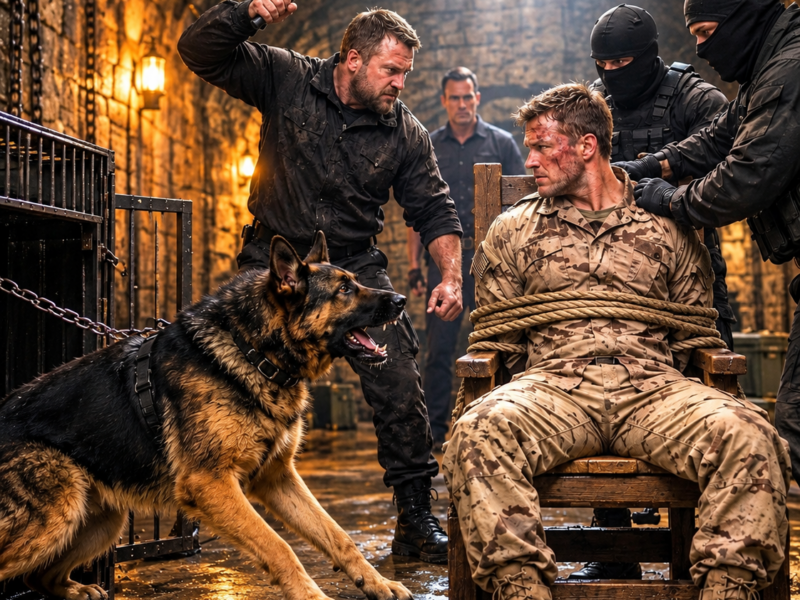
“The guards at the abandoned Virginia warehouse laughed when they chained my Navy SEAL dog beside me and poured ice water over our wounds
The man standing in the doorway was wearing a dark jacket, black gloves, and a familiar silver watch.
For several seconds, I couldn’t make my mind accept what my eyes were seeing.
Then he stepped farther into the light.
“Travis?”
My former teammate looked at me without answering.
He had a fresh cut above his eyebrow, and his left sleeve was stained with something dark. His eyes moved from my face to Ranger, who stood between me and the armed guards, his lips pulled back from his teeth.
Pike slowly lowered his weapon.
“Cole,” he said. “You’re supposed to be outside.”
Travis glanced at him.
“Change of plans.”
“What plans?”
“The kind you don’t want to discuss in front of witnesses.”
Pike’s expression hardened.
I pulled against my restraints.
“Travis, what the hell is going on?”
He looked at me, and for one brief moment, I saw the man who had stood beside me during twelve years of deployments, who had once carried me nearly a mile after a blast injured my leg, and who had sat beside me at my brother’s funeral without saying a word.
Then his face closed again.
“I’m sorry, Daniel.”
Those two words frightened me more than Pike’s threats.
I had spent years learning to distinguish genuine regret from a man preparing to do something unforgivable.
Travis sounded like someone who had already made his decision.
Pike gestured toward the black case on the floor.
“Get what you came for. We’ve wasted enough time.”
Travis didn’t move.
“Release the dog.”
Pike stared at him.
“What?”
“You heard me.”
“You’re giving orders now?”
Travis finally looked directly at him.
“The dog has nothing to do with this.”
Pike laughed.
“You brought us Mercer. You told us the dog was part of the problem.”
“I said the dog could complicate things.”
“And it has.”
Pike stepped toward Ranger, raising one hand as though he intended to grab the chain.
Ranger lunged.
The chain snapped tight, and his bark exploded through the room.
Pike stumbled backward, swearing.
Travis drew his pistol.
For a split second, I thought he was aiming at Ranger.
Instead, he pointed it at Pike.
“Take one more step toward that dog, and this ends now.”
Nobody moved.
I stared at Travis, trying to understand which version of him I was looking at.
The man who had brought me to this warehouse had disappeared.
The man standing in front of Pike seemed almost as dangerous as the people who had tortured us.
“Travis,” I said carefully, “tell me what you want.”
He glanced at the guards.
“I need everyone out of this room.”
Pike laughed again, but there was no humor in it.
“You’ve lost your mind.”
“Maybe.”
“You think you can walk in here and change the deal?”
Travis’s pistol remained steady.
“I think you should have followed the original instructions.”
Pike’s eyes narrowed.
“What original instructions?”
Travis didn’t answer.
Then the warehouse lights flickered.
A siren sounded somewhere beyond the corridor, followed by the distant slam of a metal door.
One of the guards looked toward the exit.
Pike spun around.
“What was that?”
Travis lowered his weapon just enough to reach for his radio.
“Blue team, status?”
Only static answered.
He tried again.
Nothing.
I had heard that kind of silence before.
Not ordinary interference.
A deliberate interruption.
Travis looked at me.
“Daniel, listen carefully. When I release you, take Ranger and stay behind me.”
I almost laughed.
“You’re the reason we’re here.”
“I know.”
“You watched them hurt him.”
His jaw tightened.
“I know.”
“You watched them hurt me.”
“I know, Daniel.”
He said it without defending himself, which somehow made my anger worse.
“Then give me one reason not to assume you’re here to finish the job.”
Travis glanced at Ranger.
“Because if I wanted you dead, I wouldn’t have opened that door.”
Before I could answer, Pike raised his weapon again.
“Enough.”
He pointed it at Travis.
“You’re not leaving with anything.”
Travis shifted his stance.
“Put the gun down, Mason.”
Pike fired.
The shot struck a metal cabinet with a deafening crack.
Travis dropped behind the table, and the room erupted into chaos.
A guard rushed toward the doorway.
Another ducked behind the steel post.
Pike shouted something I couldn’t hear over the ringing in my ears.
Ranger threw his weight against the chain, barking furiously.
I rolled onto my side and pulled my wrists against the sharp edge of a broken metal bracket protruding from the base of the table.
The restraints scraped my skin.
I kept working.
One pull.
Then another.
The plastic binding finally split.
I fell forward, caught myself on one hand, and reached for the chain attached to Ranger’s collar.
“Easy, buddy.”
He turned toward me immediately.
I worked the locking mechanism with fingers that barely seemed to belong to me.
When it released, Ranger pressed against my chest so hard that I nearly lost my balance.
I buried my face in his fur for one breath.
Then I heard Travis shout, “Daniel, move!”
I grabbed Ranger’s collar and pulled him behind the steel table just as Pike fired again.
Travis returned fire, forcing Pike and the remaining guard behind the cabinet.
The shooting stopped as suddenly as it had begun.
For several seconds, the only sound was Ranger’s rough breathing and the distant alarm.
Travis crouched beside us.
“Can you stand?”
“Probably.”
“That’ll have to do.”
I tried to rise, but my injured leg buckled.
Travis caught my arm.
Ranger immediately moved between us, growling at Travis.
“It’s all right,” I whispered, although I wasn’t sure it was.
Travis slowly withdrew his hand.
“Good dog.”
Ranger did not look impressed.
Under different circumstances, I might have laughed.
Instead, I leaned against the table and forced myself upright.
“What happens now?”
“We get out.”
“And then?”
Travis looked toward the corridor.
“Then I tell you everything.”
We moved toward the side exit, keeping low as the alarm continued to sound.
Travis led us through a narrow passage and into a storage room filled with empty shipping crates.
A metal door at the far end opened onto a fenced service yard.
Cold night air struck my face.
I had never been so grateful to smell rain and diesel.
Travis helped me over a low concrete barrier while Ranger stayed close to my left side.
Beyond the fence, headlights swept across the road.
A black SUV pulled to a stop.
I reached instinctively for a weapon I no longer carried.
Travis raised one hand.
The driver’s door opened, and a woman in a dark coat stepped out.
“Cole,” she called. “We have less than five minutes.”
Travis looked at me.
“This is Agent Sarah Mitchell. She’s with Naval Criminal Investigative Service.”
I stared at her.
“NCIS?”
She showed me her credentials.
“Mr. Mercer, I know you have questions. We need to get you somewhere safe first.”
I looked back toward the warehouse.
“What about the men inside?”
“Additional agents are securing the property. We have officers on the north entrance and the access road.”
“Then why were we left in there for days?”
Mitchell’s expression changed.
“We weren’t aware you were being held at this location until forty minutes ago.”
I turned to Travis.
He didn’t meet my eyes.
“Get in the vehicle,” Mitchell said. “Please.”
I wanted to refuse.
But Ranger was limping, and I could feel my own strength draining with every passing second.
I climbed into the back seat with him.
Travis sat beside the driver.
As we pulled away, I watched the warehouse disappear behind the fence.
For three days, I’d believed that my only chance of survival depended on giving Pike the codes he wanted.
Now I was free, but the man who had brought me into that building was sitting ten feet away, and I still didn’t know whether he’d come to save me or silence me.
Mitchell drove us to a secure medical facility near Norfolk.
A physician examined my injuries, treated Ranger’s damaged paw, and told me that both of us needed rest.
I barely heard him.
Ranger lay on a padded blanket beside my bed, his head resting near my hand.
Every time I moved, his ears lifted.
When the medical staff left, Mitchell returned with a folder.
“Are you well enough to talk?”
“No.”
She looked at me.
“Fair enough. But I think you’ll want to hear this.”
She placed a photograph on the bedside table.
It showed a shipping container inside a military storage facility.
A red tag had been attached to the locking mechanism.
I recognized the facility.
It belonged to my former unit.
“What is this?”
“A container listed as destroyed after an inventory discrepancy six months ago. We believe it contains equipment that was illegally diverted from military custody.”
“That’s what Travis called me about.”
“Yes.”
She opened the folder.
“Your credentials were used to approve the transfer. So were those of several other service members. Some of them were unaware their identities had been compromised.”
“Why would someone need my credentials?”
“Because you had authorization to access the inventory system before your retirement. The transfer appeared legitimate.”
I looked at the photograph again.
“Pike wanted the access codes.”
“He wanted the authentication key associated with your old account. It could allow the network to be manipulated in a way that would make the stolen equipment appear to have been transferred lawfully.”
I remembered Pike’s questions, his insistence that I had access to records I hadn’t touched in months.
He hadn’t wanted information about a single shipment.
He wanted a way to make the theft disappear.
“Who was behind it?”
Mitchell folded her hands.
“We’re still investigating. But Travis has given us evidence connecting Pike to a private security contractor that handles military logistics.”
“And Travis?”
“He approached us after discovering that your credentials had been used. He believed someone was planning to force you to authenticate a false transfer.”
I looked toward the closed door.
“He could have told me.”
“Yes,” Mitchell said. “He should have.”
Her answer caught me off guard.
She didn’t defend him or try to make the betrayal sound noble.
“Why didn’t he?”
“Because he was afraid you’d refuse to cooperate, and he thought he could bring you in without exposing you to the people behind the scheme.”
I let out a bitter laugh.
“He brought me into a warehouse full of armed men.”
“I know.”
“He knew they might hurt me.”
“He says he expected Pike to question you and then release you once he obtained the authentication key.”
I stared at her.
“And he expected Ranger to sit quietly while they did it?”
Mitchell glanced at the dog.
“I don’t think he considered what they’d do to Ranger.”
That was the first thing she had said that made me want to throw something.
Travis had spent years working beside me. He knew what Ranger meant to me, and he knew that anyone who threatened the dog would turn a difficult situation into a dangerous one.
He had made a choice on my behalf.
Again.
“Where is he?”
“Waiting outside.”
“Send him in.”
Travis entered a few minutes later.
He looked as though he hadn’t slept in days.
Ranger lifted his head and growled.
Travis stopped several feet from the bed.
“I don’t blame him,” he said.
“Good. At least one of you understands the situation.”
He looked down.
“I thought I could control it.”
“You couldn’t even control the door.”
“I know.”
I waited for an explanation.
He sat in the chair beside the wall but kept his distance from Ranger.
“When I discovered the transfer records, I realized someone had been using our old unit’s credentials. I started tracing the activity, and Pike contacted me. He knew about the investigation before NCIS did.”
“So you agreed to meet him.”
“I thought I could identify the people above him. I told myself I needed to get close enough to understand the operation.”
“And you decided I was the easiest way to do that.”
Travis swallowed.
“Yes.”
I looked at him for a long time.
The man sitting in front of me had once risked his life to bring me home.
Now he had gambled with my life because he believed he could manage the outcome.
“I trusted you,” I said.
“I know.”
“No. You knew I trusted you. That’s different.”
He looked up.
“I am sorry, Daniel.”
I turned toward the window.
I didn’t have the strength to decide whether I could ever forgive him.
I wasn’t even sure forgiveness was the right question.
The more immediate question was whether I could live with what he had done without allowing it to change the person I wanted to be.
“Tell me about the authentication key,” I said.
Travis took a breath.
“The stolen equipment was part of a larger procurement scheme. The contractor was moving restricted components through shell companies, then using false records to make the shipments look legitimate. Your credentials were used to approve one of the transfers.”
“Can they prove I approved it?”
“Not if the records are examined properly. But the false authorization was convincing enough to trigger an internal investigation.”
“And if I hadn’t cooperated?”
“They would have blamed you for the theft.”
I thought of Pike’s calm voice, his questions, and the way he had looked at Ranger whenever I refused to answer.
He hadn’t been trying to learn the truth.
He had been trying to create a version of it that he could sell.
“Who was the woman I heard in the warehouse?”
Travis looked at Mitchell.
“Her name is Laura Vance. She worked for the contractor and managed the security team assigned to the property.”
“Was she the one who ordered them not to leave a mess?”
“We believe so.”
“Where is she now?”
Mitchell answered.
“She’s in custody.”
I nodded slowly.
For the first time since waking on the concrete floor, I felt the anger settle into something I could use.
“Then I want to give a statement.”
Mitchell pulled her chair closer.
“We can arrange that.”
“And I want every record connected to my credentials preserved. Not just the shipment, all of it.”
“Understood.”
I looked at Travis.
“And you don’t make another decision for me. Not one.”
He nodded.
“I won’t.”
I believed that he meant it.
I wasn’t ready to trust that he would keep his word.
Over the next two weeks, the investigation expanded.
NCIS traced the stolen equipment through a chain of shell companies and falsified shipping records. The authentication key Pike had tried to obtain would have allowed the network to validate a transfer that never should have occurred.
My credentials had been compromised months earlier, and the false records had been designed to make it appear that I was responsible.
Travis provided messages, recordings, and financial documents that connected Pike and Vance to the contractor’s logistics director.
The evidence also showed that the warehouse had been used to hold other people who were believed to have information about the theft.
I couldn’t stop thinking about them.
I asked Mitchell whether anyone else had been held there.
She told me that investigators were reviewing the property records and searching for additional victims.
Three days later, they found a second room behind a concealed partition.
It contained restraints, medical supplies, and a wall covered with photographs of people connected to military procurement.
My photograph was near the center.
Someone had drawn a red line through my face.
Below it, in black marker, were two words.
PRIMARY LIABILITY.
I studied the photograph for a long time.
Then I asked Mitchell to include it in the evidence file.
I wanted the people responsible to explain why they had decided that a man’s life was an acceptable price for protecting their records.
The criminal case took months to prepare.
Pike and Vance were charged with kidnapping, conspiracy, and assault. The contractor’s logistics director was arrested after investigators recovered messages showing that he had approved the false transfers and authorized the use of my credentials.
Several employees cooperated in exchange for reduced charges.
The evidence established that Travis had knowingly arranged the meeting that led to my abduction, even though he claimed he never intended for me to be tortured.
He faced a separate military investigation.
I gave my statement without asking that the charges against him be reduced.
I didn’t do it out of revenge.
I did it because the truth mattered more than my feelings about the man who had betrayed me.
When the hearing ended, Travis approached me outside the courthouse.
He wore a plain suit instead of his uniform.
“I don’t expect you to forgive me,” he said.
“That’s good.”
He nodded.
“I wanted you to know that I told them everything.”
“I know.”
“I also gave them the messages proving you never authorized the transfer.”
I looked at him.
“Thank you.”
He seemed surprised that I had said it.
Then he glanced toward Ranger, who stood beside me wearing a support wrap around his injured paw.
“How is he?”
“Getting better.”
Travis crouched slightly, then stopped when Ranger shifted his weight and watched him carefully.
He didn’t reach for the dog.
“I used to think he liked me,” Travis said.
“He did.”
The words hurt more than I expected.
Travis stood again.
“I hope you both get some peace.”
He walked away without asking for another chance.
I watched him cross the parking lot until he disappeared among the cars.
I couldn’t say I hated him.
I couldn’t say I forgave him.
For now, I was willing to let those feelings remain unfinished.
Ranger leaned against my leg.
I rested my hand on his head.
“Come on, buddy. Let’s go home.”
Recovery wasn’t dramatic.
There were no speeches, no sudden return to normal, and no morning when I woke up feeling as though the warehouse had become a distant memory.
For a while, I couldn’t sleep without leaving a light on.
Ranger startled whenever a metal door slammed.
Some nights, I woke to find him standing beside my bed, watching the hallway.
I would sit on the floor with him until his breathing slowed.
Sometimes I talked.
Sometimes I didn’t.
He never demanded an explanation.
The veterinarian who treated him told me that his physical injuries would heal, but that stress could affect his behavior for some time.
I understood more than I wanted to.
We built our days around small routines.
Morning walks along the waterfront.
Breakfast at the same quiet diner.
Afternoons spent repairing the loose fence behind my house.
At first, Ranger refused to let me out of his sight. If I walked into another room, he followed. If I closed a door, he waited outside it.
I stopped trying to convince him that he was safe.
Instead, I made sure he had reasons to believe it.
One morning, nearly three months after the warehouse, I took him to the beach.
The wind was cold, and the sand was damp beneath my boots.
Ranger stood at the edge of the water, watching the waves roll in.
Then he looked back at me.
I unclipped his leash.
For a moment, he didn’t move.
Then he ran.
He raced along the shoreline, paws throwing up wet sand, ears lifted, his tail swinging behind him.
I laughed so suddenly that I surprised myself.
He circled back, nudged my hand, and ran toward the water again.
I stood there watching him, feeling something loosen in my chest that I hadn’t realized I was still holding.
He had survived the warehouse.
He had survived the people who tried to use him to break me.
And somehow, despite everything, he still believed the world contained places worth running toward.
Later that afternoon, I received a letter from the Navy.
My service record had been corrected, and the false transfer authorization had been formally removed from my file. The investigation had cleared me of any involvement in the theft.
The final paragraph offered an apology for the way the case had been handled.
I read it twice, then placed the letter in a drawer.
It mattered that the truth had been established.
It mattered that the people responsible would face consequences.
But the most important thing waiting for me that day wasn’t inside an envelope.
It was Ranger, asleep on the rug beside the couch, one paw resting against my boot.
That evening, I sat on the floor beside him and ran my fingers through the fur behind his ears.
“You know,” I whispered, “you didn’t have to protect me from everything.”
His eyes opened briefly.
He lifted his head, pressed his nose against my palm, and settled back down.
I smiled.
For years, I’d believed courage meant enduring whatever came without letting anyone see the cost.
Ranger had taught me something different.
Sometimes courage was staying beside someone when you were frightened yourself.
Sometimes it was refusing to abandon the person who could no longer stand.
And sometimes it was allowing someone else to help you heal.
I didn’t know whether I would ever return to military work.
I didn’t know whether Travis and I would speak again.
I didn’t know how long it would take for Ranger to stop watching every doorway.
But I knew what I could do that night.
I could lock the front door, turn off the lights, and let the quiet settle around us.
Ranger stretched out beside me, his warm weight resting against my leg.
Outside, the wind moved through the trees, and a car passed on the distant road.
For the first time since the warehouse, I didn’t reach for the light switch.
I stayed where I was, with my hand resting on my dog’s back, and listened to the steady rhythm of his breathing.
We had both been hurt by people who mistook loyalty for weakness.
They had been wrong about that.
And as Ranger finally drifted into a deep, peaceful sleep, I understood that the bravest thing either of us had done was not surviving what happened inside that warehouse.
It was finding our way back to a life in which we no longer had to be afraid.
The end.









