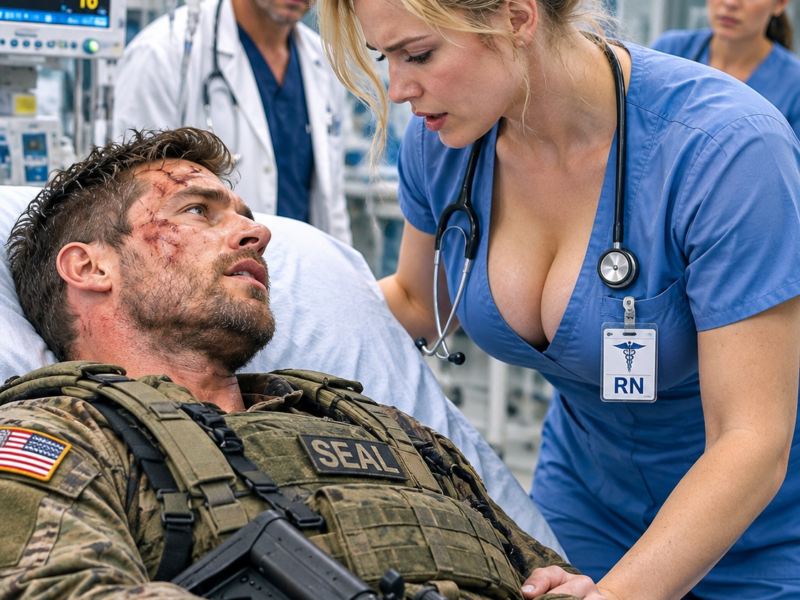
“The Green Beret sniper had been pronounced beyond saving by three of the best surgeons at Walter Reed, but when I found a handwritten note tucked beneath his hospital chart
The photograph showed a man I had seen in the hospital less than an hour earlier.
He was standing outside the surgical ICU, wearing a dark jacket and holding a paper coffee cup.
I looked up from my phone.
The hallway was empty.
I read the message again.
“Don’t let the surgeons touch that scar until you know who signed the original report.”
Then I looked at the photograph.
The man beside Daniel Mercer wasn’t Elias Ward.
It was Dr. Bennett.
I zoomed in until the image became grainy. There was no mistaking his face. Younger, perhaps, but unmistakably the same surgeon who had just dismissed my concerns.
My mouth went dry.
Why was a surgeon at Walter Reed standing beside Daniel Mercer and his teammate on a date nearly seven years earlier?
And why was someone warning me not to let him examine an old scar?
I slipped the phone into my pocket as footsteps approached.
Dr. Bennett entered the room with another surgeon.
“What’s going on?” he asked.
“Nothing. I was checking the equipment.”
His eyes moved briefly toward my pocket.
“Then finish up and let the medical team work.”
I nodded, but I didn’t leave.
I couldn’t.
Captain Mercer’s blood pressure had fallen again. The nurse was preparing another medication while Dr. Bennett studied the latest imaging.
“His internal bleeding isn’t consistent with the original injury,” the younger surgeon said.
“Then we need to find the source,” Bennett replied.
I watched them for a moment.
Then I noticed the old scar beneath Daniel’s left shoulder blade.
The hospital gown had shifted slightly, exposing a narrow section of it.
There was something unusual about its shape.
It wasn’t a straight surgical incision.
It curved around the ribs, ending just below the shoulder blade.
I remembered the photograph from his initial examination.
The report described it as an old, unrelated injury.
But the note specifically said to check it.
I stepped toward the nurse.
“Could you ask the attending to review the original report from October 2019?”
She looked at me.
“Why?”
“Because I think there’s a connection between that scar and the fragment they’re tracking.”
She hesitated.
“You’re going to have to tell Dr. Bennett.”
“I will. I just want the original report in front of him.”
She gave me a doubtful look but walked toward the workstation.
Five minutes later, she returned with a thin folder.
The first page contained a report from a military medical facility overseas.
The date was October 17, 2019.
I read the patient’s name.
Daniel Mercer.
The report described an emergency procedure following a training accident involving a damaged rifle component.
The injury had been treated, and Mercer had apparently recovered.
But the last paragraph caught my attention.
“Foreign metallic object retained adjacent to posterior rib structure. Removal deferred due to proximity to vascular tissue.”
I read it again.
The fragment inside his body hadn’t necessarily come from the recent battlefield operation.
It might have been there for seven years.
I turned the page.
The physician’s signature was at the bottom.
Dr. Thomas Bennett.
I stared at the name.
The same Dr. Bennett who had just told me the fragment was unrelated to the current problem.
Before I could say anything, the nurse leaned over my shoulder.
“That’s strange.”
“What?”
She pointed to the date of the original report.
“Dr. Bennett wasn’t listed as a surgeon at this facility in 2019. He transferred here much later.”
I looked at the signature again.
There was another detail.
The report had been scanned into the system only six days earlier.
The day Daniel arrived.
Someone had added it to his medical history after his admission.
I felt the room becoming smaller.
I showed the nurse the photograph.
She stared at it for several seconds.
“That’s Dr. Bennett.”
“I know.”
“Who sent you this?”
“I don’t know.”
She glanced toward the door.
“Don’t say anything yet.”
For the first time that night, I understood that this wasn’t simply a question of a medical mistake.
Someone had information they wanted us to find.
And someone else apparently wanted to keep it buried.
I stepped into the hallway and called the number listed for Elias Ward.
He answered on the fourth ring.
“Hello?”
“My name is Michael Turner. I’m a biomedical technician at Walter Reed. I’m calling about Captain Daniel Mercer.”
There was a long silence.
Then his voice changed.
“Is Daniel alive?”
“Yes, but he’s critical.”
“Did they remove the fragment?”
“No.”
I heard him exhale.
“Good.”
“Sergeant Ward, I need to ask you something. Who is the man in the photograph from October 17, 2019?”
Another silence.
“Where did you get that photograph?”
“It came with Daniel’s belongings.”
“Listen to me carefully. Don’t let Bennett near him.”
I glanced through the glass at the surgeon standing beside Daniel’s bed.
“Why?”
“Because he was there that day.”
“I know. His signature is on the report.”
“No,” Ward said. “You don’t understand. Bennett wasn’t supposed to be there.”
I tightened my grip on the phone.
“What happened on October 17?”
Ward lowered his voice.
“Daniel wasn’t injured in a training accident.”
I waited.
“He was shot during an operation that officially never happened.”
The hallway seemed to go quiet around me.
Ward continued.
“We were sent to recover a man who had been held by an armed group. The intelligence said the location was empty except for a few guards. It wasn’t.”
“Who was the third man in the photograph?”
“Major Robert Hayes. He was our team leader.”
“Is he still in the Army?”
“No. He’s been missing since that night.”
I glanced back toward the ICU.
“Why was Dr. Bennett involved?”
“Because he was the physician who treated Daniel after the operation. But there was something he discovered that night. Something that could have exposed what really happened.”
“What was it?”
Ward took a shaky breath.
“Daniel had been carrying a small recording device. It captured the final minutes of the operation.”
“Where is it?”
“That’s what I need you to find.”
I looked at the patient’s belongings bag.
“There’s nothing here except his wallet, watch, ring, and photograph.”
“Check the watch.”
I turned toward the room.
“What’s on it?”
“Daniel never wore that watch for telling time.”
The call ended.
I stood motionless for a moment, trying to understand what he had just told me.
Then I returned to the bedside.
The nurse was adjusting Daniel’s blanket while Dr. Bennett reviewed another chart.
I waited until Bennett stepped into the hallway.
Then I asked the nurse if I could examine the belongings inventory.
She handed me the sealed property bag.
The watch looked ordinary.
A scratched stainless-steel military watch with a black face and a worn leather strap.
I turned it over.
There was a tiny engraving on the back.
17-10-19.
The same date.
I pressed the crown.
Nothing happened.
Then I noticed a narrow seam along the side of the casing.
It was slightly wider than the other joints.
I didn’t have the tools to open it, and I wasn’t about to damage a patient’s property.
But I could see something beneath the glass.
A tiny red light blinked once.
Then disappeared.
It wasn’t a normal watch.
I placed it carefully back in the bag.
I needed someone who understood military equipment and could identify what it contained.
But before I could make another call, Dr. Bennett returned.
“What are you doing with that?”
I looked up.
“Checking his personal belongings.”
“Why?”
“The family may want them secured.”
Bennett held out his hand.
“Give me the bag.”
I hesitated.
“Is there a problem?”
“His belongings need to be documented before they leave the unit.”
He took the bag from me.
His eyes rested on the watch.
For a brief second, something crossed his face.
Not surprise.
Recognition.
Then he closed the bag and handed it to the nurse.
“Lock this in the property cabinet.”
He turned toward me.
“And Michael, I want you off this case.”
I felt my stomach tighten.
“Did I do something wrong?”
“You’ve been interfering with medical decisions.”
“I’m not making medical decisions. I noticed discrepancies in the records.”
“That’s enough.”
He walked away.
I watched him enter the consultation room and close the door.
The nurse approached me quietly.
“Michael, you need to see this.”
She showed me the monitor.
Daniel’s blood pressure had stabilized slightly, but his oxygen requirements were increasing.
“Dr. Bennett wants to take him back into surgery,” she said.
“Now?”
“He says the fragment needs to come out before it moves again.”
I remembered Ward’s warning.
Don’t let Bennett near him.
But I also knew I couldn’t simply stop a surgeon from treating a critically ill patient.
I wasn’t a doctor.
I wasn’t authorized to make that decision.
All I could do was insist that the medical team review the conflicting information before proceeding.
I found Dr. Bennett in the consultation room.
The younger surgeon was there too.
“I found the original October report,” I said.
Bennett didn’t look up.
“I told you to leave this alone.”
“Your signature is on it.”
That got his attention.
He slowly turned toward me.
“Excuse me?”
“You treated Captain Mercer in 2019. The report says the fragment was retained because of its proximity to vascular tissue.”
His expression hardened.
“That report is irrelevant to his current condition.”
“Then why was it added to his file six days ago?”
The younger surgeon looked between us.
“What report?”
Bennett closed the folder.
“Michael, leave.”
I didn’t move.
“The note said to check the old scar. Sergeant Ward told me the original injury wasn’t a training accident.”
The room went silent.
Bennett stood.
“Get security.”
The younger surgeon raised a hand.
“Thomas, hold on. What is this about?”
Bennett ignored him.
“Security. Now.”
I backed toward the door.
I knew I had crossed a line.
But before security arrived, the younger surgeon opened the folder again.
He looked at the signature.
Then at Bennett.
“Thomas, this is your handwriting.”
Bennett’s jaw tightened.
“Don’t.”
The younger surgeon turned another page.
There was a second document beneath the first.
A surgical addendum.
It described a procedure that had supposedly taken place on October 18, 2019.
But the hospital’s official records showed that Daniel had been transferred to another facility before that date.
The document carried Bennett’s signature.
And beside it was a second signature.
Major Robert Hayes.
The man listed as missing.
The younger surgeon looked up.
“Why does a missing officer’s signature appear on a surgical report from a facility he never entered?”
Bennett didn’t answer.
At that moment, the ICU alarm sounded again.
A nurse rushed into the consultation room.
“Captain Mercer’s pressure is crashing. We need you now.”
Bennett pushed past us.
The younger surgeon followed.
I ran behind them.
Daniel’s monitor was flashing red.
The nurse was calling out numbers while another staff member prepared emergency medication.
Bennett moved toward the bed.
“Get him ready for surgery.”
The younger surgeon stepped between him and the patient.
“Not until we review the original imaging.”
“We don’t have time for this.”
“Then explain why his retained fragment is in a different position from the original scan.”
Bennett stared at him.
For several seconds, neither man moved.
Then the younger surgeon turned to the nurse.
“Call vascular surgery. Tell them we have a possible delayed vascular injury and a conflicting surgical history.”
Bennett’s face changed.
“You’re making a mistake.”
“Maybe. But I’m not operating without knowing what we’re dealing with.”
Security arrived shortly afterward.
Bennett was asked to step outside while the hospital’s administrative and medical leadership reviewed the documentation.
He didn’t resist.
He simply looked at Daniel and said something I couldn’t hear.
Then he left.
I stayed near the nurses’ station, feeling the weight of what had just happened.
The younger surgeon introduced himself as Dr. Andrew Collins.
He had been on the team for less than a year.
He examined the scans with a vascular specialist and an interventional radiologist.
They found evidence of a small, intermittent leak near an injured vessel.
The old fragment was involved, but it wasn’t the only problem.
A section of tissue around the old injury had been damaged during the recent operation overseas.
The fragment’s position had changed because the surrounding tissue had become unstable.
It was a rare and dangerous complication.
Removing the metal without first controlling the damaged vessel could cause catastrophic bleeding.
Dr. Collins explained the findings to the senior surgical team.
They agreed on a different approach.
The vascular specialist would first control the bleeding through an image-guided procedure.
Only after the patient was stable would they decide whether the fragment could safely be removed.
It wasn’t a guarantee.
But it was a plan.
For the first time that night, Daniel had a chance.
The procedure began shortly before dawn.
I wasn’t allowed inside the operating area.
I sat in the waiting room with a paper cup of coffee growing cold between my hands.
At 6:18 a.m., Dr. Collins came out.
His surgical cap was still on, and there was a tired crease across his forehead.
“He’s stable.”
I stood.
“Is he going to make it?”
“We controlled the bleeding. The fragment is still there, but we didn’t need to remove it tonight.”
He paused.
“The next twenty-four hours will be important.”
I nodded, unable to find the right words.
For a moment, I thought that was the end of it.
Then Dr. Collins sat beside me.
“There’s something else you should know.”
He showed me a report from the hospital’s internal review.
The original October 2019 documents were not the only records that had been altered.
Several pages had been added after Daniel’s arrival.
Some of the timestamps didn’t match the original medical system.
Someone had used an old report to make the retained fragment appear to be a known, stable condition.
But the current scans told a different story.
“Did Bennett do it?” I asked.
“We don’t know yet.”
He rubbed his eyes.
“He’s been placed on administrative leave while the hospital investigates.”
I thought about the message on my phone.
The person who sent it had known exactly where to look.
“Have you contacted Sergeant Ward?”
“Not yet.”
I took out my phone.
There was another message waiting.
This one was from Elias.
“Tell Daniel I kept my promise. The rest is in the watch.”
I showed Dr. Collins.
He read it twice.
“The watch?”
I nodded.
“There’s something hidden inside it.”
The nurse had secured the property bag in the hospital’s locked storage area.
We arranged for hospital security to retrieve it in the presence of an authorized investigator.
The watch was examined by a digital forensics specialist later that morning.
Inside the casing was a tiny storage module.
It contained several audio files and one video.
The recording had been made on October 17, 2019.
The investigator played it in a secure conference room.
The first few seconds contained static, movement, and the sound of someone breathing heavily.
Then a voice spoke.
“Mercer, do you have visual?”
Daniel’s voice answered.
“Two vehicles. Three armed men. One civilian.”
Another voice interrupted.
“Hold position.”
It was Major Hayes.
The recording continued.
Then came a sentence that made everyone in the room stop.
“Command says we’re clearing the site. No extraction until the secondary team arrives.”
Daniel answered.
“That’s not what we were briefed.”
A few seconds of static followed.
Then gunfire.
The audio became chaotic.
Someone shouted that a civilian was down.
Daniel called for medical support.
And then came the voice of Dr. Bennett.
“Don’t put his name in the report.”
I leaned forward.
The investigator paused the recording.
“Do you recognize that voice?”
Dr. Collins nodded slowly.
“It’s Bennett.”
The investigator resumed playback.
Major Hayes was arguing with someone.
“You said the area was clear.”
A second voice replied.
“The intelligence changed.”
“Then why weren’t we told?”
There was another burst of gunfire.
Daniel shouted.
Then a final exchange.
“If this gets out, the entire operation is finished.”
The recording ended.
Nobody spoke for several seconds.
The investigator explained that the recording would be handed to the appropriate military authorities.
It did not prove every detail of what happened that night, but it provided evidence that the official account might have been false.
And it explained why someone had tried so hard to keep the old medical report buried.
Daniel’s injury wasn’t simply a forgotten accident.
It was connected to an operation that had left a man missing and a civilian dead.
But the recording raised another question.
Why had Elias waited seven years to reveal it?
I called him again.
This time, he answered immediately.
“Did you find it?”
“Yes.”
He was quiet.
“Then you know what happened.”
“Not everything. Why didn’t you come forward sooner?”
His breathing changed.
“Because I believed Hayes was dead. And because I was scared.”
“Of Bennett?”
“Of everyone who signed the report.”
He told me that after the operation, the team had been instructed to provide separate statements.
Their accounts were supposed to be combined into one official version.
But Daniel had refused to change his statement.
He insisted that the civilian had been alive when the team first reached the site and that the delay in evacuation had cost him his life.
The next morning, Daniel was injured during a second engagement.
Bennett treated him.
The old fragment was retained.
And the medical report was written in a way that made the injury appear unrelated to the operation.
“Daniel knew something was wrong,” Elias said. “He kept the recording because he didn’t trust the official report.”
“Why didn’t he tell anyone?”
“He tried. But every time he asked questions, somebody told him the investigation was closed.”
I looked through the glass toward the ICU.
Daniel was still unconscious.
“Why send the warning now?”
“Because he called me two weeks before the deployment.”
“What did he say?”
“He told me he was going to request the original medical records. He thought the missing pieces might still exist.”
“Did he find them?”
“I don’t know.”
Elias paused.
“Michael, there’s something else. Hayes may still be alive.”
I sat down.
“What?”
“Three months ago, I received a letter with no return address. It contained a photograph of Hayes outside a gas station in New Mexico.”
“Why didn’t you tell the authorities?”
“Because I didn’t know if it was real. And because the letter included a warning.”
“What warning?”
“Leave the past alone.”
I looked at the photograph from October 2019 on the table.
The gray-bearded man standing beside Daniel had been missing for seven years.
Now there was a possibility that he had survived.
“Do you still have the letter?”
“Yes.”
“Bring it to the investigators.”
“I will.”
He hesitated.
“How is Daniel?”
“Stable. Still unconscious.”
“Tell him I’m sorry.”
The call ended.
I didn’t know what to make of those words.
But I was beginning to understand that the men in that photograph had carried the same night with them in very different ways.
The next two days passed slowly.
Daniel remained in intensive care.
His blood pressure gradually improved, and the medical team began reducing his support.
The fragment was eventually removed during a carefully planned procedure after the vascular injury had been stabilized.
The surgeons found old scar tissue and evidence of damage consistent with the earlier injury.
There was no dramatic discovery inside the fragment itself.
It was simply a piece of metal that had remained in his body far longer than anyone had realized.
Dr. Collins visited me after the procedure.
“He’s responding,” he said.
“Does that mean he’ll recover?”
“It means we’re moving in the right direction.”
I smiled for the first time in days.
Then he added, “The military investigators want to speak with you.”
I agreed.
They interviewed me about the handwritten note, the watch, and the messages.
I told them everything.
I also told them I had no medical explanation for the original injury and had never attempted to make a treatment decision.
I had noticed a discrepancy and asked the people with the proper authority to investigate it.
They thanked me and left.
A week later, Daniel opened his eyes.
I was working another overnight shift when the nurse called me into his room.
“Michael, I think you should come see this.”
Daniel’s eyes were open, but his face was pale and exhausted.
He looked at the ceiling for a moment before turning his head.
“Where am I?”
“You’re at Walter Reed,” the nurse said gently.
He swallowed.
“Did Elias make it?”
I stepped closer.
“He’s alive. He’s been asking about you.”
Daniel closed his eyes briefly.
Then he whispered, “The watch?”
“It’s safe.”
He looked at me again.
“Did you hear it?”
I nodded.
“We heard the recording.”
His eyes filled.
For several seconds, he didn’t speak.
Then he turned toward the window.
“How much do you know?”
“Enough to know the official report doesn’t tell the whole story.”
He looked down at his hands.
“I thought I’d taken that night to my grave.”
I pulled a chair beside the bed.
“You don’t have to explain anything right now.”
He gave a faint, tired smile.
“I’ve spent seven years trying to convince myself that staying quiet was protecting the men I served with.”
He swallowed.
“It wasn’t.”
I waited.
“That civilian had a daughter,” he said.
His voice cracked on the last word.
“She was waiting for him to come home.”
I didn’t know what to say.
Daniel continued.
“Hayes ordered us to wait. He said the extraction team was coming. I knew the man was badly injured, but I followed the order.”
His fingers tightened around the blanket.
“By the time we reached him, he was gone.”
“Was that why you kept the recording?”
“Partly. I wanted someone to know what really happened.”
He turned his face away.
“I also wanted proof that I hadn’t imagined the argument.”
I let the silence sit between us.
After a while, he asked, “Did they find Hayes?”
“Not yet.”
Daniel nodded.
“I hope they do.”
“Why?”
He looked at me.
“Because I don’t want another seven years to pass before someone tells the truth.”
The investigation continued for several months.
Bennett’s medical records and communications were examined.
The military authorities reviewed the operation, the conflicting statements, and the recording.
Major Hayes was eventually located in New Mexico.
He was alive.
When investigators contacted him, he initially denied any knowledge of the recording.
But the evidence from the watch, combined with the original reports and the statements from the surviving team members, forced him to reconsider.
He eventually agreed to provide a formal statement.
The review found that the operation had been based on intelligence that was incomplete and had not been properly communicated to the team.
It also found that the delay in evacuation had contributed to the civilian’s death.
Several official reports had omitted important details.
Dr. Bennett’s role in the original treatment and later documentation came under serious scrutiny.
He was removed from clinical duties while the investigation proceeded.
I never learned every detail of what happened behind closed doors.
Some records remained classified.
Some questions would probably never have complete answers.
But the official account was corrected, and the civilian’s family was finally given a truthful explanation of the events surrounding his death.
Daniel’s recovery was slow.
He spent months in rehabilitation, learning to trust his body again.
The damage to his shoulder and back made certain movements painful.
He couldn’t return to his former duties.
For a while, he struggled with that more than he admitted.
One afternoon, I saw him sitting outside the rehabilitation building.
He was wearing a plain gray sweatshirt, and his left arm rested carefully against his side.
I sat beside him.
“How’s the shoulder?”
“Depends on the weather.”
“That’s not much of an answer.”
“It’s the only one I’ve got.”
We both smiled.
After a while, he looked toward the parking lot.
“Elias is coming tomorrow.”
“That’s good.”
“He’s bringing the photograph.”
I knew which one he meant.
The three men beside the military vehicle.
“Have you decided what you’ll do with it?”
Daniel shook his head.
“I used to think I wanted to burn it.”
“Why?”
“Because every time I looked at it, I remembered the man who didn’t come home.”
He rubbed his thumb over the edge of his wedding ring.
“But now I think I want to keep it.”
He looked at me.
“Not because that night was worth remembering. Because the people we were before it happened were real, too.”
I understood then that the photograph wasn’t simply evidence.
It was the last image of a friendship before fear, guilt, and silence changed everything.
The following day, Elias arrived.
He and Daniel stood together in the rehabilitation courtyard for a long time.
Neither man seemed to know what to say.
Finally, Elias reached out and placed a hand on Daniel’s shoulder.
“I’m sorry I left you alone with it.”
Daniel looked at him.
“You didn’t leave me alone. We both just got scared.”
Elias lowered his head.
“I should have spoken sooner.”
“Maybe. But we’re speaking now.”
They sat together for nearly an hour.
I left them alone.
Several weeks later, Daniel sent me a small envelope.
Inside was the old photograph from October 17, 2019.
On the back, beneath the original date and the words “Never forget what happened,” he had written something new.
“Remember what happened. Don’t let it become the only thing you remember.”
I placed the photograph in a drawer beside my work badge.
I had spent years believing that my job was simply to keep machines running.
That night taught me that a hospital depended on something more difficult to measure.
People had to be willing to notice when the pieces didn’t fit.
And they had to be willing to speak, even when someone more powerful told them to stop.
I never saved Daniel Mercer by myself.
A team of doctors, nurses, specialists, and investigators made the decisions that gave him a chance to live.
My part was smaller.
I noticed a note.
I asked a question.
And I refused to pretend I hadn’t seen what was written on that page.
The last time I saw Daniel, he was walking slowly across the rehabilitation courtyard with Elias beside him.
His steps were uneven, but he was smiling.
The old military watch was no longer on his wrist.
It had been placed in evidence, where it belonged.
For the first time in seven years, neither man had to carry its secret alone.
THE END.









