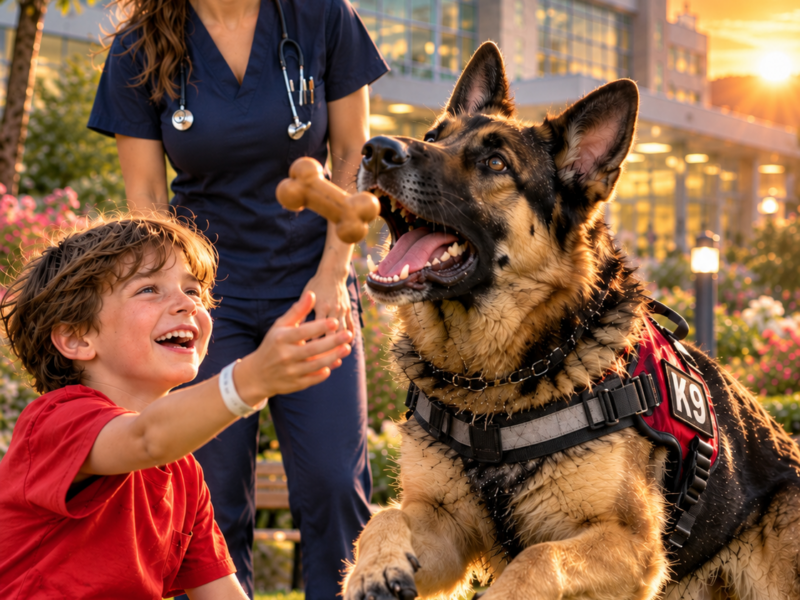
The German Shepherd walked into the emergency room carrying a tiny pink mitten in his mouth
Emily Carter had spent eleven years working in emergency rooms, and she had learned that fear came in many forms.
Sometimes it was loud—a mother screaming for help, a man pounding on the doors, a child crying so hard she could barely breathe.
Other times, fear was almost silent.
It was the way Lily clutched the edge of Emily’s sleeve as two uniformed officers stepped into the abandoned warehouse. It was the way the little girl’s eyes darted toward the officer standing on the left, then immediately dropped to the floor.
And it was the way Scout, the wounded German Shepherd who had led Emily there, positioned his body between Lily and the approaching men.
His ears were pinned back. His injured leg trembled beneath him. Yet he refused to move.
“Ma’am,” the taller officer said, raising one hand. “Step away from the child. We’ll take it from here.”
Emily didn’t move.
The officer’s nameplate read HARRIS.
Lily’s fingers tightened around Emily’s wrist.
“That’s him,” the girl whispered.
Emily felt the blood drain from her face.
“What do you mean, sweetheart?”
Lily shook her head frantically. Tears rolled down her cheeks.
“He took Mommy away.”
Officer Harris stopped walking.
For a fraction of a second, his expression changed. It was so brief that Emily might have missed it if she hadn’t been watching him carefully.
Then his face settled into practiced concern.
“This child is confused,” he said. “She’s been through a traumatic event. Let me handle it.”
Scout growled.
It was a deep, controlled warning, not the wild barking of an aggressive animal. The dog was watching Harris with the intense focus of a soldier recognizing a familiar threat.
The second officer, a younger woman named Officer Reyes, noticed it too.
“Why is that dog reacting to you?” she asked her partner.
“Because he’s injured and frightened,” Harris replied sharply. “Get him away from the child.”
Reyes hesitated.
Emily looked from one officer to the other.
Something was terribly wrong.
Then the man in the dark coat stepped forward from behind a rusted support beam.
“Enough of this,” he snapped. “The girl is my responsibility. Give her to me.”
He reached for Lily.
Scout lunged.
The dog’s injured leg buckled, but he managed to place himself directly in front of the child. His teeth showed for an instant.
The man stumbled backward.
“Control that animal!” he shouted.
Emily wrapped one arm around Lily and pulled her behind her.
“No one is taking her anywhere until I know who you are.”
The man’s face darkened.
“You have no idea what you’re interfering with.”
“Then explain it.”
He glanced toward Harris.
That single glance told Emily more than his words had.
They knew each other.
And neither of them wanted the little girl to speak.
“Officer,” Emily said, keeping her voice steady, “I want another unit here. Someone from a different department. And I want an ambulance for this child and this dog.”
Harris took a step toward her.
“You don’t get to make demands.”
“No,” Emily answered. “But I do get to protect a patient.”
For the first time, she saw uncertainty in his eyes.
Then Lily spoke.
“Mommy said the numbers were wrong.”
Everyone turned toward her.
The child’s voice was small, but the words were unmistakable.
“She said they were stealing the medicine. She told me to hide. The bad man found us.”
The man in the dark coat went pale.
“She’s making things up.”
Lily buried her face against Emily.
“Mommy said if anything happened, Scout would know where to go.”
Emily looked down at the German Shepherd.
Scout’s body had gone rigid.
He wasn’t simply protecting Lily.
He was waiting.
As if he had been given an order he could not abandon.
And suddenly, Emily understood that the tiny pink mitten was not just a child’s lost possession.
It was a message.
A message that had cost someone dearly to send.
The warehouse doors rattled in the wind.
Officer Reyes had moved several feet away from Harris. One hand rested near her radio.
“Dispatch,” she said, “I need another unit at my location. Possible child endangerment. I also need a supervisor.”
Harris turned on her.
“Stand down, Reyes.”
She stared at him.
“Why?”
“Because I gave you an order.”
“And I’m asking you why.”
The tension between them seemed to tighten the air.
The man in the dark coat suddenly reached inside his jacket.
Scout barked once.
Harris immediately grabbed the man’s arm.
“Don’t!”
The movement was so quick and so familiar that Emily knew they had practiced this kind of exchange before.
Something metallic slipped from the man’s hand and clattered across the concrete.
A set of keys.
The man jerked free and bolted toward the rear exit.
“Stop!” Reyes shouted.
She ran after him.
Harris started to follow, but Scout surged forward, forcing him to stumble sideways. Emily seized the opportunity to pull Lily behind a stack of old wooden pallets.
“Stay with me,” she whispered.
Harris recovered and reached toward his belt.
Emily’s heart hammered.
Then a voice thundered from outside.
“Police! Hands where I can see them!”
A second set of footsteps followed.
Reyes returned through the rear entrance, breathing hard. Behind her came two uniformed officers and a woman in plain clothes with a badge clipped to her jacket.
The woman surveyed the warehouse in one quick glance.
“Detective Morgan Ellis,” she announced. “Who called for assistance?”
“I did,” Reyes answered. “And I believe Officer Harris needs to explain why he tried to prevent me from requesting backup.”
Harris straightened his uniform.
“This is a misunderstanding. We received information about a missing child, and I was attempting to secure the scene.”
Detective Ellis looked at Lily.
Then she looked at the man in the dark coat, who was now being escorted inside by another officer.
“What’s his name?”
“Grant Mercer,” Harris said too quickly.
The detective’s eyes narrowed.
“I didn’t ask you.”
Mercer remained silent.
Ellis turned toward Emily.
“Ma’am, can you tell me what happened?”
Emily explained everything: the wounded dog arriving at the hospital, the mitten, the message written inside it, and the way Scout had led her to the warehouse.
She told the detective about Lily’s words.
She also described Harris’s behavior and the man’s attempt to take the child.
Detective Ellis listened without interruption.
When Emily finished, the detective crouched in front of Lily.
“Sweetheart, my name is Morgan. I want to help you. You don’t have to tell me everything right now. Can you tell me your mother’s name?”
Lily swallowed.
“Sarah Bennett.”
Ellis went very still.
She looked up at the officers.
“Get medical transport here immediately. Separate everyone at this scene. Nobody leaves without being interviewed.”
Harris’s face hardened.
“Detective, this is unnecessary.”
Ellis rose slowly.
“Officer Harris, place your service weapon on the ground.”
He stared at her.
“Excuse me?”
“Your weapon. On the ground. Now.”
For the first time, Harris seemed to realize that the situation had moved beyond his control.
He reluctantly complied.
As another officer escorted him away, Scout finally lowered his head. His breathing was rapid, and his injured leg shook so violently that he could no longer remain standing.
Emily dropped beside him.
“Easy, boy. You’ve done enough.”
Scout looked at Lily.
The girl reached out and touched his face.
“You found help,” she whispered.
Then the dog’s legs folded beneath him.
Emily caught his head before it struck the concrete.
“Scout!”
His eyes remained open, but his body was exhausted.
For one terrifying moment, Emily thought he had died.
Then she felt the faint movement of his chest.
“Get that ambulance here!” she shouted.
At the hospital, Lily was taken to a pediatric treatment room.
She had a deep cut on her scalp, bruising along her ribs, and signs of dehydration. Her left ankle was badly sprained. Fortunately, the doctors found no evidence of internal bleeding, and a scan showed that her head injury did not require surgery.
But when a nurse tried to leave the room to collect supplies, Lily panicked.
“Don’t leave me!”
Emily, who had returned from the ambulance bay after making sure Scout was in veterinary care, hurried to her bedside.
“I’m right here.”
“Promise?”
Emily pulled a chair beside the bed.
“I promise I’ll tell you before I go anywhere.”
Lily studied her face, searching for a reason to believe her.
Finally, she nodded.
A few minutes later, a pediatric specialist arrived with Detective Ellis.
The detective had removed her coat and looked as though she had aged several years since the warehouse.
“Lily,” she said gently, “we found your mother.”
The little girl’s eyes widened.
“She’s alive?”
Ellis paused.
“Yes. She’s alive, sweetheart. She’s in another hospital, and doctors are treating her.”
Lily began to cry.
Not the frightened, silent tears Emily had seen in the warehouse.
These were the tears of a child who had spent too long believing the worst.
“Can I see her?”
“Not yet,” Ellis said carefully. “Your mother has serious injuries. But the doctors are working hard to help her, and we will arrange a visit as soon as it’s safe.”
Lily gripped Emily’s hand.
“Did Scout save her too?”
Ellis glanced at Emily.
“We’re still finding out exactly what happened.”
Lily looked down at the blanket.
“Scout saved Mommy before.”
And then, for the first time, she told them the story.
Three weeks earlier, Sarah Bennett had discovered that medical supplies were disappearing from a regional distribution center.
She worked as an inventory auditor for a company that supplied hospitals, nursing facilities, and emergency clinics across the county. Her job was to reconcile shipments with delivery records.
At first, the discrepancies had seemed ordinary.
A missing box here.
An incorrect invoice there.
A shipment recorded as delivered to a clinic that had never ordered it.
But the pattern continued.
Expensive antibiotics were being diverted. Certain emergency medications appeared on paper but never reached the hospitals that needed them. Replacement supplies were billed to public emergency programs, while the original shipments were quietly sold elsewhere.
Sarah began documenting the discrepancies.
Then she found a name that appeared again and again in the altered records.
Grant Mercer.
He was a logistics contractor who managed several distribution routes and had connections throughout the regional supply network.
When Sarah raised concerns with her supervisor, she was told to correct the paperwork and stop asking questions.
She refused.
Instead, she copied the records and contacted an investigator outside her company.
That was when the threats began.
At first, they were anonymous messages.
Then someone followed her home.
Finally, a man appeared outside her daughter’s school and asked Lily whether her mother still worked late.
Sarah reported the incident to the police.
The report was assigned to Officer Harris.
He assured her that he would look into it.
Two days later, someone broke into Sarah’s home.
Nothing valuable was taken.
But the folder containing her notes had been moved, and a photograph of Lily had been placed on the kitchen counter.
Sarah understood the message.
She packed a small bag for herself and Lily and went to a friend she believed she could trust.
She also contacted a former military colleague named Thomas Reed.
Reed had served in a military working-dog unit before retiring from the service. He had helped Sarah’s late husband train Scout, a German Shepherd who had worked alongside military personnel overseas.
After her husband’s death, Sarah had adopted Scout.
The dog was retired from military service, but he still responded to familiar commands and had an extraordinary memory for people, scents, and routines.
Sarah trusted him with her daughter’s life.
When Reed heard about the threats, he offered to help Sarah preserve the evidence and get it to an investigator.
They arranged to meet at a small storage facility outside the city.
But the meeting never happened.
Someone intercepted Sarah before she arrived.
Lily remembered headlights behind their car. She remembered her mother telling her to get down and cover her ears.
She remembered the sound of glass breaking.
Then everything became a blur.
When Lily woke, she was in an unfamiliar building.
Her mother was gone.
Scout was beside her, licking blood from a cut near her hairline.
Grant Mercer stood near the doorway.
He told Lily that her mother had been taken somewhere safe.
He said she would be reunited with her soon, but only if she behaved.
Lily knew he was lying.
She had heard her mother arguing with him before the attack.
She had heard him say, “You should have destroyed those files when you had the chance.”
And she had heard her mother answer, “People are going without medicine because of you.”
Lily never forgot those words.
At the warehouse, Mercer left her with another man while he went to make a phone call. The man was distracted by a vehicle outside.
Scout recognized his chance.
He nudged Lily toward a broken side door, then helped her crawl through the opening.
They escaped into the rain.
For hours, they moved through back streets and narrow alleys.
Scout was injured during the escape, but he refused to leave her.
Eventually, Lily became too weak to continue.
She collapsed near a loading area behind the hospital.
Scout found her pink mitten on the ground, where it had fallen during the escape. He carried it in his mouth, and Lily remembered the emergency plan her mother had taught her.
If they were separated and she could not reach help, she was to leave a message where someone might find it.
With shaking fingers, Lily had used a blue pen she found in a discarded box to write two words inside the mitten.
HELP ME.
She had smeared blood across the fabric when she cut her hand climbing through the broken door.
Then she gave the mitten to Scout.
“Find a doctor,” she whispered.
Scout understood.
He had been trained to search for people. He had learned that hospitals were places where injured people received help. And he had learned that a human in distress was never someone to abandon.
So he carried the mitten through the hospital entrance.
He found Emily.
And he refused to leave until she followed.
By the time Detective Ellis finished listening to Lily’s account, her expression had become grim.
“Why didn’t you tell the man you knew where the files were?” she asked gently.
Lily shook her head.
“I don’t know where they are. Mommy said she put them somewhere safe.”
“Did she tell you anything else?”
Lily hesitated.
Then she remembered something.
“Mommy said the star.”
Emily leaned forward.
“What star, sweetheart?”
“The star on my mitten. She said if I ever got lost, I should remember that the star meant I wasn’t alone.”
Emily looked at the pink mitten, now sealed in an evidence bag.
A small white star had been embroidered near the cuff.
It appeared ordinary.
But Detective Ellis studied it for several seconds.
“Who made this mitten?”
“My daddy,” Lily said. “Before he died.”
The detective’s expression softened.
“Your father embroidered it?”
Lily nodded.
“He made two. One for me and one for Scout.”
Emily looked at the dog tag that had been recovered from Scout’s harness.
A small, scratched metal disk had been attached beneath the military identification.
On its back was a tiny engraved star.
Detective Ellis asked for the harness to be examined by the evidence team.
Inside a reinforced pocket, hidden beneath a strip of worn fabric, they discovered a small sealed memory card.
It had been wrapped in waterproof material.
The card was damaged, but the laboratory technicians managed to recover most of its contents.
The files included photographs of shipment logs, scanned invoices, delivery records, and audio recordings of conversations between Mercer and several associates.
One recording captured Mercer discussing the missing supplies.
Another included Officer Harris warning him that Sarah had begun asking questions.
A third was particularly damning.
Harris could be heard saying, “If she goes outside the company, I’ll make sure nobody believes her.”
Mercer replied, “You said the paperwork was clean.”
“It was clean until she started looking.”
Then came a pause.
Mercer spoke again.
“Get the records back. I don’t care how you do it.”
The recording ended.
The recovered files did not prove every allegation, but they gave investigators enough to establish a substantial criminal case. More importantly, they provided a direct connection between the missing medical supplies, the threats against Sarah, and the men who had tried to silence her.
The dog had not merely found help.
He had carried the evidence that could expose the entire operation.
Officer Harris was arrested that evening.
Grant Mercer was charged after investigators uncovered additional records linking him to the diverted shipments and the attack on Sarah.
Several days later, two other employees were detained, and the investigation expanded to include financial transactions, falsified delivery confirmations, and missing public funds.
But the most important development came when Sarah regained consciousness.
She had suffered a fractured arm, a concussion, and several broken ribs during the attack. For days, doctors had kept her under close observation.
When Detective Ellis finally received permission to interview her, Sarah’s first question was not about the investigation.
“Where is Lily?”
Ellis sat beside her hospital bed.
“She’s safe.”
Sarah closed her eyes.
A sob escaped her.
“And Scout?”
“He’s alive,” Ellis said. “He’s receiving treatment.”
Sarah covered her face with her uninjured hand.
For the first time since the attack, she allowed herself to cry.
Then Ellis explained what Scout had done.
She told Sarah about the hospital entrance, the pink mitten, the message inside it, and the injured dog who had refused to abandon her daughter.
Sarah listened without speaking.
When the detective finished, Sarah whispered, “He remembered.”
“Remembered what?”
“The promise.”
Before her husband died, he had spent months preparing Scout for civilian life. He knew the dog would miss his work, and he worried that Scout might never understand that he was allowed to rest.
So he had trained him to respond to one final command.
Find help.
It was a simple phrase, taught through repetition and trust.
If Sarah or Lily ever needed help, Scout was to seek out a person who could protect them.
He had never forgotten.
Sarah turned her face toward the window.
“My husband used to say that Scout wasn’t brave because he wasn’t afraid. He was brave because he knew who needed him.”
She looked back at Detective Ellis.
“Can I see my daughter?”
The reunion took place five days later.
Lily was still recovering from her injuries, but the doctors agreed that a short visit would be safe. Sarah was brought to a private room in a wheelchair, her arm secured in a brace.
Emily stood near the doorway as Lily entered.
For a moment, neither mother nor daughter moved.
They simply stared at each other, as if each needed to confirm that the other was real.
Then Lily ran forward as quickly as her injured ankle allowed.
“Mommy!”
Sarah opened her arms.
Lily collapsed against her, sobbing into her hospital gown.
“I thought you were dead.”
Sarah held her tightly.
“I know, baby. I’m so sorry.”
“I tried to be brave.”
“You were brave,” Sarah whispered. “You were so brave.”
Lily shook her head.
“I was scared.”
Sarah kissed her hair.
“Bravery doesn’t mean you aren’t scared. It means you keep going even when you are.”
Emily turned away, pretending to check the chart beside the door.
She had witnessed countless reunions in her career. Some were joyful, others heartbreaking.
This one felt different.
It was not simply a mother and daughter reunited after danger.
It was the return of a future that had almost been stolen from them.
After several minutes, Lily pulled away.
“Where’s Scout?”
Sarah smiled through her tears.
“He’s getting better.”
“Can I see him?”
“Soon.”
Lily looked toward Emily.
“Can you tell him I didn’t forget him?”
Emily crouched beside her.
“Sweetheart, I think he already knows.”
Scout’s recovery was slower than anyone hoped.
The veterinarian found an infected wound on his hind leg, several deep cuts across his paws, and signs of exhaustion severe enough to require close monitoring. He had also lost a dangerous amount of weight during the time he was missing.
For the first two days, he barely touched his food.
He slept for hours, waking only when a technician entered the room.
Then, on the third morning, Emily visited the veterinary clinic after finishing her hospital shift.
She had brought something with her.
The pink mitten.
It had been released after the evidence team finished examining it.
Emily placed it beside Scout’s bed.
At first, he didn’t react.
Then his nose moved.
He lifted his head and sniffed the fabric.
His ears rose.
A soft sound escaped his throat, somewhere between a whine and a sigh.
He nudged the mitten with his nose.
Emily felt tears sting her eyes.
“She’s safe, Scout,” she whispered. “You did it.”
Scout rested his chin beside the mitten.
For the first time since his arrival at the hospital, his body seemed to relax completely.
The veterinarian later told Emily that the dog had finally eaten a full meal that afternoon.
It was the first real sign that he was ready to heal.
Two weeks later, the hospital held a small gathering in its rehabilitation courtyard.
Sarah had been discharged to a temporary recovery residence. Lily was walking again, though she still needed to rest frequently.
Scout arrived on a short leash, his injured leg protected by a supportive wrap.
The moment Lily saw him, she broke free from her mother’s hand.
“Scout!”
The dog lifted his head.
For one second, he stood perfectly still.
Then he began moving toward her, his tail sweeping from side to side.
Lily knelt carefully on the grass.
Scout pressed his head against her chest.
She wrapped both arms around his neck.
“You came back,” she whispered.
Scout licked her cheek.
Sarah stood nearby, crying openly now. She no longer tried to hide it.
Emily watched from a few steps away.
She remembered the first time she had seen the dog.
He had stumbled through the emergency department doors, soaked in rain, bleeding, and carrying a tiny mitten between his teeth.
Everyone had assumed he needed saving.
And he did.
But that wasn’t the whole truth.
He had arrived with a mission.
A child was missing. A mother was in danger. Evidence that powerful people wanted destroyed was hidden in the one place they would never think to search.
Scout had carried all of it through the rain.
He had not known which nurse would help him. He had not known whether the people he encountered would be trustworthy. He had only known that a child needed him.
And he had kept going.
Detective Ellis approached Emily as Lily and Scout settled together beneath a tree.
“The case is moving forward,” she said. “Mercer and Harris are facing multiple charges. The financial investigators have traced several of the missing shipments, and the hospitals affected are being notified.”
“Will they recover everything?”
“Not everything. Some of the medicine was sold months ago, and some records were destroyed. But the evidence is strong enough to hold the people responsible accountable.”
Emily nodded.
“And Sarah?”
“She’ll need time. But she’s safe, and she has people around her who believe her.”
Ellis paused, watching Lily stroke Scout’s ears.
“You know what surprised me most?”
“What?”
“The dog didn’t go looking for the nearest person. He went looking for the right kind of help.”
Emily smiled faintly.
“Maybe he remembered who helped him before.”
“Maybe.”
The detective glanced toward Scout.
“Or maybe he simply understood something the rest of us sometimes forget.”
“What’s that?”
“That being in danger doesn’t make someone helpless. And being injured doesn’t mean someone has nothing left to give.”
Emily looked at the dog.
Scout was still limping. His movements were cautious, and the scars on his paws would take months to heal.
But Lily was laughing now.
It was the first carefree laugh Emily had heard from her.
And Scout, as if the sound were the reward he had been waiting for, wagged his tail.
Months passed.
The investigation exposed a network of contractors and employees who had profited from diverted medical supplies. Several faced criminal charges, and the company responsible for the distribution center was forced to overhaul its inventory controls.
Sarah eventually returned to work, but she chose a different position, helping hospitals strengthen their supply-monitoring systems. She wanted to make sure that no family would have to wonder whether lifesaving medicine had disappeared because someone had decided profit mattered more than people.
Lily returned to school.
For a while, she refused to sleep without the small pink mitten beside her pillow.
Her mother never asked her to put it away.
Scout settled into a new routine.
His military harness was retired for good. The veterinarian cleared him for gentle walks, and he spent most afternoons sleeping in the sun outside Sarah’s home.
He no longer needed to search for missing people.
He no longer needed to carry evidence.
He no longer needed to prove that he was brave.
He was allowed to be a dog.
One quiet evening, Emily visited the family.
Lily ran to the door and held up a small wooden frame.
Inside it was the pink mitten, carefully cleaned and preserved. Beneath it, in neat handwritten letters, were the words:
HE FOUND HELP. HE BROUGHT US HOME.
Emily read the inscription twice.
“Did you make this?” she asked.
Lily nodded proudly.
“Mommy helped me.”
“It’s beautiful.”
Lily glanced toward the living room, where Scout was sleeping on a blanket.
“He still gets scared sometimes,” she said.
Emily looked at her.
“How do you know?”
“Sometimes he wakes up when it rains. He looks at the door like he thinks he has to go somewhere.”
Emily felt a familiar ache in her chest.
“And what do you do?”
“I sit with him.”
Lily smiled.
“I tell him he’s home.”
Emily looked at the little girl and understood that healing did not always happen through grand gestures or dramatic rescues.
Sometimes it happened in a quiet room.
Sometimes it happened when someone stayed beside you until the fear passed.
And sometimes it happened when a child who had once been terrified learned how to comfort the very creature who had saved her.
That evening, as Emily prepared to leave, Scout lifted his head.
He rose slowly, crossed the room, and rested his muzzle against her hand.
Emily knelt to stroke his ears.
“You don’t have to do anything else, boy,” she whispered. “You’ve done enough.”
Scout’s tail moved once against the floor.
Then he returned to his blanket and settled beside Lily.
Outside, rain began to fall.
But this time, nobody was running through the darkness.
Nobody was hiding in an abandoned warehouse.
Nobody was waiting for a stranger to discover a desperate message inside a child’s mitten.
The family was together.
The danger had been exposed.
And the dog who had carried a plea for help through the rain finally had what every working dog deserves when the mission is over.
A safe place.
A loving family.
And the freedom to rest.
The end.









