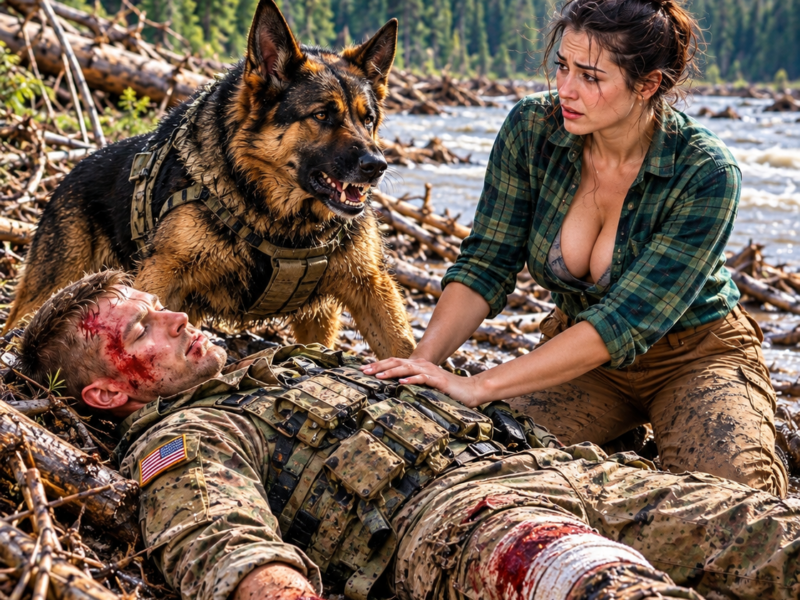
“The floodwater was dragging a Navy SEAL and his German shepherd beneath the collapsed bridge outside Asheville when I threw a rescue rope around his chest
The first flashlight swept across my face, then dropped toward the waterproof bag at my feet.
A man’s voice called from the hillside.
“Step away from the container and keep your hands where we can see them.”
I didn’t move.
Marcus was still on the ground, wrapped in a thermal blanket, with Ranger pressed against his side. The dog had stopped barking, but his ears remained fixed on the darkness beyond the bridge.
I raised my hands slowly.
“I’m a volunteer firefighter with Rescue Unit Seven. We recovered a flood victim and this bag from the river.”
“Leave the bag where it is.”
“That’s exactly where it is.”
Eddie stepped beside me, his rescue helmet dripping steadily onto his shoulders.
“Who are you?” he shouted.
The man didn’t answer.
Instead, a second flashlight appeared to our left, cutting through the rain and illuminating a narrow path down the hillside.
Two men emerged wearing dark rain jackets without visible agency markings.
They weren’t carrying medical equipment, and neither wore the reflective clothing I’d expect from a flood response team.
One approached the bag.
The other kept looking at Marcus.
That was when I noticed something that made my stomach tighten.
The man approaching the bag wasn’t watching where he stepped through the mud.
He was watching Ranger.
The shepherd rose slowly, placing himself between the stranger and his handler.
“Call your dog off,” the stranger said.
Marcus’s voice was weak but clear.
“Ranger, stay.”
The dog remained exactly where he was.
The stranger stopped.
“Sir, we’re here to secure recovered property.”
“Then show me your credentials,” I said.
He turned toward me with a thin, impatient smile.
“Ma’am, this is a federal matter.”
“Then showing me identification shouldn’t be a problem.”
For several seconds, the only sound was the rain.
Finally, he reached into his jacket and produced a credential wallet.
I couldn’t verify its authenticity from where I stood, but I could read the name printed beneath the photograph.
Evan Price.
He held it up briefly, then put it away.
“We need the container.”
“Not until you explain why your first instruction was to keep us from opening it.”
“Because it may contain hazardous material.”
“Then why aren’t you wearing protective equipment?”
His smile disappeared.
Eddie shifted beside me.
I could feel the tension in him, the same instinctive caution that kept rescuers alive when a situation stopped making sense.
Price looked past us toward the road.
“You’re interfering with an active operation.”
“Then tell us who is in charge of it.”
He took a step closer.
Before I could respond, Marcus grabbed my wrist.
“Rachel, don’t let them take it.”
I turned toward him.
“You said that bag belonged to a man who was supposed to be dead.”
“It does.”
“Then why does everyone want it?”
Marcus glanced at Price, and I saw something in his expression that frightened me more than the floodwater had.
Recognition.
Not of a stranger.
Of someone he had hoped never to see again.
“Because the man who was supposed to be dead may not be the only person who survived that mission,” he whispered.
Price heard him.
His hand moved toward the inside of his jacket.
I stepped back and raised my radio.
“Dispatch, we have two unidentified individuals at the recovery site. We need a verified law enforcement supervisor and EMS support immediately.”
Price’s expression hardened.
“Put the radio down.”
“No.”
For a moment, nobody moved.
Then Ranger lunged.
He didn’t attack Price.
He shot past him toward the hillside, barking furiously at something hidden beyond the trees.
The second man spun around.
A sharp crack split the rain.
Ranger yelped and vanished behind the collapsed guardrail.
Marcus tried to stand.
“RANGER!”
I ran before I had time to think.
The hillside was slick with mud, and the rain had turned the narrow path into a stream. I followed the dog’s barking until I found him crouched beside a fallen tree, his front leg tucked beneath him.
He was alive.
A thin line of blood marked his shoulder, but the injury appeared superficial.
I dropped to my knees.
“Easy, boy. Let me see.”
He growled at first, then recognized my voice and pressed his head against my chest.
Behind me, Marcus was shouting for someone to call an ambulance.
I heard Eddie on the radio, urgently reporting the apparent gunshot and demanding immediate law enforcement support.
Price shouted something I couldn’t make out.
Then came the sound of running footsteps.
When I looked up, a third figure stood between the trees.
He was older than the others, wearing a soaked military-style field jacket and carrying no visible weapon.
He stared at Ranger.
Then he looked at Marcus, who had struggled halfway up the slope with one arm wrapped around his ribs.
For several seconds, neither man spoke.
Finally, Marcus whispered, “You were supposed to be dead.”
The stranger’s expression barely changed.
“So were you.”
Price came down the slope behind him.
“Calder, we need to leave. Now.”
The older man didn’t look at him.
Instead, he watched Marcus with the weary expression of someone looking at a photograph of his own past.
“Four years, Cole,” he said. “Four years, and you still haven’t learned when to stop looking.”
Marcus’s hands curled into fists.
“You let us believe you were dead.”
“I had to.”
“You let three families bury empty coffins.”
The man’s jaw tightened.
“I didn’t have a choice.”
I stood slowly, keeping one hand on Ranger’s harness.
“Someone needs to explain what is happening.”
The older man turned toward me.
For the first time, I saw how exhausted he was.
“My name is Daniel Calder,” he said. “And if that bag reaches the people who sent Price here, several innocent people are going to pay for what happened four years ago.”
Price stepped forward.
“That’s enough.”
Calder looked at him.
“No, Evan. It’s been enough for a long time.”
Then, before anyone could stop him, he reached into his jacket and pulled out a small, battered photograph.
He held it toward Marcus.
Marcus stared at it.
The rain ran down his face, mixing with the blood at his temple.
“Where did you get that?”
“From the person who kept me alive.”
Marcus took the photograph with trembling fingers.
I leaned close enough to see three men standing beside a military transport vehicle. Marcus was the youngest, his face clean-shaven, his expression almost carefree.
The man in the middle was Daniel Calder.
The third man’s face had been scratched away with something sharp.
On the back, written in black ink, were six words.
THE MISSION WAS NEVER ABOUT RESCUE.
Before Marcus could speak, sirens rose from the flooded road.
Red and blue lights flashed through the trees.
Price backed away.
Calder looked at me.
“If you want the truth, don’t let them separate the evidence from the people who found it.”
Then he stepped into the darkness.
By the time the first sheriff’s deputy reached us, Calder was gone.
Price remained near the bridge, insisting that he had been acting under federal authority and that the gunshot had been an accident.
The deputy took his identification and ordered him to keep his hands visible.
Eddie gave a detailed account of what we had witnessed.
I handed over the waterproof bag without opening it, along with the metal tag we’d found attached to the zipper.
Marcus refused to leave until Ranger had been examined by an emergency veterinarian.
The dog was transported to a nearby animal hospital, where the veterinarian confirmed that the wound was consistent with a superficial grazing injury from a projectile or fragment.
Ranger would need rest and treatment, but he was expected to recover.
Marcus sat beside the examination table, one hand resting on the dog’s neck.
I stood in the doorway, exhausted enough that my legs were beginning to tremble.
“You saved him,” Marcus said.
“He saved you first.”
Marcus looked down at Ranger.
“He’s always been better at knowing when something isn’t right.”
I thought about the way the dog had dug through the mud, how he had refused to leave the bag, and how he had reacted to Price before any of us understood there was danger.
“What did he find in that case?” I asked.
Marcus looked toward the closed door.
“I don’t know everything that’s in it.”
“But you know something.”
He rubbed a hand over his face.
“Four years ago, my team was sent on a recovery operation in the mountains of Afghanistan. We were told a civilian contractor named Daniel Calder had disappeared with sensitive medical research and that we had to bring him home.”
“Why would a Navy SEAL team be sent to recover medical research?”
“Because the research was connected to a military program, and the people running it claimed it could save lives.”
He paused.
“That was what we were told.”
The operation had been approved through a chain of command that appeared legitimate. Marcus and his teammates were given a location, a timetable, and a set of instructions.
They were not told that the site had already been abandoned.
They were not told that Calder had been listed as deceased before the mission began.
And they were not told why the documents describing the objective had been revised twice in the forty-eight hours before deployment.
“When we arrived, the facility was empty,” Marcus said. “There were signs that someone had left in a hurry. We found records showing that a medical trial had been conducted without proper authorization.”
“What kind of trial?”
“An experimental treatment intended to reduce the effects of severe blood loss. It was supposed to help injured personnel survive long enough to reach surgery.”
He looked toward Ranger.
“The early results were promising. But the treatment had serious complications, and the people running the program had been hiding them.”
I sat in the chair beside him.
“Was that what was in the bag?”
“Some of it. Calder had copies of the safety reports, trial records, and correspondence showing that the risks had been known before the program was expanded.”
“Why would he need to disappear?”
“Because the official story was that the program had been suspended after a data-handling problem. Calder believed people had died because the risks were concealed, and he had evidence that could prove it.”
Marcus explained that his team had located Calder alive, but their extraction was interrupted by an attack.
Three teammates were separated during the retreat.
The mission report later stated that Calder had died and that the missing SEALs had been killed during the engagement.
Marcus and the surviving members of his team were ordered to remain silent while an investigation was conducted.
“When I questioned the report, I was told I had misunderstood the operation,” he said. “Then I was accused of mishandling classified information.”
“Did you know Calder was alive?”
“Not for certain. I saw someone who looked like him during the retreat, but I couldn’t prove it.”
“And the bag?”
“Calder had one before the attack. I thought it had been destroyed.”
I looked at the photograph again.
“Why was it in North Carolina?”
“Because the records weren’t the only things Calder took.”
Marcus’s voice dropped.
“There was a second set of files, stored separately. He believed someone inside the program had kept copies of the original data. He was trying to find them.”
I remembered the metal tag.
M.C.
“Why were your initials on the case?”
Marcus stared at it.
“They weren’t mine.”
He turned the tag over, rubbing away a smear of mud with his thumb.
Beneath the letters was a tiny engraved number.
“Those are the initials of the medical contractor who first documented the adverse reactions,” he said. “Miriam Carter.”
“Was she involved in the trial?”
“She was one of the original researchers. She filed the first safety objections and was dismissed from the program afterward.”
“Is she alive?”
“I don’t know.”
The next morning, Commander Whitaker arrived at the hospital with two investigators from a military oversight office.
They had been informed about the recovered bag, the unidentified men, and the apparent gunshot.
Whitaker listened while Marcus described the events on the hillside.
When Marcus mentioned Daniel Calder, the commander’s expression changed.
“You saw him in person?”
“Yes.”
“Are you certain?”
“I’ve worked with him. I know his face.”
Whitaker looked at the investigators.
“We need to reopen the original operation review.”
One of them shook his head.
“That review was closed four years ago.”
“Then it was closed on incomplete information.”
The commander turned to Marcus.
“Did Calder say where he was going?”
“No.”
“Did he mention Miriam Carter?”
Marcus nodded.
“He said the person who kept him alive had access to the original records.”
Whitaker’s gaze sharpened.
“That’s the first time I’ve heard that.”
I watched the exchange, wondering how much of the official account had been built on assumptions and how much on deliberate deception.
The investigators arranged for the waterproof bag to be examined by a forensic team. Its contents included copies of medical trial records, handwritten notes, a damaged storage device, and a sealed envelope addressed to Marcus.
The envelope was old enough that the adhesive had begun to peel.
Inside was a single sheet of paper.
Marcus read it once, then handed it to Whitaker.
The message was brief.
If you’re reading this, the original records may finally be safe. Do not trust the summary. Find Miriam. She knows what happened to the missing three.
Whitaker read it again.
“Who wrote this?”
Marcus stared at the signature.
“Calder.”
The investigators immediately began tracing Miriam Carter’s last known employment and residence.
By afternoon, they had located her in a small town outside Knoxville, Tennessee, where she had been working as a medical records consultant under her own name.
She agreed to meet them, but only if Marcus was present.
We drove to Tennessee two days later after the flood response ended and my rescue unit was officially released from the incident.
I told myself I was going because the recovered records might help establish what had happened to the people involved.
That was true.
It wasn’t the whole truth.
I had watched a man nearly drown while clutching a warning he could barely explain, and I’d seen a dog risk his life to recover something buried beneath a collapsed bridge.
I needed to know why.
Miriam Carter was waiting in a quiet conference room at a county administrative building when we arrived.
She was in her late fifties, with short gray hair and a pair of reading glasses hanging from a cord around her neck.
When she saw Marcus, she didn’t offer a handshake.
“You look older,” she said.
“So do you.”
“Four years will do that.”
Her eyes moved to me.
“Who are you?”
“Rachel Bennett. I was part of the rescue team that recovered Marcus and the case.”
Miriam nodded slowly.
“Then you know more than most people who have asked me about this.”
She opened a folder and placed several pages on the table.
The documents showed that the experimental treatment had produced serious complications in a small number of participants. The adverse reactions had been documented, but the final safety summary had minimized their frequency and omitted several warnings.
Miriam had challenged the summary and requested that the trial be suspended until an independent review could be completed.
Her objection was rejected.
When she refused to approve the revised documentation, she was removed from the project.
“I believed someone would eventually investigate,” she said. “Instead, the program was quietly reorganized, the records were scattered, and the people who had raised concerns were told to move on.”
“Why didn’t you go public?” I asked.
“I tried.”
She looked at me without defensiveness.
“I sent the documents to the oversight office. I also gave copies to an independent investigator. But I didn’t have the complete dataset, and the officials reviewing the complaint said the evidence was inconclusive.”
“Where did Calder fit in?”
“He was a civilian systems engineer contracted to maintain the records archive. He discovered that the original safety data and the final summary didn’t match.”
Miriam opened another folder.
“He copied the records because he believed the originals might be altered or destroyed. He contacted me after the operation went wrong.”
“How did he survive?”
“One of the missing SEALs found him after the attack and helped him escape. They reached a local clinic, where I arranged for him to receive treatment under a different name.”
Marcus’s face tightened.
“Which SEAL?”
Miriam looked at him for a long moment.
“Petty Officer James Holloway.”
Marcus closed his eyes.
James had been one of the three men listed as killed.
“He was alive?”
“For several weeks,” Miriam said. “His injuries were severe. He died before I could arrange a transfer to a hospital outside the region.”
Marcus stared at the table.
For four years, he had carried the belief that his teammates had died during the attack.
Now he learned that one had survived long enough to help save Calder, only to die without his family ever knowing what he had done.
“Did you tell the Navy?” he asked.
“I sent a report through the contact Calder gave me. I received confirmation that it had been delivered. I never learned whether anyone acted on it.”
Whitaker, who had been listening quietly, asked for the report number.
Miriam provided it.
The investigators confirmed that the submission had been received but never attached to the final case file.
It had been categorized under an unrelated administrative code.
That discovery did not prove that someone had deliberately buried the report.
It did prove that the original investigation had failed to account for evidence that should have been reviewed.
Miriam looked toward Marcus.
“Calder wanted you to know that Holloway didn’t die believing he’d failed his team.”
Marcus’s shoulders began to shake.
He covered his face with both hands.
For the first time since I’d met him, he stopped trying to hold himself together.
I moved my chair closer but didn’t touch him.
Some grief doesn’t need someone to tell you it will be okay.
It needs someone willing to sit beside you while you discover that it won’t ever be the same.
When Marcus finally lowered his hands, his eyes were red.
“Why didn’t Calder tell me himself?”
“He was afraid the people who had targeted the records would find him again,” Miriam said. “He wanted the evidence secured before he contacted anyone from the team.”
“Did he know about the flood?”
“No.”
“Then why was the case in North Carolina?”
Miriam examined the photographs of the recovered items.
“Because Calder had arranged to meet someone who claimed to have a copy of the original dataset. He was traveling to deliver the case to the investigators when his vehicle went off the road.”
“Do you think the crash was deliberate?”
“I can’t say.”
She folded her hands.
“But I can tell you that someone had been asking about Calder’s whereabouts for several weeks.”
The investigation widened.
The damaged storage device was eventually recovered well enough to reveal a series of archived records and correspondence. The data supported Miriam’s account and showed that the treatment’s risks had been understated in the final summary.
Investigators also discovered that several people had received warnings about the incomplete safety data before the operation in Afghanistan.
Some had ignored them.
Others had passed the warnings along through channels that failed to preserve the original documentation.
A small number of officials had authorized revisions without ensuring that the changes were independently reviewed.
The evidence did not establish a single mastermind who had planned every event.
It revealed something more ordinary, and in its own way more disturbing: a system in which protecting a program’s reputation had repeatedly taken precedence over asking whether the program was safe.
The federal inquiry found no conclusive proof that the attack on Marcus’s team had been ordered to eliminate witnesses. It also found no reliable evidence that the flood-related crash had been deliberate.
Price was identified as a private security contractor who had been hired to recover the case for a client whose identity was still under investigation.
His presence at the bridge and the apparent gunshot were referred to law enforcement.
I never learned whether he had intended to harm Ranger or whether the shot had been aimed at someone else.
I did learn that the official warning on my radio had not come from the rescue coordination center.
It had been transmitted through a channel used by the private contractor’s team.
Someone had wanted the bag secured before the local authorities could document it.
That was enough to justify further investigation.
Months later, the Navy formally corrected parts of the original mission record.
James Holloway’s family was informed that he had survived the initial attack and had helped Daniel Calder escape.
They received the documentation that had been missing from the official report.
Marcus attended the meeting with them.
He told me afterward that Holloway’s mother had held his hand for nearly an hour without saying a word.
“I thought I’d be able to explain everything once I knew the truth,” he said. “I didn’t realize how much of it would still hurt.”
I understood.
The truth had not brought back his teammates.
It had not erased the years their families had spent believing they had died without knowing what happened.
But it had returned something the original report had taken from them: the chance to understand their final choices.
Ranger recovered fully.
His shoulder healed, and the veterinarian found no lasting damage from the injury.
Marcus later told me that the dog had been trained to locate equipment and personal effects during search operations. During their time together, Ranger had learned the scent of the waterproof case and repeatedly searched for it whenever Marcus reviewed photographs of the original mission site.
That explained why he had dug beneath the guardrail.
It didn’t explain everything about his behavior on the hillside.
Marcus believed Ranger had recognized Calder’s scent on the case and understood that the man mattered to his handler.
I thought that was possible.
I also knew that dogs notice details humans overlook, and that Ranger had reacted to Price before any of us understood the danger.
Whatever the explanation, he had refused to abandon the case.
One evening, several months after the flood, Marcus visited our rescue station.
He brought Ranger with him and a small wooden box containing a photograph of James Holloway, a copy of the corrected mission record, and a handwritten note from Calder.
Calder had been located alive in another state after investigators secured the evidence. He had spent months in hiding, recovering from injuries and trying to protect the records.
He had agreed to testify.
His note to Marcus was simple.
I am sorry you carried the weight of my disappearance. I thought staying away would keep you safe. I know now that silence can hurt people too.
Marcus read the note twice.
Then he folded it carefully and placed it beside Holloway’s photograph.
“Do you forgive him?” I asked.
Marcus watched Ranger settle at his feet.
“I don’t know yet,” he said. “But I understand why he was afraid.”
He looked at me.
“That might have to be enough for now.”
Before they left, Marcus thanked me again for pulling him from the river.
I told him that any rescuer would have done the same.
He shook his head.
“Maybe. But you listened when I told you to save Ranger first. You didn’t treat him like a piece of equipment I could replace.”
I looked down at the dog, who was resting his chin on Marcus’s boot.
“I knew he mattered to you.”
Marcus smiled faintly.
“He mattered to a lot of people.”
After they drove away, I stood outside the station and watched the clouds break over the mountains.
I thought about the flood, the case buried beneath the mud, and the people who had spent years trying to keep a complicated truth from becoming public.
I thought about the families who had waited for answers and the men who had been told to accept a report that left out the most important parts of their story.
And I thought about Ranger, who had followed a scent through a storm when everyone else believed the trail was gone.
The flood had taken roads, homes, and pieces of the world people trusted to remain where they belonged.
But it had also uncovered something the water could not wash away.
A truth that had survived four years of silence.
A name that had been left out of a report.
And a photograph that finally allowed a grieving family to see their son not as a missing man or a line in a classified document, but as someone who had chosen to save another person’s life.
I still volunteer with Rescue Unit Seven.
When the radio calls us into bad weather, I still feel the familiar knot in my stomach, and I still think about the daughter waiting for me to come home.
But sometimes, when I see a German shepherd sitting patiently beside a rescue vehicle, I remember the night Ranger dug through the mud and refused to leave.
I used to think rescue meant pulling someone out before the current carried them away.
Now I know it can also mean staying long enough to hear what they are trying to tell you, even when the truth is buried beneath years of water, fear, and silence.
Because the most important thing Ranger brought out of that flood wasn’t the case.
It was the chance for the people left behind to finally know what had happened to the ones they loved.
The end.









