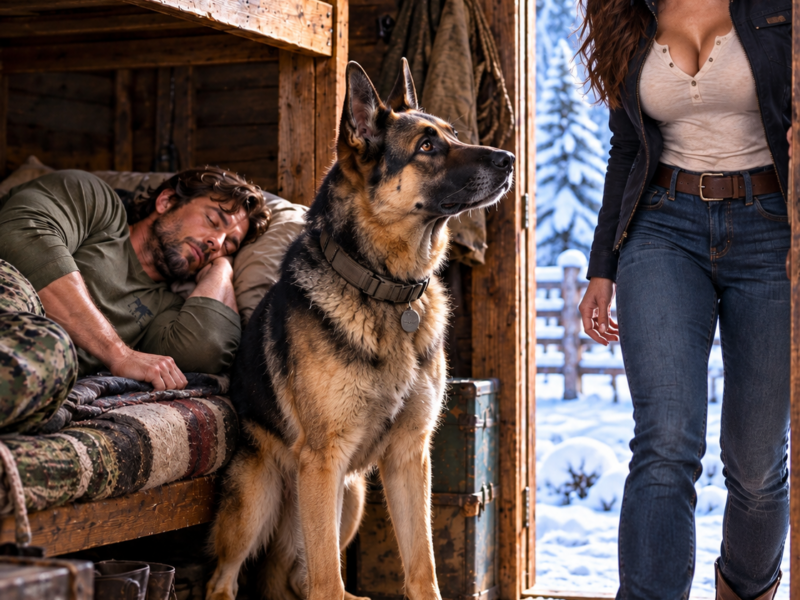
“The first night I found a former Navy SEAL and his German Shepherd sleeping in my abandoned bunkhouse, I should’ve called the sheriff
“Because your father was the last person who ever spoke to him.”
I stared at Cole, waiting for him to explain what that meant.
But he was already moving.
He pulled the buried metal box free with both hands, set it on the barn floor, and motioned for me to step back.
“Cole, you’re not going to tell me to pack a bag and then refuse to explain why, are you?”
“I am if it keeps you alive long enough for me to explain it properly.”
“That is not an answer.”
“No.” He looked at the box. “It isn’t.”
Ranger stood beside him, ears forward, watching the open barn door.
The dog had changed in the past few minutes. He was no longer the calm companion who followed Cole from room to room. His muscles were tense, his attention fixed on the darkness beyond the fence.
I had lived on that farm for eleven years.
I knew every creak in the barn, every broken fence post, every tree that leaned toward the creek.
I had never once felt afraid of the land itself.
Now, standing over a box my father had apparently buried without telling me, I felt as though the ground beneath my feet had shifted.
“Tell me about the man who saved your life,” I said.
Cole slowly lowered himself onto an overturned feed bucket.
“His name was Daniel Reeves. He was my teammate. We served together overseas for years. He was the kind of man who could walk into a room full of people who hated each other and somehow convince them to sit down and listen.”
“What happened to him?”
“He disappeared six years ago.”
“Was he killed?”
“We never found his body.”
The words came out flat, but his right hand had started trembling again.
I sat on a bale of hay opposite him.
“Why would Daniel have anything to do with my father?”
“Because Daniel believed someone was using military supply contracts to steal money and equipment. At first, he thought it was a small operation. Then he discovered the people involved were using private contractors to move stolen goods through legitimate businesses.”
“And my father’s farm?”
“Your father owned land near a freight route. A route those contractors used.”
I thought about the old gravel road behind our north pasture, the one that connected to the county highway and ran toward the abandoned railway depot.
My father had always told me never to let anyone use it as a shortcut.
He had also kept the gate locked long after the road stopped being useful to us.
I had assumed it was another of his stubborn habits.
“Did my father help Daniel?”
“Yes.”
“How?”
Cole rubbed his jaw.
“Your father found a set of records hidden in a shipment container that had been left on the property. He contacted Daniel because he recognized some of the names on the paperwork. Daniel arranged to move the records somewhere safe.”
“And then he disappeared.”
“Three days later.”
I looked down at the metal box.
“What’s inside?”
“I don’t know.”
“You’re the one who found it.”
“Ranger found it.”
“You know what I mean.”
Cole gave me a tired look.
“I know what’s likely inside. I don’t know what your father chose to keep.”
I stood.
“Then let’s open it.”
He hesitated.
“Nora, if those records are what I think they are, this isn’t just about someone trying to buy your property.”
“Wade said there were things buried here.”
“Which means he’s either bluffing or he knows more than he should.”
“Then I would prefer to know which.”
Cole studied my face, perhaps hoping I would finally become frightened enough to leave.
I was frightened.
But this was my home.
My father had spent his last years repairing the barn, planting apple trees along the creek, and refusing offers from people who claimed the land was worthless unless it was developed.
If he had buried something here, I deserved to know why.
“Open it,” I said.
Cole took a small multitool from his pocket and worked at the rusted lock.
It took several minutes.
When the lock finally broke loose, the sound echoed through the empty barn.
Inside the box lay a thick plastic envelope, a black notebook, and a small photograph wrapped in waxed paper.
Cole reached for the photograph first.
The image showed three men standing in front of a military transport vehicle.
Cole.
Daniel.
And a third man I didn’t recognize.
On the back, my father had written a date and four words.
Trust the one who returns.
Cole went utterly still.
I watched him turn the photograph over again.
“What’s wrong?”
He didn’t answer.
“Cole?”
“Your father wrote this?”
“Yes.”
He sat back, staring at the handwriting.
“I haven’t been back here in six years.”
“Why not?”
“Because the last time I saw Daniel, he told me to stay away from this place.”
“Why?”
Cole looked up at me.
“Because he believed the people searching for him were watching everyone connected to him. He thought if I disappeared from your father’s life, your family would be safer.”
“And you listened?”
“I was ordered to leave the investigation alone. Daniel was missing, the records were gone, and the people above us said there was nothing left to pursue.”
“You believed them?”
“I believed I had failed him.”
The confession was so quiet that I almost missed it.
He looked down at his shaking hand.
“After he disappeared, I kept looking for him. I used every contact I had. I followed every lead. Eventually, I was told that continuing would put other people at risk.”
“So you quit.”
“I left the Navy.”
“You left because of Daniel?”
“I left because I couldn’t sleep, couldn’t think clearly, and couldn’t trust my own judgment. I thought stepping away would stop me from getting someone else hurt.”
Ranger moved closer and rested his head against Cole’s knee.
Cole’s hand settled on the dog’s neck.
For a moment, I saw the man beneath the military posture.
Not a hero.
Not a mystery.
Just someone who had carried the same question for six years.
Whether he could have done something differently.
I understood more about that question than I wanted to.
After my father died, I had replayed our final conversation hundreds of times. I had been impatient with him that evening. I had complained about the farm, the bills, the repairs, and the way he refused to accept help.
He had told me he was proud of me.
I had told him I was too tired to talk.
He died two days later from a sudden stroke.
For a long time, I had believed those last words were the only ones that mattered.
“You don’t get to decide that someone else’s disappearance is your fault just because you were the one left behind,” I said.
Cole looked at me.
“I wish I believed that.”
“Then start by opening the box.”
He gave a small nod.
We examined the notebook first.
It contained dates, shipment numbers, names of private logistics companies, and handwritten notes in my father’s careful block lettering.
Some entries were marked with a small star.
Others had been crossed out.
The plastic envelope contained copies of freight manifests and photographs of containers parked near the abandoned railway depot.
Several documents appeared to show that equipment listed as destroyed or decommissioned had been sold through shell companies.
Others connected those companies to a private security contractor called Northstar Strategic.
I had heard the name before.
Wade Harlan had mentioned Northstar at a county meeting months earlier, claiming it would bring jobs to the area if his development proposal went through.
At the time, I hadn’t paid attention.
Now I felt sick.
“Why would a land developer care about military supply records?” I asked.
Cole pointed to a map tucked into the envelope.
The old railway route ran directly behind my north pasture, across the property next to mine, and toward an abandoned industrial yard.
A red circle marked a spot beneath the ridge.
“There’s a service road under that hill,” he said. “It connects to the old depot.”
“It’s been closed for years.”
“Officially.”
I stared at him.
“You think they’re still using it?”
“I think someone wants control of the land above it.”
He tapped the red circle.
“If they can acquire your farm and the adjoining parcels, they can control access to the road without attracting attention.”
I looked toward the north fence.
Wade had been offering to buy my property for eighteen months.
At first, he’d offered a reasonable price.
Then, after my father died, he’d offered less.
When I refused, he began sending letters about zoning restrictions, drainage problems, and potential environmental violations.
I had thought he was simply waiting for me to become desperate.
Maybe he had been waiting for something else.
A vehicle engine sounded beyond the barn.
Cole closed the box immediately.
Ranger gave a low growl.
I stepped toward the door and saw a dark pickup idling on the road beyond the north fence.
The driver was difficult to make out through the windshield.
Cole moved beside me.
“Do you recognize it?”
“No.”
“Then we assume it’s there for us.”
“That’s comforting.”
“I’m trying to be honest.”
The pickup remained in place for several seconds before turning around and disappearing behind the trees.
Cole watched the road until the engine faded.
Then he picked up the metal box.
“We need to move these records.”
“Where?”
“Somewhere secure.”
“You mean your motel?”
“I don’t have a motel.”
“Your truck?”
“I don’t have a truck.”
I blinked.
“You walked here?”
“Most of the way.”
I stared at him.
“You and Ranger have been living in my bunkhouse with no vehicle, no money, and apparently a dangerous collection of military records buried under my barn?”
“That’s a fair summary.”
I laughed once, though there was nothing funny about it.
“Unbelievable.”
“I’m aware.”
I looked at the dog.
“Does he at least have food?”
Ranger’s ears perked up at the word.
Cole sighed.
“He’s eaten better than I have.”
“Then you’re both staying tonight.”
“Nora—”
“Don’t argue. You need sleep, I need answers, and Ranger needs dinner. We’ll figure out the rest in the morning.”
Cole looked as if he wanted to refuse.
Then his eyes met mine.
“Thank you.”
I carried the metal box into the house while Cole secured the barn.
I hid it in the old pantry beneath a stack of winter blankets, then made a simple dinner of roasted chicken and potatoes.
Ranger lay near the kitchen table, one eye open whenever Cole moved.
The dog had a small scar across his muzzle and another along his flank. I wondered what he’d seen before he found this quiet stretch of countryside.
“Was he with you when Daniel disappeared?” I asked.
Cole stopped cutting his food.
“No. Ranger came later.”
“Where did you get him?”
“An injured working dog was being retired after a training accident. I was supposed to help with his rehabilitation.”
“And he stayed?”
“He decided I needed more supervision than he did.”
I smiled.
“That sounds about right.”
Cole glanced at Ranger.
“He doesn’t like crowds. Doesn’t like enclosed spaces unless he knows the exits. Sometimes he wakes up barking at things that aren’t there.”
“Like you?”
Cole looked at me.
I shrugged.
“You told me he won’t sleep indoors unless he can see the door. I assume you understand why.”
He was quiet for a long moment.
“Sometimes.”
After dinner, I showed him the spare bedroom.
He refused it at first.
“The bunkhouse is fine.”
“It’s thirty degrees tonight.”
“I’ve slept colder.”
“I’m sure you have. The bedroom has a door you can see from the bed, and the window opens. Ranger can sleep beside you. You can even leave the light on if you need to.”
His expression changed at that last sentence.
I hadn’t meant it as a kindness.
I had meant it as a practical solution.
But I could tell he’d heard something else.
“Good night, Cole,” I said before he could refuse again.
That night, I woke to the sound of footsteps in the hallway.
I sat up, my heart racing.
A narrow band of light showed beneath my bedroom door.
Then I heard Cole’s voice.
“Easy, boy.”
A moment later, Ranger padded across the hall.
I opened my door.
Cole stood by the kitchen window, looking out into the darkness. He wore the same sweatshirt, and his hands were clenched at his sides.
“Couldn’t sleep?” I asked.
“Habit.”
“Bad dreams?”
He didn’t answer.
I followed his gaze toward the north pasture.
The night was quiet, but I could see a faint light moving near the fence.
A flashlight.
Someone was walking along the property line.
Cole immediately stepped away from the window.
“Stay here.”
“Absolutely not.”
“Nora—”
“This is my house. If someone is trespassing, I’m not going to hide in my bedroom.”
He studied me for a moment, then nodded toward the kitchen phone.
“Call the sheriff. Tell them someone is near the north fence. Don’t go outside until I return.”
“Where are you going?”
“To make sure they don’t reach the barn.”
He took Ranger’s leash from the hook.
The dog stood alert, ready.
I caught Cole’s sleeve.
“You’re not going to get yourself shot over a box of papers.”
“I’m not going looking for a fight.”
“Then what are you doing?”
“Making sure the person out there doesn’t get to decide what happens next.”
He slipped through the back door with Ranger.
I called the sheriff and gave the dispatcher the details.
Then I watched from the kitchen window.
Cole moved along the shadow of the barn, staying clear of the open ground. Ranger remained close to his side.
The flashlight stopped near the north fence.
A second light appeared.
Then a third.
I heard a sharp whistle.
Ranger’s body stiffened.
Cole lifted one hand, signaling him to stay.
A man climbed over the fence.
Another followed.
They were heading toward the barn.
I grabbed the heavy flashlight beside the back door, though I knew I couldn’t do much with it.
Before I could step outside, a voice shouted from the darkness.
“Sheriff’s on the way!”
It was Cole.
The men froze.
One turned and ran toward the fence. The other took a few steps toward Cole, then stopped when Ranger moved in front of him with a deep, warning bark.
The man backed away.
“Keep that dog away from me!”
“Then keep walking,” Cole said.
No shouting.
No threats.
Just a calm, unmistakable command.
The man scrambled over the fence and disappeared.
Cole waited until the sheriff’s cruiser arrived before approaching the house.
Ranger came inside with mud on his paws and a triumphant look that made me suspect he believed he had personally solved the entire problem.
The sheriff found fresh boot prints near the barn and a cut section of fencing.
There was no sign of the intruders.
But the message was clear.
Someone knew we’d found the box.
By morning, I had made a decision.
I wasn’t going to sell the farm.
I wasn’t going to let Wade Harlan frighten me out of my own home.
And I wasn’t going to let Cole carry this burden alone.
When I told him, he looked at me as if I’d announced I planned to walk into a burning building.
“You don’t understand what you’re risking.”
“Then explain it to me.”
“This could involve people with money, influence, and access to information most people never see.”
“I understand that.”
“People have disappeared over less.”
“Daniel disappeared.”
His jaw tightened.
“Exactly.”
I stepped closer.
“Cole, I’m not asking you to pretend this is safe. I’m asking you to stop deciding that the only way to protect someone is to keep them in the dark.”
He stared at me.
The words seemed to reach somewhere he hadn’t intended to open.
Finally, he nodded.
“All right.”
It was the first time he had agreed to trust me with something important.
We took the records to Sheriff Bennett, who arranged for them to be examined by state investigators. Because the documents involved possible theft of government property and military contracting, the evidence was also referred to federal authorities.
Cole insisted that the originals remain untouched.
He explained what he knew about the shipment numbers, the contractors, and the old railway route.
He also told them about Daniel.
Bennett listened without interruption.
When Cole finished, the sheriff leaned back in his chair.
“I remember the investigation into Reeves,” he said. “There were people who thought he had stolen money and run.”
Cole’s face went rigid.
“He didn’t.”
“I know that now.”
“You knew it then?”
Bennett looked uncomfortable.
“I knew the evidence didn’t add up. But I didn’t have the authority to follow the military side of the case, and the people who did weren’t interested in reopening it.”
“Why?”
“Because the contractor involved had friends in high places.”
I looked at Cole.
He wasn’t surprised.
That somehow made it worse.
The next two days passed in a blur of interviews, phone calls, and investigators arriving at the farm.
A forensic team photographed the barn and collected soil samples around the buried box. A state investigator examined the old railway road. Federal agents traced the shell companies listed in my father’s notebook.
Wade Harlan did not appear.
On the third morning, a letter arrived from his attorney demanding that I cease making “defamatory allegations” about his business interests.
I hadn’t made any allegations.
I hadn’t spoken to him at all.
The letter included a revised purchase offer.
It was almost double the amount he’d offered the previous week.
I read it twice.
Then I handed it to Cole.
He studied the signature.
“They’re worried.”
“About the records?”
“About what the records could lead investigators to.”
I sat at the kitchen table.
“I could pay off the mortgage with this.”
“You could.”
“Repair the barn. Replace the roof. Maybe hire someone to help with the farm.”
“Yes.”
I looked at him.
“But you think I shouldn’t accept.”
“I think you should make your decision with all the information, not because someone has made you afraid.”
I folded the letter and placed it on the table.
“I don’t want to sell.”
“Then don’t.”
This time, his words didn’t sound like advice from someone who had nothing to lose.
They sounded like a promise that he would help me find another way.
That afternoon, Ranger found something else.
We were walking the edge of the pasture when he veered toward a patch of tall grass near the creek.
He sniffed the ground, circled once, and began pawing at the earth.
Cole called him back.
Ranger ignored him.
That was unusual enough to make Cole approach.
Beneath the grass was a small metal stake, half buried in mud. It had been painted the same dark green as the old fence posts.
A strip of faded orange tape was tied around it.
Cole crouched.
“Your father used markers like this?”
“No.”
He examined the stake without pulling it free.
“Then we leave it where it is until the investigators see it.”
We called Sheriff Bennett.
By late afternoon, a team had discovered a narrow metal hatch beneath a layer of brush, several yards from the creek.
It led to an old drainage tunnel that ran toward the railway depot.
The tunnel had been sealed on the official county map for more than twenty years.
The seal had been cut recently.
Inside, investigators found tire marks, discarded packaging, and evidence of recent activity. They also found a second metal container wedged behind a concrete support.
It held no weapons.
It held records.
More shipment manifests.
More payment schedules.
And a series of letters exchanged between Wade Harlan and a man using the initials R.K.
The letters showed that Harlan had been trying to acquire the farm and adjoining parcels because the tunnel and service road were part of a concealed transport route used by Northstar Strategic.
The plan was to close the route to public scrutiny by folding it into a private development project.
Once the land was consolidated, the company could remove equipment and destroy the remaining evidence without attracting attention.
My father had discovered the route years earlier.
He had copied the records and hidden them.
And someone had been trying to buy the property ever since.
The documents also contained a name that made Cole go pale.
Daniel Reeves.
One letter claimed Daniel had been transferred to a private holding facility after he threatened to expose the operation.
The letter was dated six years earlier.
There was no proof he had survived.
But there was enough to suggest that his disappearance had never been properly investigated.
Cole read the page three times.
Then he walked outside.
I found him near the apple trees, sitting on the low stone wall my father had built beside the orchard.
Ranger rested at his feet.
Cole was holding the silver challenge coin in his palm.
“He might be alive,” I said.
Cole shook his head.
“I can’t let myself believe that yet.”
“Why not?”
“Because if I believe it, I have to face the possibility that he was out there all these years and I stopped looking.”
I sat beside him.
“You stopped looking because you were told the search was over.”
“I should have known better.”
“Maybe. But you can’t punish yourself forever for a decision you made when you were exhausted and grieving.”
He gave a bitter laugh.
“You make it sound easy.”
“It isn’t.”
I looked out over the orchard.
“My father kept a secret from me for years. He died before he could explain it. I still get angry with him. Sometimes I get angry with myself for not asking more questions.”
Cole turned the coin over in his hand.
“What do you do with that?”
“You decide what you want the next part of your life to look like.”
He was silent for a long time.
Then he asked, “What do you want?”
I hadn’t expected the question.
I looked at the farmhouse, the barn, the pasture, and the hills beyond the creek.
“I want to keep my land. I want to stop living as though every bad thing that happened to me means something worse is waiting around the corner.”
I glanced at him.
“And I want to know what it’s like to have someone here who doesn’t disappear the moment things get difficult.”
Cole’s expression changed.
He looked away before I could read it.
“I don’t know if I’m that person.”
“I didn’t ask you to promise me anything.”
“No,” he said quietly. “You didn’t.”
For a moment, the only sound was the wind moving through the apple trees.
Then Ranger lifted his head and placed one enormous paw on Cole’s boot.
Cole looked down at him.
“You’re not helping.”
Ranger wagged his tail.
I laughed.
It was the first real laugh I’d had in weeks.
Cole watched me, and something in his face softened.
I wished he would stay.
The thought frightened me more than the men at the fence had.
Because I had spent years convincing myself that needing someone was a weakness.
And now I was beginning to understand how lonely that belief had made me.
The federal investigation moved quickly after the tunnel was discovered.
Harlan was arrested at his office two days later. Investigators seized his business records and uncovered payments to shell companies linked to Northstar Strategic.
Several former employees agreed to cooperate.
The operation was larger than anyone had expected, but the evidence was strong enough to support multiple charges involving fraud, theft of government property, and conspiracy.
The case also reopened the investigation into Daniel’s disappearance.
One of the cooperating witnesses identified a former Northstar supervisor who had arranged Daniel’s transfer to a private facility after his capture.
The supervisor had since retired and moved to another state.
Agents located him within a week.
He provided a statement and records that confirmed Daniel had been held under an assumed identity before being transferred to a medical facility.
The records were incomplete.
But they contained a name.
A veterans’ rehabilitation center in North Carolina.
Cole read the name in silence.
Then he looked at me.
“I need to go.”
I felt the words like a door closing.
“I know.”
“I can’t ask you to come with me.”
“You didn’t.”
He nodded, but he didn’t move.
For the first time since I’d met him, he looked uncertain about what to do next.
I stepped closer.
“Cole, go find your friend.”
“What about the farm?”
“The farm will still be here.”
“What about you?”
The question came out before he seemed to realize he had asked it.
I took a breath.
“I’ll be here.”
He looked at me for a long moment.
Then he reached for my hand.
His fingers were warm, and the tremor in his right hand had nearly disappeared.
“I don’t know how long this will take.”
“Then don’t make promises about the time.”
“I don’t know what happens when I come back.”
“Neither do I.”
I squeezed his hand.
“But if you want to come back, the door will be open.”
He looked down at our joined hands.
“I want to come back.”
The words were so quiet I almost didn’t hear them.
But I did.
And for the first time, I let myself believe that wanting someone to stay wasn’t the same as asking them to save me.
Cole left the next morning with Ranger beside him.
I watched their old borrowed truck disappear down the gravel road.
The farm felt impossibly quiet.
For six days, the bunkhouse had been filled with footsteps, the soft clink of tools, Ranger’s nails tapping across the floor, and Cole’s low voice as he spoke to the dog.
Now there was only the wind.
I went inside and stood in the doorway of the bunkhouse.
On the table lay a small folded note.
I used to think staying somewhere meant I was giving up on the people I couldn’t save.
You reminded me that leaving isn’t always the brave thing to do.
I’ll come back if you’ll still have me.
There was no signature.
There didn’t need to be one.
I folded the note and slipped it into my pocket.
Then I went outside and began repairing the porch steps.
I had a mortgage to pay, a barn to fix, and a farm that wasn’t going to save itself.
For the first time in years, those things didn’t feel like a punishment.
They felt like a life.
Three weeks passed.
Investigators kept me informed about the case, but I tried not to build my days around every phone call.
I repaired the north fence, hired a local carpenter to help with the barn roof, and began selling produce to a nearby restaurant.
The owner agreed to pay in advance for the first few deliveries.
It wasn’t enough to make me rich.
It was enough to give me room to breathe.
I also reopened the bunkhouse.
Not for strangers.
For the possibility that someone might need a place to rest without having to explain every scar before being offered a blanket.
Then, on a rainy Thursday evening, my phone rang.
It was Cole.
I answered so quickly I nearly dropped it.
“Did you find him?”
There was a pause.
Then I heard a breath that sounded almost like a laugh.
“Yes.”
I closed my eyes.
“Is he alive?”
“He is.”
For a moment, I couldn’t speak.
Cole told me that Daniel had survived, but years of confinement and untreated injuries had left him weak. He was receiving care at the rehabilitation center and would need time before he could travel.
He had recognized Cole immediately.
“He thought I was dead,” Cole said.
“What did you tell him?”
“That I was sorry.”
“And what did he say?”
Cole’s voice broke slightly.
“He told me to stop apologizing and bring him a decent cup of coffee.”
I laughed through my tears.
“That sounds like a good friend.”
“He is.”
I could hear something different in Cole’s voice.
Not happiness exactly.
Relief.
The kind that comes when a question you’ve carried for years finally has an answer.
“I’ll be back when I can,” he said.
“I’ll be here.”
This time, neither of us pretended the words were casual.
When Cole finally returned, it was nearly a month later.
I was in the pasture repairing a gate when I heard the familiar rumble of a truck on the gravel road.
Ranger jumped out before the engine had fully stopped.
He ran toward me, tail swinging, and nearly knocked me off balance.
I dropped the wrench and wrapped both arms around his neck.
“You ridiculous dog.”
He licked my cheek.
Then Cole stepped out of the truck.
He looked healthier.
He had shaved his beard, cut his hair, and traded the worn sweatshirt for a clean jacket.
But his eyes were the same.
For a moment, neither of us moved.
Then I crossed the yard.
He met me halfway.
I had imagined a dozen things I might say when he returned.
Something witty.
Something cautious.
Something that would make it clear I hadn’t spent weeks wondering whether he’d change his mind.
Instead, I stopped in front of him and asked, “Are you staying?”
Cole looked at the farmhouse, the barn, the apple trees, and the bunkhouse.
Then he looked at me.
“If you’ll have me.”
I felt my eyes fill.
“I’ve been fixing that bunkhouse for a month. You’d better stay.”
He laughed softly.
Then he took my hands in his.
“I can’t promise I’ll never have to leave.”
“I wouldn’t ask you to.”
“I can’t promise I’ll always know what to do.”
“Good. I don’t trust people who claim they always know what to do.”
He smiled.
“And I can’t promise I won’t have bad days.”
I squeezed his fingers.
“Then we’ll take them one at a time.”
He lowered his forehead to mine.
For a moment, the entire world seemed to settle around us.
Then Ranger barked from the porch, impatient with the delay.
Cole pulled back and laughed.
“Apparently, I’ve been given a deadline.”
“You have. Dinner’s at six.”
“Understood.”
He moved into the bunkhouse that evening.
Not because he had nowhere else to go.
Not because he was running from his past.
Because he had finally found a place where staying didn’t mean abandoning anyone.
Over the following months, Daniel recovered enough to visit the farm.
He arrived on a clear autumn afternoon, moving slowly with a cane and wearing a baseball cap pulled low over his forehead.
Cole stood at the end of the driveway when he saw him.
Neither man said anything at first.
Then Daniel opened his arms.
Cole walked straight into them.
They held each other for a long time.
I stayed on the porch with Ranger, giving them the privacy they deserved.
Later, Daniel sat at my kitchen table and told me stories about my father.
He said my dad had been stubborn, brave, and entirely too willing to feed anyone who showed up hungry.
I laughed because it sounded exactly right.
Before Daniel left, he handed me a small envelope.
Inside was a photograph of my father standing beside him and Cole at the old railway depot.
On the back, Dad had written the same words he’d put on the photograph in the metal box.
Trust the one who returns.
I held the picture against my chest.
For years, I had thought my father’s last secret was proof that he hadn’t trusted me.
Now I understood that he had been trying to protect people he believed had no one else to protect them.
He had made mistakes.
He had kept too much to himself.
But he had left behind enough truth for us to finish what he started.
By winter, the farm had begun to feel alive again.
The barn roof no longer leaked.
The fence held.
The bunkhouse porch was sturdy enough for two people to sit side by side without worrying about the boards giving way.
Cole helped me set up a small workshop in the old shed. Daniel called every week, and sometimes he came to stay for a few days.
Ranger claimed the warmest patch of sunlight in the house and acted personally offended whenever anyone disturbed him.
One evening, as snow began to settle over the pasture, I found Cole standing outside the bunkhouse.
He was looking toward the hills.
I walked over and slipped my hand into his.
“Thinking about Daniel?”
“Thinking about how close I came to never finding him.”
“But you did.”
“Because I came here.”
I rested my head against his shoulder.
“Maybe you needed to come here for yourself, too.”
He was quiet.
Then he turned toward me.
“I spent six years believing I had nothing left to offer anyone. I thought if I kept moving, I wouldn’t have to explain why I couldn’t stay.”
“And now?”
“Now I think I was wrong.”
He lifted my hand and kissed my knuckles.
“I want to build something here, Nora. Not because I need somewhere to hide. Because I want a life that includes you.”
My heart beat so hard I could feel it in my throat.
“I want that, too.”
He smiled, and I saw the man from the first morning again—the tired stranger on the porch, the former SEAL who had expected to leave before dark, the man who had offered to fix my broken steps because he didn’t know how to accept kindness without trying to repay it.
Only now, he wasn’t looking at the tree line.
He was looking at me.
And I finally understood what I had wanted to ask him all along.
Not whether he would stay for another night.
Not whether he would help me save the farm.
Whether he could imagine a future here, with me, when there was no emergency left to keep him.
I took a breath.
“Cole?”
“Yeah?”
“I have one more room in the house.”
He glanced toward the farmhouse.
“I noticed.”
“You don’t have to sleep in the bunkhouse anymore.”
He studied my face, and the teasing smile faded into something tender.
“Are you asking me to move in?”
I nodded.
“I am.”
He didn’t answer immediately.
For one frightening second, I wondered if I had asked for too much.
Then he took my face gently between his hands.
“I was hoping you’d ask.”
He kissed me beneath the falling snow.
It wasn’t a dramatic kiss.
There were no promises about forever, no declarations that love could heal every wound.
There was only the warmth of his hands, the quiet farm around us, and the certainty that neither of us had to face the next chapter alone.
When we finally stepped apart, Ranger pushed his head between us, demanding attention.
Cole laughed.
“Looks like we need to discuss the sleeping arrangements.”
I scratched Ranger behind the ears.
“He gets the floor.”
Cole raised an eyebrow.
“You’re going to have to negotiate that with him.”
“I have a feeling he’s the one who’s been negotiating with you all along.”
We walked toward the farmhouse together.
Behind us, the bunkhouse porch light glowed against the snow.
Six days earlier, I had found a former Navy SEAL and his K9 hiding from a past neither of them could outrun.
I had thought I was giving a stranger a place to sleep.
I hadn’t realized he would help me reclaim my home, uncover my father’s secret, and remind me that love didn’t have to arrive with a rescue plan.
Sometimes it arrived tired, carrying too much grief, and asking for nothing more than a safe place to rest.
And sometimes, after all the danger had passed, the bravest thing either person could do was ask the other to stay.
The end.









