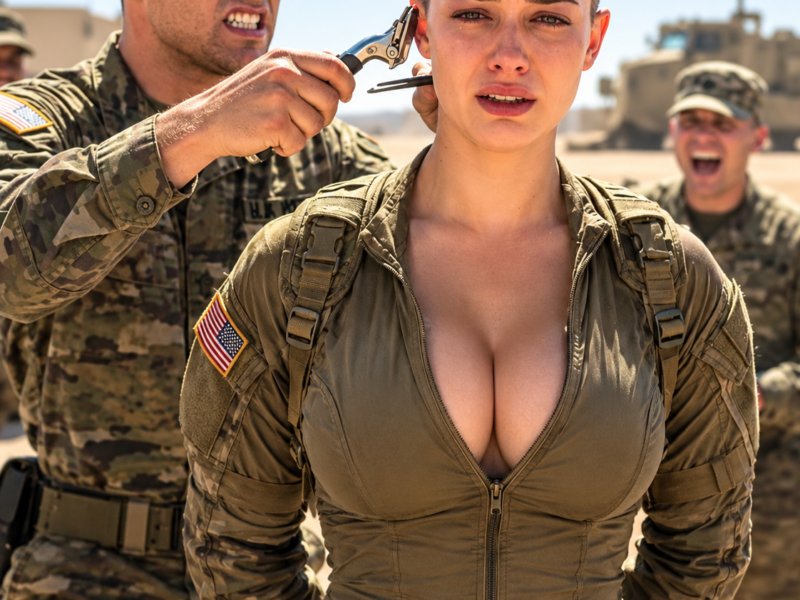
The first laugh came from somewhere near the front row
For three seconds, nobody moved.
The general stood beside the vehicle, staring at me.
Lieutenant Colonel Grant Harlan looked as if someone had suddenly pulled the ground out from beneath his feet.
Then he forced a laugh.
“General, I believe there’s been a misunderstanding.”
The general didn’t smile.
“Has there?”
He walked toward us, his boots striking the pavement with measured precision.
The soldiers stood rigidly at attention.
I remained where I was, holding my muddy clipboard.
“Ma’am,” the general said, stopping in front of me. “Are you injured?”
“No, sir.”
“Did he put his hands on you?”
Harlan interrupted.
“General, she was interfering with a training demonstration. I was simply maintaining discipline.”
The general turned slowly.
“I didn’t ask you.”
Harlan’s mouth closed.
I looked at the general.
“Lieutenant Colonel Harlan shoved me, ordered two soldiers to restrain me, and attempted to humiliate me in front of this formation. He also appears to have a problem with the medical records involving Private First Class Noah Bennett.”
The general glanced at the photograph on my clipboard.
His expression hardened.
“Where did you obtain this?”
“From an authorized preliminary review of the incident records. The original complaint was submitted three weeks ago.”
He looked toward Harlan.
“Did you know about the complaint?”
Harlan straightened.
“Sir, I receive dozens of complaints. Most are misunderstandings caused by inexperienced personnel.”
“Then this should be easy to explain.”
The general held out his hand.
I passed him the photograph.
He studied it for several seconds.
Then he looked at the soldiers.
“Everyone remain in formation. No one is to discuss this incident with witnesses or alter any records. Captain Lewis, secure the training area and preserve all available footage.”
A captain near the reviewing stand immediately acknowledged the order.
Harlan stepped forward.
“General, with respect, this is an internal training matter.”
“No,” the general replied. “It became something else when you put your hands on an authorized evaluator.”
He turned toward me again.
“Let’s talk somewhere private.”
I nodded.
Before we left, I looked toward Sergeant First Class Daniel Reeves.
He was still standing beside the equipment shed.
His hands were no longer trembling.
He was watching us with an expression I couldn’t quite read.
It wasn’t relief.
Not yet.
It was the look of someone who had seen trouble coming and had spent too long believing nobody would stop it.
I wanted to speak with him.
But first, I needed to understand why Noah Bennett had disappeared from the records.
And why Harlan had reacted so strongly to a single photograph.
The general led me into the administration building.
His name was General Thomas Whitaker.
He had served in special operations for more than thirty years and had been one of the senior officers involved in establishing the evaluation program.
He closed the conference room door.
“Tell me how much you know.”
I placed my clipboard on the table.
“An anonymous complaint alleged that soldiers were being punished for reporting injuries. Training records appeared inconsistent with medical documentation. One soldier, Noah Bennett, submitted a complaint and then vanished from the active training roster.”
“Vanished?”
“His personnel record says he was transferred to a medical holding unit. That unit has no matching admission record.”
Whitaker studied me.
“Have you confirmed his current location?”
“Not yet.”
He sat down.
“That’s a serious discrepancy.”
“There’s another one.”
I opened the clipboard to the third page.
“Three different training reports list Bennett as having completed the same obstacle course on the same date. One report says he completed it without injury. Another says he withdrew due to fatigue. The third says he was never present.”
The general rubbed his forehead.
“Who signed them?”
“Harlan approved two. The third was submitted under the name of an instructor who claims he never wrote it.”
Whitaker leaned back.
“Do you believe Harlan altered the records?”
“I believe the records were altered. I haven’t established who did it.”
“Good answer.”
I looked at him.
“Sir, I need unrestricted access to the original training footage, medical logs, and personnel communications.”
“You’ll have it.”
“I also need the witnesses protected from command interference.”
“Agreed.”
He paused.
“There’s something you should know about this installation. Harlan has been considered one of our strongest training commanders. His unit has excellent completion statistics.”
“That may be part of the problem.”
“What do you mean?”
“If the numbers are being manipulated, the unit’s reputation could be built on false results.”
Whitaker looked toward the window.
“Then we’ll find out.”
He picked up the phone and called the installation’s legal office.
Within minutes, a preservation directive was issued.
All relevant records were to be secured.
Training camera systems were to be isolated.
Medical documentation was to be preserved in its original form.
And no member of Harlan’s command would be permitted to access or modify the records under review.
I had spent twenty years learning that the first few hours of an investigation mattered.
Evidence could disappear.
Witnesses could be pressured.
People who had remained silent for months could suddenly decide that speaking was too dangerous.
I wasn’t going to let that happen again.
After the meeting, I requested a private interview with Sergeant Reeves.
He arrived fifteen minutes later.
He removed his cap and sat across from me.
“Sergeant,” I said, “I want you to understand that this interview is not a disciplinary hearing. I’m trying to establish what happened.”
“Yes, ma’am.”
“Were you present when Noah Bennett was injured?”
His eyes moved toward the closed door.
“Yes.”
“Tell me.”
Reeves took a breath.
“Bennett injured his shoulder during a live-load training exercise. The equipment shifted when he was climbing the wall. He fell hard.”
“How serious was the injury?”
“He couldn’t lift his arm. He was in a lot of pain.”
“Was medical assistance requested?”
“I called for it.”
“What happened?”
“Colonel Harlan told me to wait until the exercise was complete.”
I kept my expression neutral.
“Did you obey?”
“I did.”
“Why?”
His jaw tightened.
“Because he was my commanding officer.”
“That explains your position. It doesn’t explain why the medical team wasn’t called.”
He looked down.
“I should have ignored the order.”
I waited.
“By the time the medic arrived, Bennett was shaking. His shoulder was swollen, and he couldn’t move his fingers properly.”
“Was he taken to a hospital?”
“Yes. I thought he was.”
“But the records don’t show an admission.”
Reeves looked up.
“That’s because he was taken somewhere else.”
“Where?”
He hesitated.
“An old medical annex behind the logistics compound. It isn’t used for normal treatment anymore.”
“Why was he taken there?”
“Harlan said the main clinic was overwhelmed.”
“Was it?”
“No, ma’am.”
The answer came too quickly to be anything but honest.
“Did you see Bennett again?”
“Two days later. He was wearing a sling. He told me he’d been ordered to sign a statement saying he had injured himself during personal exercise.”
“Did he sign?”
“No.”
“What happened?”
Reeves’s face tightened.
“Harlan called him into his office.”
“And?”
“I wasn’t there for the whole conversation. But I heard Harlan tell him that if he wanted to remain in the unit, he needed to stop making accusations.”
“Did Bennett file a complaint?”
“Yes.”
“Who received it?”
“Captain Lewis.”
I wrote the name down.
“Did Lewis forward it?”
Reeves hesitated.
“I don’t know.”
“Sergeant, did you ever try to report what you saw?”
He stared at the table for a long time.
“I started a report.”
“What happened to it?”
“Harlan found out.”
“And?”
“He told me that if I submitted it, he’d make sure I never worked in special operations again.”
“Did you destroy the report?”
“No.”
“Where is it?”
Reeves looked at me.
“On a personal storage device. I kept a copy.”
That was the first real breakthrough.
“Can you provide it?”
“Yes, ma’am.”
“Don’t send it through the unit’s network. We’ll arrange a secure transfer.”
He nodded.
Before he stood, I asked one more question.
“Why did you hesitate when Harlan ordered you to bring me over?”
Reeves swallowed.
“Because I knew what he was doing.”
“What was he doing?”
“Trying to make everyone believe that he could do whatever he wanted.”
“And why didn’t you stop him?”
His eyes glistened, but his voice remained steady.
“Because I was afraid he’d do to me what he’d done to Bennett.”
I closed my notebook.
“Thank you for telling me.”
He stood.
Then he stopped at the door.
“Ma’am?”
“Yes?”
“Are you really who the general says you are?”
I understood what he meant.
He had heard the general mention my background in the hallway.
“I am.”
He nodded slowly.
“I thought you looked familiar.”
I didn’t ask how.
Not yet.
The next morning, the investigation team began reviewing the records.
I had served twenty years in the Navy, much of it in elite special operations assignments.
My career had included deployments, joint missions, and operations that were never discussed outside restricted briefings.
I had left active operational service two years earlier.
Now I worked in an oversight role, where my job was to recognize failures before they became disasters.
I wasn’t here to relive my military career.
I was here because someone had to make sure the institution followed its own rules.
But the past had a way of following you into rooms where you least expected it.
At 0900, General Whitaker joined our investigative briefing.
A digital display showed the timeline of Noah Bennett’s injury.
The first entry recorded the incident at 1420.
The medical request was logged at 1517.
The ambulance departure was listed at 1605.
But there was no corresponding hospital arrival.
A second system showed Bennett had been marked as medically cleared the following morning.
That entry was impossible.
The hospital had no record of examining him.
The installation clinic had no physician signature.
And the medic who had reportedly cleared him was on leave that day.
“Who entered the clearance?” I asked.
One of the investigators enlarged the record.
“Administrative account assigned to Harlan’s office.”
“Can we identify the user?”
“We’re working on it.”
The general folded his arms.
“Could this be a system error?”
“Not with three separate entries matching the same false sequence,” I said.
He nodded.
“Continue.”
We examined the training footage.
The camera covering the obstacle course had recorded Bennett’s fall.
The image was clear.
He hit the ground, grabbed his shoulder, and remained down.
Reeves entered the frame.
He called for medical assistance.
Then Harlan approached.
The audio was faint, but we could hear enough.
Harlan pointed toward the obstacle.
Reeves shook his head.
Harlan leaned closer.
Then Reeves stepped away from the radio.
The recording continued for another eleven minutes.
Bennett remained on the ground.
No medic arrived.
I watched the footage twice.
Then I asked the technician to freeze the image at the moment Harlan approached.
“Zoom in.”
The screen enlarged.
Harlan was holding something in his left hand.
A small black device.
“What’s that?”
The technician adjusted the image.
“It looks like a handheld radio.”
“No,” I said. “Look at the shape.”
He sharpened the image.
The device appeared to be a portable camera.
I leaned forward.
“Does the training system record from other angles?”
“Yes. There are three cameras.”
“Pull all three.”
The second camera showed a clearer view of the incident.
It also showed something the first camera had missed.
After Bennett was taken away, Harlan walked toward the equipment shed.
He handed the black device to another man.
The man was wearing a civilian maintenance uniform.
His face was partially visible.
I recognized him from the personnel list.
Martin Cole.
The contractor responsible for maintaining the training camera system.
“Find him,” I said.
The general turned toward the investigators.
“Do it.”
By noon, Cole had been located in a maintenance office.
He denied knowing anything about Bennett.
He denied handling any camera.
He denied receiving instructions from Harlan.
But when we showed him the footage, his face changed.
“I was just following maintenance orders,” he said.
“Who gave them?”
“I don’t remember.”
“Mr. Cole, this is an official inquiry. You need to be accurate.”
He looked toward the door.
Then he leaned forward.
“Colonel Harlan told me the camera had malfunctioned.”
“Did it?”
“No.”
“Did you remove footage?”
He didn’t answer.
“Did you receive any files from the colonel?”
Cole rubbed his palms together.
“I was told to replace the storage unit.”
“When?”
“The day after Bennett’s injury.”
“Why?”
“He said the footage was corrupted.”
“Was it?”
Cole looked down.
“No.”
The room became very quiet.
“Where is the original storage unit?”
“I don’t know.”
“Mr. Cole.”
He closed his eyes.
“I kept it.”
That afternoon, investigators recovered the original storage unit from a locked cabinet in Cole’s office.
It contained more than the footage of Bennett’s injury.
There were recordings of other incidents.
A recruit being forced to repeat a physical exercise after reporting chest pain.
Another being ordered to stand outside in freezing weather after asking for medical attention.
A third being threatened with removal from the program for refusing to sign an inaccurate statement.
The recordings were not all clear.
Some were missing audio.
But the dates matched several complaints that had previously been closed.
And the same commander appeared in multiple files.
Grant Harlan.
The investigation had become more serious than anyone initially expected.
But there was still one question I couldn’t answer.
Where was Noah Bennett?
The medical annex was located behind a row of old logistics buildings.
It had been used years earlier for temporary treatment during large-scale exercises.
Now it appeared almost abandoned.
The windows were dark.
The entrance was locked.
A faded sign warned that the building was restricted.
General Whitaker authorized an inspection.
We entered with a medical officer and two investigators.
Inside, we found a small reception area.
There were old examination tables, unused cabinets, and several boxes of outdated medical supplies.
At the far end of the hallway, a door stood slightly open.
A light was on inside.
I stepped toward it.
“Hello?”
A young man’s voice answered.
“Who’s there?”
I stopped.
“I’m Mara Vance. I’m here with the command investigation team.”
Silence.
Then:
“Are you with Colonel Harlan?”
“No.”
“Prove it.”
I looked at the medical officer.
He stepped forward and identified himself.
“We’re here to make sure you’re safe.”
The door opened slowly.
A young soldier stood in the doorway.
His left arm was in a sling.
His face was thinner than the photograph on my clipboard.
It was Noah Bennett.
He stared at me.
Then his eyes moved toward the general.
“Am I in trouble?”
“No,” I said.
“Are you sure?”
“Yes.”
He looked at the medical officer.
“Can I leave?”
The question was so quiet that I almost missed it.
“Of course,” I replied. “But first, we need to make sure you’re medically safe and that you understand your options.”
Noah stepped back.
Inside the room was a narrow bed, a small table, and a stack of paper files.
He had been staying there.
Not for a few hours.
For days.
He told us that Harlan had ordered him to remain in the annex until he agreed to sign a statement withdrawing his complaint.
He had received basic food and pain medication.
But he had not been given a proper medical evaluation.
He had been told that leaving without permission would be treated as unauthorized absence.
“Why didn’t you contact anyone?” I asked.
“I tried.”
“Who?”
“My family. But my phone was taken.”
“Did you ask the staff for help?”
“There wasn’t anyone here most of the time.”
He looked toward the door.
“Colonel Harlan came twice.”
“What did he say?”
“He said I was ruining my career.”
Noah’s voice trembled.
“He told me nobody would believe a recruit who couldn’t finish an obstacle course.”
I felt something cold settle in my chest.
“Did he threaten you physically?”
“No. But he said he could make sure I never served again.”
“Did he ask you to sign anything?”
Noah nodded.
He pointed toward the table.
There was a document in a clear plastic folder.
It was a prepared statement.
It claimed that Noah had injured himself during personal exercise, that no instructor had been involved, and that his complaint had been made under emotional stress.
At the bottom was a signature line.
It was blank.
“I’m not signing it,” Noah said.
“You don’t have to.”
He stared at me.
“Really?”
“Really.”
The medical officer began examining him.
The initial assessment confirmed that his shoulder injury had not been properly treated.
He needed further imaging and specialist care.
The general ordered that he be transferred to the main medical facility under independent supervision.
Before Noah left, he asked to speak with me alone.
“Ma’am, can I ask you something?”
“Of course.”
“Why did you let them laugh at you yesterday?”
I considered the question.
“Because I needed to see how they behaved when they thought I couldn’t challenge them.”
He looked down.
“They do that to everybody.”
“I know.”
“No. I mean everybody. Even people who have been here for years.”
I waited.
“They make you feel like you’re nothing unless they approve of you.”
He paused.
“Some of the guys stopped reporting injuries because they didn’t want to be called weak.”
I nodded.
“Do you know anyone else who was kept from getting medical help?”
He hesitated.
Then he gave me three names.
One of them belonged to a soldier who had recently been transferred to another installation.
Another belonged to a medic.
The third was a training instructor who had resigned without explanation.
I wrote them down.
“Thank you, Noah.”
He looked at me.
“Are they going to get away with it?”
I didn’t offer him a promise I couldn’t guarantee.
“Noah, the evidence is going to be preserved. Your statement will be heard. And the people responsible will have to answer for what happened.”
He nodded.
It wasn’t complete trust.
But it was a beginning.
That evening, Harlan requested a meeting with General Whitaker.
The general agreed, provided that the meeting was documented.
I attended with two investigators.
Harlan entered wearing his service uniform.
His posture was perfect.
His face was calm.
He looked like a man who had spent the entire day preparing his defense.
“General,” he began, “I want to formally object to the way this inquiry is being conducted.”
Whitaker folded his hands.
“State your objection.”
“This civilian evaluator has exceeded her authority.”
I didn’t react.
Harlan continued.
“She has interfered with training, questioned personnel without proper command coordination, and used her background to intimidate my staff.”
The general looked at him.
“Did she order you to shove her?”
“No, sir.”
“Did she order you to throw her clipboard into the mud?”
Harlan’s jaw tightened.
“No, sir.”
“Did she order you to humiliate her in front of your formation?”
“No.”
“Then let’s focus on the evidence.”
Harlan leaned forward.
“The footage is being taken out of context.”
“Which footage?”
“The training recordings.”
“Are you denying that the original footage was removed?”
“I was informed that the system malfunctioned.”
“By whom?”
“Maintenance personnel.”
“Do you have documentation?”
Harlan hesitated.
“Not with me.”
I placed a document on the table.
“This is the original maintenance log. It shows the storage unit was functioning normally before Mr. Cole removed it.”
Harlan glanced at the page.
Then he looked at me.
“You have no idea how complex training operations are.”
“I understand them well enough to recognize a false report.”
He gave a bitter laugh.
“You think because you spent a few years in uniform, you understand what it takes to command a unit?”
The general’s expression changed.
“Lieutenant Colonel, choose your next words carefully.”
But Harlan continued.
“People like her don’t understand the pressure. They don’t understand what happens when standards slip. Someone has to make hard decisions.”
I looked at him.
“Was keeping an injured soldier in an abandoned medical annex one of those hard decisions?”
His eyes flashed.
“He was under observation.”
“By whom?”
No answer.
“Where was the physician’s signature?”
Silence.
“Why was his complaint marked withdrawn when he never withdrew it?”
Harlan’s face hardened.
“Because he was being manipulated.”
“By whom?”
He leaned back.
“You people want a scandal. That’s all this is.”
General Whitaker stood.
“This meeting is over.”
Harlan rose.
“You can’t remove me based on accusations.”
“No,” the general said. “But I can relieve you of command responsibilities while an investigation examines the evidence.”
Harlan looked at him.
For the first time, his confidence was gone.
“Sir, I’ve served this command for twenty-six years.”
“And the people under your command have a right to be treated with dignity.”
Harlan gathered his papers.
He left without another word.
The next morning, an official notice confirmed that he had been temporarily relieved of command authority.
The investigation continued.
The evidence was reviewed by independent legal personnel.
Noah received medical treatment and was assigned an advocate who had no connection to Harlan’s command.
Reeves provided his original report.
Cole gave a sworn statement about removing the storage unit.
Captain Lewis admitted that he had received Noah’s complaint and failed to forward it through the required channels.
He also admitted that Harlan had pressured him to close the matter.
Lewis was not excused from responsibility.
His failure to act was included in the findings.
But his cooperation helped establish the timeline.
Over the next month, the team identified eight separate incidents involving improper treatment or retaliation.
Five had supporting video.
Three were corroborated by medical records and witness statements.
The review also found that training completion statistics had been inflated.
Soldiers who withdrew because of injury had been counted as successful completions.
Others had been pressured to sign forms stating they had voluntarily left the program.
The numbers had made Harlan’s unit look exceptional.
In reality, they had hidden a pattern of abuse.
The final report was delivered to the appropriate military authorities.
Harlan faced formal administrative and disciplinary proceedings.
The evidence concerning the altered records and the treatment of Noah Bennett was referred for further legal review.
Cole’s role in removing the footage was also examined.
Lewis faced consequences for failing to report what he knew.
And the training program was placed under independent oversight.
I didn’t attend every hearing.
That wasn’t my job.
My job was to make sure the facts were documented and the evidence was preserved.
But I did return to the installation once the initial findings were complete.
The courtyard was quiet that morning.
A new commander had taken over the unit.
The old training schedule had been suspended.
A medical team now reviewed injury reports independently.
And the soldiers had access to a confidential reporting channel outside their chain of command.
I found Sergeant Reeves near the equipment shed.
He was speaking with two younger soldiers.
When he saw me, he excused himself and approached.
“Good morning, ma’am.”
“Good morning, Sergeant.”
He smiled faintly.
“Things are different now.”
“Different how?”
“People are asking questions.”
“That sounds healthy.”
He laughed.
“Some of the instructors don’t like it.”
“They’ll adjust.”
He looked toward the training field.
“Noah asked me to tell you something.”
“What is it?”
“He’s going to physical rehabilitation. The doctor says there’s a good chance he’ll regain most of his shoulder function.”
“That’s good news.”
“He also wants to finish his military training someday.”
I nodded.
“I hope he gets that opportunity.”
Reeves hesitated.
“There’s something else.”
“What?”
“Some of the younger soldiers found out who you are.”
I raised an eyebrow.
“How?”
“They searched your name after the general mentioned your service.”
I sighed.
“I was hoping they wouldn’t.”
Reeves smiled.
“They found a few articles. Not many. Mostly old references to operations that were never fully explained.”
“That doesn’t tell them much.”
“No, ma’am.”
He paused.
“But it tells them enough.”
I looked toward the training field.
A group of recruits was preparing to begin an exercise.
One young soldier struggled to tighten the strap on his equipment.
An instructor stepped over.
Instead of shouting, he showed him how to adjust it.
The soldier nodded and tried again.
It was ordinary.
Almost insignificant.
But it was exactly the kind of moment I had wanted to see.
Reeves followed my gaze.
“Can I ask you something personal?”
“Go ahead.”
“Why did you leave the teams?”
I looked at him.
“Twenty years is a long time.”
“I know.”
“After a while, you learn that being strong isn’t the same as never getting hurt. And being a leader isn’t the same as making people afraid.”
He nodded slowly.
“Do you miss it?”
“Sometimes.”
“What do you miss?”
“The people who trusted each other when everything was difficult. The people who never needed to humiliate someone to prove they were in charge.”
Reeves looked down.
“I wish we’d had more of that here.”
“So do I.”
He reached into his pocket and pulled out a folded note.
“Noah asked me to give you this.”
I opened it.
The handwriting was uneven, probably because his injured arm was still recovering.
It read:
“Ma’am, I used to think the strongest person in the room was the one everyone feared. Now I think it’s the person who can stand up when everyone else is afraid to speak.”
I read the words twice.
Then I folded the paper and put it inside my clipboard.
“Tell him thank you.”
“I will.”
As I walked back toward the parking area, I passed the spot where Harlan had thrown my clipboard into the mud.
The ground had dried.
There was no sign of the confrontation.
No trace of the laughter.
No evidence of the moment when a commander believed he could humiliate someone simply because he had the authority to do so.
But I remembered it.
I remembered the soldiers who laughed because they were afraid not to.
I remembered the ones who stayed silent because they had watched what happened to Noah.
And I remembered Reeves standing near the equipment shed, trying to decide whether courage was worth the cost.
People sometimes asked me about my twenty years in special operations.
They wanted to know about missions, deployments, difficult decisions, and the things that happened far from public view.
They expected stories about physical strength and extraordinary endurance.
But the lesson I carried with me had little to do with how far a person could run or how much weight they could carry.
It was simpler than that.
A uniform doesn’t make someone honorable.
A rank doesn’t make someone right.
And authority is not a license to humiliate the people who depend on you.
The strongest leaders are not the ones who demand silence.
They’re the ones who make it safe for people to tell the truth.
I reached my vehicle and placed the clipboard on the passenger seat.
For a moment, I looked back at the courtyard.
A young recruit had raised his hand.
The instructor stopped the exercise and listened.
Nobody laughed.
Nobody ordered him to kneel.
And nobody told him that asking for help made him weak.
I started the engine.
Twenty years in the teams had taught me how to survive difficult places.
But this assignment had reminded me why the work mattered after the mission was over.
Sometimes the hardest battle isn’t fought against an enemy.
Sometimes it’s fought against the people who have forgotten what the uniform is supposed to mean.
The End.









