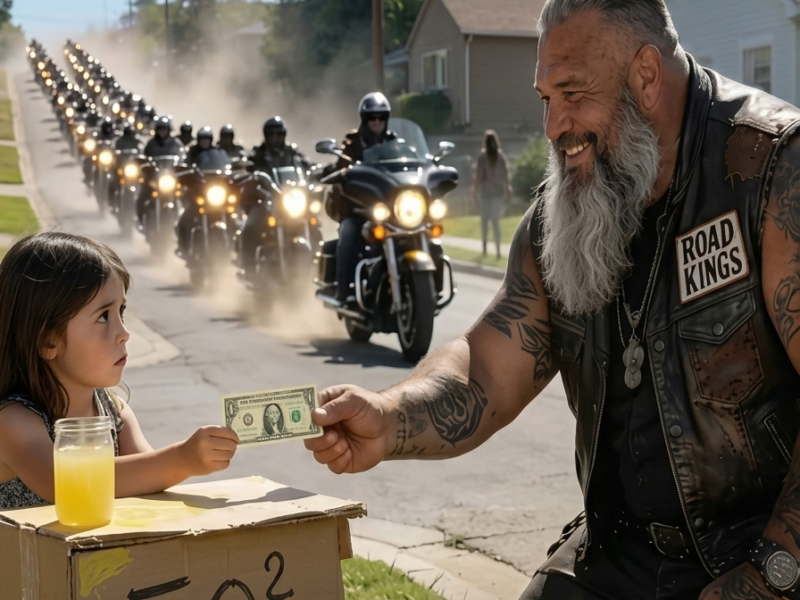
The entire town laughed at the little girl selling lemonade outside a rundown gas station
The midday sun beat down mercilessly on the cracked asphalt outside O’Malley’s Run-Down Gas & Go, radiating a suffocating heat wave that made the horizon shimmer like water. Eight-year-old Lily Carter sat on a faded plastic crate behind a table crafted from an old wooden pallet and two cinder blocks. Her fingers were sticky, her throat felt like sandpaper, and her small back ached from hours of hunching over a hand-lettered cardboard sign that read, Lemonade, 50 cents.
Around her, the town of Oakhaven buzzed with its typical Friday afternoon indifference. Cars whizzed past on the state highway, their tires hissing against the hot pavement. Occasionally, a driver would slow down, glance at the little girl with her makeshift stand, and either shake their head or speed up. Some laughed openly, pointing fingers from rolled-down windows. Others deliberately crossed the two-lane street to avoid walking past her.
At eleven-thirty, a local contractor driving a rusted white pickup truck had rolled down his window just long enough to bark, “Get a real job, kid! Nobody wants your warm sugar-water!”
Lily had lowered her eyes, staring hard at her scuffed sneakers, and pretended not to hear. The sting of the insult burned behind her eyelids, but she refused to let the tears fall. She couldn’t afford to waste water on crying.
She needed forty dollars before Friday.
That was the precise amount her mother owed down at the corner pharmacy for the refill of oxygen-regulator tubing and liquid bronchodilator. Without it, her mother’s chest would tighten into agonizing spasms as night fell, leaving her gasping for breath on the sagging living room sofa.
Ever since her father had died the previous winter when his logging truck slid off an icy logging road, the world had shrunk to a series of terrifying numbers. Lily had watched her mother grow thinner, her cheeks hollow, her skin taking on a bruised, paper-white translucence as the bills piled higher and higher on the oilcloth kitchen table.
Her mother, Clara, believed Lily was spending the afternoon two blocks away at Mrs. Gable’s house, playing with dolls and drinking juice. Clara was too weak to walk to the window, and too proud to ask for charity. Lily had sworn to herself that she would never let her mother see the panic in her eyes again. She had emptied her piggy bank—finding three quarters and a bent nickel—and then raided the kitchen cupboards for the half-full canister of powdered lemon drink mix and a bag of sugar that had gone slightly lumpy.
By noon, the sun had baked the ice in her insulated cooler into a lukewarm slurry. She had sold exactly two cups. One to an elderly mail carrier who had dropped a dollar bill and told her to keep the change, and another to a teenager on a bicycle who had tossed a quarter on the table and snatched a paper cup without slowing down.
Seventy-five cents. Forty dollars felt as distant as the moon.
Lily wiped her forehead with the back of a sticky wrist, her stomach rumbling with a hollow ache. She looked down the empty stretch of highway, wondering if she should pack up her table and try her luck outside the grocery store across town, when the steady, low-frequency rumble of heavy machinery began to vibrate through the ground.
It wasn’t a car. It wasn’t a semi-truck. It was a rhythmic, iron-chested heartbeat that grew louder with every second.
Lily sat up straighter, her heart performing a sudden, nervous flutter.
Around the bend of the highway swept a pack of motorcycles. Seven enormous machines, their chrome tailpipes gleaming blindingly in the sun, roared into the gas station parking lot. The air filled with the sharp, heavy scent of unburned gasoline and hot oil.
Lily froze, her small hands gripping the edge of the wooden pallet. She had heard the stories the adults whispered in grocery store aisles and across backyard fences—stories about men in black leather vests, men with wild beards, hard eyes, and a total disregard for the polite rules of Oakhaven. Her chest tightened with a cold spike of fear. She thought about grabbing her cardboard sign and running behind the gas station dumpster.
Instead, the lead motorcycle cut its engine with a final, dying cough, and the rest of the pack fell silent right beside her lemonade stand.
The biggest biker on the largest machine swung his heavy black boot over the leather seat and stepped onto the asphalt. He stood well over six feet tall, broad-shouldered and imposing, clad in a weathered leather vest patched with fading club insignia. A thick gray beard framed a rugged, wind-beaten face, and a jagged white scar tracked from the corner of his left jaw down beneath his collar.
For a terrifying second, his dark eyes locked onto Lily.
She swallowed hard, her mouth tasting of dust and panic, but she forced herself to stay behind the table. She didn’t run.
The biker walked slowly toward her, his heavy combat boots crunching against the gravel. The other six men milled around their bikes, removing their helmets and shaking out sweat-dampened hair, watching the scene with casual curiosity.
The giant stopped in front of the lemonade stand. He looked down at the crooked cardboard sign, then down at Lily. Up close, his face looked fierce, but his eyes—though tired—held a strange, quiet depth.
“Afternoon, small fry,” he said. His voice was like grinding stones, deep and gravelly. “How much for a cup of whatever you’re selling here? Sweetheart?”
Lily’s voice came out as a breathless squeak. “F-fifty cents, sir.”
Without a word, the biker reached into the thick leather pocket of his vest and pulled out a crisp five-dollar bill. He laid it flat on the sticky wooden table.
“Keep the change,” he said.
Lily’s hands trembled as she reached for the ladle. She dipped it into the plastic pitcher, scooped out a yellow-tinted cup of liquid, and pushed it across the pallet. But her fingers were shaking so badly that a splash of lukewarm water spilled over the rim, forming a yellow puddle on the wood.
“I-I’m sorry,” she whispered, her lower lip trembling. Her eyes burned with trapped tears. “I can make you another one. I didn’t mean to make a mess.”
The biker looked down at the spilled lemonade, then slowly raised his gaze to her frightened, tear-rimmed eyes. The hard lines of his face softened.
“Kid,” he said gently, pulling off a heavy black riding glove and tucking it into his belt. “I’ve spilled worse things than lemonade in my life. Don’t sweat it.”
He picked up the paper cup, lifted it to his lips, and took a long, deliberate swallow.
Lily held her breath, closing her eyes for a split second. She knew how terrible it tasted. It was mostly tap water, too much sugar, and a synthetic lemon tang that left a bitter aftertaste.
The biker’s expression remained completely, stoically neutral. He swallowed, smacked his lips once, and looked down at the cup.
“Well,” he rumbled. “That’s the sourest lemonade I’ve ever tasted in my entire life.”
Lily’s shoulders sank. She felt the last of her courage drain right out of her shoes. She braced herself for the mocking laugh, the cruel joke that every other adult in this town seemed to specialize in.
Then the biker smiled, revealing a row of strong, white teeth beneath his gray mustache.
“But,” he added, his voice warming, “I’ve never tasted anything more important.”
He turned around, raising the paper cup high in the air so his club brothers could see it.
“Boys,” the giant called out, “we’ve got a serious problem here.”
One of the other bikers, a leaner man with a shaved head and a long red goatee, stepped forward, resting his hands casually on his hips. “What kind of problem are we talking about, Mac?”
Mac—the giant with the scar—pointed his thumb directly at Lily’s untouched stacks of paper cups.
“This little girl has been working her tail off all morning in this damn heat,” Mac announced, his gravelly voice carrying across the entire gas station lot, “and this miserable town hasn’t bought her a single decent lunch.”
He reached back into his vest pocket, pulling out a heavy leather wallet. “I’m buying every single cup she’s got left.”
Before Lily could even process what was happening, the lean biker with the red goatee grinned, pulled out a twenty-dollar bill, and slapped it onto the table. “Put me down for ten cups, Mac! I’m parched!”
“Hell, I’ll take twenty!” shouted another biker, a stocky fellow with tattoos crawling up his neck. “Even if it tastes like battery acid!”
Within thirty seconds, the quiet, mocking atmosphere of the gas station vanished, replaced by the chaotic, joyful noise of leather-clad men crowding around a crooked wooden pallet. They joked, laughed, slapped each other on the back, and lined up like schoolboys at a church picnic. One by one, they drank the warm, sour lemonade, tossing crumpled bills onto the table until the wooden surface was entirely covered in green paper.
Lily stood frozen behind her stand, her eyes wide, staring at the growing pile of money. For the first time all day, a bright, bubbly laugh escaped her throat.
She wasn’t invisible anymore. And by the looks of the money piling up on her table, her mother was going to get her medicine.
The chaos of the impromptu biker party was interrupted by the harsh, abrasive shriek of tires locking up on pavement.
A glossy black pickup truck with tinted windows and oversized chrome wheels whipped off the highway, careening into the gas station lot with reckless speed. It didn’t park in a stall; it slammed to a halt directly beside the lemonade stand, blocking the exit and kicking up a thick cloud of white dust that settled over the motorcycles.
The driver’s side door flew open, and a heavy-set man in a tight plaid shirt and mirrored sunglasses leaped out. His face was twisted into an ugly snarl, his neck flushing a mottled red.
It was Gary Vance, the owner of the local hardware store and the landlord who owned the small, decaying duplex where Lily and her mother lived. He was also the man who had been hounding Clara Carter for the past three months over back rent.
“You!” Vance bellowed, his voice cutting through the laughter like a buzzsaw. He marched straight toward the lemonade stand, ignoring the seven massive men surrounding it.
Lily’s blood ran instantly cold. The color drained from her face, leaving her looking ghostly white. She stepped backward until her legs hit the plastic crate, her hands clutched tightly in front of her.
Vance marched up to the table, reached out, and snatched Lily’s hand-lettered cardboard sign, ripping it violently out of the air.
“You’re the little beggar kid who’s been running around town telling people lies about your mother needing charity!” Vance snarled, shaking the cardboard in the air. “Spreading sob stories to make me look like the bad guy!”
Lily shrank back, tears springing hot and fast to her eyes. “P-please,” she choked out, her voice trembling violently. “Give it back. Please.”
Vance didn’t look at her. He crumpled the sign into a tight ball and threw it onto the asphalt. “Your mother owes me three months of back rent, kid! And if she can’t pay up by tonight, I’m locking you both out on the street! In fact—” He reached across the table, his thick, calloused fingers wrapping roughly around Lily’s thin wrist. “—since she’s too sick to function, you’re coming with me right now until somebody settles her accounts!”
Lily let out a sharp, terrified shriek. “Let me go! Mommy! Mommy, help!”
She twisted and pulled, but Vance’s grip was like an iron vise, dragging her forward across the wooden pallet. The sudden movement knocked the plastic pitcher of lemonade over, sending a yellow flood cascading across the table and splashing onto Vance’s boots.
“You little brat—” Vance raised his free hand, his fingers curling into a heavy, threatening fist, ready to strike out at the terrified child.
He never finished the motion.
Mac moved with a speed that defied his massive size. In half a heartbeat, the giant biker had closed the distance between them. A heavy, leather-clad hand shot out and clamped onto Vance’s forearm—right where his fingers were digging into Lily’s wrist.
The grip was absolute. Vance winced, his face contorting in sudden pain as the bones in his arm seemed to grind together.
Mac didn’t yell. He didn’t curse. He simply stared down at the store owner with eyes as cold and dead as winter ice.
“What exactly do you think you’re doing?” Mac asked, his gravelly voice dropping an octave into a dangerous, hypnotic register.
Vance tried to jerk his arm away, but he couldn’t budge an inch. Panic flickered behind his mirrored sunglasses. “Let go of me, you-you freak! This is family business! The kid’s mother owes me money, and she’s a deadbeat! Stay out of it!”
Mac didn’t release his grip. He tightened it fractionally, causing Vance to let out a sharp, breathless gasp of agony.
“She’s eight years old,” Mac said, his tone flat, measured, and terrifyingly calm. “There is no version of this conversation where you lay your hands on a child, threaten her, and walk away feeling proud of yourself.”
“Stay out of family business, old man!” Vance sneered, his voice cracking with bravado. He looked around the circle of bikers, who had all quietly stopped drinking, their bodies tensing, their hard eyes locking onto him like a pack of wolves surrounding an injured rabbit. For the first time, Vance seemed to realize the sheer physical mass of the men he was dealing with.
The other six bikers stepped forward in unison. They didn’t draw weapons, and they didn’t raise their voices. They simply stood there, an immovable wall of black leather, silver chains, and cold, menacing silence.
Nobody touched Vance. Nobody needed to. The suffocating weight of their collective presence was enough to crush a lesser man’s courage.
Vance swallowed hard, his throat bobbing nervously. He looked from Mac’s scarred face to the towering biker on his left, then back to the terrified little girl clinging to the edge of the table.
Slowly, agonizingly, Mac opened his hand, releasing Vance’s arm as if dropping something utterly foul onto the ground.
Vance stumbled backward, clutching his bruised wrist to his chest. He glared at Mac with pure, unadulterated hatred, but he didn’t dare step forward.
“You’re making a big mistake,” Vance hissed, backing away toward his truck. “You don’t know who you’re messing with in this town!”
“And you,” Mac replied softly, stepping in front of Lily to shield her completely from view, “don’t ever let me catch you within a mile of this little girl again. Now get in your truck and drive.”
Vance muttered a vicious curse, scrambled into the cab of his black pickup, and threw the transmission into reverse. The truck’s tires spun, throwing gravel and smoke against the gas station pumps before he tore out of the lot, fishtailing onto the highway and vanishing down the road.
As the dust settled, Lily sank down behind her lemonade stand, pulling her knees up to her chest and sobbing uncontrollably, the accumulated stress, fear, and exhaustion finally breaking her defenses.
Mac immediately dropped to one knee on the hot asphalt, ignoring the dirt and spilled sugar. He reached out with surprising gentleness, placing a massive, calloused hand on her trembling shoulder.
“Hey,” Mac murmured, his rough voice softening into something entirely unexpected. “Hey now. It’s over, sweetheart. He’s gone.”
Lily buried her face in her knees, her small frame shaking. “H-he’s going to lock us out… he’s going to take my mom…”
“No, he’s not,” Mac said firmly. He looked back at the red-bearded biker. “Red, call the local detachment. Get Officer Miller on the line. Tell him we need a welfare check at 42 Elm Street right now, and let’s get a social worker down there before that slumlord causes any more trouble.”
“On it, Mac,” Red said, pulling a heavy satellite phone from his vest.
Mac turned his attention back to Lily. He reached into his pocket, pulled out a clean cotton handkerchief, and gently wiped a stray streak of sticky lemonade from her cheek.
“Listen to me, sweetheart,” Mac said, looking straight into her tear-filled eyes. “You never have to earn your right to be safe. Do you understand that?”
Lily sniffled, wiping her nose with her sleeve. “B-but what if he comes back?”
Mac looked out toward the empty highway where Vance’s truck had disappeared, his jaw hardening.
“Then you tell a trusted adult,” Mac said softly, “and we make sure the people whose job it is to protect you know exactly what’s happening.”
By late afternoon, the sun had begun its slow descent, painting the Oakhaven sky in bruised shades of orange and purple. The asphalt outside the gas station had cooled slightly, but the tension in the air remained thick.
Lily’s makeshift lemonade stand was gone, dismantled and packed neatly into the bed of Red’s pickup truck along with the leftover paper cups and the heavy plastic pitcher. On the seat of Mac’s massive Harley-Davidson sat Lily herself, perched carefully behind the giant biker, her small arms wrapped tightly around his thick leather-clad waist.
A local police cruiser, driven by a young, sympathetic officer named Miller, led the procession down the winding residential streets of Oakhaven. Behind the cruiser rode Mac, and trailing him like a protective black-metal shadow were the other six members of the motorcycle club—the Iron Skulls, as Lily had learned they were called.
The bikes rumbled to a stop in front of 42 Elm Street, a peeling, gray-sided duplex with an overgrown lawn and a sagging front porch.
Mac cut his engine, swung his heavy leg over the bike, and gently lifted Lily down to the sidewalk.
“You ready to show us the way in, kiddo?” Mac asked, offering her a reassuring nod.
Lily nodded, clutching her small, sweat-dampened hand around the wad of cash she had earned from the bikers—over a hundred and fifty dollars, folded tightly in her pocket.
Officer Miller unlocked the front door of the duplex with a skeleton key provided by the landlord’s emergency file at the station, pushing it open with a soft squeak. The interior of the house smelled faintly of stale tea, rubbing alcohol, and damp paper. The air felt heavy and still.
“Clara? Mrs. Carter?” Officer Miller called out softly, stepping into the dim hallway.
From the living room came a faint, rattling cough, followed by a weak, breathless voice. “M-miller? Is that… is that you? What’s going on?”
Lily broke past the officer, running down the narrow hall and tumbling into the cluttered living room. There, lying on a worn floral sofa beneath a faded patchwork quilt, was her mother.
Clara Carter looked devastatingly frail. Her dark hair was tangled, her cheeks sunken, and her chest rose and fell in shallow, jagged motions. On the scarred wooden coffee table beside her sat an array of empty plastic prescription bottles, a clutter of past-due utility bills, and an unshielded oxygen tank hissing softly through a cracked plastic line.
“Mom!” Lily cried out, dropping to her knees beside the sofa and burying her face against her mother’s thin, cold hand.
“Oh, Lily… baby, what’s wrong? Why are you home so early?” Clara whispered, her voice cracking as she struggled to pull enough air into her burning lungs. She reached out with trembling fingers, stroking Lily’s hair. “I thought you were at Mrs. Gable’s…”
“I wasn’t,” Lily sobbed quietly. “I was at the gas station. I was selling lemonade.”
Clara closed her eyes, a look of profound, crushing defeat washing over her face. “Oh, sweetheart… you shouldn’t have to do that. We’re going to be evicted… Gary Vance was just here an hour ago threatening to throw us out…”
“He’s not throwing you anywhere,” a deep, gravelly voice echoed from the doorway.
Clara gasped, pulling the blanket higher over her chest as she looked up. Standing in the entrance of the living room was Mac, towering over the small space, his massive shoulders nearly brushing the doorframe. Behind him crowded Red and two other bikers, their towering, menacing presence completely filling the cramped hallway, followed closely by Officer Miller.
Clara’s eyes widened in sheer terror. She tried to sit up, but her body betrayed her, and she fell back against the cushions, gasping for breath. “Who… who are you people? What are you doing in my house?”
Mac immediately held up both hands, palms out, taking a slow step back to look as unthreatening as a six-foot-four biker possibly could.
“Easy, ma’am. Take a breath. Nobody’s here to hurt you,” Mac said, his tone dropping into a soothing, gentle rumble. “My name is Mac. These are my boys. Your little girl was out on the highway trying to move some very sour lemonade today, and we happened to stop by.”
Clara looked from Mac down to Lily, who was wiping her tears and holding up the wad of cash.
“Mom, they bought everything,” Lily said, a watery smile breaking through. “They bought all the cups, and they chased away Mr. Vance!”
Officer Miller stepped forward, holding a clipboard. “Clara, I’m sorry we had to enter this way, but we received a report regarding a disturbance. I’ve already contacted the county health and human services liaison. They’re going to help bridge the gap on your rent and utilities so Vance can’t touch you.”
He looked over at Mac, who was already pulling out his heavy leather wallet again.
“As for the pharmacy,” Mac added quietly, walking over to the coffee table and setting down a thick stack of hundred-dollar bills right beside the empty medicine bottles, “that’s already been handled. Red made a run down to the corner before we got here. Your regulator refill and your monthly maintenance meds are being delivered by courier within the hour.”
Clara stared at the money, then up at Mac’s scarred, weathered face. Tears spilled over her eyelashes, tracking down her hollow cheeks. She couldn’t find her voice. Her lips trembled, and she pressed her thin hands over her face, weeping softly into her palms.
“Why?” Clara choked out through her fingers. “Why would you do this for us? We’re strangers…”
Mac knelt down beside the sofa, his massive frame awkwardly folding into the tight space. He reached out and placed one large, calloused hand gently over Clara’s thin, frail wrist.
“Because nobody fights alone, ma’am,” Mac said softly. “Not on our watch.”
Over the following weeks, the gray, decaying duplex at 42 Elm Street underwent a miraculous transformation.
It started on a Saturday morning when Clara heard a deafening chorus of roaring engines outside her front window. She sat up on her sofa—breathing easier now thanks to the steady hum of the new oxygen concentrator Mac had arranged—and looked through the curtains.
The front yard looked like a construction site crossed with a motorcycle rally.
Mac and all six of his club brothers were there, wearing tool belts over their leather vests, armed with hammers, paintbrushes, ladders, and lawnmowers. Within ten minutes, the overgrown weeds were hacked down and bagged. By noon, the peeling gray siding had been scraped, primed, and painted a cheerful, warm yellow.
Lily stood on the front porch, jumping up and down with a bright red baseball cap on her head, handing nails to Red as he hammered a new set of sturdy wooden steps onto the porch.
The lemonade stand hadn’t been forgotten either. In the corner of the yard, the bikers had rebuilt it entirely out of polished, weather-treated pine, painted it a brilliant canary yellow, and hung a brand-new, professionally engraved wooden sign above the counter:
EVERY CUP HELPS LILY’S FAMILY.
Clara watched from the doorway, wrapped in a warm blanket, a cup of tea steaming in her hands. The deep, dark circles under her eyes had begun to fade, replaced by a faint hint of natural color in her cheeks. For the first time in a year, she laughed out loud as Red accidentally dropped a hammer on his own boot and let out a string of theatrical curses, quickly apologizing to Lily with a theatrical bow.
The bikers didn’t just fix the house; they became a permanent, comforting fixture in Lily and Clara’s lives. They dropped by on Tuesday afternoons with bags of groceries, checked the oil in Clara’s aging sedan, and helped Lily with her long-division homework at the kitchen table, their heavy leather rings clacking against the wood as they scratched numbers onto scrap paper.
Lily was no longer afraid of the deep rumble of a motorcycle engine. To her, that sound meant safety. It meant nobody would ever dare knock on their door and threaten her mother again.
Life settled into a fragile, beautiful rhythm of recovery.
Then came a rainy Tuesday afternoon three weeks after the repairs were finished.
Lily had just returned home from school, shaking the raindrops from her yellow raincoat on the porch, when she spotted a white mail envelope wedged half-in, half-out of the rusty metal mailbox.
She pulled it free, noticing immediately that it didn’t have a standard postage stamp. It was hand-delivered, bearing no return address, just her mother’s name written in shaky, elegant cursive script.
“Mac! Look!” Lily yelled, swinging the front door open and darting into the living room where Mac was currently installing a new screen door hinge. “There’s a letter in the box! But there’s a name on here I don’t recognize!”
Mac wiped his grease-stained hands on a rag, turning around with a warm smile. “Is that so? Hand it over, kiddo. Let’s see who’s writing to the Carter household.”
Lily handed him the envelope. Mac used his pocketknife to carefully slice open the top flap. He pulled out a single sheet of heavy, cream-colored parchment paper and a small, faded photograph.
He glanced at the letter, but his eyes immediately drifted down to the photograph.
As soon as Mac looked at the image, the easy, amused smile vanished completely from his face. The color drained out of his skin, leaving him looking as pale as paper. The heavy pocketknife slipped from his fingers, clattering loudly against the linoleum floor.
“Mac?” Lily asked, tilting her head in confusion, her smile fading. “What’s wrong? Who is that in the picture?”
Mac didn’t answer. His hands were shaking violently as he stared down at the photograph.
It was an old, black-and-white polaroid, slightly yellowed at the edges. It showed a young soldier in a crisp military uniform—a man with sharp, clean-featured jawline, dark hair, and intense, familiar eyes—standing arm-in-arm with a much younger version of Mac himself, both of them grinning widely against the backdrop of a military barracks sign from decades ago.
Mac turned the photograph over. On the back, written in the very same shaky cursive that was on the envelope, someone had penned six haunting words:
You saved my daughter once. Now she’s the one who needs you.
Mac’s breath hitched in his throat. He looked up from the photograph, his gaze darting toward the hallway where Clara was stepping out of the kitchen, wiping her hands on a dish towel.
As Clara stepped into the bright light of the living room, Mac stared at her—really stared at her. He looked at the shape of her cheekbones, the slope of her nose, and the dark, expressive curve of her eyes.
The blood rushed out of Mac’s head. The room seemed to tilt on its axis.
Because the young soldier in the photograph—the man who had vanished twenty years ago, presumed dead in an overseas classified black-ops deployment—looked like a male twin of Clara Carter.
And the little girl standing beside him in the soldier’s faded memories… looked precisely, unmistakably, like Lily.
“Mac?” Clara asked, stopping mid-step in the hallway, her expression shifting from casual warmth to sudden, deep alarm as she saw the pale, ghost-like terror on the giant biker’s face. “My God, Mac, what is it? Did something happen?”
Mac couldn’t speak. His chest rose and fell in heavy, ragged motions. He raised a trembling hand, holding the faded photograph out toward Clara as if presenting a piece of shattered glass.
Clara walked forward slowly, her brow furrowed in confusion. She reached out and took the picture from his massive, trembling fingers.
The moment her eyes landed on the image of the young soldier, the dish towel slipped from her grip, hitting the floor with a soft thud. Clara’s knees buckled. She staggered backward, catching herself against the edge of the hallway wall, her breath catching in a strangled gasp.
“Daddy…” Clara whispered, her voice a broken, disbelieving echo that barely filled the room. “D-daddy? But… but he’s gone. He died when I was eight…”
Lily looked back and forth between her mother and Mac, her small heart pounding with sudden, nameless dread. “Mom? Who is that? Who is the man in the picture?”
Clara slid down the wall until she was sitting flat on the floor, clutching the photograph to her chest as hot tears streamed down her face. “It’s my father, Lily. Thomas. Thomas Vance.”
Mac swallowed hard, his voice finally returning, though it sounded like it had been dragged across gravel. “Thomas… Thomas Vance,” Mac repeated, tasting the name on his tongue like a forgotten memory rising from the dead.
He looked down at Clara, his dark eyes shining with unshed tears. “Clara… do you know who I am? Do you remember when you were six years old, living on that army base in Germany before everything went dark?”
Clara blinked rapidly through her tears, looking up at the towering, scarred biker standing in her living room. She studied the rugged lines of his face, the way his gray beard framed his jaw, and most importantly, the jagged white scar tracking down his left cheek.
Her breath hitched. A gasp tore from her throat.
“The… the soldier,” Clara breathed, her eyes widening in absolute shock. “The sergeant who carried me out of the fire… the man with the scar. You… you were my father’s best friend. You were Sergeant MacAllister.”
Mac let out a long, shuddering breath, closing his eyes as a single tear broke free and traced a path through the dust on his weathered cheek.
“I swore an oath to your father thirty years ago,” Mac said, his voice thick with emotion. “When things went bad overseas—when his unit was ambushed and classified—he made me promise that if anything ever happened to him, I would find his family. I searched for you kids for ten years, Clara. The military records were sealed, scrubbed clean. I thought… I thought you and your mother had vanished off the face of the earth.”
He stepped closer, kneeling down on the linoleum floor right beside Clara, gently placing his hand over hers.
“And then, a few weeks ago,” Mac continued, his voice trembling, “I pulled off the highway and saw a little girl sitting outside a gas station trying to sell sour lemonade to save her mother’s life. I didn’t know your last name. I didn’t know your face. But looking at Lily today… looking at those eyes… it was like looking straight back across twenty years of ghosts.”
Lily knelt beside them, wrapping her small arms around her mother’s waist while looking up at Mac with absolute wonder. “Mac… you knew my grandpa?”
Mac turned his gaze to Lily, a tender, broken smile finally touching his lips. He reached out with his heavy, calloused hand and gently patted her head, right over her red baseball cap.
“Sweetheart,” Mac whispered, his voice steadying with a fierce, unbreakable resolve. “Your grandpa Thomas saved my life on a battlefield half a world away when I was just a kid. He gave me a second chance at living.”
Mac looked from Lily up to Clara, his jaw setting with the immovable strength of an iron mountain.
“He saved me then,” Mac said softly. “And I promised him I’d look after his blood. Nobody is ever going to hurt you two again. Not landlords, not debt collectors, not the cruel world out there. You’ve got a whole army of bikers watching your six now.”
Clara wept, but this time, her tears weren’t born of fear or despair. They were the tears of a storm finally breaking, washing away the cold, lonely winter that had gripped their family for so long. She leaned forward, resting her head against Mac’s massive, leather-clad shoulder, while Lily squeezed in tightly beside them.
Outside the window, the steady, rhythmic rumble of a heavy motorcycle engine echoed down Elm Street, joined by the cheerful clatter of rain beginning to fall against the yellow-painted siding of the house. But inside, for the first time in as long as they could remember, the house was warm, safe, and filled with family.
The end.









