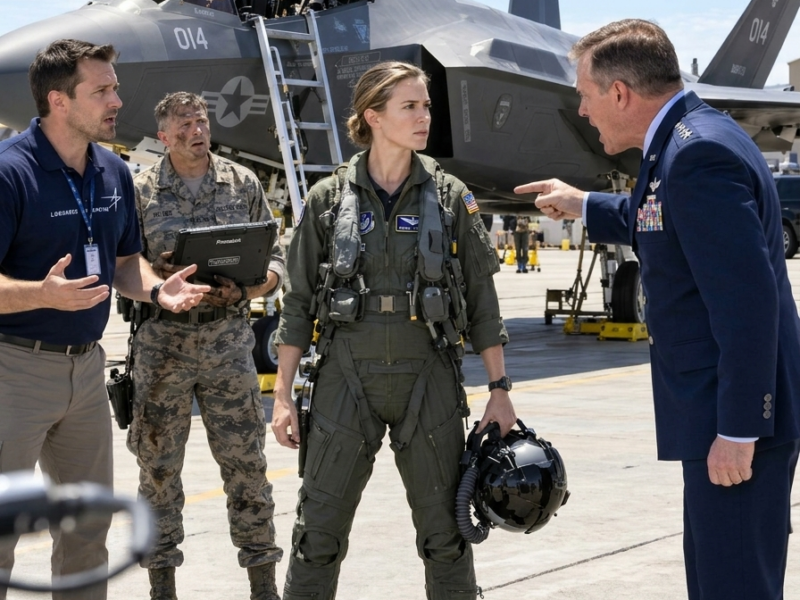
The entire airbase watched as I refused to climb into a brand-new F-35 Lightning II, but when the commanding officer called me a coward and ordered security to remove me
The morning sun over Eglin Air Force Base cast a sharp, uncompromising glare across the vast expanse of the flight line, glinting off the pristine gray skin of the multi-million-dollar F-35 Lightning II. The aircraft sat there like a coiled predator, immaculate, menacing, and surrounded by an entourage of proud ground crew members, base public affairs officers, and a battery of cameras recording what was supposed to be a historic milestone for the wing. As a veteran pilot with eleven years of flight time under my belt, I had accumulated thousands of hours in the cockpit, survived hostile airspace during combat deployments, and earned a hard-won reputation for never backing down from any tactical challenge thrown my way. Yet, as I stood on the asphalt with my helmet tucked under my arm, staring at the masterpiece of modern engineering, an inexplicable, icy knot twisted violently in my stomach. Something felt profoundly, terrifyingly wrong.
My eyes swept over the sleek fuselage, tracing the lines of the stealth coating, the razor-sharp intakes, and the massive Pratt & Whitney engine exhaust. Everything looked textbook-perfect on the surface. But then, as my gaze drifted toward the starboard side, a microscopic anomaly caught my eye—a tiny visual discrepancy that shattered the illusion of perfection. A small, composite maintenance seal situated just beneath the right wing had been replaced. It was a standardized, polymer-backed security sticker used across the fleet to verify that a specific subsystem had been inspected, signed off, and left untouched by unauthorized personnel. But this sticker was wrong. The batch number stamped onto the corner belonged to a defunct supply chain series that had been phased out over six months ago across all active-duty installations.
My heart hammered against my ribs as I stepped closer, dropping to one knee in the shadow of the massive stealth wing. I brushed a faint layer of hangar dust away from the composite panel, and the cold reality of the situation made my blood run entirely cold. The seal had been peeled back, sliced cleanly with a razor blade, and resealed with a counterfeit topcoat to mimic factory standards.
“Captain Hayes, what on earth are you doing?”
The sharp, authoritative voice cut through the hum of the auxiliary power units like a razor. I looked up to see Colonel Richard Miller marching across the tarmac, his silver eagles gleaming on his collar, his expression a mask of manufactured impatience and rigid military pride. Behind him, the base commander’s adjutant frowned, checking his wristwatch in annoyance.
I stood up slowly, keeping my eyes locked on the modified panel before turning to face the colonel. My voice, when it came out, was remarkably steady, belying the absolute hurricane of adrenaline raging inside my chest.
“I’m not flying this aircraft, sir.”
The entire hangar—dozens of mechanics, engineers, public affairs personnel, and flight officers—went dead silent instantly. The ambient whine of the generators seemed to fade into a distant hum. Colonel Miller froze mid-stride, staring at me as though I had just walked up to him, spat on the American flag, and declared allegiance to a foreign adversary. His face flushed a dark, mottled crimson, veins bulging slightly at his temples.
“You’re refusing a direct flight order?” he demanded, his voice dropping an octave into a dangerous, controlled growl.
“Yes, sir,” I replied, standing my ground with absolute, unyielding conviction.
Miller let out a short, bitter, barking laugh that carried no humor whatsoever. He stepped closer, invading my personal space, his eyes narrowing into cold slits. “After years of bureaucratic warfare, millions of dollars in federal investment, and the entire high command watching this live feed, you are seriously going to embarrass this entire base and stall a multi-national defense initiative because of a little maintenance sticker?”
I didn’t blink. I looked past him, back toward the lethal contours of the stealth fighter. “That seal wasn’t installed by our base maintenance team, Colonel. And someone has tampered with the internal architecture of this jet.”
For a fraction of a second—a mere microsecond—Miller’s confident expression falter. His eyes flickered toward the wing I had just inspected, and a flash of raw, unfiltered panic crossed his features. But it vanished almost as quickly as it had appeared, replaced by an armor of hardened bureaucratic fury.
“Remove her from the flight line immediately,” Miller barked, turning away from me and gesturing to the armed military police standing near the perimeter fence. “Insubordination and dereliction of duty in the face of a live operational demonstration. Arrest her.”
Two burly security officers in crisp desert-tan tactical gear immediately stepped forward, their hands dropping instinctively toward their sidearms. The crowd of onlookers gasped softly, murmuring among themselves as the cameras continued to roll, capturing every second of the unprecedented confrontation.
I didn’t flinch, nor did I take a step backward. Instead, I raised my hand, pointing a single, steady finger directly at the underside of the right wing, right where the altered panel sat in plain sight.
“Check the hydraulic inspection panel,” I shouted over the murmur of the crowd, my voice echoing off the concrete walls of the massive hangar. “Right now. Do it before you touch me.”
Miller spun back around, furious. “Don’t listen to her, cuff her—”
“Wait,” a voice interrupted. It was Sergeant Daniel Brooks, the chief civilian mechanic assigned to the flight line, a veteran NCO with twenty-four years of service and grease permanently embedded in the lines of his hands. Brooks had been staring at my face, reading the absolute terror and certainty in my eyes. Hesitating for a fraction of a second, he brushed past the advancing security guards, grabbed a heavy-duty tactical flashlight from his utility belt, and dropped to his knees beneath the aircraft.
The silence on the flight line became absolute. You could have heard a pin drop on the reinforced concrete.
Sergeant Brooks clicked on the flashlight, directing the brilliant LED beam straight into the narrow recess of the hydraulic inspection port. Five seconds ticked by like lead weights dropping into an empty well. Then ten seconds passed. The beam of light didn’t move. It remained locked onto a cluster of secondary bypass lines and digital relay nodes nestled deep within the airframe.
Suddenly, Brooks stopped breathing. I saw his shoulders lock up tight.
“Colonel…” Brooks whispered, his voice trembling in a way that made my spine turn to ice.
Miller, sensing the sudden shift in the atmosphere, abandoned his aggressive posture and marched hurriedly toward the mechanic. “What is it, Sergeant? Get up and explain this ridiculous circus.”
Brooks slowly looked up from beneath the wing. His face had completely drained of color, leaving him looking like a ghost in broad daylight. His lips parted, but words refused to come out for a moment. When he finally spoke, his voice was choked with disbelief.
“Someone… someone has completely tampered with the primary flight-control system.”
The chaos that followed Sergeant Brooks’s declaration was instantaneous, terrifying, and ruthlessly orchestrated.
Within three seconds of the mechanic’s words echoing across the tarmac, an unseen hand seemed to pull an invisible plug on the entire operation. The base public affairs officers dropped their professional demeanor, shouting frantically into encrypted tactical radios. Across the perimeter, the automated industrial cameras mounted on the ceiling girders abruptly whirred, pivoted upward, and shut down with a synchronized mechanical click as their indicator lights blinked from amber to dead black.
“Cut all feeds!” someone roared from the command trailer parked near the hangar doors.
Before anyone in the wider viewing gallery could process what was happening, the massive hydraulic hangar doors—capable of sealing out a hurricane—began to grind downward. The screech of heavy steel wheels rolling along concrete tracks filled the air, cutting off the natural sunlight and plunging the interior into an artificial, fluorescent-lit twilight. Armed security details materialized from every corner, forming a rigid perimeter that pushed the press, the civilian engineers, and the ground crew back toward the exterior exit corridors.
“Nobody leaves this building,” Colonel Miller commanded, his voice no longer just angry—it was sharp, frantic, and laced with a cold, desperate panic. He whipped around to face Sergeant Brooks, who was still kneeling on the concrete, clutching his heavy-duty flashlight like a lifeline. “Explain yourself, Sergeant. What kind of tampering are you talking about? Be precise.”
Brooks stood up slowly, brushing asphalt dust from the knees of his coveralls. He didn’t look at the colonel; instead, his eyes remained fixed on the open inspection panel beneath the F-35’s wing.
“It’s not a standard field modification, Colonel,” Brooks said, his voice dropping to a grim, professional register. He reached into his pocket, pulled out a small plastic calibration tool, and pointed it into the darkened interior of the bay. “Look at the secondary actuator override line. Someone spliced an unauthorized micro-relay directly into the fly-by-wire data bus. It’s wired to intercept pitch-rate telemetry from the inertial navigation unit.”
Miller took a step closer, frowning deeply, though his eyes darted nervously toward the observation gallery above. “What does that mean in plain English?”
“It means,” Brooks said, turning his head to look Miller dead in the eye, “that the aircraft will fly normally during takeoff, climb-out, and initial maneuvering. The system diagnostics will show green across the board. But the moment the jet reaches a specific dynamic pressure threshold—around Mach 1.2 during a high-G combat roll—the relay triggers a hard-over command to the tail-eron actuators. It forces the aircraft into an unrecoverable, supersonic flat spin.”
A collective gasp rippled through the small circle of officers and engineers who had crowded around the jet.
Brooks wiped his brow with the back of a greasy hand, his chest rising and falling heavily. “Anyone strapped into that cockpit wouldn’t even have time to pull the ejection handle. By the time the flight computer recognized the divergence, the aerodynamic forces would pin the canopy shut and tear the airframe apart. It’s a localized, catastrophic structural failure disguised as pilot error.”
Silence reclaimed the hangar, heavier and more suffocating than before. Every pair of eyes in the immediate vicinity slowly turned away from the stealth fighter and shifted toward me.
Colonel Miller turned his gaze upon me, his expression shifting from defensive rage to a chilling, calculated assessment. He walked over slowly, his boots clicking rhythmically against the polished concrete floor. When he stopped a foot away from me, his voice was barely a whisper, meant only for my ears.
“Captain Hayes,” Miller said softly, his eyes boring into mine with venomous intensity. “How did you know? That modification was buried deep inside a classified sub-assembly bay. Even an experienced crew chief wouldn’t spot it unless they knew exactly what they were looking for.”
I swallowed hard, tasting the metallic copper of fear and anger mixed together in the back of my throat. My hands clenched into fists inside the pockets of my flight suit, my fingernails digging painfully into my palms.
“Because,” I whispered back, my voice trembling with a rage three years in the making, “I’ve seen this exact modification before.”
The words hung in the sterile air of the hangar, heavy with a devastating history that nobody else in the room understood.
Three years earlier, at a desert testing facility two thousand miles away, my younger brother, Lieutenant Michael Hayes, had strapped into an experimental prototype during a routine evaluation flight. He was twenty-six years old—brilliant, idealistic, and possessing a natural instinct for the skies that made him a better pilot than I could ever hope to be. Twenty minutes after takeoff, his aircraft vanished from radar over a remote mountain range. The official Air Force mishap investigation board concluded its work in record time, slapping a neat, clean label on the tragedy: Pilot error. They claimed Michael had suffered spatial disorientation during a high-stress maneuver, lost control of his aircraft, and failed to execute timely recovery procedures.
I had read every page of that three-hundred-page report. I had cross-referenced the telemetry data, spoken to the recovery teams, and analyzed the wreckage photos. And I knew, with every fiber of my being, that the official conclusion was an outright lie.
Weeks before his death, Michael had called me late at night, his voice frantic, hushed, and trembling with terror. He told me he had stumbled upon a discrepancy in the fleet-wide maintenance logs—unauthorized software patches being pushed to active-duty aircraft under classified procurement codes, bypassing standard safety protocols. He told me he had downloaded the encrypted data logs onto a physical drive and hidden them, swearing that someone within the command chain was systematically altering maintenance records to cover up a catastrophic hardware flaw.
The next morning, his jet slammed into the desert floor at Mach 1.4.
When I arrived at the base following the crash, the digital trail had been scrubbed clean. Michael’s personal quarters had been cleared out before I could reach them. His final voicemail to my cell phone—the one where he promised to give me the names of the commanding officers involved—had completely vanished from the carrier’s server logs, wiped out in a mysterious network glitch. For three agonizing years, I had knocked on every closed door, filed every Freedom of Information Act request, and begged every JAG officer I knew for a re-investigation. Every single attempt was stonewalled, dismissed, or met with veiled warnings to drop the matter for the sake of my career. Every official report led back to the same convenient, sanitized conclusion: my brother was a dead pilot who had simply made a fatal mistake.
Until this very morning, when I looked at the wing of an F-35 and saw the identical, unmistakable fingerprint of murder.
Sergeant Brooks stepped back from the aircraft, pulling a heavy gray maintenance data module from his utility belt. He looked shaken to his core, holding the small electronic brick in both hands as if it were radioactive.
“Captain,” Brooks said quietly, breaking my train of thought. “There’s something else you need to see.”
Sergeant Brooks held the maintenance data module up to the ambient light of the hangar, his thumb resting nervously over the ruggedized interface port. The small monochrome screen on the device flickered to life, casting a sickly green glow across his weathered face.
“When I ran the diagnostic override to check the splice on the fly-by-wire bus,” Brooks explained, his voice low and cautious, “the system didn’t just show me the physical tampering. It pulled the maintenance authorization log directly from the local encrypted cache. Every certified modification to an active-duty bird requires a digital signature from a senior engineering officer.”
My breath caught in my throat. I stepped closer, my eyes locked on the glowing green screen. “Whose credentials were used?”
Brooks glanced nervously toward Colonel Miller, who was now standing a few yards away, watching us with the cold, dead-eyed stillness of a cornered predator. The color had drained entirely from Miller’s face, leaving his skin an ash-gray tone that contrasted sharply with his immaculate uniform.
“It wasn’t an engineer,” Brooks whispered, his voice trembling slightly. “The modification was authorized and signed off using a Level-5 command override code.”
He paused, swallowing hard before reading the name displayed on the screen.
“Colonel Richard Miller.”
For a fraction of a second, time seemed to fracture. The hum of the distant ventilation systems faded into absolute silence, and the massive, windowless hangar felt less like a military installation and more like a tomb. The accusation hung in the sterile air like a physical weight, pressing down on everyone present.
Miller didn’t flinch. He didn’t drop his head, nor did he stutter out a panicked denial. Instead, a slow, dark smile crept across his lips—a terrifying transformation that stripped away decades of polished military bearing to reveal the cold, calculating ruthlessness beneath.
“You really should have just gotten into the cockpit, Captain Hayes,” Miller said, his voice terrifyingly calm as he took a deliberate step forward.
Before anyone could react, Miller’s hand darted toward his service belt, his fingers curling around the grip of his sidearm.
“Sir! Step away from the module!” Sergeant Brooks shouted, instinctively pulling his arm back and clutching the data module to his chest like a shield.
Miller ignored him entirely. His eyes were fixed exclusively on me, burning with a mix of bitter resentment and cold calculation. “Your brother was arrogant, undisciplined, and fundamentally incapable of understanding the bigger picture. Just like you.”
The room spun. My ears began to ring, a high-pitched whine that drowned out all other sound. The casual confession hit me with the physical force of a sledgehammer to the chest.
“You…” I choked out, my voice breaking as the agonizing puzzle pieces violently snapped together in my mind. “You killed him. Michael didn’t crash because of pilot error. You murdered him.”
Miller let out a low, humorless chuckle, his hand still resting casually near his holster while the armed security guards stood frozen, paralyzed by the sudden, unprecedented breach of military chain-of-command norms playing out before them.
“We didn’t murder anyone, Captain,” Miller said smoothly, his tone chillingly administrative, as if he were discussing routine supply requisitions rather than cold-blooded homicide. “We protected national security. Do you have any idea how many billions of dollars are tied up in the Lightning II program? Do you know what a catastrophic, public structural failure during a joint allied demonstration would do to congressional funding, foreign military sales, and global defense stability? A few software glitches, a minor hardware incompatibility—these are acceptable calculated risks when you’re building the future of global air dominance. Your brother found an anomaly, and instead of following protocol and burying it like a professional, he threatened to blow the entire program wide open to the press and the congressional oversight committees.”
Miller stepped closer, his voice dropping into a harsh, venomous hiss. “Your brother wasn’t supposed to find that modification either. And you weren’t supposed to look under that wing this morning. But since you couldn’t keep your eyes to yourself, you’ve forced my hand.”
My heart hammered against my ribs, a wild, frantic rhythm. Every instinct I had honed over eleven years of military service screamed at me to lunge forward, to tackle him, to make him pay for every sleepless night, every tear shed, and every lie I had been forced to swallow since Michael’s death. But before I could move a single muscle, before Sergeant Brooks could hand over the data module, a sharp, electronic chirp cut through the tense atmosphere of the hangar.
My cell phone, tucked securely inside the breast pocket of my flight suit, vibrated violently.
I froze. Miller’s eyes flicked downward toward my chest, his hand tightening around the grip of his sidearm.
“Take it out,” Miller ordered, his voice laced with sudden danger. “Slowly. Two fingers. Drop it on the concrete.”
I didn’t move. My fingers brushed against the smooth glass of the device in my pocket. The phone vibrated a second time, a persistent, urgent pulse against my heart.
“I said, drop it!” Miller barked, snapping his holster flap open and drawing the heavy black pistol from its sheath.
The two armed security officers gasped, their rifles instinctively rising as they tried to process whether they were supposed to aim at the colonel, at me, or at Sergeant Brooks.
Before Miller could level the weapon at my head, my thumb twitched inside my pocket. The screen of my phone lit up, casting a bright rectangular glow against the dark fabric of my flight suit. Through the narrow gap of the pocket, a single notification banner flashed across the display from an unknown, unlisted number.
I didn’t drop the phone. Instead, with a sudden, desperate lunge of courage, I yanked the device out of my pocket and held it up so the glowing screen was visible to everyone in the room.
Miller lunged forward, grabbing for my wrist. “Give me that!”
“Back off!” Sergeant Brooks roared, suddenly swinging the heavy maintenance module hard enough to force Miller to stumble backward to avoid a direct hit.
In that split-second window of distraction, my eyes locked onto the glowing screen of my phone. The notification displayed a single, chilling sentence from the unknown sender:
“Captain Hayes, if you want to know who gave Miller the orders, check your brother’s final voicemail.”
My breath hitched. My mind raced into overdrive. Michael’s final voicemail? The one that had supposedly been wiped from the carrier servers by a network glitch three years ago? The one the Air Force investigators swore had never existed?
Before I could process the impossibility of the message, my phone vibrated a third time. A second text message popped up immediately beneath the first, driving a spike of icy realization straight through my heart.
“He didn’t die with the evidence. He left it with you.”
The words glowing on my phone screen seemed to burn themselves directly into my retinas.
He didn’t die with the evidence. He left it with you.
Miller recovered his balance, his face twisted into an expression of desperate, feral rage. He brushed past Sergeant Brooks, ignoring the maintenance NCO entirely, and lunged directly toward me with a speed that belied his age.
“Hand me that phone, Captain! Now!” Miller roared, his pistol rising and pointing unsteadily toward my chest.
The security guards finally snapped out of their paralyzed shock. “Colonel Miller, drop your weapon! Step away from Captain Hayes!” the senior guard yelled, leveling his rifle directly at his commanding officer’s back.
The hangar descended into absolute madness. The fragile veneer of military discipline shattered into a thousand jagged pieces as officers, mechanics, and guards took sides in the dim, fluorescent-lit enclosure.
“I am your commanding officer! That is a direct order, drop those rifles!” Miller screamed back, his voice cracking with panic as he realized the walls were closing in around him. He took another step toward me, his hand reaching out to grab the phone from my palm.
“Stay back, Colonel!” I shouted, dodging to the side and putting the massive fuselage of the F-35 between us. My fingers flew frantically across the locked touchscreen of my phone, thumbing through old archive folders, hidden cache directories, and deprecated cloud backups that hadn’t synced in years.
If Michael had left the evidence with me, it wasn’t on a cloud server that could be scrubbed by military intelligence. It wasn’t in a physical locker that could be raided by base security. It had to be somewhere local, secure, and deeply personal—something that had remained untouched, unexamined, and completely overlooked during the sanitized aftermath of his death.
“Check your brother’s final voicemail.”
The instruction echoed in my mind. But the voicemail log on my current phone was empty; the carrier had wiped it clean three days after the crash.
Or had they?
My mind flashed back to the old, ruggedized military-issue tablet Michael had given me years ago—a secure, offline, encrypted field device we used to share flight notes and tactical handbooks during our joint training days at Nellis. I hadn’t turned the tablet on since his funeral. It was sitting at the bottom of a locked metal footlocker in the back of my quarters across the base, buried beneath old flight gear, civilian clothes, and memories I couldn’t bear to look at.
“You’re too late, Miller,” I whispered, panting heavily as I kept the stealth fighter between us, watching the colonel struggle against the security team who had finally swarmed him, wrestling his service pistol away and forcing him down onto the concrete floor.
“Captain Hayes! Get out of here, now!” Sergeant Brooks yelled over the commotion, standing guard near the side exit door with a heavy wrench in his hand. “They’re locking down the base perimeter network! If you don’t leave right now, they’ll trap you inside the base firewall!”
I didn’t hesitate. I turned on my heel and sprinted toward the side personnel exit, pushing through the heavy steel door just as the automated emergency sirens began to wail across Eglin Air Force Base. Red strobe lights flashed along the concrete corridors, casting eerie, pulsing shadows against the walls. The base was going into full lockdown mode, but the confusion of the sudden, unauthorized arrest of a senior colonel had created a crucial window of chaos in the command chain.
I ran faster than I had ever run in my life, cutting across the tarmac service roads, ignoring the military police vehicles screeching past with their blue and red lights spinning wildly against the afternoon sky. I reached the bachelor officers’ quarters, threw my room door open, and slammed it shut behind me, locking the heavy deadbolt with trembling hands.
Moving with frantic speed, I dropped to my knees beside my closet, hauled out the heavy steel footlocker, and spun the brass combination dial from memory. The lid popped open with a hollow, metallic snap. I pushed aside my old flight logs, my survival knife, and a faded photograph of Michael and me standing in front of our first solo training aircraft.
At the very bottom of the chest rested the matte-black, military-grade ruggedized tablet, its rubberized casing caked in a fine layer of dust.
I grabbed it, pressed the power button, and held my breath.
For three agonizing seconds, nothing happened. The screen remained dead black.
“Come on, come on…” I muttered under my breath, my hands shaking so violently I could barely hold the device steady.
Suddenly, the screen flickered to life, illuminating my face in a pale, cold luminescence. The operating system booted up, bypassing the standard commercial network protocols and booting directly into an encrypted, localized peer-to-peer directory.
A notification icon blinked in the upper corner of the screen: 1 Unread Local Audio Archive.
With a trembling finger, I tapped the screen. The audio player interface opened, displaying a single file name created three years ago, stamped with the exact date and time of Michael’s final, fatal flight:
VOICEMAIL_BACKUP_FINAL_SECURE.WAV
My heart hammered against my ribs like a trapped bird. I plugged my tactical headset into the side port, placed the speakers over my ears, and pressed play.
The audio file began with a burst of heavy, rushing static—the unmistakable sound of a high-altitude cockpit canopy unsealed at supersonic speeds, wind howling against the airframe at six hundred knots.
Then, through the howling white noise, my brother’s voice emerged.
“…Sara? Sara, can you hear me? God, please tell me this channel is secure. If you’re listening to this, it means I didn’t make it back down from the test block.”
A sob tore itself violently from my throat. Hearing Michael’s voice—young, vibrant, and utterly terrified—after three years of silence felt like a physical blow to my chest. I slumped against the edge of my bed, pulling my knees up to my chin as the recording continued.
“Miller lied to us. The whole command structure is dirty. They’re not just testing advanced stealth tech; they’re running black-budget hardware evaluations for private defense contractors who are skipping safety certifications to beat foreign competitors to market. They altered the flight-control firmware on my bird. The inertial guidance system is rigged to fail the moment I push past Mach 1.3. I tried to pull the data logs, but they locked me out of the main server terminal twenty minutes ago.”
The wind noise on the recording grew louder, screeching in the background as the aircraft pitched sharply upward.
“I managed to dump the encrypted telemetry records and the primary authorization signatures directly onto an offline local drive and patched it into the backup comms relay on this tablet before takeoff. If the brass thinks they can bury this, they’re wrong. The audit trail goes all the way up to the Pentagon procurement office—General Vance’s office signed off on the black-budget exemptions.”
My breath hitched violently. General Marcus Vance. The Director of Air Force Materiel Command—one of the highest-ranking four-star generals in the entire military establishment, a man who had personally pinned medals on my chest and patted my shoulder at my brother’s memorial service with a look of manufactured, paternal sorrow.
“Sara, if anything happens to me, don’t let them sweep it under the rug. Take the drive to the Inspector General’s office outside the chain of command. Don’t trust anyone on base. They’re all—”*
The audio cut off abruptly with a deafening screech of rending metal, a sharp, piercing electronic shriek, and then absolute, dead silence.
I sat frozen in the center of the dark room, the headphones still clamped tightly over my ears, the ringing silence of the recording echoing in my mind. The puzzle was complete. The conspiracy wasn’t just a rogue colonel protecting his career; it was a multi-billion-dollar military-industrial corruption ring operating at the highest levels of the United States Armed Forces, trading the lives of young pilots for political leverage and corporate profits.
Suddenly, a heavy, rhythmic pounding echoed against my quarters door.
“Captain Hayes! Open the door in the name of the Department of Air Force Office of Special Investigations! Put your hands where we can see them!”
The voice outside was cold, authoritative, and backed by the heavy thud of tactical boots lining the hallway. They had tracked my signal. The base lockdown was tightening, and I was trapped in the crosshairs of a machine that had already killed my brother and was fully prepared to eliminate anyone else who got in its way.
I looked down at the ruggedized tablet resting in my lap. The screen still displayed the file directory containing the unencrypted telemetry logs, the audio recording, and the digital signatures linking Colonel Miller and General Vance to the murder of Lieutenant Michael Hayes.
Slowly, deliberately, I reached out and tapped the export button, transferring the entire package directly to an encrypted, disposable flash drive I always kept hidden in my dog tags.
The pounding on the door grew heavier. The wooden frame splintered slightly under the force of a heavy breaching ram.
“Open the door or we will use explosive entry!”
I stood up slowly, wiping the tears from my cheeks. My fear was gone, replaced by a cold, burning focus. They could lock down the base. They could arrest my friends, silence the mechanics, and bury the wreckage of another F-35 in the desert sand. But they couldn’t stop what was already out in the open.
I slipped the flash drive into my pocket, walked over to the window, and looked out across the flight line where the pristine, deadly F-35 Lightning II still sat under the harsh lights of the hangar.
My brother didn’t die in vain. And neither of us was going to let them win.
I pulled the window latch open, slipped out into the cool evening air, and vanished into the shadows of the base, carrying the truth that was about to bring an empire to its knees.
THE END.









