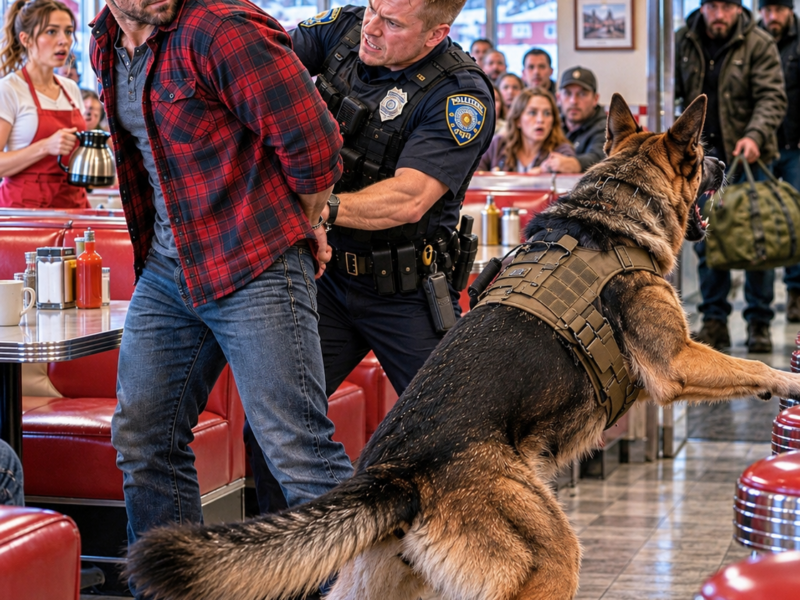
“The cop slammed the handcuffs onto my wrists in front of the entire diner and called me a nobody in uniform
The man in the apron disappeared through the rear exit.
Atlas strained against his leash, every muscle in his body tight.
“Hold,” I repeated.
He stayed exactly where he was.
That was the thing about Atlas. He could be frightened, exhausted, or in pain, but once he heard a command, he obeyed. He had been trained to trust the person holding his leash.
I wished Officer Brenner had understood that before putting handcuffs on me.
The radio crackled again.
“Unit Seven, confirm your status. Fire department reports possible hazardous materials inside the building.”
Brenner stared at the blinking red light beneath the counter.
For the first time since he’d entered the diner, the arrogance had disappeared from his face.
He looked at me.
“What do you know about that case?”
“I know my dog detected something dangerous. I also know you should stop treating this like a disturbance call.”
He swallowed.
“Can you identify the substance?”
“Not from here.”
“Then what good is the dog?”
I looked at him.
“He’s telling us where not to go.”
Another metallic crash came from the kitchen.
A woman screamed.
Then the lights went out.
For two seconds, the diner was completely dark.
The emergency lights flickered on, casting a dim red glow across the tables.
People began shouting.
A little boy started crying.
Someone knocked over a chair.
Brenner reached for his flashlight, but his hands were shaking.
“Everybody stay calm!” he shouted.
Nobody listened.
I turned toward the nearest tables.
“Listen to me! Leave your belongings. Don’t run. Move toward the front entrance in an orderly line.”
My voice carried across the room.
A few people stopped moving.
I pointed toward the main door.
“Families first. Help anyone who can’t walk. Keep away from the kitchen hallway.”
Brenner stared at me.
“You don’t give orders here.”
I held up my cuffed hands.
“Then give them yourself.”
For a moment, neither of us moved.
Then Atlas barked.
Once.
Twice.
He ran toward the kitchen entrance and stopped at the corner, refusing to cross the threshold.
He looked back at me.
I knew that signal.
Something had changed.
The danger was spreading.
“Officer, unlock these cuffs.”
Brenner hesitated.
“I can’t just—”
“Your radio said hazardous materials. Your building is filling with smoke. Your customers are panicking. Do you want to explain to their families why you wasted another minute?”
His jaw tightened.
Then he pulled out his key.
The cuffs fell away.
I rubbed my wrists and immediately moved toward the nearest table.
“Everybody out. Now.”
Brenner took a breath, raised his radio, and began directing the evacuation.
“Millie’s Diner, this is Unit Seven. We have approximately forty civilians inside. Possible hazardous material release. Request fire rescue and additional units.”
A dispatcher responded.
“Copy. Fire rescue is two minutes out. Do not approach the storage area.”
I glanced at the back hallway.
Two minutes could be a lifetime.
The waitress who had spoken earlier hurried toward us.
“My name is Laura,” she said. “The kitchen staff are still back there.”
“How many?”
“Three. Maybe four. The cook, his assistant, and two delivery workers.”
“Where’s the owner?”
“I haven’t seen him.”
I looked at Brenner.
“We need to get those people out.”
He pointed toward the front door.
“First we clear the dining room.”
“Agreed. But somebody needs to check the side exit.”
Laura shook her head.
“The back hallway is the only way to the storage room.”
“Then nobody goes near it until we know what’s happening.”
A sudden thud came from the kitchen.
Then a man’s voice shouted, “Help!”
Atlas spun toward the sound.
His ears flattened.
He moved closer to the hallway, nose working rapidly.
I took one step forward.
Brenner grabbed my sleeve.
“Don’t.”
I looked at his hand.
“I’m not going to charge in blindly.”
“Fire department said not to enter.”
“Then help me keep everyone else out.”
That seemed to reach him.
He released my arm and turned toward the customers.
“Front entrance! Keep moving!”
We began evacuating the diner.
A young mother carried a toddler against her chest. An elderly man leaned heavily on a cane. Two teenagers helped a woman who had slipped beside a booth.
I stayed near the middle of the room, directing people toward the door.
Atlas moved with me.
He didn’t bark at the customers or pull at his leash. He simply watched the kitchen entrance, then checked the people passing him.
When a little girl stopped and began crying, he lowered his head.
She reached out and touched his muzzle.
“Is he scared?” she asked.
I crouched beside her.
“No, sweetheart. He’s working.”
She looked at his eyes.
“He looks like he knows something.”
“He does.”
I helped her mother guide her outside.
By the time the last customers reached the parking lot, I counted thirty-six people.
Laura came rushing back through the entrance.
“That’s everyone from the dining room!”
“What about the staff?”
She shook her head.
“I can’t find them.”
Then we heard another shout.
“Help! Somebody help me!”
It came from the kitchen.
Brenner moved toward the hallway.
I caught his arm.
“Wait.”
He looked at me.
“There’s a person in there.”
“I know. But we need to understand what we’re walking into.”
Atlas suddenly pulled toward a narrow door beside the kitchen.
It was marked EMPLOYEES ONLY.
He sniffed beneath it, then stepped back.
He looked toward me and gave a low, sharp bark.
I crouched.
“What is it, buddy?”
He sniffed again.
Then he turned his head toward the floor.
I followed his gaze.
A thin line of smoke was slipping beneath the door.
There was something else.
A strange, sharp smell.
I couldn’t identify it, but I knew enough not to investigate by breathing deeply.
“Back away,” I told Brenner.
He immediately stepped back.
I pulled Laura away from the door.
“Is there another exit?”
She nodded.
“The delivery entrance, but it’s outside behind the dumpsters.”
“Can you show the fire crew where it is when they arrive?”
“Yes.”
A loud bang shook the building.
The metal case beneath the counter began making a rapid clicking sound.
Brenner looked toward it.
“Should we move it?”
“No.”
“Why not?”
“Because we don’t know what it contains.”
He looked frustrated.
“You keep saying that.”
“Because it’s the truth.”
Then the front doors opened.
A fire captain rushed in with two firefighters behind him.
“Everybody outside! Who’s in charge?”
Brenner stepped forward.
“Officer Brenner. Possible chemical release in the kitchen and storage area. Thirty-six civilians evacuated. Staff unaccounted for.”
The captain looked at me.
“And you?”
“Former Navy SEAL. Retired military K9 handler. My dog detected the hazard.”
The captain glanced at Atlas.
“What’s his name?”
“Atlas.”
“Can he locate the missing staff?”
“He can help us identify areas he considers unsafe. But he isn’t protective equipment, and he shouldn’t be sent into an unknown contaminated area.”
The captain nodded.
“Good answer.”
He introduced himself as Captain Harris and ordered his crew to establish a safety perimeter.
One firefighter began checking the building’s exterior while another prepared monitoring equipment.
I stepped aside as they worked.
Brenner stood near the entrance, looking toward the parking lot.
His radio crackled.
“Unit Seven, dispatch. We have an update. The caller who reported the odor says a delivery truck left the property approximately fifteen minutes before the first emergency call.”
Brenner looked up.
“Do we have a description?”
“White box truck, no visible company markings. Last seen heading north.”
I looked toward the rear of the building.
The man in the apron had run.
And he hadn’t been trying to escape the smoke.
He had been trying to escape before anyone discovered what was inside the case.
I turned to Laura.
“Who was that man?”
She looked confused.
“The man who ran?”
“Yes.”
“I thought he was one of the kitchen workers.”
“Was he?”
She hesitated.
“I’m not sure. He started about two weeks ago.”
“Did you know his name?”
“Eddie. That’s what everyone called him.”
Brenner stepped closer.
“Why didn’t you tell me this earlier?”
Laura stared at him.
“You didn’t ask.”
The captain interrupted.
“We need to clear this area. Now.”
Atlas suddenly pulled toward the side of the building.
I followed his gaze.
There was a narrow service corridor leading to the dumpsters. Fresh footprints crossed the snow.
One set of prints went toward the road.
Another stopped beside a metal utility door.
The dog sniffed the door, then backed away.
I pointed it out to Captain Harris.
He signaled to his crew.
A firefighter approached with monitoring equipment.
Within seconds, his expression changed.
“Captain, we have a reading here.”
Harris immediately ordered everyone to move farther back.
Brenner looked at me.
“You knew this was coming?”
“No.”
“Then how did your dog know?”
I looked down at Atlas.
“Because he was trained to notice what we miss.”
Captain Harris approached us after securing the area.
“We’ve identified a serious hazard in the utility room. We need a hazardous materials team.”
“What is it?” Brenner asked.
“Can’t confirm yet.”
The captain looked at Atlas again.
“He may have saved us from walking straight into it.”
Brenner said nothing.
I thought the worst was behind us.
I was wrong.
A firefighter came running from the front of the building.
“Captain! We found another problem.”
Harris turned.
“What?”
“There’s a basement beneath the kitchen. The floor plan shows a second access point, but the door is sealed from the outside.”
“Is anyone down there?”
The firefighter shook his head.
“We don’t know.”
Then Laura spoke.
“There’s a basement?”
Everyone looked at her.
She nodded slowly.
“The owner told us it was an old storage room. Nobody was allowed down there.”
Brenner frowned.
“Why?”
“I don’t know.”
I looked at the metal case visible through the kitchen window.
The blinking red light had stopped.
That bothered me more than when it was flashing.
I crouched beside Atlas.
“Find it.”
He sniffed the air and moved toward the rear corner of the building.
He stopped beside a small concrete stairwell partially covered by snow.
A heavy metal door sat at the bottom.
There were fresh scratches around the lock.
And a thin strip of light beneath it.
Someone was down there.
Captain Harris approached with two firefighters.
“Stay back,” he ordered.
A faint pounding came from below.
Three slow knocks.
Then three more.
Brenner stepped forward.
“Hello? Police!”
A weak voice answered.
“Please… help us.”
I felt my stomach tighten.
“How many people?” I called.
“Four!”
The captain looked toward his crew.
“We need the hazardous materials team before we open this.”
The voice came again.
“Please hurry!”
Atlas began scratching the snow beside the door.
I examined the frame.
There was a small ventilation opening near the ground. The dog pressed his nose against it, then backed away.
He turned toward me.
His ears were low.
He knew something was wrong.
The captain checked the monitoring equipment.
“We have an unsafe reading near this entrance. Nobody opens that door until the team gets here.”
Brenner paced in a tight circle.
“Those people could be dying down there.”
“And rushing in could create more victims,” Harris replied.
I understood both sides.
I also knew the four people below us had no idea whether anyone was coming.
I crouched beside the door.
“Can you hear me?”
A man’s voice answered.
“I’m the cook. There’s a little girl down here.”
My heart stopped.
“A little girl?”
“She came with her mother. She went into the kitchen bathroom before everything happened. We found her near the stairs.”
I looked at Brenner.
“Didn’t we count all the customers?”
He went pale.
“One family left without telling anyone they had a child in the bathroom?”
The cook began pounding again.
“Please! She’s having trouble breathing!”
Captain Harris immediately called for medical support.
Atlas moved closer to the door.
He pressed his nose against the metal and whined.
I had seen that reaction before.
He wasn’t simply detecting a smell.
He was responding to a person in distress.
“Captain,” I said, “can we communicate through the door and find out whether there’s a safe way to reach them?”
Harris nodded.
“We’ll assess it. But nobody goes through that entrance until we know what we’re dealing with.”
He ordered his team to examine the basement’s external ventilation and locate the original building plans.
Brenner stood beside me.
His face had lost its color.
“Cole.”
I looked at him.
“Earlier… when I arrested you…”
“Not now.”
He looked down.
“I know.”
For once, he didn’t have an answer.
A few minutes later, a second police vehicle arrived.
An older sergeant stepped out, followed by two officers.
He introduced himself as Sergeant Miller.
“What’s the situation?”
Brenner began explaining.
I watched his face as he described the handcuffs, the dog, and the evacuation.
He didn’t leave anything out.
When he finished, Miller stared at him.
“You handcuffed a man while his dog was alerting to a hazardous-material emergency?”
Brenner looked at the snow.
“I made a mistake.”
Miller’s expression remained hard.
“You made several.”
I turned away.
There were more important things to worry about.
The hazardous materials team arrived shortly afterward.
They wore protective suits and carried specialized monitoring equipment.
Captain Harris briefed them.
After a careful assessment, they identified a dangerous industrial chemical mixture leaking from equipment in the basement utility room.
The team could not immediately determine why it was there.
But the leak had spread into the ventilation system.
The kitchen had been the first area affected.
The basement was worse.
The team established a controlled entry point and prepared a rescue plan.
Atlas sat beside me, watching every movement.
I kept my hand on his collar.
“You’ve done enough, buddy.”
He looked at me.
His ears shifted toward the basement door.
Then he stood.
I followed his gaze.
A small sound came from beneath the door.
A child coughing.
Captain Harris heard it too.
“Move,” he ordered.
The rescue team began working.
The door was opened using specialized equipment, and a firefighter entered with monitoring gear.
Seconds passed.
Then a voice came over the radio.
“Four occupants located. One child requires immediate medical attention.”
The first man emerged carrying a young girl wrapped in a blanket.
Her face was pale.
A paramedic rushed forward.
“What’s her name?”
“Emily,” the man said weakly. “She’s six.”
The child began coughing again.
Atlas stood very still.
I knelt beside her stretcher.
“Hey, Emily.”
Her eyes moved toward the dog.
“Doggy?”
I smiled.
“His name is Atlas.”
She reached out with one trembling hand.
Atlas lowered his head and allowed her to touch his nose.
The paramedic glanced at me.
“Let’s give her some space.”
I stepped back.
The child was taken to an ambulance.
The three adults followed.
All four were alive.
But the rescue team wasn’t finished.
Captain Harris returned with a grim expression.
“The basement isn’t just a storage room. There’s an additional chamber behind the utility area.”
“What kind of chamber?” I asked.
He looked toward the building.
“We found equipment, chemical containers, and what appears to be an improvised laboratory.”
Brenner frowned.
“Why would a diner have a laboratory?”
“That’s what we’re trying to determine.”
I thought about the man in the apron.
The unmarked truck.
The metal case.
The hidden basement.
Then I remembered the words he’d whispered.
“They found it.”
Not the leak.
Not the case.
It.
I turned toward Laura.
“Do you know the owner personally?”
She shook her head.
“Only by name. Mr. Harlan.”
“Has he been acting strangely?”
She hesitated.
“He started making deliveries after closing. Sometimes people came in through the back door. He told us they were maintenance workers.”
“Did they look like maintenance workers?”
“No.”
Brenner joined us.
“Why didn’t anyone report it?”
Laura looked at him.
“Because we needed our jobs.”
The answer was simple.
And it explained more than she realized.
Captain Harris approached with a firefighter carrying a sealed plastic evidence bag.
Inside was a folded sheet of paper.
“We found this near the basement equipment,” he said.
I couldn’t read it through the plastic.
Brenner leaned closer.
“What is it?”
“Looks like a delivery schedule.”
The firefighter turned the bag.
A list of dates and times was visible.
At the bottom was a handwritten note:
FINAL TRANSFER — SATURDAY, 0900.
The time matched the moment we had arrived.
I looked toward the road.
The white truck had left fifteen minutes earlier.
Brenner took out his radio.
“Dispatch, issue an alert for an unmarked white box truck heading north from Millie’s Diner. Possible connection to a hazardous-material incident.”
Dispatch acknowledged.
Then Captain Harris received another message.
He listened, his expression tightening.
“What?” I asked.
He lowered the radio.
“The fire department has received reports of a similar odor at another property about six miles north.”
My stomach tightened.
“Another site?”
“An old distribution warehouse.”
Brenner stared at him.
“Could the truck be headed there?”
“Possibly.”
I looked at the delivery schedule again.
The diner hadn’t been the final destination.
It had been a transfer point.
And if the same operation was taking place at the warehouse, people could still be in danger.
Captain Harris contacted the regional emergency coordinator.
The hazardous materials team began preparing to move.
Brenner stepped toward me.
“Cole, I need you to tell me everything you know about Atlas’s training.”
I looked at him.
“Why?”
“Because if the truck is connected to this, your dog may be able to help us find whatever else is out there.”
I glanced at Atlas.
He was sitting calmly in the snow.
“He’s retired. He isn’t a search-and-rescue unit.”
“I understand.”
“Do you?”
Brenner nodded.
“I do now.”
I studied him for a moment.
Then I said, “Atlas can help us locate a person or identify a suspicious area from a safe distance. He cannot be used to enter contaminated buildings.”
Brenner agreed.
We drove toward the warehouse behind the emergency response vehicles.
The storm had begun to weaken, but the roads were still covered in snow.
Atlas sat beside me in the rear of the command vehicle.
He had been quiet since the rescue.
I reached down and touched his shoulder.
“You did good.”
He looked up.
Then he rested his head against my knee.
The warehouse stood at the edge of an industrial park.
It was a long, windowless building surrounded by a chain-link fence.
The front gate was open.
The white truck was parked near the loading dock.
Its rear doors stood wide open.
There was no sign of the driver.
Captain Harris ordered everyone to remain outside until the hazardous materials team could assess the building.
Brenner approached the truck with another officer.
I stayed with Atlas near the command vehicle.
The dog lifted his head.
He sniffed the air.
Then he turned toward the far side of the warehouse.
His body stiffened.
I followed his gaze.
A side door stood slightly open.
A strip of fresh snow led toward it.
Atlas began moving in that direction.
I held his leash.
“Easy.”
He stopped.
I examined the ground.
There were several sets of footprints.
One set was unusually small.
A child’s.
I called Captain Harris.
“Captain, we have possible evidence of someone entering through the side door.”
He came over with a firefighter.
“Don’t approach it.”
“I won’t.”
Atlas sniffed the snow again.
Then he turned sharply toward a drainage channel running alongside the building.
I looked down.
A small glove lay near the edge.
Pink.
The same color as the one the little girl at the diner had been wearing.
My heart sank.
I picked it up carefully.
“Is this Emily’s?”
Captain Harris examined it.
“No. The girl we rescued had blue gloves.”
Brenner joined us.
“You’re saying there’s another child?”
“I’m saying we have evidence of another person.”
The sergeant immediately called for a search team.
The warehouse was surrounded.
The team found no one inside the main loading area, but a security camera showed the white truck arriving earlier that morning with two people in the cab.
One had left the building.
The other had not appeared on any exit recording.
We searched the perimeter.
Atlas moved slowly along the drainage channel, sniffing the snow.
Then he stopped beside a metal grate.
He scratched once.
I knelt.
There was a faint sound below us.
A cough.
I looked at Captain Harris.
“Someone’s down there.”
The firefighters opened the grate using specialized equipment.
A narrow maintenance tunnel ran beneath the warehouse.
A man was lying near the wall.
He was conscious but barely moving.
Beside him was a young woman.
She had wrapped her coat around a small boy.
The boy was shivering.
The woman looked up as the flashlight reached her face.
“Please,” she whispered. “Don’t let them take him.”
The captain crouched.
“Are you hurt?”
She nodded.
“Who are you?”
“My name is Rachel. I worked here.”
“Who brought you down here?”
She looked toward the warehouse.
“The owner. He said we were being moved to another site. When I refused, they locked us in.”
Brenner crouched beside the boy.
“Is he your son?”
She nodded.
The boy began crying.
Atlas lowered his head toward the opening.
The child stopped crying for a moment.
“Dog,” he whispered.
I smiled faintly.
“Yeah. That’s Atlas.”
The rescue team brought them out.
Paramedics treated all three.
Rachel’s injuries were minor, but the man had been exposed to the leaking chemical mixture and needed urgent treatment.
Before they loaded him into the ambulance, he grabbed my sleeve.
“Don’t let them destroy the records.”
I leaned closer.
“What records?”
“The names. The shipments. The people who paid for it.”
He struggled to breathe.
“There’s a server in the office. Everything is there.”
Then he was gone.
Captain Harris turned toward the warehouse.
“We need law enforcement and a warrant.”
Brenner looked at his sergeant.
“Get the investigators here.”
The next hour changed everything.
Federal investigators arrived.
The warehouse was secured.
The server was recovered.
The unmarked truck’s driver was arrested at a highway checkpoint after another officer recognized the vehicle.
His name was Eddie Harlan.
He wasn’t a cook.
He was the owner’s nephew, and he had been using the diner as a temporary transfer point for illegal industrial chemicals.
The hidden basement was a repackaging site.
The warehouse was the main storage facility.
The plan had been to move the remaining containers before an inspection scheduled for the following week.
But the transfer had gone wrong.
A damaged container began leaking in the basement.
The alarm system triggered.
Eddie panicked and tried to leave before emergency crews arrived.
He hadn’t realized Atlas had detected the danger.
The evidence recovered from the warehouse revealed something even worse.
The chemicals were being stored and transported without proper safeguards, and records showed that several previous deliveries had been made to other properties.
Some were located near residential neighborhoods.
The investigation eventually identified a network of contractors and business owners who had knowingly ignored safety requirements.
The danger had never been limited to the diner.
The authorities traced the shipments and shut down the other storage sites before anyone else was hurt.
Forty people had been inside Millie’s Diner that morning.
All forty survived.
Four people had been trapped in the basement.
Three more were rescued at the warehouse.
And without Atlas, the emergency crews might have entered the wrong area before realizing what they were facing.
The news spread quickly.
Local reporters called him a hero.
The county sheriff’s office issued a statement thanking the emergency responders and recognizing the role of the retired military working dog.
A television station even requested an interview.
I declined.
Atlas didn’t need cameras.
He needed rest.
A week later, I returned to Millie’s Diner.
The building was still closed.
Yellow tape surrounded the entrance, and workers were repairing the damaged kitchen.
Brenner was standing near the parking lot.
When he saw me, he walked over.
“Cole.”
“Officer.”
He looked uncomfortable.
“I owe you an apology.”
I waited.
He removed his hat.
“I judged you before I knew anything about you. I saw a big dog, a man who didn’t immediately obey me, and I decided I had a problem.”
He looked down at Atlas.
“I also ignored the warning signs.”
I said nothing.
He continued.
“I’ve been a police officer for six years. I thought being in charge meant never backing down. That morning taught me something different.”
“What did it teach you?”
“That sometimes the person you’re trying to control is the only person who understands what’s happening.”
He looked at Atlas again.
“And sometimes the dog knows before any of us do.”
I studied him.
“An apology doesn’t undo what happened.”
“I know.”
“But learning from it matters.”
He nodded.
Then he reached into his jacket and handed me a small envelope.
Inside was a letter from the sheriff’s office formally acknowledging Atlas’s role in the rescue.
There was also a photograph.
It showed Atlas standing beside the firefighters outside the warehouse.
Someone had written beneath it:
FORTY LIVES. ONE GOOD DOG.
I smiled.
“I’m keeping this.”
Brenner looked relieved.
“I hoped you would.”
Before I left, I asked him something.
“Did you ever find out why the owner chose a diner?”
Brenner nodded.
“Cheap rent. Lots of deliveries. Nobody thought twice about a truck pulling up behind a restaurant.”
“And the staff?”
“Most of them had no idea what was happening. The owner used their jobs to keep them quiet.”
I looked toward the building.
A place where families had come for pancakes and coffee had become the center of a dangerous operation.
It was hard to believe.
Then Atlas nudged my hand.
I looked down.
“Ready to go?”
His tail moved once.
We walked toward the truck.
A few months later, the county held a ceremony honoring the people who had helped during the emergency.
The firefighters stood in uniform.
The paramedics received certificates.
Sergeant Miller accepted recognition on behalf of the responding officers.
Brenner was there too.
He had been disciplined for his conduct at the diner and required to complete additional training. He had also volunteered for a community emergency-awareness program.
When my name was called, I walked to the front with Atlas.
He wore his old working harness.
The same one he’d worn during his military service.
A little girl in the front row stood up.
It was Emily, the child rescued from the basement.
She held a drawing.
It showed a giant black dog standing beside a man wearing a blue shirt.
Above them, in bright red letters, she had written:
ATLAS SAVED US.
She walked over and handed it to me.
“Can I give him something?”
I nodded.
She knelt and placed a small blue ribbon beside his collar.
Atlas sniffed it gently.
“Thank you for helping my mommy,” she whispered.
I looked away for a second.
There are moments when words don’t come easily, even to people who have spent years learning to stay calm under pressure.
That was one of them.
The sheriff stepped forward and spoke into the microphone.
“Today, we recognize a retired military working dog whose instincts and training helped prevent a tragedy. But we also recognize every person who listened, responded, and worked together when the danger became clear.”
The crowd applauded.
Atlas sat beside me.
He didn’t understand the speech.
He didn’t understand the certificates or the cameras.
He only knew that the little girl was smiling and that I was holding his leash.
After the ceremony, Brenner approached us.
He crouched several feet away, careful not to invade Atlas’s space.
“May I say hello?”
I looked at Atlas.
He sniffed the air, then stepped forward.
Brenner offered his hand.
Atlas touched it with his nose.
The officer smiled.
“Good boy.”
Then he looked at me.
“I’ve been thinking about what you said that day. About the difference between being trained and being aggressive.”
I nodded.
“There’s a difference between control and force, too.”
He considered that.
“I’m beginning to understand.”
I watched him walk away.
Then I looked down at Atlas.
“You made quite a reputation for yourself, old man.”
He gave a quiet huff.
That evening, we drove home through the Virginia countryside.
The sun was setting, and the roads were quiet.
Atlas rested his head near the open window, watching the trees pass.
I thought about the morning at Millie’s.
The handcuffs.
The officer’s insults.
The frightened customers.
The hidden basement.
The people who had been trapped underground.
And the moment Atlas had stood between forty ordinary people and a danger they couldn’t see.
I had spent twelve years in the Navy learning that courage didn’t always look like charging forward.
Sometimes it meant stopping.
Sometimes it meant listening.
And sometimes it meant trusting a partner who could sense danger before the rest of the world even knew it existed.
When we reached home, Atlas stepped out of the truck and walked toward his favorite spot beneath the porch light.
I removed his harness and rubbed his shoulders.
“You’re retired, buddy.”
He looked at me.
“No more missions.”
He lay down, resting his head on his paws.
I sat beside him for a while.
Then my phone buzzed.
It was a message from Emily’s mother.
She had sent a photograph of the drawing her daughter had made.
Under it, she had written:
She says Atlas is her guardian angel. She wants to be a firefighter when she grows up.
I smiled and looked at the dog.
He was already asleep.
I saved the picture.
Not because I wanted to remember the officer who handcuffed me.
Not because I wanted people to call Atlas a hero.
I saved it because a little girl who had once been trapped in a basement now believed she could grow up and help others.
And that was worth more than any medal.
People sometimes ask me what made Atlas special.
They expect me to talk about his training, his strength, or the missions he survived.
But that’s not what I tell them.
I tell them about a Saturday morning in a crowded diner.
About forty people who thought they were having an ordinary breakfast.
About a police officer who was too proud to listen.
And about a retired German Shepherd who refused to let anyone walk into danger.
Atlas never asked for recognition.
He never asked for a ceremony.
He never asked for anyone to call him a legend.
He simply heard something wrong, stood his ground, and kept warning us until somebody finally listened.
And because of that, forty people went home that night.
The end.









