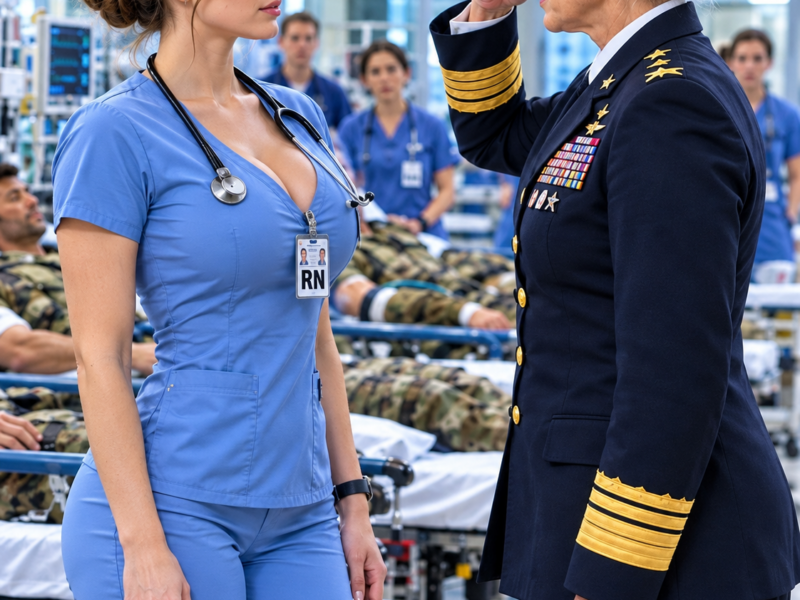
“The chief surgeon actually laughed when he ordered me to take six injured Army Rangers nobody else wanted
The authorization signature at the bottom wasn’t Richard Hayes’s.
It was my father’s.
Thomas Bennett.
For several seconds, nobody spoke.
I stared at the screen, trying to convince myself there had to be a reasonable explanation.
My father had been dead for eleven years.
His military identification had been returned to our family after his funeral. I remembered holding it in my hands, reading his name beneath the photograph, and wondering how someone so alive in my memories could suddenly become a collection of belongings in a box.
“Show me the authorization details,” I said.
Frank turned the tablet toward me.
The request had been submitted through a secure military records portal at 7:42 that morning.
It authorized the immediate transfer of six patient files, all related medical evidence, and personal property recovered from the Rangers’ original mission.
The destination was a federal military archive in Virginia.
But the approval timestamp was only four minutes old.
“Can you stop it?” I asked.
Frank shook his head.
“Not without confirmation from the administrator.”
“Then call the administrator.”
“I already did. He’s on his way.”
Dr. Hayes stepped toward the tablet.
“There’s no reason to create a scene. The transfer is part of an ongoing military investigation.”
I turned toward him.
“Then why is a dead man’s identification authorizing it?”
His face tightened.
“Someone has compromised the system.”
“Convenient.”
“Miss Bennett, you have no idea what you’re dealing with.”
“You’re right. That’s why I’m asking questions.”
Captain Cole tried to sit up.
“Don’t let them transfer anything.”
Hayes turned sharply.
“Captain, you need to remain in bed.”
“I’ve spent eleven years waiting for someone to look at that evidence. I’m not letting it disappear again.”
Hayes motioned toward the door.
“Security needs to remove these unauthorized visitors.”
Frank didn’t move.
Instead, he looked at the tablet again.
“There’s something else.”
He tapped the screen.
“The authorization contains a secondary verification code.”
“From whom?” I asked.
Frank swallowed.
“Captain Mason Cole.”
Everyone turned toward the bed.
Cole looked genuinely confused.
“I didn’t authorize anything.”
Frank enlarged the record.
The code was generated from a device registered to Cole’s military account.
But the device itself had been reported missing after the mission in Afghanistan.
The same day my father disappeared from the official investigation.
I looked at Hayes.
“You knew about this.”
He rubbed his forehead.
“I knew Robert had kept a backup authorization token. I thought it had been destroyed.”
“Your brother?”
He nodded.
“Major Robert Hayes kept copies of everything. He was meticulous.”
“Then how did my father’s identification get attached to it?”
Hayes didn’t answer.
The hospital administrator arrived before anyone could ask another question.
He was accompanied by two security officers and a woman in a dark blue suit carrying a leather folder.
She introduced herself as Special Agent Laura Mitchell from the Army Criminal Investigation Division.
“I’m here regarding the property transfer request,” she said.
Hayes immediately straightened.
“Agent Mitchell, thank you for coming. We have a situation involving unauthorized access to military records.”
She looked at him.
“That’s what I’m here to investigate.”
Then she turned to me.
“You’re Claire Bennett?”
“Yes.”
“Thomas Bennett’s daughter?”
My throat tightened.
“Yes.”
She opened her folder.
“I’ve been trying to locate you for three months.”
I looked at Captain Cole.
He appeared just as surprised as I was.
“Why?”
Agent Mitchell removed a photograph from her folder.
It showed my father standing outside a military transport vehicle.
Beside him was a younger woman I didn’t recognize.
“Your father contacted an Army investigator shortly before his death. He believed someone had manipulated the evacuation orders during the October 2014 mission.”
“Was that investigation ever completed?”
“No. The investigator was reassigned, and the case was closed after the primary evidence disappeared.”
“Who closed it?”
She glanced at Hayes.
“Major Robert Hayes.”
Richard Hayes lowered his eyes.
Agent Mitchell continued.
“However, three months ago, an anonymous source submitted a copy of the original mission log. It contained information that reopened the case.”
“Who submitted it?”
She looked toward Captain Cole.
“He did.”
Cole nodded.
“I finally found someone willing to listen.”
“Why didn’t you contact me?”
“Because I didn’t know whether you were involved. And I didn’t know who else might be watching.”
I looked down at the letter inside my pocket.
“My father said he had the original order.”
Agent Mitchell nodded.
“That’s what we’ve been trying to recover.”
I took out the letter.
She read it carefully, then examined the photograph and the metal tag from the bag.
“Where did you find these?”
“In storage room B-17.”
Her expression changed.
“That room was supposed to be sealed.”
I looked at Frank.
He looked equally surprised.
Agent Mitchell turned toward the administrator.
“Nobody leaves this floor until we establish who accessed the property.”
Then she faced Richard Hayes.
“Doctor, I’d like you to explain your connection to Major Robert Hayes.”
Hayes slowly removed his glasses.
“He was my brother.”
“Did you know about the altered evacuation order?”
“I knew there had been questions.”
“That’s not what I asked.”
He looked at the floor.
“Yes.”
The room became silent.
Agent Mitchell waited.
Hayes finally spoke.
“My brother told me about the operation. He said the evacuation coordinates had been changed, but he insisted the changes were made to protect the unit.”
“Protect them from what?”
“An operation that had gone wrong.”
Cole let out a bitter laugh.
“Three men died. One of them was Corporal Turner.”
Hayes flinched.
“I know.”
“No,” Cole said. “You know his name. You never met his mother. You never had to tell her why her son wasn’t coming home.”
Agent Mitchell raised a hand.
“Captain, we’ll get to that.”
She turned back to Hayes.
“Did your brother tell you that Thomas Bennett had found the original transmission?”
“Yes.”
“And did you know he intended to report it?”
Hayes nodded.
“Then why was the evidence never recovered?”
Hayes looked at me.
“Because my brother asked me to protect him.”
I frowned.
“Protect him from whom?”
“My brother had been receiving threats. He believed people within the command structure wanted him silenced. He thought the safest place for the evidence was outside the military system.”
“That doesn’t explain why you took the bag.”
Hayes looked down at his hands.
“Because I was afraid.”
It was the first honest-sounding thing he’d said all night.
He explained that Robert had died two years earlier after suffering a heart attack.
Before his death, he had given Richard a sealed envelope containing copies of the investigation records.
Richard had promised to keep them safe.
But he had also discovered that his brother had been involved in an internal effort to conceal the altered order.
“He told me he had made a mistake,” Hayes said. “He said he had approved a communications override without fully understanding its consequences.”
Captain Cole stared at him.
“Your brother signed the override?”
Hayes nodded.
“Yes.”
“Then he knew.”
“He knew afterward. He claimed the original coordinates were changed because of an intelligence warning. But he never explained who gave him that information.”
Agent Mitchell made a note.
“Did you destroy any records?”
Hayes looked at her.
“No.”
“Did you attempt to remove evidence from this hospital?”
He hesitated.
“I transferred the bag to administrative storage because I believed it was safer there.”
“Without documenting the transfer?”
“Yes.”
“And you requested the records transfer this morning?”
“No.”
Agent Mitchell turned toward the tablet.
“Then who did?”
Before anyone could answer, Frank spoke.
“The authorization came from an external device. But the system shows the request was initiated inside this hospital.”
Agent Mitchell looked at him.
“Can you identify the terminal?”
Frank checked.
“Administrative office. Computer three.”
Hayes looked up sharply.
“That’s impossible. Nobody uses that terminal except the night administrator.”
The administrator’s face turned pale.
“I wasn’t in the building this morning.”
Agent Mitchell stepped toward him.
“Who has access?”
He swallowed.
“Dr. Hayes. The chief of security. And the hospital’s records manager.”
At that moment, the records manager appeared in the doorway.
He was carrying a folder.
His name was Peter Lawson.
He looked from Agent Mitchell to Hayes, then to me.
“Is there a problem?”
Agent Mitchell held out her hand.
“Please put the folder down.”
Lawson hesitated.
Then he slowly placed it on the nearest table.
“What’s happening?”
“You’re going to explain why you accessed a restricted military transfer request this morning.”
Lawson glanced at Hayes.
That single glance told me more than his answer would have.
“I was following instructions.”
“Whose?”
He said nothing.
Agent Mitchell opened the folder.
Inside were printed copies of the authorization request, the six Rangers’ medical records, and a photograph of my father’s military identification.
There was also a handwritten note.
Destroy the original before the archive receives the transfer.
Agent Mitchell looked at Lawson.
“Who wrote this?”
Lawson’s face had gone gray.
“Major Robert Hayes.”
“Your brother’s been dead for two years,” Richard whispered.
Lawson looked at him.
“I know.”
Then he turned toward the agent.
“But he left instructions.”
Agent Mitchell’s expression hardened.
“Instructions to destroy evidence?”
Lawson nodded.
He explained that Robert had contacted him several times during the final months of his life.
He had paid him to keep certain military records out of the hospital’s official system.
The money had been transferred through an account belonging to a private consulting company.
Lawson had never met Robert in person after his retirement.
But he had followed his instructions.
“Who sent the authorization this morning?” Agent Mitchell asked.
Lawson looked at me.
“Someone used the credentials stored in the original file.”
“Whose credentials?”
He swallowed.
“Thomas Bennett’s.”
My hands went cold.
“How?”
Lawson hesitated.
“Because the original identification card wasn’t destroyed. It was kept with the records.”
I looked at Hayes.
He seemed genuinely shocked.
“Robert told me he’d destroyed it.”
Lawson shook his head.
“He didn’t.”
Agent Mitchell closed the folder.
“Mr. Lawson, you’re coming with us.”
Two officers escorted him from the room.
For a moment, nobody spoke.
Then Captain Cole asked the question I had been avoiding.
“Agent Mitchell, does this mean the original evidence is still somewhere?”
She nodded.
“Possibly.”
“Where?”
She looked at the photograph.
“Your father’s bag contains an item we haven’t identified yet.”
I remembered the broken military radio.
“There was an old radio in the bag.”
Agent Mitchell’s eyes sharpened.
“Did you examine it?”
“No. I didn’t know what to look for.”
She asked Frank to retrieve the bag.
When it arrived, she carefully inspected the radio.
The casing was scratched, and one corner had been crushed.
She removed the battery cover.
A small metal compartment was hidden beneath it.
Inside was a second memory card.
Captain Cole leaned forward.
“Thomas.”
He said my father’s name like a prayer.
Agent Mitchell placed the card inside an evidence sleeve.
“This is exactly what we need.”
But there was something else in the compartment.
A small folded note.
I recognized the handwriting immediately.
This time, the words were addressed to the six men.
“To the men who came home,
I am sorry I could not save Michael.
I am sorry I could not make the people responsible answer for what happened.
But I want you to understand something.
You were not cowards.
You were not failures.
You followed the orders you were given, and you did everything possible to bring one another home.
If this evidence is ever found, I hope it gives you the chance to stop blaming yourselves.
Your friend,
Thomas.”
Captain Cole lowered his head.
For eleven years, I had never seen a grown man cry so quietly.
Daniel Brooks, standing in the doorway with his injured wrist supported by a sling, wiped his eyes.
Evan Miller looked away.
Noah Walker pressed his lips together.
Even Richard Hayes stood motionless.
I folded the note carefully.
My father had spent his final months carrying the guilt of a mission that wasn’t entirely his fault.
And somehow, he had found time to write six men a message he hoped they would receive one day.
***
The investigation lasted nine months.
The second memory card contained the original communications log, a recording of a conversation between Major Robert Hayes and another senior officer, and a scanned copy of the authorization order.
The recording confirmed that the evacuation coordinates had been altered before the Rangers received them.
It also revealed that Robert Hayes had been warned that the new route was unverified.
He approved the override anyway.
The original order had been deliberately removed from the official file afterward.
The investigation established that several officers had helped conceal the changes.
Robert Hayes had not acted alone, although he had played a central role.
Richard Hayes was eventually cleared of direct involvement in the original military operation, but he was formally disciplined for removing and mishandling evidence.
He resigned from his position at Walter Reed before the hospital could complete its review.
I never received an apology from him.
I didn’t need one.
What mattered was that the truth was finally documented.
Captain Cole and the five surviving Rangers were formally cleared of the allegations that had followed them for years.
Their records were corrected.
The official findings acknowledged that the unit had followed authenticated orders that had been compromised by an unauthorized command override.
Corporal Michael Turner’s family received a formal letter of acknowledgment.
His mother, Margaret, attended the ceremony at Fort Campbell.
She was seventy-two years old, with silver hair and hands that trembled when she held the framed photograph of her son.
Captain Cole stood beside her.
“I’m sorry we couldn’t bring Michael home,” he said.
She looked at him for a long moment.
Then she reached for his hand.
“You brought the truth home,” she replied. “That’s something.”
I stood behind them, holding my father’s old photograph.
Six young soldiers.
One medic.
One little girl.
For years, I had thought the photograph was simply a memory of a deployment my father didn’t want to discuss.
Now I understood why he had kept it.
It wasn’t a picture of a mission.
It was a promise.
A promise that the men who survived would never be forgotten.
***
Three months after the investigation ended, I returned to work at Walter Reed.
The hospital had offered to reinstate me, but I had initially refused.
I wasn’t sure I could walk back into the same unit without remembering the night everything began.
Then Daniel called.
He was recovering well and had returned to Virginia.
“You’re not going to let one arrogant surgeon decide where you belong, are you?” he asked.
I laughed.
“I thought you were supposed to be resting.”
“I am. I’m resting from people telling me what to do.”
I considered his words for a few days.
Then I returned.
Not because I needed to prove anything to Dr. Hayes.
Because there were still people who needed care, and I was still a nurse.
On my first night back, I found a small envelope waiting at the nurses’ station.
My name was written across the front.
Inside was a photograph.
The six Rangers stood together outside the hospital.
They were wearing civilian clothes.
Captain Cole stood in the center, his damaged watch visible on his wrist.
Beside him was an empty space.
On the back, someone had written:
“We saved this spot for the person who helped bring us home.”
I smiled.
Then I noticed another photograph tucked behind it.
It was an old picture of my father standing beside the same six men.
This time, I noticed something I hadn’t seen before.
My father was holding the little girl, but his other hand rested on Captain Cole’s shoulder.
They weren’t simply posing for a photograph.
They looked like family.
***
The following Saturday, I drove to Virginia to visit my father’s grave.
I brought the photographs and the letter from the six Rangers.
The cemetery was quiet.
A light wind moved through the trees, and the grass was still wet from the morning rain.
I sat beside his headstone and placed the photographs against the stone.
For a while, I didn’t say anything.
Then I unfolded his letter.
“I found them, Dad,” I whispered.
“All six of them.”
I told him about the investigation.
About Michael’s mother.
About the men who had finally stopped blaming themselves.
I told him about Captain Cole’s broken watch and the way Daniel had laughed when he saw me again.
And I told him something I wished I had said while he was still alive.
“I used to think you kept your stories from me because you didn’t trust me with them.”
My voice caught.
“Now I think you were trying to protect me from carrying what you carried.”
I brushed a fallen leaf from his headstone.
“You don’t have to carry it anymore.”
I stayed until the sun began to disappear behind the trees.
Before leaving, I placed the little silver pendant against the photograph.
For the first time, I didn’t feel as though I was holding a piece of a mystery.
I was holding a piece of my father.
A week later, Captain Cole visited the hospital.
He had recovered enough to walk without assistance, although he still moved carefully when he stood for too long.
He found me at the nurses’ station.
“Thought you might be able to use this.”
He handed me a small wooden box.
Inside was my father’s old military medic insignia.
I stared at it.
“Where did you get this?”
“Your father gave it to me the night before our mission. He said if anything happened to him, I should make sure it found its way back to you.”
I carefully lifted it from the box.
“Why didn’t you give it to me sooner?”
Cole smiled sadly.
“Because I spent eleven years believing I’d failed him.”
He looked at the insignia.
“I didn’t think I deserved to come looking for his daughter.”
I shook my head.
“You didn’t fail him, Captain.”
He looked at me.
“Neither did you.”
For a moment, neither of us spoke.
Then he extended his hand.
I shook it.
“Take care of yourself, Mason.”
“You too, Claire.”
He walked toward the exit.
Before reaching the doors, he turned around.
“Your father would have been proud of you.”
I watched him leave.
That evening, I placed the insignia beside my father’s photograph at home.
The little girl in the picture had grown up.
The six men had found their way home.
And the truth my father had carried for eleven years had finally been spoken aloud.
I used to believe that saving someone meant keeping them alive.
My father had taught me something more difficult.
Sometimes, saving someone means making sure the world remembers what really happened to them.
And sometimes, the people who come home carrying the deepest wounds are the ones who need someone to tell them they can finally put the weight down.
The end.









