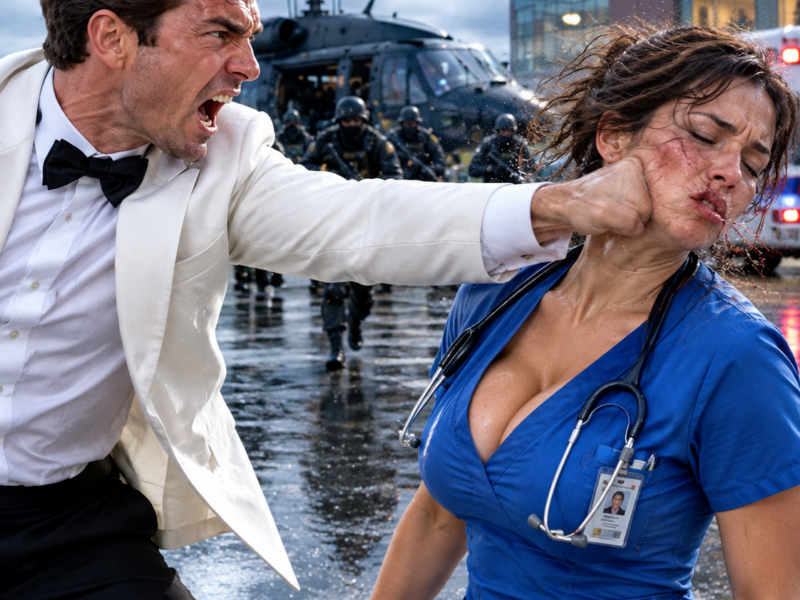
“The CEO slapped me so hard my head struck the medication cart. He called me a useless nurse in front of thirty patients
The older man was still standing in front of me when the hospital doors opened again.
This time, nobody rushed forward.
Nobody shouted.
Even the paramedics seemed to sense that whatever was happening had nothing to do with an ordinary emergency.
A man in a charcoal-gray suit walked into the department, accompanied by two security officers.
He was in his late fifties, with neatly combed white hair and a polished silver watch.
I recognized him immediately.
Dr. Nathaniel Cross.
Five years earlier, he had been the deputy director of the military medical operations division.
He had signed the paperwork declaring my unit’s final mission unsuccessful.
He had also signed my discharge papers.
And according to the official report, he was the last person who had spoken to my commanding officer before the entire operation went dark.
I hadn’t seen him since the night I was ordered to disappear.
“Emily,” he said.
Hearing my first name in his voice made my stomach turn.
I stepped away from the tactical officer.
“Don’t come any closer.”
Cross stopped.
His eyes moved briefly to my bruised cheek.
“I see you’ve had an unpleasant morning.”
Richard Vaughn immediately moved toward him.
“Dr. Cross, thank goodness. These people have entered my hospital without authorization. One of my employees has activated some kind of military signal, and I expect you to explain what’s happening.”
Cross barely acknowledged him.
“Mr. Vaughn, please step aside.”
“I’m the CEO of this hospital.”
“And I’m the person who authorized the operation that brought these men here.”
Vaughn’s mouth closed.
The tactical officer beside me introduced himself.
“Major Daniel Mercer, ma’am. Special Operations Medical Recovery Unit.”
I remembered him.
Not by his face.
By his voice.
Five years ago, I had heard that voice over a damaged radio while treating three injured soldiers inside a makeshift medical station.
He had been the youngest member of the evacuation team.
Back then, he had called me Captain Brooks.
Now he was looking at me as if he had spent eleven months wondering whether he would ever see me again.
“Major,” I said quietly. “Why are you here?”
He glanced at Cross.
“Because the classified medical archive from Operation Black Harbor was accessed six days ago.”
My pulse quickened.
“That’s impossible.”
“It shouldn’t have been possible.”
“That archive was destroyed.”
“Only the public-facing copy.”
Cross stepped forward.
“Emily, we need to talk somewhere private.”
I laughed once.
It wasn’t a happy sound.
“Five years ago, you told me the people I treated that night were dead. You told me my team had been wiped out. You told me there was nothing left to investigate.”
“That was the information available to me.”
“Then why did you sign the report?”
His expression tightened.
“Because I was ordered to.”
The answer was so simple that it almost knocked the breath out of me.
I had spent five years wondering whether I had misunderstood something.
Whether I had missed a radio transmission.
Whether I had made the wrong decision when I chose which wounded soldier to evacuate first.
And now he was telling me he had simply followed an order.
“Who gave it?” I asked.
Cross didn’t answer.
Major Mercer did.
“General Adrian Vale.”
The name hit me harder than Vaughn’s slap.
General Vale had been the director of the entire operation.
He had personally approved my team’s deployment.
He had been the person who promised that every wounded operator would be brought home.
And he had been the person whose final transmission I remembered hearing through the static.
Leave the position. There are no survivors worth recovering.
I had refused.
That refusal had cost me everything.
I looked at Cross.
“Where is he?”
“At this hospital.”
My eyes moved toward Vaughn.
The CEO had gone completely pale.
Cross followed my gaze.
“Mr. Vaughn has been assisting General Vale with a private medical project.”
Vaughn suddenly found his voice.
“This is absurd. I have no idea what you’re talking about.”
Mercer motioned to one of his men.
The officer placed a tablet on the medication cart.
A photograph appeared on the screen.
It showed Vaughn entering a restricted medical storage area at 2:14 in the morning.
Another image showed him meeting Dr. Cross in the hospital’s underground parking garage.
Then came a third photograph.
A military medical container being transferred into a hospital supply vehicle.
I recognized the container immediately.
My hands began to shake.
“Where did you get that?”
Mercer answered.
“From the access logs of the classified archive.”
I leaned closer.
The container had a small white label.
Black Harbor.
The same label that had appeared on the medical supplies in our field hospital five years earlier.
But those containers were never supposed to leave military custody.
“What is inside them?” I asked.
Cross looked away.
“Medical research materials.”
“That’s not an answer.”
“Samples collected during the operation.”
I stared at him.
“From the wounded soldiers?”
Silence.
That was when I understood.
Black Harbor had never been just a rescue mission.
The operation had taken place near an abandoned communications facility overseas.
Our team had been ordered to establish a temporary medical station and evacuate injured personnel from a damaged compound.
But when we arrived, there were no ordinary soldiers waiting for us.
There were men with unexplained neurological symptoms.
Some were unconscious.
Others were bleeding from their noses and ears.
Their medical records had been removed.
Their identities had been replaced with numbers.
I had spent hours treating them without knowing why they had been exposed to whatever was happening inside that facility.
Then someone had ordered us to evacuate.
Not the patients.
The research equipment.
I had refused.
I remembered the argument over the radio.
I remembered the explosion.
I remembered carrying a wounded soldier through smoke while the entire medical station collapsed behind us.
And I remembered the final voice I heard before the radio went silent.
General Vale.
“Why are the samples here?” I asked.
Cross lowered his voice.
“Because General Vale believes the research can save lives.”
“By hiding it in a civilian hospital?”
“By completing work that was interrupted.”
I looked at the patients around us.
At the nurses.
At the families waiting for updates.
At the young paramedic who had been standing beside me when Vaughn struck me.
“How many people know?”
“More than I wanted to.”
Vaughn suddenly stepped toward the tablet.
“Turn that off.”
Mercer moved between him and the cart.
“Don’t.”
Vaughn’s face twisted.
“You have no authority here.”
Mercer looked at him.
“Actually, Mr. Vaughn, we have a federal warrant.”
He pulled a folded document from his jacket and handed it to the nearest security officer.
“Effective immediately, all restricted storage areas, pharmacy inventory, patient transfer logs, and surveillance records are to be preserved.”
Vaughn stared at the paper.
Then he looked at me.
His expression changed from anger to something much uglier.
“You have no idea what you’ve done.”
I touched my swollen cheek.
“You’re right. I don’t think I do.”
He leaned closer.
“You should have stayed quiet.”
Mercer grabbed his arm.
“That’s enough.”
Vaughn tried to pull away.
“Get your hands off me!”
Two hospital security guards rushed forward, but Mercer showed them his identification.
“Nobody touches her. Nobody moves any evidence. And nobody leaves this department without being cleared.”
Cross rubbed his forehead.
“This is getting out of control.”
I turned toward him.
“No. It got out of control five years ago.”
For the first time, he looked ashamed.
Then the hospital’s overhead announcement system crackled.
“Code Silver. Security response required in the east administrative wing.”
Everyone froze.
A second announcement followed.
“Code Silver. Security response required in the east administrative wing.”
Mercer reached for his radio.
“Control, this is Mercer. Report.”
A burst of static answered him.
Then a voice came through.
“Major, we have an unauthorized access event in the restricted medical archive.”
Mercer looked at me.
“Someone is trying to destroy the records.”
I didn’t need another explanation.
I knew where the archive was.
The basement.
Room B-17.
The same room where I had once discovered a set of patient files that didn’t match the names on the evacuation manifest.
“Take me there,” I said.
Mercer shook his head.
“Absolutely not.”
“Major, I was the medical officer who treated those patients.”
“You’re not cleared for this operation.”
I looked directly at him.
“Then consider this a medical emergency.”
He hesitated.
Cross stepped between us.
“Emily, please. You don’t understand the risk.”
I looked at him.
“Then tell me.”
He said nothing.
That was enough.
I turned toward the elevator.
Mercer followed.
Two members of his team moved with us.
Behind us, Vaughn shouted something about lawsuits and police departments.
I didn’t look back.
The elevator doors closed.
For several seconds, nobody spoke.
Then Mercer said something I hadn’t expected.
“Your old team is alive.”
I turned toward him.
“What?”
He looked uncomfortable.
“Not all of them. But more than the report says.”
I gripped the railing.
“Who?”
“Sergeant Luis Ortega. Corporal James Bell. Dr. Samuel Price.”
My throat tightened.
Samuel Price had been our field surgeon.
He had stayed behind to stabilize the wounded when I ordered the evacuation.
The official report listed him as killed in the explosion.
“Where is he?”
Mercer swallowed.
“He’s the reason we came for you.”
The elevator stopped.
The doors opened onto the basement.
A long corridor stretched ahead, lit by fluorescent lights.
At the far end stood a gray security door with a keypad.
Room B-17.
Mercer raised one hand.
His team moved forward.
The door was slightly open.
That was wrong.
It should have been locked behind two separate access controls.
Mercer signaled for everyone to stay back.
A faint mechanical sound came from inside.
Then a voice.
“Please don’t.”
It was a woman’s voice.
We entered carefully.
A hospital technician was sitting on the floor beside a computer terminal.
Her hands were trembling.
A man in a dark jacket stood behind her, holding a small device near the server rack.
He turned when we entered.
I recognized him.
Dr. Adrian Shaw.
He had been the research director at the Black Harbor facility.
He had also been the last person I saw standing beside the medical containers before the explosion.
I thought he had died.
He looked older now, but his eyes were exactly the same.
Cold.
Calculating.
“Emily Brooks,” he said.
I stared at him.
“You were there.”
“Yes.”
“You told me those patients were contaminated.”
“They were.”
“You told me the equipment had to be evacuated because the compound was unstable.”
“It was.”
“Then why were you taking blood samples from unconscious soldiers?”
His expression didn’t change.
“Because the research was important.”
I stepped closer.
“Those men were human beings.”
“And their sacrifice may eventually save thousands.”
I felt something inside me go still.
Not calm.
Not forgiveness.
Something harder.
“Did you know they were being used without consent?”
He didn’t answer.
Mercer moved toward him.
Shaw pressed a button on the device.
The server rack began to emit a high-pitched warning tone.
“Don’t move,” Shaw said.
Mercer stopped.
I looked at the technician.
She was barely twenty-five.
Her hospital badge read LISA MORENO.
“Lisa,” I said gently. “Are you hurt?”
She shook her head.
“He told me to erase the files. I didn’t know what they were. When I saw the patient names, I refused.”
“Good.”
Shaw laughed.
“You think you’ve accomplished something? Those records are only copies.”
I glanced at the monitor.
A progress bar showed that the archive was being overwritten.
Forty-two percent.
I knew enough about emergency medical systems to understand what was happening.
If the archive disappeared, the hospital would lose the only remaining record connecting its restricted medical shipments to the original Black Harbor patients.
And if those names vanished, it would become much harder to prove what had happened.
“Mercer,” I said quietly. “The backup terminal.”
He followed my gaze.
A smaller computer sat beneath the desk.
Its screen was still active.
Shaw noticed.
“Don’t.”
I moved.
He lunged toward me.
Mercer caught his arm, and the device fell to the floor.
A loud electrical crack echoed through the room.
The main server went dark.
For one second, there was complete silence.
Then the backup terminal began flashing.
Lisa scrambled toward it.
“It’s still there!”
She pressed a key.
A directory opened.
Hundreds of patient files appeared.
Some had dates from five years ago.
Others had been updated within the last month.
I recognized the first name.
Michael Hayes.
Then another.
David Collins.
Then another.
Samuel Price.
I stopped breathing.
The screen showed a medical record marked ACTIVE.
I leaned closer.
“Open that file.”
Lisa clicked.
A photograph appeared.
A man with gray hair, a surgical scar above his left eyebrow, and tired eyes stared back at me.
Samuel.
My Samuel.
The man I had buried in my mind for five years.
Below the photograph was a line of text.
LOCATION: MERCY GENERAL HOSPITAL — PRIVATE RECOVERY WARD.
I felt the room tilt.
“Where is he?”
Mercer looked at the screen.
“Third floor. Room 312.”
I didn’t wait.
I ran.
The corridor seemed endless.
The elevator took too long.
My heart was beating so hard I could barely hear the people around me.
When the doors opened on the third floor, a nurse was standing near the station.
“Room 312?”
She looked confused.
“Who are you?”
“Emily Brooks. I need to see the patient.”
She checked the chart.
Then her expression changed.
“He’s been asking for someone named Emily.”
I stopped.
“What?”
She pointed down the hallway.
“He’s been asking for you since he woke up.”
I walked toward the room.
The door was open.
A man sat in the hospital bed, his left arm resting in a sling.
His face was thinner than I remembered.
His hair had turned almost completely gray.
But the moment he looked up, I knew.
“Samuel?”
His eyes filled with tears.
“You’re late, Captain.”
I couldn’t move.
He smiled weakly.
“Five years, Emily. I waited five years.”
I crossed the room and took his hand.
For several seconds, neither of us spoke.
Then I began crying.
Not quietly.
Not carefully.
I cried the way I had wanted to cry on the night the official report arrived.
The way I had wanted to cry when I received the medals and the condolences.
The way I had wanted to cry when I packed away my uniform and promised myself I would never again let anyone know who I had been.
Samuel squeezed my hand.
“I’m sorry.”
I shook my head.
“Don’t.”
“I should have found you.”
“You were alive.”
He nodded.
“Not exactly.”
He explained that after the explosion, he had been recovered by a private extraction team working under General Vale’s authority.
He had suffered severe injuries and spent months in an isolated military facility.
When he began asking questions about the missing patients, his medical records were restricted.
When he refused to cooperate with Dr. Shaw, his treatment was delayed.
Eventually, he was transferred to Mercy General under a false identity.
Vaughn had approved the arrangement.
“Why didn’t you contact me?” I whispered.
Samuel looked down.
“They told me you were dead.”
I felt my chest tighten.
“What?”
“They showed me your official death report. They said you had died during the evacuation.”
I stared at him.
“They told me the same thing about you.”
Samuel closed his eyes.
“Then they kept us apart deliberately.”
The realization was almost unbearable.
We had both spent years believing the other was gone.
And the people responsible had known the truth.
A knock sounded at the door.
Major Mercer entered with two federal investigators.
“Commander, we secured the archive.”
He glanced at Samuel.
“Doctor, it’s good to see you.”
Samuel gave a tired nod.
Mercer turned toward me.
“We also recovered the original transfer authorization.”
“Whose signature?”
He placed a printed document on the bedside table.
At the bottom was the name of General Adrian Vale.
Beside it was another signature.
Richard Vaughn.
I looked at the page.
The document authorized the transfer of restricted biological samples through Mercy General’s private medical supply network.
It also authorized the use of selected patients for an unapproved clinical program.
My hands went cold.
“How many patients?”
The investigator answered.
“At least nineteen confirmed. We’re still reviewing the files.”
Samuel closed his eyes.
“Some of them didn’t survive.”
I sat beside him.
For the first time, I understood why the people behind Black Harbor had been so desperate to keep the archive hidden.
It wasn’t just about a failed military operation.
It was about what they had done to the people who had trusted them.
And now the truth was sitting in a hospital room, waiting to be heard.
The investigation moved quickly after that.
Federal agents secured the basement servers, seized the hospital’s restricted shipment records, and interviewed every employee connected to the private medical program.
Richard Vaughn was escorted out of the building in handcuffs.
He didn’t look at me as he passed.
Dr. Cross remained behind to give a statement.
He admitted that he had known about the false casualty reports.
He also admitted that he had signed the documents that allowed the operation to remain classified.
But he insisted that General Vale had threatened to destroy the careers and lives of anyone who challenged him.
I believed that part.
I didn’t forgive him.
There was a difference.
Two days later, General Vale was arrested at a private residence outside Washington, D.C.
The charges included conspiracy, obstruction of justice, unlawful medical experimentation, and destruction of government records.
Dr. Shaw was charged with falsifying medical data and conducting unauthorized research.
The hospital board removed Vaughn as CEO.
Mercy General issued a public statement acknowledging that restricted medical activities had taken place within its facilities.
The statement didn’t mention my name.
I didn’t want it to.
For the first time in five years, the people who had been erased from the official story were being identified.
Samuel was transferred to a rehabilitation unit.
His recovery would take months.
But he was alive.
And every morning, I visited him before my shift.
Sometimes we talked about the operation.
Sometimes we talked about ordinary things.
Coffee.
Weather.
The ridiculous television programs he watched.
And sometimes we said nothing at all.
One afternoon, he looked at me and asked the question I had been avoiding.
“Are you going to stay here?”
I looked around the room.
The hospital had offered to reinstate me with full back pay and a senior nursing position.
The federal investigators had also asked me to assist with reviewing the Black Harbor medical records.
I hadn’t decided what I wanted.
“I don’t know,” I admitted.
Samuel nodded.
“Then don’t decide because someone expects you to.”
I smiled faintly.
“That’s what you used to tell me.”
“Because you never listened.”
For the first time in years, I laughed without feeling guilty.
Three weeks later, I was called to testify before a federal investigative panel.
The room was smaller than I expected.
There were no cameras.
No reporters.
Just a long table, several investigators, and a stack of documents.
General Vale sat at the far end.
His hair was thinner now.
His uniform had been replaced by a dark suit.
But his expression was unchanged.
He looked at me as if I were still the young officer who had once been expected to obey without question.
“Commander Brooks,” he said. “It’s been a long time.”
I took my seat.
“Yes, sir.”
He leaned back.
“You should understand that the operation was conducted under extraordinary circumstances.”
I looked at the photographs in front of me.
The field hospital.
The wounded soldiers.
The medical containers.
Samuel’s old identification card.
“I understand that nineteen people were used without consent.”
“That was not the intention.”
“Then why were their records falsified?”
He didn’t answer.
“Why were my teammates declared dead?”
He looked toward the investigators.
“Operational security.”
I felt my hands tighten beneath the table.
“Why was I told Samuel had died?”
Vale’s jaw moved.
“Those decisions were made to protect the broader mission.”
I leaned forward.
“Which mission?”
He stared at me.
“The mission to prevent sensitive research from falling into hostile hands.”
I shook my head.
“No. You were protecting the people who ordered it.”
The room went silent.
Vale’s expression hardened.
“You were a medical officer. You were not cleared to understand the strategic implications.”
I held his gaze.
“I was cleared to treat the people you abandoned.”
For several seconds, he said nothing.
Then one of the investigators slid a document across the table.
It was a copy of the original Black Harbor evacuation log.
The final entry had been written by me.
All remaining patients are to be evacuated. No medical personnel are to abandon the wounded.
I recognized my handwriting immediately.
The investigator asked General Vale whether he had received that order.
He said he couldn’t remember.
But the radio recording did.
His voice was clear.
His command was unmistakable.
And the investigators had the original transmission.
By the end of the hearing, General Vale’s attorney had stopped asking questions.
The case continued for months.
Eventually, Vale pleaded guilty to multiple federal offenses in exchange for cooperating with the investigation.
Vaughn was convicted for his role in concealing the unauthorized program.
Dr. Shaw received a lengthy prison sentence.
Dr. Cross lost his position and faced criminal penalties for falsifying official records.
The full list of Black Harbor patients was released to their families.
Some received answers.
Others received apologies that could never make up for what had been taken from them.
But their names were no longer hidden.
And neither was mine.
I returned to Mercy General six months later.
Not as a commander.
Not as a classified medical officer.
As a nurse.
The hospital had a new CEO, a new medical board, and a completely different security system.
The emergency department was still loud.
Patients still needed help.
Doctors still shouted orders.
And the medication cart still made an annoying squeaking sound whenever someone pushed it too quickly.
On my first day back, a young nurse approached me.
She was the same nurse who had covered her mouth when Vaughn struck me.
Her name was Rachel.
“I wasn’t sure you’d come back,” she said.
“Neither was I.”
She looked uncomfortable.
“I should have done something that day.”
I studied her face.
“You were scared.”
“That doesn’t make it right.”
“No,” I said. “But it doesn’t mean you can’t do better next time.”
She nodded.
Then she asked whether I would show her how to handle trauma cases.
I smiled.
“Of course.”
Later that afternoon, I passed the administrative corridor where Vaughn had once stood and humiliated me.
The wall had been repainted.
The security cameras had been replaced.
The hospital had even removed the large portrait of the former CEO.
But I remembered every second.
I remembered the slap.
The broken medication tray.
The way everyone had gone silent.
And I remembered how little power I had felt in that moment.
A few minutes later, I received a message from Samuel.
They finally gave me permission to leave rehabilitation for a few hours. Coffee?
I smiled.
I typed back.
Only if you’re paying.
His reply came immediately.
Still giving orders, Captain?
I laughed.
Then I walked toward the hospital entrance.
Outside, a familiar black helicopter waited on the landing pad.
Mercer stood beside it, wearing civilian clothes.
He waved when he saw me.
I hadn’t expected him to be there.
“What are you doing here?” I asked.
“Thought I’d check on you.”
“I’m a nurse now, Major. I can manage.”
He smiled.
“I know.”
He handed me a small envelope.
Inside was a photograph.
It showed our original medical team standing outside the field hospital five years earlier.
Samuel was there.
Mercer was there.
And I was standing in the center, wearing my old uniform.
On the back, someone had written:
THEY DIDN’T FORGET YOU.
I looked up.
“Who wrote this?”
Mercer smiled.
“Samuel.”
I held the photograph against my chest.
For five years, I had believed that surviving Black Harbor meant leaving every part of that life behind.
I had changed my name.
Changed my career.
Changed the way I introduced myself.
I had convinced myself that being invisible was the same as being safe.
But the truth had been waiting for me all along.
The people who needed me had never forgotten.
And neither had the people who were afraid of what I knew.
That evening, I met Samuel at a small café across the street from the hospital.
He was walking slowly, but he was walking.
When he saw me, he stood up.
I moved to help him.
He raised one hand.
“Don’t.”
I stopped.
He smiled.
“I’ve spent five years being carried by other people. Let me do this myself.”
I nodded.
We sat by the window.
For a while, we talked about the future.
Samuel wanted to return to medicine when he was strong enough.
Mercer had been assigned to a new recovery unit.
And I had accepted a position training nurses in emergency trauma response.
I didn’t know what the next year would bring.
But I wasn’t afraid of being seen anymore.
Before we left, Samuel reached across the table and took my hand.
“Do you regret pressing that button?”
I thought about the hospital.
The helicopter.
The investigation.
The families who finally learned what had happened to their loved ones.
Then I thought about the first patient I had treated that morning.
The man who had been bleeding while Vaughn was busy humiliating me.
“No,” I said. “I regret waiting five years to believe I was allowed to speak.”
Samuel squeezed my hand.
Outside, the city lights flickered on.
For the first time since Black Harbor, I didn’t feel like I was running from the past.
I was finally walking toward something that belonged to me.
And I knew one thing with absolute certainty.
The next time someone tried to silence a nurse, they would have to answer for it.
The end.









