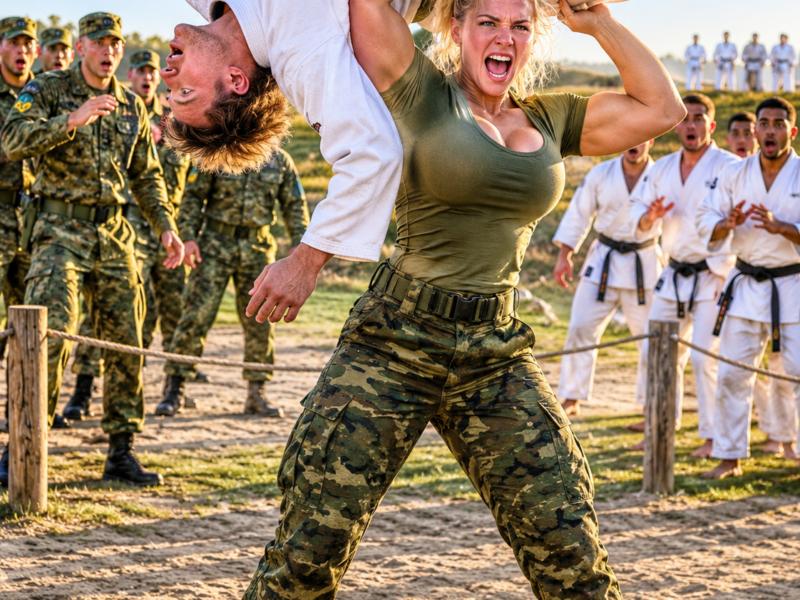
“The black belt laughed when he saw me mopping the floor outside his martial arts studio, then deliberately kicked my bucket across the lobby in front of twenty students
Marcus Reed had no idea that the woman standing across from him had once spent twenty years teaching men exactly like him what a black belt was supposed to mean.
And I had no intention of reminding him.
Not yet.
The academy had gone completely silent.
Twenty students stood around the edge of the training mat, their parents watching from folding chairs along the wall. A few phones were still recording.
Marcus rolled his shoulders and adjusted the black belt around his waist.
He was thirty-eight, broad-shouldered, confident, and accustomed to being the strongest person in every room.
I was fifty-one.
My gray cleaning uniform was damp from an afternoon of work, and one sleeve had a small tear near the elbow.
My hands smelled of disinfectant.
I looked like someone who had wandered into the wrong building.
That was exactly what Marcus believed.
“Come on, Rebecca,” he said, smiling at the students. “Let’s see what you can do.”
I glanced at the mop bucket lying on its side near the entrance.
“You kicked that over,” I said quietly. “You could have simply asked me to move it.”
A few students lowered their eyes.
Marcus laughed.
“Are we going to talk about a bucket all night?”
“No,” I replied. “We’re going to talk about respect.”
His smile tightened.
Then Mr. Tanaka stepped onto the edge of the mat.
He was seventy-four, small and slightly stooped, with silver hair and a face that seemed carved from patience. He wore an old dark jacket, and in one hand he carried a weathered leather training bag.
He looked at Marcus.
Then he looked at me.
“Rebecca,” he said, “I see you finally decided to take off the uniform.”
I almost smiled.
“Not quite, Sensei.”
Marcus frowned.
“Wait. You two know each other?”
Mr. Tanaka placed the leather bag beside the wall.
“Know each other?” he repeated. “I taught this woman when she was younger than you are now.”
A murmur passed through the room.
Marcus looked at me again.
“That’s interesting,” he said. “But what does that have to do with tonight?”
Mr. Tanaka’s expression became serious.
“Everything.”
He turned toward the students.
“Before anyone steps onto this mat, I want you to understand something. A black belt is not a license to humiliate someone. It is not a crown. It is not proof that you are better than the people around you.”
Marcus crossed his arms.
“I know what a black belt means.”
“Do you?”
The question landed harder than a shout.
Marcus glanced at the students, clearly irritated that his authority was being challenged in front of them.
“Sensei, I respect your history. But this is my academy.”
Mr. Tanaka nodded slowly.
“Yes. And that is why I came.”
He opened the leather bag.
Inside lay a pair of worn training gloves, a faded photograph, and a small black belt folded carefully in half.
I hadn’t seen that belt in almost sixteen years.
My throat tightened.
Mr. Tanaka lifted the photograph.
It showed a much younger version of me, standing on a wooden platform in a white karate uniform. My hair was tied back, my face bruised, and a black belt wrapped around my waist.
Beside me stood Mr. Tanaka.
On the back, in his familiar handwriting, were three words:
“Strength protects others.”
Marcus stared at it.
“That’s you?”
I nodded.
“Before I started cleaning floors, yes.”
“Why didn’t you tell anyone?”
“Because nobody asked.”
A few students exchanged glances.
Marcus shook his head.
“So you’re saying you used to train?”
“I’m saying I spent most of my adult life training.”
He gave a short laugh.
“Fine. Then let’s spar.”
Mr. Tanaka looked at me.
I knew what he was asking without hearing a word.
Was I ready?
I had avoided that question for years.
There had been a time when I lived for the sound of bare feet against a training mat, the sharp rhythm of controlled breathing, and the quiet satisfaction of learning something difficult.
I had competed.
I had taught.
I had earned a third-degree black belt.
Then life had changed.
My husband, Daniel, had become ill. Medical bills swallowed our savings. I stopped teaching because someone had to take care of him.
After he died, I couldn’t bring myself to return to the academy where we had once trained together.
The uniform, the belt, the trophies—they all belonged to a life that seemed to have ended with him.
So I took a cleaning job.
It paid the rent.
It gave me a routine.
And, most importantly, nobody expected me to be anything other than invisible.
Until Marcus kicked my bucket.
I looked at him.
“Are you sure you want to do this?”
His grin returned.
“Absolutely.”
“Then there are rules.”
He raised an eyebrow.
“Rules?”
“No strikes to the head. No uncontrolled techniques. We stop when either person says stop.”
Marcus glanced at the students.
“Of course.”
“And one more thing.”
“What?”
“Don’t confuse a demonstration with a fight.”
His expression hardened.
“Let’s get started.”
I removed my work gloves and placed them beside the mop bucket.
My fingers felt stiff.
I flexed them slowly.
Mr. Tanaka stepped forward.
“Before you begin,” he said, “remember that the purpose of this exercise is not to defeat one another.”
Marcus sighed.
“Understood.”
“Good. Then perhaps you should begin by listening.”
Marcus stepped onto the mat.
I followed.
My shoes were still on.
He pointed toward them.
“You’re going to spar in those?”
I looked down.
“I wasn’t planning to change clothes.”
The students laughed nervously.
Marcus shook his head.
“Take them off. I don’t want anyone saying you slipped.”
I removed my shoes and placed them neatly beside the mat.
My feet touched the cool surface.
For a moment, the years disappeared.
I could feel the familiar firmness beneath my soles.
The room seemed to grow quieter.
I stood naturally, my hands relaxed, my knees slightly bent.
Marcus raised his fists in a textbook fighting stance.
I didn’t.
“Ready?” Mr. Tanaka asked.
Marcus nodded.
I nodded too.
“Begin.”
Marcus moved first.
He came forward quickly, throwing a controlled straight punch toward my shoulder.
I shifted half a step.
His fist passed through empty space.
He turned and tried again, this time reaching for my upper arm.
I stepped outside his movement and gently guided his wrist past me.
He stumbled one step forward.
Nothing dramatic.
No throw.
No strike.
Just a simple demonstration of how much effort can be wasted when someone refuses to move in the direction you expect.
The students watched silently.
Marcus turned around.
“Lucky timing.”
I said nothing.
He attacked again.
This time, he came faster.
His hand reached toward my collar.
I pivoted, moved my shoulder out of the line of contact, and placed my palm lightly against his chest.
He stopped.
He looked down at my hand.
Then at me.
“Again,” he said.
I lowered my hand.
“Whenever you’re ready.”
He came forward with a combination.
The first strike missed.
The second passed close enough for me to feel the air move.
I stepped away, turned my body, and redirected his momentum.
His own movement carried him past me.
He caught himself before falling.
A boy near the front whispered, “Whoa.”
Marcus heard him.
His face reddened.
“Stop playing around,” he snapped.
“I am not playing.”
He rushed forward again.
This time, I didn’t move immediately.
I watched his shoulders.
His weight shifted.
His right foot planted too heavily.
His eyes focused on my chest.
Everything he was about to do appeared in his body before he did it.
I stepped aside and used a small movement of my forearm to guide his arm across his centerline.
His balance broke.
He dropped to one knee.
The room went still.
I released him immediately and stepped back.
“You okay?” I asked.
Marcus stood.
“I’m fine.”
But he wasn’t smiling anymore.
He glanced at Mr. Tanaka.
“Is this what you brought her here to do?”
Mr. Tanaka’s voice remained calm.
“No. I brought you here to see what you have forgotten.”
Marcus brushed his uniform.
“I haven’t forgotten anything.”
“Then why are you angry?”
That question made him pause.
I could see the answer in his face.
He wasn’t angry because he had lost control of the exchange.
He was angry because the students had witnessed it.
His authority had been built on the belief that nobody in the room could challenge him.
And now a woman he had treated like a nuisance had done so without raising her voice.
“That’s enough,” I said.
I stepped away from the center of the mat.
Marcus looked at me sharply.
“What? You’re done?”
“Yes.”
He gave a bitter laugh.
“Because you think you’ve proved something?”
“No,” I said. “Because I think you have.”
He moved toward me.
“Don’t walk away now.”
I turned.
“Marcus, this isn’t about winning.”
“Easy for you to say.”
I studied him for a moment.
Then I asked, “Why did you open this academy?”
He frowned.
“What?”
“Why did you start teaching?”
He glanced toward the students.
“To teach martial arts.”
“That’s what you do. I’m asking why.”
He didn’t answer.
Mr. Tanaka moved closer.
“Think carefully,” he said. “The answer matters.”
Marcus looked uncomfortable.
“My father had a small dojo when I was a kid. I grew up there. He taught me discipline.”
“And what did he teach you about people who couldn’t defend themselves?” I asked.
Marcus’s jaw tightened.
“He taught me not to underestimate anyone.”
I nodded.
“Then tonight, you ignored your own lesson.”
He looked away.
For the first time, I saw something beneath his confidence.
Not fear exactly.
Embarrassment.
Perhaps even recognition.
A small voice came from the side of the room.
“Coach?”
It was Tyler, one of the academy’s senior students.
He was seventeen, tall and thin, with a white bandage wrapped around his left wrist.
Marcus turned.
“What?”
Tyler hesitated.
“Is that why you made me keep practicing after I hurt my wrist last week?”
Marcus frowned.
“We discussed that.”
“You said I was being weak.”
The room became uncomfortable again.
Tyler looked down.
“I told you it hurt. You said black belts don’t make excuses.”
Marcus opened his mouth.
Nothing came out.
I looked at Tyler’s bandage.
“Did you see a doctor?”
He shook his head.
“Not yet.”
I felt a familiar ache in my chest.
Not because of his injury.
Because I knew exactly how easily a young student could confuse pain with progress when an instructor told him to.
I turned toward Marcus.
“May I ask you something?”
He didn’t respond.
“Did you teach Tyler how to recognize an injury?”
Marcus rubbed his forehead.
“I teach them to push through discomfort.”
“Discomfort and injury are not the same thing.”
Mr. Tanaka nodded.
“A good instructor knows the difference.”
Marcus looked around the room.
The parents were no longer smiling.
The students were watching him, waiting.
He had wanted a public demonstration.
Now he was facing a lesson he had never planned to give.
I picked up the faded photograph from the wall where Mr. Tanaka had placed it.
“Do you know why I stopped teaching?” I asked.
Marcus shook his head.
“My husband became ill. I cared for him for years. When he died, I couldn’t afford to keep my old life. I took this job because I needed to survive.”
I folded the photograph carefully.
“I didn’t lose my black belt. I simply stopped needing people to see it.”
Nobody spoke.
I continued.
“Every morning, I clean this building. I empty the trash. I wipe the mirrors. I scrub the mats where your students train.”
I looked around the room.
“And every morning, I see children walk in here hoping they’ll become stronger. Some are shy. Some are frightened. Some are trying to find a place where they belong.”
My voice softened.
“They don’t need an instructor who makes them afraid of being embarrassed. They need someone who makes them feel safe enough to learn.”
Marcus stared at the floor.
I handed the photograph back to Mr. Tanaka.
“That’s what a black belt means to me.”
For a long moment, nobody moved.
Then Marcus looked at Tyler.
“Let me see your wrist.”
Tyler hesitated before stepping forward.
Marcus carefully examined the bandage.
“Why didn’t you tell me it was this bad?”
“I did.”
The words were quiet.
But they were clear.
Marcus closed his eyes briefly.
“I know.”
He looked up.
“I’m sorry.”
Tyler didn’t answer immediately.
Neither did anyone else.
An apology doesn’t repair everything in one breath.
But it can be the first honest thing a person has said in a long time.
Marcus turned toward the students.
“Class is over for tonight.”
A few parents began gathering their belongings.
“Wait,” he said.
They stopped.
“I owe everyone an explanation.”
His voice sounded different now.
Less commanding.
More human.
He looked at me.
“Rebecca, would you stay?”
I wasn’t sure I wanted to.
Then I glanced at the mop bucket near the entrance.
The water had spread across the floor.
There was still work to do.
But perhaps, for once, it could wait.
I nodded.
“Five minutes.”
Marcus took a breath.
“Then I think I owe you more than five.”
Mr. Tanaka quietly closed the leather bag.
And as I watched Marcus stand in front of the people he had spent years teaching, I realized the most difficult part of the evening was still ahead.
Because it is easy to apologize when everyone is watching.
It is much harder to change when nobody is.
The next morning, I arrived at the academy at six.
The lights were off.
The building smelled of old wood, floor cleaner, and the faint rubber scent of training mats.
I unlocked the supply closet and reached for my mop.
Before I could pull it out, I heard footsteps behind me.
“Rebecca?”
Marcus stood near the office door.
He wore sweatpants and a plain T-shirt.
No black belt.
No audience.
No confident smile.
“Good morning,” I said.
He looked at the mop in my hand.
“Can we talk?”
I glanced at the clock.
“I have work to do.”
“I know. I’ll help.”
I studied him.
He seemed uncomfortable with the offer, as if he had never before considered what it meant to clean the place where he worked.
“That’s not necessary,” I said.
“I think it is.”
He took the mop from me.
I let him.
For the next twenty minutes, we cleaned the floor in silence.
He wasn’t very good at it.
He used too much water and pushed dirt into the corners.
But he didn’t complain.
When we finished, he leaned the mop against the wall.
“I’ve been thinking about what you said.”
“Which part?”
“All of it.”
I waited.
He rubbed his hands together.
“My father used to tell me that the dojo belonged to everyone who walked through the door. I thought he meant everyone had to respect the rules.”
“And now?”
“Maybe he meant everyone deserved respect before they even knew the rules.”
I nodded.
“That sounds closer.”
He looked toward the training floor.
“I don’t want to be the kind of instructor you described.”
“Then don’t be.”
He gave a small, tired smile.
“You make it sound simple.”
“It isn’t simple. That’s why you have to practice.”
He looked at me for a long moment.
“Would you consider helping me?”
I didn’t answer immediately.
“What kind of help?”
“Teaching. Not necessarily full classes. Maybe helping with the younger students. Showing me what I missed.”
I looked at the empty mat.
For years, I had convinced myself that part of my life was gone.
I had built a wall around those memories because opening it hurt too much.
But the truth was, I missed teaching.
I missed the sound of students laughing after finally getting a movement right.
I missed watching a frightened child stand a little taller.
I missed the quiet responsibility of helping someone become stronger without making them cruel.
Still, I wasn’t ready to step back into that world because Marcus had asked.
“I’ll think about it,” I said.
He nodded.
“That’s fair.”
Then he hesitated.
“And Rebecca?”
“Yes?”
“I’m sorry about the bucket.”
I looked at him.
He swallowed.
“I know it sounds small. But I wanted everyone to laugh at you. I wanted them to see me as the strongest person in the room.”
“Why?”
He looked away.
“My father died three years ago. After that, I took over the academy. I thought if I wasn’t tougher than everyone, the place would fall apart.”
I listened.
He continued.
“Enrollment has been dropping. Parents have been leaving. I thought I needed to make the school more competitive.”
“Did that work?”
He shook his head.
“No.”
“Then perhaps it wasn’t the answer.”
He let out a slow breath.
“I know that now.”
I picked up my cleaning cloth.
“Knowing is a start.”
I returned to work.
He didn’t ask again.
And for the first time since I had known him, Marcus walked away without needing the last word.
Three days later, I found a notice taped to the academy’s front door.
It announced a temporary suspension of advanced sparring sessions while the school reviewed its safety procedures.
There was also a new rule requiring students to report injuries without fear of losing their place in class.
Tyler’s name was written on a small card beside the office phone.
Under it, someone had written:
“Follow up on wrist appointment.”
I smiled.
It wasn’t a grand transformation.
It was a beginning.
The following Saturday, Mr. Tanaka returned.
He arrived carrying the same leather bag.
Marcus greeted him at the door.
“Sensei.”
Mr. Tanaka looked at him.
“Marcus.”
“I’ve been thinking about what you said.”
“Good. Thinking is useful.”
Marcus glanced at me.
“Rebecca said she might help with the students.”
Mr. Tanaka’s eyes warmed.
“Did she?”
“I haven’t agreed,” I said.
He smiled.
“Of course you haven’t.”
Marcus laughed quietly.
It was the first time I’d heard him laugh without someone else being the target.
We gathered in the training room.
There were only eight students that morning.
Tyler was among them, his wrist resting in a removable brace.
A little girl named Sophie stood near the back, gripping the sleeves of her uniform.
She couldn’t have been older than nine.
Marcus called the group together.
“Today we’re doing something different.”
The students looked at one another.
He turned toward me.
“Rebecca will lead the first part of class.”
I stared at him.
“You didn’t ask me.”
“I know.”
“Then why did you announce it?”
His expression changed immediately.
“You’re right. I’m sorry.”
He faced the students again.
“Correction. Rebecca has agreed to help us today, if she wants to.”
I looked at the little girl in the back.
Sophie was watching me with wide eyes.
I thought of Daniel.
I thought of the years I had spent believing that returning to the mat would somehow betray the life I had lost.
Then I remembered what Mr. Tanaka had written on the photograph.
Strength protects others.
I stepped forward.
“All right,” I said. “But we’re starting with something simple.”
I asked the students to stand in a circle.
“Before we learn how to block a strike, we’re going to learn how to fall.”
A boy raised his hand.
“Isn’t that easy?”
I smiled.
“Not if you’re afraid of hitting the ground.”
I demonstrated slowly.
I showed them how to bend their knees, protect their heads, and distribute their weight.
Then I asked each student to try.
Some fell awkwardly.
Some laughed.
Tyler helped a younger boy adjust his position.
Sophie stayed near the edge of the circle.
I walked over.
“Would you like to try?”
She shook her head.
“I’m scared.”
“That’s okay.”
“I don’t want everyone to laugh.”
I crouched so we were at eye level.
“Then we’ll make sure nobody laughs.”
She looked at the others.
“Even if I fall?”
“Especially if you fall.”
She considered that.
Then she stepped forward.
I guided her through the movement.
Her first attempt was stiff.
Her second was better.
On the third, she landed safely and sat up with a surprised smile.
“I did it!”
“You did.”
She looked around.
Nobody laughed.
Tyler gave her a thumbs-up.
I felt something loosen inside my chest.
For the first time in sixteen years, I was teaching again.
And it didn’t hurt as much as I thought it would.
Over the next month, I began helping twice a week.
I still worked as the academy’s cleaner.
Marcus offered to change my job title and pay me for teaching hours separately.
I accepted the teaching pay.
I refused to stop cleaning.
“Why?” he asked.
“Because the building still needs to be clean.”
He laughed.
“Fair enough.”
The academy changed slowly.
Marcus stopped using humiliation as motivation.
He started asking students how they felt after training.
He learned to recognize when someone needed rest.
He also began sitting with parents after class, listening to concerns he had previously dismissed.
Some people returned.
Others didn’t.
Trust, like strength, could not be demanded.
It had to be earned.
Tyler came back after his doctor cleared him to train.
His wrist had healed, but he was more cautious.
One afternoon, I found him practicing alone.
He was repeating a basic block, over and over.
“You’re rushing,” I said.
He stopped.
“Sorry.”
“Don’t apologize. Look at your movement.”
He tried again.
I watched his shoulders.
“Relax your hands. You’re trying to force the technique.”
He adjusted.
“Better?”
“Much.”
He smiled.
“Coach Marcus says you’re the toughest instructor he’s ever had.”
I laughed.
“Marcus says a lot of things.”
Tyler lowered his voice.
“He also said he wants to be better.”
I looked toward the office.
Marcus was helping Sophie tie her belt.
“Then I hope he keeps trying.”
Tyler nodded.
After a moment, he asked, “Were you really a third-degree black belt?”
“Yes.”
“Why did you stop?”
I considered how to answer.
“Sometimes life asks you to put one thing down so you can carry something more important.”
“Do you miss it?”
I looked at the mat.
“Every day.”
He seemed surprised.
“Then why didn’t you come back?”
I smiled faintly.
“Because missing something and being ready to return to it are two different things.”
He thought about that.
Then he returned to his practice.
One evening, after class, Marcus found me folding towels.
He stood in the doorway holding a small envelope.
“I found something in my father’s old office,” he said.
I took it.
Inside was a photograph of the academy from decades earlier.
The walls were bare.
The mats were worn.
A much younger Mr. Tanaka stood beside Marcus’s father.
And in the center was a woman in a white uniform.
Me.
I stared at it.
“Where did you find this?”
“In a box behind the filing cabinet. My father kept it with his old certificates.”
I turned the photograph over.
There was a handwritten note.
“Rebecca Miller — a student who understood the real purpose of training.”
My eyes blurred.
Marcus shifted uncomfortably.
“I thought you should have it.”
I held the photograph carefully.
“Thank you.”
He nodded.
Then he said something I hadn’t expected.
“My father used to talk about you.”
I looked up.
“He did?”
“He said you were one of the most talented students he’d ever taught. But he said your greatest strength wasn’t your technique.”
“What did he say it was?”
Marcus smiled sadly.
“He said you never made someone feel small just because you were stronger.”
I couldn’t speak.
For a moment, I was twenty-eight again.
Daniel was standing by the doorway, teasing me about how seriously I took every training session.
Mr. Tanaka was correcting my stance.
The academy smelled of fresh mats and summer rain.
Then the memory faded.
I looked down at the photograph.
“Your father was a good man.”
“He was.”
Marcus hesitated.
“I wish I’d listened to him more.”
I put the photograph inside my bag.
“You still can.”
He nodded.
By the end of the year, the academy held its annual student demonstration.
This time, Marcus asked me to help organize it.
The chairs were arranged in neat rows.
Parents filled the room.
Children stood in their uniforms, whispering nervously.
The mop bucket was tucked away in the supply closet.
No one had kicked it.
Before the demonstration began, Marcus stood in front of the students.
“I want to say something,” he announced.
The room quieted.
“Last year, I made a mistake. I treated someone who worked here as if she mattered less than the people who trained here.”
He paused.
“That person was Rebecca.”
I looked down.
I hadn’t expected him to say it publicly.
“I embarrassed her because I wanted to prove I was strong. But she showed me that strength without respect is just ego.”
He turned toward me.
“I owe her an apology. Not only for what I did, but for the kind of example I set.”
He bowed.
Not a theatrical bow.
Not a quick gesture to satisfy the audience.
A deep, deliberate bow.
The room remained silent.
I stepped forward.
I bowed back.
Then I spoke.
“An apology matters when it becomes a promise about what happens next.”
Marcus nodded.
“I know.”
I looked at the students.
“And the promise isn’t only his. Every person on this mat has a responsibility to make this a place where people can learn without being humiliated.”
The students nodded.
Sophie raised her hand.
“Does that mean we can make mistakes?”
I smiled.
“It means mistakes are part of learning.”
“Even big ones?”
“Especially big ones.”
The room laughed softly.
Then the demonstration began.
Tyler performed a basic defensive sequence with another student.
Sophie demonstrated her first controlled fall.
When she stood, the audience applauded.
She looked toward me, grinning.
I applauded louder than anyone.
After the final demonstration, Marcus approached with a folded white uniform.
“I thought you might want this.”
I looked at it.
The fabric was clean and carefully pressed.
On top lay my old black belt.
I hadn’t worn it in sixteen years.
“I don’t know,” I said.
“You don’t have to.”
He stepped back.
I unfolded the uniform.
For a moment, my hands trembled.
Then I looked at Mr. Tanaka.
He stood near the back, watching quietly.
He didn’t nod.
He didn’t urge me.
He simply waited.
I took the uniform.
A few minutes later, I returned wearing it.
The fabric felt unfamiliar.
The belt was softer than I remembered, its edges worn from years of training.
I tied it around my waist.
When I stepped onto the mat, the students rose.
Not because Marcus told them to.
Because they wanted to.
I stood in front of them.
My knees were older.
My shoulders carried more history.
My hair had silver strands I once would have tried to hide.
But I was still myself.
Marcus stepped beside me.
“Would you lead us?”
I looked at the students.
Then at the old photograph hanging on the wall.
And finally at the empty space where Daniel would once have stood.
I took a breath.
“Yes.”
I raised my hands.
“Let’s begin.”
The students bowed.
I bowed with them.
And as the room filled with the sound of their voices, I understood something I had spent years trying to learn.
A black belt does not make you important.
It reminds you that you are responsible for what you do with your strength.
Marcus had once believed that power meant making people afraid to challenge him.
I had once believed that losing my place on the mat meant losing a part of myself.
We were both wrong.
The real lesson had never been about who could throw whom.
It was about who could stand back up, who could admit they were wrong, and who was willing to protect someone who had less power.
After the demonstration, Sophie ran up and hugged me around the waist.
“Are you going to teach us again next week?”
I laughed.
“If you’ll have me.”
She looked confused.
“Of course we will.”
I glanced toward Marcus.
He was helping Tyler stack chairs.
Mr. Tanaka was speaking with a group of parents.
The academy was noisy, imperfect, and full of life.
For the first time in years, I didn’t feel like a visitor in a place I used to belong.
I felt at home.
And when I finally untied my black belt that evening, I didn’t put it away in a box.
I hung it beside the photograph.
Not as a trophy.
Not as proof.
But as a reminder of the promise I had made long before anyone called me Sensei.
Strength protects others.
And respect is where that strength begins.
The end.









