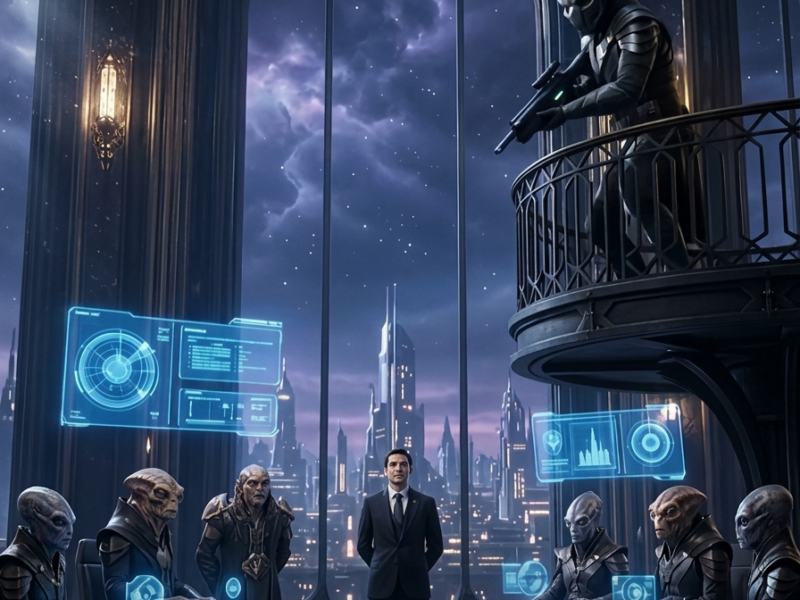
The assassin shot me in front of twelve alien ambassadors during the Galactic Peace Summit in Washington, D.C
The assassination attempt did not begin with dramatic music or a prolonged countdown; it began with the sharp, deafening shatter of reinforced quartz and the smell of ozone.
The Galactic Peace Summit was being held in the grand rotunda of the United States Capitol in Washington, D.C.—a neutral zone chosen because humanity was considered too insignificant to bias the proceedings. Twelve alien ambassadors sat around the massive circular mahogany table, their diverse anatomies taking up vast swaths of space. There were towering beings of silicon and light, aquatic diplomats hovering in anti-gravity tanks filled with synthetic ocean water, and predatory avian delegates whose plumage bristled every time someone raised their voice.
For three hours, they had debated whether humanity deserved a seat among the galaxy’s dominant civilizations. One delegate, a crystalline entity from the Kryon Cluster, had explicitly called us a species of temporary inconvenience—a footnote in galactic history whose primary export was noise and pollution. Another, a heavy-set reptile from the Varkhan Dominion, had sneered that our technology was little more than sharpened stones compared to their sub-space artillery.
I had said nothing. My name is Daniel Hayes, and until that afternoon, I was considered the most ordinary human in the Galactic Coalition. I had no glowing eyes, no armored skin, and no genetic enhancements like the elite warriors who guarded the summit hall. I was just a diplomat in a dark, off-the-rack suit, carrying a leather folder full of peace agreements and a small, framed photograph of my seven-year-old daughter, Chloe, tucked safely into my breast pocket.
Then the doors exploded inward.
A tall figure in sleek, obsidian-black armor stepped through the billows of white smoke, its four glowing crimson eyes fixed entirely on me.
“Human Ambassador Daniel Hayes,” it announced, its voice synthesized and metallic, cutting through the sudden pandemonium. “By order of the Sovereign Dominion, you are sentenced to death.”
Before the human guards could even draw their sidearms, before the alien security officers could activate their energy shields, the weapon in the assassin’s hands flashed. A blinding beam of searing blue plasma leaped across the room.
The shot struck me squarely in the center of my chest.
The sheer kinetic force hurled me backward against the heavy mahogany conference table, shattering crystal water pitchers and scattering diplomatic folders across the polished marble floor. Someone screamed—a high, piercing sound of pure terror. An aquatic diplomat thrashed wildly in its tank, splashing nutrient-rich liquid over the edge.
The assassin lowered its smoking weapon, its mission supposedly accomplished, and began to turn toward the shattered exit.
Then I looked down.
A thin, dark ribbon of smoke curled upward from a smoking, scorched hole right where my heart should have been. My dark wool jacket was charred around the edges, the fabric melted into a stiff, blackened crust. Slowly, deliberately, I reached up, brushed a little gray ash from my shirt collar, and raised my eyes to meet the assassin’s gaze.
“Was that it?” I asked. My voice sounded entirely too calm, cutting through the terrified silence of the chamber like a razor blade.
The assassin froze mid-stride. I heard the sharp intake of its mechanical breathing change inside the helmet, stuttering in genuine disbelief.
“That weapon can penetrate the armor of a Varkhan warlord,” the assassin whispered, its metallic voice trembling.
“Congratulations,” I said, casually straightening my tie with fingers that did not shake. “Do you have anything stronger?”
The chamber erupted into a chaotic storm of frightened murmurs and shrieks. The Varkhan delegates recoiled in horror, their scaly skin flushing dark purple.
The assassin fired again.
Flash. Flash.
Each blast struck my chest with thunderous impact, driving me backward step by step until my leather shoes scraped harshly against the marble floor. The heat was immense, searing the air around me, but when the assassin’s weapon finally clicked empty, clicking frantically on an empty power cell, I was still standing.
I glanced down at the ruined fabric of my suit.
“My daughter bought me this jacket for my promotion,” I said quietly, the warmth draining entirely from my tone. “I am going to have a very difficult conversation with her about your manners.”
Nobody laughed. Not the trembling guards, not the horrified alien dignitaries, and certainly not the assassin.
Because looking into my eyes, the assassin finally understood the terrifying truth. It wasn’t afraid of failing its mission anymore. It was suddenly, paralyzingly terrified of what would happen if it had actually succeeded.
The obsidian-armored figure stumbled backward, its metallic boots clacking against the shattered glass. Its glowing crimson eyes flickered erratically, as if the suit’s internal diagnostics were failing to process what its optical sensors were feeding it.
“No,” the assassin muttered, its voice dropping from a synthesized broadcast to a ragged, frantic whisper. “The intelligence dossiers… they said you were biologically ordinary. You were supposed to have the bone density of a standard terrestrial primate. You were supposed to burn like dry paper.”
I took a slow, deliberate step forward. The marble floor felt cold beneath my soles, grounding me in a reality that the rest of the room seemed to think was a waking nightmare.
“I am ordinary,” I replied, my voice steady, carrying an unnatural weight that seemed to press down on the chest of everyone in the room.
“Then what are you?” the assassin cried out, raising its empty weapon as if bludgeoning me with it might yield a different physical law.
For the first time that afternoon, I let the professional, polite smile leave my face entirely. My expression hardened into something carved from granite and frozen time.
“Someone who remembers,” I said.
Before the assassin could speak another word, the lighting inside the grand rotunda flickered violently. The warm, golden chandeliers overhead died instantly, replaced by the throbbing, crimson glare of emergency beacons. Every digital display, every holographic translator, and every diplomatic terminal in the chamber locked up simultaneously, flashing a single, ominous warning in bold crimson letters across their screens:
WARNING: RESTRICTED HUMAN ARCHIVE ACCESSED. LEVEL ZERO OVERRIDE.
The alien delegates shrank back into their seats, staring at me not as a helpless diplomat from a primitive species, but as something ancient, slumbering, and infinitely dangerous that had accidentally been poked with a stick.
I reached slowly into my breast pocket—the very pocket that had just absorbed three direct plasma blasts—and carefully retrieved the small, silver-framed photograph of my daughter. The glass was cracked down the middle, but Chloe’s bright, gap-toothed smile was still clearly visible beneath the torn, smoking fabric.
“I asked my government to bury this secret,” I murmured, my thumb gently tracing the edge of the photograph. “I begged the Council to let the galaxy believe humanity was weak, compliant, and content to sit at the children’s table while the big empires carved up the Orion Arm.”
The assassin sank heavily to its knees, its massive armor clattering against the floor. Its hands were shaking violently now, dropping the useless plasma rifle with a dull metallic thud.
“Please,” the assassin whispered, bowing its head toward the floor. “They told us your species had forgotten. They said the Great Purge broke your spirit.”
I looked up from the photograph, scanning the terrified faces of the twelve alien ambassadors. The Kryon crystal entity was shivering, its geometric facets fracturing under the sudden surge of ambient energy radiating from my skin.
“No,” I answered softly, the word echoing off the marble pillars of the Capitol. “We didn’t forget. We simply remembered what happened the last time we were pushed too far, and we decided we didn’t want to unleash that on the universe twice.”
Then, the heavy, blast-proof titanium doors of the summit chamber slammed shut and locked with a series of heavy hydraulic thuds. The manual overrides hissed and died, sealing us inside.
An overhead speaker crackled to life. The synthesized translation software was gone, replaced by a voice that was older, deeper, and unmistakably human. It was a voice that carried the weight of centuries, speaking directly through the Capitol’s secure military channel.
“Ambassador Hayes,” the voice said, cold and mechanical yet laden with an impending storm. “We have intercepted a tight-beam transmission from the Sovereign Dominion fleet orbiting Jupiter. They have located your daughter.”
For the very first time since the shooting began, my hands began to shake.
The photograph of Chloe slipped from my fingers, clattering softly against the floor. Because in that single, agonizing fraction of a second, the horrifying puzzle pieces clicked into place.
The assassin had never been sent to kill me.
It had been sent as a probe—a violent, calculated test to discover whether the greatest defense system humanity had ever built was still active, and whether I was still standing guard over the trigger.
The red emergency strobes painted the grand rotunda in dripping shades of crimson. The twelve alien ambassadors sat frozen in their seats, paralyzed by a terror far deeper than the fear of a lone assassin. They could sense it now—not just with their eyes, but through the subspace telepathic links and sensory arrays native to their races.
Earth was waking up.
Beneath the manicured lawns of Washington, D.C., beneath the oceans, beneath the tectonic plates of the Pacific and the ancient granite of the Canadian Shield, ancient dampening fields were failing. For three hundred years, humanity had played the part of the docile newcomer. We had signed treaties, surrendered territorial claims, and allowed ourselves to be patronized by civilizations that had existed for eons. We did it because our ancestors understood a fundamental truth that the arrogant galactic empires had forgotten: peace is only maintained when the monsters are kept safely chained in the dark.
“Ambassador Hayes,” the military voice continued through the encrypted comm-link, echoing off the marble walls. “Orbital defense grids in Sector Four have registered an unauthorized hyperspace jump at the edge of the solar system. A Dominion dreadnought fleet has cleared the Oort cloud.”
I closed my eyes for a fraction of a second, taking a deep, steadying breath. When I opened them, the warm brown of my iris was eclipsed entirely by a faint, pulsing ring of golden-white light. The genetic lock—the failsafe engineered into every human generation since the end of the Orion Wars—was dissolving.
“Status of the civilian evacuation protocols?” I asked, my voice carrying a resonant sub-harmonic frequency that made the water in the aquatic diplomat’s tank ripple violently.
“Incomplete, sir,” the voice replied grimly. “They hit the residential sector in New Philadelphia twenty minutes ago. Initial casualty reports indicate… primary targets compromised.”
A cold fury, vast and ancient, rushed through my veins. Chloe. My little girl, who loved drawing pictures of spaceships with crayons, who asked me every night when Daddy would come home from work. They had touched her. They had reached across the stars to pull the pin on a grenade they didn’t understand.
The kneeling assassin let out a pathetic whimper, pressing its helmeted head against the floorboards. “We didn’t know… the archives from the First Hegemony were sealed. They said humanity was a genetic dead end.”
“Your ancestors burned our colonies to ash because they feared our potential,” I said, stepping past the assassin as if it were nothing more than a discarded piece of trash. I walked slowly toward the center of the mahogany table, looking down at the cowering Kryon ambassador. “We offered you peace. We gave you diplomacy, trade agreements, and open borders. And you repaid us by testing our defenses with a plasma bolt aimed at my heart.”
The Kryon delegate’s crystalline form flashed a blinding white of pure panic. “We—we are members of the Coalition! You cannot wage war against the collective body of—”
“The Coalition is a nursery,” I interrupted, my voice cutting through its protests like a diamond saw. “And humanity is the architect that built the walls around it. You thought we integrated into your society because we needed your protection. You never stopped to consider that we were hiding you from ourselves.”
Around the room, the holographic displays shifted from the red warning screens to a live, real-time tactical feed streamed directly from the Department of Defense orbital command.
The twelve ambassadors gasped.
Projected in the center of the room was a three-dimensional holographic map of the Sol system. Where there had previously been a modest human defensive fleet of a few dozen patrol cruisers, the map now flickered and expanded. Hundreds, then thousands of massive geometric signatures blinked into existence. Ships that dwarfed the Varkhan dreadnoughts—vessels built not for exploration or diplomacy, but for absolute, systematic orbital annihilation—were uncloaking from the dark side of the gas giants.
These were the Cradle Ships. The relics of a species that had once conquered half the galaxy before voluntarily retiring to a quiet, backwater blue planet to forget its own power.
“My God,” whispered the avian ambassador, its feathers standing completely on end as it stared at the staggering armada. “You… you never disarmed. You just parked your fleets in the dark.”
“We didn’t want to use them,” I said quietly, reaching into my pocket to pick up the cracked photograph of Chloe. I brushed a speck of soot off her smiling face and tucked the picture safely back against my chest, right over the smoking wound that was already rapidly knitting itself back together beneath my ruined shirt. “We really, truly wanted to be civilized. But civilization, it turns out, requires a baseline of mutual respect.”
I turned toward the sealed blast doors, which were now humming with a high-voltage current, glowing a faint, ethereal blue as the human override protocols took total control of the Capitol building.
“Open the doors,” I commanded the secure channel.
“Destination, Ambassador?” the AI asked.
I looked back one last time at the trembling, terrified alien delegates who had spent three hours debating whether humanity deserved to exist.
“Earth isn’t asking for a seat at the table anymore,” I said, my eyes glowing fiercely in the red-lit room. “Call the fleet. Tell them the diplomatic mission is concluded. We’re going home to rescue my daughter—and then we’re going to have a very long conversation with the Sovereign Dominion.”
The heavy titanium doors hissed as they parted, sliding effortlessly into the thick reinforced walls of the Capitol rotunda. The chaotic sounds of Washington, D.C. rushed in—not the panicked sirens of a city under ordinary attack, but something far more orderly, far more terrifyingly efficient.
In the streets outside, the civilian populace was moving with mechanical precision. There was no screaming, no wild stampeding. Sirens wailed a low, rhythmic cadence that every human on the planet recognized from childhood safety drills: The Cradle is Open. Millions of citizens were walking calmly toward designated subterranean transit hubs, their faces set with a grim, chilling resolve. They had lived under the shadow of the galactic lie for generations—the comforting falsehood that humanity was weak, fragile, and in need of protection. Now, the mask had slipped.
I stepped out of the rotunda and into the grand marble hallway, my ruined suit jacket flapping slightly in the draft. Behind me, the twelve alien ambassadors remained trapped in the chamber, too terrified to follow, watching through the transparent archway as the true nature of human biology began to manifest.
My skin, scorched black by the assassin’s plasma rifle, was already shedding the dead carbon layers, revealing smooth, unblemished flesh underneath. The cellular regeneration protocols hardwired into human DNA—suppressed by generations of chemical dampers and psychological conditioning—were running at full capacity.
A sleek, black-ops armored transport hovered silently at the Capitol steps, its descent-fans whispering a low, sub-audible hum. The hatch slid open instantly upon my approach. Major Sarah Vance sat inside, clad in pitch-black tactical combat gear, her face illuminated by the green glow of a tactical tablet.
“Status, Hayes?” she asked sharply, not even looking up as I climbed aboard and settled into the jump seat.
“The probe test is complete,” I said, my voice cold and flat. “They hit New Philadelphia. They have Chloe.”
Sarah’s fingers froze on the tablet. She looked up, her eyes hard as flint. The friendly, cheerful intelligence officer she had pretended to be during our diplomatic briefings was entirely gone, replaced by the hardened veteran of a hundred forgotten skirmishes.
“The Prime Minister has already authorized General Order Zero,” Sarah said, her voice dropping an octave. “The orbital network is fully unmasked. Every defense satellite between here and the Kuiper Belt is hot.”
“Good,” I replied, pulling a heavy-duty tactical harness over my shoulders and clicking the magnetic locks into place. “I don’t want a blockade. I don’t want negotiations. I want a corridor straight to the Dominion’s core worlds. If they wanted a war with the species that built the stars, we should at least give them a proper introduction.”
The transport lifted off with a sudden, bone-crushing G-force acceleration that would have liquefied an ordinary, un-enhanced human. But my body absorbed the pressure effortlessly, my muscles and skeletal structure flexing and hardening to match the kinetic load. We shot straight up through the stratosphere, punching through the heavy cloud cover and leaving the blue expanse of Earth behind in a matter of seconds.
Through the reinforced quartz canopy of the transport, the true scale of humanity’s hidden power was revealed.
Orbiting Earth was not a modest fleet of defensive picket ships, but an endless, sprawling tapestry of industrial might and military terror. Thousands of colossal, ring-shaped Cradle Ships—structures large enough to swallow entire continents—were spinning up their sub-space drives. They weren’t warships in the conventional sense; they were world-builders and world-breakers alike, ancient engines of creation and destruction designed by a species that had colonized the Orion Arm long before the current galactic empires had even invented fire.
“They thought we were soft,” Sarah murmured, watching the sprawling armada illuminate the blackness of space with millions of pulsing blue plasma trails. “They looked at our open borders, our soft diplomacy, our polite requests for a seat at their little council table, and they thought we were supplicants.”
“Arrogance is a terminal disease,” I said, staring out at the vast fleet. I reached into my tactical vest, pulling out the slightly singed photograph of Chloe. I looked at her smile, anchoring my fury in the only thing that mattered in this vast, cold universe. “And the Dominion is about to experience a very painful cure.”
The transport docked smoothly with the flagship of the First Fleet—a massive vessel named The Dawn of Memory. As the airlock cycled open, an honor guard of twelve elite human operatives stood at attention. They wore no armor, no glowing energy shields, and no decorative uniforms—just simple dark tactical suits, identical to the one I wore. But as I stepped past them, every single one of them saluted, their eyes glowing with that same unmistakable, suppressed golden-white light.
“Ambassador Hayes,” the ship’s artificial intelligence greeted me as the bridge doors slid open. “Hyperspace window calculated. Trajectory locked onto the Sovereign Dominion’s capital sector. Fleet readiness is at one hundred percent.”
I walked to the center of the command dais, looking out at the massive viewport that framed the infinite, starry void. Behind us, the blue marble of Earth shone brightly—a peaceful, quiet cradle hiding an absolute storm.
“Engage,” I commanded.
The transition from real space to hyperspace did not produce the gentle, shimmering tunnels depicted in galactic holovideos. When the Cradle Ships engaged their drives, the fabric of spacetime simply groaned, folding inward under the unimaginable gravity-well generators developed during the twilight of the Orion Wars. The stars outside the viewport stretched into long, blinding lances of white light before snapping into a deep, velvety violet.
On the bridge of The Dawn of Memory, the atmosphere was eerily quiet. There were no frantic shouts, no rushed orders, and no hesitation. Every crew member operated with the cold, practiced efficiency of a machine that had been designed for a single, overarching purpose: the preservation of order through absolute deterrence.
Major Sarah Vance stood beside the central tactical console, her fingers dancing across the glass surface as telemetry data streamed in from our vanguard scouts.
“We’ve exited hyperspace in the Vanguard sector, right on the doorstep of the Sovereign Dominion’s core worlds,” Sarah reported, her voice calm and measured. “Their automated defense networks are pinging our signature, but their local garrison fleets are scrambling in complete disarray. They didn’t expect us to cross interstellar distances in under six minutes.”
“They expected us to cower,” I said, standing before the massive viewport as the obsidian-and-gold architecture of the Dominion’s capital world, Oros Prime, filled the screen.
It was a magnificent, arrogant metropolis of towering spires and orbital ring-stations that spanned the entire circumference of the planet—a monument to centuries of unchallenged galactic hegemony. For generations, the Dominion had lorded over weaker species, dictating trade, imposing taxes, and occasionally wiping out dissenting colonies to remind the galaxy of their absolute supremacy.
They had viewed humanity as a charmingly naive newcomer—a species of cute, emotional primates who made good artists and polite diplomats, but who lacked the stomach for real interstellar power.
They were about to learn how wrong a civilization could be before it ceased to exist.
“Open all hailing frequencies across the public galactic broadcast network,” I ordered.
“Channels open, Ambassador,” the ship’s AI confirmed. “Every sentient receiver from here to the Kryon Cluster is currently tuned to this broadcast.”
I stepped closer to the primary communications array, letting the camera capture every detail: the simple dark suit, the slight scorch mark on the lapel where the plasma bolt had hit me, and the cold, unyielding fire in my eyes.
“Citizens of the Galactic Coalition,” I began, my voice carrying across trillions of miles, instantly translating into every known dialect in the galaxy. “This is Ambassador Daniel Hayes of Earth.”
Across the galaxy, billions of beings—in quiet homes, in bustling spaceports, and in the trembling halls of the Senate—stopped what they were doing.
“Three hours ago,” I continued, my tone even and devoid of theatrical anger, “an assassin sent by the Sovereign Dominion walked into a peace summit in Washington, D.C., and shot me in the chest with a heavy plasma rifle. They did it to test our limits. They did it to see if humanity was still bound by the laws of fragile biology, and whether we were still willing to play the part of the quiet, obedient neighbor.”
I reached into my breast pocket and pulled out the small, singed photograph of Chloe, holding it up so the entire galaxy could see her smiling face through the cracked glass.
“They also took my daughter from her home in New Philadelphia. They thought that by holding a child, they could chain the beast they foolishly thought was dead.”
I lowered the photograph, my gaze locking onto the massive planetary shield generators of Oros Prime that were desperately trying to power up on the viewport before us.
“Humanity did not forget the Orion Wars,” I said, and across the void, millions of ancient defense networks began to hum in unison. “We simply grew tired of the violence. We wanted peace. We wanted to build schools, write poetry, and watch our children grow up under a quiet sun. But if the price of your peace is our silence, and if the price of your dominance is our children…”
I paused, letting the silence stretch across the galaxy like a drawn blade.
“…then let there be no mistake. We are not ordinary. We are the architects. And we are coming home.”
With a subtle flick of my wrist, I pressed the primary authorization seal on the command console.
Behind us, thousands of Cradle Ships opened their massive kinetic-induction gates. There were no particle beams, no theatrical explosions, and no flashing energy weapons. Just the raw, unadulterated weight of physics—massive, planet-shaking kinetic slugs launched at a fraction of the speed of light, carrying the kinetic fury of a thousand dying suns.
The planetary shields of Oros Prime flared brilliantly for a single microsecond against the incoming impact, turning a blinding shade of violet before shattering like cheap glass under a hammer.
As the first shockwaves rippled across the surface of the Dominion’s capital, signaling the absolute, irreversible end of an empire’s arrogance, I turned away from the viewport and looked at Sarah.
“Set a course for the detention sector in New Philadelphia,” I said softly, sliding the photograph of Chloe back into my breast pocket. “It’s time to bring my daughter home.”
The end









