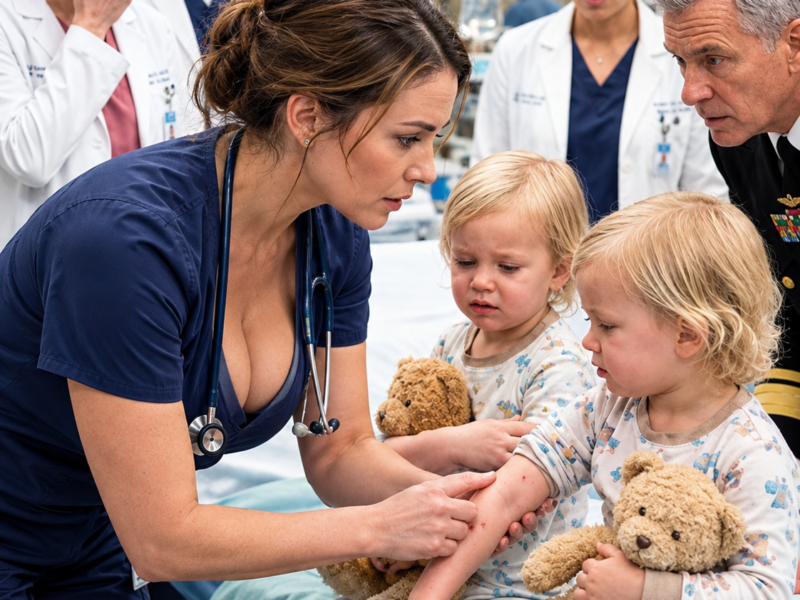
“The Admiral’s six-year-old twins had been rushed to three different hospitals, and every specialist insisted their pain had no medical explanation
The words came out of Noah’s mouth so quietly I almost missed them.
“That’s not Mommy.”
I looked down at him. His small fingers had twisted into the fabric of my scrub top, and his eyes were fixed on the woman approaching Room 412.
“Are you sure?” I whispered.
He nodded hard enough to make his dark hair fall across his forehead.
Nathan had gone completely still in the bed behind us.
The woman looked exactly like the photographs Admiral Hayes had shown me earlier that afternoon. Same chestnut hair. Same narrow face. Same small crescent-shaped scar near her eyebrow.
Same face as the woman who had supposedly died two years ago.
She carried a brown paper bag in one hand and wore a pale blue coat. Her expression was gentle, almost maternal, as she glanced toward the boys.
“Richard,” she called.
The admiral turned.
For the first time since I had met him, his face softened completely.
“Laura.”
He crossed the waiting area toward her.
I felt Noah’s grip tighten.
“Please,” he whispered. “Don’t let her take us.”
I stepped between the twins and the doorway.
“Mr. Hayes,” I called, keeping my voice steady. “Could I speak with you for a moment?”
The admiral stopped, surprised.
The woman’s smile disappeared.
It lasted only a second, but I saw it.
Then she smiled again.
“Is something wrong with the boys?” she asked.
“I’d like to discuss that privately,” I said.
The admiral glanced from me to the woman. “Claire, this is a family matter.”
“I understand. But Noah and Nathan are my patients.”
Her eyes moved to the boys.
“Hello, sweetheart,” she said softly. “Aren’t you going to say hello to Mommy?”
Nathan began to cry.
That was enough.
“Security,” I said into the radio clipped to my uniform. “I need assistance outside Room 412.”
The woman’s expression changed.
Not fear.
Anger.
“You have no idea what you’re doing,” she said.
The admiral stared at me. “Claire, stop this.”
I looked at him.
“Sir, your sons have been telling us someone is frightening them. They have marks on their bodies that nobody has documented. Their pain episodes happen at specific times, and they’ve been begging us not to let someone come back.”
His face drained of color.
“What marks?”
I gently lifted Noah’s wrist, showing him the four purple dots beneath the hospital bracelet.
He stared at them as though he had never seen them before.
The woman took one step forward.
“They bruise easily,” she said. “You’re making this into something it isn’t.”
Noah flinched.
The admiral noticed.
For a moment, the entire hallway seemed to hold its breath.
Then he turned toward her.
“Laura, what is she talking about?”
She lowered the paper bag.
“Richard, the boys have been confused since their mother died. You know that. They need routine. They need familiar people.”
“You said you were coming to visit them,” he replied.
“I am.”
“Then why are they afraid of you?”
Her mouth opened, but no answer came.
Two security officers arrived. I asked them to remain nearby without approaching the boys.
The woman looked at the officers, then at the admiral.
“You’re really going to let a nurse interfere with your family?”
The admiral’s jaw tightened.
“I’m going to find out why my sons are afraid.”
She looked at him for a long second.
Then she turned and walked toward the elevators.
One of the officers followed at a distance.
I expected relief.
Instead, Nathan started shaking.
“She’ll come back,” he whispered.
I crouched beside him.
“Not without us knowing. I promise.”
But I knew promises were dangerous things when children had already learned that adults could break them.
I turned to the admiral.
“Sir, I need you to tell me exactly who that woman is.”
He stared at the elevator doors.
“Her name is Laura Hayes,” he said. “She’s my wife.”
I glanced at the family photograph on the counter.
“Your wife died two years ago.”
“I know what I told you.”
His voice cracked on the last word.
“And I need you to understand something. I believed it.”
***
The hospital administrator arranged a private consultation room. A pediatric social worker joined us, along with the attending physician, Dr. Patel.
The twins remained in their room with a second nurse and a child-life specialist. They were frightened, but they agreed to stay after I told them I would not leave without explaining where I was going.
The admiral sat at the end of the table.
His hands were clasped so tightly that his knuckles had turned white.
“I need to start at the beginning,” he said.
Nobody interrupted.
“Two years ago, I was deployed overseas. My wife, Laura, was driving the boys home from my sister’s house when their car went off the road. The vehicle caught fire. The authorities told me she had died at the scene.”
He swallowed.
“The boys survived. They were in the back seat. They had minor injuries, but they were badly shaken. I was notified after the incident. By the time I got home, the funeral had already happened.”
Dr. Patel leaned forward.
“Did you see her body?”
“No.”
“Did you identify her?”
“No. The military handled the notification, and my sister arranged everything. I was overseas. I was told there had been a positive identification through dental records.”
“Who told you?”
“My sister, Margaret. She said she had spoken with the authorities.”
He rubbed his forehead.
“I couldn’t question every detail. I was grieving. The boys were grieving. I accepted what I was told.”
“And the woman who came today?” the social worker asked.
He looked up.
“Laura.”
“Could she be someone who resembles your wife?”
“No.” His answer was immediate. “I know my wife.”
The room fell silent.
“Then why did you believe she was dead?” I asked.
He stared at me.
“Because Margaret told me.”
I remembered the name from the boys’ admission paperwork.
Margaret Hayes was listed as their emergency contact.
“Is she the boys’ aunt?” I asked.
“My older sister.”
“Does she live nearby?”
“She lives about twenty minutes away. She helped raise the boys after Laura died. She also recommended Patricia, the caregiver who left three weeks ago.”
The social worker made a note.
“Did Margaret ever tell you that Laura might still be alive?”
“No.”
“Did she know you were bringing the boys here?”
“Yes. She called this morning. She said she was worried about them.”
The admiral looked suddenly sick.
“Wait.”
He reached into his jacket and pulled out his phone.
“She told me she was going to visit them tonight.”
He looked at the screen.
“She said she was bringing something for them.”
I thought of the brown paper bag.
“What was in it?”
“I don’t know.”
He began to dial.
The social worker put a hand up.
“Before you call anyone, let’s make sure we understand what’s happening. We need to protect the children and avoid giving anyone an opportunity to influence their statements.”
He slowly lowered the phone.
Dr. Patel turned toward me.
“Claire, tell us exactly what the boys said.”
I described the pain episodes, the four purple dots, the drawing, and the repeated references to a woman who came when the clock made a noise.
When I mentioned the words on the back of the drawing, the admiral covered his face.
“WE DID WHAT SHE SAID,” he whispered.
He looked up.
“What did they do?”
“I don’t know.”
The social worker spoke gently.
“We shouldn’t pressure them. A trained child-protection interviewer can speak with them in a safe, neutral setting.”
The admiral nodded.
Then he looked at me.
“You said they were afraid of someone coming back.”
“Yes.”
“Did they say who?”
“No. Not directly.”
He stared at the table.
“I should have noticed.”
I wanted to tell him that parents missed things, that grief could make even intelligent people overlook the obvious.
But something about his expression stopped me.
He wasn’t simply blaming himself.
He was remembering.
***
At 8:40 p.m., a child-protection specialist named Dana arrived.
She asked the boys to speak separately, with no family members in the room. I waited outside with the admiral.
He paced the corridor for nearly twenty minutes.
Finally, the door opened.
Dana stepped out.
“Mr. Hayes, could you come in?”
He looked at me before following her.
I stayed in the hall, where I could see the doorway but not hear the conversation.
When he came out again, he looked ten years older.
“What did they say?” I asked.
He sat down.
“They said the woman who visited them wasn’t their mother.”
I waited.
“They said she told them she was Mommy’s sister.”
I frowned.
“Your sister?”
“No.” He shook his head. “Laura had a sister. Her name was Elise. She died when she was a teenager.”
He rubbed his hands over his face.
“The boys said the woman told them she was Elise. That she had come back because she missed them.”
“Did they know her before?”
“Apparently. They said she visited the house when I was deployed. She wore Laura’s clothes and told them it was a game.”
My stomach tightened.
“What kind of game?”
He looked at me.
“They were told to call her Mommy. They were told that Daddy would be sad if they didn’t.”
I felt cold.
“Did they say anything about the pain?”
He nodded.
“Dana asked them about the purple marks. They said the woman pressed something against their wrists. She called it a reminder.”
The admiral stood up abruptly.
“I want her arrested.”
“That isn’t something we can decide here,” I said carefully. “But the hospital can document what we’ve found and make sure the proper authorities are involved.”
He looked toward the boys’ room.
“They’ve been hurting for three weeks.”
“I know.”
“And I thought it was anxiety.”
I didn’t have an answer.
He turned away.
“Patricia was there too. She must have known.”
“Maybe. We need to let the investigators determine what she knew.”
The admiral stared at the floor.
Then he said something that made my heart sink.
“Margaret hired Patricia. Margaret said she was the only person who could keep the boys calm.”
***
The twins’ medical results remained reassuring. Their bloodwork showed no sign of infection, and their imaging had revealed no obvious internal injury. But Dr. Patel was no longer satisfied with calling the symptoms stress-related.
He ordered a fresh examination and asked the hospital’s child-protection team to document every mark.
The four purple dots on each wrist were arranged with unsettling precision. They weren’t bruises from ordinary play. The skin around them showed tiny areas of irritation, as though something had been pressed against it repeatedly.
The doctor photographed them and collected the appropriate samples.
While he worked, Noah watched him carefully.
“Are you going to make them go away?” he asked.
“We’re going to find out what caused them,” Dr. Patel answered.
Noah considered that.
“Can you make the clock stop?”
Dr. Patel glanced at me.
“What clock, buddy?”
“The one that tells her when to come.”
Nathan rolled onto his side.
“It isn’t a real clock,” he whispered. “It’s the sound on Daddy’s phone.”
The admiral went still.
“My phone?”
Noah nodded.
“Every time it makes the little song, she comes.”
The admiral took his phone out.
He opened his settings and looked at the notifications.
There was a recurring reminder scheduled for 6:30 p.m.
The label read: **GIVE THE BOYS THEIR VITAMINS.**
He stared at it.
“I didn’t set this.”
He checked the details.
The reminder had been created on a day when he was at work. It had been synced from a shared family account.
“Margaret,” he said.
He looked up at me.
“She had access to the family calendar. She helped manage the house while I was deployed.”
The nurse beside us asked if he wanted the reminder disabled.
He nodded.
When the sound stopped, Nathan’s shoulders loosened.
For the first time since I had met him, he took a full breath.
***
At 10:15 p.m., the hospital received a call from the police.
The woman who had introduced herself as Laura Hayes had been stopped in the parking garage. She had provided identification under the name Elise Warren.
The photograph on the identification matched the woman from the hallway.
But the name meant nothing to the admiral.
He searched his memory.
Then his face changed.
“That’s the name of Laura’s sister.”
I looked at him.
“You said her sister died.”
“She did.”
He sat down slowly.
“Or I thought she did.”
He explained that Laura had once had an older half-sister named Elise. The two had been estranged for years. Elise had struggled with addiction and had disappeared from the family after a series of incidents. Laura rarely spoke about her.
“Why would she pretend to be Laura?”
“I don’t know.”
“Did she have a reason to be around the boys?”
He shook his head.
“Not without permission.”
The police asked the admiral to come downstairs and identify the woman.
He hesitated.
Then he looked toward the twins.
“I don’t want them to see her again.”
“They won’t,” Dana assured him. “We’ll keep them separate.”
He left with the officers.
I stayed beside the boys.
Nathan was asleep.
Noah was awake, watching the door.
“Is Daddy coming back?”
“Yes.”
“Is he going to be mad?”
“Noah, listen to me. You are not in trouble.”
He looked down at his wrist.
“But we did what she said.”
I pulled a chair closer.
“What did she ask you to do?”
He was quiet for a long time.
“Take the little medicine.”
My chest tightened.
“What medicine?”
“The one in the bag.”
He looked toward Nathan.
“She said it would make our tummies quiet. She said we had to take it when the clock sang.”
I kept my voice calm.
“Did you take it?”
“Sometimes.”
“How many times?”
He held up three fingers.
“Three nights.”
I didn’t ask anything else.
I pressed the call button and told Dr. Patel and Dana what Noah had said.
The brown paper bag.
The recurring reminder.
The unexplained pain.
The samples collected from the marks.
Suddenly, all of it seemed connected.
Dr. Patel ordered additional toxicology testing. The hospital’s safeguarding team notified the appropriate authorities. The boys would remain under observation, and no medication or food from outside the hospital would be given to them without medical review.
I sat beside Noah until his eyes finally closed.
For the first time that night, he let go of my hand.
***
The admiral returned shortly after midnight.
He looked exhausted.
“It’s Elise,” he said. “The police confirmed her identity.”
“What did she tell them?”
“That she was helping the boys. That she was visiting them because she believed Laura would have wanted her to.”
He shook his head.
“She said the boys were confused and that she was trying to preserve their connection to their mother.”
“That doesn’t explain the marks.”
“No.”
“Or the medicine.”
“No.”
He lowered himself into the chair.
“They found several bottles in her car. None were prescribed to the boys. The officers took them for testing.”
“Did she say who gave them to her?”
“She said Margaret did.”
The admiral’s face hardened.
“She claimed my sister told her the boys had become difficult since Laura’s death. That they were having nightmares and stomach problems. Margaret supposedly said they needed something to calm them down.”
“Did Elise admit to giving them the medicine?”
He nodded.
“She said it was a mild supplement.”
“Did she know what was in it?”
“She claims she didn’t.”
I thought of the tiny marks beneath the boys’ bracelets.
“And the dots?”
“She said she used a small device to mark the boys so she could tell if they’d taken the medication.”
I felt sick.
The admiral stared at the wall.
“She told the police she was only trying to help.”
“People can call something help even when it hurts someone.”
He closed his eyes.
Then he asked, “Do you think they knew she wasn’t their mother all along?”
I looked through the glass at the two small beds.
“I think they knew something was wrong. I think they were trying to tell us in the only way they knew how.”
He nodded slowly.
“I should have listened.”
I didn’t argue.
***
At 1:30 a.m., the laboratory called.
The initial testing had identified a medication in the samples collected from the boys. It was not a supplement. It was a prescription drug that could cause abdominal discomfort, nausea, and other symptoms when given improperly.
The doctor wouldn’t discuss the full findings until the confirmatory testing was complete.
But it explained why the twins’ symptoms had started after Patricia left.
It also explained why their pain had appeared at predictable times.
Someone had been giving them something they shouldn’t have been taking.
The police obtained permission to examine the medication bottles from Elise’s car. They also began looking into the family’s shared accounts, financial records, and the circumstances surrounding Laura’s death.
The admiral sat beside the boys’ beds, watching them sleep.
At some point, he took Noah’s hand.
“I am sorry,” he whispered.
I pretended not to hear.
There are moments when a parent needs to speak to a child without an audience.
***
By morning, the hospital had become a place of quiet activity.
A social worker met with the admiral. A child-protection physician completed the medical assessment. The police interviewed staff who had been involved in the boys’ care.
Patricia was located at her apartment.
She initially denied knowing anything about the medication. But when investigators showed her photographs of the four-dot marks, she broke down.
She admitted that Elise had asked her to help administer a powder mixed into the boys’ evening drinks. Patricia said she believed it was a doctor-approved treatment for anxiety.
She had never seen a prescription.
When she began asking questions, Elise told her the boys’ father had authorized it.
Patricia quit three weeks earlier after one of the twins became violently sick and she became frightened.
She hadn’t reported it.
She said she was afraid of losing her job and didn’t know whom to trust.
It wasn’t a good excuse.
But it was the first piece of the story that explained why the twins had started saying the woman was coming back.
Patricia had left.
Elise had continued visiting.
And Margaret had arranged the entire system.
The police requested a meeting with the admiral.
He agreed.
Before leaving, he stopped beside me.
“Claire, if you hadn’t noticed those marks—”
“Someone else might have.”
“But you did.”
I glanced at the boys.
“They were trying to tell us.”
He nodded.
Then he walked away.
***
At noon, the admiral returned with news.
Margaret had been questioned.
At first, she denied arranging the visits or providing any medication. Then investigators showed her the messages recovered from Elise’s phone.
There were dozens.
Some were about household schedules. Others discussed the boys’ behavior.
One message, sent three weeks earlier, read:
**If they start asking questions, remind them their father could disappear again. They can’t afford to lose another parent.**
Another read:
**Keep the routine. The sound on Richard’s phone will tell you when to give it to them.**
The admiral read those messages in silence.
Then he handed the phone back to the detective.
“Why?” he asked.
The detective didn’t pretend to know.
“That’s what we’re trying to establish.”
But the admiral had an idea.
He told us that Margaret had always believed she should have been the person raising the boys. She had been the one who arranged Laura’s funeral, handled the household during his deployment, and helped him after he returned.
After Laura’s death, she had become increasingly involved in every decision.
When he announced that he was changing assignments to spend more time with his sons, Margaret had argued that he was being selfish.
She had said the boys needed stability.
She had said he didn’t know how to raise them alone.
“She made herself indispensable,” he said.
“And when you began taking back control?”
“She fought it.”
He stared at the recovered messages.
“I thought she was grieving with us.”
He looked toward the boys.
“I never imagined she was using that grief to control them.”
***
The most difficult conversation happened that afternoon.
The twins were awake, sitting side by side on the bed. Noah was drawing with a box of crayons. Nathan was holding a stuffed blue whale a volunteer had brought him.
The admiral stood in the doorway.
“Can I come in?”
Noah looked at Nathan.
Then he nodded.
Their father sat between them.
“I need to tell you something,” he said.
The boys watched him.
“You were right to tell Claire that the woman who came to see you wasn’t Mommy.”
Noah’s crayon stopped moving.
“You’re not angry?”
“No.”
“Not even because we called her a liar?”
The admiral shook his head.
“You did the right thing.”
Nathan looked at him.
“She said you would go away if we told.”
The admiral closed his eyes for a moment.
“I am sorry she made you believe that.”
He reached for their hands, but didn’t force them to take his.
“I am not going anywhere.”
Noah studied his face.
“Even if we tell you more?”
“Especially then.”
Nathan began to cry.
The admiral pulled him gently into his arms.
Noah waited a few seconds before leaning against his father’s shoulder.
I turned away.
Not because I didn’t want to see it.
Because I did.
***
The investigation continued for weeks.
The hospital confirmed that the boys’ symptoms were consistent with exposure to the medication found in the samples. Their condition improved after the substance was discontinued, and the abdominal pain gradually disappeared.
The marks on their wrists faded.
Elise was charged in connection with the unauthorized administration of medication and the harm caused to the children. Margaret faced separate charges related to her role in arranging the visits and supplying the medication. Patricia cooperated with investigators and was investigated for her part in the events.
The police also reopened questions surrounding Laura’s death.
The original accident records had inconsistencies. The dental identification had been based on records supplied through a private intermediary, and investigators were now examining whether the identification had been properly verified.
No one told the boys that their mother might still be alive.
There was no evidence to support that hope.
The woman in the family photographs was Laura. The woman who had appeared at the hospital was Elise, her half-sister, who had deliberately copied her appearance.
For now, that was the truth the boys needed.
The rest belonged to the investigators.
***
Three days after their admission, Noah and Nathan were cleared to leave the hospital.
Before they went, Noah asked if he could see me.
I found him sitting on the edge of the bed, holding the drawing he had hidden beneath his pillow.
He had added something to it.
The two stick figures still held hands beside the house with the red door. But now there was a third figure standing beside them.
A taller figure with a small circle for a head and a large blue shirt.
“Who’s that?” I asked.
“Daddy.”
I smiled.
“And where are you going?”
He pointed to the house.
“Home.”
I looked at the drawing again.
“What about the red door?”
Noah thought for a moment.
“Daddy said we’re going to paint it a different color.”
“Which color?”
“Blue.”
Nathan climbed off the bed and came over.
“Because blue is safe,” he explained.
I felt something tighten in my throat.
“That’s a good color.”
Noah handed me the drawing.
“Can you keep it?”
I looked at him.
“Are you sure?”
He nodded.
“So you remember we told.”
I folded the paper carefully and placed it in the pocket of my scrub top.
“I’ll remember.”
The admiral came in carrying two small backpacks.
He looked tired, but his eyes were clearer than they had been the night before.
“Ready, gentlemen?”
Nathan nodded.
Noah reached for his father’s hand.
Then he looked back at me.
“Claire?”
“Yes?”
“Will you tell other kids if they say something is wrong?”
I crouched in front of him.
“I will listen.”
He seemed satisfied with that.
Then he took his father’s hand, and the three of them walked toward the elevators.
***
A month later, I received a letter at the hospital.
It was written in careful handwriting, with several words crossed out and rewritten.
Inside was a photograph.
The twins stood on either side of their father in front of a small blue door. Both boys were smiling. The admiral had one arm around each of them.
On the back, Noah had written:
**WE DON’T HAVE TO BE QUIET ANYMORE.**
I placed the photograph beside my desk.
That evening, I thought about the first day they had arrived.
Two little boys with normal scans, normal bloodwork, and pain nobody could explain.
Doctors had looked at organs and numbers. Specialists had searched for patterns in test results.
And all the while, the answer had been hiding in the things the boys were too frightened to say.
A sound on a phone.
A woman at the door.
Four tiny purple marks.
A drawing folded beneath a pillow.
Sometimes the most important evidence isn’t the thing a machine can measure.
Sometimes it’s a child holding your sleeve and whispering that something isn’t right.
And sometimes, the first step toward saving them is simply believing them.
The end.









