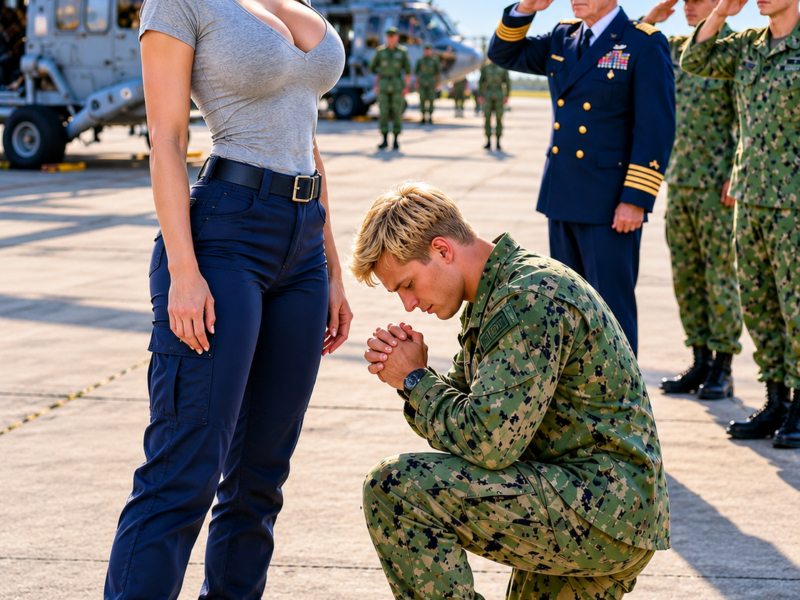
“The admiral had just ordered me removed from the command briefing in front of thirty senior officers, calling me an administrative mistake who had wandered into the wrong room
The admiral didn’t answer my question immediately.
He was still staring at the second document I’d placed on the conference table.
“Commander Carter,” he finally said, “I want you to explain exactly what I’m looking at.”
I pulled out the chair opposite him but didn’t sit down.
“Three weeks ago, a classified operational review identified a serious security breach involving the mission scheduled for tomorrow morning. The review was conducted independently of this command.”
Hayes glanced at Captain Mitchell.
“Why wasn’t I informed?”
“Because your command was part of the investigation, sir.”
The room became uncomfortably quiet.
One of the rear admirals near the windows leaned forward.
“Are you saying someone on this staff compromised the operation?”
“I’m saying the evidence indicates that someone with access to restricted mission information has been sharing details outside authorized channels.”
Hayes slowly lowered the document.
“That’s a serious accusation.”
“Which is why I’m not making it without evidence.”
I opened my folder and removed three photographs.
The first showed a naval transport vessel leaving a restricted harbor.
The second showed a maintenance team working beneath its port-side communications array.
The third was a photograph of a printed operational schedule sitting on a desk.
The admiral studied them.
“What am I supposed to be seeing?”
I pointed to the final photograph.
“The schedule was photographed at 9:17 p.m. on October 12. It contains information that was not released to the wider command until October 14.”
“That is impossible.”
“That’s what we initially thought.”
I turned the photograph toward the other officers.
“Someone had access to the mission’s original planning documents before the official briefing. The same information appeared in a message recovered from an unauthorized device two days later.”
A commander near the wall shifted in his seat.
I noticed.
I also noticed that he wasn’t looking at the photographs.
He was looking at the admiral.
His name was Commander Daniel Brooks.
He had served under Hayes for six years and was widely considered one of the admiral’s most dependable officers.
“Do you have evidence that the information actually left this building?” Brooks asked.
His voice was controlled, almost casual.
I looked at him.
“We do.”
“What kind?”
“An intercepted communication, a timestamped access record, and a copy of the original document.”
“Then why haven’t you brought the evidence to the proper authorities?”
“I have.”
I paused.
“You’re sitting in the room where the final stage of that investigation is supposed to take place.”
Brooks leaned back.
Hayes looked increasingly irritated.
“Commander, I appreciate whatever work you’ve done, but this command doesn’t operate on anonymous suspicions and photographs.”
“Neither do I, Admiral.”
I reached for the sealed envelope.
“That’s why I brought the authorization.”
He looked at the first page again.
Then his eyes moved to the signature at the bottom.
His expression changed.
“Where is the director?”
“On his way.”
“Which director?”
Before I could answer, the conference room door opened.
A civilian man in a dark navy suit entered with two uniformed officers.
He was in his late fifties, with a thin silver watch and the tired expression of someone who had spent too many years dealing with classified emergencies.
“Good morning, everyone,” he said.
Hayes stood.
“Mr. Bennett. I wasn’t informed you would be attending.”
“That was intentional, Admiral.”
The man approached me and extended his hand.
“Commander Carter.”
“Mr. Bennett.”
He placed a black folder on the table.
“I assume you’ve briefed them on the preliminary findings?”
“Only enough to explain why the meeting needs to change direction.”
“Good.”
He turned toward the room.
“My name is Thomas Bennett. I represent the Naval Inspector General’s special investigative office. Effective immediately, this briefing is no longer an operational approval meeting. It is an investigative proceeding.”
The reaction was immediate.
A few officers exchanged glances.
Someone quietly closed a laptop.
Hayes remained standing.
“You’re turning an operational briefing into an investigation without consulting the commanding admiral?”
Bennett looked at him.
“Admiral, the investigation has already been authorized at a higher level.”
“And Commander Carter is leading it?”
Bennett glanced at me.
“Commander Carter is the designated operational liaison and lead field investigator for this matter.”
For a moment, nobody moved.
Then Hayes slowly returned to his chair.
I had seen that reaction before.
It was the moment someone realized that the person they had dismissed was not there by accident.
But I wasn’t interested in watching the admiral struggle with his pride.
There were people whose lives depended on what happened next.
I opened my folder again.
“Tomorrow’s mission involves a joint naval exercise with two allied vessels. The exercise itself is routine. The route, however, has been modified twice in the last seventy-two hours.”
Bennett nodded.
“Continue.”
“The first modification was approved through normal channels. The second was entered into the system using credentials belonging to an officer who was officially on medical leave.”
Hayes frowned.
“Whose credentials?”
I placed a printed access report on the table.
“Captain Michael Reynolds.”
Several people looked toward the empty chair near the windows.
Reynolds was the operations officer responsible for coordinating the exercise.
He was also the man who had personally signed the original mission schedule.
“Where is Captain Reynolds?” Hayes asked.
“At his residence,” I replied. “He was placed on administrative leave pending an interview.”
Brooks spoke again.
“That doesn’t establish misconduct. His credentials could have been used by someone else.”
I turned toward him.
“That’s correct.”
I watched him carefully.
“Which is why we examined the access logs.”
I placed another sheet beside the first.
“Captain Reynolds’ credentials were used from a terminal located inside this building. At the time, the system recorded a physical access card entering the same restricted area.”
Hayes leaned forward.
“Whose card?”
I looked at the paper.
Then I looked around the room.
“That’s the part I wanted to discuss before the briefing began.”
Nobody spoke.
I read the name.
“Commander Daniel Brooks.”
The silence was immediate and absolute.
Brooks stared at me.
Then he gave a short laugh.
“That’s absurd.”
“I understand.”
“That card was reported missing two weeks ago.”
“Was it?”
His expression tightened.
“I filed the report myself.”
I nodded.
“We have a copy.”
I placed it on the table.
“Unfortunately, the report was filed three days after the first unauthorized access.”
Brooks stood.
“Are you accusing me of stealing operational information?”
“I’m asking you to explain why your access card was used to enter a restricted terminal room while another officer’s credentials were being used to modify a mission schedule.”
“Anyone could have taken my card.”
“That’s possible.”
I didn’t raise my voice.
“Which is why I haven’t made an accusation.”
Brooks looked toward Hayes.
“Admiral, surely you’re not going to let this continue.”
Hayes didn’t answer.
He was staring at the access report.
For the first time since I had entered the room, he seemed to be listening instead of defending his authority.
Bennett closed his folder.
“Commander Brooks, please remain seated. We’ll arrange a formal interview.”
Brooks didn’t sit.
“With all due respect, this is a circus.”
One of the investigative officers stepped closer.
“Sir, please.”
Brooks looked at the door.
Then he looked at me.
“You have no idea what you’re getting yourself into.”
I had heard that sentence more times than I cared to remember.
Usually from people who believed intimidation was a substitute for an explanation.
I kept my eyes on him.
“Then help me understand.”
He said nothing.
Finally, he sat down.
The meeting continued for another forty minutes.
We reviewed the access records, the intercepted message, and the two versions of the mission schedule.
The evidence was concerning, but it wasn’t complete.
I knew that.
And I knew better than to confuse suspicion with proof.
By the time the officers were dismissed, Hayes remained seated at the head of the table.
I was gathering my documents when he spoke.
“Commander Carter.”
“Yes, sir?”
“Stay a moment.”
Bennett looked at me.
I nodded.
He left with the investigative team.
The door closed.
For several seconds, Hayes stared out the window at the harbor.
Then he spoke.
“I owe you an apology.”
I stopped organizing my papers.
“Sir?”
“What happened at the door. The way I treated you.”
I didn’t immediately respond.
He turned toward me.
“I saw your rank, made an assumption, and decided you didn’t belong in my briefing. I didn’t even bother to read the entire authorization.”
“Yes, sir.”
“I was wrong.”
There was something uncomfortable about hearing an apology from a man who had spent the morning trying to humiliate me.
Not because I didn’t appreciate it.
Because I wondered how many other people had stood in front of him and never received one.
“Thank you, Admiral.”
He nodded.
Then his expression became more serious.
“There’s something else.”
I waited.
“Three weeks ago, I received a confidential warning that someone might be attempting to compromise this exercise. I was instructed to limit distribution until the source could be verified.”
“Who sent it?”
“An unidentified number.”
“Did you report it?”
“I forwarded it to our security office.”
“Did you preserve the original message?”
He hesitated.
“I believe so.”
“Admiral, I need to see it.”
He opened a drawer and removed a small encrypted tablet.
“I kept a copy.”
He turned it toward me.
The message was short.
Your command is being watched. Do not trust the revised schedule. Someone has already chosen where your ships will be.
I read it twice.
Then I checked the timestamp.
October 10.
Four days before the first unauthorized access.
“Why didn’t you mention this earlier?”
Hayes looked down.
“Because I didn’t know whether it was genuine. And because I didn’t want to create unnecessary panic.”
“Did you recognize the sender?”
“No.”
I examined the metadata.
There was no name, no official signature, and no identifying information.
But there was one detail that caught my attention.
The message had been delivered through a secure internal relay.
Not an outside number.
An internal relay.
I looked up.
“Admiral, who has access to this system?”
“Senior command personnel, communications security, and a limited number of technical administrators.”
“How many?”
“Fifteen, perhaps sixteen.”
I saved the relevant details in my notes.
Then I asked the question I had been avoiding.
“Did anyone else see this message?”
Hayes shook his head.
“Only me.”
I looked at the screen again.
“Are you certain?”
He didn’t answer.
That was when I realized the investigation might be much larger than the access logs suggested.
Someone had known the mission was in danger before we had even identified the breach.
And that person had found a way to send a warning directly to the admiral.
I left the building just after noon.
The rain had started again, tapping against the windows of the command vehicle as I drove toward the temporary investigative office.
My phone vibrated.
A message from Captain Mitchell.
Call me when you’re alone.
I called immediately.
She answered on the first ring.
“Evie, have you seen the latest access report?”
“Not since the briefing.”
“Then don’t go back to your office yet.”
I tightened my grip on the steering wheel.
“Why?”
“Someone entered your temporary workspace twenty minutes ago.”
“Did they take anything?”
“I don’t know. Security is checking.”
“Was anything damaged?”
“No. That’s what bothers me.”
I pulled into a parking space near the waterfront.
“Laura, what aren’t you telling me?”
She exhaled.
“Your father.”
For a moment, I couldn’t find the next breath.
“My father has been retired for twelve years.”
“I know.”
“What does he have to do with this?”
“Someone requested his old service records yesterday.”
I stared through the windshield.
“Who requested them?”
“The request came through an internal personnel channel. It was approved using credentials assigned to the command office.”
I closed my eyes briefly.
My father, James Carter, had served aboard a destroyer for twenty-six years before retiring.
He was the reason I had joined the Navy.
He was also the reason I had learned to distrust easy answers.
“Why would anyone be interested in his records?”
“I don’t know.”
“Did they access the files?”
“Some of them.”
“Which ones?”
There was a pause.
“His last operational assignment.”
I looked down at the steering wheel.
My father had never spoken much about his final years in service.
Whenever I asked about his last deployment, he would say the same thing.
“Some things are better left with the people who were there.”
I had always assumed it was because of classification.
Now I wasn’t sure.
“Laura, I need you to send me everything you have.”
“I already did.”
My phone chimed.
An encrypted file appeared.
“There’s one more thing,” she said.
“What?”
“The request wasn’t made in your father’s name.”
I frowned.
“Then whose name?”
She hesitated.
“Yours.”
I stared at the screen.
Someone had accessed my personnel history to retrieve my father’s operational records.
I opened the file.
At first, it looked like a routine archive request.
Then I noticed the final attachment.
A scanned document from twenty-three years earlier.
The header read:
OPERATION HARBOR GLASS — AFTER-ACTION REVIEW
I had never heard that name before.
I scrolled down.
The document contained a list of personnel assigned to a classified naval operation off the coast of the Middle East.
My father’s name appeared near the top.
Beneath it was another name.
Thomas Bennett.
I read it again.
The same Thomas Bennett who had entered the conference room that morning.
The same man who had told the admiral that I was the designated field investigator.
I called Laura back.
“Did Bennett serve with my father?”
“Apparently.”
“Why didn’t he tell me?”
“I don’t know, Evie.”
I kept scrolling.
There was a section titled Incident Review — Personnel Discrepancies.
Three names had been blacked out.
But one sentence remained visible beneath the redaction:
The mission was officially recorded as a successful recovery. The internal findings indicate that one member of the team was never accounted for.
I read the sentence again.
Never accounted for.
Then I noticed the date.
The operation had taken place twenty-three years earlier.
The same year my mother died.
I had been nineteen.
My father had returned home from deployment three weeks after the funeral.
He had hugged me in the kitchen, placed his cap on the counter, and told me he was sorry he hadn’t been there.
I had never questioned him.
Not once.
I opened the next attachment.
It was a photograph.
Five sailors stood beside a naval vessel at dusk.
My father was on the far left.
Thomas Bennett stood beside him.
Three other faces were visible.
One belonged to a younger officer I didn’t recognize.
The last person stood partly outside the frame.
Someone had drawn a black line across his face.
I enlarged the image.
Then I noticed something written on the back in faded blue ink.
If anything happens to us, make sure Evelyn never sees this.
I read the sentence again.
My name.
My father had been thinking about me twenty-three years ago.
And someone had deliberately hidden this photograph in a restricted archive.
My phone rang.
The caller ID showed an unknown number.
I answered.
“Commander Carter.”
A man’s voice came through.
Low.
Measured.
Older.
“Your father should have told you the truth.”
I stood very still.
“Who is this?”
There was a brief silence.
Then the man said something that made my fingers tighten around the phone.
“My name is Daniel Mercer. I was the man they never accounted for.”
The line went dead.
For several seconds, I couldn’t move.
I looked at the photograph on my screen.
The partially obscured man stood at the edge of the frame, his face hidden by the black mark.
Daniel Mercer.
Alive.
According to the official record, he had disappeared during Operation Harbor Glass.
According to the man who had just called me, someone had made sure the Navy believed he was dead.
And now, twenty-three years later, he had contacted me.
I didn’t go home that night.
I drove straight to my father’s house in Chesapeake.
He opened the door wearing an old Virginia Tech sweatshirt and the reading glasses he always pushed up onto his forehead.
“Evie?”
He smiled at first.
Then he saw my face.
“What’s happened?”
I stepped inside without answering.
His house smelled of coffee and cedar polish. The television was on in the living room, but the volume was low.
He followed me into the kitchen.
“Have you eaten?”
“Dad.”
Something in my voice made him stop.
I placed the photograph on the table.
His eyes moved to it.
The color slowly left his face.
For a long moment, he didn’t touch it.
Then he pulled out a chair and sat down.
“Where did you get that?”
“From your operational records.”
He looked at the photograph again.
“Those files were supposed to be sealed.”
“Apparently, somebody forgot.”
He rubbed his forehead.
“Evie, you need to leave this alone.”
I stared at him.
“That’s what you told me when I was nineteen.”
He looked up.
“Because I was trying to protect you.”
“From what?”
He didn’t answer.
I pulled out the chair opposite him.
“Who was Daniel Mercer?”
My father closed his eyes.
When he opened them, there was a sadness in his expression I had never seen before.
“Daniel was my closest friend.”
“Was?”
He looked at the photograph.
“I thought he was dead.”
“He’s alive.”
My father went completely still.
I placed my phone on the table and played the recording of the call.
When Daniel’s voice filled the kitchen, my father covered his mouth.
The recording ended.
He stared at the phone.
“Dear God.”
“Dad, what happened twenty-three years ago?”
He stood and walked toward the sink.
For several seconds, he looked out at the dark backyard.
Then he began to speak.
“Operation Harbor Glass was supposed to be a recovery mission. We were sent to retrieve a naval intelligence officer who had been operating under an allied cover identity.”
“Who was the officer?”
He turned.
“Daniel Mercer.”
I frowned.
“Then why does the report say he was never accounted for?”
“Because the recovery mission failed.”
He returned to the table.
“Not because Daniel was lost. Because we were ordered to leave him behind.”
I felt my stomach tighten.
“Who gave the order?”
My father looked down.
“Thomas Bennett.”
The name seemed to change the air in the room.
“Bennett was there?”
“He was a young intelligence officer at the time. He wasn’t in command, but he carried the authorization from people above him.”
“Why would he order you to leave his own team member?”
My father shook his head.
“That’s what I spent years trying to understand.”
He explained that the mission had uncovered evidence of an unauthorized intelligence network operating through a contractor responsible for supplying naval communications equipment.
The network had been selling operational information to an unidentified foreign intermediary.
Daniel had discovered the arrangement.
He had managed to copy a set of records before his cover was compromised.
But when the extraction team arrived, their route had already been exposed.
The team was forced to retreat under fire.
My father had wanted to return for Daniel.
Bennett refused.
“He said the extraction point was compromised,” my father explained. “He said we’d lose everyone if we went back.”
“Was he right?”
“I don’t know.”
My father looked at me.
“I have asked myself that question every day since.”
“What happened afterward?”
“The official report said Daniel was missing and presumed dead. Bennett signed the review. I was instructed to keep the details classified.”
“And you agreed?”
My father flinched.
“I was a young officer with a family. Your mother had just died. You were nineteen, and I thought if I kept my head down, I could at least come home to you.”
His voice cracked.
“I told myself there was nothing else I could do.”
I looked at the photograph.
“You never told me.”
“No.”
“Not even when I asked about that deployment?”
“No.”
I stood and walked toward the window.
I understood fear.
I understood classified information.
I understood orders.
But I couldn’t understand how a man who had taught me to stand up for what was right could spend twenty-three years carrying a secret that had cost another man his life on paper.
“Did you know Daniel was alive?”
My father shook his head.
“Not until today.”
“Then why did he call me?”
He looked at the photograph.
“Because whatever happened back then, it’s happening again.”
I turned.
“What do you mean?”
He pointed to the second document I’d left on the table.
The revised mission schedule.
“That contractor.”
I looked at the page.
“Which one?”
He tapped the company name.
“Northstar Maritime Systems.”
The name meant nothing to me at first.
Then I remembered the procurement records from the current investigation.
Northstar had supplied the communications equipment installed on both allied vessels scheduled for tomorrow’s exercise.
I sat down.
“You’re saying the same contractor is involved?”
“I don’t know. But twenty-three years ago, Northstar operated under a different subsidiary name.”
I opened my laptop.
The connection was there.
Not proof, but enough to make the hairs rise along my arms.
The contractor had changed ownership twice.
Its technical division had been absorbed by a larger corporation.
Several of its senior executives had retired.
One had disappeared from public records.
And one had become a senior adviser to the same command structure currently overseeing tomorrow’s exercise.
I looked at my father.
“Who?”
He didn’t answer.
He didn’t need to.
Thomas Bennett.
My phone vibrated again.
An encrypted message from Bennett.
We need to meet immediately. Do not discuss Harbor Glass over any official channel.
I showed my father.
He read it twice.
Then he looked at me.
“Evie, be careful.”
I nodded.
But I was already thinking about the message the admiral had received.
The warning about the revised schedule.
The internal relay.
The person who had chosen where the ships would be.
Someone had been trying to warn us.
And someone else had spent twenty-three years making sure the truth stayed buried.
The next morning, I met Bennett at a secure facility outside Norfolk.
He arrived alone.
No assistant.
No visible security detail.
He looked older than he had the previous day.
“Your father told you,” he said.
I didn’t sit.
“Not everything.”
Bennett studied my face.
“Daniel contacted you.”
“Yes.”
He looked toward the closed door.
“Then we’re running out of time.”
“Start talking.”
He placed a thin folder on the table.
Inside were copies of the original Harbor Glass operational orders.
I recognized my father’s signature.
Beneath it was Bennett’s authorization.
And at the bottom of the page was a third signature.
Rear Admiral Richard Hayes.
I looked up.
“Hayes was involved?”
“Not as the commanding officer. He was a junior operations liaison at the time.”
“Why didn’t he tell me?”
“Because he wasn’t supposed to know the entire operation.”
I studied the document.
“Then why is his signature here?”
Bennett pulled out another page.
“Because he approved the communications route.”
I remembered the admiral’s tablet.
The warning message.
The internal relay.
“Did he send the warning?”
Bennett didn’t answer immediately.
“Possibly.”
“Possibly isn’t good enough.”
“He received information suggesting that someone had accessed the exercise planning system. He wanted the investigation handled quietly.”
“Why?”
“Because he recognized the old contractor name.”
I leaned forward.
“And you?”
Bennett looked down at the folder.
“I recognized it too.”
“Then explain why you waited twenty-three years.”
His eyes met mine.
“Because I was afraid.”
The admission was so plain that I almost missed it.
He continued.
“After Harbor Glass, I was told that Daniel’s disappearance was an acceptable operational loss. I knew there were irregularities in the orders, but I didn’t have enough evidence to challenge them.”
“So you signed the report.”
“Yes.”
“And my father stayed silent.”
“Yes.”
I felt anger rising, but beneath it was something worse.
Disappointment.
“You both let the official record bury him.”
Bennett nodded.
“I did.”
He didn’t defend himself.
That made it harder to dismiss him.
“Why are you telling me now?”
“Because Daniel has evidence that could identify the people who authorized the original operation. And because the current exercise appears to be designed to repeat the same compromise.”
He opened the folder.
There was a list of communications equipment installed on the two allied vessels.
Beside several serial numbers were handwritten notes.
“Daniel has been monitoring Northstar for years,” Bennett said. “He believes the network never disappeared. It simply changed names.”
“Where is he?”
“I don’t know.”
I stared at him.
“You just told me he contacted me.”
“He did. But he hasn’t given me his location.”
“Why?”
“Because he doesn’t trust me.”
I couldn’t blame him.
Bennett pushed another document toward me.
“This is the original warning sent to Hayes.”
I read it.
The message had been signed with a code.
A code I recognized from the Harbor Glass report.
“Daniel sent it.”
Bennett nodded.
“He wanted Hayes to stop the exercise before the compromised equipment could be used.”
“Then why didn’t he contact the Inspector General directly?”
“Because he believes the leak reaches into the investigative system.”
I studied the message.
“How do we know this isn’t another trap?”
Bennett looked at me.
“We don’t.”
For a moment, neither of us spoke.
Then my phone rang.
It was Captain Mitchell.
“Evie, you need to come back to the command center.”
“What happened?”
“Someone just changed the exercise route again.”
I looked at Bennett.
“How?”
“An emergency override. It was approved under the admiral’s credentials.”
I closed my eyes.
“Is Hayes aware?”
“He’s standing beside me. He says he didn’t authorize it.”
The line went quiet for a second.
Then Mitchell added, “There’s another problem.”
“What?”
“One of the allied vessels has already left its assigned position.”
I grabbed my folder.
“Which vessel?”
“The USS Meridian.”
I looked at the clock.
The exercise was scheduled to begin in less than two hours.
“Tell the admiral not to approve any further changes. We’re coming.”
I hung up.
Bennett was already standing.
“Commander, we need to move.”
I looked at him.
“Not until you answer one question.”
He stopped.
“Did you know Daniel was alive before yesterday?”
His expression changed.
Only slightly.
But I saw it.
“Yes,” he said.
The room seemed to narrow.
“How long?”
“Four months.”
I stared at him.
“And you let me walk into that briefing without telling me?”
“I needed to know whether the current breach was connected to Harbor Glass.”
“You used me.”
“I used the only person who could investigate the present operation without knowing the history.”
I stepped closer.
“You could have told me.”
“And then you would have gone straight to your father. Which is exactly what happened anyway.”
I wanted to strike the table.
Instead, I picked up my folder.
“Don’t mistake my cooperation for trust.”
“I don’t.”
We drove back to the command center.
The rain had stopped, but the sky remained heavy and gray.
When we entered the operations room, Admiral Hayes was standing beside the main display.
Captain Mitchell was at the communications station.
Several officers were monitoring the vessel positions.
Hayes turned toward me.
“Commander, we have a situation.”
I moved to the screen.
The USS Meridian was several nautical miles outside its approved route.
“Who is commanding the vessel?”
“Captain Reynolds.”
“He’s supposed to be on administrative leave.”
Hayes looked uncomfortable.
“He requested permission to return to duty after the route change.”
“Who approved it?”
Nobody answered.
I turned toward the operations console.
“Show me the authorization.”
An officer brought up the system record.
The command had been approved using Hayes’s credentials.
But the access time was wrong.
The admiral had been standing in a secure meeting with three witnesses at the moment the authorization was entered.
“Someone cloned your credentials,” I said.
Hayes stared at the screen.
“Can they control the ship?”
“Not directly. But they can alter the information reaching the bridge.”
I looked at Mitchell.
“Get me the vessel’s captain on a secure channel.”
She began working.
The connection opened after several seconds.
Captain Reynolds appeared on the main screen.
His face was pale.
“Admiral. Commander.”
“Captain, confirm your current position,” I said.
He gave us the coordinates.
They matched the altered route.
“Who instructed you to leave the assigned position?”
“Command authorization.”
“Did you speak to Admiral Hayes directly?”
“No, ma’am. The order came through the operations system.”
“Captain, return to your original route.”
He hesitated.
“Commander, I have a second instruction.”
“What instruction?”
“Proceed toward the alternate exercise area. The allied vessel is already waiting there.”
I looked at the display.
There was no allied vessel at the reported location.
Only an unidentified contact.
I leaned closer.
“Captain, do not proceed.”
The connection crackled.
“Ma’am, we’re receiving a warning from our navigation system.”
“What kind of warning?”
“An inconsistency in the route data.”
I looked at Bennett.
He had gone completely still.
“What is it?” I asked.
He pointed to the coordinates.
“Those are the coordinates from Harbor Glass.”
I felt the room turn cold.
Twenty-three years ago, my father had been ordered to leave Daniel Mercer at those coordinates.
Now someone was directing an American naval vessel toward the same location.
“Captain Reynolds, maintain your current heading and reduce speed. Do not follow any further digital route instructions.”
“Understood.”
“Keep the channel open.”
I turned to the communications officer.
“Find the origin of the override.”
The officer worked rapidly.
“Commander, the authorization originated from a relay outside the command network.”
“Where?”
“An external contractor server.”
“Northstar?”
He nodded.
I looked at Hayes.
“Admiral, we need to suspend the exercise.”
Hayes didn’t hesitate.
“Do it.”
The order went out.
But the situation had already moved beyond a simple cancellation.
The unidentified contact was approaching the Meridian.
Captain Reynolds reported that his communications were becoming unstable.
Then the screen went dark.
“Captain?” I said.
No response.
“Meridian, this is command. Do you read?”
Static.
A few seconds later, a different voice came through.
“Commander Carter.”
I recognized it immediately.
Daniel Mercer.
“Daniel, where are you?”
“Close enough.”
“Are you on that vessel?”
“No.”
“Then how are you accessing this channel?”
“Because the people who changed the route are using an old system. One they never bothered to remove.”
I glanced at Bennett.
“Can you identify the unidentified contact?”
Daniel paused.
“Not yet.”
“Then tell me what you know.”
His voice lowered.
“The exercise was never the real target.”
I looked at the display.
“What was?”
“The evidence.”
I didn’t understand.
Daniel continued.
“They know the original records are still somewhere in the command network. The route change was designed to force an emergency response. During the confusion, they’ll erase the archive.”
I turned toward the communications officer.
“Disconnect the archival network from external access.”
“Working on it.”
The officer’s hands moved across the console.
Then he stopped.
“Commander, I can’t.”
“Why?”
“The system is already locked.”
A warning appeared on the main display.
ARCHIVE PURGE INITIATED.
I stared at it.
“How long?”
“Six minutes.”
Bennett stepped closer.
“That’s impossible. The archive is physically isolated.”
“Apparently, it isn’t.”
Daniel’s voice returned.
“There’s a manual terminal in the old communications annex. The original Harbor Glass records were copied there before the archive was sealed.”
I looked at Hayes.
“Where is that annex?”
He answered immediately.
“Building Four. It’s been closed for years.”
“Then we’re going there.”
Bennett grabbed his coat.
“I’ll come with you.”
I turned toward him.
“No. You’ll stay here and help secure the archive.”
He looked as though he wanted to argue.
Then he nodded.
Captain Mitchell joined me.
We took two security officers and drove across the base.
Building Four stood behind a chain-link fence near the older maintenance facilities.
Its windows were dark.
The sign above the entrance had faded almost beyond recognition.
One of the security officers opened the door.
The smell of dust and old electronics met us.
I followed the corridor toward the communications room.
“Commander,” Mitchell whispered.
I stopped.
A light was on beneath the door at the end of the hallway.
Someone was inside.
I drew my sidearm and motioned for the others to take position.
“Security. Open the door.”
Silence.
Then a man’s voice.
“Don’t come any closer.”
I recognized it.
Daniel.
“Daniel, it’s Evelyn Carter.”
The door opened a few inches.
An older man stood in the darkness.
He had gray hair, a weathered face, and a scar running from his left temple toward his cheek.
He looked at me for a long moment.
Then his eyes moved to the photograph in my hand.
“Your father kept it.”
I lowered my weapon.
“You’re Daniel Mercer.”
He nodded.
For twenty-three years, I had known him only as a name on a missing-person report.
Now he was standing in front of me.
Alive.
And he looked more tired than dangerous.
“Why did you contact me?” I asked.
“Because your father was right about one thing.”
“What’s that?”
“Some things should never be buried.”
He stepped aside.
Inside the room, an old terminal was connected to a small encrypted storage unit.
On the screen were several files.
The original Harbor Glass records.
“Is this what they’re trying to erase?”
“Part of it.”
He opened the first file.
The screen displayed a list of payments, access codes, and operational instructions.
I recognized Northstar’s old subsidiary name.
Then I saw another name.
A senior executive who had later become a government contractor adviser.
And beneath that, the name of the officer who had approved the original extraction order.
Thomas Bennett.
I looked at Daniel.
“Why is Bennett on this list?”
“Because he was involved.”
“Did he know the operation was compromised?”
Daniel nodded.
“He knew before we left.”
I felt anger rise again.
“Then why did he send my father into that mission?”
“Because he believed the evidence would disappear if we recovered it.”
“That doesn’t explain why he left you behind.”
Daniel looked at the screen.
“Because I found something else.”
He opened another file.
It contained a recorded communication from the night of Harbor Glass.
A younger voice came through the speakers.
Bennett’s voice.
“Abort extraction. The recovery team is compromised. Do not return for Mercer.”
Another voice answered.
My father’s.
“He’s still alive. We can reach him.”
Bennett replied.
“That is an order, Commander.”
My father’s voice came again.
“Then put it in writing.”
The recording ended.
I stared at the screen.
My father had tried to bring Daniel home.
Bennett had refused.
But that wasn’t the whole story.
“Why did you say Bennett knew before you left?”
Daniel looked at me.
“Because the original mission route was leaked before deployment. Bennett knew it was compromised, but he allowed us to proceed.”
“Why?”
“Because he believed the operation would expose the network.”
“And the people on the team?”
He looked away.
“Collateral.”
I couldn’t speak for a moment.
The truth was uglier than I had expected.
Bennett hadn’t simply made a bad decision under pressure.
He had knowingly risked an entire team to obtain evidence.
And when the operation failed, he had signed the report that buried the consequences.
“Why didn’t you come forward?”
Daniel gave a tired laugh.
“I tried.”
He showed me a series of old letters.
Each one had been returned or marked as undeliverable.
“I contacted investigators, congressional offices, and people I thought I could trust. Every time I got close, someone warned me to stop.”
“How did you survive?”
“An allied intelligence officer helped me escape. I spent years moving between countries, trying to keep the records safe.”
He looked at me.
“I didn’t want to spend the rest of my life hiding. But I wasn’t going to hand the evidence to the same people who buried it.”
A sharp alarm sounded from the terminal.
The archive purge had reached its final stage.
“Commander,” Mitchell said, “we have less than a minute.”
Daniel removed a small storage device from the terminal.
“Take this.”
I accepted it.
“Is everything here?”
“Enough to prove the original operation was deliberately compromised and that the same network is active again.”
“What about the current mission?”
Daniel opened another file.
It contained a list of recent communications between Northstar and an unidentified recipient.
One message was timestamped less than an hour earlier.
Proceed with route diversion. Preserve the contact. Destroy all archived records.
I looked at him.
“Who is the recipient?”
Daniel hesitated.
“That’s the part I couldn’t verify.”
He enlarged the final line.
The recipient’s identifier was not a name.
It was a government security code.
I had seen it before.
On the authorization document from that morning.
The same code attached to the investigation.
Thomas Bennett’s office.
My radio crackled.
Hayes’s voice came through.
“Commander Carter, report.”
I pressed the button.
“Sir, we have recovered the original Harbor Glass records. The archive purge is almost complete, but we have an additional problem.”
“What problem?”
I looked at Daniel.
“Evidence indicates the current breach is connected to the original investigation.”
There was a pause.
Then Hayes said, “Understood. Return to the command center. Bennett has been secured.”
I looked at Mitchell.
“Secured?”
Hayes continued.
“He attempted to leave the facility. Security intercepted him at the south entrance.”
Daniel closed his eyes.
“Of course.”
I stared at the terminal.
The man who had spent twenty-three years hiding the truth was now finally within reach of the people who could investigate it.
But I wasn’t ready to celebrate.
“Admiral, make sure no one accesses the recovered files until we arrive.”
“Already done.”
We returned to the command center.
Bennett was sitting in a secure interview room.
His coat was folded neatly beside him.
He looked up when I entered.
His eyes went immediately to Daniel.
For the first time, I saw something like genuine fear cross his face.
“Daniel.”
Daniel stood near the door.
“Thomas.”
Neither man moved.
I placed the storage device on the table.
“Before either of you says anything, I want the truth about Harbor Glass.”
Bennett looked at me.
“I’ve already explained—”
“No. You explained what you wanted me to believe.”
I opened the recovered recording.
His own voice filled the room.
Abort extraction. The recovery team is compromised. Do not return for Mercer.
Bennett stared at the table.
Daniel spoke quietly.
“You left me there.”
Bennett swallowed.
“I thought the team would be killed if we returned.”
“You knew the route was compromised before we deployed.”
Bennett didn’t answer.
“You knew.”
Finally, he nodded.
“I did.”
Daniel looked down.
For a moment, the anger in his face seemed to give way to something older and heavier.
“Why?”
Bennett rubbed his hands together.
“Because I believed the evidence was more important than one man’s life.”
Daniel’s voice was almost a whisper.
“One man’s life?”
He stepped closer.
“There were six of us on that team, Thomas. Six people who trusted your orders.”
Bennett’s eyes filled.
“I know.”
“No, you don’t.”
Daniel’s voice broke.
“You went home. You built a career. You sat in rooms with people who shook your hand. I spent twenty-three years wondering whether my family believed I had abandoned them.”
Bennett looked down.
“I can’t undo that.”
“No.”
Daniel returned to his chair.
“But you can stop lying.”
The room remained silent.
Then Bennett began to talk.
He admitted that Northstar’s predecessor had been supplying restricted communications data to an outside network.
He had received intelligence about the operation before the mission began.
He had also been warned that the extraction route was compromised.
Instead of canceling the operation, he allowed it to proceed because he believed a successful recovery would expose the network’s leadership.
When Daniel was left behind, Bennett signed the report that described him as missing and presumed dead.
He told himself the decision had saved the rest of the team.
He told himself the classified records could never be released.
He told himself that one day the truth would no longer matter.
But the current breach had forced the past back into the present.
And when Northstar discovered that Daniel was still alive, the network began trying to destroy the evidence again.
“Who authorized the current route diversion?” I asked.
Bennett gave us a name.
Not Hayes.
Not Brooks.
A senior contractor executive who had maintained access to the old communications architecture.
The same man whose name appeared in the Harbor Glass records.
His current role gave him no legitimate authority over naval operations.
But he had used compromised credentials and an internal relay to manipulate the exercise system.
The original network had never been dismantled.
It had simply learned how to hide inside a different organization.
Hayes entered the room after the interview ended.
He looked at Daniel for a long moment.
“Mr. Mercer.”
Daniel nodded.
“Admiral.”
Hayes turned to me.
“Commander, the exercise has been suspended. The Meridian is returning to its assigned position. All contractor access has been disabled.”
“Have the allied vessels been notified?”
“Yes.”
“And the evidence?”
“Secured under independent investigative authority.”
I nodded.
For the first time in two days, I felt the pressure in my shoulders begin to ease.
But there was one thing left.
My father.
He arrived at the command center shortly after sunset.
He walked into the interview room slowly, as though every step required a decision.
Daniel stood.
The two men looked at each other.
Neither spoke at first.
Then my father said, “I’m sorry.”
Daniel’s face tightened.
“I know.”
My father shook his head.
“No. You don’t. I should have kept fighting.”
Daniel looked at him for a long time.
“Why didn’t you?”
My father lowered his eyes.
“Because I was afraid of losing the only family I had left.”
I felt the words settle somewhere deep inside me.
My father had spent years protecting me from a truth he believed would destroy us.
But silence had its own cost.
Daniel finally pulled out a chair.
“Sit down, James.”
My father did.
They spoke for nearly an hour.
They talked about the six people who had served on the mission.
They talked about the years that had disappeared.
They talked about the families who had never received honest answers.
There was no dramatic embrace.
No sudden forgiveness.
Just two older men sitting across from each other, trying to find words for something that had been waiting twenty-three years.
When Daniel finally stood, he placed his hand on my father’s shoulder.
“I don’t know if I can forgive you today.”
My father nodded.
“I understand.”
“But I don’t want to spend another twenty-three years carrying this alone.”
My father looked up.
For the first time that evening, he smiled.
Not because everything was fixed.
Because someone had finally allowed him to stop pretending.
The investigation continued for months.
The contractor executive was arrested after investigators uncovered financial records and communications linking him to the unauthorized network.
Commander Brooks was cleared of knowingly compromising the operation after evidence showed his access card had been duplicated, although he faced a separate review for failing to secure it properly.
Admiral Hayes remained in command during the initial review, then voluntarily requested reassignment after submitting a full account of his involvement in Harbor Glass.
He never asked me to defend him.
He never mentioned the briefing room again.
A week before his reassignment, he sent me a short handwritten note.
It contained only three sentences.
I mistook your quiet confidence for a lack of authority. I will remember that mistake longer than you probably will.
I kept the note in my desk.
Not because I needed an apology.
Because it reminded me how easily people could confuse appearance with ability.
Daniel’s official status was corrected.
After twenty-three years, the Navy finally acknowledged that he had survived the operation and that the original report had been materially inaccurate.
He chose not to return to active service.
Instead, he testified before the independent review panel and helped investigators identify the remaining members of the network.
My father attended the hearing.
He sat in the back row, wearing the same old watch he had worn throughout my childhood.
When Daniel finished speaking, he looked toward my father.
My father nodded.
It wasn’t forgiveness.
Not completely.
But it was a beginning.
Several months later, I visited my father on a quiet Sunday afternoon.
He was sitting on the porch, repairing an old fishing reel.
I brought two coffees.
He took one and smiled.
“Still taking yours black?”
“Always.”
We sat without speaking for a while.
Then he said, “I heard you might be getting a new assignment.”
I nodded.
“Pacific command.”
“That’s a long way from Norfolk.”
“Not as far as some places I’ve been.”
He smiled faintly.
Then he looked at me.
“Evie, there’s something I’ve wanted to tell you.”
I waited.
“When you were little, I thought the most important thing I could teach you was how to be strong.”
He turned the coffee cup between his hands.
“I was wrong. I should have taught you that being strong doesn’t mean carrying everything alone.”
I looked at him.
For once, I didn’t have an answer ready.
He reached across the small table and squeezed my hand.
“I’m proud of you.”
I looked down at our hands.
My father had said those words before, but never quite like that.
There was no rank in them.
No official record.
No hidden condition.
Just a father telling his daughter what he should have said years ago.
A few weeks later, I returned to Norfolk Naval Station for my final briefing before the new assignment.
The conference room was almost identical to the one where Admiral Hayes had ordered me removed.
The same long table.
The same windows overlooking the harbor.
The same rows of officers waiting for someone to speak.
This time, I arrived early.
A young lieutenant stood near the entrance, reviewing the attendance roster.
When he saw me, he straightened.
“Commander Carter?”
“Yes.”
He checked the list.
“Welcome, ma’am. Your seat is at the head of the table.”
I glanced at the empty chair.
Then I looked at him.
“Thank you, Lieutenant.”
As I walked inside, I noticed another young officer standing near the doorway.
She was holding a folder against her chest.
Her uniform was neat, her expression uncertain.
A senior commander was speaking to her in a dismissive tone.
“You’re not on the list. You’ll need to wait outside.”
She looked down at the folder.
“Sir, I was specifically instructed to attend.”
He barely looked at her.
I stopped.
Then I turned back.
“Commander?”
He looked toward me.
“Yes, ma’am?”
“Would you mind checking the full authorization before you make that decision?”
He frowned.
I recognized the expression.
I had seen it in the mirror of too many conference rooms.
The young officer looked at me.
I gave her a small nod.
“Come in,” I said.
“Let’s make sure everyone who belongs in this room gets the chance to speak.”
And as I took my seat, I finally understood something my father had spent years trying to teach me.
A person’s rank might determine where they sit.
But their character determines whether they make room for someone else.
THE END.









