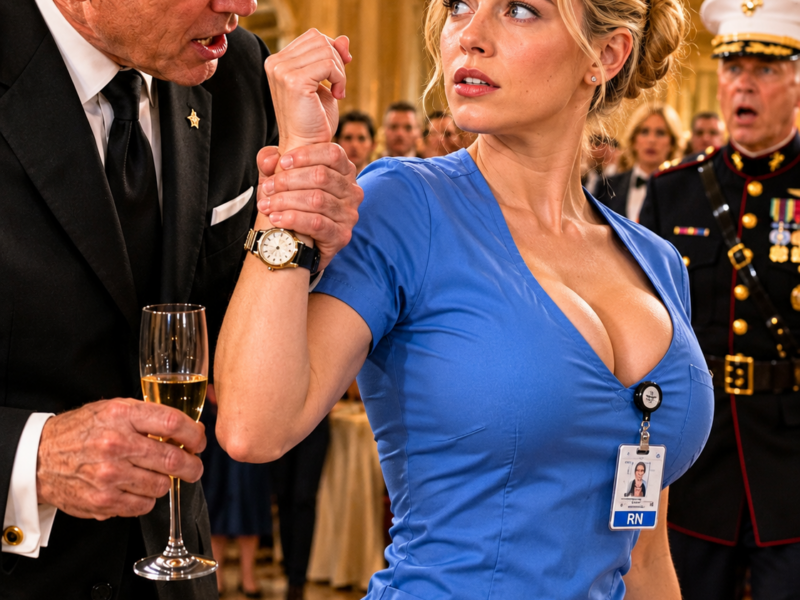
“That’s not a watch, Emily. It’s something you’d find in a junk drawer,” Dr. Miller laughed, loud enough for the entire nurses’ station to hear
The colonel held the envelope out to me.
“Before you open this,” he said, “there’s something you need to understand about the man your father saved that night.”
He paused.
“His name was Daniel Reeves.”
Captain Reeves lowered his head.
I looked from him to the colonel.
“Daniel?” I repeated.
The captain nodded slowly.
“Your father saved my life, Emily.”
For a moment, I couldn’t move.
The emergency department continued around us. Monitors beeped. A nurse called for a physician. Someone pushed a cart past the trauma bays. Yet it all seemed impossibly far away.
I looked down at the watch.
June 18, 2009.
The date had been on my wrist for years. I had traced those numbers with my thumb whenever I missed my father.
I had never known they marked the night he saved twelve Marines.
“Why didn’t he tell me?” I whispered.
Colonel Harris looked at me with an expression that held both respect and sadness.
“Because he believed the men who survived deserved to live without owing him anything.”
Captain Reeves shifted uncomfortably.
“That’s not the whole reason, sir.”
The colonel looked at him.
Reeves continued.
“Your father made us promise not to turn what happened into a story about one man. He wanted us to remember the twelve people who came home, not the person who made it possible.”
I swallowed.
“And now you’re here because…?”
“Because we finally have the chance to give you something he never received,” Harris replied. “The truth.”
Dr. Miller, who had been standing nearby with his arms folded, cleared his throat.
“Perhaps we should move this conversation out of the treatment area.”
The colonel turned toward him.
“Agreed.”
Miller glanced at me.
“Emily, you have patients to attend to.”
“I know.”
“I can take over here.”
For the first time that morning, I noticed how carefully he avoided looking at my watch.
I turned toward Rachel, who was waiting near the nurses’ station.
“Can you cover my assignments for a few minutes?”
“Absolutely,” she said.
Her eyes moved to the envelope.
“Are you okay?”
“I don’t know yet.”
She squeezed my hand.
“Take the time you need.”
Colonel Harris led us into a small consultation room near the administrative corridor. Captain Reeves followed, moving stiffly because of the injuries he had sustained in the collision.
A younger Marine officer closed the door behind us.
The colonel pointed toward a chair.
“Please sit.”
I remained standing.
“I’d rather know why you have a letter addressed to my family.”
He accepted that.
“Fair enough.”
He placed a folder on the table.
“On June 18, 2009, a Marine reconnaissance element was operating in a mountainous region overseas. Your father was the senior enlisted communications specialist attached to the unit.”
I stared at him.
“My father was a communications specialist?”
“He had served in several capacities over his career. That night, his experience with field communications became critical.”
“Where was this?”
“I can tell you the general circumstances. Some operational details remain restricted, but the essential facts have been cleared for release.”
He opened the folder.
“There were twelve Marines in a forward position. Their planned extraction route became unusable after an unexpected attack. The team lost contact with its command post, and the backup communications system failed.”
I looked at Reeves.
“You were there?”
“I was a lieutenant then,” he said. “I was leading the patrol.”
The colonel continued.
“Your father was attached to a support element several miles away. When he received the emergency signal, he recognized that the coordinates being transmitted did not match the team’s actual position.”
“Why?”
“Because he knew the terrain and had been monitoring the communications traffic. He suspected the extraction information was wrong.”
I looked at the watch.
“What did he do?”
“He refused to send the team toward the designated pickup point.”
“Wasn’t that an order?”
“Yes.”
“Then he disobeyed it?”
The colonel nodded.
“He believed following it would have put all twelve men in greater danger.”
I sat down.
For most of my childhood, my father had been a man who followed rules. He believed in being punctual, keeping promises, and doing the difficult thing even when nobody was watching.
I could not picture him openly refusing an order.
“What happened next?”
“Your father used an alternate communications channel to reach the patrol. He guided Captain Reeves and his men toward a narrow service route that had been left off the updated map.”
Reeves leaned forward.
“We were running out of time. Two men were badly injured. We had no reliable way to confirm whether the route was clear.”
He looked at me.
“Your father stayed on the radio with us. He kept giving us instructions even after his own position came under fire.”
I imagined my father with a radio pressed against his ear, his familiar calm voice cutting through the noise.
“He came to get you?”
“He tried,” Reeves answered. “But the route was too dangerous for his vehicle. He moved to a relay point and coordinated the recovery.”
The colonel turned a page.
“Your father also made a decision that saved the entire team. He redirected the evacuation aircraft to a safer landing area, despite receiving a direct instruction not to alter the original plan.”
“Why would someone tell him not to?”
“That is one of the questions the Marine Corps has spent years trying to answer.”
I looked up sharply.
“What do you mean?”
Harris exchanged a glance with the younger officer.
“Because the original extraction coordinates had been changed before the patrol entered the area.”
“By whom?”
“We don’t know yet.”
Reeves’s jaw tightened.
“We know someone changed them. We just haven’t established who authorized it.”
I looked at the envelope.
“Is that what the letter explains?”
“Partly,” Harris said.
I finally picked it up.
The paper was old, its corners slightly worn. My father’s name was written across the front in handwriting I recognized immediately.
Thomas Carter.
Beneath it was a smaller line.
To be delivered to Emily, if she ever asks what happened.
My fingers trembled.
“Did my father write this?”
“Yes,” Harris said.
“When?”
“Several months after the operation.”
I broke the seal.
Inside was a folded letter and a small photograph.
The photograph showed twelve Marines standing beside a military transport vehicle. They were exhausted, dusty, and smiling in the way people smile when they have survived something they don’t yet know how to describe.
My father stood at the far end.
He looked younger than I remembered him in his final years. His uniform was stained, his hair was dark, and his left sleeve was torn.
He was smiling.
I had not seen that expression in a long time.
I turned the photograph over.
Twelve came home. One promise remained.
I unfolded the letter.
Emily,
If you’re reading this, someone has finally decided you deserve to know about that night.
I hope you are older now. I hope you’ve found work that matters to you. I hope you still laugh too loudly when something is funny and still refuse to eat the crusts of your sandwiches.
I know you will probably be angry that I never told you.
You have a right to be.
There are things I cannot explain without making the people involved carry a burden they did not choose. But I want you to know one thing.
On June 18, 2009, twelve Marines were in danger. I was given information that I believed was wrong. I had to decide whether to follow an order or trust what I knew.
I trusted the men whose lives depended on me.
I would make that decision again.
There was another man who helped us that night. His name was not on the mission report. He made a decision that gave us the time we needed, and he never asked for recognition.
If the truth ever comes out, make sure his name is included.
I love you.
Dad.
I read the letter twice.
Then I lowered it.
“Who was the other man?”
The colonel’s expression changed.
“That’s why we’re here.”
He opened the folder again and removed a photocopy of an operational report.
A name had been blacked out.
“What am I looking at?”
“The original report credited your father with the successful recovery. But the communications log shows that another individual transmitted the final route confirmation.”
“Who?”
“We believe it was Sergeant Michael Lawson.”
Reeves looked up.
“Lawson wasn’t part of our patrol.”
“No,” Harris said. “He was attached to the communications relay station.”
“Was he the one who helped my father?”
“That’s what we need to establish.”
I stared at the blacked-out name.
“Why was his name removed?”
Harris closed the folder.
“Because Sergeant Lawson was officially reported as having abandoned his post that night.”
The room went quiet.
“Abandoned?” I asked.
“He disappeared from his assignment shortly before the extraction. His commanding officer reported that he had left without authorization.”
“But my father says he helped.”
“Yes.”
“Then why would the report say he abandoned his post?”
“That is the question.”
I looked at Reeves.
“Do you know him?”
“I remember the name. I never met him face-to-face. I heard his voice over the radio.”
“Was he helping you?”
Reeves nodded.
“He gave us the last set of coordinates. Without that transmission, we wouldn’t have reached the pickup point.”
“Then he saved you too.”
“Yes.”
I looked at the colonel.
“What happened to him?”
Harris took a breath.
“He was discharged from the Marine Corps under circumstances that remain disputed. He died three years ago.”
My throat tightened.
“Did anyone tell his family what he did?”
“Not that we can establish.”
I looked at the photograph again.
Twelve men had come home.
One man had died without knowing whether anyone remembered his part in it.
I felt a familiar ache behind my ribs.
My father had been right.
The story could not be about one man.
It had to include everyone who had made it possible.
“Why are you telling me this now?” I asked.
“Because Captain Reeves recognized your watch,” Harris replied. “He told us that you were Thomas Carter’s daughter. We began checking the old records, and we discovered that a review had recently been opened into the June 18 operation.”
“Who opened it?”
“We’re still investigating that.”
“Is it connected to the collision today?”
“No. The accident involving Captain Reeves and the other Marines was a training incident. There is no evidence of foul play.”
“Then why did he recognize the watch?”
Reeves looked down at his hands.
“Because your father showed it to us.”
I blinked.
“He showed you the watch?”
“Not this one. A photograph of it.”
He gave a faint smile.
“Your father carried a picture of you in his wallet. In it, you were wearing a little yellow dress, and he was holding your hand. The watch was on his wrist.”
I felt tears gather.
“I remember that dress.”
“He told us you had given him the watch for Father’s Day.”
I looked down.
I had been nine years old.
It had been a cheap watch from a department store, bought with money I had saved from doing small chores. My father had worn it until the strap broke. Years later, he had replaced it with the old military watch he eventually gave me.
I had forgotten the first watch.
“Why did he tell you about it?”
“Because he said it was the most important gift he’d ever received.”
I covered my mouth.
The colonel waited.
Then he placed a second envelope on the table.
“This one is from the Marine Corps.”
I looked at it.
“What is it?”
“A request for your permission to include your father’s name in a formal recognition ceremony. The review has confirmed that his actions saved twelve lives. The command wants to acknowledge his decision and correct the historical record.”
I didn’t take it.
“Is that all?”
“No.”
He turned another page.
“We also want to recognize Sergeant Lawson’s contribution. But we need help locating his family and verifying what happened after he left the relay station.”
I looked at the photograph.
“Then find them.”
“We’re trying.”
“Try harder.”
The words came out sharper than I intended.
Harris nodded.
“We will.”
I finally took the second envelope.
“I need to get back to work.”
“Of course.”
Reeves started to stand.
“Emily—”
“Don’t get up. You’re injured.”
He gave a small smile.
“Still giving orders.”
“Someone has to.”
He sat back.
I paused at the door.
“Captain?”
“Yes?”
“Thank you for remembering my father.”
Reeves’s eyes shone.
“Thank you for wearing his watch.”
I returned to the emergency department.
The moment I stepped through the doors, the ordinary noise of the hospital surrounded me again.
Rachel approached.
“Are you okay?”
I nodded.
“I’m going to be.”
She glanced at the envelope in my hand.
“Do you want to talk?”
“Later.”
She squeezed my arm.
“I’m here.”
I looked toward the trauma bays.
Dr. Miller was reviewing a chart. When he noticed me, he looked away.
I checked the status of the patients and helped Rachel prepare a discharge packet.
But my mind kept returning to the letter.
My father had saved twelve Marines.
He had also protected the name of a man who had been erased from the official report.
And there was something else.
Someone had changed the extraction coordinates.
Someone had made the wrong route appear correct.
Someone had allowed a Marine who helped save twelve lives to be branded a deserter.
I couldn’t stop thinking about the date.
June 18, 2009.
It had been carved into my watch for years.
Now it felt like a door I had finally opened.
At the end of my shift, I found Dr. Miller waiting near the staff lockers.
“Emily.”
I stopped.
“What?”
He looked uncomfortable.
“I owe you an apology.”
I said nothing.
He glanced at my wrist.
“I shouldn’t have made jokes about your watch.”
“No, you shouldn’t have.”
“I didn’t know it belonged to your father.”
I met his eyes.
“You didn’t need to know that to be respectful.”
He nodded.
“You’re right.”
For a moment, he seemed ready to say more.
Then he looked toward the floor.
“I was wrong.”
I adjusted my bag.
“Yes.”
I didn’t offer him forgiveness just to make the moment easier.
He had embarrassed me repeatedly, and he needed to understand that an apology did not erase it.
But I also didn’t want to spend the rest of the day carrying his behavior with me.
“Good night, Dr. Miller.”
“Good night, Emily.”
I left the hospital.
Outside, the evening air was cool.
I sat in my car for several minutes before starting the engine.
Then I called my mother.
She answered on the second ring.
“Emily? Is everything all right?”
“I think so.”
“What happened?”
I looked at the watch.
“Mom, do you remember June 18, 2009?”
There was a pause.
“Of course I do.”
“Did Dad ever tell you what happened that night?”
Another pause.
“No.”
“Did he ever mention twelve Marines?”
I heard her take a slow breath.
“Your father received a commendation that year. He told me it was for helping a unit during an evacuation. He said there was nothing special about it.”
“Did he mention someone named Michael Lawson?”
“No. Why?”
I explained what the colonel had told me.
I read part of the letter.
My mother did not interrupt.
When I finished, she was crying quietly.
“He never told me,” she said.
“I know.”
“He came home that week and sat in the kitchen for hours. He wouldn’t eat. I asked him what happened, and he said he was thinking about a friend.”
“Did he say who?”
“No. But he kept looking at his watch.”
I closed my eyes.
“Mom, did Dad ever say why he gave me the watch?”
“He said it had stopped working properly, and he wanted you to have something that would remind you of him.”
“Did he say anything else?”
My mother was quiet for a moment.
“He said that time wasn’t measured by how long a watch kept ticking. It was measured by what you did while you had it.”
I felt tears slip down my face.
“I remember that.”
“He loved you very much.”
“I know.”
“Are you going to be all right?”
“I think I need to find out what happened to Sergeant Lawson.”
My mother sighed.
“Then find out.”
I drove home and placed the letter on my kitchen table.
For a long time, I simply sat beside it.
I thought about my father.
I thought about the twelve Marines.
I thought about Sergeant Lawson, a man I had never met, who had apparently helped save lives and then lost his career because of it.
The next morning, I called Colonel Harris.
“I want to help find Lawson’s family.”
He sounded unsurprised.
“I hoped you might.”
“What do you need from me?”
“Your father’s personal records may contain something useful. Any letters, photographs, notes, or names he kept.”
“I’ll look.”
“Please don’t remove or alter anything that may be relevant. We can arrange for an investigator to document the material.”
“I understand.”
“And Emily?”
“Yes?”
“I want you to know that you are not responsible for solving this.”
“I know.”
“Then why are you doing it?”
I looked at the watch.
“Because my father asked someone to remember him.”
Harris was silent.
“And because someone else deserves to be remembered too.”
We arranged for an investigator to visit my mother’s house that weekend.
My mother had kept most of my father’s belongings in a cedar chest in the spare bedroom. His service records were in a folder, along with photographs, old letters, and a small notebook.
The investigator, a civilian named Karen Ellis, carefully catalogued everything.
She found several photographs of the twelve Marines.
She found a copy of my father’s commendation.
And she found a folded piece of paper tucked inside the back cover of his notebook.
It was a name and an address.
MICHAEL LAWSON.
The address was in a small town in North Carolina.
Below it, my father had written:
HE DIDN’T DESERT US.
Karen looked at me.
“Do you know what this means?”
I shook my head.
“No. But I think we found where to start.”
She photographed the page and sent the information to the colonel.
Two days later, Harris called.
“We located the family.”
I sat down.
“Who?”
“His daughter. Her name is Sarah Lawson. She lives outside Raleigh.”
“Does she know?”
“She knows her father served in the Marines. She was told he left under disciplinary circumstances.”
“Does she know about June 18?”
“No.”
“Can I speak to her?”
“We’ll ask whether she’s comfortable with that.”
The next afternoon, Harris called again.
“She has agreed to speak with you.”
I was given her number.
I waited until evening before dialing.
A woman answered.
“Hello?”
“Hi. My name is Emily Carter. I’m calling about your father, Michael Lawson.”
There was a long pause.
“Why?”
“My father was First Sergeant Thomas Carter. He served with your father on June 18, 2009.”
Another pause.
“I don’t think my father ever mentioned anyone named Carter.”
“He may not have. But my father wrote your father’s name in a notebook. He said he didn’t desert the team.”
The woman inhaled sharply.
“What did you say?”
“He wrote that your father didn’t desert them.”
I heard a quiet sound, as if she had covered her mouth.
“My father died believing everyone thought he was a coward.”
I closed my eyes.
“I’m sorry.”
“He never talked about the Marines after he came home. He wouldn’t even keep his uniform in the house.”
“Did he tell you why he left?”
“He said he had made a decision that cost him everything. He said there were men who would never forgive him.”
I felt my chest tighten.
“Did he ever mention twelve Marines?”
“No.”
“Did he ever mention a communications officer named Thomas Carter?”
“I don’t know. Maybe. He used to say there was one man who understood.”
I gripped the phone.
“Sarah, I think my father was that man.”
She began to cry.
I waited.
When she was ready, she said, “Can we meet?”
“Of course.”
We met at a small café two days later.
Sarah was in her early thirties, with dark hair and tired eyes. She carried a photograph of her father in uniform.
When she saw my watch, she looked at it for a long moment.
“Is that his?”
“Yes.”
She smiled sadly.
“My father had a watch like that.”
I sat down.
She placed the photograph on the table.
“He used to take it off and put it beside his bed. I remember the sound it made when it hit the nightstand.”
I studied the photograph.
Michael Lawson was younger than I expected. He had a broad smile and a slightly crooked nose.
“He helped my father save twelve Marines,” I said.
Sarah stared at me.
“What?”
I explained the mission, the changed coordinates, and the final transmission.
I told her what Reeves remembered.
I told her about the letter.
And I told her that the official record was being reviewed.
She listened without speaking.
When I finished, she looked down at her father’s photograph.
“Why didn’t he tell us?”
“I don’t know.”
“He could have defended himself.”
“Maybe he thought no one would believe him.”
She shook her head.
“He lost his career. He lost his friends. He came home and barely spoke for years.”
I reached across the table.
“I’m sorry he carried that alone.”
Sarah wiped her eyes.
“Do you think they can clear his name?”
“I think they’re trying.”
“Will it matter now?”
I thought about the watch on my wrist.
“Yes,” I said. “It will.”
Sarah looked at me for a long moment.
Then she nodded.
“I want to help.”
We contacted Colonel Harris and arranged for Sarah to provide a statement.
She also brought several letters her father had written during the years after his discharge.
Most were ordinary.
He wrote about work, family, and the difficulty of finding a place where he felt useful.
But one letter stood out.
It had never been sent.
It was addressed to First Sergeant Thomas Carter.
I read it with Sarah’s permission.
Thomas,
I don’t know if you’ll ever read this.
I keep thinking about that night. I keep hearing the radio. I keep wondering if I should have done something different.
You told me to send the final coordinates. I did. But I left my post to reach the relay station because the main transmitter had failed.
They said I abandoned my assignment.
They said I had endangered the team.
I tried to explain that I was the only one who could get the signal through.
Nobody listened.
You told me not to let it destroy my life.
I tried.
I hope the twelve men made it home.
I hope you did too.
Michael.
Sarah held the paper against her chest.
“He never sent it.”
“No,” I said.
“He thought my father was dead?”
“I don’t know.”
She looked at me.
“Can I keep a copy?”
“Of course.”
I photographed the letter and sent it to Karen Ellis.
Within days, the review team had another important piece of evidence.
The original communications logs were recovered from an archived server. They showed that Lawson had transmitted the corrected coordinates from the relay station.
They also showed that the command center had received his message.
But the final report had omitted it.
A supervisor had signed the report despite the missing transmission record.
The investigation traced the omission to a captain named Robert Hale, who had been responsible for compiling the operation’s final communications summary.
Hale was retired and living in Arizona.
He agreed to an interview.
At first, he claimed he had followed the information provided by command.
Then investigators showed him the archived transmission.
He changed his account.
He admitted that he had received Lawson’s message and had been told to exclude it from the report.
“Who told you?” Mitchell asked.
Hale named a senior officer who had since died.
“Why did you comply?”
Hale looked down.
“I was a young captain. I thought I was following a legitimate order.”
“Did you believe Sergeant Lawson had abandoned his post?”
“No.”
“Then why did you allow that accusation to stand?”
He was silent for a long time.
“Because correcting it would have meant admitting the report was false.”
The investigation expanded.
The Marine Corps review board examined the original orders, the communications logs, the witness statements, and the evidence provided by my father and Sarah.
They determined that Lawson had left his assigned position only after the primary transmitter failed. He had moved to an alternate relay point and successfully transmitted the coordinates that allowed the patrol to reach the extraction zone.
His actions were consistent with his duty.
The abandonment charge was removed from his record.
His discharge characterization was corrected.
The official report now recognized him as a critical participant in the recovery.
The news came on a Thursday morning.
Colonel Harris called me while I was preparing medication in the hospital.
“Emily, the board has made its decision.”
I set the medication tray down.
“What did they decide?”
“Your father and Sergeant Lawson will both receive formal recognition for their actions.”
I closed my eyes.
“And the report?”
“Corrected. The record now reflects that Lawson’s transmission helped save the patrol.”
I felt a tear run down my cheek.
“Thank you.”
“You don’t need to thank me. Your father left the evidence. You helped us find it.”
I looked at the watch.
“I wish he were here.”
“So do I.”
The ceremony was scheduled for the following month at a Marine Corps installation in California.
My mother agreed to attend.
Sarah Lawson would be there too.
Captain Reeves and the surviving members of the patrol were invited.
I wasn’t sure I wanted to go.
Part of me feared standing in a room full of uniforms and hearing my father’s name spoken aloud.
It felt too personal.
But my mother insisted.
“Your father would want you there,” she said.
“He never wanted attention.”
“He didn’t want attention for himself,” she replied. “But he wanted people treated fairly.”
That settled it.
On the morning of the ceremony, I stood in front of my mirror wearing a simple dark blue dress.
The old watch was on my wrist.
I had cleaned the metal strap carefully, but I left the scratches untouched.
My mother came into the room.
“You look like him,” she said.
I smiled.
“I have his stubbornness.”
“And his heart.”
She adjusted the collar of my dress.
“He would be proud.”
The ceremony took place in a large hall.
Rows of Marines stood in uniform. Families filled the seats. A photograph of my father was displayed near the stage.
I had not seen that photograph before.
He was standing beside a communications vehicle, one hand resting on the hood, his expression serious.
He looked like the man I remembered.
But now I knew there had been a whole part of his life I had never seen.
Colonel Harris approached us before the ceremony.
“Emily. Mrs. Carter.”
My mother shook his hand.
“Thank you for bringing us here.”
“It’s an honor.”
He turned to Sarah.
“Ms. Lawson.”
She nodded.
“Thank you for what you’ve done.”
He looked at me.
“Your father would be glad to see both families here.”
I glanced at Sarah.
She smiled through her nerves.
“I’m glad we’re here too.”
When the ceremony began, the commanding officer spoke about service, responsibility, and the importance of accurate records.
He acknowledged that the original report had failed two men.
He did not pretend the correction could undo the years of damage.
He simply stated that the record had been wrong and that it had finally been corrected.
Then he called my father’s name.
“First Sergeant Thomas Carter.”
I stood.
The room rose with me.
An officer presented my mother with a framed commendation.
It recognized my father’s judgment, courage, and actions during the June 18 operation.
My mother held the frame against her chest.
She was crying.
Then the commanding officer called another name.
“Sergeant Michael Lawson.”
Sarah stood.
She looked as if she might collapse, but I reached for her hand.
We stood together as the officer presented her with the corrected service record and a formal letter of recognition.
The commanding officer read a short statement:
“Sergeant Lawson’s actions were not an abandonment of duty. They were an act of commitment to the Marines whose lives depended on his communications support. His service deserves to be remembered with honor.”
Sarah covered her face.
I held her hand until she could breathe again.
Then Captain Reeves stepped forward.
He stood before the audience in his dress uniform.
“Sir,” he said to the commanding officer, “may I say something?”
The officer nodded.
Reeves turned toward the room.
“I was a young lieutenant on June 18, 2009. I was responsible for twelve Marines who were caught in a situation we were not prepared for. We had bad information, failing equipment, and no clear way out.”
He paused.
“First Sergeant Carter refused to let us follow coordinates he believed were wrong. Sergeant Lawson found a way to get a message through when our main channel failed. Together, they gave us a chance to survive.”
His voice thickened.
“I spent years believing that the record would eventually tell the truth. It didn’t. It took too long. But today, the names of both men are being spoken together, as they should have been from the beginning.”
He turned toward me.
“Emily, your father never asked us to repay him. But he gave us something we could never forget.”
He placed his hand over his heart.
“He gave us another day.”
Every Marine in the room stood.
Then, one by one, they saluted.
I looked at my mother’s face.
She was crying openly now.
I felt the old watch against my wrist.
For the first time, I understood why my father had kept it.
It was never about time.
It was about the people who made every minute worth living.
After the ceremony, Reeves approached me.
“You all right?”
I nodded.
“I think so.”
He smiled.
“Your father would have been embarrassed by all this.”
I laughed through my tears.
“He hated being the center of attention.”
“He would have tried to escape through the kitchen.”
“That sounds exactly like him.”
Reeves looked at the watch.
“May I?”
I turned my wrist toward him.
He read the inscription.
“For the ones who never left a man behind.”
He nodded.
“That’s what he did.”
I looked at him.
“And what about you?”
“What about me?”
“You’ve carried this story for years. You could have forgotten it.”
He shook his head.
“Some things don’t let you forget.”
He reached into his jacket and handed me a small photograph.
It showed the twelve Marines after the evacuation.
My father stood at the edge of the group.
Behind him, near a communications vehicle, was another man.
A younger Marine with a narrow face and dark hair.
“Is that Sergeant Lawson?”
Reeves nodded.
“He was there for the photograph. He didn’t want to stand in the middle, so he stayed near the equipment.”
I studied his face.
“He looks like Sarah.”
“He does.”
I turned the photograph over.
On the back, someone had written:
TWELVE HOME.
NO ONE FORGOTTEN.
I looked at Reeves.
“Who wrote that?”
“Your father.”
I held the photograph carefully.
“Thank you.”
He nodded.
Then he said something I had not expected.
“There’s one more thing.”
I looked up.
“What?”
“Your father gave me a message for you.”
My breath caught.
“When?”
“The morning after the operation. Before I was transferred to another unit.”
“What did he say?”
Reeves thought for a moment.
“He told me that if I ever met you, I should tell you he was sorry he couldn’t be there for every important moment in your life.”
I looked down.
“He was there for more than he knew.”
Reeves nodded.
“He said he hoped you would never feel that you had to become a soldier to understand him.”
My eyes filled.
“He said that?”
“Yes.”
I laughed softly.
“He knew me.”
“He said you were stubborn, compassionate, and far too good at arguing.”
“That sounds like him.”
Reeves smiled.
“He also said that you had given him the best gift he had ever received.”
“The watch?”
“The first watch. The one you bought when you were nine.”
I pressed my lips together.
I remembered the small cardboard box.
The cheap metal band.
The way my father had worn it proudly even after the strap broke.
“I thought he had forgotten.”
“He never forgot.”
I looked down at the old watch.
It was not the first one.
But it had carried the memory of that gift through years I had never understood.
And now, at last, I understood.
My father had worn it because it reminded him that someone loved him enough to give him a piece of their time.
He had given it to me because he wanted that reminder to remain with me.
After the ceremony, my mother, Sarah, and I sat together in a quiet corner of the hall.
Sarah held her father’s corrected service record.
“I don’t know how to thank you,” she said.
“You don’t have to.”
“My father died thinking he had failed.”
I reached across the table.
“He helped save twelve people.”
“And your father made sure the truth wasn’t lost.”
“Both things matter.”
Sarah nodded.
She looked at my watch.
“I think my father would have liked yours.”
“I think they would have gotten along.”
For the first time, she smiled without sadness.
My mother took my hand.
“Your father would have been glad to see this.”
I looked at the two framed records.
Two names.
Two families.
One night that had connected all of us.
“I wish we had known sooner,” I said.
“So do I,” my mother replied.
“But we know now.”
And sometimes, knowing now was the only thing we could still give the past.
A few weeks later, I returned to work.
The watch was still on my wrist.
Dr. Miller saw it during a morning shift.
He opened his mouth as if he might make another joke.
Then he stopped.
“Good morning, Emily,” he said.
“Good morning.”
He glanced at the watch.
“It’s a beautiful piece.”
I looked at him.
“Thank you.”
He nodded and returned to his chart.
It wasn’t a dramatic apology.
It wasn’t a transformation.
It was simply a small sign that he had learned something.
That was enough for that morning.
Rachel approached me near the medication room.
“I heard about the ceremony.”
“It’s all over the hospital newsletter.”
“You must be proud.”
I looked down at the watch.
“I am.”
“Does it feel different wearing it now?”
I thought about the question.
“Yes.”
“How?”
“Before, it reminded me of my father. Now it reminds me of the people he refused to leave behind.”
Rachel smiled.
“That’s a good reason to keep wearing it.”
I nodded.
Then the ambulance doors opened, and a new patient came in.
I moved toward the bed.
“Let’s get him into Trauma Two.”
The day continued.
There were patients to treat, families to reassure, and charts to complete.
The world did not stop because my father had finally been recognized.
And I didn’t want it to.
For a long time, I had believed that the watch was simply the last thing my father had left me.
Now I understood that it carried more than memory.
It carried a promise.
A promise that no person should be erased because the truth was inconvenient.
A promise that service meant more than following an order without question.
And a promise that the people who helped others survive deserved to be remembered, even if they never asked for recognition.
The watch still lost a minute now and then.
The glass was still scratched.
The strap was still worn.
It was not valuable in any way a jeweler would understand.
But every morning, before I left for work, I fastened it around my wrist.
I no longer cared who laughed.
Because the people who mattered knew what it meant.
And I finally did too.
My father had given twelve Marines another day.
He had helped restore the name of a man who had been wrongly condemned.
And he had left me a lesson that took years to understand:
Time is not measured by how perfectly a watch works.
It is measured by the lives we touch while we have it.
I touched the inscription once before walking into the emergency department.
Then I went to work, carrying his promise with me.
The end.









