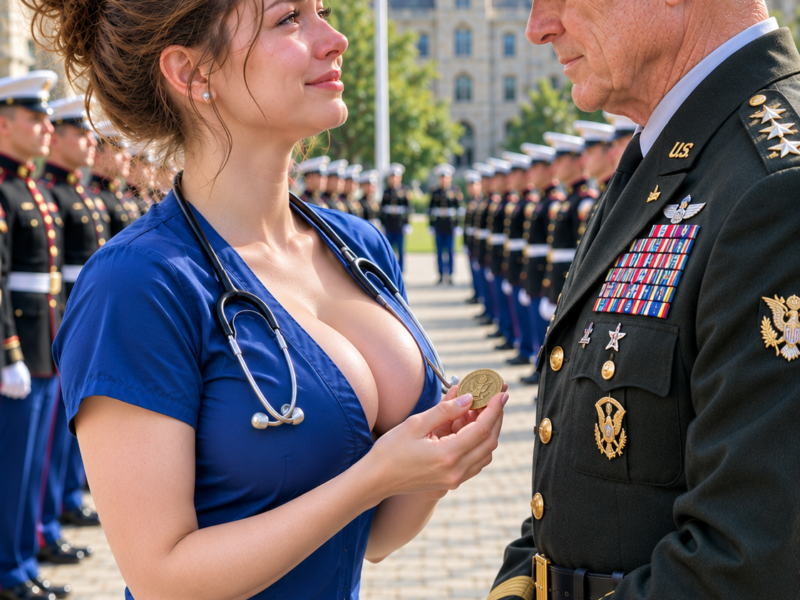
“‘Step away from the commander,’ the Marine shouted as I reached for the wounded man’s shoulder. Every soldier in the room turned toward me
For eleven years, I had believed my brother died because he was in the wrong place at the wrong time.
Now a Marine commander was standing in front of me, holding a coin identical to the one Matthew had left me, telling me the official story was a lie.
I wanted to demand answers.
I wanted to grab him by the uniform and make him explain every word.
Instead, I heard myself ask, “What evidence?”
The commander studied me.
“Your brother’s coin was part of a pair. Each one carried a different number. Together, those numbers identified a sealed mission record.”
“What mission?”
“Operation Night Lantern.”
The name meant nothing to me.
He glanced toward the trauma room.
“My name is Colonel Thomas Grant. I served with your brother. I was there the night he disappeared.”
My throat tightened.
“You said he was never supposed to give me that coin.”
“He wasn’t.”
“Then why did he?”
Grant looked down at the small metal disc in his hand.
“Because he knew he might not come back.”
A door opened behind us.
A physician stepped into the corridor and removed his gloves.
“Colonel Whitaker is stable. He’s going to surgery, but he’s responding to treatment.”
Grant nodded.
“Thank you, Doctor.”
Then he turned back to me.
“I need you to understand something before we continue. Your brother didn’t die in combat. He died trying to get people out of a situation that should never have happened.”
I felt my knees weaken.
“Tell me.”
Grant took a breath.
“Eleven years ago, Matthew was assigned to a reconnaissance team investigating a series of missing weapons shipments. The official explanation was that equipment had been lost during transfers between units. But the quantities were too large, and the paperwork didn’t match.”
“Why would my brother be involved in that?”
“He was a communications specialist. He noticed that the transmission logs had been altered. At first, he thought it was a technical mistake. Then he found messages that had been deleted from the original record.”
I remembered Matthew at our kitchen table, taking apart an old radio because he couldn’t stand not knowing why it had stopped working.
He had always needed to understand how things fit together.
“What did he find?”
“A pattern. Weapons were being moved through military supply channels and sold to private buyers. Someone inside the operation was helping make the shipments disappear.”
Grant lowered his voice.
“Matthew discovered that one of the people approving those transfers was a senior officer.”
“Who?”
“General Adrian Mercer.”
The name meant nothing to me, but the way Grant said it made the corridor feel colder.
“He was never charged,” Grant continued. “The investigation was closed after your brother’s death. The report said Matthew had been killed during an ambush.”
“And you’re saying that wasn’t true?”
“I’m saying the report left out what happened before the ambush.”
He opened the velvet pouch again.
“Your brother copied a set of encrypted communications onto a small storage device. He split the access information between two coins. One stayed with him. The other he gave to you.”
I looked at the coin in my palm.
“Why me?”
“Because he believed you were the one person nobody would think to search.”
I let out a short, disbelieving breath.
“I was twenty-one. I was studying nursing. I didn’t know anything about military operations.”
“Exactly.”
Grant’s expression softened.
“He wanted you to have something that could survive if everything else disappeared.”
I stared at him.
“Then why didn’t anyone come to me after he died?”
“We tried.”
The answer came too quickly.
“What?”
“An investigator visited your apartment three weeks after the funeral. You weren’t home. He left a card.”
“I never received a card.”
Grant looked troubled.
“Someone signed the visitor report saying you had refused to cooperate.”
“I never met anyone.”
He exchanged a glance with the staff sergeant.
That was when I realized the story was larger than a missing coin or an altered report.
Someone had known where I lived.
Someone had known what Matthew had left me.
And someone had made sure I never heard from the people searching for it.
“Who signed that report?” I asked.
Grant hesitated.
“Colonel James Whitaker.”
I looked toward the trauma department.
“The man on the operating table?”
“Yes.”
I couldn’t understand it.
“Why would he lie?”
“That’s what I came here to find out.”
For the next hour, I returned to work because I didn’t know what else to do.
A patient needed medication. Another needed discharge instructions. A frightened family wanted an update.
I did what I had always done.
I kept my voice calm and my hands steady.
But every time I reached for my necklace, I felt the weight of eleven years pressing against my chest.
At 2:40 a.m., Colonel Whitaker came out of surgery.
He was moved to the intensive care unit, where the medical team continued monitoring him.
Grant waited until the doctors had finished before approaching the bedside.
I stood near the doorway.
Whitaker opened his eyes.
“Tom?”
“I’m here.”
His gaze shifted toward me.
“Rebecca?”
I stepped closer.
“I’m Matthew Hayes’s sister.”
His face changed.
For a moment, he looked almost relieved.
Then he began to cry.
“I tried to find you.”
I held the rail of the bed.
“You signed a report saying I refused to speak with investigators.”
He closed his eyes.
“I know.”
“Why?”
His breathing was shallow.
“Because I was told you were being watched.”
“By whom?”
He looked at Grant.
“Not here.”
Grant leaned closer.
“James, we don’t have much time to keep hiding things.”
Whitaker shook his head.
“Not because of them. Because I need her to understand what happened first.”
I looked at him.
“Then tell me.”
He swallowed.
“Your brother saved my life.”
The room went silent.
Whitaker continued slowly.
“Our team had been ordered to recover a shipment that was supposed to contain communications equipment. Matthew discovered the cargo was different. It contained weapons that had been reported destroyed months earlier.”
“And General Mercer?”
“He was the officer who authorized the transfer.”
Whitaker paused, wincing.
“We were told to secure the shipment and wait for instructions. But Matthew found another transmission. It said the entire team was to be eliminated before morning.”
My fingers tightened around the bed rail.
“Why?”
“Because we had seen the shipment. Because Matthew had copied the messages.”
Grant looked down.
Whitaker continued.
“We were trapped near an abandoned industrial site. Our communications were jammed. Matthew managed to send a short distress signal, but the response never came.”
“What happened?”
“Your brother got us out through a service tunnel. He stayed behind to keep the route open.”
I could barely breathe.
“He was killed?”
Whitaker looked at me.
“He was captured.”
The words struck like a physical blow.
I shook my head.
“No. The military told us he died during the ambush.”
“They recovered a damaged vehicle and personal effects. They never recovered his body.”
I stepped away from the bed.
For eleven years, I had stood beside a grave marker.
There had been a funeral.
A folded flag.
A chaplain who told me my brother had died serving his country.
Now a wounded Marine commander was telling me the grave might not contain him.
“Why would they tell us he was dead?”
Whitaker’s eyes filled again.
“Because someone needed the investigation to end.”
I looked at Grant.
“Did you know?”
“No,” he said. “I believed the report until recently.”
“What changed?”
Grant removed a small photograph from his pocket.
It showed a man standing outside a building, his face partly turned away from the camera.
The picture was grainy, but the posture was familiar.
The shoulders.
The way he held his left hand slightly lower than his right.
My brother had injured that wrist when he was sixteen.
I took the photograph.
“Where did you get this?”
“An intelligence analyst found it in a file that had been sealed for years. It was taken at a private detention facility overseas.”
I looked at the date.
Four years after Matthew’s reported death.
My knees almost gave way.
“That’s him.”
Grant didn’t argue.
“We believe it is.”
Whitaker turned his head toward me.
“Matthew may still be alive.”
I gripped the photograph.
“Where is he?”
“We don’t know.”
The monitor beside the bed beeped faster as Whitaker became agitated.
A nurse came in and asked us to step back.
Grant guided me into the corridor.
I stared at the picture.
My brother had been alive four years after the military told us he was dead.
Four years.
Four years in which I had visited his grave, celebrated his birthday alone, and tried to convince myself that the last phone call we shared had been enough.
I remembered his final words.
“Don’t let anyone make you feel small, Becca. You hear me?”
I had thought he was just being a big brother.
Now I wondered whether he had known what was coming.
Grant waited until I looked up.
“There’s something else.”
I almost laughed.
“Of course there is.”
“Your coin isn’t just an access key. It contains a second engraving beneath the outer rim. We couldn’t read it without the matching piece.”
He placed his coin beside mine.
The numbers lined up.
Together, they formed a short sequence.
Grant showed it to a military communications specialist who had accompanied the team.
The specialist examined the coins under a small light.
“There’s a micro-engraved code here,” he said. “It looks like a location reference.”
He entered the sequence into an encrypted device.
A map appeared.
I recognized the region only because Matthew had once shown me a photograph from a training exercise.
It was a former military communications station in Virginia.
“What’s there?” I asked.
Grant’s expression tightened.
“An archive facility. It was decommissioned years ago.”
“Why would my brother hide something there?”
“Because it was one of the few places connected to the original mission that wasn’t under Mercer’s control.”
Grant looked at the specialist.
“Can you access the archive?”
The specialist shook his head.
“Not remotely. The system was disconnected from the network.”
Grant turned to me.
“We need to go there.”
I looked at my uniform.
“I have patients.”
“I understand.”
“I can’t just walk out in the middle of a shift.”
He nodded.
“We’ll wait until your replacement arrives.”
It was the first thing he had said all night that made me trust him a little.
At sunrise, another nurse took over my assignment.
Before leaving, I returned to Whitaker’s room.
He was awake again.
“I’m going to find out what happened to Matthew,” I told him.
He gave a weak nod.
“He would have wanted you to.”
I hesitated.
“Why did you sign that report?”
Whitaker stared at the ceiling.
“Mercer told me that if I cooperated, my team would be protected. He said you were already being watched and that contacting you would put you in danger.”
“So you let me believe my brother was dead.”
“I told myself it was the only way to keep you safe.”
I looked at him for a long moment.
“That’s what everyone says when they decide someone else doesn’t deserve the truth.”
He began to cry again.
I left without forgiving him.
The drive to Virginia took several hours.
Colonel Grant rode in the front passenger seat of an unmarked vehicle. The communications specialist sat beside me in the back, carrying a secure case.
The other Marines followed in a second vehicle.
No one spoke much.
I kept the coin in my hand, turning it over and over.
When we reached the old facility, I expected a guarded military installation.
Instead, we found a low concrete building behind a chain-link fence, surrounded by overgrown grass and rusted equipment.
A sign near the entrance read:
AUTHORIZED PERSONNEL ONLY.
The specialist used an old access code from the coin sequence.
The door unlocked.
Inside, the air smelled of dust and cold metal.
Rows of cabinets lined a narrow hallway. Most were empty.
At the far end stood a steel archive terminal.
Grant examined the door.
“Can you open it?”
The specialist connected the coins to a reader built into the terminal.
A green light appeared.
Then a message flashed across the screen.
IDENTITY CONFIRMED.
SECOND AUTHORIZATION REQUIRED.
The specialist looked at me.
“Your brother designed this to require both halves.”
I placed my coin into the second slot.
The terminal unlocked.
A list of archived files appeared.
One was labeled NIGHT LANTERN.
Another carried a date from eleven years earlier.
And a third was marked:
HAYES, MATTHEW — PERSONNEL STATUS: UNRESOLVED.
My hand flew to my mouth.
“Open it.”
The specialist hesitated.
“Once this file is opened, the system will record the access.”
“Open it.”
The screen filled with documents.
There were mission logs, transfer authorizations, and a series of encrypted audio files.
The first recording began with static.
Then I heard my brother’s voice.
“Becca, if you’re hearing this, I need you to know I didn’t leave you.”
My legs weakened.
Grant caught my arm.
I stared at the screen as Matthew continued.
“I don’t know how long they’ll keep me here. I don’t know whether I’ll ever get home. But I found proof of what Mercer did. The weapons shipments were only part of it.”
The recording crackled.
“They were moving people, too.”
I looked at Grant.
He went completely still.
Matthew’s voice continued.
“Some of the men listed as killed during the operation were transferred to a private detention site. Their identities were changed. Their records were closed. I found the transfer orders.”
The next sentence was barely audible.
“I’m one of them.”
I couldn’t stop the tears.
The recording ended.
For several seconds, no one moved.
Then another file opened automatically.
It contained a list of names.
Beside each name was a location and a date.
There were seventeen.
At the bottom was an authorization signature.
General Adrian Mercer.
Grant stared at the screen.
“This is enough to reopen the investigation.”
“Can it tell us where Matthew is now?”
The specialist searched the file directory.
“There are updated records. One was added six months ago.”
He opened it.
A current photograph appeared.
I leaned toward the screen.
The man was older, thinner, and had gray in his hair.
But the eyes were unmistakable.
Matthew.
Below the photograph was a location.
A private medical rehabilitation facility in North Carolina.
The record had been added under a different name.
I covered my mouth.
“He’s alive.”
Grant nodded slowly.
“We’re going to bring him home.”
Before he could call his team, an alarm sounded.
The terminal screen went black.
A red warning appeared.
UNAUTHORIZED REMOTE ACCESS DETECTED.
The specialist disconnected the system.
“Someone just tried to erase the archive.”
Grant pulled out his phone.
“Secure the building. Nobody leaves.”
A vehicle engine sounded outside.
I moved toward the window.
A black SUV had stopped beyond the fence.
Two men stepped out.
Neither wore a uniform.
One held a phone to his ear.
The other looked directly at the building.
Grant drew his sidearm.
“Get away from the windows.”
The specialist hurried to copy the archive onto a portable drive.
I crouched beside the terminal, my heart pounding.
Then my phone rang.
Unknown number.
I stared at it.
Grant shook his head.
“Don’t answer.”
But the call stopped.
A message appeared.
Rebecca, this is Matthew.
I froze.
Another message followed.
They know you opened the archive. Do not let Grant take you to the North Carolina facility.
My mouth went dry.
I turned toward the colonel.
“Grant?”
He looked at me.
I showed him the phone.
He read the message.
His face changed.
“That’s not possible.”
“Why?”
“Because Matthew doesn’t know we’re here.”
Before I could respond, another message arrived.
I’M NOT AT THE FACILITY ANYMORE.
I stared at the words.
Then the phone rang again.
This time, the number was visible.
A Virginia area code.
I answered.
“Matthew?”
A breath.
Then a voice I had spent eleven years believing I would never hear again.
“Becca?”
I pressed the phone against my ear.
“It’s me. It’s really me.”
“Listen carefully,” he whispered. “You have to get out of there.”
“Where are you?”
“Not safe to say.”
I began crying.
“Are you alive? Are you hurt?”
“I’m alive. That’s all you need to know right now.”
“I’m coming to get you.”
“No. You can’t.”
“Matthew, I buried you.”
His voice broke.
“I know.”
I closed my eyes.
“Why didn’t you come home?”
There was a long silence.
Then he said, “Because the people who ordered my disappearance were still in the military. And one of them was standing beside you in that hospital tonight.”
I looked at Colonel Grant.
He was watching me.
“Who?” I whispered.
Matthew’s answer was almost inaudible.
“Thomas Grant.”
I pulled the phone away from my ear.
Grant stared at me.
For one terrible moment, the building seemed to stop breathing.
Then he lowered his weapon.
“Rebecca, let me explain.”
The two men outside were moving toward the entrance.
The communications specialist had finished copying the files.
I stepped away from Grant.
“Don’t come closer.”
He looked devastated.
“I knew Matthew had survived. I didn’t know where he was. I swear to you.”
“Then why did he say you were involved?”
Grant’s eyes flicked toward the terminal.
“Because I was the one who arranged the transfer.”
I felt sick.
“You sent him to that facility?”
“I sent him somewhere Mercer couldn’t reach him.”
“You let me think he was dead.”
“I thought it was the only way to keep you safe.”
I shook my head.
“I’m tired of hearing that.”
A heavy impact struck the outer door.
The men outside were trying to force their way in.
Grant turned toward the entrance.
“Rebecca, we need to move. We can argue later.”
I looked at the phone.
“Matthew, can you hear me?”
“I’m here.”
“Tell me what to do.”
“Trust the evidence. Not the people carrying it.”
The call ended.
The outer door shook again.
Grant ordered his men to secure the rear exit while the communications specialist handed me the copied drive.
“Keep this with you,” he said.
I looked at him.
“Why me?”
“Because it’s the only copy we know hasn’t been compromised.”
We moved through a narrow service corridor and emerged behind the building.
The second Marine vehicle had blocked the rear access road.
The men from the SUV were nowhere in sight.
Grant led us to the vehicles, but I stopped before getting in.
“Where are you taking me?”
“To a secure location.”
“No.”
He turned.
“Rebecca—”
“I’m going to North Carolina. But I’m not going with you.”
He looked at me for a long moment.
Then he nodded.
“I understand.”
I didn’t know whether I believed him.
The communications specialist contacted federal investigators using a secure line. Within an hour, an independent team had taken custody of the archive and arranged protection for me.
Colonel Grant was ordered to remain available for questioning.
He didn’t resist.
Before he left, he approached me.
“I did what I thought would keep your brother alive.”
“You should have told me the truth.”
“I know.”
“Did Matthew ask you to keep me in the dark?”
Grant looked down.
“No. He asked me to protect you. I made the decision about the rest.”
That was the first honest answer he had given me.
I left without saying goodbye.
The rehabilitation facility in North Carolina was not a prison.
It was a quiet medical center surrounded by trees, with a small courtyard and a reception desk that smelled faintly of coffee.
Federal agents had already secured the building.
A nurse led me down a hallway.
At the end, a door stood open.
A man was sitting beside the window.
His hair was gray at the temples. His left hand rested stiffly on his knee. A thin scar ran from his jaw to his neck.
But when he turned, I saw the same crooked smile that used to appear whenever he knew he had won an argument.
“Hey, Becca.”
I couldn’t move.
He stood slowly.
“I’m sorry it took so long.”
I crossed the room and wrapped my arms around him.
He held me carefully at first, as if he was afraid I might disappear.
Then he pulled me close.
I cried into his shoulder until I couldn’t breathe.
“You were dead,” I whispered.
“I know.”
“I went to your funeral.”
“I know.”
“I talked to your photograph every Christmas.”
His arms tightened around me.
“I know.”
I pulled back and hit his chest with the flat of my hand.
“Don’t you ever do that to me again.”
He let out a broken laugh.
“I’ll try not to.”
Then we both cried.
For a long time, neither of us spoke.
When we finally sat down, Matthew told me what had happened.
After the operation, he had been taken to a private detention facility under an assumed identity. Mercer had wanted the location of the copied communications and the names of everyone who had helped him.
Matthew refused.
He was moved several times, and his medical records were deliberately altered to make it difficult to track him.
Colonel Grant had arranged one transfer after discovering that the original detention site was compromised. He had believed that keeping Matthew hidden was the only way to prevent Mercer from finding and killing him.
But Grant had also made a terrible choice.
He had accepted the false death report and allowed it to stand, believing that any attempt to correct it would expose Matthew’s location.
“Why didn’t you call me?” I asked.
Matthew looked at his hands.
“I tried once. The call was intercepted. After that, they moved me again.”
“And the coin?”
“I gave it to you because I knew they wouldn’t search your belongings. I hoped the evidence would survive even if I didn’t.”
He glanced at the small metal disc around my neck.
“You kept it.”
“Every day.”
His eyes filled.
“I knew you would.”
I reached for his hand.
“Did you know I became a nurse?”
He smiled.
“I found out from a photograph in a local newspaper. You were receiving an award for helping a patient during a storm.”
I laughed through my tears.
“You were reading newspapers about me while I thought you were in a grave?”
“I wasn’t exactly enjoying the situation.”
For the first time in eleven years, I laughed with my brother.
It wasn’t the end of the investigation.
Mercer was arrested two weeks later after the archive files were authenticated and several former officers agreed to testify. The evidence connected him to the weapons transfers, the false death reports, and the illegal detention of military personnel.
The investigation also uncovered records showing that seventeen people had been moved through the same network.
Several were found alive.
Others had died before anyone knew where to look.
The case lasted more than a year.
Colonel Grant testified about his role in the transfer and admitted that he had allowed the false report to remain in place. He faced disciplinary action for concealing information, but investigators confirmed that he had not participated in Mercer’s trafficking operation.
I didn’t forgive him quickly.
But I eventually understood that he had been trapped between fear, loyalty, and a decision he could never take back.
Colonel Whitaker also testified.
He apologized to me in person.
I listened, but I didn’t tell him everything was all right.
Some apologies are important even when they cannot repair what was broken.
Matthew’s military record was finally corrected.
The grave marker bearing his name was removed, and the military held a formal review of the original casualty report.
When he was strong enough, he returned to our hometown.
We visited our parents’ graves together.
He stood quietly in front of our mother’s headstone.
“I should have come sooner,” he said.
I took his hand.
“You’re here now.”
He nodded.
We didn’t try to make eleven years disappear.
We couldn’t.
Instead, we started with small things.
Coffee on Sunday mornings.
Arguments about old movies.
Calls that lasted too long.
A second chair at my kitchen table.
And every time my phone rang late at night, I no longer had to wonder whether it might be him.
A few months after his return, the Marines held a ceremony to recognize the people who had helped expose Operation Night Lantern.
I attended in my nursing uniform.
Matthew stood beside me, wearing his dress uniform.
Colonel Grant approached us before the ceremony began.
He carried the two coins in a small display case.
“Your brother asked that these be returned to you,” he said.
I looked at Matthew.
He nodded.
“Keep them together.”
I accepted the case.
The two numbers that had once seemed meaningless now sat side by side beneath the engraved eagle.
For eleven years, I had worn one half of a truth I didn’t understand.
Now both pieces were finally together.
The commander who had first recognized my coin stood at the front of the room and spoke about courage, loyalty, and the cost of keeping promises.
I listened, but my attention kept returning to the man beside me.
When the ceremony ended, Matthew leaned close.
“You know,” he said, “I always thought you’d become a doctor.”
I smiled.
“And I always thought you’d learn to follow instructions.”
He laughed.
“Neither of us got what we expected.”
We walked outside together.
The afternoon sun caught the edge of the coin case in my hands.
For years, I had believed the small piece of metal around my neck was all I had left of my brother.
I was wrong.
It had never been a memorial.
It was a promise he had trusted me to keep.
And this time, when Matthew walked away from me, I knew exactly where he was going—and that he was coming home.
The End.









