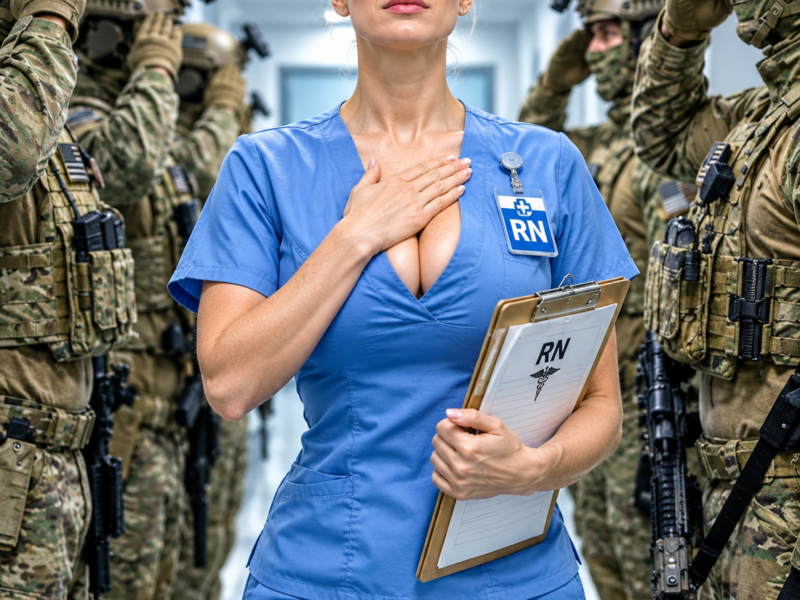
“Stay out of this, rookie. You’re just a nurse, and nobody asked for your opinion,” the senior officer snapped as he ordered me away from the emergency landing zone
The envelope felt heavier than it should have.
I stood in the middle of the hospital corridor, surrounded by officers, medics, and the distant thud of helicopter blades fading above the roof.
Nobody spoke.
Captain Carter.
That was what they had called me.
A title I had spent eleven months trying to forget.
I looked down at the sealed envelope.
The handwriting on the front was unmistakable.
I had seen it on field reports, emergency orders, and one final letter that had arrived after the military officially declared him dead.
My fingers tightened around the paper.
“Who gave you this?” I asked.
The older officer stepped closer.
“Admiral Thomas Whitaker. He’s waiting in the command conference room.”
“Then he can wait a little longer.”
The officer glanced at the blood on my sleeves.
“Captain, this is classified.”
“So was the operation that got him killed.”
His expression changed.
For the first time since the helicopters landed, nobody treated me like a rookie nurse.
Chief Dawson approached from behind.
“Carter, what the hell is going on?”
I turned toward him.
“Right now, Chief, I need you to clear this hallway.”
He looked at the officers.
Then at the envelope.
Then back at me.
“I don’t take orders from—”
“Today, you do,” the older officer interrupted.
Dawson went silent.
I walked into an empty consultation room and closed the door.
My hands were shaking.
Not because I was afraid of what the envelope contained.
Because I was afraid it might contain nothing.
Eleven months earlier, I had been Captain Emily Carter, medical operations officer attached to a joint Navy task force in Afghanistan.
I wasn’t the kind of officer who shouted to be heard.
I learned names.
I learned who was afraid of needles, who pretended an old injury didn’t hurt, and who always gave away the last clean pair of socks.
I also learned that the people who looked invincible were often the ones most terrified of being left behind.
Lieutenant Commander James Walker had been one of those people.
He was a Navy SEAL team leader with a crooked smile and a habit of checking on everyone else before checking on himself.
We weren’t supposed to become close.
He was operational command.
I was medical support.
But after months of working together, the distance between those roles became harder to maintain.
He trusted my judgment.
I trusted his.
And when an operation went wrong, that trust was the only reason either of us survived.
The mission had been described as a straightforward extraction.
A small team would locate a group of trapped civilians and escort them to a temporary landing zone.
The intelligence said the area was secure.
James didn’t believe it.
He had noticed a discrepancy in the coordinates.
He brought it to command.
They told him the information had been verified.
He asked me to review the medical evacuation plan.
I found something worse.
The proposed landing zone was surrounded by buildings with narrow access roads.
If the team came under fire, there would be no safe route for casualties.
I sent a written objection.
It was dismissed.
James refused to proceed until someone explained the discrepancy.
The answer came from Colonel Nathan Brooks, the senior officer overseeing the operation.
He told James that hesitation could cost innocent lives.
Then he ordered the mission forward.
The team departed just before sunrise.
I stayed at the forward medical station.
At 09:17, the first emergency transmission came through.
At 09:21, communications failed.
At 09:26, a damaged helicopter returned with two wounded operators and no clear account of what had happened.
James was missing.
So were two members of his team.
I worked on the wounded until my hands were slick with blood and my hearing became a dull ringing.
One operator, Petty Officer Daniel Price, kept asking me where James was.
I couldn’t answer.
The next day, command announced that the missing men had been killed during an enemy attack.
No remains had been recovered.
No personal effects were returned.
The official report said the helicopter had been forced to abandon the area under hostile fire.
I read it three times.
Then I read the coordinates.
They were different from the ones James had challenged before the mission.
Someone had changed them.
I requested the original flight plan.
Denied.
I requested the communications logs.
Denied.
I asked to speak with Colonel Brooks.
He told me the matter was closed.
When I refused to sign the medical after-action report, he reminded me that my career depended on following the chain of command.
I told him my signature was not a decoration.
It was a statement that the report was true.
He reassigned me.
Three weeks later, I was informed that James Walker had been officially declared dead.
The notification came with a folded American flag and a formal expression of regret.
I never accepted the flag.
I couldn’t.
There had been no body.
No confirmation.
No final transmission.
Only a report that seemed designed to end the questions.
I filed a formal complaint.
Then another.
Both disappeared into administrative review.
Eventually, I was transferred back to the United States and placed on a medical assignment.
My rank remained.
My authority did not.
I stopped wearing my captain’s insignia unless regulations required it.
I stopped correcting people when they called me nurse.
I told myself I was starting over.
But the truth was simpler.
I was waiting for a reason to believe James might still be alive.
And now that reason was sitting in my hands.
I tore open the envelope.
Inside was a single photograph.
James stood beside a military transport aircraft.
His hair was shorter.
His face was thinner.
There was a scar along his jaw that I had never seen before.
But he was alive.
On the back of the photograph, someone had written:
“Recovered 36 hours ago. Conscious. Asking for you.”
A second sheet was folded beneath it.
I opened it.
The first line made my knees weaken.
“Captain Carter, the official account of Operation Lantern was false.”
I read the page twice.
The message was signed by Admiral Whitaker.
It stated that an independent review had uncovered evidence of an unauthorized change to the mission coordinates.
The team had not been trapped by an unexpected enemy attack.
They had been directed into a location where they were never supposed to land.
The helicopter had been hit while attempting to extract them.
James and two others had survived the initial crash.
They were captured and held at an undisclosed location.
One of the missing operators had died in captivity.
James and the other had been recovered during a joint operation forty-eight hours earlier.
I stopped reading.
The room seemed to tilt.
There was a final paragraph.
“Your original medical risk assessment was preserved. It was the first documented warning that the mission plan was compromised. Your testimony is required at the forthcoming inquiry. Colonel Brooks has been detained pending investigation.”
I lowered the page.
A knock came at the door.
“Captain?”
It was the older officer.
“Admiral Whitaker is ready to see you.”
I folded the letter carefully.
“Where is James?”
The officer hesitated.
“He’s at the naval hospital. Under observation.”
“Which floor?”
“Fourth. Intensive care.”
I stood so quickly that the chair scraped backward.
“Then let’s go.”
The officer opened the door.
Chief Dawson was waiting outside.
His face looked different now.
The confidence had drained out of it.
“Carter,” he said quietly. “I owe you an apology.”
I looked at him.
“For what?”
“For telling you to stay out. For assuming you were just a new nurse who didn’t understand what was happening.”
I wanted to be angry.
Part of me was.
But I had spent eleven months learning that anger could become a place to hide.
“Next time someone warns you about an aircraft, Chief, listen before you decide whether they have the right title.”
He nodded.
“Yes, Captain.”
I walked past him.
The fourth-floor corridor smelled of disinfectant and stale coffee.
Two armed security personnel stood outside a private room.
The officer beside me showed his identification.
They stepped aside.
I stopped at the door.
Through the narrow window, I could see a man lying in a hospital bed.
His face was bruised.
His left arm was immobilized.
A bandage crossed his forehead.
But I knew him.
Even after eleven months.
Even after all the paperwork.
Even after the military had told me to grieve someone who was still breathing.
I pushed the door open.
James turned his head.
For a moment, he only stared.
Then his eyes widened.
“Emily?”
My throat tightened.
I tried to speak.
Nothing came out.
He looked down at my uniform.
At the blood on my sleeves.
Then back at my face.
“You’re still wearing that look,” he whispered.
“What look?”
“The one you get when someone tells you something impossible and you start looking for the medical explanation.”
A laugh escaped me.
It sounded dangerously close to a sob.
I stepped toward the bed.
“You were declared dead.”
“I heard.”
“For eleven months.”
“I know.”
“They sent me a flag.”
His expression changed.
“I’m sorry.”
I shook my head.
“Don’t apologize for surviving.”
He reached toward me with his good hand.
I took it.
His fingers were cold.
Real.
Alive.
I leaned down, resting my forehead against his hand.
For a while, neither of us spoke.
Then I pulled back.
“Who got you out?”
James glanced toward the doorway.
“An extraction team. They found us after the location was compromised.”
“Who gave them the location?”
He swallowed.
“Someone inside command.”
I looked at the admiral’s letter in my hand.
“Colonel Brooks?”
James’s eyes moved away.
“He changed the coordinates. But he didn’t act alone.”
The room seemed to grow colder.
“Who else?”
James took a slow breath.
“Commander Ellis.”
I knew the name.
Commander Robert Ellis had overseen logistics for Operation Lantern.
He had approved the final flight plan.
He had also been the officer who signed the document dismissing my safety objections.
“He told us the landing zone was secure,” James continued. “When we realized the coordinates were wrong, we tried to pull back. The helicopter was hit before we could reach the alternate route.”
“Why would Ellis do that?”
James’s voice dropped.
“He was selling operational information. The mission was supposed to fail in a way that looked like an enemy ambush. The people holding us wanted names, routes, and future movements.”
I felt sick.
“Did you tell anyone?”
“We tried. The first time they moved us, one of the guards left a radio unattended. Daniel got a message out.”
“Daniel Price?”
James nodded.
“He was captured with us. He died before the rescue.”
I closed my eyes.
I remembered Daniel asking me where James was.
I remembered promising him we would bring everyone home.
A promise I hadn’t been able to keep.
“I’m sorry,” I whispered.
James squeezed my hand.
“You did everything you could.”
“I should have found you.”
“No.”
His voice was firmer now.
“You warned them. You put it in writing. You tried to stop the mission. They ignored you.”
I looked at him.
“And then I let them send me away.”
“You didn’t let them do anything. They used your orders against you.”
For the first time, I understood how much of my guilt had been built from things I had never controlled.
I sat beside him.
“Admiral Whitaker says there’s an inquiry.”
“There will be.”
“They need my testimony.”
“They need the truth.”
I looked at the photograph again.
“Then they’ll get it.”
The next morning, I walked into a secure conference room at Naval Base San Diego.
I wore my captain’s uniform.
My insignia was polished.
My hair was pinned back.
I carried three folders.
The first contained my original medical risk assessment.
The second contained copies of every objection I had filed.
The third contained a timeline I had reconstructed from the records I could access.
Admiral Whitaker sat at the head of the table.
Beside him were investigators, legal officers, and representatives from the command that had overseen Operation Lantern.
Colonel Brooks was not there.
Commander Ellis was.
He sat with his hands folded in front of him.
He looked calm.
Too calm.
When I entered, he glanced at my rank insignia.
“Captain Carter,” he said. “I was under the impression you were assigned to hospital duty.”
“I am.”
“Then I don’t understand why you’re here.”
Admiral Whitaker answered before I could.
“Because she was the first officer to identify the danger you concealed.”
Ellis leaned back.
“That is an interpretation.”
I placed my folders on the table.
“No,” I said. “It’s a record.”
The lead investigator asked me to describe my involvement in the operation.
I began with the original mission briefing.
I explained the evacuation route.
The landing zone.
The medical limitations.
The changes I had identified.
I read the dates of my written objections.
I provided the copies.
Then I showed them the revised coordinates.
The room went silent.
Ellis looked at the documents.
“That file was incomplete.”
“Then explain why the coordinates were changed after the safety review.”
He said nothing.
I placed a final page on the table.
It was a copy of an internal message recovered from the mission archive.
The message showed Ellis approving the revised route after receiving a request from an unidentified external contact.
The investigator leaned forward.
“Commander, do you recognize this communication?”
Ellis looked at it.
His jaw tightened.
“I would need to verify its authenticity.”
Admiral Whitaker folded his hands.
“We already have.”
For the first time, Ellis looked afraid.
The inquiry lasted six hours.
James gave his testimony from the hospital through a secure video connection.
Two other recovered records supported his account.
The aircraft’s flight data confirmed that the team had attempted to divert from the compromised landing zone.
Communications logs showed that the emergency signal had been deliberately delayed.
A financial investigation connected Ellis to payments routed through a private contracting company.
Brooks had approved the operation despite knowing the intelligence was unreliable.
The evidence did not erase what happened.
It did not bring Daniel Price back.
It did not return eleven months of James’s life.
But it established the truth.
By the end of the week, Ellis had been arrested.
Brooks was formally charged with conspiracy, dereliction of duty, and obstruction of an official investigation.
Several other officers were placed under review.
The military issued a correction to the official record.
The men who had been listed as killed in action were no longer described as casualties of an enemy ambush.
Their names were attached to the actual circumstances of the operation.
Daniel Price’s family received a personal briefing.
I attended because I had promised him, even if he could no longer hear it, that I would not let his name disappear into a file.
His mother held my hands across a small conference table.
“Did he know someone was trying to bring him home?” she asked.
I swallowed.
“He knew we hadn’t forgotten him.”
She nodded.
Then she began to cry.
I sat with her until she was ready to leave.
There was no speech that could make it better.
No medal that could replace her son.
Some losses could only be witnessed.
James spent several weeks recovering.
His injuries were serious, but the doctors expected him to regain most of his strength.
I visited after every shift.
Sometimes we talked.
Sometimes we didn’t.
He told me about the months in captivity in fragments.
I never pressed him for details.
He asked about the hospital.
I told him about the nurses who worked double shifts, the patients who complained about cafeteria coffee, and Chief Dawson, who had started listening to people before deciding whether they were worth hearing.
James smiled at that.
“Sounds like you’ve been keeping busy.”
“I’ve had a lot to do.”
“Still trying to save everyone?”
I looked at him.
“Not everyone.”
He waited.
“Just the ones I can reach.”
He reached for my hand.
“That was always enough.”
A month later, I returned to the hospital’s main treatment floor.
I was still Captain Emily Carter.
I was still a medical officer.
And I was no longer pretending those things were separate parts of my life.
Chief Dawson met me near the nurses’ station.
He held out a clipboard.
“Captain, we’ve got a new arrival coming in. Multiple injuries. The transport team is requesting a medical lead.”
I took the clipboard.
“What do we know?”
“Two patients stable. One critical. Aircraft is ten minutes out.”
“Get the trauma team ready. Notify blood bank. Have respiratory meet us at the helipad.”
Dawson nodded and moved immediately.
No argument.
No lecture.
No question about whether I belonged there.
As I walked toward the emergency entrance, a young nurse hurried beside me.
“Captain Carter?”
I turned.
“Yes?”
She looked nervous.
“I wanted to ask you something. When you first arrived here, people kept calling you a rookie. How did you handle it?”
I thought about the envelope.
The helicopters.
The eleven months of silence.
The moment I had stood in a corridor with a warning nobody wanted to hear.
“I stopped trying to prove I belonged to people who had already decided I didn’t,” I said.
She considered that.
“Then what did you do?”
“I did the work. I documented what I saw. And when someone’s life depended on it, I spoke up.”
The radio crackled.
“Medical team, prepare for arrival.”
I turned toward the doors.
Above us, the first helicopter appeared beyond the hospital roof.
Its blades beat against the air.
The sound no longer reminded me of the morning James disappeared.
It reminded me that someone was coming home.
Later that evening, I found him sitting outside the rehabilitation wing in a wheelchair, watching the sun lower over San Diego Bay.
He had a blanket across his legs and a cup of terrible hospital coffee in his hand.
“You know,” he said as I approached, “I used to think the hardest part would be getting out.”
I sat beside him.
“What do you think now?”
He looked at the water.
“Learning how to live after.”
I rested my hand on his.
“We’ll figure that part out.”
He turned toward me.
“Together?”
I smiled.
“Together.”
For eleven months, I had been told to accept that he was gone.
I had been told to stay in my lane.
To stop asking questions.
To let the official report be the final word.
But the truth had survived.
So had James.
And so had the part of me that refused to stay silent when someone’s life was at stake.
The next time the helicopters came calling for Captain Carter, I wouldn’t be standing in the corridor wondering whether I had the right to speak.
I would already be there.
THe ENd.









