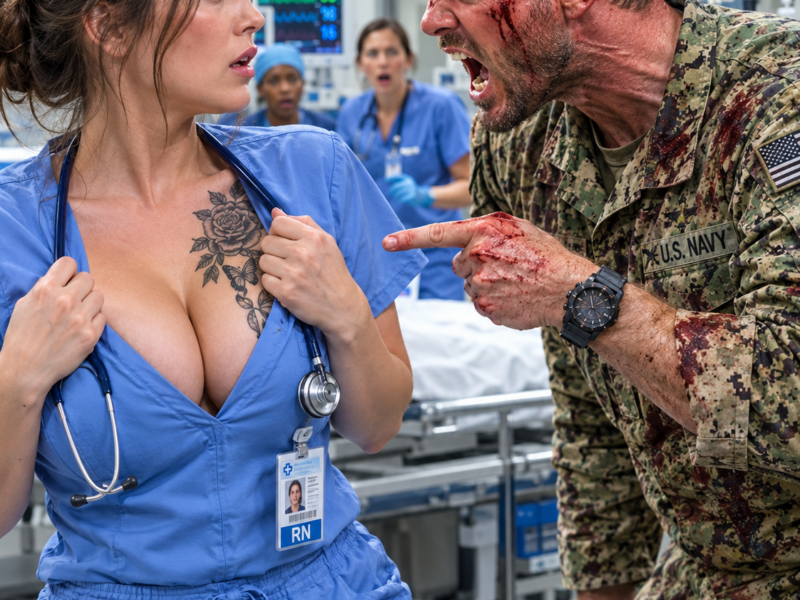
“‘SHUT UP, SL*T!’ the Navy SEAL roared, shoving away every doctor who tried to treat him—until the quiet nurse rolled up her sleeve
The warning on my phone stayed on the screen long after the display went dark.
“We know Mercer found you. If you want your patients to stay safe, forget what he said.”
I read it three times, hoping the words would become less real.
They didn’t.
For nine years, I had convinced myself that the people from Operation Nightglass were gone. Dead, scattered, or buried beneath layers of classified reports that no one would ever read. I had built a quiet life around that belief, one shift at a time, one patient at a time.
Now Jack Mercer was lying behind the operating room doors, and someone knew exactly who I was.
I slipped the phone into my pocket and returned to the surgical corridor.
A young resident named Patel hurried past carrying a stack of charts. “They’re taking Mercer in now. He lost a lot of blood, but the surgeon thinks he can stabilize him.”
“Did he say anything else?”
Patel glanced toward the operating room. “Only that he wouldn’t let anyone touch him until you came back.”
That frightened me more than the text.
Jack had recognized my tattoo. He had known the symbol before I said a word about it. But recognition was not proof that I could trust him.
Nine years ago, I had trusted the wrong person.
And it had cost my team everything.
I found a chair near the nurses’ station and sat down, forcing my hands to stop shaking. I had just started to stand when a man in a dark civilian jacket approached.
He was in his early fifties, clean-shaven, with silver beginning at his temples. He carried himself with the rigid confidence of someone accustomed to being obeyed.
“Ms. Brooks?”
I didn’t answer immediately.
“I’m Deputy Director Adrian Vale,” he said. “Naval Intelligence.”
He showed me an identification card so quickly that I barely had time to read it.
“I need to speak with you about Petty Officer Mercer.”
My pulse thudded against my throat.
“Is he in trouble?”
“That’s what I’m trying to establish.” Vale’s gaze dropped briefly to my sleeve. “I understand you may have served together.”
“I’m a nurse.”
“Of course.” His smile was polite enough to feel rehearsed. “Then you’ll understand why his medical condition and anything he said while disoriented should be handled carefully.”
“He was alert when he spoke to me.”
“Wounded people can become confused. Particularly when old memories are involved.”
He took a small card from his pocket and set it on the counter.
“If he says anything about Nightglass, call me. Don’t discuss it with hospital staff, law enforcement, or anyone outside authorized channels.”
The name struck me like a physical blow.
I had not spoken the word Nightglass in nine years.
Vale watched my face.
“Does that mean something to you, Ms. Brooks?”
I kept my expression still. “You said you were here about Mercer. He’s in surgery. You’ll have to wait for an update like everyone else.”
His smile disappeared for half a second.
Then he nodded.
“Of course. But understand something. Whatever happened overseas, people have spent a great deal of time ensuring it stays buried. Digging it up could put innocent people at risk.”
He walked away before I could ask him how he knew what I was thinking.
I stared at the card.
There was a number on it, but no office address. No direct title beyond his name and agency.
I turned it over.
In tiny print on the back were three words.
**DON’T TRUST MERCER.**
My stomach tightened.
Someone was working very hard to make sure I distrusted the one man who might tell me the truth.
That didn’t mean Jack was innocent.
It meant I needed to find out for myself.
An hour later, the surgeon came out and removed his cap.
“Mercer is stable. We repaired the damage, but he lost enough blood that he’ll need close monitoring. He’s sedated right now.”
“Can I see him when he wakes up?”
The surgeon studied me. “Are you family?”
“No.”
“Then I can’t promise anything.”
“I was the nurse who got him to cooperate.”
He considered that, then nodded. “When he’s transferred to recovery, ask the charge nurse.”
I waited until the hallway quieted before I called the number on Vale’s card.
It rang once.
A voice answered immediately. “Vale.”
“I have a question about Operation Nightglass.”
Silence.
Then, very carefully, he said, “Where did you hear that name?”
“You said it first.”
“I advised you not to discuss classified matters.”
“You also told me not to trust Mercer. Why?”
“Because he has a history of instability.”
“What kind of instability?”
“Ms. Brooks, this conversation is over.”
He hung up.
I looked at my phone, my heartbeat pounding in my ears.
It wasn’t proof of anything.
But it was the first time in nine years that asking a question had made someone afraid to answer.
When Jack was moved to recovery, I went to his bedside.
His face looked thinner without the anger that had filled it in the emergency department. A monitor beeped steadily beside him. Bandages covered his side, and an IV ran into his arm.
I stood there for several minutes, unsure whether I wanted him to wake up.
Then his eyelids fluttered.
He opened his eyes and immediately tried to sit up.
“Don’t,” I said, pressing a hand against his shoulder. “You have stitches that I’d prefer not to see from the inside.”
He winced and sank back into the pillow.
“Elena.”
My name sounded strange coming from him.
“Who is Adrian Vale?”
The color drained from his face.
“You saw him?”
“He came here and told me not to trust you.”
Jack closed his eyes.
“Then he knows I’m alive.”
“Jack, stop talking in riddles. What happened to our team?”
He looked toward the curtain, then back at me.
“Did he tell you to forget Nightglass?”
“Yes.”
“Did he say it was for your own protection?”
“Yes.”
Jack let out a humorless breath. “That’s how he always does it. Makes a threat sound like a favor.”
I pulled the visitor chair closer.
“Start at the beginning.”
He hesitated. I saw the struggle in his face, the calculation between speaking and staying silent.
Then he reached toward the bedside table.
“There’s something in my bag.”
“Your belongings are with security.”
“Tell them to check the inner lining. There’s a seam at the bottom. I put it there before the transport.”
I went to the nurses’ station and spoke to security. The bag had been logged and sealed, but after the charge nurse verified Jack’s identity and consent, they brought it to the room.
Inside were a wallet, a set of keys, a cracked phone, and a bloodstained jacket.
I searched the lining.
My fingers found a small rectangular object wrapped in plastic and stitched beneath the fabric.
A memory card.
Jack watched me hold it up.
“That’s why they tried to stop me from getting here,” he said.
“What’s on it?”
“Enough to prove that Nightglass wasn’t a rescue operation.”
The room seemed to shrink around us.
Nine years earlier, our team had been sent into a remote valley to evacuate three intelligence assets before an enemy force reached them. The briefing had described a narrow extraction window and a compromised communications network.
I had been the combat medic attached to the team. My job was simple: keep the wounded alive long enough to get them home.
But the extraction helicopter never arrived.
Our radio operator, Finch, reported that command had redirected the aircraft. Minutes later, an explosion tore through the compound where we were sheltering.
I remembered smoke, screaming, and the sensation of being thrown against a concrete wall.
I remembered dragging Jack toward a narrow passage, my arm bleeding and my ears ringing.
Then the roof began to collapse.
Jack had been trapped beneath a fallen beam. I had cut him free, shoved him toward the service tunnel, and gone back for the others.
The last thing I remembered was a flash of white light.
After that, there had been darkness.
I woke in a military hospital weeks later with burns across my shoulder and chest. I was told the team had been killed in the blast. My own survival had been attributed to an unexplained gap in the casualty reports.
I asked for the names of the bodies recovered.
I was told the remains were too damaged to identify.
I asked to see the mission file.
I was told the file was sealed.
When I pushed harder, an officer warned me that my memory of the event might be unreliable because of my injuries.
Eventually, I stopped asking.
Jack’s voice pulled me back.
“They didn’t die in that explosion.”
I stared at him. “You told me you were trapped.”
“I was. You got me out. I made it into the tunnel, but I lost consciousness before I reached the exit.”
“You were listed as dead.”
“Because someone needed me dead.”
He swallowed painfully.
“When I woke up, I was in a field hospital under another name. Two men told me our mission had failed and that the rest of the team was gone. They said you were dead too.”
My throat tightened.
“Who were the men?”
“One wore a uniform. The other was a civilian. I never got their names.”
“And you believed them?”
“For a while.” His eyes held mine. “I wanted to believe them. It was easier than thinking command had left us behind.”
He told me he had spent months recovering under medical supervision, then been reassigned. Whenever he tried to request the Nightglass records, his applications disappeared. When he asked former contacts for help, they warned him to stop.
He began investigating quietly.
Two years ago, he found evidence that the mission’s communications logs had been altered. The original extraction order had been replaced with a new one, timestamped after the blast.
Last month, a retired signals officer agreed to meet him.
The officer died in a car accident the night before they were supposed to speak.
Jack had found the memory card hidden in the officer’s belongings.
“What does it contain?” I asked.
“Original radio traffic. A command authorization. And a list of names.”
“Whose names?”
“People who were moved out of the valley before the explosion.”
I felt cold all over.
“The three intelligence assets?”
“Not just them.”
Jack looked away.
“Your team wasn’t sent in to rescue those assets, Elena. We were sent to recover them and a set of records they had collected. Records showing that a covert detention program was operating without legal authorization. The assets were witnesses. Someone in our chain of command decided it would be cleaner if the witnesses, the records, and the team sent to retrieve them all disappeared together.”
I shook my head, but the denial felt weak even to me.
“Command wouldn’t authorize that.”
“Someone did.”
“Who?”
Jack’s jaw tightened.
“Rear Admiral Nathaniel Shaw.”
The name was familiar. Shaw had been a senior operations officer at the time. He had signed the commendation papers sent to the families of our fallen teammates.
“He was promoted,” I whispered.
“After Nightglass. And Vale was his intelligence liaison.”
I looked at the memory card in my hand.
“Why bring it to me now?”
“Because the files name you as the medic who recovered the original records.”
“I never recovered any records.”
“You were listed as having them when the extraction was canceled.”
“That isn’t true.”
“I know.”
His answer came too quickly, too firmly.
I leaned closer. “How do you know?”
“Because I heard the order.”
He took a careful breath, wincing as pain pulled at his side.
“After you pushed me into the tunnel, I came around for a few seconds. My radio was still working. I heard Finch asking command why the helicopter had been diverted. Then a voice ordered him to destroy the mission logs. Finch refused. The next transmission was Shaw’s.”
Jack’s eyes shone with anger.
“He said, ‘No witnesses. Close the channel.’”
I couldn’t speak.
For nine years, I had imagined our final moments as chaos and bad luck. A failed extraction. A terrible accident. A tragedy that no one could have prevented.
Now Jack was telling me that someone had listened to us die and called it an order.
A knock interrupted us.
A nurse entered carrying a medication tray. She glanced at Jack, checked his monitor, and gave me a professional smile.
“Everything all right in here?”
“Fine,” I said.
Her gaze lingered on the memory card.
“Is that hospital property?”
“No.”
She nodded, but her expression had changed.
When she left, I put the card inside my pocket.
“We need to get this copied,” I said.
“Not on a hospital computer.”
“I know.”
“And don’t hand it to Vale.”
“I wasn’t planning to.”
Jack caught my wrist before I could stand.
“Elena, listen to me. There’s something else.”
His fingers were weak, but his grip carried an urgency that made me sit again.
“The list includes a survivor.”
I waited.
“Someone from our team.”
My chest tightened. “Who?”
“Sergeant Luis Ortega.”
I shook my head.
“Ortega was the first casualty reported. They said he died in the blast.”
“I know what they said.”
“His mother held a memorial.”
“I know.”
Jack’s voice broke. “I went to it. I stood at the back and watched her bury an empty casket because I thought he was dead.”
He looked down at his hands.
“The memory card has a transport record. Ortega was moved out of the valley two hours before the explosion. He’s alive, Elena. At least he was when that record was made.”
I thought of Luis’s crooked grin, his terrible singing, the way he used to tap my helmet twice before a patrol because he said it brought luck.
My knees felt weak.
“Where is he?”
“We don’t know. But there’s a location attached to the transport record. A facility outside Norfolk.”
“Why didn’t you go there?”
“I did.”
“And?”
“The facility is officially abandoned. But someone has been using it. New power bills. Security cameras. Deliveries under a contractor’s name.”
“Then we take the evidence to federal investigators.”
“Which ones?” Jack asked. “The ones who report to Shaw’s allies? The ones who let Vale walk into this hospital before you had even finished your shift?”
I hated that he had a point.
But I hated even more the idea of doing nothing.
“We can’t just break into a classified facility.”
“I’m not asking you to break in.”
“You were about to.”
“I was about to ask you to help me find out whether Ortega is there.”
“That is exactly what breaking in sounds like.”
For the first time, a faint smile touched his mouth.
“You always were the sensible one.”
“And you were always a terrible liar.”
The smile faded.
“I’m sorry,” he said.
Two words.
They landed harder than any explanation.
“For what?”
“For letting you think we were all dead. For not finding you sooner. For not knowing whether you were alive until I saw that tattoo.”
“You were told I was dead.”
“I should have kept looking.”
I wanted to forgive him. Part of me already had. But nine years of grief could not be undone by an apology, even a sincere one.
“You should rest,” I said.
“Don’t go to the facility alone.”
“I haven’t agreed to go anywhere.”
“Elena.”
“I said I’ll think about it.”
I left the room with the memory card pressed against my palm.
By midnight, I had copied its contents onto two encrypted drives using a personal laptop I kept locked in my apartment. I didn’t open every file. I didn’t need to. The first audio recording was enough to make my hands tremble.
Static.
A burst of gunfire.
Finch’s voice, frantic and clear.
“Command, extraction is compromised. We have wounded. Request immediate pickup.”
Another voice responded, cold and controlled.
“Aircraft diverted. Hold position.”
Then Finch again.
“Sir, we have civilians here. We can’t hold this position.”
A pause.
Then the voice I recognized from the old briefing recordings.
Admiral Shaw.
“Terminate the channel. No witnesses. Close it now.”
The recording ended.
I sat motionless in the dark.
There was no way to explain that away as confusion. No way to call it a tragic misunderstanding.
I had spent nine years believing the people I loved had died because the mission went wrong.
The mission hadn’t gone wrong.
Someone had decided our lives were expendable.
At 1:17 a.m., my phone rang from an unknown number.
I almost ignored it.
Then I answered.
A man’s voice whispered, “Elena? It’s Luis.”
I gripped the edge of the desk.
“Luis?”
“Don’t say my name again.”
The voice was older, rougher, but unmistakable.
“Where are you?”
“Somewhere I should never have been taken.”
“Are you alive? Are you hurt?”
A quiet laugh, brittle and exhausted.
“I’m alive. That’s about all I can promise.”
I pressed a hand over my mouth.
“Jack is here. He’s alive too.”
Silence.
Then I heard Luis breathe out, like a man who had been holding his breath for years.
“Mercer made it.”
“He says you’re on the transport list.”
“I am.”
“Can we get you out?”
“Not by coming through the front door.”
“Tell me where you are.”
“Listen carefully. Shaw doesn’t know I can still access the old system. Vale thinks I’m dead. If they find out I called you, they’ll move everyone before morning.”
“Everyone? Who else is there?”
“Witnesses. People who were supposed to vanish after Nightglass. Some were moved through the detention program. Some never made it out.”
My stomach turned.
“Luis, we need to take this to the authorities.”
“Not yet. There’s a server here with the original transfer records. If you get those records out, you can prove what happened. If you come for me without them, they’ll call it a rescue attempt by a disgraced soldier and bury the whole thing.”
“Where is the facility?”
He gave me an address outside the city, then told me not to come alone.
“I won’t,” I said.
“And Elena?”
“I’m here.”
“I’m sorry about the others.”
My eyes filled.
“I know.”
“No, you don’t.” His voice cracked. “I was awake when they brought us out. I heard them say your name. They said you were the only one who could identify the records, so they needed you gone.”
I couldn’t breathe.
“Who said that?”
“Shaw.”
The call ended.
I sat there until dawn began to gray the windows.
At six, I returned to the hospital. Jack was awake, angry that the nurse had refused to let him stand, and visibly relieved when I told him Luis had called.
“We need a plan,” I said.
He studied my face. “You’re going.”
“Yes.”
“I knew you would.”
“Don’t sound pleased. You’re not cleared to leave the hospital.”
“Then I’ll be the least mobile member of the operation.”
“You’re not coming.”
“Elena—”
“You have a fresh surgical wound. You can barely sit up. I’m not risking your life because you think pain is a personal insult.”
He looked as though he wanted to argue, then stopped.
“Take the drives,” he said. “And don’t trust anyone who knows your route.”
“I need someone official on our side.”
“There was one person I considered calling. Commander Naomi Price. She handled internal oversight after Shaw’s promotion. She was the only investigator who asked questions about Nightglass.”
“Why didn’t you contact her?”
“Because the first time I did, she told me to disappear.”
“Maybe she was trying to protect you.”
“Maybe.” He handed me a number from memory. “But she’s the best chance we’ve got.”
I called Commander Price from a quiet stairwell.
She answered on the fourth ring.
“Price.”
“My name is Elena Brooks. I served as a medic on Operation Nightglass.”
The silence was so complete that I checked the screen to make sure the call hadn’t dropped.
Then she said, “Where did you get that name?”
“From a man who was there. I have evidence that the mission was deliberately compromised. I have a living witness who was reported dead.”
“Who?”
“Luis Ortega.”
I heard a chair scrape.
“Don’t move,” she said. “Don’t call anyone else. I’ll meet you at the hospital in thirty minutes.”
“Why should I trust you?”
“Because nine years ago, I was ordered to close the Nightglass inquiry. I refused. They removed me from the case and told me every surviving witness was dead.”
Her voice hardened.
“If Ortega is alive, then I have been waiting nine years for this call.”
She arrived twenty-six minutes later in plain clothes, alone, carrying no visible badge. I showed her the audio recording and the transfer list.
She listened without interrupting.
When Shaw’s voice said, “No witnesses,” her jaw tightened.
When the recording ended, she sat very still.
“This is enough to reopen the investigation,” she said. “But it won’t be enough to secure Ortega before they move him. We need the server records.”
“Can you get a warrant?”
“Not before they destroy the evidence. I can contact an inspector general’s team outside Shaw’s command structure, but it will take time.”
“Luis said they might move everyone before morning.”
Price looked at me.
“Then we need to get him out and preserve the records. We do it with a documented emergency extraction, not a private raid. I’ll contact two agents I trust and arrange a perimeter. You will not enter the building.”
“I know Luis. He may not come out unless he sees someone he trusts.”
“Then you can speak to him from a safe location. But if anything goes wrong, you follow instructions. Understood?”
I nodded.
For the first time since Jack had arrived, I felt that we were no longer fighting alone.
By late morning, we were on the road to the facility.
The building stood behind a chain-link fence at the edge of an industrial park. From the outside, it looked abandoned: boarded windows, rusted sign, weeds pushing through cracked asphalt.
But there were fresh tire tracks near the side entrance.
Two unmarked vehicles waited several streets away. Price remained with the agents while I stayed in a van with a secure radio. Jack, against every medical instruction he had received, had managed to convince his surgeon to let him leave under supervision. He was in the second vehicle, pale and sweating, but determined.
I wanted to yell at him.
Instead, I handed him a bottle of water.
“If you collapse, I’m leaving you here.”
“Understood.”
“You don’t look like you understand.”
“I understand that you’re angry.”
“I’m furious.”
“Good. Means you’re still you.”
I looked away before he could see how much that hurt.
Price gave the signal.
The agents approached the entrance, identified themselves, and demanded access. For several seconds, nothing happened.
Then the side door opened.
A man stepped out holding a phone. He spoke rapidly, glanced toward the road, and disappeared back inside.
“Movement,” one agent reported.
Price’s voice came through the radio. “Nobody enters until we establish a lawful basis and confirm what’s inside.”
A minute later, a second vehicle came out of the rear gate.
It accelerated toward the road.
The agents moved to block it. The driver swerved, clipped a barrier, and stopped. Two men climbed out and were immediately ordered to the ground.
The facility’s front door burst open.
People began coming out with their hands raised.
Not armed guards.
Civilians.
A woman with gray hair. A young man limping badly. Two older men supporting someone who could barely walk.
And then I saw him.
Luis Ortega stood in the doorway, thinner than I remembered, his hair almost completely gray at the temples. He was wearing a plain sweatshirt and hospital-style trousers. A dark mark circled one wrist where a restraint had rubbed the skin raw.
For a moment, neither of us moved.
Then he saw me.
“Medic,” he whispered.
I ran before Price could stop me.
Luis caught me in his arms, and I felt his whole body shake.
“I thought you were dead,” I said into his shoulder.
“I thought you were.”
We held on to each other as if the years between us were a physical thing we could somehow push away.
Then Luis pulled back and looked at my tattoo.
“You kept it.”
“I never knew what else to do with it.”
He touched the edge of the compass rose with one trembling finger.
“Finch designed that for us. Remember? Said it meant we always found our way back.”
My eyes burned.
“I remember.”
Behind him, agents were escorting people out and securing the building. Commander Price approached with two investigators carrying evidence bags.
“Sergeant Ortega,” she said. “I’m Commander Price. You’re safe now.”
Luis looked at her carefully.
“Safe is a big word, ma’am.”
“I know. We’ll start with protected.”
He nodded once.
“The server is in the basement. The original transfer records are there, along with the detention files. They were going to wipe it today.”
Price signaled to the agents.
They went inside under her authority, documenting every room, every device, every locked cabinet. No one touched the server until the forensic team arrived.
When they emerged an hour later, one of the agents carried a sealed evidence case.
“We have the records,” he said.
Price let out a breath she had been holding for nine years.
“Then we have a case.”
But the victory was not clean.
The files revealed that the detention program had been authorized through a chain of shell contractors and falsified emergency orders. Several officials had known about it. Others had signed documents without understanding what they were authorizing. Some of the people held at the facility had been witnesses; others had been staff who tried to report the program.
The Nightglass team had discovered the records by accident while evacuating the intelligence assets.
The original plan had been to extract everyone.
When Shaw learned that the team had copied the files, he redirected the helicopter and ordered the communication channel shut down. The explosion had been intended to destroy the records and eliminate the people who could authenticate them.
But the explosion hadn’t killed everyone.
Luis and Jack survived. I survived. A handful of detainees escaped the original compound and were recaptured elsewhere. Over the years, the surviving witnesses had been moved through the covert facility, their identities altered and their accounts dismissed as unreliable.
The file listed my name beside a note written in stark administrative language:
**SURVIVING MEDICAL WITNESS. RECOVERY STATUS UNKNOWN.**
Below it was an instruction signed by Shaw.
**If located, contain before disclosure.**
I read it twice.
Then I put the page down because I couldn’t bear to see my name beside that order any longer.
Adrian Vale was arrested that afternoon while attempting to leave a government office with a briefcase full of classified documents. Investigators found evidence that he had helped conceal the detention program and had tracked Jack’s movements after the memory card surfaced.
Admiral Shaw was taken into custody two days later.
He denied everything.
His attorneys argued that the recordings had been altered, the transfer logs were incomplete, and the witnesses had been traumatized. They tried to turn the truth into a collection of technical questions, hoping the people who had suffered would become too exhausted to keep answering them.
But this time, the evidence did not disappear.
The memory card matched the original server files. The forensic team verified the audio timestamps. The transfer records matched the testimony of surviving detainees. Commander Price’s old investigation files showed that she had been ordered to close the case despite documented inconsistencies.
And Jack and Luis were alive to testify.
For the first time in nine years, our names were spoken in an official room without being followed by the word deceased.
The hearings lasted months.
I returned to work at Harbor Point, though I found myself staring too long at the hospital doors whenever a wounded service member came through them. My colleagues knew I had been involved in a military investigation, but I kept the details private until I was ready.
Some nights, I woke from dreams of smoke and falling concrete. Other nights, I dreamed that I was back in the valley, calling for a helicopter that never came.
Jack visited when his recovery allowed it. He never asked me to forgive him for the years we had lost. He brought coffee, complained about physical therapy, and sat with me in silence when words were too difficult.
One evening, he found me in the hospital courtyard, tracing the outline of my tattoo through my sleeve.
“Do you still wish you’d never shown it to me?” he asked.
I thought about the question.
“When you first walked into the ER, I wished I’d never seen you.”
“Fair.”
“You were loud, insulting, and completely unreasonable.”
“I’ve been told.”
“And you nearly tore open your stitches trying to prove you didn’t need help.”
“Also fair.”
I smiled despite myself.
Then the smile faded.
“If I hadn’t shown you the tattoo, I might still believe everyone was gone.”
Jack looked down at his hands.
“I don’t know if that makes me grateful or sorry.”
“Maybe both.”
We sat quietly as the evening light moved across the courtyard.
“Do you think the others would be proud?” he asked.
I knew who he meant.
Finch. Morales. Bennett. The men and women whose families had mourned them without knowing the truth.
“I think they’d be angry that it took us so long,” I said.
Jack laughed softly, and for a moment I could almost hear the old team around us.
Luis came to visit the following week. He was staying in a protected residence while investigators helped him reconnect with his family. He had not yet told his mother everything. He was afraid that seeing him alive after all those years might bring more pain than relief.
I told him she deserved the chance to decide that for herself.
He went to see her two days later.
When he returned, he sat beside me in the hospital cafeteria and cried without trying to hide it.
“She hit me,” he said.
I stared at him.
“Your mother?”
“Twice. Then she hugged me so hard I thought she’d break my ribs.”
I laughed, and then I cried too.
It was not a happy ending in the way people imagine endings. The dead remained dead. Families had to confront the truth that their loved ones had not simply been lost in a terrible accident; they had been abandoned by people sworn to protect them. Some witnesses were too damaged to speak publicly. Some would never recover the lives stolen from them.
Justice did not give us back nine years.
It did not erase the fear, the grief, or the quiet shame I had carried for surviving.
But it gave the truth somewhere to stand.
Six months after the arrests, I was invited to a private memorial for the Nightglass team. This time, the names on the wall were not followed by a false account of their deaths. The official record acknowledged the mission’s betrayal and named those responsible for concealing it.
I stood before the names with Jack on one side and Luis on the other.
For a long time, none of us spoke.
Then I rolled up my sleeve.
The small compass rose caught the light. Its narrow silver line crossed the black ink, and the three tiny stars rested beneath it.
“I used to think this tattoo meant we were lost,” I said.
Jack looked at it.
“What do you think now?”
I watched the sunlight fall across the names of the people who had never made it home.
“I think it means someone has to remember the way back.”
Luis placed a hand on my shoulder.
Jack stood beside me, quiet for once.
We could not bring the others back. We could not repair every life damaged by the program, or make the years of silence disappear.
But we could tell the truth.
And we could make sure that the next person who asked what happened to Nightglass would not be told to shut up, look away, or forget.
I lowered my sleeve and took one last look at the memorial.
For nine years, I had survived by believing the past was a place I could leave behind.
Now I understood that some things followed you—not to punish you, but to remind you that you were still here.
And that being alive was not the same as being finished.
For the first time since the valley, I no longer felt like the last survivor of a dead team.
I felt like a witness.
And I was finally ready to speak.
The end.









