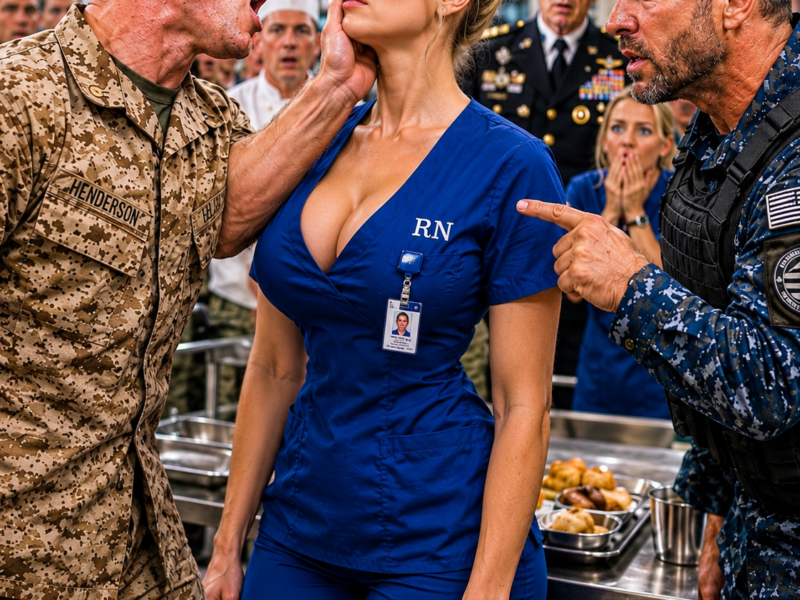
“Sergeant Cole slapped me across the face in front of nearly two hundred Marines in the Camp Pendleton chow hall
Harris didn’t move for several seconds.
He stood beside my table, holding his phone in one hand, his eyes fixed on the message.
I had seen that expression before.
It was the same look he’d worn six months earlier when a helicopter had gone down outside a designated extraction zone and three men hadn’t made it back.
“Michael,” I said quietly. “Tell me exactly what happened.”
He locked his phone.
“Not here.”
I glanced at Sergeant Cole.
He was still standing beside my chair, but the confidence had drained from his face.
“Commander Bennett,” he repeated, almost under his breath.
I picked up my tablet and placed it inside my bag.
“Sergeant Cole, you’re going to remain here until someone from your command arrives.”
He opened his mouth.
Harris interrupted him.
“That’s an order.”
Cole looked at the SEAL, then at me.
For the first time since he’d walked up to my table, he seemed unsure which direction to turn.
Two military police officers entered the chow hall less than a minute later.
Behind them came Lieutenant Colonel James Whitaker, the Marine battalion commander.
He was in his late forties, with silver beginning to show at his temples.
I’d met him twice since arriving at Camp Pendleton.
Both times, he’d been polite.
Neither time had he asked why a Navy commander was working quietly among his medical personnel.
Now his eyes went straight to my cheek.
“What happened?”
Cole immediately stepped forward.
“Sir, there was a misunderstanding.”
Whitaker looked at the overturned glass.
Then he looked at the corporal who had witnessed the incident.
“Corporal?”
The young Marine stood.
“Sergeant Cole struck Commander Bennett, sir.”
Nobody spoke.
Whitaker slowly turned toward Cole.
“Is that true?”
Cole swallowed.
“She was being disrespectful.”
“I asked whether you struck her.”
A long pause followed.
“Yes, sir.”
Whitaker’s jaw tightened.
“Military police, escort Sergeant Cole to the administrative office. No contact with witnesses.”
Cole started to protest.
“Sir, I didn’t know who she was.”
Whitaker looked at him coldly.
“That doesn’t make it better.”
The officers escorted him out.
As he passed me, he briefly turned his head.
There was something in his eyes I hadn’t expected.
It wasn’t just embarrassment.
It was fear.
And I had a feeling that fear had very little to do with the slap.
When the doors closed behind him, Whitaker approached.
“Commander Bennett, I apologize for what happened.”
“Thank you, Colonel.”
“Medical evaluation?”
“I’ll have the corpsman check my cheek.”
He nodded.
Then he glanced at Harris.
“I assume this has something to do with the assignment?”
Harris answered before I could.
“Yes, sir.”
Whitaker’s expression changed.
“Then we should move.”
I followed them out of the chow hall.
Behind us, the room slowly returned to conversation, although I could still hear my title being repeated in whispers.
For three weeks, I had been practically invisible.
In less than five minutes, that had changed.
And I wasn’t sure I wanted anyone noticing me.
We entered a small conference room in the command building.
Harris closed the door.
Whitaker placed his cap on the table.
“All right. What’s happened?”
Harris handed me his phone.
A message appeared on the screen.
UNKNOWN NUMBER:
Bennett is on base. The medical records are still accessible. Make sure she doesn’t reach the original report.
I read it twice.
Then I looked at him.
“How long ago?”
“Seven minutes.”
“Who sent it?”
“We’re tracing the number. It came through a prepaid device.”
I handed the phone back.
“Does anyone else know?”
“Not yet.”
Whitaker folded his arms.
“Commander, I need to understand something. Your assignment was approved through channels above my level. I was told you were here to review medical readiness.”
“That was the official description.”
“And the actual assignment?”
I looked at the closed door.
Then I turned back to him.
“An investigation into the deaths of four service members during a training exercise six months ago.”
Whitaker didn’t move.
Harris pulled out a chair.
“Tell him.”
I sat down.
Six months earlier, I had been serving as a Navy medical officer attached to a joint special operations unit.
My responsibilities included medical readiness, casualty documentation, and reviewing treatment procedures after high-risk training missions.
It wasn’t glamorous work.
Most of it involved records, interviews, and making sure the right people received the right information.
But on one particular night, those records had become the only thing standing between four dead service members and a false official explanation.
The exercise had taken place near a remote training area in Southern California.
A simulated extraction had been scheduled for 0200.
The weather was clear.
Communications had been tested.
Every team member had received the same operational briefing.
At 0147, the ground team reported that their extraction coordinates had changed.
The new coordinates were outside the approved training zone.
At 0213, an emergency transmission came through.
One vehicle had rolled over.
Four men were critically injured.
Two died before reaching the medical station.
A third died during transport.
The fourth survived for eleven hours before his condition deteriorated.
The initial report blamed poor visibility, equipment failure, and a navigation error.
But I had reviewed the medical logs.
The first casualty had injuries inconsistent with the reported rollover.
The second had been treated for a wound that didn’t appear anywhere in the original incident summary.
And the fourth man had managed to say something before he died.
Something that never made it into the official report.
I leaned forward.
“He told me the coordinates had been changed before the exercise began.”
Whitaker frowned.
“Changed by whom?”
“That’s what I was sent here to find out.”
Harris rubbed his forehead.
“We found evidence that the original mission data was altered. Someone accessed the system using credentials belonging to a medical administrator.”
I looked at him.
“Mine?”
“No.”
He hesitated.
“Your former supervisor’s.”
My stomach tightened.
“Captain Richard Lawson?”
Harris nodded.
I stared at the tabletop.
Lawson had been my commanding officer for nearly four years.
He had recommended me for my medical command qualification.
He’d attended the memorial service for the men who died.
He’d even called me afterward to make sure I was holding up.
I remembered his voice.
You did everything you could, Claire.
I’d believed him.
For a long time, I’d believed him.
“Why would Lawson alter the coordinates?” Whitaker asked.
“I don’t know.”
Harris leaned forward.
“But there’s another problem. The original medical report disappeared from the archive three weeks ago.”
“Who accessed it?”
“Someone using credentials from this installation.”
Whitaker stood.
“That means we have a security breach.”
“Yes, sir.”
He walked toward the window.
“Does Cole have access to the medical records?”
I thought about the slap.
The timing.
The way his eyes had changed when Harris said my title.
“I don’t know,” I answered.
Harris placed another photograph on the table.
It showed Sergeant Cole standing outside a medical administration building.
The timestamp was from two nights earlier.
“One of our surveillance teams captured this while monitoring the archive entrance.”
I studied the photograph.
Cole was speaking to a man wearing civilian clothes.
The man’s face was partly hidden by the hood of his jacket.
But I recognized the posture.
The narrow shoulders.
The way he held his left hand close to his body.
I had seen him before.
“Do you know him?” Harris asked.
I didn’t answer immediately.
Then I pointed at the photograph.
“That’s Richard Lawson.”
Whitaker looked at the image.
“Your former supervisor?”
“Yes.”
Harris nodded.
“We thought so.”
I looked up sharply.
“You knew he was here?”
“We had a suspicion. We didn’t have confirmation.”
“Why wasn’t I told?”
“Because we didn’t know who else might be monitoring your communications.”
I stood.
“So you brought me onto this base without telling me that the man I was investigating might already be here?”
Harris didn’t flinch.
“We were trying to protect the investigation.”
“By keeping the person conducting it in the dark?”
He looked away.
That silence told me enough.
I walked toward the window.
Outside, Marines crossed the courtyard carrying equipment cases.
Everything looked ordinary.
That was the strangest part.
Four men were dead.
Someone had altered the records.
Someone had tried to erase the original evidence.
And people were still going to lunch, making phone calls, and complaining about the weather.
I turned back.
“Where is Lawson now?”
“We don’t know,” Harris said.
“But Cole might.”
I thought about the fear in Cole’s face.
Not the embarrassment.
The fear.
He hadn’t looked like a man worried about disciplinary action.
He had looked like someone who had just realized the wrong person had walked into the room.
“Bring him in,” I said.
Whitaker nodded.
“That’s already being arranged.”
Sergeant Cole was sitting in an administrative interview room when I entered.
His uniform was neat again.
He had washed his hands.
There was a paper cup of water in front of him.
A military police officer stood near the door.
Cole looked up.
“Commander.”
I pulled out the chair across from him.
“Sergeant.”
He glanced at the officer.
“Am I allowed to speak with her?”
“Yes,” Whitaker answered from the doorway. “But everything said in this room is being documented.”
I placed a photograph on the table.
It was the same image Harris had shown me.
Cole looked at it for less than a second.
Then he looked away.
“Do you recognize this man?”
“No.”
I waited.
He shifted in his chair.
“Never seen him.”
“That’s interesting.”
“Why?”
“Because the man in this photograph was standing outside the medical archive with you two nights ago.”
Cole’s fingers tightened around the paper cup.
“I don’t know what you’re talking about.”
I slid the photograph closer.
“Look at his left hand.”
He didn’t.
I continued.
“Richard Lawson has an old injury. His left thumb doesn’t bend properly. You can see it in the photograph.”
Cole’s eyes flickered toward the image.
That was enough.
“How long have you known him?” I asked.
He leaned back.
“He’s a civilian contractor. He comes and goes.”
“That’s not an answer.”
“He was here on business.”
“What business?”
“Medical equipment.”
“Then why were you meeting him outside the archive at eleven forty at night?”
Cole looked toward the officer.
“Am I being accused of something?”
“You’re being asked a question.”
He swallowed.
I waited.
Finally, he spoke.
“He said he needed access to a file.”
“Which file?”
“I don’t know.”
“Sergeant, you were standing beside him.”
“I was helping him get into the building.”
The room went quiet.
Whitaker stepped closer.
“Did you authorize him to enter a restricted facility?”
Cole’s shoulders dropped.
“He said he had approval.”
“From whom?”
“He didn’t say.”
“Did you verify it?”
Cole shook his head.
I studied him.
“Why?”
He rubbed his forehead.
“Because he told me it was important.”
“Important enough to break security regulations?”
He didn’t answer.
I leaned forward.
“Did Lawson tell you why he needed the file?”
Cole’s eyes moved toward mine.
“He said it was about the accident.”
The word settled between us.
I kept my voice steady.
“What accident?”
“The training accident.”
“How did he know I was coming here?”
Cole looked down.
“He asked about you.”
“When?”
“Last week.”
“What did he ask?”
Cole took a breath.
“He wanted to know when the new medical commander would arrive.”
I felt the muscles in my jaw tighten.
“Did he know my name?”
Cole nodded.
“He said you were coming to reopen the investigation.”
I looked at Whitaker.
Then back at Cole.
“Did he tell you to stop me?”
“No.”
“Did he ask you to intimidate me?”
“No.”
“Then why did you strike me?”
Cole looked genuinely uncomfortable for the first time.
“I didn’t know you were the commander.”
I let the silence stretch.
“Would it have been acceptable if I were only a nurse?”
He opened his mouth.
Nothing came out.
I stood.
“That’s what I thought.”
But before I reached the door, he spoke again.
“Commander?”
I turned.
“There’s something else.”
I waited.
Cole stared at the table.
“Lawson said the report wasn’t the only thing that had disappeared.”
“What else?”
“He said someone had kept a copy.”
My pulse quickened.
“Who?”
Cole shook his head.
“He didn’t tell me.”
“Did he say where it was?”
Cole hesitated.
Then he whispered, “He said it was somewhere nobody would think to look.”
I looked at Harris.
He had been standing quietly near the wall.
“Did he say anything else?”
Cole rubbed his palms together.
“Just one thing.”
“What?”
Cole finally raised his eyes.
“He said the dead men weren’t supposed to be there.”
For several seconds, nobody spoke.
I sat back down.
“Explain that.”
Cole shook his head.
“I don’t know what he meant.”
“Try.”
“He said the training exercise had been changed at the last minute. He said there were supposed to be only two teams in that area.”
“But four men died.”
“Yes.”
“Why weren’t they supposed to be there?”
“I don’t know.”
I studied his face.
He was frightened, but he wasn’t acting.
At least not entirely.
“Did Lawson tell you who changed the coordinates?”
Cole hesitated.
Then he said, “He mentioned a name.”
“Whose?”
He looked at Whitaker.
Then back at me.
“Captain Lawson said the change came from someone who was supposed to be dead.”
A cold sensation moved through my chest.
Harris stepped forward.
“Did he give you a name?”
Cole shook his head.
“No. He said the person had been officially declared dead after the exercise.”
I stared at him.
One of the four men killed during that incident had been a communications specialist named Petty Officer First Class Aaron Mitchell.
His body had been recovered.
His death had been confirmed.
His family had received the notification.
There had been a funeral.
I’d attended it.
But there had been another name in the original mission log.
A fifth person.
A man whose presence had been removed from the final report.
I had seen the name once, in a preliminary document.
Then it disappeared.
I opened my bag and took out my tablet.
I pulled up the archived notes I’d saved before coming to Camp Pendleton.
“Michael, find the preliminary roster from the night of the exercise.”
He moved beside me.
“Which version?”
“The first one.”
His fingers moved across the screen.
A moment later, the document appeared.
There were five names.
I read them slowly.
Then stopped.
The fifth name wasn’t a stranger.
It belonged to Lieutenant Commander Daniel Reeves.
A Navy officer who had supposedly died during an overseas deployment two years earlier.
I remembered his file.
His death had been confirmed.
His family had received benefits.
His name had been engraved on a memorial wall.
Yet somehow, he had appeared on a training roster six months ago.
Whitaker leaned over my shoulder.
“Who is Reeves?”
I couldn’t take my eyes off the screen.
“He was my instructor when I first entered medical command.”
Harris frowned.
“You knew him?”
“I worked with him for almost three years.”
“Is he alive?”
I looked at the timestamp.
The roster had been created at 2308.
The night before the accident.
I enlarged the final entry.
Beside Reeves’s name was a small note.
MEDICAL CLEARANCE — VERIFIED IN PERSON.
I read it again.
Then I remembered something.
A detail from the night of the accident that I had never understood.
The fourth casualty had been carrying a medical identification tag that didn’t belong to him.
I’d noticed it while preparing the initial report.
I had asked about it.
Lawson told me it was an administrative mistake.
He had asked me not to delay the documentation over a minor discrepancy.
I’d accepted his explanation.
Now I wondered whether the tag had been the only thing that was wrong.
“Michael,” I said, “I need the original casualty identification records.”
He nodded.
“I’ll get them.”
“No. I want to go to the archive myself.”
Whitaker shook his head.
“That’s not happening until we know the system is secure.”
I looked at him.
“Then secure it.”
He held my gaze.
Finally, he nodded to Harris.
“Take a team. No one enters or leaves that building without authorization.”
Harris picked up his phone.
“I’ll handle it.”
I turned toward Cole.
“Sergeant, one more question.”
He looked exhausted.
“What?”
“Did Lawson know about the slap?”
Cole frowned.
“What?”
“Did he know you were going to confront me in the chow hall?”
He shook his head.
“Not specifically.”
“Did he tell you to make sure I couldn’t work?”
Cole’s face changed.
He looked down at his hands.
“He said you needed to understand that people here didn’t want the investigation reopened.”
I waited.
Then he added, “He said if you became a problem, someone would make sure you were removed from the assignment.”
I felt a quiet anger settle inside me.
“By striking me?”
“I didn’t know what he meant.”
I stood.
“Sergeant, I believe you understand now.”
I left the room without another word.
The archive was located in a low concrete building behind the medical administration complex.
By the time Harris and I arrived, two security officers had already sealed the entrance.
The building smelled of dust, disinfectant, and warm electronics.
A technician met us inside.
“Commander, the system has been isolated.”
“Any unauthorized access?”
He hesitated.
“One login attempt about twenty minutes ago.”
“From where?”
“An internal terminal.”
“Which terminal?”
He checked his screen.
“Room 214.”
I knew that room.
It was the records office.
“Who works there?”
“Staff Sergeant Miller.”
Harris looked at the security officer.
“Find him.”
The officer left.
I followed the technician into the archive.
Rows of cabinets lined the walls.
Most of the original records had been digitized, but some paper files were still stored in locked compartments.
I went straight to the casualty section.
The technician entered the incident number.
A list of documents appeared.
Most were marked as standard records.
One file was different.
It had been accessed three times in the previous month.
The last access was seven minutes before Harris received the anonymous message.
“Open it,” I said.
The technician hesitated.
“It’s restricted.”
I showed him my authorization.
He entered the code.
A scanned document appeared.
It was a medical transfer record.
The patient name had been blacked out.
But the date was unmistakable.
The night of the training accident.
I leaned closer.
The document listed an emergency transfer from the training area to a civilian hospital.
The patient had been classified as alive.
The receiving hospital had signed for the transfer.
I looked at the name of the physician.
Then I felt the room tilt slightly.
“Michael.”
He came beside me.
“What?”
I pointed.
The physician was Dr. Samuel Price.
A retired Navy surgeon who had worked with us during the exercise.
He had been the one who told me the fourth casualty had died before reaching the hospital.
Yet his signature was on a transfer record confirming that the patient had arrived alive.
Harris read it twice.
“That doesn’t make sense.”
“No,” I said. “It doesn’t.”
The technician scrolled down.
At the bottom of the document was a handwritten note.
PATIENT TRANSFERRED UNDER ALTERNATE IDENTIFICATION.
I felt my throat tighten.
“Print it.”
The technician did.
I took the paper and folded it carefully.
For the first time in six months, I had something that wasn’t just a suspicion.
I had evidence.
Then the lights went out.
A low alarm sounded somewhere in the hallway.
Harris immediately moved in front of me.
“Stay behind me.”
The emergency lighting flickered on.
The technician stared at his monitor.
“Someone just triggered a manual shutdown.”
“From where?” Harris asked.
“Room 214.”
The same office.
We moved toward the corridor.
A security officer appeared at the far end.
“Commander! We have someone inside!”
Harris drew his weapon.
I stayed close behind him as we reached the records office.
The door was open.
A chair had been knocked over.
The computer screen was dark.
And the technician’s access card was lying on the floor.
There was no sign of Staff Sergeant Miller.
But on the desk, someone had left a small white envelope.
My name was written across the front.
Not Commander Bennett.
Not Nurse Bennett.
Just:
CLAIRE.
I stared at it.
Harris stopped beside me.
“Don’t touch it.”
He signaled for the security team.
After the envelope had been photographed and cleared, I opened it.
Inside was a single photograph.
It showed five people standing beside a military ambulance.
I recognized three of them immediately.
Myself.
Captain Lawson.
And Lieutenant Commander Reeves.
The other two were the medical personnel who had treated the casualties that night.
On the back of the photograph, someone had written a sentence in black ink.
YOU SAVED THE WRONG MAN.
I read it once.
Then again.
Harris looked over my shoulder.
“Claire, what does that mean?”
I didn’t answer.
I was staring at the man standing behind us in the photograph.
Lieutenant Commander Reeves was smiling.
His uniform was clean.
His hands were folded.
But there was something else.
Something I hadn’t noticed the first time.
His name tag didn’t say REEVES.
It said MITCHELL.
Aaron Mitchell.
The man whose death I had personally certified.
The man whose funeral I had attended.
The man whose family had buried an empty coffin.
My hands began to tremble.
“Michael,” I whispered.
He looked at the photograph.
Then at me.
“That’s not possible.”
I shook my head.
“No. It isn’t.”
Because I had just recognized the man in the picture.
And I knew exactly why someone had gone to so much trouble to make the world believe he was dead.
We didn’t speak until we were back in the conference room.
The photograph lay on the table between us.
Whitaker had called in a security team and ordered the building locked down.
Staff Sergeant Miller was still missing.
The access card had been traced to him, but no one knew whether he had left the installation or was hiding somewhere inside it.
Harris stood near the window.
I sat with my hands folded, trying to keep them still.
“Tell me what you’re thinking,” Whitaker said.
I looked at the photograph.
“Aaron Mitchell wasn’t the man we thought he was.”
“His remains were identified.”
“By dental records?”
Whitaker nodded.
I shook my head.
“The records were incomplete. The identification was approved using a secondary comparison.”
Harris turned.
“By whom?”
“Captain Lawson.”
The room became very quiet.
I continued.
“I remember asking him why we weren’t waiting for a full identification. He told me the family needed closure. He said the remains were consistent with Mitchell’s records.”
“And you signed the medical certification,” Whitaker said.
“Yes.”
The word hurt more than I expected.
I had spent six months believing I had done everything correctly.
Now I was looking at a photograph suggesting I had helped bury a man who was still alive.
Harris pulled out a chair.
“Claire, you were working with the information you had.”
“That’s what everyone says when they don’t want to admit something went wrong.”
“That’s not what I’m saying.”
I looked at him.
He lowered his voice.
“You didn’t create the false records.”
I looked away.
Whitaker placed both hands on the table.
“We need to establish where Mitchell is now.”
I shook my head.
“His name was removed from the roster, but Reeves appeared in his place.”
“Could Reeves have been using Mitchell’s identity?”
“Possibly.”
“Then who was the fifth man?”
I looked at the photograph again.
The fifth man was partly obscured by the ambulance.
But I could see his face.
It was Dr. Price.
The same physician who had signed the transfer record.
I stood.
“Price knew.”
Harris nodded slowly.
“That’s what the evidence suggests.”
I reached for my phone.
There was one person I needed to speak to.
A woman named Laura Mitchell.
Aaron’s younger sister.
She had called me after the funeral, asking whether her brother had suffered.
I’d told her he hadn’t been alone.
I’d told her we’d done everything we could.
And I’d believed every word.
Now I had to call her again.
I found her number.
My thumb hovered over the screen.
Harris watched me.
“Not yet.”
I looked up.
“She’s his family.”
“I know.”
“She deserves to know.”
“She deserves to hear the truth, not a theory.”
I hated that he was right.
I put the phone down.
Whitaker’s radio crackled.
A security officer reported that a vehicle had been found abandoned near the north gate.
Inside was Staff Sergeant Miller’s identification badge.
No sign of Miller.
But there was a second item.
A phone.
Whitaker took the call.
“What’s on it?”
He listened.
Then his face tightened.
“Secure the device. Don’t open anything until the forensic team arrives.”
He ended the call.
Harris looked at him.
“What?”
Whitaker hesitated.
“There’s a message on the lock screen.”
He turned the phone so we could see it.
If Bennett wants the original report, tell her to come alone.
Below it was an address.
An old medical storage facility outside the main installation.
I looked at Harris.
“No.”
He shook his head immediately.
“Absolutely not.”
I picked up the photograph.
“Someone knows I found the transfer record. They know I recognized Mitchell.”
“Which is exactly why you’re not going alone.”
I looked toward Whitaker.
“Can you secure the address?”
“Yes.”
“Then we go.”
Harris exhaled.
“Claire, this could be a trap.”
“It probably is.”
“That doesn’t make it a good idea.”
I looked at him.
“Four men died because someone decided the truth was inconvenient. One family buried the wrong person. And someone has just sent me a message using the name I haven’t heard in six months.”
I paused.
“I’m not walking away.”
Harris studied me.
Then he nodded.
“Fine. But you stay with my team.”
The storage facility stood at the edge of an industrial road, surrounded by a chain-link fence and dry weeds.
It had once been used to store medical supplies during training exercises.
Now the building was mostly empty.
Two security vehicles waited near the entrance.
Harris and I approached with the team.
The front door was unlocked.
Inside, the air smelled of old cardboard and antiseptic.
A single light was burning at the far end of the hallway.
Someone had left a metal chair in the center of the room.
On it sat a sealed medical records box.
I recognized the label.
The original incident number.
My hands tightened around the strap of my bag.
Harris signaled for the team to clear the building.
One officer checked the adjoining rooms.
Another moved toward the rear exit.
“Clear,” came the report.
I approached the box.
It was sealed with an old red evidence strip.
The strip had been broken and replaced.
Someone had opened it.
I lifted the lid.
Inside were medical forms, casualty photographs, and a small black notebook.
The first page contained a list of names.
The second contained times and coordinates.
The third contained a handwritten note.
I recognized the handwriting immediately.
Captain Lawson.
Mitchell was alive when transferred. Reeves was never on the ground team.
I read it again.
Then I turned the page.
There was another sentence.
Price arranged the transfer. Cole handled access. Miller removed the archive copy.
I felt a chill move through me.
The pieces were finally connecting.
But the last page was missing.
I searched the box.
Nothing.
Then Harris found a folded sheet tucked into the inside cover.
He handed it to me.
It was a medical transport manifest.
The destination was a private rehabilitation facility in Arizona.
The patient’s name was listed as Daniel Reeves.
But the photograph attached to the manifest was unmistakably Aaron Mitchell.
I stared at it.
“He was alive.”
Harris looked at the date.
“Six months ago.”
I turned the paper over.
There was a handwritten phone number.
And beneath it:
Ask him why he changed the coordinates.
Before I could respond, a voice came from the doorway.
“Because he was trying to keep the other men alive.”
We turned.
A man stood at the entrance.
He was older than I remembered.
Thinner.
His hair had grown longer, and there was a scar running from his left temple toward his jaw.
But I knew him.
Captain Richard Lawson.
He raised both hands.
“I came to talk.”
Harris moved between us.
“Stay where you are.”
Lawson looked at me.
“Claire.”
I couldn’t speak.
He glanced at the notebook in my hands.
“You found it.”
“You knew I would.”
“I hoped you would.”
“Why?”
He looked exhausted.
“Because I couldn’t carry this anymore.”
I took one step forward.
“You told me Aaron Mitchell was dead.”
Lawson closed his eyes.
“I know.”
“I certified his death.”
“I know.”
“His family buried an empty coffin.”
His face tightened.
“I know.”
I wanted to hit him.
Instead, I held the notebook tighter.
“Tell me what happened.”
Lawson looked at Harris.
Then back at me.
“Six months ago, the exercise wasn’t just a training operation. Someone had inserted a live communications test into the mission. The team was supposed to recover a device from a restricted area.”
“Who authorized it?”
“An officer whose name wasn’t on the roster.”
“Who?”
Lawson hesitated.
“Reeves.”
I stared at him.
“Daniel Reeves was dead.”
“That’s what the records said.”
“You’re telling me he was alive?”
Lawson nodded.
“He had been working under another identity for months. Mitchell discovered it.”
I felt my stomach tighten.
“Why would Mitchell change the coordinates?”
“Because he realized the team was being sent into an area where the device was already active. He believed it was a live test, not a simulation. He changed the coordinates to move the team away from the danger.”
“Then why did the accident happen?”
“Because someone changed them back.”
Harris stepped forward.
“Who?”
Lawson looked at him.
“Reeves.”
The room went silent.
I looked down at the manifest.
“Why did you help Mitchell disappear?”
“Because he was the only witness who could prove Reeves was alive. And because Reeves had people inside the system.”
“Why didn’t you tell me?”
Lawson looked directly at me.
“Because I was afraid.”
The answer was so ordinary that it made me angrier.
“You let me sign a false death certification.”
“I thought if you knew, you’d be pulled into it.”
“You put my name on a document that helped cover up a crime.”
“I know.”
“And you let me tell his sister he was dead.”
Lawson lowered his head.
“I know.”
For a moment, I couldn’t find words.
Then I asked the question that had been sitting in my chest since the photograph appeared.
“Where is Aaron now?”
Lawson looked at the transport manifest.
“Arizona.”
“Is he safe?”
“I don’t know.”
Harris stepped closer.
“Then we’re going to find out.”
Lawson nodded.
But before anyone could move, a sound came from outside.
A vehicle engine.
Then another.
Harris turned toward the door.
“Contact the perimeter.”
A radio crackled.
“Two vehicles approaching. No visible markings.”
Lawson’s face went pale.
“They found me.”
Harris raised his weapon.
“Everyone down.”
The first shot shattered the window.
Glass sprayed across the room.
Harris pushed me behind a concrete support column.
The security team returned fire from the hallway.
I pressed the notebook against my chest.
Another shot struck the metal shelving.
Lawson dropped to the floor.
“Stay down!” Harris shouted.
The exchange lasted less than a minute.
Then came silence.
A security officer called from the entrance.
“One vehicle is leaving. The second is disabled.”
Harris moved toward the window.
“Do not pursue without authorization.”
He turned back to me.
“Are you hit?”
I shook my head.
Lawson was sitting against the wall, one hand pressed to his shoulder.
Blood seeped between his fingers.
I moved toward him.
“Let me see.”
He tried to wave me away.
“Don’t.”
“You’re bleeding.”
I opened my medical kit.
The wound was on his upper arm.
It wasn’t life-threatening, but it needed pressure.
As I treated him, he looked at me.
“I didn’t expect you to help me.”
“I’m not helping you because I forgive you.”
He nodded.
“I know.”
I secured the dressing.
Then I stood.
“You’re going to tell investigators everything.”
“I will.”
“Not just the parts that make you look better.”
He looked down.
“Everything.”
Harris returned from the entrance.
“We have one suspect in custody. The other vehicle escaped.”
He looked at Lawson.
“You’re coming with us.”
Lawson nodded.
Then he looked at me one last time.
“Claire, there’s something I need you to know.”
I waited.
“Aaron didn’t change those coordinates to save himself.”
I felt my throat tighten.
“He changed them because the original route passed through the medical station.”
I stared at him.
“What?”
“Your medical team was scheduled to be there at 0200. He knew the device was active. He knew if the team followed the original coordinates, the explosion would have reached the station.”
I remembered the night.
The medical tents.
The emergency lights.
The young corpsman who had been standing beside me.
The route had been changed, then changed back.
Aaron had been trying to protect us.
And I’d spent six months believing he had been another casualty of a failed exercise.
The investigation took another eleven days.
It wasn’t simple.
There were interviews, evidence reviews, security audits, and hours of testimony.
Staff Sergeant Miller was found in a motel outside Oceanside.
He admitted removing the archive copy after being promised that his involvement would remain confidential.
Sergeant Cole cooperated with investigators and provided messages from Lawson.
He was formally charged under the applicable military disciplinary process for assault and security violations.
His explanation didn’t erase what he’d done.
But his testimony helped establish the chain of events.
Dr. Price was located in Arizona.
He had arranged Aaron’s medical transfer under an alternate identity after the accident.
He claimed he had done it to protect Aaron from people who wanted him silenced.
The investigators eventually confirmed that Reeves had orchestrated the unauthorized operation and manipulated the training coordinates.
He had used the confusion surrounding the accident to disappear again.
He was arrested several weeks later after attempting to leave the country.
Richard Lawson gave a full statement.
He admitted falsifying parts of the casualty documentation and concealing Aaron’s survival.
He also admitted that he had allowed the false death certification to stand because he feared exposing the operation would put more people at risk.
The military investigation didn’t excuse his decisions.
Neither did I.
But at least the truth was finally on paper.
And Aaron Mitchell was alive.
I met Laura Mitchell in a small coffee shop outside San Diego.
She arrived wearing a blue sweater and carrying a photograph of her brother.
It was the same picture she’d shown me at the funeral.
For a few seconds, neither of us spoke.
Then she looked at me.
“Is it true?”
I nodded.
“Yes.”
Her fingers tightened around the photograph.
“He’s alive?”
“Yes.”
She closed her eyes.
A tear rolled down her cheek.
I reached across the table, but stopped before touching her hand.
“I am so sorry, Laura.”
She looked at me.
“Why did you tell me he was dead?”
The question was quiet.
It was also deserved.
“Because I believed the report I was given. I had no reason to think the identification was false.”
“But you signed it.”
I nodded.
“Yes.”
She looked down at the photograph.
“I called you after the funeral because I thought you were the last person who saw him.”
I swallowed.
“I remember.”
“You told me he wasn’t alone.”
I looked at her.
“He wasn’t.”
She wiped her cheek.
“Did he suffer?”
I hesitated.
This time, I wasn’t going to offer comfort I couldn’t support.
“I don’t know everything about what happened after he was transferred. But I know he survived the accident. I know he was treated. And I know he has been receiving care.”
She nodded slowly.
“Can I see him?”
“We’re working on that.”
She took a breath.
Then she asked something I hadn’t expected.
“Does he know I kept his room?”
I looked at her.
“What?”
“His apartment. I never changed anything. His books are still on the shelf. His coffee mug is still beside the sink.”
Her voice broke.
“I thought it was stupid. Everyone told me I needed to move on.”
I shook my head.
“It wasn’t stupid.”
She looked at me for a long time.
Then she folded the photograph and put it inside her purse.
“Thank you for telling me.”
It wasn’t forgiveness.
Not yet.
But it was a beginning.
Three weeks later, I received authorization to visit Aaron at the rehabilitation facility in Arizona.
Harris accompanied me.
We drove through the desert under a pale afternoon sky.
The facility was quiet, surrounded by low trees and a wide parking lot.
A nurse led us to a private room.
Aaron was sitting beside the window.
He looked older than the man in the photograph.
His hair was shorter.
There was a slight tremor in his right hand.
But when he turned toward me, I recognized his eyes immediately.
“Commander Bennett.”
I stopped at the doorway.
“Petty Officer Mitchell.”
He gave a tired smile.
“Still formal.”
I stepped inside.
“I wasn’t sure what to call you.”
“Just Aaron.”
I pulled up a chair.
For a moment, neither of us spoke.
Then I placed the photograph on his bedside table.
The one from the storage facility.
He looked at it.
“Lawson found that?”
“Someone left it for me.”
Aaron sighed.
“I wondered when that would happen.”
I leaned forward.
“Why didn’t you tell anyone you were alive?”
He looked out the window.
“Because the people who wanted Reeves protected had access to the systems. They could change records, redirect teams, and make people disappear. I didn’t know who I could trust.”
“You could have trusted me.”
He looked at me.
“I know.”
“Then why didn’t you?”
His answer came slowly.
“Because I knew you’d try to save me. And I couldn’t risk you becoming another name in a report.”
I looked down.
I thought about the four men.
The false records.
The empty coffin.
The slap in the chow hall.
All of it had started because someone believed the truth could be controlled if enough people stayed quiet.
“Laura wants to see you,” I said.
Aaron’s face changed.
“She knows?”
“Yes.”
He looked toward the window again.
“Is she angry?”
“Yes.”
He gave a faint nod.
“She should be.”
“She’s also waiting.”
For the first time, his eyes filled.
He reached for the photograph and held it carefully.
“I thought I’d never see her again.”
I stood.
“Then don’t waste the chance.”
He looked up at me.
“Claire?”
I turned.
“Thank you for not giving up.”
I didn’t know what to say.
So I simply nodded.
The day I returned to Camp Pendleton, the chow hall was just as crowded as it had been the afternoon Cole slapped me.
The same metal trays.
The same noisy conversations.
The same smell of coffee and grilled chicken.
I stood near the entrance for a moment.
Harris was beside me.
“Going in?”
I nodded.
“Eventually.”
He smiled.
“You know, you could sit anywhere you want.”
I glanced at him.
“That’s the problem with you SEALs. You think everything is a tactical decision.”
He laughed.
We walked inside.
Several Marines looked up.
One of them was the young corporal who had witnessed the assault.
He approached me.
“Commander Bennett?”
“Yes?”
He straightened.
“I wanted to apologize for not speaking up sooner.”
I studied his face.
“You told the truth when you were asked.”
“I should’ve said something immediately.”
I considered that.
Then I nodded.
“Next time, don’t wait for someone with a higher rank to ask.”
He gave a small, serious nod.
“Yes, ma’am.”
I picked up a tray.
For the first time in weeks, I wasn’t trying to disappear.
I sat near the window.
Harris joined me a moment later.
Across the room, a young Navy corpsman was helping an older Marine carry his tray.
Nobody was watching them.
Nobody was applauding.
It was just an ordinary moment in an ordinary room.
And somehow, that felt more important than anything that had happened during the investigation.
My cheek had healed.
The records had been corrected.
The four men had their names restored to the official account.
Aaron was alive.
Laura was finally going to see her brother again.
And I had learned something about the silence I’d once mistaken for strength.
Sometimes staying quiet gives other people permission to keep doing harm.
I looked around the chow hall.
Then I took a sip of coffee.
This time, I didn’t lower my eyes when someone looked my way.
THE END.









