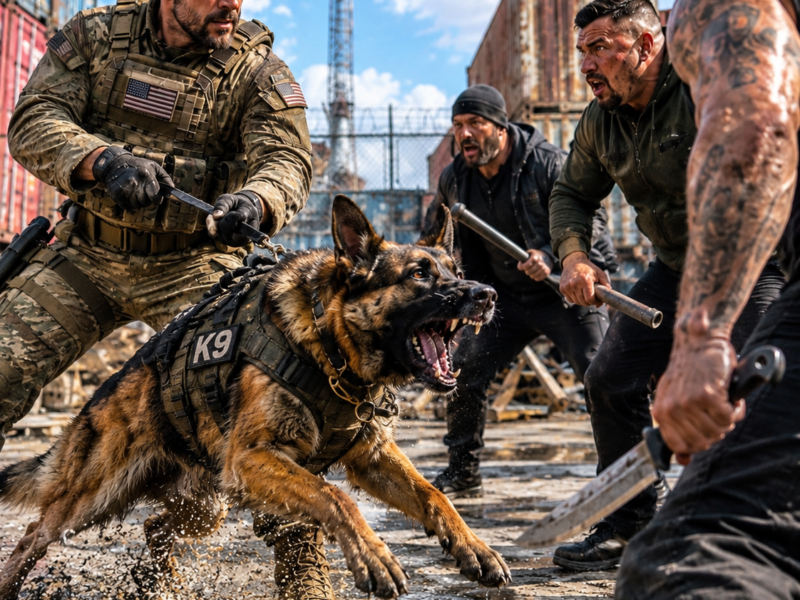
“Last warning!” I shouted, stepping between the three men and my German Shepherd
The phone went silent, but Adrian Cross’s final words remained in my head.
“Consider this your final warning.”
I stared at the screen for several seconds before slipping it into my pocket. Through the hospital window, I could see Ranger resting beneath a white blanket, his injured hind leg carefully supported. The dog who had once crossed enemy territory beside me was now lying in a veterinary hospital because three spoiled young men had decided hurting him would be entertaining.
And someone had been desperate enough to threaten us both.
I called Detective Laura Mitchell again and told her everything. She instructed me to remain at the hospital until officers could check my house and review the security footage. For once, I didn’t argue. Ranger needed me calm, and I couldn’t protect him if anger made me careless.
Twenty minutes later, two uniformed officers arrived. One stayed near Ranger’s room while the other accompanied me to a small consultation office.
“Detective Mitchell wants you to know they’re taking the threat seriously,” the officer said. “She also wants you to avoid contacting Cross directly.”
“I wasn’t planning to invite him over for coffee.”
The officer almost smiled.
“Good. Because if he calls again, don’t provoke him. Record what you can, preserve the messages, and let us handle it.”
I nodded.
Then I looked through the doorway toward Ranger.
“Can someone stay with him while I make a call?”
“Of course.”
I dialed Mason Reed, my former teammate. He answered immediately.
“Daniel? What’s happened?”
“Cross called me. He wants Ranger’s old equipment.”
Mason went silent.
“Did he threaten you?”
“Not directly. He called Ranger a liability and told me to return the equipment.”
“Then he knows something is still out there.”
“That’s what I’m thinking.”
Mason exhaled slowly. “Listen, I need to tell you something I should have told you three years ago.”
I stood.
“I’m listening.”
“After Lucas died, the contractor hired an outside investigator to interview everyone who had been near the equipment before the mission. He asked me whether Ranger had worn a modified harness. I told him about the replacement.”
“Why didn’t you tell me?”
“Because I thought it was routine. And because, two weeks later, someone from the contracting office called me and said the equipment had been inspected. They told me the investigation was closed and that there was no reason to keep discussing it.”
“You believed them?”
“I wanted to. We had lost Lucas. You were injured. Ranger was hurt. Everybody was exhausted, and the official report said the failure was an unforeseeable accident.”
I closed my eyes.
I remembered that report. Its language had been polished and precise, describing the death of a good man as a chain of unfortunate circumstances. Every paragraph sounded final. Every unanswered question had been classified as irrelevant.
“What did the investigator look like?” I asked.
“Tall. Gray hair. Expensive watch. He introduced himself as Adrian Cross.”
My hand tightened around the phone.
“He was there three years ago?”
“Yes.”
“And now he’s calling me because he thinks Ranger has something he wants.”
“Daniel, whatever is on that harness, don’t let anyone take it. Not Cross, not a private security company, not even somebody claiming to represent the military. Make sure every piece of evidence is documented.”
“Detective Mitchell is arranging collection.”
“Good. Let the professionals handle it. We don’t know what we’re dealing with yet.”
I looked at Ranger again.
“I know what I’m dealing with. Someone hurt my dog because they were afraid of what he might reveal.”
Mason’s voice softened.
“Then let’s make sure they don’t get away with it.”
When the call ended, I returned to Ranger’s room. He lifted his head as soon as I entered, his ears moving toward my footsteps.
“Hey, buddy.”
His tail tapped the blanket twice.
I pulled a chair close and sat beside him. His eyes followed my hand as I carefully stroked the fur between his ears.
“You know, you’ve never been very good at staying out of trouble.”
He gave a tired sigh.
For a moment, I could almost imagine he understood every word.
I had met Ranger seven years earlier at a military working-dog training facility. He had been a young German Shepherd with a powerful build, bright eyes, and an almost unreasonable determination to finish every task put in front of him. During our first training exercise, he refused to leave a training area until he had located a hidden instructor. The handler supervising the session finally laughed and said the dog would either become the best partner in the unit or drive every person around him insane.
He became both.
Overseas, Ranger learned to read the smallest changes in the environment. He noticed unfamiliar scents, sudden silence, and movements that human eyes often missed. He was never invincible, and he was never a machine. He was a living creature who trusted me to make decisions that kept us both alive.
During our final deployment, he had saved two men by locating them after an explosion damaged a building. Lucas Bennett had been one of those men. He survived that incident, joked with Ranger afterward, and promised to buy him a steak when we returned home.
He never got the chance.
Weeks later, during another operation, a communications failure left our team without a warning that should have reached us. The resulting attack killed Lucas and wounded several others. I survived, but not without injuries that ended my operational career.
Ranger came home with me after his medical retirement. His old harness was placed in storage with his other equipment, and I tried to build a quieter life.
I had believed that part of our story was over.
Now I knew someone else had been writing a different ending.
The next morning, Dr. Emily Carter allowed Ranger to leave intensive observation, although she wanted him to remain at the hospital another day.
“He’s stable,” she explained. “The bruising is extensive, and we’ll need to watch his abdomen carefully. His old leg injury has been aggravated, but we haven’t found a new fracture. He’s going to need rest, medication, and a gradual rehabilitation plan.”
“Can I take him home?”
“Tomorrow, provided his condition continues to improve. And no long walks, no stairs if you can avoid them, and absolutely no running.”
I glanced at Ranger.
“He’ll hate that.”
“He’ll survive being bored.”
Ranger chose that moment to attempt to stand, then gave up and settled back onto his blanket.
Dr. Carter raised an eyebrow.
“He’s already negotiating.”
I laughed for the first time since the marina.
It wasn’t much, but it helped.
Before leaving the hospital, I spoke with Detective Mitchell. She had arranged for an evidence team to visit my house and collect Ranger’s stored equipment under documented conditions. She also told me that Marcus Hale and the three young men had been questioned separately.
“Tyler, the tallest one, is talking,” she said. “The second man is still insisting it was a prank. Ethan Vale has admitted that they were told to locate Ranger, but his account is incomplete.”
“Why would Ethan go along with it?”
“He says he believed the plan was to identify the dog and report his location. He claims he didn’t know the others would hurt Ranger.”
“Did he try to stop them?”
“Not soon enough.”
I thought about Ethan’s face at the marina. He had been frightened, but fear didn’t erase what he had done.
“What about Cross?”
“We’re working on his connection to the contractor. His name appears in records from the earlier equipment investigation, but we haven’t established whether he directed the assault.”
“His phone call suggests he knows exactly what’s happening.”
“It suggests he wants the equipment. We’ll need more than a threatening conversation to prove his involvement.”
She was right. I didn’t like it, but she was right.
“What happens now?”
“We’re reviewing the video and the messages recovered from the young men’s phones. We’re also checking whether anyone accessed your property.”
I handed her the footage from my home cameras.
She watched the clip showing a dark sedan parked across the street. A figure remained inside for several minutes before driving away.
“We’ll try to identify the vehicle,” she said. “Until then, I want you to report any unusual activity.”
I agreed.
As I returned to the hospital room, I made myself a promise. I would not let the desire for answers turn me into the kind of man Cross expected me to be. I would preserve the evidence, cooperate with the investigation, and stay beside Ranger.
That was the mission now.
And it mattered just as much as any mission I’d ever been given.
The evidence team arrived at my house that afternoon. I met them at the garage and showed them the locked cabinet where I’d stored Ranger’s old working gear.
A forensic technician named Owen Price explained the process before touching anything.
“We’ll photograph the cabinet and its contents as found, document identifying marks, and package each item separately. If we discover anything that needs specialized testing, we’ll transfer it to the appropriate lab.”
“Understood.”
I unlocked the cabinet.
Inside were Ranger’s retired harness, a working vest, two leashes, a damaged protective panel, and several pieces of equipment from our final deployment. Everything had been cleaned and stored years earlier. Nothing had been altered since.
Price photographed each item before removing it.
When he reached the harness, he paused.
“Do you recognize this number?”
He pointed to a small metal tag stitched beneath the outer strap.
I leaned closer.
“Yes. It was on the replacement harness.”
“Was that number there when you received it?”
“I believe so, but I didn’t document it at the time.”
He photographed the tag from several angles.
“That’s fine. We’ll compare it with the contractor’s inventory records.”
As he examined the stitching, he noticed a section that appeared slightly thicker than the rest.
“Could be a reinforcement,” he said. “Could be ordinary construction. We’ll leave it intact and have the lab examine it.”
I watched as the harness was placed into a protective evidence container.
For years, I had looked at that piece of equipment as a reminder of Ranger’s service. Now it felt like a door to a room I had never wanted to enter.
When the team finished, Price gave me a receipt listing every item collected.
“Nothing leaves our custody without being logged,” he assured me. “If we find anything significant, Detective Mitchell will be notified.”
I thanked him and locked the empty cabinet.
That evening, I returned to the hospital. Ranger was awake, and his eyes brightened when he saw me.
The technician had placed a soft protective collar around his neck to stop him from licking the bandage on his leg. He looked deeply offended by it.
“You look ridiculous,” I told him.
He stared at me.
“Don’t give me that look. You once ate half a field ration and then acted surprised when you got sick.”
His tail moved faintly.
I sat with him until visiting hours ended.
The following afternoon, I brought him home.
I had prepared a bed in the living room so he wouldn’t need to climb the stairs. His food and water were within easy reach, and I had cleared the floor of anything he might trip over.
When I opened the truck door, Ranger looked at the ramp leading to the ground.
He looked at me.
Then he looked at the ramp again.
“Don’t even think about jumping.”
He gave a low whine.
“I know. You used to leap out of helicopters. Today, you’re using the ramp.”
With patience and a little encouragement, he made it down safely.
He took three careful steps toward the house, then paused and leaned against my leg.
I put my arm around him.
“We’ll take it slow.”
For the first few days, I barely left his side. I followed Dr. Carter’s instructions, gave him his medication on schedule, and helped him move around the house. At night, I slept on the couch so I could hear him if he needed me.
Ranger wasn’t the kind of dog who complained. That made it harder to judge how much pain he was in. I learned to watch the small things: the way he lowered himself onto his bed, how long he hesitated before standing, and whether he finished his food.
By the fourth day, he was eating normally.
By the sixth, he could stand without help.
His recovery gave me something concrete to focus on while the investigation continued.
Then Detective Mitchell called with the first major development.
“The lab has examined the harness,” she said. “There’s evidence of a concealed compartment beneath the reinforced stitching. It appears to have been added after the original harness was manufactured.”
I sat down.
“What’s inside?”
“We’re still processing it. The technician found a small electronic component. We don’t know yet whether it can be recovered or what it was designed to do.”
“Could it have recorded the mission?”
“Possibly, but we need to establish that scientifically. We’re sending it to a specialist lab.”
I rubbed my forehead.
“Could Cross have known it was there?”
“His name appears on the contractor’s inspection paperwork associated with the harness replacement.”
That was the first direct connection between Cross and Ranger’s equipment.
“Does that prove he installed it?”
“No. It establishes that he was involved in the process. We’re still tracing who handled the harness and when.”
I thanked her and ended the call.
Ranger was asleep at my feet. His breathing was slow and steady, and his injured leg lay stretched beside him.
I stared at the old dog and wondered how many people had looked at him over the years and seen only a piece of equipment, a potential witness, or a problem to be eliminated.
They had never understood him.
Ranger had never cared about contracts or reports. He had never known which officer had signed which document. He had simply done his job, trusted his handler, and survived what he could.
Now, three years after his retirement, the truth might finally be coming into reach.
Two days later, Detective Mitchell invited me to the station.
She had received preliminary findings from the laboratory and wanted me to hear them in person.
A technician had recovered a portion of data from the electronic component. It wasn’t a complete recording, and much of the information was damaged. But the lab had identified a series of timestamps and fragments that appeared to correspond with the date of our final mission.
“Can you tell what it recorded?” I asked.
“Not yet,” Mitchell replied. “The data is incomplete. However, we have a second source of evidence. An internal contractor email refers to the component as a ‘field telemetry module’ and instructs staff to remove it before the harness is returned to military inventory.”
“Was it removed?”
“According to the maintenance record, yes. But the module was still physically present when the harness was examined.”
I stared at her.
“So somebody signed off on removing it without actually removing it.”
“That’s what the records suggest.”
“Why?”
“That is one of the questions investigators are pursuing.”
She showed me a copy of the email. It contained the names of several contractor employees and a reference to a restricted technical review.
One name appeared repeatedly.
Adrian Cross.
“He was involved in the equipment inspection,” Mitchell explained. “He also submitted a statement after the mission, claiming that the harness contained no electronic components and that all contractor equipment had passed inspection.”
I felt a familiar pressure behind my ribs.
“He knew the component existed.”
“We have reason to believe he knew it was installed. We don’t yet know whether he knew it remained in place after the inspection.”
I leaned back.
“What does the data show?”
“Only fragments so far. There are time markers that align with the communications failure you described. We have not established what the component captured, and we can’t yet conclude that it caused the failure.”
I nodded slowly.
I wanted the answer to be simple. I wanted the component to reveal exactly what had happened, who had made the decision, and why Lucas had died.
But investigations were not stories built around one perfect clue.
They were pieces of evidence, each requiring verification.
“What happens next?” I asked.
“We’re expanding the investigation into the contractor’s records. We also need your testimony about the equipment exchange and your team’s communications that night.”
“I’ll cooperate.”
Mitchell closed the folder.
“There’s something else. Marcus Hale has agreed to provide information about Cross.”
I sat forward.
“What kind of information?”
“He says Cross contacted him several weeks ago and asked whether he knew anyone who could locate a retired military working dog. Cross claimed the dog had been removed from an inventory record and might still possess restricted equipment.”
“Marcus hired the three young men?”
“That’s what his initial statement indicates. He says he told them to identify the dog, photograph him, and report his location. He denies ordering them to injure Ranger.”
“Do you believe him?”
“That’s not the question I have to answer today. We need to corroborate his account.”
I thought about Marcus at the marina, the way he had watched Ranger with recognition and fear.
“Did Cross tell him to take the harness?”
“Marcus says he was told the dog was the priority, and that the equipment could be recovered later.”
The pieces fit together, but I reminded myself that fitting together wasn’t the same as being proven.
“What about the three young men?”
“The two who physically assaulted Ranger are facing charges related to the attack. Ethan Vale has provided messages and video. He is also cooperating about the instructions they received.”
I remembered Ethan’s frightened expression.
“He still has to take responsibility for what he did.”
“Yes,” Mitchell said. “Cooperation doesn’t erase his actions.”
I appreciated that she understood.
Before I left, she showed me a still image from the recovered video. It showed Ranger on the ground, with the tallest young man standing over him. In the background, Marcus was looking toward the road, apparently checking whether anyone was approaching.
The image made my hands curl into fists.
Mitchell noticed.
“I know this is personal.”
“He’s family.”
“I understand. But I need you to let us handle the investigation.”
I looked at the photograph one more time.
“I’m letting you handle it. I’m just not going to pretend it doesn’t matter.”
She nodded.
“That’s fair.”
When I got home, Ranger was waiting near the living room window. He had begun walking a little more confidently, though his gait remained stiff.
I knelt beside him.
“They’re looking into it, buddy.”
He nudged my hand.
“I know. You don’t care about any of that.”
He rested his head against my shoulder.
For the first time in years, I felt that the past was no longer a locked room. Someone had finally opened the door.
But the hardest part was still ahead.
Because two days later, Adrian Cross showed up at my house.
I saw his car on the security monitor just after noon. A dark sedan pulled into the driveway and stopped behind my truck.
Cross stepped out wearing a gray coat and carrying a slim leather case.
I didn’t open the door.
Instead, I called Detective Mitchell and told her he was there.
“Stay inside,” she instructed. “Do not engage with him. Officers are on the way.”
Cross walked to the front porch and knocked twice.
“Mr. Brooks,” he called. “I know you’re home.”
I stood several feet back from the door.
“What do you want?”
“To talk.”
“You can talk to my lawyer or the police.”
He sighed, as if I were being unreasonable.
“I think you’ve misunderstood the situation. I came to make an offer.”
“I don’t want your offer.”
“You haven’t heard it.”
“I don’t need to.”
There was a pause.
Then Cross lowered his voice.
“The device in that harness is damaged. Whatever it contains may not be useful to you. I can arrange compensation for the dog, cover every veterinary expense, and make sure you never have to worry about money again.”
I felt my anger rise, but I kept my voice level.
“You know what they found.”
“I know what the laboratory may have recovered.”
“How?”
He didn’t answer.
That silence was more revealing than any confession.
“You’ve been following me,” I said.
“I’ve been trying to prevent a misunderstanding from becoming a catastrophe.”
“You sent people after my dog.”
“I did not tell anyone to hurt him.”
“Then why did you send them?”
Cross exhaled.
“Because there are things in that device that were never intended to leave the contractor’s possession. If they’re released without context, innocent people could be harmed.”
“Lucas Bennett is dead.”
Cross went quiet.
For the first time, I had said the name that had haunted me for three years.
“Petty Officer Bennett’s death was tragic,” he replied. “But you cannot change the past by turning incomplete data into an accusation.”
“I haven’t accused anyone. I’ve asked questions.”
“And those questions may put you in danger.”
“Is that a threat?”
“No,” he said. “It’s a warning.”
I looked through the narrow window beside the door. Cross was standing on my porch with his hands folded in front of him, looking like a man who expected the world to move aside when he asked.
“You’ve had three years to tell the truth,” I said. “You don’t get to show up at my home now and pretend you’re protecting me.”
Cross’s face hardened.
“You have no idea what that operation involved.”
“Then explain it to the investigators.”
He stared at the door for a long moment.
“You’re making a mistake, Brooks.”
“Maybe. But it’s mine to make.”
I heard sirens in the distance.
Cross looked toward the street. His expression changed, and he took a step back from the porch.
When the police cars turned into the driveway, he raised his hands without being asked.
Detective Mitchell arrived a few minutes later. She spoke with Cross on the lawn while the officers checked his identification and documented the visit.
I watched from the doorway.
Cross did not try to run. He did not shout. He simply stood there, his face arranged into an expression of wounded dignity.
That frightened me more than an outburst would have.
Men who believed they were untouchable often stayed calm until the last possible moment.
Mitchell came to the door after speaking with him.
“He says he came to offer compensation and discuss the equipment.”
“Did he admit sending Marcus?”
“No. But his visit is documented, and we’re reviewing the circumstances. For now, he hasn’t been arrested.”
I nodded.
“What’s next?”
“We have a search warrant for additional contractor records. The recovered data is being analyzed by an independent specialist. And Marcus has agreed to provide a detailed statement.”
“Will that be enough?”
“Possibly. But I want you to understand something, Daniel. The evidence may establish misconduct without answering every question about the mission. We have to follow what it proves, not what we hope it proves.”
I appreciated her honesty.
After the officers left, I locked the door and checked on Ranger. He was lying on his bed, watching me with sleepy eyes.
I sat beside him.
“Looks like we have company.”
He yawned.
I scratched behind his ear.
“Don’t worry. Nobody is taking you anywhere.”
Over the following week, the investigation accelerated. Investigators obtained contractor emails, maintenance logs, and payment records. They found evidence that several equipment inspections had been marked complete without the required tests being performed.
The records also showed that Cross had approved a report stating the harness contained no electronic module.
But the laboratory’s findings indicated that the module had remained inside.
That discrepancy became central to the case.
Then came the breakthrough.
The specialist laboratory recovered enough data to identify a sequence of audio fragments and system logs from the day of our final mission. The recording was incomplete, but it contained a conversation between two contractor personnel discussing a warning that had not been passed to our team.
The transcript was difficult to read. Several lines were missing, and the voices had not yet been formally identified.
But one sentence was clear.
“Leave the warning in the queue until the field test is complete.”
I read it twice.
The warning had not simply vanished.
Someone had decided to delay it.
Detective Mitchell sat across from me while I processed the words.
“We’re working to identify the speakers and establish the context,” she said. “This is significant, but we need to corroborate it with the communications logs and witness statements.”
“Who made the decision?”
“We don’t know yet.”
“Was Cross there?”
“His access credentials were used to enter the equipment control system that day. That does not establish that he personally made the entry, but it gives us a specific line of inquiry.”
I stared at the transcript.
The official report had described a communications failure caused by an unpredictable technical problem. It had never mentioned a deliberate delay.
“If someone held the warning,” I said, “they knew we were going into danger without it.”
“That is one possibility we’re investigating.”
I pressed my palms against the table.
Lucas had trusted us to bring him home. We had all trusted the system to deliver the information we needed to survive.
Someone had treated that trust as an acceptable risk.
I didn’t feel triumphant.
I felt sick.
Mitchell gave me a moment before continuing.
“The evidence team is also reviewing the assault. We believe Cross may have been trying to recover the module before it could be analyzed. But we need more evidence before we can attribute the attack to him.”
I nodded.
“Keep going.”
“We will.”
When I got home, Ranger was waiting by the door. His leg had improved enough for him to walk across the living room without help, although he still needed to rest frequently.
I knelt and hugged him carefully around the shoulders.
“We found something,” I whispered.
He leaned against me.
I told him about Lucas, the warning, and the evidence. Of course, he understood none of the words. But he stayed beside me while I spoke, and sometimes that was more useful than any answer.
A few days later, Ethan Vale asked to meet me.
Detective Mitchell arranged the meeting in a public room at the station, with his mother present. Ethan looked different from the young man I had seen at the marina. His hair was neatly combed, his eyes were tired, and he held his hands together so tightly that his knuckles had turned white.
“I know I don’t deserve your time,” he began.
“You’re right that you don’t get to decide what I owe you,” I said. “But I’m here. Talk.”
He swallowed.
“I didn’t know what my father was involved in. I thought the whole thing was about locating a retired dog because the company had lost track of some equipment. Marcus told us nobody would get hurt.”
“You saw them hurt Ranger.”
“Yes.”
“And you didn’t stop them.”
His eyes filled with tears.
“No. I was scared. And I didn’t want the other two to turn on me.”
I let the silence sit between us.
Finally, he continued.
“When I saw Ranger at the marina, I recognized him from the photograph my father kept in his office. He told me the dog was connected to an old military investigation. He said if we ever saw him, we should call Marcus immediately.”
“Why didn’t you call the police when the others started attacking him?”
“Because I thought my father would find out. I thought I could make them stop without making everything worse.”
“You were wrong.”
“I know.”
He looked down at his hands.
“When I saw Ranger fall, I realized I was helping people who didn’t care whether he lived. That’s why I recorded the video. It was the only thing I could think to do.”
“Recording it was better than doing nothing,” I said. “But it didn’t make you innocent.”
“I understand.”
He took a folded sheet of paper from his pocket.
“This is a copy of an email I found on my father’s laptop. The detective has the original file, but I wanted you to know what it said.”
I didn’t take it immediately.
“Give it to Detective Mitchell. She needs to preserve it properly.”
“I already did. This is just a copy.”
I unfolded the page.
The email referred to a “legacy field device” and instructed staff to locate the associated equipment before an external review. It mentioned Cross by name and stated that the device could create “unacceptable exposure if independently examined.”
I read the passage twice.
“What does your father say about this?”
“He says he was only following legal advice. He says he never knew the device was still inside the harness.”
“Do you believe him?”
Ethan shook his head.
“I don’t know what to believe anymore.”
I folded the paper and handed it back.
“Then keep telling the truth about what you know. Don’t fill in the gaps with guesses. Let the evidence speak.”
He nodded.
Before the meeting ended, he asked me a question.
“Do you think Ranger will ever trust people again?”
I thought about the way Ranger still leaned into my hand whenever a stranger approached too quickly.
“He trusted people before you hurt him. He’ll probably trust people again, because that’s who he is. But you don’t get to use his forgiveness as proof that what happened didn’t matter.”
Ethan wiped his eyes.
“I understand.”
I hoped he did.
When I returned home, Ranger was waiting in the sun near the window. I sat beside him and rubbed his ears.
“You’ve made quite a mess, old friend.”
He looked up at me.
“But I suppose it’s a mess worth cleaning up.”
His tail tapped the floor.
The investigation continued for several more weeks. Investigators matched the recovered data with the communications system logs and interviewed personnel who had worked on the equipment. Two former contractor employees eventually confirmed that the warning had been delayed while an equipment test was underway.
Their statements contradicted the original report.
The review also established that required safety checks had been skipped and that the equipment had been returned to service without proper certification.
The evidence did not prove that every person involved had intended to endanger our team. It did, however, establish that critical safeguards had been ignored and that the official explanation had omitted facts that should have been disclosed.
Cross was arrested after investigators gathered evidence connecting him to the falsified inspection records and the attempted recovery of the device. Marcus Hale faced separate charges related to the marina assault investigation and his role in coordinating the search for Ranger. The two young men who had kicked my dog were charged in connection with the attack, while Ethan’s cooperation was considered alongside his own actions.
The contractor suspended several employees and lost access to certain contracts while the authorities reviewed its conduct.
For the first time in three years, the truth was no longer hidden behind a closed report.
But the hardest phone call came from Lucas Bennett’s sister.
Anna had waited for an update since the investigation reopened. When she finally called, her voice was unsteady.
“Daniel, I read the preliminary findings. They said the warning was delayed.”
“Yes.”
“Does that mean Lucas could have survived?”
I looked out the window at Ranger, who was sleeping with his head on his paws.
“I don’t know,” I said honestly. “No one can tell us exactly what would have happened if the warning had reached us in time. But we now know that the decision to delay it was not properly disclosed, and the equipment inspection was not what the report claimed.”
Anna began to cry.
“I keep thinking that if somebody had done their job, he might still be here.”
“I think about that, too.”
“I just want someone to admit what happened.”
“They’re going to have to answer for the evidence.”
She was quiet for a long time.
Then she said, “Thank you for not letting them bury it.”
I couldn’t find a response that felt big enough.
“Lucas deserved better,” I finally said.
“He did.”
After the call, I sat beside Ranger and remembered Lucas laughing during a training exercise when Ranger refused to release a rubber training dummy. Lucas had crouched beside the dog, looked him directly in the eyes, and said, “You know you’re not actually in charge here, right?”
Ranger had wagged his tail and kept the dummy.
Lucas had laughed so hard he nearly fell backward.
I had not allowed myself to remember that moment in years. Most of my memories of Lucas ended with the mission, the evacuation, and the official report.
Now, for the first time, I could remember him as he had been before the tragedy.
A good man.
A friend.
Someone who had believed that doing the right thing mattered.
The legal process took months. Cross’s case involved multiple documents, technical evidence, and witness statements. Marcus and the young men faced their own proceedings. The military review examined the original mission report and the circumstances surrounding the delayed warning.
I testified about the equipment exchange, the warning we never received, and the questions I had raised after Lucas’s death. Mason provided his account of the replacement harness and the contractor’s later inquiries.
The evidence established serious misconduct in the inspection process and showed that the original report had not presented the full picture. Some questions remained unanswered, and not every individual who had handled the equipment could be conclusively linked to the decision to delay the warning.
But the investigation was no longer closed.
The record was corrected.
Lucas’s family received a formal acknowledgment that the earlier findings had been incomplete, along with an explanation of the failures that had contributed to the mission’s outcome.
It wasn’t the same as bringing him home.
Nothing could do that.
But it mattered.
Meanwhile, Ranger’s recovery continued one careful day at a time.
Dr. Carter prescribed rehabilitation exercises and short walks. I followed the plan even when Ranger tried to convince me that he was ready to run. His limp gradually eased, and his appetite returned to normal. By the time the weather warmed, he could walk comfortably around the neighborhood.
He never regained the exact stride he had before the assault, but he was no longer in constant discomfort.
One afternoon, I took him back to the marina.
I had avoided that place since the night he was attacked. I didn’t want the last memory I had of it to be the sound of Ranger crying out on the pavement.
The water was calm, and sunlight moved across the boats. Families walked along the waterfront, and a restaurant worker carried a tray of drinks between the tables.
Ranger moved beside me with his head held high.
We stopped near the place where the assault had happened.
For a moment, I felt the anger return. I remembered the laughter, the kick, and Marcus’s cold expression when he had demanded that I hand over my dog.
Then Ranger nudged my hand.
I looked down.
He was watching me, not the pavement.
“You’re right,” I murmured. “We’re not staying here all day.”
We found a quiet table outside a café. I ordered coffee and water for Ranger, and we sat watching the boats move through the harbor.
A little boy approached with his father. He stopped several feet away and stared at Ranger’s ears.
“Can I pet him?”
His father looked at me.
“Only if it’s okay with you.”
I smiled.
“Let’s ask him.”
I let Ranger sniff the boy’s hand first. Ranger’s tail moved slowly, and he leaned forward to accept a gentle scratch behind the ears.
“Is he a police dog?” the boy asked.
“He was a military working dog,” I replied.
“Was he brave?”
I glanced at Ranger.
“He was. But bravery isn’t about being the biggest or strongest. It’s about doing your job, protecting others, and knowing when to let someone help you.”
The boy considered that.
“Does he still protect people?”
“He does it a little differently now.”
Ranger chose that moment to lean against my leg.
The boy laughed.
“He likes you.”
“I think he does.”
After the boy and his father left, I rested my hand on Ranger’s back and watched the water.
For years, I had thought that leaving the military meant leaving the past behind. I had believed that if I kept my life quiet enough, the memories would eventually lose their sharp edges.
But the past did not disappear simply because I stopped talking about it.
Sometimes, it waited in a locked cabinet.
Sometimes, it appeared in a photograph taken from across the street.
And sometimes, it arrived at a marina in the form of three men who believed a wounded dog was an easy target.
I had spent a long time thinking that strength meant being able to endure pain without asking for help. Ranger had taught me otherwise.
He had trusted me to protect him, and when I couldn’t prevent him from being hurt, I could still stay beside him. I could take him to the vet, follow his treatment plan, and refuse to let the people who hurt him dictate what happened next.
That was strength, too.
A few days later, Ethan sent me a letter. He did not ask for forgiveness. He wrote that he had begun volunteering at an animal shelter as part of a court-supervised program, and that the first time a frightened dog flinched away from him, he had understood how little he knew about fear.
He wrote that he was trying to become someone who would step forward instead of standing still.
I read the letter once and placed it in a drawer.
I didn’t know whether Ethan would change permanently. That was something he would have to prove over time.
But I hoped he would.
As for Ranger, he returned to his favorite routine: morning walks, afternoon naps, and watching the neighborhood from the living room window. He still barked at delivery trucks, still stole food if I turned my back, and still acted offended whenever I tried to give him medication.
Some things never changed.
One evening, as the sun settled behind the houses, I sat on the floor beside his bed.
“You know,” I told him, “you’ve caused me more trouble in retirement than you ever did overseas.”
He lifted his head.
“Don’t look so proud.”
His tail began to thump against the floor.
I laughed and scratched behind his ears.
For the first time in a long time, the sound came easily.
The case had not given us everything we wanted. It had not brought Lucas home, erased Ranger’s pain, or made the world fair. It had given us something smaller, but still valuable: a truthful record, accountability for the people whose actions could be proven, and the chance to stop living under an explanation that had never told the whole story.
I leaned back against the couch.
Ranger shuffled closer and rested his head on my knee.
I placed my hand over his shoulder, careful of the old scar.
“It’s over for tonight, buddy,” I whispered.
His eyes closed.
Outside, the wind moved gently through the trees. There were no sirens, no angry voices, and no footsteps approaching the door. Just the quiet sound of the house settling around us.
I thought about the warning I had shouted at the marina.
Last warning.
At the time, I had meant it for the men who were hurting my dog.
But looking back, I realized that the warning had been meant for me, too.
I could let anger consume me. I could chase revenge and become so focused on punishing the people responsible that I forgot the living creature who needed me most.
Or I could do what Ranger had always done when faced with uncertainty.
Stay alert.
Protect the ones who depended on me.
And keep moving forward, one careful step at a time.
I looked down at the old war dog sleeping beside me.
“You did good, soldier.”
His tail moved once without his eyes opening.
And in that quiet room, with the truth finally moving into the light and Ranger safe at my side, I understood something I should have known all along.
The strongest person in a fight isn’t always the one who throws the hardest punch.
Sometimes, it’s the one who refuses to let cruelty have the final word.
And sometimes, the bravest thing a Navy SEAL can do is kneel beside an injured dog, keep his promise, and bring him home.
The end.









