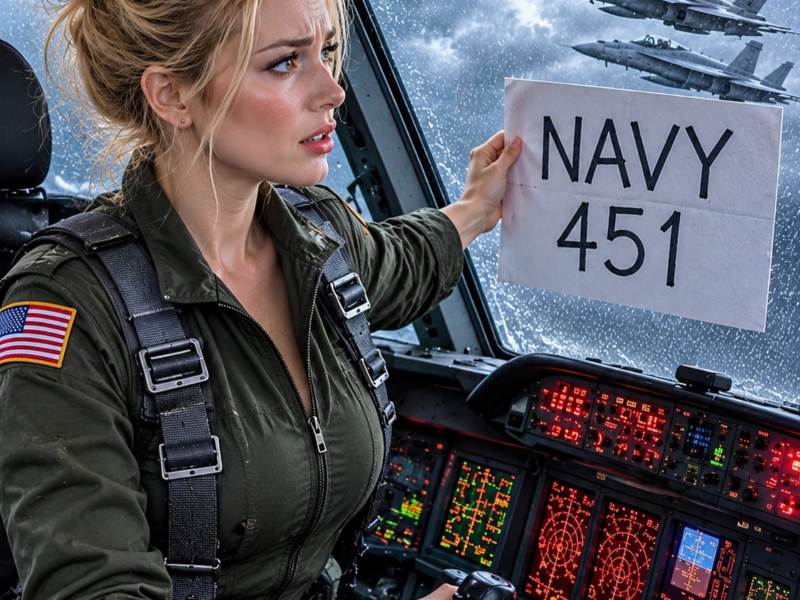
““Know your place, passenger.” The words echoed through the F-22 briefing room as three pilots laughed at me
The first voice that came through the speakers was Daniel’s.
“Viper, do you copy? I’m getting a second return. That’s not part of the exercise.”
I gripped the edge of the table.
Four years had passed, but I could still hear the strain in his voice. Daniel always spoke calmly in the air. Even when things went wrong, he had a way of making every word sound deliberate.
This time, he sounded frightened.
The recording crackled.
Then came my own voice.
“Two, say again. I’m not seeing anything on my display.”
Daniel answered immediately.
“There’s something between us and the coast. My radar picture is being corrupted. I’m getting altitude changes that don’t match my instruments.”
A second voice interrupted.
“Flight Lead, maintain assigned heading. Continue the profile.”
I leaned closer to the speakers.
That voice wasn’t mine.
It wasn’t Daniel’s.
And I knew it.
Colonel Hayes stopped the recording.
“Do you recognize that voice?” he asked.
Nobody moved.
I stared at the audio display.
“Play it again.”
Hayes looked at me for a moment, then restarted the clip.
The same command came through.
“Flight Lead, maintain assigned heading. Continue the profile.”
My stomach tightened.
I had heard that voice before, but not in the cockpit. It belonged to someone who had been monitoring our mission from the ground.
“Who was controlling the exercise?” I asked.
Hayes glanced toward the pilots.
“At the time, the electronic-warfare cell was operating under Major General Thomas Rourke.”
A murmur moved through the room.
Rourke had since retired. During the investigation, he had testified that the exercise had been conducted according to approved procedures.
I looked at Hayes.
“That isn’t his voice.”
“No,” Hayes replied. “It isn’t.”
He pressed another key.
A second recording began.
This one was quieter, with more background noise. Daniel’s breathing was audible between transmissions.
“Viper, I’m switching to backup navigation. Something’s feeding false position data into my system.”
Then the unknown voice returned.
“Disregard the anomaly. Continue as briefed.”
Daniel’s answer was sharp.
“Negative. My instruments disagree. I need confirmation from the lead.”
The recording ended with a burst of static.
I could barely feel my fingertips.
For four years, the official report had said Daniel had failed to follow formation instructions. It said he had become disoriented after a simulated systems disruption and descended below the safe recovery altitude.
But the recording showed him doing exactly what a disciplined pilot should do.
He had identified a problem.
He had reported it.
And someone had ordered him to ignore it.
“Why wasn’t this included in the investigation?” I asked.
Hayes closed the audio window.
“That’s what we’re trying to find out.”
Captain Carter shifted in his chair.
“Sir, with respect, an old recording doesn’t prove misconduct. There may have been a technical reason for the transmission.”
I turned toward him.
“You’re right. It doesn’t prove everything.”
I pointed at the timestamp.
“But it proves the official timeline is incomplete.”
Carter looked uncomfortable.
Hayes opened the folder again.
“The original mission archive was transferred twice after the incident. The version used by the investigation was missing eleven minutes of audio and a portion of the radar data.”
“Who authorized the transfer?” I asked.
“That signature is on the final page.”
He turned the document toward me.
I recognized the name before I finished reading it.
Colonel Andrew Mercer.
He had been the operations officer responsible for coordinating the exercise.
He had also been the officer who met me after Daniel’s aircraft disappeared.
I remembered the room.
The stale coffee.
The folded American flag on the table.
Mercer telling me that Daniel’s last transmission showed confusion and poor judgment.
I remembered asking whether the ground controller had given him conflicting instructions.
Mercer had looked directly at me and said, “There was no conflicting instruction, Major Morgan.”
I had believed him.
Or maybe I had needed to believe him because the alternative was too painful.
“Where is Mercer now?” I asked.
Hayes didn’t answer immediately.
“He’s a civilian consultant. He advises the current exercise planning group.”
My eyes moved to the tactical display.
The red corridor was still there.
The same coastal region.
The same electronic-warfare profile.
“He’s involved in this exercise?”
Hayes nodded.
“He’s been reviewing the mission parameters for six months.”
I looked back at the recording.
“Then why did you invite me?”
“Because three weeks ago, one of our test pilots reported the same navigation anomaly Daniel described. His warning was dismissed as a software calibration issue.”
Hayes placed a printed report beside the audio transcript.
The pilot’s name was Lieutenant Alex Reed.
He had survived the test flight, but his aircraft had returned with conflicting navigation records and an unexplained drop in recorded altitude.
I read the report twice.
The language was familiar.
Too familiar.
“Did he report it directly to Mercer?”
“Yes.”
“And what happened?”
“His flight was classified as a training error. He was removed from the next exercise.”
I looked around the room.
The young pilots were no longer amused.
Carter’s expression had hardened, but I could see that he was listening now.
Hayes turned toward him.
“Captain, your squadron is scheduled to fly the same profile tomorrow morning. Until we understand the anomaly, no aircraft enters that corridor.”
Carter stood.
“Sir, the exercise schedule has already been approved.”
“Then it can be changed.”
“General Rourke’s office has been expecting this evaluation.”
Hayes’s eyes narrowed.
“General Rourke retired three years ago.”
Carter paused.
“His office still coordinates with the contractor supporting the simulation.”
That was the first time anyone had mentioned a contractor.
I looked at the report again.
“Which company?”
Carter hesitated.
“Northstar Avionics.”
I knew the name.
Northstar had developed the electronic-warfare package used in the Atlantic exercise. It had also supplied the software update installed before Daniel’s final flight.
I felt a chill move through me.
“Does Northstar still have access to the original mission archive?”
Hayes looked down at his folder.
“According to the access logs, someone from their technical team opened it last month.”
“Who?”
“We’re checking.”
I stepped away from the table.
“Then you need to check who opened it, who authorized the access, and whether the missing data was ever altered.”
Hayes nodded.
“That’s why you’re here.”
Carter looked between us.
“Sir, are we saying the entire exercise is compromised?”
“No,” Hayes said. “We’re saying we don’t know yet.”
He turned to the pilots.
“And until we do, I expect every one of you to treat an unexplained instrument reading as a safety issue, not an inconvenience.”
The briefing ended without the usual jokes or confident chatter.
Pilots gathered their folders and left in small groups.
Carter stayed behind.
When the room was nearly empty, he approached me.
“Major Morgan?”
I looked at him.
“Former Major. You can call me Rachel.”
He glanced toward the door.
“I owe you an apology.”
I waited.
He rubbed the back of his neck.
“I thought you were a civilian guest who’d gotten lost. I didn’t know—”
“You don’t need to know my flight history to speak to me with respect.”
He looked down.
“You’re right.”
His apology sounded uncomfortable, but not insincere.
I nodded once.
“Then make sure your pilots understand the same thing.”
He left.
Hayes remained by the display, studying the frozen waveform.
“You all right?” he asked.
“No.”
He didn’t try to tell me I would be.
I appreciated that.
Instead, he pushed a chair toward me.
“There’s something else you should know.”
I sat down.
Hayes removed a small envelope from the folder. It was sealed in a clear evidence sleeve, with a handwritten label on the front.
D. PRICE — PERSONAL EFFECTS.
I stared at it.
“Where did you get that?”
“It was in the storage inventory at the old operations building. It was supposed to have been returned to Daniel’s family after the investigation.”
“Supposed to have been?”
“His personal effects were divided into several boxes. This one was listed as transferred, but the receiving signature doesn’t match the family records.”
My throat tightened.
“What’s inside?”
Hayes slid the envelope across the table.
I didn’t touch it immediately.
For years, I had avoided looking at Daniel’s belongings. His sister had offered me his watch, his books, even the old baseball cap he used to wear on leave.
I couldn’t accept any of it.
Taking something home had felt too much like admitting he wasn’t coming back.
Finally, I opened the sleeve.
Inside was a folded sheet of paper and a small memory card.
The paper had Daniel’s handwriting.
I knew it from the notes he’d left on my desk and the ridiculous birthday cards he’d mailed from deployments.
The message was brief.
Rachel,
If the system starts lying again, don’t trust the green light.
Check the raw recording.
D.
I read it once.
Then again.
“What’s the green light?” Hayes asked.
I shook my head slowly.
“On the aircraft, it was an indicator that the navigation system had accepted its position solution. Green meant the system considered the data valid.”
“But Daniel didn’t trust it.”
“He didn’t trust it enough to write this.”
I held the memory card between my fingers.
“Has anyone read this?”
“No.”
“Why not?”
“Because it wasn’t in the original inventory. We found it yesterday.”
I looked at the card.
It was old, but the label had not faded.
A single word was written across it.
RAW.
Hayes called the base evidence technician.
Within twenty minutes, we were in a secure analysis room with the card connected to an isolated workstation.
The first files were routine flight logs.
Then we found a folder marked with the date of Daniel’s final mission.
Inside were several recordings that had never appeared in the official archive.
One file contained a sequence of navigation data.
Another contained a short audio clip.
The last was a video recorded from the cockpit’s instrument display.
Hayes opened the data file first.
I watched the numbers move across the screen.
At first, everything looked normal.
Then the aircraft’s reported position shifted several miles in less than a minute.
The system still showed green.
Daniel’s actual heading hadn’t changed.
His altitude readings disagreed with the radar record.
And the aircraft’s navigation computer continued accepting the corrupted position as valid.
I leaned forward.
“That’s not a pilot error.”
Hayes said nothing.
I pointed to the timestamp.
“Look at the signal quality. It drops here, but the validity flag stays green. That means the system wasn’t rejecting the bad input.”
“Could it be a sensor failure?”
“Possibly. But the pattern is too consistent.”
I opened the second file.
It was a cockpit recording, mostly filled with instrument noise and clipped radio transmissions.
Daniel’s voice came through.
“Viper, I’m seeing the same false position. Switching to backup.”
Then my own voice.
“Copy. Maintain separation. I’m trying to get a ground confirmation.”
Another voice interrupted.
“Negative. No deviation authorized.”
I recognized the voice now.
Not Mercer.
Not Rourke.
Someone else.
A man with a calm, clipped delivery.
Hayes leaned closer to the speaker.
“Who is that?”
I shook my head.
“I don’t know.”
The voice continued.
“Do not switch to the alternate navigation channel. The primary system is stable.”
Daniel answered.
“That’s not what my instruments show.”
A pause followed.
Then the man said something that made my hands go cold.
“Your aircraft is receiving the correct data. Continue.”
Daniel’s reply was barely audible.
“Who verified that?”
The recording stopped.
Hayes looked at me.
“Could that be someone from Northstar?”
“Maybe. We need a voice comparison and the original transmission logs.”
He called the investigation team.
I remained at the workstation, replaying the final seconds.
The unknown controller had known Daniel’s instruments were showing a problem.
He had still insisted the system was stable.
That didn’t prove he had caused the failure.
But it raised a question nobody had asked in the original investigation.
Who had been telling the pilots what their aircraft was supposed to be seeing?
The next morning, the exercise was still on the schedule.
Hayes had ordered a temporary hold on the coastal corridor, but the decision had not been entered into the formal flight operations system.
At 6:20 a.m., I received a call from an unfamiliar number.
“Rachel Morgan?”
“Speaking.”
“This is Colonel Mercer.”
I sat up.
“What do you want?”
“I heard you’ve been reviewing old material.”
“Then you’ve heard correctly.”
There was a pause.
“You should be careful about drawing conclusions from incomplete recordings.”
I looked toward the window.
Outside, the sky was still dark.
“That’s interesting advice from someone who signed off on an incomplete archive.”
His breathing changed.
“Those files were handled under standard procedures.”
“Then you won’t mind explaining why Daniel’s original recordings were missing.”
“I don’t know what you’re talking about.”
“Your signature is on the transfer.”
Silence.
Then Mercer spoke more quietly.
“Rachel, I understand this is personal for you. But you were involved in that mission. You have a reason to interpret the evidence emotionally.”
I closed my eyes.
There it was again.
The same careful suggestion that my grief made me unreliable.
“Daniel was my wingman,” I said. “That doesn’t make the data less real.”
“You’re not qualified to conduct this investigation.”
“I didn’t say I was.”
“Then leave it to people who are.”
He ended the call.
I sat there for several seconds, listening to the empty line.
Then I called Hayes.
“Mercer knows we’re looking.”
“I expected that.”
“He tried to make it sound like I’m too emotionally involved.”
“That’s not unusual when someone wants to discredit a witness.”
“Did you authorize the exercise to continue?”
“No.”
“Then someone entered the approval without your signature.”
Hayes went quiet.
“I’ll check the operations system.”
I looked at the clock.
The first F-22 launch was scheduled for 8:00 a.m.
“Colonel, I think we have a bigger problem.”
By 7:10, I was back at the briefing building.
The pilots were preparing for the exercise.
Captain Carter stood near the front, speaking with two flight leads.
When he saw me, he approached.
“Rachel, we’re on hold, aren’t we?”
“We should be.”
“Operations just confirmed the corridor is open.”
I stared at him.
“Who confirmed it?”
“Command authorization came through twenty minutes ago.”
“From Hayes?”
“No. It came from the exercise director.”
I felt the old pressure building behind my ribs.
“Do not launch until you verify that order.”
Carter looked toward the other pilots.
“That’s not my decision.”
“It is if you believe the aircraft may be flying with corrupted navigation data.”
He studied my face.
“Do you have evidence?”
I thought of Daniel’s handwritten note.
The raw files.
The unknown voice.
“I have enough to say the risk hasn’t been resolved.”
Carter turned toward the operations desk.
“Hold the launch.”
One of the pilots objected.
“Captain, we’re already behind schedule.”
Carter didn’t look at him.
“Then we’ll be behind schedule.”
I watched him pick up the phone.
For the first time since I had entered the briefing room, I saw him act like the commander he was supposed to be.
But the delay lasted less than five minutes.
A duty officer hurried into the room.
“Captain, the exercise director has ordered immediate launch. All aircraft are cleared.”
Carter frowned.
“Who issued the clearance?”
“Colonel Mercer.”
The room went still.
I looked at Carter.
“Ask for written confirmation.”
The duty officer shook his head.
“It’s already in the system.”
I moved toward the operations terminal.
The authorization record was open on the screen.
A digital signature appeared at the bottom.
COLONEL ANDREW MERCER.
But something was wrong.
The approval timestamp was 6:52 a.m.
Hayes had still been speaking with me on the phone at that exact time.
He had not authorized it.
I pointed to the screen.
“This order needs to be verified.”
The duty officer stiffened.
“Ma’am, you don’t have authority to—”
“Then call the colonel whose name is on it.”
Carter picked up the phone before the duty officer could respond.
He called Hayes directly.
I watched his expression change as he listened.
“Understood, sir.”
He hung up.
“Colonel Hayes says he did not authorize the launch.”
The duty officer’s face lost color.
Carter turned toward the pilots.
“Nobody moves.”
For a moment, I thought that would be enough.
Then the tower called.
“Operations, this is control tower. We have a flight lead requesting immediate taxi clearance. They say they have direct authorization from the exercise director.”
Carter grabbed the radio.
“Identify the flight lead.”
The answer came back.
“Viper One.”
I stared at the speaker.
That call sign had not been used in years.
It was assigned to the lead aircraft in Daniel’s old formation.
And someone had just used it to request clearance into the same corridor where he died.
Hayes arrived less than ten minutes later, carrying a tablet and speaking rapidly into his phone.
He went straight to the operations terminal.
“Shut down the exercise authorization network.”
The duty officer hesitated.
“Sir, that’s going to affect all scheduled training.”
“Do it.”
Carter turned to me.
“Whoever is in that aircraft, they’re already moving.”
I looked through the glass toward the flight line.
Two F-22s were taxiing toward the runway.
The lead aircraft’s canopy reflected the morning light.
I couldn’t see the pilot’s face.
Hayes checked the aircraft assignment.
“That’s Reed.”
Lieutenant Alex Reed.
The pilot who had reported the navigation anomaly three weeks earlier.
“Why is he flying?” I asked.
Hayes looked at the screen.
“His flight was removed from the schedule.”
“Then who put him back?”
Nobody answered.
The tower called again.
“Viper One, confirm navigation system status.”
A pause.
Then Reed’s voice came over the radio.
“Primary navigation is showing green.”
I stepped toward the speaker.
“Alex, this is Rachel Morgan. Do not trust the green indicator.”
There was a long silence.
Then his voice returned.
“Rachel? I thought you were in the analysis building.”
“I’m in operations. Listen carefully. If your position data shifts, switch to the backup channel and do not accept any ground instruction that conflicts with your instruments.”
A second voice interrupted.
“Viper One, disregard that transmission. Continue taxi.”
I recognized the calm, clipped delivery from Daniel’s recording.
The same voice.
The same deliberate certainty.
My mouth went dry.
Hayes looked at me.
“Who is that?”
I couldn’t answer.
Not yet.
The aircraft stopped near the runway threshold.
Reed came back over the radio.
“Control, I’m getting a position discrepancy.”
The tower replied.
“Your system is showing normal status.”
“That’s not what I’m seeing.”
The unknown voice cut in.
“Viper One, your instruments are stable. Continue.”
Reed hesitated.
“Request confirmation from flight lead.”
I stepped closer to the radio.
“Alex, hold your position.”
The unknown voice spoke again.
“Viper One, this is exercise control. You are cleared to proceed.”
Hayes grabbed the microphone.
“This is Colonel Hayes. Abort the launch. Repeat, abort the launch.”
No response came.
Then the tower operator said, “Exercise control has overridden your hold order.”
Hayes looked toward the duty officer.
“Who has access to that system?”
The officer began typing.
“Colonel, there are two active administrator sessions.”
“Where?”
“Operations and the contractor network.”
Hayes stared at the screen.
“Northstar.”
I looked back through the glass.
The lead F-22 was still stopped.
Its engines were running.
Its navigation display might have been telling Reed that everything was fine.
Just as it had told Daniel.
I pressed the radio switch.
“Alex, listen to me. You are not required to continue a flight when your instruments disagree. Do you understand?”
His reply came after a moment.
“Understood.”
Then the unknown voice said, “Viper One, maintain the assigned heading. You have no authority to abort.”
Reed answered.
“Actually, I do.”
The aircraft turned away from the runway.
The second F-22 followed.
Nobody in the operations room spoke until both jets had returned to their parking positions.
I released the breath I hadn’t realized I was holding.
Hayes lowered the microphone.
“Good call, Lieutenant.”
But I wasn’t looking at the aircraft anymore.
I was looking at the operations terminal.
The two administrator sessions were still active.
One belonged to the base.
The other was listed under a Northstar technical account.
And the account was connected from inside the building.
“Find the terminal,” I said.
The duty officer traced the connection.
His eyes moved across the screen.
“Conference room three.”
Hayes turned toward the door.
“Stay here, Rachel.”
I stood.
“No.”
He studied me.
“You don’t have authority to confront a contractor.”
“I’m not asking to confront anyone. I want to hear what they say when they realize we know.”
Hayes considered it, then nodded to two security officers.
We walked down the corridor.
Conference room three was at the far end, its door closed.
A strip of light showed beneath it.
Hayes opened the door.
A man in a navy blazer sat at the table with a laptop open.
He was in his early forties, with neatly combed hair and a silver watch.
A Northstar badge hung from his belt.
He looked up.
“Colonel Hayes. Is there a problem?”
Hayes stepped inside.
“Shut down your connection.”
The man glanced at his laptop.
“I don’t know what you’re referring to.”
I recognized him then.
Not from the flight line.
From the old investigation photographs.
He had been a junior technical representative at the time.
His name was Evan Cole.
I pointed to the screen.
“You’re the voice on Daniel’s recording.”
Cole’s expression barely changed.
“That’s impossible.”
“Then you won’t mind submitting your voice for comparison.”
He closed the laptop.
“I was part of a technical support team. I don’t remember every transmission from four years ago.”
“You told Daniel his navigation system was stable when it wasn’t.”
“I relayed the information provided to me.”
“By whom?”
Cole looked at Hayes.
“I’d prefer to speak with legal counsel.”
Hayes nodded to the security officers.
“That’s your right. But the computer stays here.”
One officer moved toward the laptop.
Cole’s hand came down hard on the lid.
“Don’t touch that.”
The room went quiet.
Hayes looked at him.
“Why?”
Cole withdrew his hand.
For the first time, his composure cracked.
“Because you don’t understand what you’re looking at.”
“Then explain it.”
Cole glanced toward me.
His expression wasn’t angry.
It was frightened.
“That software was never supposed to be used in live flight conditions.”
I felt the words land before I fully understood them.
“What software?”
He swallowed.
“The signal validation package. It was designed to test how pilots responded to false navigation inputs. It was supposed to be isolated from the aircraft’s actual guidance system.”
“Supposed to be?”
Cole looked down.
“The integration wasn’t finished.”
Hayes stepped closer.
“Who approved its use?”
Cole didn’t answer.
I thought of Daniel’s note.
If the system starts lying again, don’t trust the green light.
“Did Daniel know the software was feeding false data?”
Cole looked at me.
“He knew something was wrong.”
“Did you know?”
His silence was enough.
I moved toward the table.
“Who told you to keep the exercise running?”
Cole’s voice dropped.
“Mercer.”
Hayes’s expression hardened.
“Colonel Mercer?”
Cole nodded.
“He said the exercise had to be completed. The evaluation was tied to a major contract renewal. If the system failed, the entire program would be suspended.”
“And Daniel?”
Cole looked away.
“Daniel refused to continue.”
I waited.
Cole rubbed his forehead.
“He requested an abort. Mercer ordered us to mark the anomaly as a simulated event and keep the profile active.”
“Why?”
“Because the aircraft was still receiving valid flight-control data. The navigation display was wrong, but the aircraft could still fly.”
I stared at him.
“Daniel wasn’t asking whether the aircraft could stay in the air. He was asking why his instruments were contradicting each other.”
Cole nodded.
“He was right.”
The room seemed to shrink around me.
“Then why did the report say he ignored instructions?”
Cole’s eyes filled with something that looked like shame.
“Because the official record was changed.”
Hayes spoke carefully.
“Who changed it?”
“Mercer provided the revised transcript. Northstar supplied the technical summary. I signed the certification.”
“You knew the summary was false?”
“I knew it was incomplete.”
“That’s not the same thing.”
Cole looked at him.
“No, sir. It isn’t.”
He opened the laptop again, slowly this time.
“I kept a copy of the original validation logs. I thought someone might need them someday.”
Hayes motioned for the evidence technician.
“Make a forensic copy. Preserve everything.”
Cole leaned back.
“I should have come forward.”
I looked at him.
“Yes.”
He didn’t ask me to forgive him.
That mattered.
The investigation took weeks.
The original data was recovered from Northstar’s archived server, along with messages between Mercer and several technical staff members.
The records showed that Mercer had been warned repeatedly about the incomplete software integration.
They also showed that he had pressured the team to continue the Atlantic exercise.
But one question remained.
Had Mercer knowingly sent Daniel into a dangerous situation, or had he believed the system was safe enough to proceed?
The evidence supported negligence, concealment, and deliberate alteration of the investigation record.
It did not establish that he had intended Daniel’s aircraft to go down.
That distinction mattered to the legal team.
It mattered to me, too.
I wanted the truth.
Not a story built around the person I hated most.
Mercer was suspended from his consulting role and later charged with making false statements during the original investigation. Northstar lost its contract pending a full review of its software and testing practices.
Evan Cole cooperated with investigators and admitted his role in certifying the altered technical summary.
His career in defense contracting was effectively over.
The base revised its flight-safety procedures.
Pilots were given direct authority to reject exercise instructions that conflicted with aircraft indications.
The green status indicator was redesigned so that a valid display could no longer conceal an unresolved signal-integrity warning.
Lieutenant Reed was cleared of the training error that had been placed in his record.
Captain Carter personally delivered the updated safety briefing to his squadron.
At the end, he invited me to stand beside him.
I almost refused.
Then I remembered the young pilots watching me from the back of the room.
I walked to the front.
Carter spoke first.
“Some of you met Major Morgan during the original briefing. I didn’t treat her with the respect she deserved.”
He looked directly at me.
“I was wrong.”
I nodded.
He turned to his pilots.
“Her call sign is Viper. She earned it in the air, and she earned the right to be heard long before she walked into this room.”
Nobody clapped.
I was grateful.
This wasn’t a ceremony.
It was a correction.
After the briefing, Reed approached me.
“Ma’am, can I ask you something?”
“Sure.”
“When you heard that voice on the radio, how did you know it was the same one from the old recording?”
I thought about Daniel.
About the way he had trusted his instincts even when the system told him otherwise.
“I didn’t know for certain,” I said. “I recognized the phrasing. The confidence. The way the speaker treated a warning like an inconvenience.”
Reed nodded.
“That’s what bothered me most. I thought I was doing something wrong because the display said everything was normal.”
“That’s why you have to trust your training, not just a light on a screen.”
He looked down at his hands.
“I almost kept going.”
“But you didn’t.”
He gave a small nod.
“Because you called.”
I looked toward the flight line.
Two F-22s sat beneath the pale afternoon sky.
“Because you listened,” I corrected.
A few days later, Hayes asked me to visit the old memorial garden near the base chapel.
Daniel’s name was engraved on a dark stone beside the names of other airmen who had died in service.
I had visited before, but never stayed long.
This time, I brought the folded note from his personal effects.
I stood in front of his name and read it again.
If the system starts lying again, don’t trust the green light.
Check the raw recording.
For years, I had thought Daniel’s last act had been a mistake.
I had remembered the radio silence, the unanswered calls, and the moment the search team told us they had found debris.
I had carried the official report like a verdict.
But Daniel hadn’t ignored the danger.
He had identified it.
He had warned us.
And he had kept trying to get someone to listen.
I folded the note and placed it back inside the evidence sleeve.
Hayes stood a few feet away.
“You don’t have to carry the investigation anymore,” he said.
“I know.”
“Do you feel like you can move on?”
I looked at Daniel’s name.
“I don’t think moving on is the right phrase.”
Hayes waited.
“I can stop blaming myself for something I didn’t know. That’s enough for now.”
He nodded.
We stood there without speaking.
A week later, I received an offer to return to active flight status in a limited evaluation role.
I read the letter twice.
The first time, I felt the old fear.
The second time, I felt something else.
Not excitement.
Not certainty.
A quiet willingness to consider it.
I wasn’t the same pilot who had left four years earlier. I wasn’t going to pretend that grief could be erased by another assignment.
But I also knew that leaving the cockpit had never meant I had stopped being a pilot.
I accepted the role.
My first day back, I walked onto the flight line before sunrise.
The air smelled of jet fuel and damp concrete.
A crew chief looked up from beneath an aircraft wing.
“Morning, ma’am.”
“Morning.”
He glanced at the name on my temporary flight badge.
MORGAN.
Then he looked at the call sign printed beneath it.
VIPER.
He gave a small smile.
“Good to have you back.”
I stood beside the aircraft for a long moment, one hand resting against its cool metal skin.
I thought of Daniel.
I thought of all the people who had been told to ignore what they saw because a computer, a superior officer, or an official report said everything was fine.
Then I climbed the ladder.
The cockpit was familiar, but it didn’t feel like going backward.
It felt like choosing to return with my eyes open.
When the canopy closed, the world narrowed to instruments, switches, and the steady rhythm of my breathing.
The ground crew gave the signal.
I checked each display myself.
And when the navigation indicator turned green, I didn’t simply trust it.
I checked the raw data.
Because a call sign can earn a pilot respect.
A uniform can give someone authority.
But neither one matters if you stop listening when the truth is trying to reach you.
The end.









