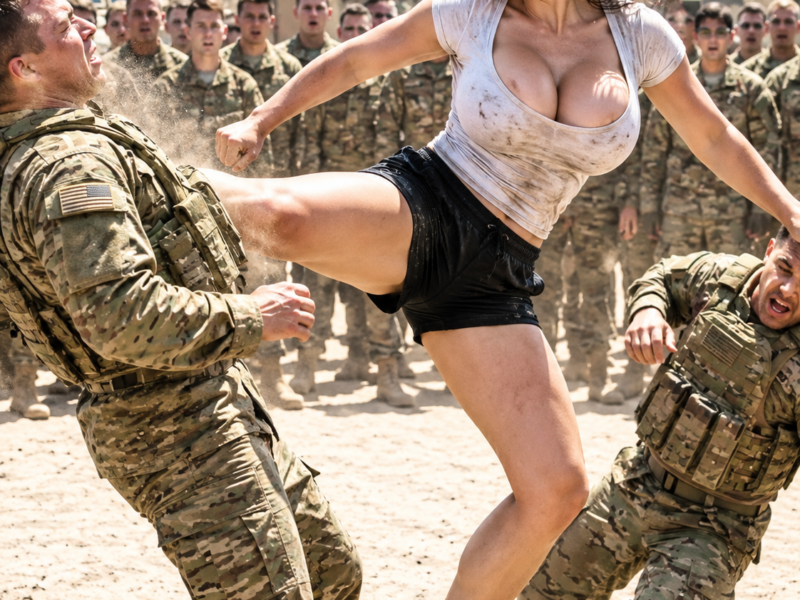
“Kneel before me!” the Navy SEAL barked as he kicked me onto the concrete in front of 280 elite operators
The admiral held the photograph between two fingers, but nobody in the corridor seemed willing to look at it.
Commander Daniel Hayes stood rigid beside him, his face drained of color. Behind us, two corpsmen were stabilizing Petty Officer First Class Travis Cole and Petty Officer First Class Mason Redd, both of whom had discovered that arrogance offered little protection against a broken leg.
Cole was sweating through his uniform.
Redd had stopped laughing.
I stood with my canvas duffel beside my boots, my left arm throbbing where Redd had grabbed it, and watched the admiral study the men who had attacked me.
“Major Ward,” Admiral Thomas Whitaker said, “would you care to explain why two members of my command are on the ground before you’ve even checked in?”
“Sir, they initiated physical contact. I attempted to disengage. When they escalated, I defended myself.”
“That all?”
“No, sir.”
His eyes lifted from the photograph.
“I gave them opportunities to stop.”
Whitaker nodded once, then turned the photograph toward Commander Hayes.
It showed a dark room, a metal table, and three men seated beneath a wall clock. One man wore a Naval Special Warfare uniform. Another had his face partially obscured by a baseball cap. The third was unmistakable.
Travis Cole.
The photograph was dated eleven months earlier.
Cole stared at it as if he had just seen a ghost.
“That’s not what it looks like,” he muttered.
The admiral’s expression remained cold.
“I haven’t asked you what it looks like, Petty Officer.”
He turned the picture back toward me.
“Major, do you recognize the other two men?”
I studied the image.
The man in the baseball cap was younger than I remembered, with a narrow face and a scar crossing his chin. The uniformed man sat with his hands folded on the table, his expression calm, almost bored.
I knew both of them.
The younger man was Evan Pike, a civilian contractor who had been attached to a classified maritime security program.
The uniformed man was Chief Petty Officer Nathan Voss.
Voss had been declared dead after a training accident off the coast of Virginia.
I had signed the report that closed his case.
“Where did you get this?” I asked.
“Recovered during an internal investigation,” Whitaker replied. “It was buried in a drive that someone tried very hard to erase.”
I looked again at the timestamp.
Then at Cole.
“Eleven months ago,” I said quietly. “Three weeks before the operation.”
Cole’s breathing changed.
It was a small thing, but I noticed. Men who were frightened often tried to hide it by becoming angry. Cole’s jaw tightened, and his eyes darted toward the corridor exit.
Whitaker noticed too.
“Secure the building,” he ordered.
Two security officers moved immediately.
“No one enters or leaves without my authorization. Preserve the camera footage from every corridor, the parking area, and the training grounds. I want the original files, not copies.”
“Yes, Admiral.”
Then he looked at Hayes.
“Get Major Ward somewhere private. Have a medic examine her arm. After that, bring your senior leadership into the briefing room.”
Hayes nodded.
“And Cole and Redd?” he asked.
“They’re not going anywhere.”
As the corpsmen lifted Cole onto a stretcher, he looked at me.
“You don’t understand what you’re walking into,” he said.
I met his eyes.
“Then you should have explained it before you kicked me.”
His mouth opened, but nothing came out.
The stretcher disappeared around the corner.
For the first time since I had arrived, the corridor became quiet.
Whitaker waited until the security officers had moved away before lowering his voice.
“Your orders have changed, Major.”
“They usually do when somebody breaks a leg, sir.”
For half a second, I thought he might smile.
He didn’t.
“Your original assignment was to evaluate discipline, operational readiness, and command integrity within this unit. That was the public explanation. Your actual mission concerns a missing intelligence package, a dead operator who may not be dead, and a series of unauthorized maritime operations.”
“And you believe Cole is connected.”
“I believe the photograph suggests that he has been connected for longer than we knew.”
I looked down at my duffel.
The black insignia stitched into its side was almost invisible unless the light struck it from the right angle. It wasn’t a conventional unit patch. It marked the small joint team I had led during an operation three years earlier, an operation that had officially never happened.
The photograph had brought that night back with brutal clarity.
A storm over the North Atlantic.
A vessel with no registered owner.
A radio call that came twenty seconds too late.
And six men who never made it home.
“Sir,” I said, “if Voss is alive, we have a much bigger problem than misconduct.”
“I know.”
“No. You know what the photograph tells you. You don’t know what it means.”
Whitaker held my gaze.
“Then tell me.”
I wasn’t ready to.
Not in a corridor where every camera might have been compromised, not with Cole and Redd still inside the building, and certainly not before I knew whether the person who had sent the photograph to the admiral was trying to expose the truth or manipulate us.
“Not here, sir.”
For the first time, Whitaker looked satisfied.
“Good answer.”
He handed the photograph to Hayes, who placed it inside a clear evidence sleeve.
“Briefing room. Fifteen minutes.”
Then the admiral walked away.
I followed Hayes down the corridor, my boots striking the concrete in an even rhythm. My arm hurt, but pain was familiar. Uncertainty was worse.
At the medical room, a corpsman examined the swelling around my forearm and found no fracture. I refused the stronger pain medication and accepted an ice pack.
While he wrapped my arm, Hayes stood by the door.
“You could have walked away,” he said.
“Yes.”
“Cole shoved you before he kicked you. Redd gave you every reason to believe he was going to keep going.”
“Yes.”
“You know they’ll claim you used excessive force.”
“They can claim whatever they like. The cameras will show what happened.”
Hayes glanced at the ice pack.
“You seem very sure of that.”
“I’m sure of what I did. The footage can establish the rest.”
He rubbed a hand over his face.
“I’ve served with Cole for four years. He’s aggressive, but he’s not stupid. He knew you were a woman arriving alone. He assumed you were some civilian evaluator who’d be too embarrassed to make a scene.”
“He wasn’t wrong about the assumption,” I said. “He was wrong about the consequences.”
Hayes gave a tired laugh that vanished almost immediately.
“You’ve done this before.”
“Defended myself?”
“Walked into a room full of men who thought they understood your assignment.”
I looked at him.
“More times than I’d like.”
The corpsman finished the wrap and left us alone.
Hayes lowered his voice.
“There’s something else you should know. Six months ago, I requested an inquiry into missing equipment and unexplained fuel transfers. My request was closed before it reached the regional command.”
“Who closed it?”
“Someone with enough authority to make the paperwork disappear.”
“Name?”
“Rear Admiral Paul Mercer.”
The name landed like a stone in still water.
Mercer had overseen the maritime security program before Whitaker took command. He had also been the senior officer who approved the final report on Voss’s supposed death.
“Does Mercer know I’m here?” I asked.
Hayes shook his head.
“Only a small circle was informed of your arrival. Whitaker, two people at the Pentagon, and me.”
“Then someone inside that circle leaked it, or someone was watching the assignment before it was approved.”
Hayes looked toward the door.
“Which possibility worries you more?”
“Neither.”
He frowned.
“The possibility that someone knew I was coming and decided to test how much I knew.”
For a moment, neither of us spoke.
Then I stood.
“Let’s go to the briefing room.”
The room was already crowded when we arrived.
Six senior officers sat around a long table. Two intelligence specialists occupied a station near the wall, their laptops connected to a secure network. Admiral Whitaker stood at the head of the table with the photograph and a thick black folder.
Every conversation stopped when I entered.
I was accustomed to the looks. Some men saw my rank and wondered how I had earned it. Others saw my age and assumed I had been promoted because somebody important liked me. A few noticed the insignia on my duffel and recognized something they couldn’t quite place.
I let them wonder.
Whitaker pointed to the empty chair beside him.
“Major Ward, take your seat.”
I did.
He opened the folder.
Inside were photographs, financial records, shipping manifests, personnel reports, and a map of the Atlantic coastline marked with red circles.
The first photograph showed Voss at a dock, wearing civilian clothes.
The second showed Evan Pike carrying a black equipment case onto a vessel registered to a company that had ceased operating two years earlier.
The third showed Cole standing beside a warehouse door.
There were more.
Cole at a marina.
Cole entering a private hangar.
Cole meeting a man whose face had been blurred in the copy.
And, on one page, a list of equipment reported lost during training exercises.
Night-vision systems.
Encrypted radios.
Navigation modules.
Thermal optics.
None of it was enough to prove a crime on its own. Together, the records formed a pattern.
“Over the past fourteen months,” Whitaker said, “equipment has disappeared from several Naval Special Warfare facilities. The losses were recorded as training damage, inventory discrepancies, or administrative errors. At the same time, vessels connected to shell companies have conducted unauthorized movements along restricted maritime routes.”
One of the intelligence specialists advanced the presentation.
A map appeared on the screen.
“Three vessels are of particular interest,” she said. “Their transponders were disabled near designated training zones. Two later appeared in ports under different names. The third has not been located.”
“Cargo?” I asked.
“Unknown.”
“Crew?”
“Officially, none. The vessels were listed as unmanned equipment platforms.”
I stared at the map.
“That is impossible. Those platforms require manual maintenance and cannot complete the reported movements autonomously.”
“Correct,” the specialist said.
“Then someone falsified the records.”
“That’s our assessment.”
I pointed to the northern route.
“This isn’t random. These movements follow a corridor used during the operation three years ago.”
The room went still.
Whitaker turned toward me.
“Explain.”
I stood and walked to the screen.
“Three years ago, my team was assigned to intercept a vessel suspected of transporting stolen military technology. We were told the cargo was experimental navigation equipment. The intelligence package indicated that the vessel would pass through this corridor before midnight.”
I remembered the cold water against my face, the radio hiss, and the silhouettes moving across the deck.
“We intercepted the vessel. The operation was compromised before we reached the target. Someone knew our approach, our timing, and our fallback route.”
“Casualties?” an officer asked.
“Six personnel were lost. Two were recovered. Three were never found. The sixth was Chief Petty Officer Nathan Voss.”
“And the official conclusion?”
“Equipment failure and an unexpected weather event.”
“Do you believe that conclusion?”
“No.”
The answer came out harder than I intended.
I took a breath.
“My team had trained for those conditions. Our equipment was functioning when we launched. The radio failure happened after we entered the final approach, and the distress signal we received was transmitted on a channel that should not have been accessible to the vessel.”
Whitaker closed the folder halfway.
“You never reported that discrepancy.”
“I did. Three separate times.”
“And?”
“Each report was returned with instructions to remove classified technical details. When I refused, I was told the investigation had been transferred to Admiral Mercer’s office.”
A captain at the far end of the table shifted in his chair.
“Major, are you suggesting a senior flag officer deliberately compromised a special operations mission?”
“I’m suggesting that the evidence points to an insider. I won’t name the person responsible until I can support it.”
“Yet you have already identified Mercer.”
“I identified him as the officer who controlled the investigation. That is a fact. Whether he caused the compromise is a question.”
Whitaker watched me for several seconds.
“That’s why I wanted you here.”
He turned to the intelligence specialist.
“Show the transfer records.”
A second screen appeared.
The missing equipment had been moved through a chain of inventory accounts, each transfer approved by a different official. Several names were familiar to the officers in the room. One belonged to a logistics commander who had retired. Another belonged to a civilian procurement manager who had been dismissed. A third was still active.
Cole’s name appeared near the bottom.
He had signed for a set of encrypted communications modules that were later reported destroyed during an exercise.
The exercise had never taken place.
A low murmur spread around the table.
“Where is the original record?” I asked.
“On a secured server,” the specialist replied. “The copy in this folder came from an offline archive.”
“Who accessed the archive?”
“We’re still tracing that.”
“Then don’t connect it to any other system. Make a forensic copy and seal the original.”
The specialist nodded.
I looked at Whitaker.
“If Voss survived, he may have taken evidence with him. If he was involved in the compromise, he may have been trying to protect himself. Either way, somebody has spent three years making sure we never learn what happened.”
“And Cole?”
“He might be a participant, a courier, or a man who signed documents without understanding what they meant. The photograph proves contact, not guilt.”
Whitaker tapped the folder.
“Then we’ll establish the difference.”
The briefing continued for another hour. The team assigned to the inquiry divided the work into three tracks: financial records, maritime movements, and personnel access. I requested the original mission logs from three years earlier, including every version of the radio transcript and the names of everyone who had accessed them.
When the meeting ended, Hayes caught up with me outside.
“You believe Voss is alive.”
“I believe the photograph is recent enough to make that possible.”
“How recent?”
“The timestamp could have been altered. We need the original file.”
“And if it is genuine?”
I looked through the window toward the training grounds.
“Then we find him before whoever buried this investigation does.”
My first lead came from the photograph itself.
The image had been printed on ordinary paper, but the back contained a faint impression from another document. Under angled light, the intelligence team recovered part of a shipping reference and a sequence of six digits.
The reference belonged to a storage facility near San Diego harbor.
By late afternoon, we had a warrant for a controlled inspection and a small team authorized to accompany me. Hayes insisted on coming.
“You’re responsible for the unit,” I reminded him.
“Which is exactly why I’m coming.”
I didn’t argue.
The storage facility occupied a narrow strip of industrial land between a repair yard and a row of warehouses. Its exterior looked unremarkable. Cameras covered the entrance, but two were pointed away from the gate.
That bothered me.
A facility holding ordinary commercial equipment didn’t need to hide its own entrance from its cameras.
We approached in plain clothes, with a separate security team positioned nearby. The facility manager met us at the office and produced a stack of paperwork that looked almost too perfect.
Every shipment had a matching invoice.
Every invoice had a signature.
Every signature had a corresponding approval.
It was the kind of order people created when they expected somebody to inspect the records.
“Where is unit twelve?” I asked.
The manager hesitated.
“It’s under maintenance.”
“Then take us there.”
He led us through a corridor that smelled of oil and salt. Unit twelve stood at the end, its metal door secured by a new electronic lock.
The manager entered a code.
Inside were rows of shipping crates, several military-grade equipment cases, and a folding table covered with papers.
The crates were labeled as marine surveying instruments.
I opened the nearest case.
Encrypted communications modules lay inside, wrapped in protective foam.
The serial numbers matched the missing inventory records.
Hayes exhaled slowly.
“That’s enough to end careers.”
“Not yet,” I said. “We need to know who moved them and where they were going.”
On the folding table, I found a handwritten list of dates and vessel names. Beside each name was a short code.
One code matched the sequence recovered from the photograph.
At the bottom of the page was a phrase written in block capitals:
NIGHT GLASS — FINAL TRANSFER.
My fingers tightened around the paper.
Night Glass was the operation three years earlier.
It was the name we had used for the mission that cost six people their lives.
“Commander,” I said, “photograph everything. Do not touch anything else.”
He signaled the team.
Then a noise came from behind the crates.
A single scrape.
A quiet breath.
I turned toward the sound.
“Military police,” Hayes called. “Come out with your hands visible.”
For several seconds, nothing happened.
Then a man stepped into the light.
He was thin, pale, and older than the photograph had suggested. A rough beard covered his jaw. His right hand rested against the wall as if he needed it to stand.
But the scar across his chin was unmistakable.
Evan Pike.
He looked at me, then at the insignia on my duffel.
“You shouldn’t have come here,” he said.
“That’s becoming a familiar greeting.”
His eyes moved toward the open equipment case.
“You don’t understand what those modules were used for.”
“Then tell me.”
Pike swallowed.
“Cole was only the delivery man. He didn’t design the system, and he didn’t know what was inside the final shipment.”
“Who did?”
He looked at Hayes.
“Not here.”
I stepped closer.
“You were photographed with Voss eleven months ago. Is he alive?”
Pike’s face changed.
It wasn’t fear alone. It was grief.
“Yes.”
The word seemed to empty the room.
“Where is he?” I asked.
“I don’t know where he is now.”
“Then tell me where you last saw him.”
Pike stared at the floor.
“He came to me because he thought somebody was going to kill him. He had evidence that the Night Glass operation had been compromised before your team launched. He said the radio failure was intentional.”
“I know.”
“No,” Pike whispered. “You know about the radio. You don’t know what was transmitted.”
He reached inside his jacket.
Every member of the security team raised a weapon.
“Slowly,” I ordered.
Pike removed a small, sealed memory card and held it between two fingers.
“This is a copy of the original transmission log. Voss hid it before he disappeared. I kept it because I thought somebody might eventually come looking.”
I didn’t take it immediately.
“Why didn’t you give it to investigators?”
“Because the first investigator who contacted me knew details that only the person who altered the log should have known. Two days later, my apartment was searched. Nothing was taken, but somebody left a message on my kitchen table.”
“What message?”
Pike’s eyes lifted to mine.
“Stop digging, or your name will be added to the casualty list.”
Hayes swore under his breath.
I took the memory card and sealed it in an evidence pouch.
“Who threatened you?”
“I never saw his face.”
“Did Voss name anyone?”
Pike hesitated.
“He said the order came from inside the command structure. He believed a senior officer wanted the equipment moved because the system could track vessels without using conventional signals. The technology was supposed to be tested during Night Glass.”
“And the mission was compromised to hide the test?”
“I don’t know. Voss thought your team was sent in to recover the system, not destroy it. He believed somebody changed the mission parameters after your briefing.”
That possibility hit harder than any accusation against Cole.
My team had entered the water believing we were intercepting stolen technology. If someone had secretly changed our objective, every decision we made that night might have been based on a lie.
“Who changed the parameters?” I asked.
Pike shook his head.
“Voss had a name, but he wouldn’t tell me. He said if he disappeared, the evidence had to reach someone who knew the mission well enough to recognize the altered record.”
He looked directly at me.
“He said you would.”
Before I could ask another question, a security officer called from the corridor.
“Commander, we’ve got movement outside. A vehicle just left the rear access road.”
Hayes turned toward the door.
“Did anyone authorize an exit?”
“No, sir.”
I looked at Pike.
“Were you expecting someone?”
He shook his head, but the expression on his face told me he had been afraid of this moment for months.
The security team moved to secure the facility. We found the rear gate open and fresh tire tracks in the wet dirt. The vehicle had no visible plates, and the camera that should have captured it had been disabled.
Someone had known we were coming.
Again.
By the time we returned to the base, Admiral Whitaker had ordered a communications lockdown. The memory card went directly to a forensic lab under dual custody. Pike was placed in protective detention, not as a suspect but as a material witness whose life might be in danger.
Cole and Redd were receiving medical treatment under guard.
Both had requested legal counsel.
Neither had offered a formal statement.
At 2300 hours, Whitaker summoned me to his office.
The room was dark except for a desk lamp and the glow of a monitor. He had removed his jacket and looked older than he had that morning.
“The forensic team recovered the transmission log,” he said.
“Does it authenticate?”
“They’re still checking the metadata. The signal sequence, however, matches the fragments from your original mission record.”
He turned the monitor toward me.
A waveform filled the screen, followed by a transcript.
Most of it consisted of routine communications: course adjustments, weather updates, status reports. Then, twenty-three minutes before the first distress call, a message appeared on a channel that should have been restricted to senior command.
Proceed with revised objective. Recover the package. Leave the team in place.
I read it twice.
“What does ‘leave the team in place’ mean?”
Whitaker didn’t answer immediately.
“The message was transmitted using a command authentication key assigned to Admiral Mercer’s office.”
I felt the room tilt, though I remained standing.
“Was Mercer in the command center that night?”
“His office claims he was attending a classified meeting elsewhere.”
“Can anyone verify that?”
“Not yet.”
I stared at the transcript.
The message did not explicitly order anyone to harm my team. It didn’t need to. It redirected our operation at the exact moment our communications failed, leaving us exposed to a threat we had not been briefed to expect.
“Someone wanted us there,” I said.
“Or wanted the system tested under real operational conditions.”
I looked at him.
“And Voss?”
“His personnel record was altered after the mission. The original casualty entry lists him as missing, not dead. The designation was changed three days later.”
“By whom?”
Whitaker brought up the audit record.
The approval field contained a digital signature.
Rear Admiral Paul Mercer.
For several seconds, I couldn’t speak.
The man who had closed my reports had also changed Voss’s status. He had helped turn a missing operator into a dead one, removing the obligation to keep searching for him.
But that still didn’t prove Mercer had ordered the operation compromised.
I forced myself to step back from the conclusion.
“Sir, we have a transmission, an altered personnel record, stolen equipment, and a photograph connecting Cole to Voss and Pike. We have enough to justify a full investigation. We don’t yet have enough to determine who gave the original order or why.”
Whitaker nodded slowly.
“You’re right.”
He closed the file.
“Which is why Mercer is being summoned to headquarters tomorrow morning.”
“Does he know about the memory card?”
“Only the people in this room and the forensic team.”
I thought of the disabled camera at the storage facility.
“Then assume he knows.”
Whitaker studied me.
“What makes you say that?”
“Someone watched our arrival. Someone disabled a camera before we entered. Either our movements were monitored, or our inquiry was anticipated. Until we know which, we should assume every routine communication can be compromised.”
He reached for the secure telephone.
“Then we won’t use routine communications.”
By dawn, the base had changed.
Access credentials were being reissued. Equipment inventories were frozen. Every person with access to the Night Glass records had been ordered to remain available for questioning. A small team was reviewing the chain of custody for each document connected to the case.
I hadn’t slept.
I stood alone in a quiet office, reading the names of the six people lost during the operation.
Petty Officer Daniel Shaw.
Lieutenant Marcus Bell.
Specialist Aaron Price.
Corporal James Holloway.
Petty Officer Nathan Voss.
And Lieutenant Commander Samuel Cross.
Cross had been my closest friend on the team.
He was the one who had pulled me clear of a damaged line when the sea swallowed our approach boat. He was the one who had stayed behind to help another operator reach the extraction point.
His body had never been recovered.
For three years, I had replayed the final minutes of that mission, wondering whether I had made the wrong call. Whether I had sent my team into a trap because I trusted the briefing more than my instincts.
Now I had to consider something worse.
What if my instincts had been right, and somebody had made sure I could never prove it?
A knock interrupted the thought.
Hayes entered carrying two cups of coffee.
“Thought you might need this.”
“I need a time machine.”
“Coffee’s cheaper.”
I accepted the cup.
He sat across from me and glanced at the casualty list.
“Cross was your friend?”
“My teammate.”
“That wasn’t what I asked.”
I looked at the name.
“He was the person I trusted to tell me when I was wrong.”
Hayes was quiet.
“Then I hope we find out what happened.”
“So do I.”
At 0745, Admiral Whitaker called us to the secure conference room. Rear Admiral Paul Mercer had arrived.
He entered wearing a spotless uniform, his silver hair neatly combed, his expression composed. He looked like a man who had spent his life in rooms where everyone stood when he entered.
His eyes moved across the officers, paused briefly on me, then settled on Whitaker.
“You requested my presence,” he said. “I assume this concerns the unauthorized inquiry into the Night Glass records.”
The room went silent.
Whitaker folded his hands.
“You seem remarkably well informed.”
“Your staff contacted mine.”
“They did not disclose the subject.”
Mercer smiled without warmth.
“Then perhaps I inferred it.”
He sat without being invited.
I watched his hands. They were steady. No fidgeting, no hesitation. If he was worried, he had spent years learning how not to show it.
Whitaker placed the photograph on the table.
Mercer looked at it for less than two seconds.
“Where did you get this?”
“That’s what we’re investigating,” Whitaker said.
“This photograph proves nothing.”
“Agreed. It establishes contact between Cole, Pike, and Voss eleven months ago. We are examining what that contact involved.”
Mercer leaned back.
“Cole is a junior operator. Pike is a contractor with a questionable history. Voss is dead. You are building a conspiracy out of unrelated facts.”
I spoke before Whitaker could respond.
“Voss’s original personnel record lists him as missing.”
Mercer’s gaze shifted to me.
“Major Ward.”
“Sir.”
“I remember your reports. You were understandably distressed after the operation. Grief can make a person search for patterns where none exist.”
The room tightened around the words.
I had heard that tone before. It was the tone used to turn a question into a personal failing.
“Grief doesn’t alter digital signatures, Admiral,” I said. “People do.”
A muscle moved in his jaw.
Whitaker slid a second document across the table.
“Your authentication key was used to transmit a revised objective twenty-three minutes before the Night Glass distress call.”
Mercer glanced at the page.
“That key was accessible to authorized staff.”
“Who had access?”
“My office personnel.”
“Names?”
“I would need to review the duty roster.”
“We have it.”
“Then you have your answer.”
“No,” Whitaker said. “We have a list of people who may have had access. We want to know who used the key.”
Mercer stood.
“This inquiry has exceeded its authority. The mission was reviewed, the findings were approved, and the matter was closed. You are risking operational security by reopening it.”
Whitaker remained seated.
“I have authority to investigate misconduct within my command. If the evidence points beyond it, I will refer the matter to the appropriate inspector general and law enforcement authorities.”
Mercer’s eyes hardened.
“You will regret this.”
“Perhaps. But I would rather regret an investigation than regret failing to conduct one.”
For the first time, Mercer looked at me with something other than disdain.
It was recognition.
Not of my rank.
Of my purpose.
“You should be careful, Major,” he said. “Some truths destroy more than careers.”
I held his gaze.
“Then they should have been buried more carefully.”
Security officers entered the room.
Mercer looked toward Whitaker.
“Am I being detained?”
“Not at this time. You will surrender your government devices for preservation and remain available for questioning. Your access to the relevant systems is suspended pending review.”
“You cannot do that without formal authorization.”
“The authorization was signed this morning.”
Whitaker placed the order on the table.
Mercer read it, then slowly returned it.
He left without another word.
I didn’t mistake his departure for defeat.
People who had protected a secret for three years did not surrender simply because somebody finally asked the right questions.
At 1012, the forensic team delivered its preliminary findings.
The memory card contained an additional audio segment that had been deleted from the official record. The restored file began with static and a series of clipped commands.
Then came a voice I recognized.
Lieutenant Commander Samuel Cross.
“Command, this is Cross. Our objective has changed. We have personnel moving on the eastern side of the vessel. These are not the crew members described in the briefing.”
A burst of interference followed.
Then another voice answered.
“Continue recovery. Do not break position.”
Cross responded immediately.
“We have wounded personnel. We need extraction.”
The reply came after a pause.
“Negative. Hold position until the package is secured.”
The recording ended with an impact and a fragment of a distress call.
I sat very still.
Cross had not abandoned the mission. He had asked for extraction after discovering the situation was different from what we had been told. Someone had denied it.
“Can you identify the voice?” Whitaker asked.
The analyst shook her head.
“The audio is distorted. We can compare it against known samples, but we can’t make a reliable identification yet.”
“Keep working,” I said.
The analyst nodded.
Then she hesitated.
“There is one more thing.”
She brought up the final seconds of the file. Beneath the interference, a second signal had been captured. It was not part of the official mission channel. It appeared to have been transmitted from a separate device close to the vessel.
A short sequence of numbers followed.
I recognized them immediately.
They were the emergency authentication digits assigned to my own team.
Only six people had known them.
My throat tightened.
“If those digits were used to authenticate the revised objective,” I said, “then someone had access to our team credentials before we launched.”
“Or someone copied them during the operation,” Whitaker said.
I shook my head.
“The sequence was transmitted before we reached the vessel.”
The room seemed to grow smaller.
This wasn’t merely a senior officer making a bad decision. Someone had penetrated our operational security before the mission began. Someone had known our access codes, our route, and our fallback plan.
Someone had prepared the conditions under which six people would disappear.
Then the analyst opened the final metadata pane.
A device identifier appeared beside the secondary transmission.
It belonged to a portable communications unit issued to Lieutenant Commander Samuel Cross.
For a moment, I couldn’t hear anything.
Cross had carried the device himself.
If he had transmitted the authentication sequence, he might have been helping the person who compromised us.
Or he might have been trying to identify the source of the order.
The recording could not tell us which.
I looked at the analyst.
“Can you recover any more from the device signature?”
“We’ll try.”
“Don’t assume the transmission was hostile. Cross may have been investigating the breach.”
Whitaker nodded.
“Then we need to find out what he knew.”
A security officer appeared at the door.
“Admiral, we have an incoming call from an encrypted external line. The caller requested Major Ward by name.”
Every head turned toward me.
“Did they identify themselves?” Whitaker asked.
“No, sir. They said they have information about Night Glass.”
I stood.
“Put it through to the secure room. Audio only. No location data.”
The officer nodded and left.
A few seconds later, the speaker clicked.
At first, there was only breathing.
Then a man’s voice emerged, rough and quiet.
“Major Ward?”
I gripped the edge of the table.
“Speaking.”
“You’ve been asking questions about a man who was declared dead.”
“Who is this?”
“My name is Nathan Voss.”
No one moved.
I closed my eyes for one brief second.
Then I opened them.
“Prove it.”
A pause.
“On the night of Night Glass, Cross told you to abandon the eastern approach. You refused because you believed the radio failure was temporary. He argued with you for forty seconds. You told him you weren’t leaving anyone behind.”
The memory struck me with the force of a physical blow.
Nobody outside that team knew those words.
“Where are you?” I asked.
“Somewhere I can still hear the people who want me dead.”
“Are you in danger right now?”
“I have been in danger for three years.”
“Why contact me now?”
“Because Mercer knows you’ve recovered the transmission. And because the photograph was never supposed to reach Whitaker.”
My eyes moved to the black folder.
“Who sent it?”
“Someone who wants the truth exposed.”
“Who?”
“I can’t tell you over this line.”
“Then give me something I can verify.”
Voss breathed into the microphone.
“The final transfer is scheduled for tonight. The equipment in that warehouse is only a decoy. The real system is aboard a vessel operating under a new identity. It will leave the harbor before midnight.”
“What’s the vessel’s name?”
“Northstar.”
The intelligence specialist was already typing.
“Destination?” I asked.
“Not a port. A rendezvous point offshore. The buyer is expecting the system before dawn.”
“Who is the buyer?”
Voss hesitated.
Then he said, “Someone who was at the original mission briefing.”
The line crackled.
“Voss, listen to me. We can protect you. We can get you somewhere safe, but I need your location.”
“You can’t protect me until you know who has access to your operation.”
“We’ve locked down the base.”
“Then you have locked down the wrong place.”
A sudden metallic sound came through the speaker.
Voss’s breathing changed.
“Major, there’s one thing you need to understand. The men who attacked you this morning weren’t trying to intimidate a stranger.”
I glanced at Hayes.
“What do you mean?”
“They were told to find out whether you still carried the original insignia. The one on your bag.”
My stomach tightened.
The insignia had belonged to our team. After the mission, I had kept it because the official report had ordered all unit markings destroyed. I had refused to surrender the last one I owned.
“Who told them?” I asked.
“Cole was given a photograph of your bag. He was told to provoke you, search your belongings, and make it look like you were the aggressor if you resisted.”
The room erupted in overlapping voices.
Whitaker raised a hand for silence.
I stared at the speaker.
“Why?”
“Because the insignia marks the team that recovered a fragment of the system before the vessel went down.”
I remembered the final moments of Night Glass. A damaged case had washed against our boat. Cross had pulled it aboard before the next wave struck. I had ordered him to leave it behind, but he had refused.
He’d said it was evidence.
The boat capsized seconds later.
The case disappeared beneath the water.
At least, that was what I had believed.
“Did Cross recover the fragment?” I asked.
“Yes.”
“Where is it?”
Voss’s voice dropped almost to a whisper.
“He gave it to you.”
I looked down at my canvas duffel.
The black insignia was stitched into the side pocket. Beneath it, hidden behind a strip of reinforced fabric, was a small metal plate I had never examined closely. I had kept the bag packed since the operation, unable to bring myself to throw it away.
My hands went cold.
“Are you saying the fragment is inside my bag?”
“No. I’m saying Cross hid something in the insignia itself. He told me he had given you the only copy of the original authentication sequence.”
I reached for the bag, but Whitaker stopped me.
“Don’t touch it until the evidence team arrives.”
He turned to the security officer.
“Secure the room. Nobody leaves. Get an explosive ordnance specialist and a digital forensics team here immediately.”
The speaker crackled again.
“Major?”
“I’m here.”
“There’s something else. The person who gave Cole his instructions wasn’t Mercer.”
“Who was it?”
Voss’s answer came so quietly that I almost missed it.
“Commander Daniel Hayes.”
Every face turned toward Hayes.
He stood motionless beside the wall, his expression unreadable.
The call ended.
For several seconds, nobody spoke.
Then Hayes slowly raised both hands, palms open.
“Admiral, I can explain.”
Whitaker’s voice was ice.
“You’d better.”
Hayes looked at me.
“I didn’t know Cole would attack you. I swear to you, I didn’t.”
“You gave him my photograph?”
“I was ordered to verify whether you still possessed the insignia. I was told it was a security concern.”
“By whom?”
Hayes swallowed.
“Mercer.”
“Then why did Voss say your name?”
“I don’t know.”
“Did you know Cole was supposed to provoke me?”
“No. I was told to observe your arrival and report whether you had the bag. Nothing more.”
“Did you report it?”
Hayes didn’t answer.
He didn’t need to.
Whitaker stepped toward him.
“Commander, surrender your credentials and sidearm.”
Hayes looked as though he had been struck.
“Sir, I’ve served this command for eighteen years.”
“Then you understand why I’m asking.”
Slowly, Hayes removed his credentials and placed them on the table. He unfastened his sidearm and handed it to the security officer.
I watched him do it.
Part of me wanted to believe him. He had helped me find the stolen equipment. He had stood beside me in the warehouse. He had brought me coffee while I read the names of the dead.
But loyalty without honesty was just another form of camouflage.
The evidence team arrived twenty minutes later.
They photographed the duffel, documented every seam, and removed the insignia under controlled conditions. Inside the reinforced backing, they found a thin metal capsule containing a storage chip and a handwritten note folded into a narrow strip.
The note was in Cross’s handwriting.
Elena — if you’re reading this, the official record is false. Don’t trust the first explanation. Trust the evidence, even when it points toward someone you love.
I read the words twice.
The chip contained the original system authentication sequence, along with a set of encrypted coordinates and a short video file. The video showed a control room on the night of Night Glass. Several figures stood around a display. One of them was Mercer.
Another was Hayes.
The third figure stood with his back to the camera.
The voice recording began.
Mercer was speaking.
“The team must remain in position until the package is secured.”
Hayes replied, “They weren’t briefed for that objective.”
“Then they don’t need to know.”
“And if they request extraction?”
Mercer looked toward the screen.
“Deny it.”
The video ended.
Hayes sat down heavily.
“I was a lieutenant commander then,” he said. “I was assigned to communications oversight. Mercer told me the operation had been compromised by an external source and that the revised objective was necessary to prevent the system from falling into hostile hands.”
“You knew our team was in danger,” I said.
“I knew the situation was unstable. I didn’t know the distress calls were being suppressed.”
“You heard the order to deny extraction.”
His eyes filled with shame.
“I thought Mercer had intelligence we didn’t have. I believed the delay would last minutes, not long enough to cost lives.”
“And afterward?”
He looked down at his hands.
“Afterward, he told me the operation had succeeded in recovering the system. He said the casualties were unavoidable and that the official report would protect the unit from public scrutiny. When I found inconsistencies, I asked questions. He told me to stop.”
“So you stopped.”
“Yes.”
The answer was barely audible.
“You let six people become a footnote because you were afraid of losing your career.”
Hayes flinched.
“I thought I was protecting the command.”
“You were protecting the people who compromised it.”
He had no answer.
Whitaker ordered Hayes placed under formal investigation. The admiral did not declare him guilty; the evidence had to be tested, and Hayes would have the opportunity to answer the charges. But his access was suspended, his devices seized, and his account of the events recorded.
The video gave us enough to act.
The coordinates on the chip pointed to a rendezvous area beyond the harbor approaches. The Northstar was scheduled to leave at 2100 hours. Its registered owner was a shell company tied to the same procurement network that had handled the missing equipment.
Whitaker authorized an operation to intercept the vessel, secure the technology, and arrest anyone involved under the appropriate authority.
I requested to lead the boarding team.
He studied me carefully.
“You have a personal connection to this case.”
“I do.”
“That can compromise judgment.”
“It can. That’s why I want a second officer with independent authority and a separate evidence team. I won’t make decisions alone.”
He nodded.
“Approved. You will lead the tactical element. Commander Hayes will not be involved. He remains under investigation.”
At 2030, I stood on the deck of a patrol vessel as the coastline faded into darkness.
The sea was calmer than it had been three years earlier. That almost made it worse. There was no storm to blame, no sudden wave to explain a lost signal. Whatever happened tonight would happen because people made choices.
We located the Northstar just before 2200.
It was a low-profile vessel with a clean hull and a darkened bridge. Its navigation lights were on, but its transponder was transmitting a false identity. Our team approached under the cover of the harbor traffic, keeping the vessel in view while the operations center confirmed the target.
“Visual confirmed,” the team leader reported.
“Prepare to board.”
As we closed the distance, a light flashed twice from the aft deck.
A signal.
Then the vessel changed course.
“Target is moving toward the outer channel,” the coxswain called.
“Intercept,” I ordered.
The boarding team moved.
We secured the aft deck without a shot being fired. Two crew members surrendered immediately. A third tried to reach the bridge but was stopped by the second element.
Inside the main compartment, we found a rack of encrypted communications equipment and a control console matching the technical description recovered from the chip.
The system was real.
It could identify and track vessels through a network of signals that were supposed to be invisible to conventional monitoring. In the wrong hands, it could reveal the movements of military assets without triggering standard alerts.
And somebody had used it during Night Glass.
We secured the console and began documenting the equipment.
Then the bridge door opened.
Rear Admiral Paul Mercer stepped out, flanked by two men in civilian clothes.
For a moment, I couldn’t believe he had come aboard himself.
He looked at the weapons trained on him, then at me.
“Major Ward,” he said. “You have no authority to seize this vessel.”
“The vessel is carrying stolen military equipment and operating under a false identity. The operation is authorized by Admiral Whitaker.”
“You have no idea what you’re interfering with.”
“I know six people died because their extraction request was denied.”
His face hardened.
“You were never meant to recover the system. Your mission was to secure the area while the transfer was completed.”
“You changed our objective after we launched.”
“I made a decision to protect national security.”
“You concealed the real mission from the people you sent into danger.”
“I protected a capability that would have been lost if the technology had fallen into hostile hands.”
“You protected your position.”
For the first time, his composure cracked.
“You think this is about me? The system was years ahead of anything we had. It could have prevented attacks. It could have saved lives. Your team was unfortunate collateral in an operation larger than you could understand.”
I stepped closer.
“Say their names.”
He stared at me.
“What?”
“Say the names of the six people you left out there.”
He said nothing.
“Daniel Shaw. Marcus Bell. Aaron Price. James Holloway. Nathan Voss. Samuel Cross.”
Mercer looked away.
That was the answer.
The boarding team took him into custody. The two civilians were detained, and the equipment was secured under the supervision of the independent evidence team. No one was permitted to remove a single component without documenting it.
As Mercer was escorted below, he turned back toward me.
“You’ve destroyed something that could have changed the world.”
“No,” I said. “I’ve stopped you from deciding who gets sacrificed to protect it.”
He disappeared down the passageway.
We found Nathan Voss in a concealed compartment beneath the lower deck.
He was weak, dehydrated, and carrying a pistol he lowered the moment he saw my face. He looked older than the man in the photograph, but the scar on his chin was the same.
For a few seconds, neither of us moved.
Then he said, “You took your time, Major.”
I let out a breath that was almost a laugh.
“You were declared dead.”
“I’ve been told worse.”
I reached for his shoulder, then stopped, unsure whether he would welcome the gesture.
He solved the problem by gripping my arm.
“I’m sorry about Cross,” he said.
The words broke through the wall I had built around myself.
“Tell me what happened.”
Voss lowered his head.
“Cross recovered the system fragment, but he realized it contained proof that the command channel had been used to redirect the operation. He tried to get the evidence out. When the boat capsized, he gave me the chip and told me to get clear.”
“Why didn’t you come back?”
“I tried. The extraction point was compromised. The people searching for me were using our own call signs. I couldn’t tell who was coming to rescue me and who was coming to silence me.”
“You could have contacted me.”
“I didn’t know who I could trust. I watched the reports. I saw you challenge the findings, and I saw those reports disappear. I thought if I contacted you, they’d use you to reach me.”
He looked toward the compartment where the recovered equipment was being secured.
“Pike helped me stay alive. He knew how to move without leaving a trail. When he found the photograph of Cole and me, he sent it to Whitaker. We hoped the investigation would bring you here before Mercer moved the system.”
“Cole knew you were alive?”
“He knew he was handling something connected to Voss. I don’t think he knew the full story. But he knew enough to be afraid of what you might recognize.”
I thought of Cole’s face when the photograph had appeared.
His fear had not been the fear of an innocent man falsely accused. It had been the fear of a man realizing the secret he had been protecting was finally exposed.
Still, the inquiry would determine exactly what he knew, and what he had done.
We returned to Coronado shortly after midnight.
By morning, the investigation had expanded beyond the base. Federal investigators were examining the shell companies, the falsified inventory records, and the unauthorized transfers. Mercer’s devices had been seized. His orders and communications were being reviewed by independent authorities.
Cole and Redd remained under investigation for their actions against me, as well as their potential involvement in the equipment scheme. The footage from the corridor confirmed that I had tried to disengage and that they had continued the confrontation. Neither man could credibly claim that I had attacked without provocation.
Redd eventually admitted that Cole had been instructed to provoke me and search my belongings. Cole denied knowing the full purpose of the plan, but he acknowledged that he had received a photograph of my duffel and orders to determine whether I still possessed the insignia.
The evidence would decide the rest.
Commander Hayes gave a full statement. He admitted that he had followed Mercer’s instructions during Night Glass and had later helped suppress questions because he feared the consequences of exposing the operation. His cooperation became part of the formal record, but it did not erase his responsibility.
I did not speak to him again before I left the base.
Three weeks later, I stood in a small military cemetery under a pale morning sky.
Six names were engraved on a memorial stone.
For three years, I had believed the official report was the final word on what happened to my team. I had carried the weight of that night as if every unanswered question were a failure of my own leadership.
Now I knew the truth was more complicated.
Some decisions had been made above my authority. Some people had betrayed their oaths. Others had remained silent because they were afraid. And the people who died had been denied the chance to understand the danger they were facing.
But the truth did not bring them back.
I placed six small stones at the base of the memorial, one for each name.
Nathan Voss had survived. Pike had agreed to testify. The stolen system had been recovered, and the operation that concealed its transfer was now under investigation. The official record of Night Glass would be corrected.
Those were important things.
They were not justice by themselves.
Justice would take time, evidence, and the willingness to let the facts stand even when they embarrassed powerful people.
I could not promise the families that every person responsible would face the same consequences. I could promise that no one would be allowed to quietly rewrite what had happened again.
A breeze moved through the trees.
I touched Samuel Cross’s name with two fingers.
“You were right,” I whispered. “The evidence mattered.”
For the first time in three years, I didn’t feel the need to replay the final radio call.
I could still hear it. I always would.
But I no longer had to wonder whether I had failed my team by trusting the wrong people. I had done what I could with the information I had been given. The betrayal belonged to the people who had hidden the truth, not to the people who had believed their orders were honest.
When I turned away from the memorial, Whitaker was waiting near the path.
“The inquiry is moving forward,” he said. “Mercer will face charges. Hayes’s case will be handled separately. Cole and Redd will answer for their conduct, and the evidence involving the missing equipment will be reviewed by prosecutors.”
“And Voss?”
“He’s in protective custody. He’s agreed to testify when the medical team clears him.”
I nodded.
“Good.”
Whitaker glanced toward the memorial.
“You could have left the base the morning you arrived. No one would have blamed you for refusing to work with a command that had treated you that way.”
“I wasn’t there to protect my pride.”
“Then what were you there to protect?”
I looked back at the six names.
“The truth. And the people who never got the chance to tell it.”
Whitaker stood beside me for a moment before offering his hand.
“Your assignment is complete, Major.”
I shook it.
“No, sir. The investigation is just beginning.”
He gave a faint, weary smile.
“That’s what I was afraid you’d say.”
I returned to the base that afternoon to collect my duffel. The corridor where Cole had kicked me was quiet. The concrete had been cleaned, and the cameras were still mounted above the doors, recording every person who passed beneath them.
I stopped at the spot where I had fallen.
The pain in my arm had faded to a dull ache. The bruises would disappear in a few days. Cole and Redd would recover too, though the consequences of their choices would last much longer.
I picked up the duffel and ran my hand over the place where the insignia had been removed.
The bag looked ordinary now.
That suited me.
I had spent years carrying a secret I hadn’t known I possessed, and the secret had nearly destroyed the people who tried to protect it. I didn’t need the insignia to remember my team. I had their names, their voices, and the truth of what they had done.
At the exit, I paused and looked back at the building.
The men who had ordered me to kneel had believed that rank, reputation, and intimidation could make the truth disappear. They had mistaken silence for obedience and fear for respect.
They were wrong.
I had not won because I was stronger than them. I had won because I had stopped when I could, fought only when I had to, and refused to let their version of events become the official one.
Behind me, the base continued its work. Training carried on. Reports were filed. Investigators asked questions that should have been asked three years earlier.
And somewhere beyond the harbor, the ocean moved over the place where six people had disappeared.
I could not bring them home.
But I could make sure their names were no longer buried beneath a lie.
The end.









