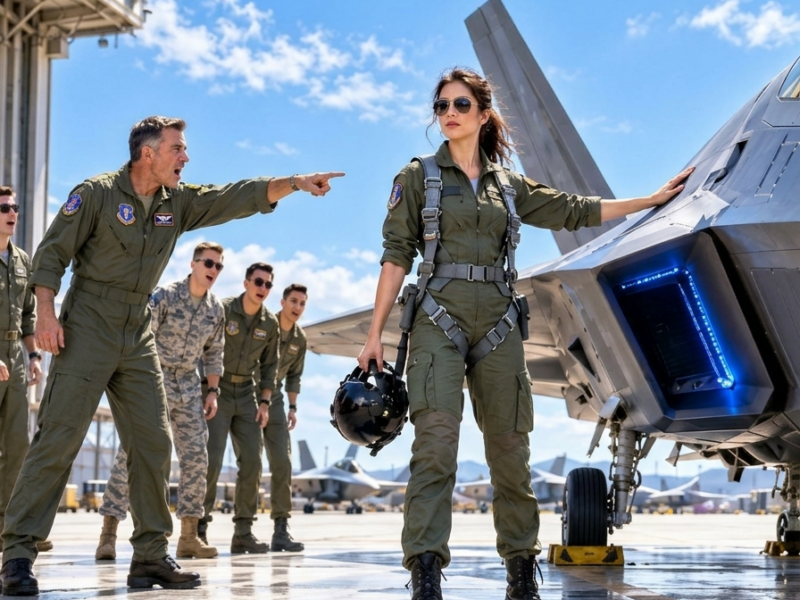
In front of an entire squadron at a military airfield in Texas, a senior fighter pilot sneered at me and said, “That jet is not for women,”
The brutal Texas sun beat down relentlessly on the concrete apron of Redstone Air Base, baking the heat-shimmering tarmac until the air smelled of scorched rubber, ozone, and old JP-8 jet fuel. Wind whipped through the open hangar bays, tugging at the collar of my flight suit while a dozen pilots from the 77th Fighter Squadron formed an informal semicircle, watching me like I was an unwanted intruder who had stumbled onto sacred ground.
Captain Ryan Mitchell stood at the center of the crowd, his arms crossed over a chest adorned with combat ribbons, a cocky smirk plastered across his sun-burned face. He was a veteran lead aviator who carried himself with the effortless, aggressive swagger of a man who believed every inch of sky in North America belonged to him by divine right.
“Ma’am, maintenance processing is on the other side of the hangar,” Mitchell said, his voice dripping with condescending humor. “Unless you’re here to deliver coffee to the flight line, you’re in the wrong zip code. That jet is not for women.”
A few junior officers chuckled behind him, swapping amused glances.
I didn’t blink, nor did I offer him the explosive reaction he was clearly fishing for. My name was Lieutenant Elena Brooks, and I had endured worse from men who routinely mistook self-control for fragility. I had spent seven years in black-budget aerospace laboratories, pulling eighteen-hour shifts in cold, windowless cleanrooms, while half the men laughing in this hangar were still learning how to fly basic formation routes at Randolph.
The jet resting behind Mitchell wasn’t just any F-16. It was a heavily modified block-50 Viper, designated Tail Number 804. Its radar absorbent skin was scarred, dull, and scratched from months of exposure to high-altitude stress testing. It had been grounded for eleven agonizing months, locked inside a black-out maintenance shed after a classified flight-control test ended in a fatal crash off the Gulf Coast.
The pilot who went down with it was my older brother, Major Daniel Brooks.
Mitchell stepped closer, dropping his voice into a conspiratorial undertone, as if he were bestowing a piece of wisdom on an ignorant civilian. “Listen to me, Brooks. Whatever you’re here to prove to the board, this aircraft has already cost the United States Air Force one good man. We don’t need a novelty test pilot turning it into a second funeral.”
Inside my right pocket, my thumb slid over the cold, notched edge of Daniel’s original steel dog tag. The metal was worn smooth at the corners where he used to rub it whenever he was nervous before a night launch.
“You’re right, Captain,” I said, my voice deadpan and icy. “It did cost a good man.”
Mitchell’s smile faltered slightly, caught off guard by the absence of anger in my tone.
I turned my back on him and walked straight toward the aircraft’s ladder. The F-16 sat suspended on its heavy landing gear, looking less like a machine and more like a sleeping, wounded predator.
“Hey! Don’t touch that aircraft!” Mitchell snapped, his boots striking the concrete as he closed the distance between us. “That bird is red-tagged! It’s not cleared for pre-flight, let alone operational power!”
I ignored him. I reached out and pressed my bare palm flat against the cold, tinted glass of the canopy frame.
For three seconds, nothing happened. The hot Texas wind blew a trail of dust across the tarmac, and I heard Mitchell draw a breath to yell for security.
Then, deep within the dark, dormant belly of the fuselage, a heavy pneumatic relay clicked.
CLACK.
A sharp, high-frequency electrical hum surged through the airframe. Inside the dark cockpit, the primary multi-function displays flickered to life in a cascading sequence of pale green and neon amber. The heads-up display glass flared with digital telemetry lines, and the auxiliary power unit spooled up with a soft, hungry whistle that vibrated straight through the soles of my combat boots.
The laughter in the hangar vanished instantly.
Mitchell froze two feet away from me, his jaw slackening as he stared at the illuminated cockpit. “What the hell? How did you… where is the external power cart?”
I kept my palm glued to the glass, watching the diagnostic code scroll across the main display.
PROJECT ARES – SYSTEM STATUS: ONLINE.ENCRYPTION SEQUENCE ALPHA-9 ACCEPTED.
The pilots didn’t understand what they were looking at. They thought it was magic, or a glitch in a broken electrical harness. They didn’t know that three years ago, before the military slapped a Level-5 security classification over the entire program, Daniel and I had spent hundreds of hours in our father’s greasy garage in San Antonio, designing the baseline neural-logic interface for this exact fly-by-wire flight-control system.
The standard military maintenance manual didn’t contain the diagnostic bypass code. Daniel and I had hard-coded a biometric resonance loop directly into the digital flight control computer—a secret diagnostic handshake triggered by a specific pressure sequence applied to the canopy sensor grid. It was an easter egg built by two obsessive young engineers who dreamed of revolutionizing how humans flew fighters.
When Daniel died over the Gulf, the Air Force buried the project, impounded the jet, and erased my name from the flight-test development roster to ensure no civilian contractor could claim intellectual property rights over the military’s top-secret flight architecture.
“Shut it down!” Mitchell shouted, turning toward the stunned chief of maintenance. “Get a crew over here and pull the main breaker now!”
Before any of the mechanics could move, the heavy steel side doors of the main hangar slammed open.
General Thomas Warren stepped into the light, flanked by two armed Air Force Security Forces personnel carrying M4 carbines. Warren was a broad-shouldered, silver-haired officer whose chest looked like a tapestry of modern warfare. He was the commander of the Air Force Test Center, a man who answered only to the Pentagon and whose presence alone was enough to turn senior captains into nervous recruits.
Every pilot in the hangar snapped to rigid attention.
Warren ignored Mitchell completely. He walked straight up to the side of Tail 804, his dark eyes locking onto my face.
“Lieutenant Brooks,” Warren said, his voice raspy and devoid of emotion. “Did the system recognize your bio-metric signature?”
I pulled my hand back from the glass, standing at attention. “No, sir. It recognized the handshake sequence.”
Warren’s jaw tightened.
Mitchell stepped forward, looking wildly between the General and me. “General Warren, sir… what is going on here? Lieutenant Brooks just breached a grounded prototype without clearance! I thought she was assigned to civilian logistics support!”
General Warren turned his head slowly, fixing Mitchell with an icy stare that instantly choked the captain’s indignation.
“Lieutenant Brooks isn’t logistics support, Captain Mitchell,” Warren said coldly. “She was the lead civilian flight-control engineer who built the fly-by-wire software currently sitting inside that airframe. And as of 0600 hours this morning, she has been reactivated to active military status under my direct authority.”
A heavy, breathless silence fell over the hangar. Mitchell’s face drained of color as the pieces fell into place. The men behind him shifted uncomfortably, realizing they had just publicly insulted the lead mind behind the base’s most classified weapons platform.
Warren reached into his inner jacket pocket and pulled out a thick, manila envelope sealed with red tamper-evident tape. He held it out to me.
“There’s something you need to review before your flight evaluation begins, Lieutenant,” Warren whispered.
I took the envelope, my fingers trembling slightly as I broke the seal. Inside was an eight-by-ten glossy photograph.
It showed my brother, Daniel, standing in his flight suit beside Tail 804, smiling broadly under the bright Texas sun. The photo had been taken on the flight line exactly two days before his fatal test flight over the Gulf of Mexico.
I turned the photograph over. On the back, written in sharp, heavy black ink that I recognized as Daniel’s precise, engineer-style handwriting, were six words:
THE CRASH WAS NOT AN ACCIDENT, ELENA.
My breath hitched in my throat. My heart hammered against my ribs like a trapped bird.
“General… where did you get this?” I whispered, my voice shaking. “This wasn’t in the official accident investigation report.”
Warren was about to answer when a young security officer sprinted into the hangar from the administrative corridor, his face pale and slick with sweat. He skidded to a halt beside the General and leaned in, whispering frantically into Warren’s ear.
Warren’s expression hardened into granite. His eyes snapped back to the glowing cockpit displays of Tail 804.
“Lieutenant,” Warren said, his voice dropping into a low, dangerous register. “We have a critical security breach.”
I stared at him. “Sir?”
Warren pointed at the main multi-function display inside the cockpit, where a secondary green telemetry line was flashing wildly in the corner of the screen.
“Someone just initiated a remote override sequence on this aircraft from an off-base terminal,” Warren said. “And the flight computer just accepted a second authorized user.”
The electrical hum inside the cockpit shifted pitched, rising from a low buzz to a high-frequency whine that vibrated through the metal floorboards of the hangar. On the main tactical screen, line after line of encrypted code scrolled automatically, bypassing the base’s local security firewalls as if they were made of damp paper.
“All non-essential personnel, clear the hangar immediately!” General Warren ordered, his voice echoing off the corrugated steel walls like a gunshot.
Mitchell and his squadron stood frozen for half a second before the urgency in the General’s eyes triggered their training. Within ten seconds, the flight line crew and junior pilots were hustled out by the armed guards, leaving only General Warren, myself, and a senior avionics technician named Master Sergeant Miller inside the bay.
Miller rushed up to the nose wheel well with a handheld diagnostic terminal, plugging a heavy fiber-optic cable into the aircraft’s data port.
“General!” Miller yelled over the rising whine of the turbine starter. “The command signal isn’t coming from our ground control station! It’s routing through an encrypted satellite relay bounced off a commercial server in Guadalajara!”
“Can you cut the link?” Warren demanded, stepping up beside the technician.
“Negative, sir!” Miller’s fingers flew across his terminal keyboard, sweat dripping off his chin onto the screen. “The remote terminal is using a master administrative key! It’s rewriting the flight-control firmware in real time! It’s… my God, it’s loading an autonomous flight profile!”
My mind raced. I grabbed the maintenance ladder, scrambled three rungs up the side of the fuselage, and leaned deep into the cockpit. The primary multi-function display was flashing a terrifying sequence of red telemetry prompts:
AUTONOMOUS GUIDANCE: ACTIVE.PRIMARY VECTOR: COORDINATES 27.44 N, 95.12 W.DESTINATION: GULF EXCLUSION ZONE 4.
My stomach dropped into a freefall. Those coordinates were identical to the exact spot in the Gulf of Mexico where Daniel’s F-16 had plunged thirty thousand feet into the ocean eleven months ago.
“Elena!” Warren called out, standing at the base of the ladder. “What is it doing?”
“It’s executing a hard-coded recovery protocol!” I shouted back, my eyes scanning the rapid code deployment. “Someone is trying to trigger the aircraft’s automated ferry mode to fly it out of here remotely! If those engines spool all the way up, the automated throttle will break the tie-down chains and roll this bird right out onto the taxiway!”
“Override it!” Warren ordered. “Use your designer clearance!”
“I can’t overwrite it from the outside!” I yelled, pulling my head out of the canopy. “The remote user has locked out the external service ports! The only way to break the satellite hand-shake is from inside the pit—using the physical manual flight-control stick!”
Warren didn’t hesitate for a single second. He looked me dead in the eye, the weight of a thousand classified directives hanging in the space between us.
“Get in the seat, Lieutenant,” Warren commanded. “Take control of that bird.”
I didn’t need to be told twice. I scrambled up the remaining rungs, dropped heavily into the ACES II ejection seat of Tail 804, and grabbed my helmet from the storage hook beside the canopy frame.
The moment my legs slid into the rudder wells and my thighs hit the seat cushions, a wave of ghostly familiarity washed over me. The cockpit smelled faintly of leather, anti-exposure suit rubber, and the distinct, crisp scent of peppermint—the exact mints Daniel used to chew during long cross-country flights.
I pulled the heavy harness straps over my shoulders, snapping the buckles into the central locking hub with a metallic CLICK. I slapped my flight helmet over my head, pulled the oxygen mask tight across my face, and reached for the right-hand side-stick controller.
The moment my gloved fingers wrapped around the rubber grip, the aircraft’s neural interface registered the physical connection.
A violent surge of electrical feedback rattled through the side-stick, vibrating up my forearm. On the HUD, a glowing red prompt flashed in front of my eyes:
WARNING: MANUAL OVERRIDE CONFLICT.REMOTE USER: ARCH-ANGEL-01.LOCAL USER: BROOKS_E.
ARCH-ANGEL-01.
My heart stopped in my chest.
Archangel-01 wasn’t a code name for an enemy spy or a rogue hacker. It was Daniel’s personal tactical call sign—the designation assigned to his flight helmet during the initial testing phase of Project ARES.
“Daniel…” I whispered into my mask, my knuckles turning white around the flight stick.
Over the cockpit comms channel, buried beneath layers of thick satellite static, a digitized audio stream suddenly clicked open in my headset.
A heavy, synthesized voice rasped through the ear cups, cutting through the scream of the spooled-up jet engine:
“Elena… do not… break the link…”
My hands froze on the throttle quadrant. “Daniel? Is that you? Where are you transmitting from?”
“The file… inside the computer…” the raspy voice static-bled through the frequency. “They didn’t just crash my plane… they downloaded my flight profile… you have to find… the black box file inside Sector 7…”
“Lieutenant!” General Warren’s voice thundered through the hangar’s external comms speaker. “What’s happening? The throttle is advancing! She’s rolling!”
Outside the canopy glass, the heavy steel tie-down chains securing the landing gear to the hangar deck groaned under immense tension. The twin afterburner nozzles at the tail of the F-16 opened wide, unleashing a wave of heat and force that shattered a glass observation window at the rear of the hangar.
The remote command was forcing the aircraft into an unauthorized, automated launch.
“Elena!” Warren yelled, his voice laced with pure panic. “Kill the fuel cutoff valve! That’s an order!”
I looked down at the master fuel shutoff switch on the left console. If I flipped it, the engine would starve, the jet would go dark, and the base security detail would impound Tail 804 forever, burying Daniel’s final transmission inside a Pentagon vault.
I looked back at the HUD display, where the coordinates to the Gulf Exclusion Zone were flashing in neon green text.
“THE CRASH WAS NOT AN ACCIDENT, ELENA.”
I took a deep, ragged breath inside my oxygen mask, grabbed the canopy lower handle, and pulled it shut. The heavy acrylic bubble descended with a pneumatic hiss, locking into place with a vacuum seal that instantly muted the roar of the hangar.
“I’m sorry, General,” I muttered into my chest mic. “I’m taking this evaluation into the air.”
I didn’t kill the fuel.
Instead, I raised my right boot, slammed my heel down onto the manual brake pedal override, and pulled the side-stick hard to the left, engaging the nose-wheel steering.
The F-16 surged forward, snapping the heavy steel tie-down chains like thin plastic threads. The twenty-thousand-pound fighter rocketed out of the dark hangar bay and burst out onto the sun-blinded Texas taxiway, leaving General Warren and his security team standing in a cloud of dust and burnt rubber.
The sky above Redstone Air Base was a sea of endless, pale blue, broken only by thin wisps of high-altitude cirrus clouds.
The moment the main gear retracted into the belly of Tail 804 with a heavy THUD-LATCH, the violent turbulence of the lower atmosphere vanished. The Super Viper sliced through thirty thousand feet of air like a scalpel, its engine roaring in a clean, steady military power setting.
Inside the cockpit, the master caution lights were dark, but the battle inside the flight-control computer was raging out of sight.
The remote satellite feed from Archangel-01 was fighting my manual inputs every inch of the way. Whenever I tried to roll the jet westward toward the safety of the inland military corridor, the fly-by-wire actuators in the wings would fight my stick inputs, nudging the nose back toward heading 135—straight toward the open waters of the Gulf of Mexico.
“Redstone Control to Test-Bird 804,” General Warren’s voice cut through the primary tactical frequency, crisp and cold as dry ice. “Lieutenant Brooks, you are flying an unauthorized aircraft in restricted civilian airspace. Turn back immediately to vector three-six-zero or I will be forced to launch the ready-alert interceptors.”
I adjusted my oxygen flow, keeping my eyes locked on the tactical display screen. “General, with all due respect, if you launch Captain Mitchell’s squad after me, they won’t be able to catch this bird before it reaches the Gulf. You know what this flight control system can do.”
A long, agonizing pause filled the radio channel. I could hear the faint murmur of radar operators shouting in the background at Redstone’s primary flight control center.
“Elena,” Warren’s voice softened slightly, dropping the formal military cadence. “Listen to me carefully. You don’t understand the full scope of what you’re flying into. The Gulf Exclusion Zone isn’t just an accident site. It’s an active black-ops testing range operated by Defense Advanced Research Projects. If you cross the coastline without a cleared transponder code, the automated sea-based AEGIS defense batteries will shoot you out of the sky before you ever see what’s down there.”
“Then give me the transponder code, General!” I demanded, banking the fighter hard to the right as we crossed the coastal flats near Corpus Christi. “My brother didn’t die because of pilot error or a mechanical failure! Someone uploaded a corrupted flight profile to his computer while he was in mid-air! The transmission that just activated this jet came from inside the DARPA network!”
Silence hung on the line for five seconds.
Then Warren sighed—a sound of profound, weary defeat.
“Transponder code for Sector 7 is… Bravo-Seven-Niner-Zero,” Warren said softly. “God help you, Elena. Because if the Pentagon finds out I gave you that code, we’re both going to end up in a federal penitentiary.”
“Thank you, Sir,” I said, punching the four-digit crypto code into the upfront control panel.
Instantly, the master threat display on the glass cockpit shifted from a flashing orange alarm to a steady, green clearance ring. The automated surface-to-air missile batteries guarding the naval exclusion zone stood down, recognizing Tail 804 as a friendly research vessel.
Below my left wing, the golden Texas coastline slipped away, replaced by the vast, glittering expanse of the dark blue Gulf water.
“All right, Daniel,” I whispered, sliding my hand along the right console to open the deep system diagnostic sub-directory. “Show me what you hid inside this bird.”
I bypassed the secondary security encryption using the date of our father’s death—a eight-digit number only Daniel and I knew by heart.
Instantly, a hidden audio and data partition opened on the central multi-function screen. It was an unredacted cockpit voice and flight-data recording, dated November 14th of the previous year—the exact date of Daniel’s fatal crash.
I pressed the playback button on the side-stick.
Daniel’s voice filled my helmet, crystal clear, uncompressed, and entirely free of static:
“Redstone Control, this is Test-Bird 804. Entering Sector 7 at Mach 1.4. Flight-control interface is responding at one-hundred percent efficiency. The neural-logic software is executing flawlessly.”
Then, a second voice entered the recording—a cold, mechanical voice broadcasting from an unknown ground station:
“Test-Bird 804, this is Project Oversight. Commencing secondary stress test. Uploading Override Script Omega.”
On the flight log screen, the telemetry lines plunged into chaos.
“Oversight, what the hell are you doing?” Daniel’s voice cracked with sudden panic on the recording. “My controls are locked! The trim tabs are driving the nose down! I’m in an unrecoverable seventy-degree dive! Disengage! Disengage!”
“Negative, 804,” the mechanical voice replied calmly. “Stress testing human pilot override capacity under fatal flight parameters. Data collection is paramount.”
My blood turned to pure ice inside my veins.
They hadn’t just lost Daniel in an accident. They had deliberately overwritten his controls in mid-flight, turning his aircraft into an unguided missile to test whether their remote black-budget AI script could force a human pilot to pass out under extreme G-forces before recovering the airframe.
It was an unsanctioned, lethal human experiment conducted by someone inside the Pentagon’s black-projects division.
“Elena…” Daniel’s voice rasped on the final seconds of the recording, over the shrieking wail of the master ground-proximity warning system. “If you’re listening to this… they kept a copy of the AI script on the ocean floor platform… don’t let them… bury it…”
A sudden, deafening BEEP-BEEP-BEEP exploded through my helmet speakers.
The radar warning receiver flared wildly on the HUD. Two high-velocity radar locks had just painted my aircraft from behind.
I glanced at the tactical mirror.
Cruising out of the cloud deck ten miles behind me were two matte-black, tail-less stealth fighters—unmarked prototype drones carrying active air-to-air missile loads.
They weren’t trying to intercept me. They were coming to make sure Tail 804 never reached the ocean floor platform alive.
The two stealth drones closed the distance at Mach 2, their sleek, razor-thin fuselages cutting through the thin air like twin shadows. On my tactical display, red hazard rings flashed around both targets, indicating active radar guidance locks.
WARNING: HOSTILE WEAPON LOCK.THREAT VECTOR: 180 DEGREES.
“Elena!” General Warren’s voice crackled through the emergency radio band, thick with heavy atmospheric interference. “Radar is picking up two unidentified high-speed contacts converging on your tail! They aren’t standard Air Force assets! Get out of there! Break west toward the mainland!”
“Negative, General!” I yelled, pulling the side-stick back into my chest as I shoved the throttle quadrant past the military power detent into full afterburner.
The twin Pratt & Whitney engines roared behind me, dumping raw jet fuel into the exhaust tailpipe. Tail 804 surged forward with violent force, pinning my body back against the ejection seat cushions with five times the force of gravity.
“I have the flight recorder file!” I shouted over the rushing roar of the slipstream. “They murdered Daniel! They deliberately locked his controls during a high-G test to measure the AI’s autonomous recovery limits!”
A long, heavy breath sounded over the comms. When Warren spoke again, his voice was choked with a mix of fury and terror. “Jesus Christ… it was Project ARES… the rogue DARPA sub-contractors…”
Before he could finish his sentence, the radar warning receiver let out a high-pitched, continuous shrieking tone.
MISSILE LAUNCH. MISSILE LAUNCH.
Two white smoke trails erupted from the belly bays of the lead drone, streaking toward my tail at four times the speed of sound.
I didn’t have weapons. Tail 804 was a clean test airframe—no sidewinders on the wingtips, no radar-guided missiles under the pylons, and no ammunition loaded into the internal twenty-millimeter Vulcan cannon. All I had was twenty thousand pounds of thrust, a set of experimental flight-control flaps, and the software Daniel and I had written in a greasy garage six years ago.
“Let’s see how smart your AI really is,” I growled into my oxygen mask.
Instead of diving away or throwing out chaff flares, I did the unthinkable. I slammed the airbrakes open, pulled the side-stick back to the far left corner, and stomped hard on the right rudder pedal.
In a conventional F-16, this maneuver would have caused an immediate aerodynamic stall, spinning the jet into an unrecoverable flat spin that would have torn the wings clean off the fuselage.
But Tail 804 wasn’t a conventional jet.
The experimental neural-logic interface I had designed recognized the extreme control input. In less than three milliseconds, the computer executed over two thousand micro-adjustments to the wing leading-edge flaps and tail elevons, forcing the fighter into a violent Cobra maneuver.
The nose of the Super Viper pitched straight up ninety degrees while the airframe continued sliding forward along its original flight path.
The two incoming heat-seeking missiles, expecting a linear evasive target, overshot my belly by less than twenty feet, detonating harmlessly in the empty sky two miles ahead of me.
The sudden deceleration dropped my airspeed from seven hundred knots to less than one hundred in three seconds. The lead stealth drone, flying at Mach 2, couldn’t react in time. It screamed past my canopy so close I could see the metallic reflection of the Texas sun glinting off its unmanned composite nose cone.
“My turn,” I whispered.
I dumped the airbrakes, shoved the throttle back into full afterburner, and dropped the nose of Tail 804 directly behind the lead drone.
I didn’t have cannon rounds to fire at him, but I didn’t need them.
I engaged the secondary function of our experimental flight-control software: the high-yield directional electromagnetic pulse transmitter mounted inside the nose radome—a system originally designed to jam enemy surface-to-air missile guidance systems.
I lined up the optical sight crosshairs on the HUD with the center mass of the lead drone’s engine intake.
TARGET LOCKED.ENGAGING DIRECTED EMP.
I slapped the red weapon-release button on the flight stick.
An invisible wave of high-density electromagnetic energy erupted from the nose of my fighter, striking the lead drone squarely in its main avionics bay.
The stealth drone’s flight-control computers instantly fried. Its control surfaces went limp, its engine spooled down into a dead stall, and the ten-ton unmanned aircraft tumbled out of the sky like a thrown brick, plunging headfirst into the dark ocean waters five miles below.
The second drone, recognizing the immediate destruction of its wingman, immediately broke off its attack vector, banking hard toward the south and diving into a bank of heavy storm clouds to escape the EMP envelope.
I sat in the cockpit, my breath coming in short, ragged gasps as my heart hammered against my ribs. My flight suit was soaked through with sweat, and my hands were trembling against the rubber grip of the stick.
On the tactical display screen, a glowing yellow marker flashed over the ocean surface three miles ahead.
It was a semi-submersible oceanic research barge—unmarked, unflagged, and anchored directly over the deep-water trench where Daniel’s jet had crashed eleven months ago.
“General Warren,” I called into the comms, my voice cold, steady, and filled with a quiet, lethal promise. “I’m hovering over the DARPA research platform right now. And I’m downloading their entire server database to your station before they can pull the plug.”
The final descent of Tail 804 over Redstone Air Base was a sight that nobody who stood on the flight line that afternoon would ever forget.
The sun was sinking low over the western horizon, painting the Texas sky in deep shades of burnt orange, purple, and gold. The Super Viper glided through the cool evening air, its engine spooled down to a quiet, rhythmic whistle as its main landing gear touched the concrete tarmac with a puff of white rubber smoke.
The aircraft rolled smoothly down the runway, turning onto the taxiway leading back to the main maintenance hangar.
Waiting on the apron was half the base.
Dozens of fire trucks, military police vehicles, and staff cars stood with their emergency lights flashing, casting red and blue strobes across the concrete. Standing near the center of the crowd was General Thomas Warren, flanked by three federal agents in dark suits from the Department of Defense Inspector General’s office.
Beside them stood Captain Ryan Mitchell, his face pale, his arms hanging awkwardly at his sides as he stared at the returning fighter jet as if looking at a ghost returning from the dead.
I taxied Tail 804 directly into the center of the apron, cut the fuel flow, and brought the twin Pratt & Whitney engines to a complete, final shutdown.
The electrical hum inside the cockpit faded away. The multi-function displays went dark, line by line, until only the small green standby light on the main flight-control computer remained illuminated.
I popped the canopy latch, letting the heavy acrylic glass bubble slide upward. The cool, dry evening Texas breeze rushed into the cockpit, carrying the scent of wild sage and damp earth.
I unclipped my helmet, pulled my oxygen mask down, and took a long, deep breath of the open air.
Master Sergeant Miller rushed up the boarding ladder, dropping a heavy maintenance step into place. As I climbed down from the cockpit, my boots hit the concrete with a solid, echoing thud.
General Warren walked up to me, stopping two feet away. He looked at my face, then down at the small USB storage drive I was clutching tightly in my right hand—the drive containing the complete, unredacted telemetry logs from the ocean barge platform, proving the black-budget AI conspiracy that had cost my brother his life.
Warren didn’t issue an arrest order. He didn’t mention court-martials, stolen aircraft, or broken airspace regulations.
Instead, the silver-haired General stood at rigid attention and offered me a crisp, slow, formal salute.
“Outstanding flying, Lieutenant Brooks,” Warren said, his voice thick with a emotion he didn’t try to hide. “Your brother would have been damn proud of you today.”
I returned the salute, my chin held high, my eyes clear and unblinking. “Thank you, General. The data is secure. The truth is coming out.”
The three federal agents stepped forward, taking the storage drive from my hand with meticulous care, securing it inside a tamper-evident evidence bag before turning toward their staff car to initiate the federal warrants that would dismantle the rogue DARPA program before the night was over.
Captain Mitchell stepped out from the crowd of silent pilots, walking slowly toward me. The arrogant, condescending swagger that had defined his posture five hours ago was completely gone, replaced by an expression of profound, quiet humility.
He looked at me, then up at the dark, silent silhouette of Tail 804 resting on the tarmac behind me.
“Lieutenant Brooks…” Mitchell began, his voice raspy and hesitant. “I… I didn’t know. About your brother. About what you built.”
He paused, swallowing hard as he looked down at his own flight helmet held beneath his arm.
“I was wrong,” Mitchell said quietly, meeting my eyes. “That jet… it wasn’t made for just anyone. It was made for you.”
I looked at him for a long moment, feeling the cold weight of Daniel’s dog tag inside my pocket. The anger that had burned inside my chest for eleven months didn’t disappear, but it shifted—transforming from a jagged, painful wound into a quiet, enduring strength.
“The jet isn’t mine, Captain,” I said softly, looking up at the first evening stars appearing in the darkening Texas sky. “It belongs to the people who aren’t afraid to push past the lies to find the truth.”
I turned and walked away from the flight line, my boots clicking rhythmically against the tarmac as the night air settled over Redstone Air Base. Behind me, the standing lights of the airfield clicked on, illuminating Tail 804 in a brilliant halo of white light.
The aircraft sat quiet, peaceful, and unbroken, its long shadow stretching across the concrete into the dusk. The war inside its circuits was over, the ghosts had been laid to rest, and for the first time in a very long time, the sky finally felt clean again.
The end.









