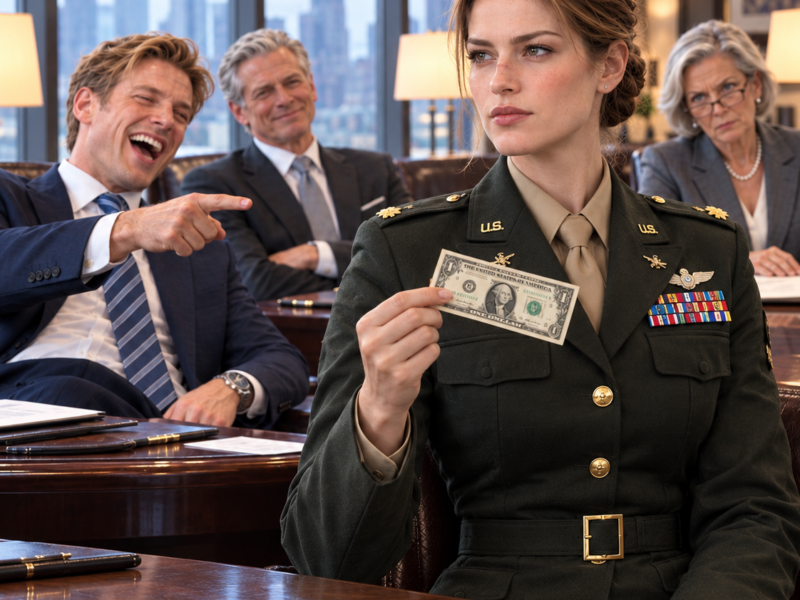
“I watched three Marines laugh when my grandfather left a two-dollar bill on the counter of a bank he’d trusted for forty years
The name on the first page was Captain Michael Reeves.
My father’s name.
For a moment, I forgot how to breathe.
Danielle stood beside me, staring at the folder as if the paper might disappear if she blinked.
“That’s my dad,” she whispered.
Bank President Whitmore closed the office door.
“I know,” he said quietly. “And I’m sorry it took us this long to bring you here.”
Grandpa Walter didn’t sit down.
He remained beside the window, his hands clasped behind his back, looking out over downtown Jacksonville.
“Tell them,” he said.
Whitmore opened the folder.
“Fifteen years ago, Captain Reeves deposited something with this bank. Something he believed would protect his family if he never came home.”
Danielle looked at him.
“My father didn’t have money. My mom worked two jobs after he died. We lost our house.”
“I know,” Whitmore replied. “That’s why this is going to be difficult to explain.”
He turned the first page toward us.
Under my father’s name was a number.
$2,400,000.
Danielle stepped backward.
“No.”
Her voice was barely audible.
“That can’t be right.”
Whitmore didn’t look away.
“It’s not a debt your family owes. It’s money that belongs to your family.”
I stared at the number.
Two million, four hundred thousand dollars.
My grandfather had handed a young Marine a two-dollar bill in a diner, and somehow it had led us to a bank account worth more than most people would earn in several lifetimes.
“What is this?” I demanded.
Whitmore folded his hands.
“Before I explain the money, I need to tell you what your father did.”
Danielle’s eyes filled with tears.
“Then tell me.”
Whitmore glanced at Grandpa.
Walter finally turned from the window.
“Your father saved my life,” he said.
The room went still.
I looked at him.
“You told me Dad died in a training accident.”
“He did,” Grandpa said. “But that wasn’t the whole story.”
He pulled out a chair and lowered himself into it.
For the first time that morning, he looked old.
Not like the tough retired Marine who still woke before sunrise and polished his boots every Sunday.
He looked like a man who had carried something heavy for fifteen years and had finally run out of strength to hold it alone.
“Michael and I served together before he married your mother,” he began. “We were assigned to a logistics unit supporting operations overseas. Our job was to move equipment, track shipments, and make sure everything arrived where it was supposed to.”
I knew pieces of that story.
Grandpa had mentioned my father’s service, but never the details.
“He discovered that equipment was being diverted,” Grandpa continued. “Not ordinary supplies. Communications gear, protective systems, things that were supposed to reach American units.”
“Stolen?” I asked.
“Worse. Sold.”
Whitmore slid another document across the desk.
It contained a series of transactions, dates, and company names.
Some were listed as contractors.
Others were unfamiliar shell companies.
“Captain Reeves documented the transfers,” Whitmore explained. “He found evidence that a small group of people had been using military procurement contracts to move equipment and money through private companies.”
Danielle shook her head.
“My father was a supply officer.”
“He was also meticulous,” Grandpa said. “He kept copies of everything. Receipts, shipment records, authorization forms. He noticed discrepancies other people ignored.”
“Why didn’t he report it?” I asked.
“He did.”
Grandpa’s voice cracked on the last word.
“He reported it through the proper channels. The investigation began, and then someone warned him to stop.”
Danielle covered her mouth.
Whitmore turned another page.
“There was a second part to what Captain Reeves discovered. Some of the money was being routed through legitimate financial institutions. This bank was one of them.”
“So the bank was involved?” I asked.
“Some employees were,” Whitmore said. “Not the institution as a whole. The people responsible used accounts opened under false business names. When the suspicious transfers were identified, the bank froze the remaining funds and notified federal investigators.”
He paused.
“Your father helped identify where the money had gone.”
I looked at the figure again.
“Then why is it in his name?”
“Because he was promised compensation for the information and the personal losses he suffered while cooperating with the investigation. But he refused to accept it while the case was open.”
Grandpa nodded.
“He said the money wasn’t the point. He wanted the people responsible stopped.”
“Was he paid?” Danielle asked.
“No,” Whitmore answered. “Not while he was alive.”
The room seemed to tilt.
“What do you mean?” she whispered.
Whitmore took a breath.
“Captain Reeves was killed before the investigation was completed. His death was officially classified as an accident. The case was suspended, and the money remained frozen.”
Danielle gripped the edge of the desk.
“You’re saying my father was murdered?”
“I’m saying I don’t know that,” Whitmore replied carefully. “I won’t tell you something I can’t prove. But the circumstances surrounding his death were never fully resolved.”
Grandpa stared at the floor.
I turned toward him.
“You knew?”
He didn’t answer immediately.
“Not everything.”
“That’s not what I asked.”
“I knew Michael was frightened. I knew he thought someone was watching him. I knew he had made copies of his evidence and arranged for them to be kept somewhere safe.”
“Where?”
Grandpa reached into his jacket and removed a small, worn envelope.
“Here.”
He placed it on the desk.
The envelope had my father’s handwriting on the front.
WALTER — IF I DON’T MAKE IT HOME.
Danielle began to cry.
I couldn’t move.
I had seen my father’s handwriting in birthday cards, old photographs, and the notes he used to leave on the refrigerator.
Seeing it now felt like hearing his voice from another room.
Grandpa pushed the envelope toward Danielle.
“It belongs to you.”
She didn’t take it.
“Why did you wait fifteen years?”
The question came out sharper than anything she had said before.
Grandpa lowered his eyes.
“Because I was a coward.”
“Walter,” Whitmore said gently.
“No,” Grandpa interrupted. “She deserves the truth.”
He looked directly at Danielle.
“After Michael died, I wanted to believe the accident report. I wanted to believe there was nothing more to it. His wife was grieving. You were a little girl. Claire was grieving too. I thought if I stayed quiet, I could keep everyone from being dragged into something dangerous.”
“You decided that for us?” I asked.
“Yes.”
“And you let us believe there was nothing else?”
“Yes.”
My voice rose.
“You watched Danielle grow up thinking her father left her with nothing. You watched my mother struggle to pay bills. You let me think my father’s death was just another tragedy we couldn’t change.”
Grandpa’s eyes shone.
“I know.”
“No, you don’t.”
I stood so quickly my chair scraped against the floor.
“You don’t get to call it protection just because you were afraid.”
He absorbed the words without defending himself.
That somehow made me angrier.
Danielle finally picked up the envelope.
Her fingers trembled as she opened it.
Inside was a folded letter and a small brass key.
She unfolded the letter.
The first line made her knees weaken.
MY DARLING GIRL,
IF YOU ARE READING THIS, I DIDN’T GET THE CHANCE TO TELL YOU SOMETHING IMPORTANT.
She pressed the letter to her chest.
“Can I read it?” I asked softly.
She nodded.
I read it aloud.
“Danielle, if you’re old enough to understand these words, then you’re old enough to know that your father loved you more than anything. Nothing I did was meant to make you rich. Nothing I risked was worth missing your childhood. But if something happens to me, I need you to know that I tried to leave you something better than money.”
My throat tightened.
“There’s a record of what I found. Walter knows where the original documents are. He has promised to keep them safe until the people responsible can no longer hurt anyone.”
I looked at Grandpa.
He had gone pale.
I continued.
“The key is for a storage box. Do not open it alone. Take it to Walter when the time is right. He will know what to do.”
The letter ended with three words.
I LOVE YOU.
Danielle took it from my hands and held it against her face.
For several seconds, nobody spoke.
Then she looked at Grandpa.
“What storage box?”
Grandpa closed his eyes.
“I have it.”
“Where?”
“At home.”
“Then we’re going.”
He stood slowly.
“There’s something else you need to know first.”
I had reached the limit of my patience.
“What else?”
“Michael didn’t leave the money for himself. He arranged for it to be held until you turned twenty-five.”
Danielle stared at him.
“I’m twenty-two.”
“I know.”
“Then why did you bring me here now?”
Grandpa looked toward Whitmore.
The bank president opened a second folder.
“Because someone contacted the bank three weeks ago asking about Captain Reeves’s account.”
My stomach tightened.
“Who?”
“We don’t know their identity. The inquiry came through a law firm representing a private investment company. They claimed the account had been improperly assigned and requested access to the original records.”
“Could they get the money?” Danielle asked.
“Not without establishing a legal claim. But they knew details that were never made public.”
Grandpa’s jaw tightened.
“They knew about Michael’s account.”
Whitmore nodded.
“And they knew the two-dollar bill was connected to it.”
I looked down at the bill.
It was still lying on the desk, its edges soft from years of handling.
“That’s why you gave it to her,” I said.
Grandpa nodded.
“Michael and I agreed on a signal. If I ever brought that bill to the bank with his daughter, it meant the old protection was no longer enough. It meant she needed to know everything.”
Danielle looked at the bill.
“What does it have to do with me?”
“Your father wrote a code on it,” Grandpa explained. “A number that identifies the original storage box. The bank kept a copy of the number in its sealed records.”
Whitmore turned the bill over.
On the back, beneath the handwriting we had already noticed, was a faint series of digits.
I leaned closer.
They were almost invisible.
“Why didn’t you tell us this at the diner?” I asked.
“Because I didn’t know who might be watching.”
The answer made the room feel colder.
Whitmore gathered the documents.
“I recommend we contact the authorities before anyone leaves with the original records.”
Grandpa shook his head.
“Not yet.”
“Walter, we’ve waited fifteen years.”
“And that’s exactly why we don’t make a careless move now.”
Whitmore looked at Danielle.
“The decision is yours. But if someone has started looking for these records, you should understand that opening the storage box may change everything.”
Danielle wiped her cheeks.
“My father left it for me. I’m opening it.”
I nodded.
“Then I’m coming with you.”
Grandpa looked at me.
“So am I.”
We left the bank through a side entrance.
Whitmore insisted on arranging a security escort, but Grandpa refused.
He said he knew the way home.
I didn’t argue.
I was too busy watching every car that followed us.
The storage box was in Grandpa’s garage, behind an old metal cabinet filled with tools and military keepsakes.
He moved the cabinet aside and unlocked a narrow door in the wall.
Inside sat a small steel safe.
It looked older than I was.
Grandpa took the brass key from Danielle and inserted it into the lock.
It turned with a dry click.
He opened the door.
There were three things inside.
A thick envelope.
A black notebook.
And a photograph.
Danielle reached for the photograph first.
It showed her father standing beside Grandpa in front of a transport aircraft.
They were both younger, smiling at the camera.
On the back, someone had written:
TWO BROTHERS. ONE PROMISE.
Danielle stared at the words.
“Were you really that close?”
Grandpa swallowed.
“He was the brother I chose.”
She put the photograph down carefully.
I picked up the notebook.
Its pages were filled with dates, names, account numbers, and handwritten notes.
Some entries had been crossed out.
Others were marked with red circles.
At the bottom of one page was a name I recognized.
Daniel R. Whitmore.
I looked at Grandpa.
“Why is the bank president in here?”
Grandpa took the notebook from me.
“Because he helped your father.”
“That doesn’t explain why his name is written next to these transactions.”
“He was a junior compliance officer at the time,” Grandpa said. “He helped identify the suspicious accounts.”
I turned another page.
A name appeared again and again.
Elliot Vance.
Under it were several company names and a handwritten note:
DO NOT TRUST THE REPORT.
I recognized the name.
Elliot Vance had become a well-known defense contractor. His company held federal contracts and sponsored military charities. I’d seen his face in news articles and recruitment advertisements.
“He’s still in business,” I said.
Grandpa nodded.
“And he was the man Michael believed was behind the operation.”
Danielle opened the thick envelope.
Inside were copies of financial records, photographs of shipping documents, and a sealed letter.
The letter was addressed to a federal investigator.
There was also a small flash drive.
“What’s on it?” I asked.
“Copies of the original evidence,” Grandpa said.
“Then why didn’t you give it to investigators?”
He looked at me.
“Because the last time Michael tried, someone inside the investigation leaked his identity.”
I felt my anger returning.
“You kept evidence of a crime in your garage for fifteen years?”
“I kept it because I didn’t know who I could trust.”
“You could have trusted the law.”
“I thought I had.”
His voice was quiet.
“I was wrong.”
Danielle held up the sealed letter.
“Who is this addressed to?”
Grandpa read the name.
His expression changed.
“Special Agent Rebecca Lawson.”
“Is she still with the government?” I asked.
“She was when Michael wrote this.”
I took out my phone.
“I’ll find out.”
Grandpa put a hand over it.
“Not from your personal number.”
I stared at him.
He released my wrist.
“I’m sorry. I know how this sounds.”
“It sounds like you expect us to live in hiding because of something that happened fifteen years ago.”
“I expect you to be careful because someone has already started asking questions.”
Danielle looked from him to me.
“I don’t want to spend another day being afraid of a secret I don’t understand.”
She picked up the flash drive.
“We’re taking this to the authorities.”
Grandpa nodded slowly.
“Then we do it properly.”
The next morning, we met with Whitmore at the bank.
He had arranged a secure meeting with the bank’s legal counsel and a federal investigator whose credentials he verified through an independent channel.
The investigator was a woman in her late fifties with short gray hair and a calm, direct manner.
Her name was Special Agent Rebecca Lawson.
When she saw the letter, she stopped moving.
“I haven’t seen Michael Reeves’s handwriting in fifteen years,” she said.
Danielle stood.
“You knew my father?”
Lawson nodded.
“I was assigned to the financial investigation. Your father was one of the most important witnesses we had.”
“Then why did you let everyone believe his death was an accident?”
The agent’s expression tightened.
“We didn’t know enough to challenge the official finding. We suspected interference, but the evidence disappeared before we could establish who was responsible.”
Grandpa placed the notebook on the table.
“Not all of it.”
Lawson opened it.
She studied the entries for several minutes.
Then she looked up.
“Where did you get this?”
“Michael gave it to me.”
“Why wasn’t it submitted?”
Grandpa didn’t look away.
“Because I was afraid the wrong people would see it.”
Lawson closed the notebook.
“I understand fear. But evidence hidden for fifteen years is evidence that can no longer protect anyone.”
“I know that now.”
She turned to Danielle.
“Your father believed the records could expose a network that was moving money through defense contractors. He also believed someone had access to confidential investigative information.”
“Was he right?”
“We found signs that he was.”
She examined the flash drive.
“We’ll need to authenticate everything. We can’t promise what it will prove.”
Danielle nodded.
“I don’t need promises. I need the truth.”
Lawson looked at her for a long moment.
“That’s what your father wanted too.”
The investigation began quietly.
For the next several weeks, Danielle and I were interviewed repeatedly.
We gave investigators the notebook, the storage box, the original letter, and the two-dollar bill.
The bank preserved its records and provided the documentation supporting the account.
The money was not immediately released.
It was placed under a legal hold while investigators confirmed the source of the funds and the identity of the rightful beneficiary.
Danielle didn’t complain.
She said she had spent fifteen years without answers.
She could wait a little longer for the truth.
Then, one Thursday evening, my phone rang.
It was Agent Lawson.
“I need you and Danielle to come in tomorrow morning,” she said.
“Did something happen?”
“We identified the person who requested access to the account.”
“Who?”
“Elliot Vance.”
My grip tightened around the phone.
“What did he want?”
“To establish that the funds belonged to one of his companies. His attorney submitted a claim arguing that Captain Reeves had obtained the money through an unauthorized transfer.”
“That’s ridiculous.”
“We believe it is. But the claim gave us a reason to reopen the financial investigation.”
“What else?”
There was a pause.
“We also found a connection between Vance and the officer who signed the original accident report.”
I looked across the kitchen.
Danielle was sitting at the table, reading her father’s letter for what must have been the hundredth time.
“Was my father’s death connected to him?” I asked.
“We’re looking into it.”
The next morning, we learned the truth was worse than we expected.
The officer who had signed the report was no longer in the military. He had later worked as a security consultant for one of Vance’s companies.
A payment record showed that his consulting firm had received money shortly after my father’s death.
It wasn’t proof of murder.
But it was enough to establish that the official investigation had overlooked a serious conflict of interest.
Lawson showed us a second document.
It was a message recovered from an archived company server.
The sender’s name was hidden behind an internal account number.
The message read:
REEVES HAS COPIES. THE WITNESS MUST BE SILENCED BEFORE THE REVIEW.
Danielle went white.
“That’s about my father.”
Lawson nodded.
“We believe so.”
I felt the room narrow around me.
“Who sent it?”
“We’re still working on that.”
Grandpa sat motionless.
His hands were folded on the table.
I had never seen him look so defeated.
“Walter,” Lawson said, “did Michael tell you he was in immediate danger?”
Grandpa nodded.
“He called me two nights before the accident. He said someone had followed him from the base.”
“Why didn’t you report that?”
“I told him to come home. I said I’d help him get the evidence to the right people.”
“And?”
“He said he had already arranged to meet someone.”
“Who?”
Grandpa looked at Danielle.
“I don’t know.”
Lawson leaned forward.
“Walter, this is important.”
“I know.”
He rubbed his forehead.
“Michael said he had a source inside Vance’s company. Someone who was willing to testify.”
“Did he give you a name?”
“No.”
“Did he tell you where they were meeting?”
Grandpa hesitated.
Then he looked at me.
“There was a place. A diner off Highway 17. He said if anything happened, I should look for a waitress named June.”
Lawson wrote it down.
“Why didn’t you tell me this before?”
“Because I thought the meeting was a dead end. Michael never told me whether he made it.”
Danielle’s voice trembled.
“You knew he might have been in danger, and you still let us think it was an accident?”
Grandpa lowered his head.
“I thought if I told you, you’d spend your lives waiting for someone to come after you.”
“Instead, I spent my life wondering why he never came home.”
He closed his eyes.
“I know.”
For the first time, I saw Danielle’s anger soften into something more painful.
Not forgiveness.
Grief.
Agent Lawson sent investigators to the diner.
June was still alive.
She was seventy-three now and living in a small house outside Wilmington.
When they showed her the photograph of my father, she began to cry.
She remembered him.
She remembered the night he came in wearing his uniform and carrying a brown folder.
And she remembered the man who followed him.
June told investigators that my father had met a company accountant named Peter Lang.
Lang had discovered that Vance’s company was falsifying equipment invoices and routing money through overseas accounts.
He had agreed to testify.
But the meeting never happened.
June had seen a dark sedan parked across the road.
A man got out and entered the diner.
He asked for Michael by name.
My father left through the kitchen door.
The next day, his vehicle was found after the crash that killed him.
June had never told anyone because the man who approached her afterward had threatened her family.
Lawson asked if she could identify him.
June studied several photographs.
Then she pointed to one.
It was a former security director for Vance’s company.
His name was Robert Hale.
Investigators found Hale living in another state.
He had retired years earlier, but his financial records showed payments from companies linked to Vance.
When agents questioned him, he denied knowing my father.
Then they showed him the diner photograph.
He asked for a lawyer.
That was when the investigation changed.
The financial records, the notebook, June’s testimony, and the archived messages began to fit together.
Hale had been involved in intimidating witnesses.
The former officer who signed the accident report had concealed evidence.
And Vance’s company had received millions in payments connected to fraudulent contracts.
The government filed charges.
Vance publicly denied everything.
His attorneys called the investigation a politically motivated attack.
But the evidence was no longer hidden in a garage.
It was in the hands of investigators.
Three months later, Danielle received a call from the bank.
The legal hold had been lifted.
The original account had been authenticated.
The money belonged to her.
All $2.4 million.
When she walked into Whitmore’s office, he placed a document in front of her.
“Your father wanted this to be released when you turned twenty-five,” he explained. “But the account was never intended to be a prize for reaching a particular birthday. It was intended to provide for your future.”
Danielle read the document carefully.
“Why did he put it in my name?”
“Because he wanted you to have choices,” Whitmore said. “He wanted you to be able to study, buy a home, or build a life without being trapped by the circumstances that followed his death.”
She looked at the signature.
Michael Reeves.
For a long time, she said nothing.
Then she asked Whitmore for a pen.
She signed.
But she didn’t celebrate.
She folded the paperwork and placed it in her bag.
Outside the bank, she stood beside me on the sidewalk.
“I thought finding out about the money would make me feel different,” she said.
“Does it?”
She shook her head.
“I’d give every dollar back to have one more afternoon with him.”
I put my arm around her.
“I know.”
She looked at the two-dollar bill.
Grandpa had insisted she keep it.
It was now protected in a clear sleeve, with the faint code still visible on the back.
“I think I’ll use the money to start something,” she said.
“What?”
“A scholarship. For military families who lose someone while serving. Not just tuition. Emergency bills, rent, childcare. The things people need when the world falls apart and everyone expects them to be strong.”
I smiled.
“Your father would be proud.”
She looked down at the bill.
“I hope so.”
The legal case took another year.
Robert Hale eventually agreed to cooperate.
The former officer who had signed the accident report was charged with obstruction and falsifying records.
Elliot Vance was indicted on multiple federal counts related to fraud, conspiracy, and witness intimidation.
The government never established beyond a reasonable doubt that Vance had ordered my father’s death.
That question remained unresolved.
But the official accident report was reopened, and investigators formally acknowledged that critical evidence had been withheld.
For Danielle, that mattered.
Her father was no longer remembered only as a young officer who died in a vehicle accident.
He was remembered as a man who discovered wrongdoing, documented it, and tried to protect the people who depended on him.
Grandpa attended the first hearing.
He sat beside Danielle, wearing his old Marine dress uniform.
When the prosecutor asked him why he had kept the evidence, he didn’t make excuses.
“I was afraid,” he said. “And my fear cost this family fifteen years of answers.”
After the hearing, Danielle walked with him to the parking lot.
She stopped beside his car.
“I don’t know if I can forgive you yet,” she said.
Grandpa nodded.
“You don’t have to.”
“But I don’t want you to disappear from my life either.”
His eyes filled.
“I won’t.”
She took his hand.
It was a small gesture.
But I knew what it cost her.
That evening, we went back to the diner where everything had started.
The same waitress who had watched Grandpa hand Danielle the two-dollar bill was working.
She recognized us immediately.
“Well,” she said, setting down three cups of coffee, “I guess that little bill caused quite a day.”
Grandpa smiled faintly.
“It did.”
Danielle took the bill from her purse and placed it on the table.
“I used to think my father left me nothing,” she said.
She looked at Grandpa.
“Then I thought he left me money.”
Finally, she looked at me.
“But he left me people who remembered him. People who were willing to tell the truth, even when it hurt.”
Grandpa stared at his coffee.
“I should have told you sooner.”
“Yes,” Danielle said. “You should have.”
He nodded.
She reached across the table and touched his hand.
“Don’t waste the time we have left.”
He covered her fingers with his own.
“I won’t.”
A few weeks later, Danielle invited me to the first meeting of the Michael Reeves Memorial Fund.
The office was small, with two desks, a printer that jammed every few pages, and a framed photograph of her father on the wall.
Under the photograph was a simple inscription:
COURAGE IS TELLING THE TRUTH WHEN SILENCE WOULD BE EASIER.
She had chosen it herself.
The first scholarship went to the daughter of a Marine mechanic who had died unexpectedly.
The second helped a Navy widow keep her home while she completed nursing school.
Danielle refused to put her own name on the building.
She said the money had never been hers in the way people thought.
It was her father’s promise, finally being kept.
On the anniversary of his death, we visited his grave.
Grandpa brought flowers.
I brought the photograph from the storage box.
Danielle brought the two-dollar bill.
She knelt and placed her hand on the stone.
“I’m twenty-five now, Dad,” she whispered. “I got your letter. I found the money. I found out what happened. And I’m going to make sure what you did matters.”
The wind moved through the trees.
For a moment, none of us spoke.
Then Grandpa stepped forward.
“Michael,” he said quietly, “I kept the promise. But I should have trusted your family with the truth.”
He stood there with his head bowed.
I watched him, remembering the man who had handed over that bill in the diner.
At the time, I thought he was giving away two dollars.
Now I understood.
He had been giving Danielle back a part of her father.
And perhaps, in a way, he had been trying to give himself one last chance to become the man Michael had trusted.
As we walked back to the car, Danielle slipped the bill into its protective sleeve.
“Do you think he knew we’d find it?” she asked.
“I think he hoped you would.”
She looked at the faded handwriting on the back.
Then she smiled through her tears.
“For fifteen years, everybody thought Grandpa had given away two dollars.”
She held the bill carefully between her fingers.
“But he was carrying a whole life in his pocket.”
And for the first time since I could remember, the story of my father’s death no longer ended with an unanswered question.
It ended with the truth.
Not every part of it.
Not every answer we wanted.
But enough to let us stop living inside the silence.
Enough to let Danielle know that her father had never forgotten her.
And enough to remind all of us that sometimes the most valuable thing a person can leave behind isn’t money, property, or a name.
It’s a promise someone else is brave enough to finish.
The end.









