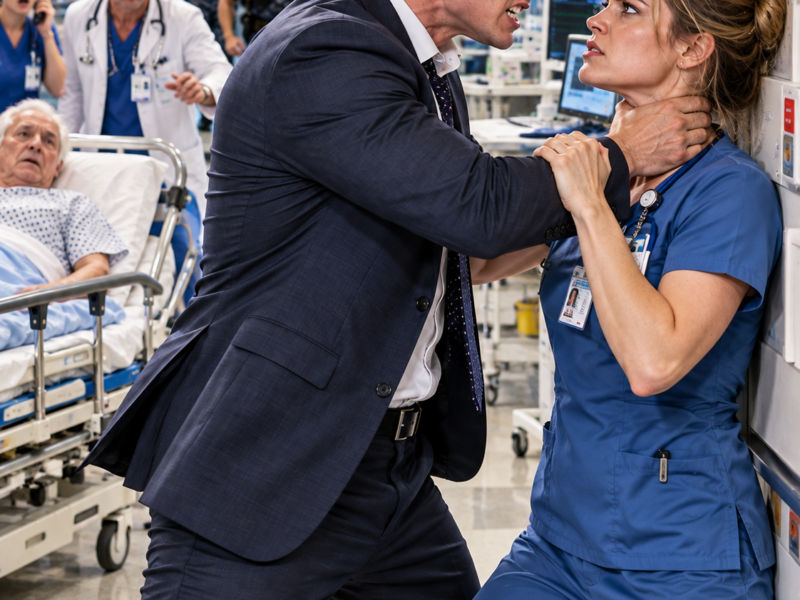
“I watched the hospital CEO’s son grab me by the throat in front of a crowded emergency department and sneer, ‘I OWN this hospital, and you’re nothing,’
The commander’s eyes stayed on the envelope as he withdrew a single sheet of paper.
“Petty Officer First Class Daniel Hayes,” he read aloud.
My hands went cold.
For three years, I’d trained myself not to react when I heard that name.
I’d learned to keep my face still when someone mentioned Afghanistan, to change the subject when a conversation drifted toward the Navy, and to sleep through the occasional nightmare without calling anyone afterward.
But hearing Daniel’s name inside Harbor Point Medical Center, with Brandon Whitmore standing only a few feet away, brought everything back.
The dust.
The gunfire.
The radio cutting out.
And the last promise I’d made to a man who knew he might not make it home.
“Commander,” I whispered, “where did you get that?”
Commander James Callahan folded the paper.
“From a Navy investigation that was reopened six days ago.”
Brandon finally released my scrub top completely.
He looked from Callahan to the female officer, then back at me.
“Can somebody explain what’s happening? I was assaulted by an employee, and now military officers are barging into my hospital.”
The female officer turned toward him.
“You assaulted a nurse in a crowded emergency department. There are at least twelve witnesses.”
Brandon scoffed.
“She provoked me.”
I touched the side of my neck.
The skin was already tender beneath my fingertips.
“That’s an interesting way to describe grabbing someone’s throat because they wouldn’t give you a private room.”
A few people in the waiting area exchanged glances.
Brandon noticed.
“Everyone here works for my father.”
“No,” I said quietly. “They work here to care for patients.”
His face twisted.
He looked as though he wanted to grab me again, but the commander stepped between us.
“Mr. Whitmore, I suggest you take a seat and allow the hospital’s security team to do its job.”
“You don’t get to order me around.”
Callahan’s expression didn’t change.
“Then consider it professional advice.”
For the first time that morning, Brandon didn’t have an immediate answer.
A monitor alarm sounded from Trauma Two.
I turned instinctively toward the room.
Mason’s mother was standing outside the doors, crying into her hands while a physician spoke urgently to the team inside.
I started toward her.
Brandon moved into my path.
“You’re not going anywhere until we settle this.”
I looked at him.
“Move.”
Something in my voice made him hesitate.
He stepped aside.
I crossed the corridor and went straight to Mason’s mother.
“Mrs. Miller, the team is working on him. I need you to stay here where we can find you.”
She gripped my hand.
“Is he going to die?”
I had no honest way to promise her that he wouldn’t.
“We’re doing everything we can.”
She looked at the red marks appearing on my neck.
“What happened to you?”
“Nothing you need to worry about right now.”
She squeezed my fingers.
“You’re shaking.”
I hadn’t realized I was.
I took one slow breath, then another.
“I’ll be right outside if you need me.”
When I turned back toward the trauma desk, the commander was watching me with a strange mixture of concern and recognition.
The female officer approached.
“Rachel.”
I looked at her properly for the first time.
Lieutenant Commander Sarah Bennett had been my operations officer during my final deployment.
She had once dragged me behind a concrete barrier while rounds struck the wall above us.
I’d last seen her at my separation ceremony, when she’d hugged me and promised that if I ever needed anything, I’d only have to call.
I hadn’t called.
Not once.
“Sarah,” I said.
Her eyes moved to my neck.
“I should have gotten to you sooner.”
“You got here when you could.”
She shook her head.
“That’s what you always say.”
Behind her, Commander Callahan closed the envelope and addressed the hospital security director.
“Preserve the surveillance footage from every camera covering this department. Nobody is to delete, overwrite, or alter anything.”
The security director nodded.
“Of course, Commander.”
“And I need the hospital’s legal representative and chief medical officer here immediately.”
Brandon gave an incredulous laugh.
“You’re acting like this is some federal crime.”
Callahan looked at him.
“Whether your conduct constitutes a crime is for the appropriate authorities to determine. What I will not do is let you intimidate witnesses while that determination is made.”
Brandon’s face darkened.
Then he turned toward me.
“You have no idea what you’ve just started.”
I held his gaze.
“For once, I think I do.”
But I was wrong about one thing.
The assault wasn’t what the Navy had come to discuss.
It was only the reason I finally heard a name I’d spent three years trying to bury.
The hospital’s chief medical officer arrived fifteen minutes later, accompanied by a representative from legal and the director of nursing.
By then, the emergency department had returned to its uneasy rhythm.
Patients still needed care.
Ambulances still arrived.
The world hadn’t paused just because the CEO’s son had finally met someone he couldn’t frighten into silence.
I gave my statement to hospital security and requested medical documentation of the injuries to my neck.
I also asked that the witnesses be interviewed separately.
The security director seemed surprised by how specific my requests were.
Sarah wasn’t.
“You still organize a chaotic room like it’s an operations briefing,” she said quietly.
“Some habits stick.”
“Apparently.”
She hesitated.
“Are you really all right?”
I looked toward Trauma Two.
“Mason needs me.”
“Rachel.”
I turned.
“You don’t have to prove you’re fine by taking care of everybody else.”
The words struck closer than I wanted them to.
I looked down at my hands.
“I’m not sure I remember how to do anything else.”
Sarah didn’t answer immediately.
Then she touched my shoulder.
“We’ll talk after the patient is stable.”
I returned to the clinical area after the physician cleared me to continue working.
The hospital had temporarily removed Brandon from the emergency department, and two security officers escorted him to an administrative conference room.
His father had not yet arrived.
For the next hour, I concentrated on Mason.
His condition remained critical, but the trauma team had stabilized him enough to transfer him for further treatment.
When his mother finally saw him being moved, she broke down.
I held her while she cried.
She didn’t know that my hands still trembled when I remembered Brandon’s fingers around my throat.
She didn’t need to know.
She needed someone who could stay beside her while her son fought to live.
When the transport team disappeared through the doors, I stepped into the staff restroom and locked myself inside.
I braced both hands against the sink.
My reflection looked almost ordinary.
A woman in navy scrubs.
Hair pulled back.
A faint red mark along her throat.
Nothing about me suggested the person I’d once been.
I ran cold water over my wrists.
For a moment, I could almost hear Daniel laughing beside me in the back of an armored vehicle.
“You know, Morgan, for somebody who claims she hates surprises, you sure do find yourself in them a lot.”
I shut off the faucet.
“I could use one of your stupid jokes right now,” I whispered.
The room gave me nothing back.
When I emerged, Sarah was waiting outside.
She held two paper cups of coffee.
“I guessed you hadn’t eaten.”
“I haven’t.”
“Then take this.”
I accepted the cup.
We sat in a small consultation room away from the main corridor.
For a few minutes, neither of us spoke.
Then I asked the question I’d been avoiding.
“How did you find me?”
Sarah set her coffee down.
“We didn’t come here because of Brandon.”
“I figured.”
“Three weeks ago, the Navy received a new piece of evidence related to Daniel’s death. It was recovered during an unrelated review of contractor records.”
I looked at her.
“What kind of evidence?”
“A communication log from the day of the operation.”
My throat tightened.
“What does it say?”
“That the coordinates provided to your team were changed shortly before deployment.”
I stared at her.
“No.”
“Rachel—”
“No. We checked those coordinates before we moved.”
“You checked the coordinates you were given.”
I felt my fingers tighten around the cup.
The distinction was small.
It was also devastating.
Sarah continued carefully.
“The original route plan was altered through an authorized command channel. The change directed your team toward a location that was supposed to be clear.”
I remembered the briefing.
The map spread across the table.
The intelligence officer pointing to a narrow route between two ridges.
Daniel leaning toward me and tapping the paper.
“Something about this feels too clean.”
I’d told him the route had been approved.
He’d nodded, but he’d kept studying the map.
“What happened to the person who changed it?” I asked.
“We don’t know yet.”
“You came all this way to tell me you don’t know?”
“We came because the review found a second communication. It suggests Daniel recognized that the route had been compromised before your team moved.”
I couldn’t breathe properly for a moment.
“Why didn’t he tell us?”
“He may have tried.”
Sarah reached into her bag and removed a small evidence photograph.
It showed a handwritten note beside a printed operations schedule.
I recognized Daniel’s handwriting immediately.
Three short lines appeared at the bottom of the page.
Route doesn’t match the brief.
Hold movement until verified.
If approval stands, record who signed it.
I stared at the words until they blurred.
“He never showed me this.”
“No,” Sarah said. “He didn’t.”
“Was the note recovered from his gear?”
“Not originally. It was found among archived materials held by a contractor that provided communications support to the operation.”
I looked up.
“Why did a contractor have his notes?”
“That’s one of the questions investigators are trying to answer.”
I set the photograph down.
“Sarah, tell me what happened to the report after the mission.”
She took a slow breath.
“Your official report stated that the route change had been properly authorized and that the team had received the revised coordinates before deployment. Daniel was listed as the senior team member responsible for confirming the final movement plan.”
My jaw tightened.
“He questioned the route.”
“I know.”
“And then the report blamed him for failing to verify it?”
“The report assigned him responsibility for the final confirmation.”
I stood so abruptly that my chair scraped the floor.
“That’s not the same thing.”
“No,” Sarah said. “It isn’t.”
I walked to the window.
Outside, an ambulance backed toward the entrance.
Its reverse alarm sounded steadily through the glass.
For three years, I’d believed Daniel died because we made a mistake in the field.
I’d believed I had missed something, trusted a bad decision, and failed to recognize the danger soon enough.
I’d carried that guilt into my nursing career.
Every time I checked a medication twice.
Every time I questioned an order.
Every time I refused to accept “that’s how we do it” as a sufficient answer.
Now the Navy was telling me that the decision I’d blamed myself for might have been made before we ever left the staging area.
I turned back to Sarah.
“Why are you telling me this now?”
“Because the new evidence contradicts the original report. And because you were there.”
She paused.
“There’s one more thing.”
I closed my eyes briefly.
“Of course there is.”
“Daniel’s final radio transmission was recorded, but the recording submitted with the original investigation was incomplete.”
I looked at her.
“How incomplete?”
“The final forty-seven seconds were missing.”
The coffee in my cup had gone cold.
“Do you have the full recording?”
Sarah nodded.
“Yes.”
“Then play it.”
She didn’t move.
“Rachel, I need you to understand that hearing it may bring back things you haven’t thought about in a long time.”
“I’ve thought about them every day.”
She held my gaze.
“All right.”
She placed a small digital recorder on the table.
Then she pressed play.
Static filled the room.
A distant voice called out a grid reference.
Someone asked for a status report.
Then I heard Daniel.
His voice was rough, strained, but unmistakable.
“Command, this is Hayes. We have a discrepancy in the route authorization. Repeat, the authorization does not match the original brief.”
A burst of interference followed.
Then another voice came through.
“Hayes, proceed as directed. The route has been cleared.”
Daniel answered immediately.
“Negative. I am requesting independent verification.”
The recording crackled.
I leaned forward.
“Come on,” I whispered.
Daniel’s voice returned, quieter this time.
“Morgan, if you’re hearing this later, check the second—”
The audio cut off.
I stared at the recorder.
“What second?”
Sarah stopped the playback.
“We don’t know. The transmission was interrupted, and the remaining audio contains only interference.”
I felt as though someone had opened a door inside my chest and left me standing in the cold.
“Second what?”
“That’s what we need to establish.”
I looked at the evidence photograph again.
The note.
The route.
The missing forty-seven seconds.
Then I remembered something I hadn’t thought about in years.
A small encrypted drive Daniel had handed me during our final equipment check.
He’d told me to keep it in my personal kit until he asked for it back.
After the mission, my gear had been inventoried.
The drive had never been returned to me.
I’d assumed it had been destroyed or lost during recovery.
I looked at Sarah.
“Do you still have the original inventory from our mission?”
Her expression sharpened.
“Yes. Why?”
“Because I think I know what he meant by ‘the second.'”
The Navy arranged a formal interview two days later.
I was placed on administrative leave from my nursing duties while the hospital completed its own investigation into Brandon’s assault.
The decision was partly protective and partly practical.
I wasn’t pleased about being away from my patients, but the hospital’s board had finally recognized that the situation was larger than one employee’s complaint.
Richard Whitmore arrived at the meeting accompanied by two attorneys.
He wore a charcoal suit and carried himself with the practiced confidence of a man accustomed to rooms becoming quiet when he entered.
Unlike his son, he didn’t raise his voice.
He didn’t need to.
He shook hands with the investigators, thanked them for their time, and asked whether he could speak privately with me.
Commander Callahan declined.
“All discussions related to the investigation will be documented.”
Whitmore gave a polite smile.
“Of course.”
He took the seat opposite me.
“Ms. Morgan, I understand you’ve had a difficult week.”
I looked at him.
“Your son put his hand around my throat.”
“Brandon has a temper. He has made mistakes.”
“That isn’t an apology.”
His smile faded slightly.
“I wasn’t asking you to excuse his behavior.”
“Then what are you asking?”
He leaned forward.
“I’m asking you not to let a personal dispute interfere with your judgment about the hospital.”
I almost laughed.
“My judgment about the hospital?”
“You’re a skilled nurse. Your record is excellent. I would hate to see this incident damage a career you’ve worked hard to build.”
There it was.
Not a threat, exactly.
A warning wrapped in concern.
I set my hands flat on the table.
“My career isn’t the issue. The patients are.”
“Of course.”
“Then your son can explain why he believed he could assault a nurse and order her to give him a room while a trauma patient was being treated.”
Whitmore looked toward his attorneys.
“I’ll address Brandon’s conduct through the appropriate channels.”
“Good.”
I turned back to the investigators.
“I’m ready to continue.”
The interview lasted three hours.
I explained the mission, the route change, Daniel’s final radio transmission, and the encrypted drive I remembered him giving me.
An investigator pulled the original inventory records.
My personal kit had been logged after the mission.
The drive appeared on the list under a generic equipment number, followed by a handwritten notation: Transferred for technical review.
There was no receipt showing who had accepted it.
No record of its return.
No explanation of what had happened to it afterward.
The investigator studied the page.
“Do you remember the drive’s serial number?”
I shook my head.
“Not the entire number. I remember a blue label on the side. Daniel wrote two letters on it.”
“What letters?”
I closed my eyes, trying to reconstruct the memory.
“R and two.”
The investigator made a note.
Sarah looked at me.
“Does that mean anything to you?”
“Not yet.”
But I had a feeling it would.
That evening, I went home and opened the box of old belongings I’d kept since leaving the Navy.
I hadn’t looked through it in years.
Inside were deployment photographs, a folded flag, a few letters, and the small notebook I’d carried during our final months overseas.
I turned the pages slowly.
Most contained routine observations and reminders.
Then I found a note Daniel had written beside a list of radio frequencies.
If primary channel fails, use R2. Never trust a single route.
I sat on the floor with the notebook in my lap.
R2.
The second channel.
Daniel had tried to tell me where to look.
But I still didn’t know what the drive contained, who had taken it, or why its disappearance had been left unexplained.
I called Sarah.
When I told her about the note, she went quiet.
“We’ll check the technical transfer records again,” she said.
“Someone signed for that drive.”
“Almost certainly.”
“And if they did, we need to know who.”
“Agreed.”
For the first time since the investigation began, I felt that the past was no longer simply a place where I had lost someone.
It was a trail.
And the next step was something we could actually follow.
Three days later, the Navy’s technical review team found the missing transfer entry.
The drive had been received by a communications contractor working under a military support agreement.
The receiving technician had documented its serial number and assigned it to a secure storage system.
Then, six weeks later, the storage entry had been closed.
The reason listed was routine equipment disposal.
But the disposal record lacked the required authorization.
The technician had since retired and moved out of state.
Investigators located him and arranged an interview.
His name was Peter Lawson.
He agreed to meet us at a federal office building, where he sat with both hands folded on the table and stared at the photograph of the drive.
“I remember this,” he said.
Sarah leaned forward.
“Do you remember what was stored on it?”
Lawson shook his head.
“I didn’t access the contents. My job was to log the equipment, verify the transfer, and make sure it went to the right technical team.”
“Who collected it?”
He rubbed his forehead.
“A supervisor. I don’t remember the name at first, but I remember the badge.”
“Can you describe it?”
“Contractor identification. Red stripe at the bottom. He said the drive was needed for an urgent review.”
“Was that unusual?”
“Not by itself. Equipment moved between teams all the time.”
He paused.
“But the disposal request was unusual. It came through weeks later, and the authorization number didn’t match our normal format.”
The investigators showed him the record.
Lawson studied it.
“That’s not my signature.”
The room went still.
He pointed to the bottom of the page.
“I never signed this.”
“Are you certain?”
“Yes. I used a short signature with my middle initial. This is someone trying to imitate it.”
I felt my stomach tighten.
The drive hadn’t simply gone missing.
Someone had created a record to make it appear that the evidence had been lawfully destroyed.
The investigation widened again.
The contractor’s archived access logs were examined, and a supervisor’s account was found to have accessed the storage entry shortly before the disposal record appeared.
The account belonged to a man named Michael Dorsey.
Dorsey had since moved into private consulting and had worked with several medical logistics companies.
One of those companies had supplied equipment to Harbor Point Medical Center.
When investigators asked Richard Whitmore about Dorsey, he said he’d met him at industry conferences but had never discussed military operations with him.
The answer sounded reasonable until another document surfaced.
A payment record showed that Whitmore’s hospital foundation had hired Dorsey’s consulting firm for a procurement review two years earlier.
The contract itself was legitimate.
The question was why Dorsey had been selected, what information he’d been given, and whether anyone had recognized his connection to the missing drive.
I sat in the interview room while Sarah read the report.
“Do you think Whitmore knew what happened to the evidence?” I asked.
“I don’t know.”
“His hospital hired the man who handled the drive.”
“Yes.”
“And the hospital’s procurement records overlap with the same contractor network.”
“Yes.”
She set the report down.
“But we have to distinguish association from knowledge. Dorsey could have concealed his past. Whitmore could have hired him without knowing about the drive.”
I nodded, though the uncertainty was wearing on me.
I wanted someone to have a simple answer.
I wanted the missing evidence to lead directly to the person responsible.
Instead, each discovery opened another question.
That afternoon, investigators located a backup of the drive’s index file on an old technical server.
The index didn’t contain the original audio, but it listed several archived files.
One was named R2_FINAL.
Another was labeled ROUTE_APPROVAL.
The third contained only a date and a string of numbers.
The technical team began recovering the files.
They warned us that the data might be incomplete.
I sat beside Sarah in a small monitoring room while a technician worked through the damaged archive.
A progress bar moved slowly across the screen.
Then a message appeared.
File recovered.
The technician opened the first document.
It contained a series of radio logs and route verification records.
The original route plan had been approved two days before our mission.
The revised plan had been entered only hours before departure.
The change had been made using a valid command authorization, but the second verification had never been completed.
A note from Daniel was attached.
Approval received. Independent confirmation still pending. Do not treat acknowledgment as verification.
I read the sentence twice.
The route change had not been fully verified.
Daniel had known it.
He had asked for confirmation.
And someone had told him to proceed anyway.
The second recovered file contained a short audio recording.
The technician adjusted the sound and played it through the room speakers.
A man’s voice came through, muffled but clear enough to understand.
“The route has been changed. If Hayes objects, tell him the confirmation came from command.”
Another voice answered.
“He won’t accept that without the second verification.”
The first man replied, “Then make sure he doesn’t get another chance to ask.”
The recording ended.
Nobody in the room moved.
Sarah’s face had gone pale.
I felt as though the air had been pulled from my lungs.
The voice wasn’t clear enough to identify the speaker with certainty.
But it established that someone had anticipated Daniel’s objections and wanted to prevent him from obtaining an independent confirmation.
The technician looked at the recovered file.
“There’s a third item.”
He opened the document.
It contained a list of user accounts associated with the route change and the subsequent transfer of the drive.
One account belonged to the contractor supervisor, Michael Dorsey.
Another belonged to a command liaison who had approved the revised route.
The third was associated with an administrative review office.
Sarah read the name aloud.
I recognized it from the original mission briefing.
Captain Robert Ellis.
He had been the officer who told us the route was clear.
He had also been the officer who signed the original report assigning Daniel responsibility for the final confirmation.
For three years, I had believed Ellis was simply the man who delivered the worst news of my life.
Now his name appeared in records connected to the route change, the missing drive, and the report that blamed Daniel.
I stood.
“I want to speak to him.”
Sarah looked at me.
“We need to do this properly.”
“I know.”
“If we approach him before the investigators are ready, he could destroy records or coordinate his story with Dorsey.”
I forced myself to sit back down.
She was right.
The hardest part of following evidence was accepting that anger could not be allowed to set the pace.
Daniel had written the same warning in his letter.
The truth deserved better than that.
So I waited.
The Navy investigators interviewed Captain Ellis two days later.
I was not present for the first interview.
I spent the morning at Harbor Point, where the hospital’s board had asked me to provide a supplemental statement about Brandon’s assault and the conditions in the emergency department.
Brandon had been formally suspended from his administrative duties.
The security footage showed him approaching the desk, taking my phone, entering the staff area, and grabbing me by the throat.
The footage also showed the security guards hesitating after he ordered them not to intervene.
Their failure to protect me had become a separate issue.
One guard admitted that he had been told by a senior administrator to avoid physically confronting Brandon unless there was an immediate threat of serious injury.
The policy had never been written down.
It had simply become an unspoken rule.
The hospital board ordered an independent review of security procedures and placed the guards’ supervisor on leave pending the outcome.
Richard Whitmore released a statement apologizing for his son’s behavior.
He called the assault unacceptable and promised that no employee would be punished for cooperating with the investigation.
For the first time, he sounded less like a man managing a public relations problem and more like someone who understood that the institution he had led was facing questions it could no longer avoid.
But I still didn’t know how much he had known about the procurement irregularities.
And I didn’t know what Captain Ellis would say.
Late that afternoon, Sarah called.
“Ellis has admitted that he approved the revised route.”
I sat down.
“Why?”
“He says the change came from a higher command channel and that he believed the verification had already been completed.”
“Did he know it hadn’t?”
“He says he didn’t.”
I closed my eyes.
“Do you believe him?”
“I believe his account is incomplete.”
She continued.
“He also admits that he signed the original report assigning Daniel responsibility for the final confirmation. He says he relied on the communications summary provided by Dorsey’s contractor.”
“So he signed a report without checking the original recording?”
“That’s what we’re investigating.”
I pressed my fingers against my forehead.
“Did he know the recording was incomplete?”
“He says he didn’t.”
The same answer again.
No one knew.
No one remembered.
No one had intended harm.
Yet every decision had moved responsibility away from the people who approved the change and toward the man who had questioned it.
“What’s next?” I asked.
“We’re reviewing his communications and the contractor’s records. There may be enough evidence to establish whether he knowingly misrepresented what happened.”
I looked out the window.
Cars moved along the road as if nothing had changed.
“Sarah, if he didn’t know, then who did?”
“We’re getting closer.”
It wasn’t the answer I wanted.
But it was honest.
And after years of living with a false certainty about Daniel’s death, I was learning to value honesty even when it arrived without closure.
Two weeks later, the investigators asked me to attend a final evidence review.
The room was smaller than I expected.
A long table stood beneath fluorescent lights, covered with printed records and labeled evidence folders.
Sarah sat beside me.
Commander Callahan stood near the wall while the lead investigator summarized the findings.
Michael Dorsey had used his contractor credentials to access the route approval records and arrange the transfer of the encrypted drive.
He had also authorized the creation of a false disposal entry.
The recovered communications showed that Dorsey had known the second verification was incomplete.
His purpose had been to prevent Daniel’s objections from delaying the mission.
Captain Ellis had approved the revised route based on information supplied through the contractor’s communications channel.
The evidence established that he had failed to verify the approval independently, despite Daniel’s warning.
It also established that he had signed the original report without reviewing the full radio recording.
However, investigators had not found evidence proving Ellis knew the route change was deliberately deceptive.
He had been negligent.
Whether he had knowingly participated in a cover-up remained a separate question.
Dorsey, by contrast, had concealed records and submitted a false disposal authorization.
He was facing formal proceedings related to those actions.
The investigators then turned to the final audio file.
It had been partially recovered from the drive’s damaged storage.
Daniel’s voice came through the speakers.
“Command, this is Hayes. We have a discrepancy in the route authorization. Requesting independent verification before movement.”
A pause.
Then the reply.
“Hayes, proceed as directed.”
Daniel answered, “Negative. The second verification is not in the record.”
Static crackled.
Then Daniel spoke again, more quietly.
“Morgan, if you’re hearing this later, check the second channel. I left the original coordinates there. Don’t let them tell you we failed to verify what we were never given.”
The recording ended.
I covered my mouth.
For three years, I had replayed the final moments of that mission in my mind.
I had wondered whether I should have argued harder, checked the map again, or refused to move.
I had blamed myself for trusting an order that had come through what I believed was a legitimate command channel.
Now I understood that Daniel had tried to protect us.
He had recognized the discrepancy.
He had asked for independent verification.
And he had left evidence in the one place he hoped someone would eventually look.
I couldn’t undo what happened to him.
But I could finally stop blaming myself for a decision I hadn’t been given the information to make.
Sarah placed a hand over mine.
I didn’t pull away.
The lead investigator waited until I had composed myself.
“Ms. Morgan, the Navy will issue a corrected report reflecting the newly established facts. Daniel Hayes will no longer be identified as responsible for failing to verify the revised route.”
I looked at the papers.
“What about the official finding on his death?”
“The mission review will be amended to reflect the deliberate interference with the route verification process. We cannot change the fact that he died during the operation, but we can correct the record of how that operation was authorized and conducted.”
I nodded slowly.
It wasn’t everything.
It wasn’t a complete explanation of every decision that had led to that day.
But it was a correction.
And sometimes, when a lie has been repeated long enough, the first honest sentence matters more than anyone realizes.
The hospital’s independent board completed its initial review of Richard Whitmore’s conduct the following month.
Investigators found that Whitmore had received warnings about irregularities in medical supply procurement and had repeatedly directed staff to resolve them internally.
They did not establish that he had known about the missing Navy drive or the deliberate interference with Daniel’s mission.
They did establish that his hospital had hired Dorsey’s consulting firm without adequately reviewing the firm’s prior work and that Whitmore had failed to ensure that patient safety concerns were handled independently.
He resigned as CEO.
In a letter to hospital staff, he acknowledged that his leadership had allowed a culture of intimidation to develop.
He also admitted that he had treated his son’s position as a private matter for the family instead of recognizing the danger it posed to employees and patients.
Brandon’s future was less straightforward.
The assault investigation proceeded separately.
The security footage, witness statements, and medical documentation supported the allegation that he had intentionally grabbed me by the throat.
His attorneys argued that he had acted impulsively during an emotional confrontation.
The hospital board permanently revoked his access to administrative areas and ended his informal role in hospital operations.
He later accepted responsibility for the assault through a legal agreement that included court-ordered conditions, counseling, and restrictions on his contact with me.
I didn’t attend the hearing.
I didn’t need to watch him stand in front of a judge to know what he’d done.
What mattered was that the incident was documented honestly and that the hospital could no longer pretend it had been an ordinary workplace disagreement.
The hospital also introduced mandatory training for managers and security staff, established an independent reporting system, and created a policy requiring any physical assault on an employee to be reported and investigated regardless of the alleged offender’s family connections.
The changes didn’t make Harbor Point perfect.
No policy could do that.
But they gave people a way to speak without relying on the goodwill of whoever happened to be in charge.
When the board offered me the opportunity to return to my regular position, I accepted.
Not because I’d forgotten what happened.
Because I wanted to keep doing the work I had chosen.
On my first day back, Mason’s mother was waiting near the nurses’ station.
Her son had survived surgery and was beginning rehabilitation.
She recognized me immediately.
“You’re the nurse who stayed with me,” she said.
I smiled.
“How is he doing?”
“Stubborn. Just like his father.”
She laughed through tears.
Then she handed me a folded card.
Inside, Mason had written a short message thanking the trauma team for giving him another chance.
At the bottom, he’d added, Mom says you were scared that day, too, but you still came back to help me.
I read the sentence twice.
Then I tucked the card into my pocket.
For weeks, I’d been thinking about strength as the ability to withstand pressure without breaking.
Mason had reminded me that strength could also mean returning to a place where something painful had happened because someone else still needed you there.
Six months after the investigation began, the Navy held a small memorial service for Daniel.
It wasn’t a grand ceremony.
There were no television cameras or speeches about heroism designed for a public audience.
A dozen people gathered in a quiet room at the base, including former members of our team, Sarah, Commander Callahan, and Daniel’s sister.
The corrected report was placed beside his photograph.
When the commanding officer read the amended findings, he acknowledged that Daniel had identified a discrepancy in the mission route and had requested independent verification.
He had not failed to follow a properly verified order.
He had questioned an order that did not match the original briefing.
The room remained silent after the reading.
I thought about the years I had spent trying to become the kind of person who could never make a mistake.
I had become a nurse partly because I wanted to help people, but also because I wanted to believe that careful work could prevent the kind of loss I’d experienced.
I checked every medication.
I asked for second opinions.
I kept notes.
Those habits were good.
The belief that I could control every outcome had never been.
After the ceremony, Daniel’s sister approached me.
“He always talked about you,” she said.
I looked at her.
“What did he say?”
“That you were the one person who would tell him when he was wrong.”
A laugh escaped me before the tears came.
“That sounds about right.”
She hugged me.
“He trusted you.”
I closed my eyes.
For years, I’d thought I had failed him because I hadn’t stopped the mission.
Now I understood that trust wasn’t a promise to prevent every tragedy.
It was the knowledge that someone would tell you the truth, even when the truth was difficult.
Daniel had trusted me enough to leave a warning.
I had trusted him enough to keep looking.
And at last, the official record reflected what he had tried to say.
I saw Brandon one final time nearly a year after the assault.
I was leaving the hospital after a long shift when I noticed him standing outside the main entrance.
He looked different without the tailored suit and the entourage.
He wore a plain jacket and held his hands in his pockets.
For a moment, I considered turning back inside.
Then he stepped forward, keeping several feet between us.
“Rachel.”
I stopped but didn’t approach.
“What do you want?”
He swallowed.
“I wanted to apologize.”
I waited.
“I was angry that you wouldn’t do what I asked. I thought because my father ran the place, I could make people do whatever I wanted.”
“You didn’t think that day,” I said. “You acted.”
He nodded.
“You’re right.”
He looked down at the pavement.
“I’ve been going to counseling. I’ve been trying to understand why I thought I could treat people that way.”
I studied him.
There was no audience.
No security team waiting to intervene.
No father nearby to protect him from the consequences.
Just a man standing outside a hospital, finally forced to acknowledge that his behavior had been real.
“I’m glad you’re getting help,” I said.
He looked up, hopeful for a moment.
“But I need you to understand something. An apology doesn’t give you access to me. It doesn’t erase what happened, and it doesn’t mean I have to forgive you on your schedule.”
His face fell.
“I understand.”
“I hope you do.”
I walked toward my car.
He didn’t follow.
I wasn’t relieved because he’d suffered.
I was relieved because I no longer felt responsible for making him understand why he had hurt me.
That responsibility belonged to him.
And whatever he chose to do with it was no longer mine to carry.
On the anniversary of Daniel’s death, I visited his grave alone.
I brought a fresh photograph from the memorial service and placed it beside the flowers.
The afternoon sun warmed the stone beneath my palm.
“I heard the recording,” I told him.
For a while, I stood without speaking.
I thought about the mission, the hospital, the missing evidence, and the long chain of people who had been afraid to ask one more question.
I thought about the moment Brandon’s hand closed around my throat and how quickly the emergency department had fallen silent.
The world had taught him that power meant nobody would stop him.
It had nearly taught me that speaking up meant standing alone.
But I hadn’t been alone.
A nurse had spoken up when she saw me hurt.
A security guard had finally admitted the policy he’d been afraid to challenge.
Sarah had returned when the evidence surfaced.
Investigators had followed the records instead of accepting the first convenient explanation.
And strangers had continued caring for patients while the people in charge faced difficult questions.
None of them had done everything perfectly.
They had simply chosen, at different moments, not to look away.
I rested the photograph against the stone.
“I used to think being strong meant never letting anyone see that something hurt,” I whispered. “I don’t think that anymore.”
The breeze moved through the grass.
I stood, brushed the dirt from my knees, and turned toward the path.
My phone buzzed with a message from the emergency department.
A new nurse had a question about a medication order that didn’t match the chart.
I read it, then typed back.
Hold the dose until pharmacy verifies it. Document the discrepancy, and call me if you need support.
I slipped the phone into my pocket and walked toward the parking lot.
Daniel’s name had finally been cleared.
The hospital had begun to change.
Brandon had been held accountable.
And I had stopped mistaking guilt for responsibility.
I still carried the memory of the day I’d lost my friend, and I knew I always would.
But I no longer carried the lie that his death had been my failure.
When I reached my car, I looked back once at the quiet cemetery.
Then I got in and drove toward the hospital, where another patient was waiting and another question needed an honest answer.
THE END.









