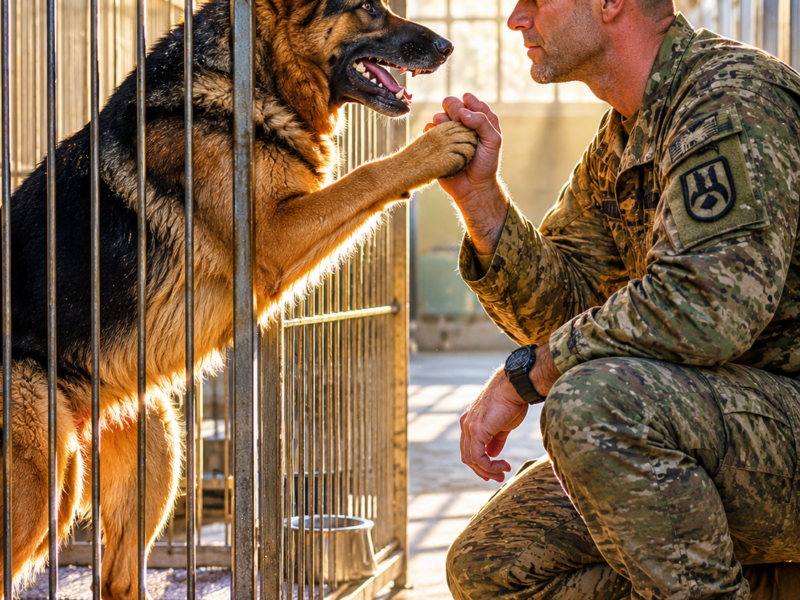
“I watched a shelter worker slide a German Shepherd’s old military service tag across the counter and tell the man in uniform
Daniel didn’t touch the pouch.
He remained kneeling in front of Duke’s kennel, staring at the name stitched into the faded fabric.
“Emily,” he whispered.
The name seemed to take something out of him.
I glanced at Marcus, who had come closer to the kennel.
“Who is Emily?” I asked.
Daniel closed his eyes for a moment.
“My daughter.”
He looked down at Duke again.
“She gave him that pouch before my last deployment. She was twelve years old at the time.”
Duke sat quietly, the red pouch between his paws.
Daniel wiped his face with the back of his hand.
“She told me it was a good-luck charm. Said if I ever got scared, I should hold it and remember that somebody was waiting for me at home.”
He gave a small, broken laugh.
“She made me promise I’d bring it back.”
I looked at the pouch.
“Why does the dog have it?”
Daniel finally opened the kennel gate.
Duke didn’t retreat.
Instead, he stepped forward and placed his head against Daniel’s chest.
The sound Daniel made wasn’t quite a laugh or a sob.
He wrapped both arms around the dog’s neck and held him.
For several seconds, the shelter hallway became unusually quiet.
Then Daniel pulled back and looked at the tag again.
“Where exactly did you say he came from?”
I handed him the surrender paperwork.
He read the name of the previous owner.
His jaw tightened.
“Grant Miller.”
“Do you know him?”
Daniel stood slowly.
“I know that name.”
He looked at Marcus.
“Can I make a phone call?”
Marcus nodded and led him into the small office beside the reception desk.
I stayed with Duke.
For the first time since he had arrived, he was standing near the kennel door.
He watched the office as if he understood that something important was happening.
Through the glass, I could see Daniel pacing with his phone pressed to his ear.
He spoke in short sentences.
Then he stopped moving.
His shoulders lowered.
When he returned, he looked older than he had ten minutes earlier.
“Grant was a contractor who worked with our search-and-rescue unit,” he explained. “He handled equipment and transportation. He wasn’t military, but he had access to the team.”
“What happened five years ago?” I asked.
Daniel took a long breath.
“We were deployed to assist after a major landslide in the Pacific Northwest. Several homes had been buried, and there were people trapped beneath the debris.”
He glanced toward Duke.
“He was one of our best search dogs. He could find a person under concrete when everyone else had given up.”
“Was he hurt?”
“Yes.”
Daniel’s voice became quieter.
“But that’s not the whole story.”
He sat down in the office chair.
“During the second night, one of our team members, Sergeant Michael Reed, disappeared while searching a damaged residential area. We found his equipment near a collapsed structure, but we never found him.”
He rubbed his forehead.
“Duke was with him.”
I remembered the way the dog had stared at the kennel door.
“Was Michael his handler?”
Daniel nodded.
“They worked together for almost four years. Michael trained him, fed him, slept beside him during deployments. They were practically inseparable.”
“What happened to Duke?”
Daniel looked at the surrender form.
“After the search, Grant told us Duke had been transported for medical treatment. A few weeks later, we were told he had died from his injuries.”
I felt a chill move through me.
“But he’s alive.”
“Apparently.”
Daniel stared at the paperwork again.
“And Grant signed the report.”
Marcus leaned against the desk.
“Are you saying he lied?”
“I’m saying I need to know why.”
Daniel asked if we could examine the pouch.
I brought Duke into the small consultation room.
He walked carefully, occasionally looking back to make sure Daniel was following.
When we reached the table, Duke placed the pouch on the floor.
Daniel picked it up with both hands.
The fabric was faded red, with one corner repaired using dark blue thread.
He turned it over.
There was a small brass zipper.
“Emily must have sewn this herself,” he said.
“She was terrible at sewing. She once tried to fix a hole in my jacket and accidentally attached the sleeve to the lining.”
He smiled faintly.
Then he opened the pouch.
Inside was a folded photograph, a tiny silver key, and a piece of paper protected by a thin plastic sleeve.
Daniel carefully removed the photograph.
It showed a younger Daniel standing beside a German Shepherd.
A man in a rescue uniform stood behind them, smiling.
I recognized the dog immediately.
Duke.
The man beside him had his hand resting on the dog’s shoulder.
“That’s Michael,” Daniel said.
He turned the photograph over.
Written on the back were the words:
“Three members of the same team. Nobody gets left behind.”
Daniel stared at the handwriting.
“Michael wrote this.”
I looked at the key.
“What does it open?”
Daniel picked it up.
“I don’t know.”
The folded paper was next.
It contained a short message written in blue ink.
The handwriting was shaky, as if the person had been injured.
Daniel read it silently.
Then he read it again.
His fingers tightened around the paper.
“What does it say?” Marcus asked.
Daniel hesitated.
Finally, he handed it to me.
The message read:
“Daniel, if Duke made it back, then Grant knows where I am. Don’t trust the official report. Find the storage unit. The key is still yours. —Michael.”
For a moment, nobody spoke.
Then Marcus looked at Daniel.
“Storage unit?”
Daniel shook his head.
“I have no idea.”
He examined the key again.
There was a small number stamped into its metal.
217.
I looked at the date on the surrender form.
Duke had arrived at our shelter three days earlier.
“Why would someone wait five years to bring him here?” I asked.
Daniel looked toward the dog.
“Maybe they didn’t want him to be found until now.”
That possibility changed the room.
Marcus immediately called the shelter director.
Because Duke had been surrendered under circumstances that now appeared suspicious, we needed to document everything and make sure no one could simply reclaim him.
Daniel contacted his former unit.
I expected him to leave immediately, but he didn’t.
He sat on the floor beside Duke until the dog rested his head on his knee.
“You stayed with him, didn’t you?” Daniel whispered.
Duke’s tail moved once.
Daniel looked away.
“I should have kept looking.”
I watched him scratch the fur behind Duke’s ears.
There was no anger in the gesture.
Only regret.
The next morning, Daniel returned to the shelter with a man named Captain Laura Bennett, a former military investigator who had worked with his unit.
She was in her early fifties, with sharp eyes and a calm manner.
She examined the note, photograph, and key.
“Where did you get this pouch?” she asked.
I explained that Duke had brought it out from beneath his blanket.
Laura looked at the dog.
“Then we need to find out where he was kept before he arrived here.”
Daniel handed her the surrender paperwork.
“Grant Miller.”
Laura’s expression changed slightly.
“That name again.”
“You know him?”
“I reviewed part of the investigation five years ago. He gave a statement about Michael’s disappearance.”
She placed the paperwork on the table.
“He claimed Michael had entered an unstable structure alone and never came back out. He also claimed Duke had been transported to a veterinary facility.”
“Was that verified?”
Laura shook her head.
“Not properly. The facility was a private contractor. Its records were incomplete.”
Daniel leaned forward.
“Why wasn’t the investigation reopened?”
“Because there was no evidence that Michael had survived. The site was searched, the debris was cleared, and his disappearance was eventually classified as presumed death.”
She looked at the note again.
“But this is evidence that someone believed he was alive.”
Daniel stood.
“Then let’s find storage unit 217.”
The key led us to a storage facility outside Sacramento.
It was a plain building surrounded by chain-link fencing and rows of identical metal doors.
Daniel drove.
Laura sat beside him.
I came along because I had handled Duke’s intake paperwork and could provide a statement about how the pouch had been discovered.
Duke rode in the back seat.
He had been quiet during the drive, but when we turned into the facility, he lifted his head.
His ears pointed forward.
Daniel noticed.
“Do you recognize this place, buddy?”
Duke pressed his nose against the window.
The manager checked the key and led us down a narrow hallway.
Unit 217 was at the end.
The lock turned with a metallic click.
Daniel pulled the door upward.
Inside were several plastic containers, a folding chair, an old sleeping bag, and a small desk.
Dust covered everything.
There were no signs of anyone living there recently.
Laura entered first.
She began checking the boxes.
Most contained ordinary belongings: old clothes, medical supplies, spare equipment, and notebooks.
Then she found a brown envelope inside a locked metal case.
It had Daniel’s name written across the front.
His hands trembled as he opened it.
Inside were several photographs, copies of medical records, and a letter.
The first photograph showed Michael sitting in a hospital bed.
He was thinner than I remembered from the photograph, but he was unmistakably the same man.
Duke approached the picture and sniffed it.
Daniel crouched beside him.
“That’s Michael,” he whispered.
The medical records revealed that Michael had survived the landslide.
He had suffered serious injuries, including a head injury and multiple fractures.
He had been taken to a private rehabilitation facility under a different name.
The records showed he had remained there for several months.
Then the documents stopped.
Laura studied the dates.
“Someone arranged his transfer.”
“Who?” Daniel asked.
She turned to the final page.
The authorization carried Grant Miller’s signature.
Daniel stepped backward.
“Why would he do that?”
Laura didn’t answer immediately.
She opened the letter.
It was written by Michael.
“Daniel,
If you’re reading this, I hope Duke found his way to you.
I don’t know how much time I have, and I don’t know who I can trust.
I survived the collapse, but I heard Grant telling someone that I wasn’t supposed to be found.
I was injured badly enough that I couldn’t fight him.
He said the rescue operation had cost too much money and that the contractor would be ruined if the missing equipment and falsified safety reports were discovered.
He told me that if I ever contacted anyone, the people who were helping me would lose their jobs.
I didn’t know whether he was telling the truth.
I only knew I couldn’t put anyone else in danger.
Duke stayed with me for as long as he could.
When I was moved, he was taken away.
I tried to get him back, but Grant said the dog was dead.
I didn’t believe him.
If you find this letter, please don’t waste time looking for revenge.
Just find out what happened to Duke.
He deserves to come home.”
Daniel lowered the paper.
His eyes were wet.
“He thought I would come looking for him.”
Laura folded her arms.
“Daniel, there’s something else.”
She pointed to a second document.
It was a payment record from the contractor.
Large sums of money had been transferred to several accounts after the landslide.
One of the recipients was a company owned by Grant.
The evidence suggested that equipment inspections had been falsified before the disaster.
If those records were accurate, the contractor had knowingly sent rescue teams into an unsafe area.
Michael had apparently discovered the truth.
And Grant had made sure he couldn’t tell anyone.
Daniel stared at the documents.
“Then why did Grant keep Duke?”
Laura looked toward the German Shepherd.
“Perhaps because the dog was the only witness who could connect him to Michael.”
Duke suddenly stood and walked toward the back wall.
He sniffed beneath a shelf, then began scratching at a small section of flooring.
Laura knelt.
There was a loose panel.
She carefully lifted it.
Beneath it lay a second envelope.
This one contained a photograph of Grant standing beside a van outside the rehabilitation facility.
The date was printed in the corner.
It was taken less than two months before Duke was surrendered to the shelter.
On the back, Michael had written:
“He’s watching the house. I think he’s waiting for something.”
Daniel looked at Laura.
“Where is Michael now?”
She examined the medical records again.
“The last address I can find is in Oregon.”
She made a phone call.
Within an hour, she had located a former nurse who remembered a patient matching Michael’s description.
He had left the facility nearly four years earlier.
He was living under his own name.
But there was a complication.
The nurse said he had moved frequently and rarely allowed visitors.
Laura finally obtained a current address through an official records search.
It was a small house in a quiet town near the Oregon coast.
Daniel wanted to leave immediately.
Laura stopped him.
“We need to involve the authorities first. We have evidence of fraud, possible unlawful confinement, and obstruction. We don’t know whether Grant is still watching him.”
Daniel clenched his fists.
“He’s been alone for five years.”
“I know.”
Laura softened her voice.
“But if we rush in, we could put him in danger again.”
For the first time, Daniel sat down without arguing.
He looked at Duke.
“Can you wait a little longer, old friend?”
Duke placed his chin on Daniel’s knee.
We left the storage facility with the evidence secured.
Two days later, Laura called.
The authorities had located Michael.
He was alive.
And he had agreed to meet Daniel.
The meeting was arranged at a small community center in Oregon.
I wasn’t sure I should be there, but Daniel asked me to come.
“You’re part of this now,” he said. “You helped him when he had nobody.”
When we arrived, a man was sitting near the window.
He was in his late forties, with gray hair and a slight limp.
His hands rested on a wooden cane.
Daniel stopped at the entrance.
For several seconds, neither man spoke.
Then Michael looked up.
“Dan?”
Daniel crossed the room.
He didn’t say anything.
He simply wrapped his arms around his old friend.
Michael held him tightly.
“I’m sorry,” he whispered.
Daniel shook his head.
“Don’t you dare apologize.”
They stood there for a long time.
Then Michael looked toward the doorway.
Duke was standing beside me.
The dog had been calm throughout the drive, but now his entire body seemed to change.
He took one step.
Then another.
Michael lowered his cane.
“Duke?”
The dog began walking faster.
By the time he reached Michael, his tail was moving so hard that his whole body swayed.
Michael dropped to his knees.
Duke pushed his face into the man’s chest, whining and licking his cheeks.
Michael buried both hands in the dog’s fur.
“Oh, my boy.”
His voice broke.
“I thought I’d never see you again.”
Duke pressed closer.
Michael kissed the top of his head.
“I looked for you. I swear I did.”
I turned away for a moment.
Daniel was crying openly.
He didn’t seem embarrassed.
Neither was I.
After five years, the dog had finally found the man he had been waiting for.
But the story wasn’t over.
Over the following weeks, investigators gathered more evidence.
Michael gave a formal statement.
The documents from the storage unit helped establish that Grant had falsified records and arranged Michael’s transfer under misleading circumstances.
The contractor’s financial records were examined.
Several former employees came forward.
Grant was eventually arrested and charged in connection with the fraud and obstruction investigation.
He also faced questions about the circumstances surrounding Michael’s disappearance and the years he had concealed information from investigators.
During questioning, Grant claimed he had kept Duke because the dog was valuable and because he believed Michael would never return.
But his explanation didn’t hold up against the evidence.
The authorities also discovered that Duke had been moved between two properties before being surrendered to the shelter.
There was no medical reason for the surrender.
Grant had simply wanted the dog out of his possession before investigators connected him to Michael.
The little red pouch had been the one thing he hadn’t noticed.
And Duke had carried it all the way to the place where someone could finally understand what it meant.
Three months later, I received an invitation to visit Michael.
His house was small, with a wooden porch and a garden full of flowers.
Duke was lying in the sunlight when I arrived.
He looked different.
His coat had been brushed.
His collar was new.
And there was a blue blanket beside the front door with his name stitched into it.
Michael walked slowly toward me.
“He’s sleeping better,” he said.
“That’s wonderful.”
Michael smiled.
“He still checks the front door every evening. I think he expects me to come through it, even though I’m already here.”
We both laughed.
Then he looked at Duke.
“Some habits take time.”
Daniel had also become a regular visitor.
He and Michael were rebuilding their friendship, one conversation at a time.
There were difficult days.
Michael sometimes woke from nightmares.
Daniel sometimes struggled with guilt over the years he had spent believing his friend was gone.
Neither pretended that everything could be repaired simply because they had found each other.
But they kept showing up.
One afternoon, I asked Michael what he planned to do with the red pouch.
He looked at it on the shelf beside a framed photograph.
“I’m keeping it.”
He picked it up carefully.
“Emily gave it to Daniel, but somehow it brought all three of us back together.”
Daniel had been standing in the kitchen.
He came over and examined the little brass zipper.
“Emily’s going to want to see this.”
He pulled out his phone.
“She’s twenty now. She’ll probably laugh when she sees how badly she sewed it.”
He called her.
A few minutes later, a young woman appeared on the screen.
When Daniel showed her the pouch, she covered her mouth.
“Wait. You still have that?”
Daniel nodded.
“Your old friend brought it home.”
She looked at Duke.
“Is that the dog from the picture?”
Michael leaned closer to the phone.
“That’s him.”
Emily smiled through tears.
“He’s so much older.”
Daniel rubbed Duke’s ears.
“So are we.”
A week later, Emily came to visit.
She had grown into a confident young woman, but when she saw Duke, she knelt on the porch just as she had in the photograph years earlier.
Duke sniffed her hand.
Then he leaned his head against her shoulder.
Emily laughed softly.
“Do you remember me?”
Duke’s tail tapped against the wooden floor.
She reached for the red pouch.
“I made this when I was twelve. Dad told me he carried it everywhere.”
Daniel sat beside her.
“I did.”
She turned it over and ran her fingers across the uneven stitches.
“I always thought it was ugly.”
Michael smiled.
“It was perfect.”
That evening, the four of us sat outside as the sun disappeared behind the trees.
Duke lay between Michael and Daniel.
Every so often, he lifted his head to check that both men were still there.
I thought about the dog I had first seen in the shelter.
The one who wouldn’t eat, wouldn’t bark, and wouldn’t look at anyone who approached his kennel.
I had mistaken his silence for giving up.
I hadn’t understood that he was waiting.
Not for just anyone.
For the people whose lives had once been tied to his.
Before I left, Michael walked me to my car.
“Do you know what surprised me most?” he asked.
I shook my head.
“That dog remembered the way home.”
He glanced toward the porch.
“And he remembered who belonged there.”
I watched Duke resting between the two men who had finally found each other again.
His old service tag hung beside his new collar.
The engraving was worn, but still readable.
It carried the name of a dog who had spent five years separated from the people he loved.
And beneath it, Emily’s little red pouch rested safely on the porch table.
For the first time in a long while, nobody was waiting for someone to come back.
Everyone was home.
The end.









