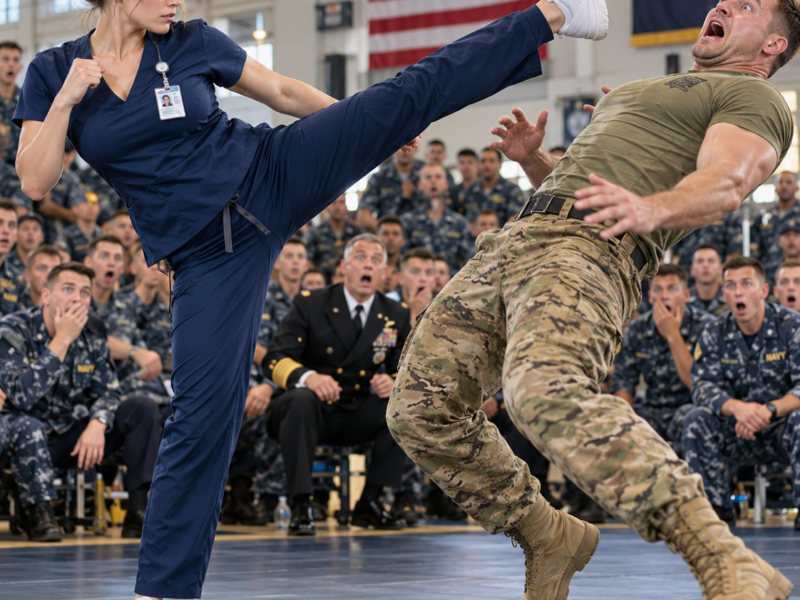
“I watched a self-proclaimed Navy SEAL slap me across the face in front of 960 exhausted service members
Chief Reed’s words followed me into the commander’s office like a warning neither of us could afford to ignore.
Commander Walker closed the door and held out his hand for the tablet.
“Show me the request.”
Reed turned the screen toward him. An official records inquiry had been submitted less than twenty minutes after the incident in the training facility. It requested my complete service history, operational evaluations, medical deployment records, and any documents connected to a restricted assignment four years earlier.
The request had been routed through a legitimate military channel, but the originating office wasn’t part of our command.
Walker read the screen twice.
“Who authorized this?”
“The system shows a senior-level credential,” Reed replied. “The request is marked urgent, but the authorization details are restricted.”
Walker looked at me.
“Emily, I need you to understand something. Nobody is going to punish you for reporting an assault. But if there’s a security issue connected to your previous assignment, I have to deal with it.”
“I understand, sir.”
“Then I need the truth about what happened in that room. And I need to know why someone is suddenly interested in your old records.”
I looked at the folder he had carried from the training facility.
For years, I’d imagined what it would feel like to explain my past to someone who had the authority to listen. Now that the opportunity had arrived, I found myself wishing I could put the folder back where it belonged and return to checking blood pressure readings.
“I’ll answer what I can,” I said. “But I’d like legal representation before discussing anything classified.”
Walker gave a small nod.
“That’s your right.”
He set the folder on the desk.
“Until we establish what’s happening, you’re relieved of your regular duties. Not as punishment. I want you available for the investigation, and I don’t want anyone putting pressure on you while we sort this out.”
I accepted the order without arguing.
As I turned toward the door, he spoke again.
“One more thing. Cole has already filed a complaint alleging that you used excessive force.”
I almost laughed.
“He hit me.”
“I know. There were hundreds of witnesses. His complaint doesn’t erase that.”
“Then why does it matter?”
“Because people who believe they’re untouchable rarely give up quietly.”
I left his office with the feeling that I’d walked into a room expecting a simple medical incident and discovered an entirely different battle waiting behind it.
By noon, the story had spread across the base.
Some people said I’d broken Cole’s nose. Others claimed I’d thrown him across the room. One version had me disarming three armed men before breakfast.
The truth was considerably less dramatic.
I had stopped a second strike, taken away his balance, and let gravity do the rest.
But the rumors weren’t what bothered me.
What bothered me was the way people watched me now.
Before that morning, I had been Emily Bennett, the new nurse who remembered everyone’s allergies and kept spare pens in her pockets. Now, conversations stopped when I entered a room. Men who had never spoken to me suddenly wanted to know where I’d trained.
A young corpsman caught up with me outside the medical unit.
“Ma’am?”
I turned.
He looked uncomfortable, shifting his weight from one boot to the other.
“I just wanted to say what happened in there wasn’t right.”
“Thank you.”
“I mean, everybody knew Cole was difficult, but nobody thought he’d actually hit someone in front of the entire group.”
I studied his face.
“Did you witness it?”
“Yes, ma’am.”
“Then make sure you tell the investigator exactly what you saw. Nothing more and nothing less.”
He nodded, visibly relieved that I hadn’t asked him to take sides.
As he left, I realized something I’d forgotten during my years away from military life.
People didn’t always stay silent because they believed the person causing harm was right. Sometimes they stayed silent because they assumed everyone else would.
That afternoon, I gave my formal statement.
I described Cole’s refusal to complete his examination, my explanation of the medical protocol, the first strike, and his attempt to hit me again. I made no claims about his character or his intentions beyond what I had directly observed.
When the investigator asked about my response, I explained the movement I had used and why I had stopped once he was no longer a threat.
“Have you received formal defensive tactics training?” she asked.
“Yes.”
“What kind?”
I glanced at the attorney assigned to advise me on the restricted nature of my prior service.
“Some of that information is classified. I can provide the relevant details through the proper channels.”
The investigator made a note.
“Understood.”
She paused before continuing.
“Petty Officer Cole claims you deliberately provoked him.”
“I told him I couldn’t approve a medical clearance without examining him. That’s the extent of the interaction before he struck me.”
“Did you insult him?”
“No.”
“Threaten him?”
“No.”
“Did you strike him after he was on the ground?”
“No.”
She looked up.
“Several witnesses have confirmed that.”
For the first time since the incident, I felt a little of the pressure leave my chest.
Then she asked the question I’d been dreading.
“Ms. Bennett, your record shows that you previously served in a specialized medical support unit. Your current personnel file doesn’t include details about that assignment. Can you explain why?”
“Because the details are restricted.”
“Was your previous assignment terminated?”
“No.”
“Did you leave under disciplinary action?”
“No.”
“Then why did you leave?”
I looked at the clock on the wall.
There was no answer that could fit neatly into the box she had opened.
“I left because the work was over, and I needed to decide whether I could continue doing it.”
She waited, but I had nothing else to offer.
The interview ended shortly afterward.
Outside the room, my attorney walked beside me toward the medical wing.
“You handled that well,” she said.
“I answered the questions.”
“That is often harder than people realize.”
I stopped beside a window overlooking the base parking lot.
“Do you think the records request has something to do with Cole?”
“I don’t know. But I wouldn’t assume the timing is a coincidence.”
Neither would I.
That evening, I returned to my apartment and sat at the kitchen table without turning on the lights.
My cheek had begun to swell. I held a cold pack against it and watched the dark window reflect the small, ordinary room around me.
I had chosen this life carefully.
After my previous assignment, I’d wanted work where the problems were immediate and human. A patient came in with a fever, a cut, a broken wrist, or a frightened look in their eyes. I could assess the situation, make a plan, and help.
There were rules. There were difficult days. There were still people who confused authority with permission.
But the purpose was clear.
I hadn’t expected to be pulled back into the part of my life I’d spent years trying to put behind me.
At 8:17 p.m., my phone rang.
The number was blocked.
I considered letting it go to voicemail.
Then I answered.
“Emily Bennett.”
A man’s voice came through the speaker.
“Captain Bennett?”
My fingers tightened around the phone.
“Who is this?”
“Someone who knew you before Norfolk.”
“That doesn’t narrow it down.”
He gave a short, humorless laugh.
“Still careful. Good.”
I stood.
“If you have a legitimate reason to contact me, identify yourself.”
A pause followed.
“Your records have been requested. You should know that the request isn’t about the nurse you are now.”
“I gathered that.”
“It’s about the people you worked with four years ago.”
I felt the old, familiar pressure settle behind my ribs.
“Who submitted the request?”
“I can’t tell you that over the phone.”
“Then you shouldn’t have called.”
“Emily, listen. Somebody has been looking for you for months. The incident today simply gave them a reason to move faster.”
I walked to the window and looked down at the parking lot.
“Why?”
“Because of what happened during Operation Lantern.”
The name landed like a stone in still water.
I hadn’t heard it spoken outside an official debriefing in four years.
“Who are you?” I asked again.
This time, the man answered.
“Lieutenant Commander Daniel Price. We served together at the forward medical station.”
I closed my eyes.
Price had been the operations liaison on the night everything went wrong. He had helped coordinate the extraction of wounded personnel during an operation that had never appeared in any public report.
I’d believed he was still serving overseas.
“What do you want from me, Daniel?”
“To warn you.”
“About what?”
“Don’t let them turn today’s incident into a reason to open your old case. And whatever you do, don’t discuss the final thirty minutes of Operation Lantern with anyone who hasn’t been cleared to hear it.”
My hand went cold around the phone.
“The final thirty minutes were reviewed.”
“No,” he said. “The first report was reviewed. The final thirty minutes were removed from the record.”
I couldn’t speak.
“Emily, are you listening?”
“Yes.”
“Then remember this. You weren’t the reason that operation failed.”
The call ended.
I stared at the phone until the screen went dark.
For four years, I had carried the memory of a decision I’d been told was mine.
I’d been responsible for the medical evacuation during Operation Lantern, a mission that had ended with casualties, a missing team member, and an investigation whose findings were never fully explained to me.
I had followed the orders I was given. I’d treated the wounded, coordinated transport, and stayed until the last aircraft was ready to leave.
But the official review had raised questions about the timing of the evacuation and the loss of a classified communications device.
The final report concluded that I had acted within protocol, but the mission’s outcome had been classified as an operational failure.
I’d been cleared of wrongdoing.
I’d never been told what had actually happened during those last thirty minutes.
I had thought the matter was closed.
Now someone was looking for me again.
The following morning, Commander Walker summoned me to his office.
This time, two people I’d never met were waiting inside.
One wore a dark civilian suit and carried a thin leather folder. The other wore a uniform with insignia that identified him as a senior officer from a command outside Norfolk.
Walker closed the door.
“Emily, this is Commander Robert Shaw and Special Agent Laura Mitchell. They’re here regarding your prior assignment.”
The woman offered her identification.
“Ms. Bennett, we’re reviewing several irregularities connected to Operation Lantern. Your name appears in the original operational record, and certain sections of that record were altered after the initial review.”
I kept my face still.
“What kind of alterations?”
“Changes to the evacuation timeline, the accountability of a communications device, and the reported status of a team member.”
“Which team member?”
She opened her folder.
“Staff Sergeant Michael Torres.”
I knew the name.
Torres had been a communications specialist attached to the team. He was competent, reserved, and unusually meticulous about keeping his equipment secured. On the night of the operation, he’d been assigned to maintain the encrypted communications unit that connected our position with the extraction team.
During the final minutes, we had lost contact with him.
The report said he had been evacuated separately.
I’d never seen him at the receiving facility.
“Is he missing?” I asked.
Agent Mitchell studied me.
“His current status is uncertain.”
“How can his status be uncertain after four years?”
“Because the record says he was transferred to a different unit, but that unit has no record of receiving him.”
The office seemed to grow smaller.
I remembered the final minutes of the operation with painful clarity.
The wounded had been lined along the inside wall of the medical shelter. Rain had turned the ground outside into thick mud. Our radio had failed twice, and the extraction team was working against a deadline that had already been extended once.
Torres had come to me with a split lip and blood running down his sleeve.
“Captain, we need to leave.”
“I have two patients who can’t be moved without assistance.”
“I know.”
“Then help me get them ready.”
He’d looked over his shoulder toward the communications tent.
“There’s something you need to see.”
Before he could explain, the radio had crackled with the extraction command.
We were ordered to move.
I’d told Torres to bring the communications unit and follow the medical team.
He’d nodded.
I never saw him again.
At the time, I believed he had left with the equipment crew.
Later, the report stated that he had been transferred to another unit before the evacuation.
I’d accepted the explanation because I had no evidence to challenge it.
Now, four years later, the investigators were telling me the receiving unit had never heard of him.
“What does this have to do with Petty Officer Cole?” I asked.
Commander Shaw folded his hands.
“We’re not prepared to say that it does. However, Cole’s service record shows that he was attached to a support detachment that handled equipment recovery following Operation Lantern.”
“Was he part of the operation?”
“Not according to the official roster.”
“Then why was he involved in the recovery?”
“That’s one of the questions we’re investigating.”
Agent Mitchell slid a photograph across the desk.
It showed Cole standing beside several service members outside a warehouse. The image was grainy, apparently taken from a security camera.
A date appeared in the lower corner.
Four years earlier.
I leaned closer.
Cole was younger, his face leaner, but unmistakable.
Behind him stood a man in civilian clothing holding a hard-sided equipment case.
I recognized the case.
It was the kind used to transport encrypted field communications equipment.
“Where was this taken?” I asked.
“At a recovery facility near the extraction site.”
“Was the communications unit recovered?”
“According to the inventory, yes.”
“And the unit’s serial number?”
Agent Mitchell glanced at Commander Shaw.
“The serial number on the inventory doesn’t match the one assigned to Torres.”
I looked back at the photograph.
“Then someone substituted a different unit.”
“That’s a possibility we’re examining.”
I sat back.
The case was beginning to look less like a failed operation and more like a chain of decisions designed to make certain things disappear.
“Why are you telling me this now?”
“Because we believe you may have seen something during those final thirty minutes that was never included in your statement,” Mitchell said.
I looked at her.
“I told the investigators everything I remembered.”
“Your first statement was taken less than twelve hours after the evacuation. You were injured, exhausted, and treating patients. The final interview occurred three days later.”
“I remember.”
“There’s a discrepancy between the two.”
“What discrepancy?”
She opened another page.
“In your first statement, you said Torres told you there was something you needed to see in the communications tent. In the final report, that sentence is missing.”
My mouth went dry.
I remembered writing that statement.
I’d been sitting in a small office with a bandage around my wrist, answering questions while someone typed on a laptop. I had described the radio failure, the evacuation order, and the last time I’d seen Torres.
I distinctly remembered mentioning the communications tent.
I’d assumed it was included.
“Who removed it?”
“We don’t know yet.”
I looked at Walker.
He had been silent throughout the meeting, but his expression had changed.
“Emily,” he said, “I need you to understand that you’re not being accused of anything. We’re asking you to help establish what happened.”
“I understand.”
But the old fear had returned, and this time it was accompanied by anger.
For years, I had wondered whether I should have made a different decision that night.
Should I have sent another person to find Torres? Should I have delayed the evacuation? Should I have refused to leave until everyone was accounted for?
I’d replayed those questions so many times that I could no longer tell which memories were mine and which had been shaped by the official report.
Now I knew that somebody had edited the record.
And if the statement had been altered, the investigation might have been built around a version of events that never happened.
Agent Mitchell closed her folder.
“We’d like you to review the original site photographs and the available communications logs. We can arrange a secure session.”
“I’ll cooperate through the proper channels.”
“That’s all we’re asking.”
Before they left, Commander Shaw paused beside the door.
“One more thing. Petty Officer Cole has been temporarily removed from training duties pending the assault investigation. He has requested an interview with you.”
I frowned.
“Why?”
“He says he has information about Operation Lantern.”
I almost told them I didn’t want to see him.
Then I remembered the expression on his face when I’d mentioned the incident report. It hadn’t looked like ordinary embarrassment. It had looked like recognition.
“Under what conditions?”
“With counsel present, the meeting documented, and no direct contact outside the formal process.”
I considered it.
“Then I’ll hear what he has to say.”
The interview was scheduled for the following afternoon in a secure conference room.
Cole entered with an attorney and a commanding officer. His right cheek carried a faint mark from the fall, but he walked confidently enough to make it clear he intended to recover his dignity.
He didn’t look at me at first.
When he finally did, his eyes narrowed.
“Captain Bennett.”
“Petty Officer Cole.”
The investigator reviewed the ground rules, then invited him to speak.
Cole folded his hands on the table.
“I want to clarify what happened yesterday. I lost my temper, and I shouldn’t have struck you.”
The words sounded rehearsed, but at least he had said them.
“You’re correct,” I replied.
His attorney shifted in his chair.
Cole continued.
“I also want to explain why I reacted the way I did when I saw your name on the training roster.”
I kept my expression neutral.
“You knew my name before yesterday?”
“I recognized it from a report.”
“What report?”
“An equipment recovery report connected to Operation Lantern.”
The investigator leaned forward.
“Petty Officer, are you stating that you knew Captain Bennett’s prior assignment before the incident?”
“Yes.”
“Did that knowledge influence your behavior?”
Cole hesitated.
“I was told she was involved in an incident that had caused serious problems for a team I supported.”
“What problems?”
He looked at me.
“I was told a communications unit had gone missing and that the officer responsible for the medical evacuation had failed to account for a team member.”
My stomach tightened.
“Who told you that?”
“A former supervisor.”
“Name?”
Cole gave it.
The investigator wrote it down.
“Did that supervisor tell you to confront Captain Bennett?”
“No.”
“Did anyone tell you to provoke her?”
Cole’s jaw worked.
“No.”
“Then why did you strike her?”
He looked away.
“I was angry.”
The answer was so small compared with the harm he’d caused that I almost felt sorry for him.
Almost.
“Did you know that your behavior could end your career?” I asked.
He looked back at me.
“I didn’t think you’d actually report it.”
There it was.
Not a misunderstanding. Not a conflict between two strong personalities.
He’d believed I would accept the assault quietly because he was senior, because he was respected, and because he expected his reputation to protect him.
I nodded once.
“Thank you for being honest.”
The investigator ended the interview shortly afterward.
As Cole stood, he turned toward me.
“I still think you could have handled it differently.”
I met his gaze.
“I did handle it differently. I stopped when you were no longer a threat. You were the one who decided that my refusal to approve your medical clearance was an insult.”
He had no answer.
For the first time, he left a room without having the last word.
The next week was a blur of interviews, records reviews, and secure briefings.
The investigators recovered the original communications inventory from an archived storage system. The serial number had been changed in a later version, and the amendment had been approved using credentials belonging to an officer who claimed never to have reviewed the document.
A separate audit showed that the same credentials had been used to alter the accountability record for Staff Sergeant Torres.
The trail led to a contractor that had managed equipment recovery and secure transport after the operation.
Cole’s former supervisor had worked with that contractor before returning to active duty.
But the evidence still didn’t explain what Torres had discovered or why someone had gone to such lengths to hide his status.
Then Agent Mitchell called me into the secure review room.
“We found a fragment of the original communications log,” she said.
The display showed a series of transmissions recorded during the final thirty minutes of Operation Lantern. Most were routine check-ins and extraction updates.
One entry stood out.
A transmission from Torres to the medical station, timestamped eleven minutes before the evacuation order.
The message had been partially corrupted, but a few words remained readable.
“Secondary transfer unauthorized. Evidence retained. Do not release equipment.”
I read it twice.
“He knew the equipment had been altered before the evacuation.”
“That’s our current interpretation,” Mitchell said. “We also found a reference to a storage location in an attached maintenance note.”
“Where?”
She brought up a map.
A small warehouse near the extraction point had been used as a temporary holding facility. It was listed as cleared and empty before the operation.
But the inventory records showed that a locked cabinet had been moved out of the building after the evacuation.
The cabinet’s contents were never documented.
“Could Torres have hidden the original unit there?” I asked.
“Possibly. We have a team checking the location.”
I stared at the map.
The last time I had seen Torres, he had been heading toward that same warehouse.
I’d assumed he was collecting the communications equipment.
Now I wondered whether he’d been trying to preserve evidence.
Agent Mitchell watched me carefully.
“Do you remember anything else about that night?”
I closed my eyes and let the memory return without trying to force it into the shape of the official report.
Rain. Mud. The sound of the extraction vehicles.
Torres standing beside the tent, his sleeve dark with blood.
“There’s something you need to see.”
The words came back with a clarity that made my hands go cold.
“I remember that he wasn’t carrying the communications case when he left me.”
Mitchell leaned forward.
“Are you certain?”
“Yes. He was wearing his equipment harness, but his hands were empty. I thought he’d left the case in the tent.”
“Did you tell anyone?”
“I said he was going to the communications area. I don’t remember being asked whether he was carrying the unit.”
The agent made a note.
“That may be important.”
Two days later, the investigators located the warehouse cabinet.
It had been moved to a private storage site and placed under a different inventory number. Inside were maintenance logs, spare components, and a sealed evidence pouch containing a small encrypted storage module.
The serial number matched the one originally assigned to Torres.
The module had not been destroyed.
It had been hidden.
The investigators secured it and arranged for a technical team to examine its contents. They did not tell me what was recovered until the following week.
When Agent Mitchell finally called, I was sitting in the medical unit reviewing a stack of patient charts.
“Ms. Bennett, we found records on the module that support Torres’s original message. There were unauthorized equipment transfers, falsified inventory entries, and communications showing that several people knew the records were being changed.”
“Does it say what happened to Torres?”
“Not directly. But it establishes that he was trying to preserve evidence before the evacuation.”
I closed the chart in front of me.
“Then why was he listed as transferred?”
“We’re still tracing the authorization. The evidence points to an attempt to conceal his whereabouts, but we haven’t established who made the final decision.”
I stared out the window at the gray morning sky.
“Is he alive?”
There was a pause.
“We have reason to believe he may be.”
For four years, Torres had been a name in a report, a missing person whose status was treated as an administrative detail.
Now, for the first time, the investigators were looking for him as a living man.
The search took another month.
During that time, Cole was formally disciplined for the assault and removed from his training assignment. His service record was reviewed separately from the investigation into Operation Lantern, and the evidence against the people who altered the records continued to build.
He sent me a written apology through the proper channel.
It was brief. He acknowledged that he’d used his rank and reputation to intimidate me, and that he’d struck me because he believed I would not challenge him publicly.
I read it once, then placed it in the file with the investigation documents.
I didn’t forgive him immediately.
An apology could acknowledge harm, but it couldn’t erase the moment when I had stood in front of 960 people and wondered whether anyone would speak up.
Still, I no longer needed him to understand me in order to move forward.
One rainy Thursday afternoon, Agent Mitchell called again.
“We’ve located Staff Sergeant Michael Torres.”
I sat down.
“Where?”
“At a medical rehabilitation facility outside Raleigh. He was admitted under a different identity after an injury sustained during a transport incident four years ago.”
“Does he know who he is?”
“Yes. His memory is intact, although he has ongoing medical issues. He’s agreed to speak with investigators.”
I covered my mouth with one hand.
“Can I see him?”
“Not immediately. We need to complete the initial interview and make sure his safety is protected. But he asked us to pass along a message.”
“What message?”
Mitchell’s voice softened.
“He said, ‘Tell Captain Bennett she made the right call. She got the wounded out.'”
I couldn’t answer.
For years, I’d believed that leaving the site without finding Torres had been the decision that defined me. I had treated every patient who came through my door as if I could somehow make up for the person I hadn’t brought home.
Now the man I’d feared I’d abandoned was telling me I’d made the right call.
I cried in the empty supply room, quietly enough that nobody outside could hear.
Not because everything had been fixed.
Torres still had to recover. The people responsible still had to face the consequences. And the investigation had exposed damage that no official correction could undo.
I cried because, for the first time, I could remember that night without hearing the accusation hidden inside the report.
A week later, I was granted permission to speak with Torres over a secure video call.
He looked older than the man I remembered. His hair had thinned, and he held himself carefully, as though every movement required consideration.
But his eyes were the same.
“Captain Bennett,” he said.
I smiled through the tears gathering in my eyes.
“Michael. It’s good to see you.”
He glanced down before looking back at the screen.
“I’ve wanted to tell you something for a long time.”
“You don’t have to explain everything today.”
“I know. But I need you to hear this.”
He took a breath.
“When I left the medical station, I went to the warehouse because I had discovered that the communications records were being altered. I thought I could secure the original module before the equipment was moved.”
“What happened?”
“I was intercepted before I could get back. The people who took me knew I had seen the inventory changes. They needed to keep me from explaining what I’d found.”
He paused.
“I didn’t know what happened after I was moved. I only knew that my identity had been changed and that nobody outside the facility was supposed to contact me.”
“Why didn’t you try to reach us?”
“I did, at first. My messages never went through. Later, I was told that the team had been informed I was dead or transferred. I didn’t know which version they’d been given.”
I looked down at my hands.
“We were told you’d been transferred.”
“I figured.”
He gave a tired smile.
“Emily, I heard what happened at Norfolk.”
I laughed softly.
“Of course you did.”
“Eight hundred and sixty people?”
“Nine hundred and sixty.”
“That many?”
“Apparently, I needed an audience.”
He smiled, then grew serious.
“I’m sorry you were put through that. You shouldn’t have had to fight two battles just to be believed.”
I thought about the slap, the room full of witnesses, and the moment when Cole had raised his hand again.
“I didn’t do it to prove anything,” I said. “I just wanted him to stop.”
“That’s usually when people show you who they are.”
We spoke for nearly an hour.
He told me about the rehabilitation process, the investigators, and the small routines that had helped him regain some sense of normal life. I told him about the hospital, the patients I’d treated, and the cold coffee that seemed to follow me wherever I went.
When the call ended, I sat in silence for a long time.
The case continued through the following months. The altered records and recovered module supported formal proceedings against those involved in the concealment. Some faced criminal charges, while others were removed from positions of authority or disciplined for their roles in the falsification.
The full story of Operation Lantern was never released publicly. Certain details remained classified, and I learned to accept that not every answer would be mine to share.
But the official record was corrected.
Torres was no longer listed as transferred without confirmation. The false entries were marked as disputed, and the investigation formally acknowledged that his whereabouts had been concealed.
My own record was amended to reflect the missing communications evidence and the altered timeline.
It didn’t change what had happened that night.
It changed what I had been expected to believe about it.
I remained at Norfolk.
When my temporary reassignment ended, Commander Walker asked whether I wanted to return to the medical unit.
“Yes, sir,” I said.
“Even after everything that’s happened?”
I thought about the people who came through our doors every day: sailors with sprained ankles, young recruits with fevers, exhausted service members who were too proud to admit they needed help.
“Especially after everything that’s happened.”
He nodded.
“Then there’s one more thing I should tell you.”
I waited.
“The people who witnessed the incident with Cole have submitted statements. Several specifically noted that you stopped using force as soon as the threat ended. Your actions were reviewed, and the finding is that you acted in self-defense.”
I let out a slow breath.
“Thank you, sir.”
“You don’t owe me thanks for doing my job.”
He paused.
“And for what it’s worth, I hope the next time people hear your name, it’s because of the work you do here, not because someone decided to challenge you.”
I returned to the medical unit the following Monday.
The first person I treated was a young sailor who had fallen during a training exercise and was convinced his ankle was merely sore.
I examined it, explained what I suspected, and arranged for imaging.
He looked at my name badge.
“You’re the nurse from the training facility, aren’t you?”
I held his gaze.
“I’m the nurse assigned to your case. Let’s focus on your ankle.”
He flushed.
“Yes, ma’am.”
I smiled and returned to the chart.
That was the life I wanted. Not a legend. Not a rumor. Just the opportunity to do the work I had trained to do, without someone else’s arrogance becoming the center of it.
Several weeks later, I attended a small gathering for the medical unit staff. There were no speeches about heroes, no dramatic presentations, and no cameras waiting to capture a salute.
Torres joined us by video for a few minutes. His recovery was slow, but he was making progress.
Before the call ended, he raised his hand in a small salute.
I returned it.
Afterward, I stepped outside into the cool evening air.
The base was quiet, the sky darkening beyond the buildings. Somewhere in the distance, a group of recruits marched in cadence, their voices rising and falling together.
I touched the faint mark still visible along my cheekbone.
It had taken less than a second for Cole to strike me.
It had taken much longer for the people around him to decide that his rank did not make him right.
And it had taken four years for the truth about Operation Lantern to begin emerging from beneath the paperwork designed to bury it.
I had once believed that strength meant enduring whatever came your way without letting anyone see the cost.
Now I understood something simpler.
Strength could mean holding pressure on a wound until help arrived. It could mean telling the truth when silence was safer. And sometimes, when someone raised a hand against you, it meant making sure they never got the chance to do it twice.
I turned toward the medical building, where the lights were on and the next patient was waiting.
For the first time in years, I walked back inside without carrying the past like a sentence I still had to serve.
The end.









