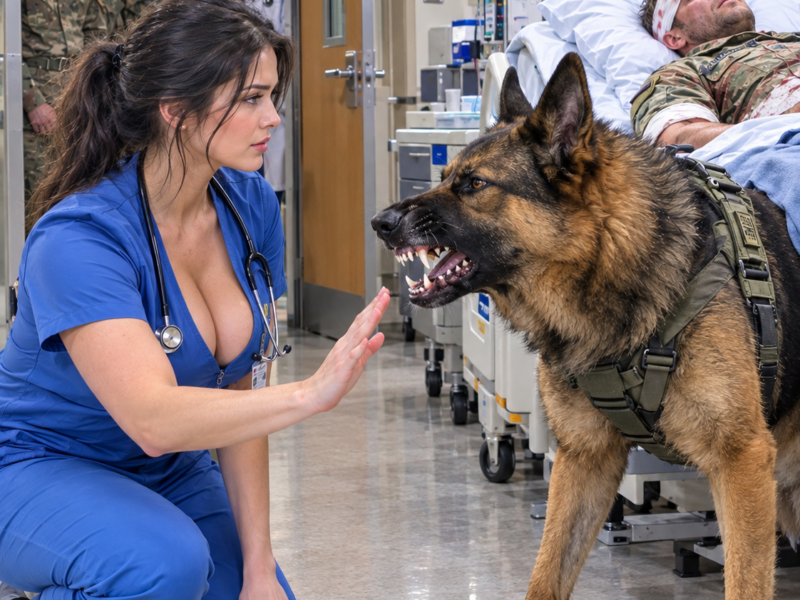
“I was the only nurse left in the treatment room when the hospital security team shut the door behind me with their most aggressive service K9 still inside
I turned the tag over in my palm, searching for something that would explain why an unconscious stranger had been carrying part of a missing police officer’s equipment.
The name engraved beneath the serial number was Daniel Brooks.
I’d heard that name before.
Three months earlier, Daniel had been brought into our emergency department after a traffic accident. He’d left with a fractured wrist, a bruised shoulder, and a German Shepherd that refused to leave his side.
That dog had been Rex.
I looked at the animal beside Walter’s bed. His ears lifted when I whispered Daniel’s name, and he nudged the metal tag again.
“Rex, do you know him?” I asked quietly.
The dog gave a sharp bark and turned toward the door.
Outside, the younger officer was no longer laughing.
“Put that tag down, Nurse Carter,” he said through the glass.
There was something in his voice that made me close my fingers around it.
“Why?”
“Because it’s police property. You don’t need to be handling it.”
“Then explain why it’s in my patient’s hand.”
He glanced at his partner.
It lasted less than a second, but I saw it.
The older officer’s jaw tightened. He reached for his radio and spoke too quietly for me to hear.
Walter’s monitor began beeping faster.
I pushed the tag into my scrub pocket and turned back to the bed. Whatever had happened in the parking garage, my patient was deteriorating, and I wasn’t going to let an argument with security distract me from keeping him alive.
I checked his breathing, reassessed his pulse, and tried the emergency call button again.
Nothing.
“Someone get me a working monitor and a crash cart!” I shouted.
The older officer struck the door with his palm.
“We’re getting the door open!”
“Then get it open faster!”
Rex moved close to Walter’s head. His nose hovered over the patient’s shoulder, and his eyes followed every movement of my hands.
I had seen trained dogs respond to familiar voices and gestures. What I was seeing now looked different. Rex wasn’t trying to control the room. He seemed desperate to draw my attention to something I hadn’t noticed.
I lifted Walter’s gown enough to inspect the bruising around the puncture wound.
There were two small marks, not one.
The surrounding skin was swollen, and a faint line of discoloration extended toward his collarbone.
I couldn’t determine the cause from appearance alone, but the injury needed immediate medical evaluation. I called out for the physician again.
Then Walter’s fingers twitched.
His eyes opened a fraction.
“Daniel,” he whispered.
I leaned toward him.
“Mr. Hayes, can you hear me? You’re at St. Matthew’s. You’re safe. Can you tell me what happened?”
His lips moved, but the words came out as a dry rasp.
“Don’t let them…”
He tried to lift his hand.
Rex pressed his muzzle against it.
Walter’s fingers curled weakly into the dog’s fur.
“Don’t let them take him.”
The door rattled.
“Step away from the patient!” the younger officer shouted.
I looked up.
He was holding a key card against the electronic lock, trying to override it. The older officer stood several feet behind him, speaking into his radio.
I couldn’t hear the full conversation, but I caught one sentence.
“He’s awake. We have a problem.”
My stomach tightened.
Who was he talking about?
Walter?
Daniel?
Or Rex?
The lock clicked, but the door didn’t open. The security system had engaged a secondary mechanism.
The younger officer slammed his hand against the glass.
“Carter, move away from that dog now!”
Rex stood between us, his body rigid.
I had spent years learning to recognize fear in people who were trying to hide it. I knew the clenched jaw, the restless hands, the way a person looked at an exit before answering a simple question.
I was beginning to see those same signs in the officer.
And for the first time, I wondered whether Rex was the only one in the room who had been misjudged.
The door finally opened when a hospital maintenance worker arrived with a manual release key.
The older officer entered first, his hand hovering near his belt.
“Move away from the patient,” he repeated.
I stayed beside Walter.
“He’s unstable. I need a physician and a functioning cardiac monitor.”
“That’s not your concern anymore.”
“I’m his nurse. It absolutely is.”
His eyes dropped to my scrub pocket.
“Give me the tag.”
I didn’t move.
“Tell me what happened to Daniel Brooks.”
The officer’s expression hardened.
“Officer Brooks is missing. That equipment is part of an active investigation.”
“Then why are you more interested in a metal tag than a patient who may be dying?”
For a moment, neither of us spoke.
The younger officer stepped inside and reached for Rex’s harness.
Rex swung around with a sudden bark, forcing the man to pull his hand back.
“Get that animal under control!” he shouted.
“I haven’t touched him,” I said.
“He’s aggressive.”
“Then why has he stayed beside Walter without attacking anyone?”
The younger officer looked at Walter, and something flickered across his face.
Recognition.
It vanished almost immediately, but I saw it.
Before I could question him, a physician hurried into the room with two nurses and a portable monitor.
Dr. Melissa Grant took one look at Walter and began issuing instructions. The room filled with movement as we transferred him to a working monitor and prepared for emergency treatment.
The officers were ordered into the hallway.
I expected them to leave.
Instead, the younger one lingered at the door, watching the bed.
Rex followed him with his eyes until the door closed.
Only then did the dog settle.
Dr. Grant examined Walter’s injury and ordered urgent testing. I helped stabilize him while the team worked to determine what had caused his collapse.
His condition was serious, but we managed to get him through the immediate crisis.
When his vital signs became more stable, Dr. Grant pulled me aside.
“Emily, what happened in here?”
I told her about Rex, the tag, the officers’ behavior, and Walter’s whispered warning.
She listened without interrupting.
When I finished, she glanced toward the closed door.
“Don’t make accusations you can’t support,” she said gently. “But don’t ignore what you witnessed, either.”
“I think those officers know something about Daniel Brooks.”
“Then let the proper investigators establish what it is.”
She returned to Walter’s bedside.
I remained in the hallway, staring at my hands.
I had come close to being bitten by a trained police dog. I had discovered a piece of equipment connected to a missing officer. And two men who were supposed to protect the hospital seemed more interested in controlling what I saw than explaining what had happened.
I could have reported the incident and gone back to my shift.
Instead, I went to the nurses’ station and asked our charge nurse to preserve the treatment room’s security footage.
Then I called hospital security and requested that the original report of Walter’s arrival be secured, including the paramedics’ notes and any available parking garage footage.
I didn’t know whether I was uncovering a crime or misunderstanding a chain of coincidences.
But I knew I would regret it if I did nothing.
At six that evening, I returned to Walter’s room.
Rex was no longer there.
A hospital administrator had arranged for a certified animal-control specialist to take custody of him until the department could establish who was authorized to handle him.
I was relieved that nobody had been hurt, but the empty space beside Walter’s bed bothered me.
Walter was awake now, though he looked exhausted. His left hand rested on top of the blanket, and an IV line ran into his arm.
When he saw me, he tried to sit up.
“Easy,” I said, adjusting his pillow. “You’ve had a rough day.”
“Where’s the dog?”
“He’s safe. A specialist is looking after him.”
Walter closed his eyes.
“Good.”
I pulled a chair beside the bed.
“Mr. Hayes, I need to ask you something. Why did you have Officer Brooks’s tag?”
His expression changed.
He looked toward the door, then back at me.
“I promised Daniel I’d keep it safe.”
“Where is he?”
Walter swallowed.
“I don’t know.”
“Did you see him before you collapsed?”
He nodded faintly.
“Two nights ago. He came to my house. He was hurt, frightened, and carrying something he said could get people killed.”
“What was it?”
“A flash drive.”
I waited.
“He told me not to give it to anyone unless I was certain they could be trusted. He said there were people inside his own department who would do anything to get it back.”
My skin prickled.
“Did he tell you what was on it?”
“Not everything. He said it contained records of evidence being moved, reports being altered, and people being paid to look the other way.”
I thought of the two officers outside Treatment Four.
“Did he name anyone?”
Walter looked away.
“He didn’t have to. I knew one of the names.”
“Whose?”
Before he could answer, someone knocked on the door.
A uniformed officer entered with a woman in plain clothes. She introduced herself as Detective Laura Mitchell, assigned to the department’s internal investigations unit.
“I understand Mr. Hayes may have information related to Officer Brooks’s disappearance,” she said.
Walter’s face went pale.
“Who told you that?”
“The hospital contacted us after an unusual incident involving a K9 and two officers.”
She pulled a chair toward the bed.
“I need to ask you a few questions, Mr. Hayes.”
Walter’s eyes shifted to me.
I gave him a small nod.
He began slowly, describing Daniel’s visit, the flash drive, and the fear that had brought him to Walter’s home.
Detective Mitchell took notes without interrupting.
When Walter mentioned that two officers had been present during the parking garage incident, she asked for their names.
He couldn’t identify them clearly.
“They wore plain jackets,” he said. “One was younger. The other had a scar near his chin.”
I felt a cold sensation spread through my arms.
The older officer from Treatment Four had a scar near his chin.
Detective Mitchell stopped writing.
“Did you see their faces?”
“Only briefly.”
“Would you recognize either man again?”
Walter hesitated, then nodded.
“Yes.”
She closed her notebook.
“That may be important. For now, I want you to remain here, and I don’t want you discussing these details with anyone who hasn’t been assigned to this investigation.”
After she left, Walter caught my wrist.
“Did you tell those officers about the tag?”
“No.”
“Good. Don’t.”
His grip was weak, but his eyes were suddenly clear.
“If they know you have it, they may think you have the drive, too.”
I looked toward the door.
The metal tag was still in my pocket.
For the first time, I understood that keeping it might place me in danger.
I also understood why Daniel had trusted Walter with it.
The tag was not simply a piece of equipment. It was proof that someone had taken something belonging to a missing officer and left it with a man who might never have survived long enough to explain why.
But the flash drive was still missing.
And if Walter had been telling the truth, someone believed he knew where it was.
I finished my shift at eight, but I didn’t go home.
I sat in my car in the hospital parking garage and called Detective Mitchell’s office number from her card.
She answered after several rings.
“Mitchell.”
“This is Emily Carter, the nurse who was with Walter Hayes.”
“Is he stable?”
“For now. He told me about a flash drive Daniel left with him.”
There was a pause.
“Did he tell you where it is?”
“No. But he said someone was looking for it.”
“Then I need you to come back inside. Don’t approach anyone from the security team, and don’t go anywhere alone.”
Her voice was controlled, but the urgency beneath it made me grip the phone more tightly.
“Do you think I’m in danger?”
“I think we need to take precautions until we understand who was involved in that parking garage incident.”
I returned to the hospital and met her in a small consultation room.
She had obtained the incident report and a preliminary review of the parking garage cameras.
The footage showed Walter arriving at the garage shortly before his collapse. A dark sedan had entered behind him and stopped several spaces away.
Two men got out.
One approached Walter.
The other remained near the vehicle, looking around as though he was keeping watch.
The camera angle was poor, but one man appeared to match the description Walter had given.
Detective Mitchell paused the footage.
“Do you recognize him?”
I leaned closer to the screen.
The image was grainy, but the shape of the man’s face and the pale line near his chin were familiar.
It was the older officer.
“I saw him today,” I said. “He was one of the men guarding Rex.”
Mitchell’s expression became grim.
“His name is Sergeant Mark Ellison.”
“Is he under investigation?”
“We’re looking into his connection to Daniel’s disappearance.”
She continued the footage.
Walter stumbled toward a concrete pillar. One of the men reached for him, but Walter pulled away and ran toward the stairwell.
The second man followed.
A few minutes later, Walter emerged alone, clutching something near his chest.
Then he collapsed.
The dark sedan left the garage.
I stared at the screen.
“Why would they come after him?”
“That’s what we’re trying to establish.”
“Could Daniel still be alive?”
Mitchell didn’t answer immediately.
“We haven’t found a body, and we haven’t ruled out the possibility. That’s all I can tell you.”
I wanted to ask more, but her expression made it clear that she couldn’t offer certainty.
She shut down the footage.
“Emily, I need you to understand something. If this investigation involves officers inside the department, we have to be careful about who receives information and when. You did the right thing by preserving the hospital records.”
“What happens to Rex?”
“He’s being held safely. His handler’s status is being reviewed, and we have people working to establish what happened to him.”
I thought of Rex pressing his muzzle against Walter’s hand.
“He wasn’t trying to attack us.”
“I believe you.”
“He was trying to tell me something.”
Mitchell looked at me thoughtfully.
“Sometimes animals notice things humans overlook. That doesn’t mean we should assume we understand exactly what they’re communicating.”
“I know. But he recognized Daniel’s tag.”
“That makes the tag worth examining.”
She held out her hand.
I placed it on the table.
She photographed it, sealed it in an evidence bag, and gave me a receipt.
As she did, she said something that stayed with me.
“If Ellison realizes you’ve become part of this investigation, he may try to intimidate you. Don’t mistake confidence for authority. If anyone contacts you about this case, call me.”
I nodded.
For the first time that day, I felt that someone was taking my concerns seriously.
Then her phone rang.
She listened for a few seconds, and the color drained from her face.
“What do you mean he’s gone?”
She stood.
“From where?”
A pause.
“Secure the building. Nobody leaves until I get there.”
She ended the call and looked at me.
“Daniel Brooks has just been located.”
I stood so quickly my chair scraped the floor.
“Is he alive?”
“He’s alive,” she said. “But he’s been found somewhere he should never have been.”
Detective Mitchell wouldn’t tell me more until the next morning.
I spent a sleepless night replaying every detail of the previous day, wondering how a missing officer, an unconscious stranger, and an agitated K9 had become connected.
At seven thirty, I arrived at the hospital early.
Walter had slept for several hours, and his condition had improved. His physician believed he would recover, though further tests were necessary to determine the cause of his collapse and the extent of his injuries.
I told him Daniel had been found.
His eyes filled with tears.
“Alive?”
“Yes.”
Walter pressed his lips together and looked toward the window.
For a long moment, he said nothing.
Then he whispered, “Thank God.”
I wanted to ask where Walter had hidden the flash drive, but he looked so exhausted that I decided to wait until Detective Mitchell arrived.
She came shortly before nine, accompanied by another investigator.
Daniel had been discovered in an abandoned storage building outside the city, injured and dehydrated. He was conscious but had been taken to a secure medical facility for treatment.
The first thing he’d asked for, Mitchell told us, was Rex.
The second was Walter.
“He wants to speak with you,” she said to Walter. “But only when his medical team agrees he’s ready.”
Walter nodded.
Then he reached beneath his pillow and drew out a small brass key.
“I need you to give this to Daniel.”
Mitchell looked at it.
“What does it open?”
“A locker at the bus station. Daniel told me to keep it in case something happened to him.”
“Why didn’t you tell us about this earlier?”
“Because I didn’t know who I could trust.”
He turned the key over in his hand.
“The flash drive is there.”
Mitchell did not take it immediately.
“Mr. Hayes, I need you to understand that if this contains evidence of criminal conduct, it has to be handled carefully.”
“I understand.”
He held the key out.
“But I want Daniel to see it first. He risked his life to get that evidence, and I won’t have it disappear into another report that nobody reads.”
Mitchell studied him for several seconds before accepting the key.
“I’ll make sure it’s documented and secured.”
Walter relaxed against his pillow.
I watched the exchange, thinking about how easily fear could silence someone who had already lost so much.
Then Mitchell turned to me.
“We’ll need your statement about the two officers and the treatment room incident. The hospital footage will be important, too.”
“I’ll cooperate.”
“Thank you.”
She left with the key, and I stayed beside Walter while he drifted back to sleep.
For the first time since Rex had been locked in that room with me, I believed the truth might actually come out.
I was wrong about how simple that would be.
The flash drive contained years of records.
According to Detective Mitchell, the evidence suggested that a small group of officers had been diverting seized property, altering reports, and using false paperwork to conceal the disappearance of evidence from criminal investigations.
Daniel had discovered the pattern while reviewing an unrelated case.
At first, he’d believed the discrepancies were clerical mistakes.
Then he found a report that had been changed after he’d signed it.
When he raised concerns with Sergeant Ellison, he was told to stop digging.
Daniel didn’t.
He began documenting what he found and copying records he was legally authorized to access. When he realized someone had been tracking his movements, he contacted Walter, an old family friend who had helped him after his father died.
Walter agreed to hold the flash drive temporarily.
But the men discovered that Daniel had taken something they wanted.
They attacked him and tried to find the evidence.
Daniel managed to escape long enough to arrange a meeting with Walter in the parking garage. He was injured and knew he was being followed.
He gave Walter the tag from Rex’s harness, a personal token Daniel had kept after Rex was assigned to him.
The tag was supposed to be a signal. If Daniel disappeared, Walter could use it to identify the dog and alert someone who might recognize the connection.
But Walter was attacked before he could reach a safe location.
He escaped with the tag and collapsed before he could contact anyone.
The flash drive remained hidden in the bus station locker.
When Daniel’s condition improved, he gave a formal statement to investigators. His testimony, combined with the records, led to warrants for several people involved in the scheme.
Sergeant Ellison was suspended and later arrested.
The younger officer, whose name was Jason Pike, was placed under investigation for helping conceal evidence and attempting to intimidate witnesses.
Neither man admitted the full extent of his involvement, but the evidence against them was substantial.
The hospital also launched an internal review of the incident.
The security team had mishandled the K9 situation, ignored the patient’s medical needs, and failed to follow emergency procedures during the lock malfunction.
The younger officer’s mocking comments had been recorded by the treatment room camera.
When the footage was reviewed, his words sounded even uglier than I remembered.
“Let’s see how brave she is now.”
He’d said it while I stood alone with an animal he believed was dangerous.
What he hadn’t known was that the dog had been trying to protect someone.
Or perhaps he had known exactly what Rex was doing and wanted to stop it.
The investigation established that Ellison had arranged for Rex to be brought to the hospital under the pretense of a behavioral assessment. He wanted the dog isolated and out of the way while he searched for Walter and the missing evidence.
Rex had been separated from Daniel during the attack that led to Daniel’s disappearance. The dog had been recovered later that day, frightened and defensive after being confined in an unfamiliar vehicle.
The officers described him as aggressive because it was easier than explaining why he had become so distressed whenever they approached Walter.
But Rex had recognized the tag.
He had recognized the scent and the connection to the man Daniel had trusted.
And when Walter’s condition worsened, the dog had tried to draw my attention to him.
That didn’t make Rex a detective, and it didn’t mean every instinct he had was correct.
It meant that the people in the room had been so certain they understood what they were seeing that they had stopped looking closely enough.
Three weeks later, I visited Daniel at the rehabilitation center where he was recovering.
He was thinner than I remembered, with bruising still visible along his jaw and one arm supported in a sling.
But when he saw me, he smiled.
“Nurse Carter.”
“Officer Brooks.”
He laughed softly.
“I hear you gave my dog a hard time.”
“I believe your dog gave me a hard time.”
“That sounds more like him.”
I sat beside his bed.
For a while, we talked about his recovery and Walter’s progress. Then I asked the question that had stayed with me.
“Why did Rex react to Walter the way he did?”
Daniel considered it.
“Rex had been trained to recognize certain changes in my behavior and respond when I was in distress. We worked together for years. He learned my routines, my scent, my voice.”
He paused.
“After I disappeared, he was separated from me. Then he encountered a man carrying my tag, someone who had been around me before. I can’t tell you exactly what he understood. But I know he recognized something familiar.”
“And the way he kept nudging Walter’s chest?”
“Rex was trained to alert when something seemed wrong. He may have noticed the changes in Walter’s breathing or behavior before you did.”
I nodded.
That explanation made sense. It was less mysterious than the story I’d told myself in the treatment room, but somehow more remarkable.
Daniel looked down at his hands.
“I owe you an apology.”
“For what?”
“For putting you in danger without even knowing you were involved. Those officers should never have left you in that room.”
“You didn’t put me there.”
“No, but I know what it’s like when people decide who you are before they know the facts.”
I thought about the younger officer’s smile.
“Yes,” I said. “I know what you mean.”
Daniel’s expression softened.
“Rex is coming back to work when he’s cleared. I’d like you to meet him again, somewhere that isn’t an emergency room.”
“I’d like that.”
Before I left, Daniel thanked me for preserving the footage and refusing to hand over the tag without an explanation.
I told him I had only done what I believed was right.
He shook his head.
“That’s usually what makes the difference.”
The following month, the hospital invited staff to a small recognition ceremony.
I nearly declined.
I had never been comfortable receiving praise for doing my job, especially when the events that led to it had exposed failures that should never have happened.
But Dr. Grant persuaded me to attend.
“You don’t have to pretend the experience was pleasant,” she told me. “You can still acknowledge what you did.”
So I went.
Daniel attended with Rex, who had been cleared by his veterinary team and approved to return to carefully supervised duty.
The dog looked different in the bright hospital atrium.
His ears were relaxed, and his tail moved gently when Daniel spoke to him. The tension I remembered from Treatment Four was gone.
When I approached, Rex studied me for a moment.
Then he stepped forward and rested his head against my hand.
I felt my throat tighten.
“Hello, you,” I whispered.
Daniel smiled.
“I think he remembers you.”
“I certainly remember him.”
A few people nearby laughed quietly.
The hospital director spoke about patient advocacy, emergency preparedness, and the importance of taking concerns seriously, regardless of who raised them.
I listened, but my attention kept returning to Rex.
After the ceremony, Daniel asked if I’d walk with him through the courtyard.
We stopped near a bench beneath a young oak tree.
“There’s something I wanted to tell you,” he said.
I waited.
“When I was missing, I kept thinking about Walter. He was the person who taught me that asking for help wasn’t the same as being weak. I spent years trying to prove I could handle everything myself.”
He looked down at Rex.
“That mistake nearly cost me my life.”
I thought of Walter’s fingers curled around the dog’s fur, of his fear when he realized the men who had attacked him might reach him again.
“Did you ever think about giving up the evidence?” I asked.
“Yes.”
He answered without hesitation.
“There were moments when I thought about handing over the drive and pretending I hadn’t found anything. It would have been easier. Safer, maybe.”
“What stopped you?”
He took a slow breath.
“I kept remembering the people whose cases had been damaged by those altered reports. People who didn’t have a badge, a lawyer, or anyone who would listen if the evidence disappeared.”
He rubbed Rex’s neck.
“I couldn’t make myself believe that staying quiet was the safer choice for them.”
I understood then that courage didn’t always look like someone charging into danger.
Sometimes it looked like a tired man deciding to preserve a file.
Sometimes it looked like an elderly patient refusing to surrender a key.
And sometimes it looked like a nurse who was frightened enough to tremble but stayed beside a bed because the person in it needed her.
Daniel glanced at me.
“Can I ask you something?”
“Sure.”
“When you were alone in that room, were you afraid of Rex?”
I looked at the dog.
“Absolutely.”
Daniel chuckled.
“Fair answer.”
“But I was more afraid of making the wrong decision because I was scared.”
His smile faded into something more thoughtful.
“That’s probably the best answer I’ve heard.”
Rex leaned against my leg, warm and solid.
I scratched behind his ears, and he closed his eyes.
For the first time, I could touch him without watching every movement or measuring the distance to the door.
He was still a powerful animal, trained to respond when circumstances demanded it. But he was also a partner who had lost the person he trusted most and found himself surrounded by people who misunderstood his fear.
I had mistaken his warning for a threat because I’d been told to expect danger.
Others had made the same mistake for reasons that were far less innocent.
The investigation continued for months, and the legal proceedings took even longer. Not every question was answered, and not everyone involved accepted responsibility.
But Walter recovered enough to return home. Daniel returned to duty after rehabilitation, eventually taking on a role in training officers to recognize and report misconduct. Rex resumed work only after his veterinary and behavioral evaluations were complete.
As for me, I returned to my shifts at St. Matthew’s.
The treatment room door was repaired, the emergency release procedures were reviewed, and the hospital changed its policy for handling working animals brought in during security incidents.
I still think about that afternoon whenever I hear a dog bark in the hallway.
I remember the locked door, the metal tag, and the man outside the glass who believed he already knew how the story would end.
Most of all, I remember the moment Rex lowered his head beside Walter’s hand and waited for someone to understand.
I had entered that room believing my job was to protect a patient from whatever threatened him.
I left it understanding that sometimes the first thing we have to protect is the truth from the assumptions that hide it.
And whenever Rex visits the hospital with Daniel, I make sure to stop and greet him.
He always rests his head against my hand.
I no longer mistake that quiet gesture for anything other than trust.
The end.









