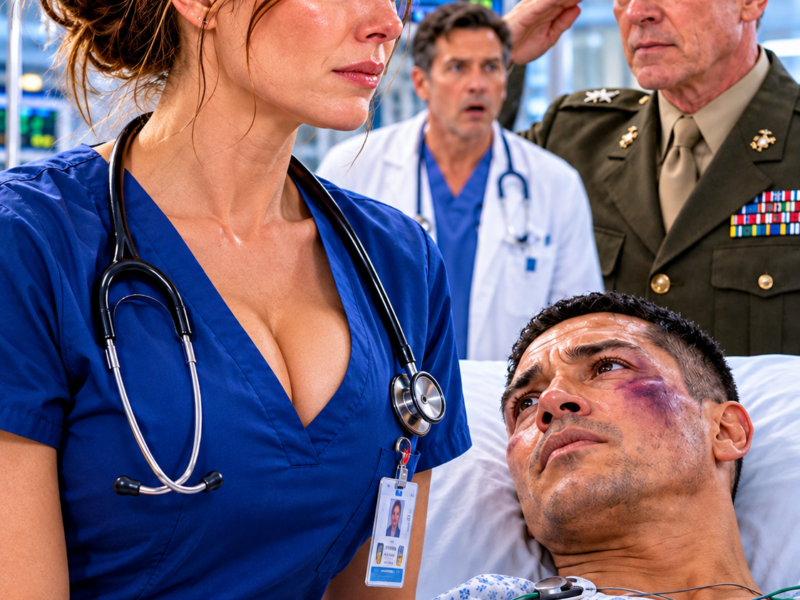
“I was suspended for breaking hospital protocol to save a dying Marine. They took my badge, escorted me out, and warned me never to return
The first thing I heard when I walked back into St. Matthew’s Military Medical Center was the sound of my own name.
“Commander Morgan.”
I stopped just inside the emergency department.
Six years.
Six years since anyone had called me that. Six years since I had taken off my uniform, packed my belongings, and promised myself I would never again answer to a military title.
But Colonel Daniel Reeves was standing beside the nurses’ station, waiting for me.
“Sergeant Torres is awake,” he said.
“Is he stable?”
“For now.”
“Then why are you looking at me like that?”
“Because he refused to speak to anyone until we told him you were coming.”
I glanced toward the intensive care unit.
“I saved his life. That doesn’t mean I know him.”
Reeves lowered his voice.
“He knows you, Claire. He was part of the team that recovered your unit’s final transmission.”
My stomach tightened.
The final transmission.
I had heard it in my dreams for years.
A radio full of static. Three people shouting over one another. Someone calling my name. Then a voice saying, “Commander, we’re not leaving without you.”
And finally, silence.
I had never learned who sent that message.
“Take me to him,” I said.
The colonel nodded and led me down the corridor.
Two military police officers stood outside Torres’s room. One of them stepped aside when Reeves showed his identification.
Inside, Sergeant Michael Torres was lying in bed with a bandage across his chest. His face was pale, and an oxygen tube rested beneath his nose. A monitor beeped steadily beside him.
When he saw me, he tried to sit up.
“Don’t,” I said, moving toward him. “You’ve had surgery. You need to stay still.”
He stared at my face.
“Commander.”
I pulled a chair beside his bed.
“I’m a nurse now. You can call me Claire.”
His eyes filled with emotion.
“I don’t think I can.”
“Why?”
“Because I was told you were dead.”
I felt the room grow smaller.
“Who told you that?”
“Colonel Shaw.”
The name struck me like a physical blow.
I looked at Reeves.
He didn’t appear surprised.
“Tell me what happened,” I said.
Torres took a careful breath.
“Six years ago, my team was assigned to recover a communications specialist from a temporary base outside Kandahar. We were told the area was secure. It wasn’t.”
I looked down at my hands.
“I remember.”
“You were leading the medical extraction unit. Your helicopter was hit during the evacuation. The official report said everyone aboard was killed.”
“Everyone except me,” I whispered.
Torres shook his head.
“That’s not what happened.”
He reached toward the bedside table. His fingers trembled as he picked up a small plastic evidence pouch.
Inside was a military identification card, its edges burned.
I recognized the photograph.
Captain Daniel Mercer.
My commanding officer.
The man who had ordered me onto the evacuation helicopter six years earlier.
The man I had watched disappear into smoke.
“Where did you get this?”
“From the man who pulled me out of the building.”
“Who?”
Torres looked at Colonel Reeves.
The colonel answered quietly.
“Daniel Mercer is alive.”
For a moment, I couldn’t hear the monitor.
“No.”
“I saw him three weeks ago,” Torres said. “He gave me that card and told me to find you.”
I stood so abruptly that the chair scraped against the floor.
“Why didn’t he come himself?”
“Because he’s been hiding.”
“From whom?”
Torres glanced toward the door.
“From the people who arranged the ambush.”
The colonel closed the door.
“Claire, there’s something you need to understand. The operation that destroyed your unit wasn’t a failed extraction. Someone changed the coordinates before your team arrived.”
I stared at him.
“Who authorized the change?”
“That’s what we’re investigating.”
“Six years, Colonel. You can’t tell me you still don’t know.”
He didn’t answer.
Instead, he placed the black envelope on the bedside table.
The date on the front was still visible.
07-19-16.
“Your unit’s last transmission was recovered from a damaged satellite relay,” he said. “The recording was encrypted. Torres brought us the key.”
I looked at the sergeant.
“You were carrying it when you were shot?”
He nodded.
“I was supposed to deliver it to Colonel Reeves. Someone followed me from the base.”
“Who shot you?”
“I never saw his face.”
The colonel opened the envelope and removed a small memory card.
“This contains the recovered transmission.”
I couldn’t move.
“Play it.”
Reeves connected the card to a secure tablet.
A burst of static filled the room.
Then I heard my own voice.
“Command, this is Morgan. Our extraction point has been compromised. We have wounded personnel. Request immediate evacuation.”
A second voice answered.
“Hold position. Reinforcements are on the way.”
I closed my eyes.
That was the moment everything had begun to collapse.
Another voice broke through the static.
“Negative. The coordinates are wrong. They sent us to the wrong location.”
Captain Mercer.
My hands began to shake.
Then came a sound I had never heard before: someone speaking directly into the radio, calm and unmistakably close to the microphone.
“Let them stay where they are.”
A pause.
“By the time anyone reaches them, there won’t be a team left to report what happened.”
The recording ended.
No one spoke.
I looked at Reeves.
“Who is that?”
He stopped the playback and enlarged the final section of the audio.
“We’re still confirming the voice.”
“Don’t give me that answer.”
He looked at me for a long moment.
“General Thomas Whitaker.”
I knew the name.
Whitaker had been the senior officer overseeing several operations in the region. He had later been promoted and appointed to a powerful defense advisory position.
I had once stood in front of him during a commendation ceremony.
He had shaken my hand and told me my unit’s sacrifice would never be forgotten.
I felt sick.
“He knew,” I whispered.
“We believe he authorized the coordinate change,” Reeves said. “But we don’t yet have enough evidence to prove it.”
“Then what does Mercer have?”
Torres answered.
“The original orders.”
He shifted painfully against his pillow.
“Mercer found the transmission log before they moved him. He copied everything. The original coordinates, the altered orders, and the names of the people who approved the change.”
“Where is he?”
Torres hesitated.
“He said you’d know where to find him.”
I frowned.
“I haven’t seen him in six years.”
“He told me to give you one message.”
“What message?”
Torres swallowed.
“He said, ‘The lighthouse is still standing.’”
I felt my breath catch.
The lighthouse.
It was an old abandoned structure near the coast where our unit had once conducted training exercises. Mercer had used it as a meeting point when official channels were compromised.
It was also where he had made me promise that if anything happened to him, I would protect the people under my command.
I looked at Colonel Reeves.
“I need to go.”
“You’re not going anywhere alone.”
“I wasn’t asking permission.”
For the first time, he almost smiled.
“Good. I was hoping the commander was still in there.”
Before we could leave, a nurse hurried into the room.
“Colonel, security just called. There’s been an incident at the south entrance.”
Reeves turned.
“What kind of incident?”
“Someone tried to access the patient records using a senior administrator’s credentials. When security challenged him, he ran.”
My eyes moved to Torres.
“Were you expecting anyone?”
He shook his head.
The nurse lowered her voice.
“He left something at the computer station.”
She handed the colonel a folded piece of paper.
Reeves opened it.
His expression hardened.
“What does it say?” I asked.
He passed it to me.
There were only six words.
STOP LOOKING OR THE NURSE DIES.
For several seconds, I couldn’t speak.
Then I looked at the colonel.
“Someone knows I’m here.”
“They’ve known since you entered the hospital.”
“Then we have a problem.”
Reeves folded the paper.
“No, Commander. We have an opportunity.”
He explained that federal investigators had already been tracking suspicious communications connected to the old operation. The attempted access to Torres’s records could help identify whoever was trying to erase the evidence.
But there was another problem.
The hospital administrator, Dr. Eleanor Price, had signed the suspension order against me.
And according to Reeves, she had also authorized the release of Torres’s medical records to an outside security contractor.
I remembered Price’s expression in the trauma bay.
Cold. Certain. Uninterested in the fact that a young Marine had nearly died.
“She’s involved?”
“We don’t know how deeply.”
I looked through the glass at the hallway.
“I want to speak to her.”
Reeves shook his head.
“Not yet. We need her to believe you’re still unaware of the full investigation.”
I almost laughed.
“I’m suspended, Colonel. I don’t think anyone is worried about what I know.”
“That’s exactly what makes you useful.”
I didn’t like it.
But I understood.
For six years, I had tried to bury the part of myself that made decisions under pressure. I had convinced myself that becoming a civilian nurse meant leaving the battlefield behind.
Yet the battlefield had followed me into the hospital.
And now a patient I had saved was the only person who could lead me back to the truth.
Before leaving Torres’s room, I turned toward him.
“You’re going to be all right.”
He gave a weak smile.
“You always say that to your patients?”
“Only the difficult ones.”
He laughed, then winced.
I adjusted his blanket.
“Rest. We’ll talk when I get back.”
“Commander?”
I paused at the door.
“Thank you for not letting me die.”
I held his gaze.
“You don’t have to thank me for doing my job.”
He shook his head.
“I’m not talking about today.”
I understood.
He was thanking me for the promise I had made six years earlier, when our unit was still intact and the world hadn’t yet fallen apart.
I left before he could see my eyes fill.
The lighthouse stood on a rocky stretch of coastline nearly forty miles from the hospital.
By the time Colonel Reeves and I arrived, the sun was setting.
The old structure looked smaller than I remembered. Its white paint had peeled away, and weeds covered the path leading to the entrance.
I had once stood there with Mercer after a difficult training exercise.
He had handed me a cup of terrible coffee and told me that leadership wasn’t about having the right answer.
It was about refusing to abandon people when the answer wasn’t clear.
I wondered if he remembered saying it.
Reeves checked the perimeter.
“Stay behind me.”
“I used to lead a medical extraction team.”
“And now you’re a civilian nurse who has been suspended from her job.”
“That’s a very polite way of saying I’m out of practice.”
He gave me a brief look.
“Just stay alert.”
The lighthouse door was unlocked.
Inside, a small lamp burned on a table.
A man sat beside it with his back to us.
He was thinner than I remembered. His hair had turned almost completely gray, and one shoulder sat lower than the other.
But when he turned around, I knew him.
“Captain Mercer.”
His expression softened.
“Hello, Claire.”
I crossed the room before I could think.
For a moment, I simply stood in front of him.
Then I hugged him.
He held me with one arm, careful of his injured shoulder.
“I thought you were dead,” I whispered.
“I know.”
“I saw the helicopter go down.”
“I wasn’t on it.”
I pulled back.
“What?”
“Your team had been ordered to evacuate. I was told to remain behind and secure the communications equipment. When the second attack started, I was trapped inside the operations building.”
“You were listed as missing.”
“Because someone wanted it that way.”
I stared at him.
“Why didn’t you contact me?”
“I tried. Twice. Both attempts were intercepted. After that, I realized anyone I contacted could become a target.”
“Torres found you.”
“He found the evidence first. I found him afterward.”
Mercer reached into a metal case and removed a thick folder.
“This is the original mission record.”
I opened it.
There were copies of the initial orders, radio logs, and a signed authorization sheet. The extraction coordinates had been changed less than an hour before our unit arrived.
The approval signature belonged to General Whitaker.
But another name appeared beneath it.
Dr. Eleanor Price.
I looked up.
“She was working with the military?”
“She was the civilian liaison responsible for coordinating medical transport and casualty reports,” Mercer said. “She knew the extraction route had been changed. She also knew your unit had requested an emergency evacuation.”
“And she did nothing?”
“Worse. She altered the medical record afterward. Your unit was listed as unrecoverable before the final search had even begun.”
My fingers tightened around the folder.
“That means she knew I survived.”
“Yes.”
“Then why let me work at her hospital?”
Mercer looked at me.
“Because she wanted to know whether you remembered.”
The room seemed to grow colder.
My suspension hadn’t been about hospital policy.
It had been a test.
The unauthorized procedure had given Price a reason to remove me from the building without raising questions. And when Colonel Reeves arrived, someone had realized the old investigation was moving again.
“What does Whitaker want now?”
Mercer closed the metal case.
“The original records are enough to reopen the investigation, but not enough to prove who ordered the attack. There was another recording. The person who gave the final order spoke directly to the field team before the transmission was cut.”
“Where is it?”
Mercer looked toward the lighthouse window.
“Inside the hospital.”
I stared at him.
“Why would it be there?”
“Because the medical communications system recorded every emergency transmission that came through the evacuation network. The hospital kept a backup archive. Price was responsible for transferring it to the military records office.”
“And she kept a copy?”
“Or someone did.”
Reeves stepped closer.
“We have a federal warrant ready. But we need to identify the archive before Price can destroy it.”
I looked down at the folder.
“Then we go back.”
Mercer shook his head.
“You don’t understand. Price will be expecting us.”
“Good.”
“Claire, this isn’t an extraction mission. You don’t have a team.”
I met his eyes.
“I had a team once. Someone decided we were disposable. I’m not making that mistake again.”
He studied me for a moment.
Then he nodded.
“That’s my commander.”
We returned to the hospital just before midnight.
Federal agents were positioned around the building, but their presence was deliberately discreet. Colonel Reeves had arranged for the hospital to remain operational while investigators secured the medical records department.
I was still technically suspended.
But the moment I entered the emergency department, two nurses looked up.
One of them, a young nurse named Olivia, hurried toward me.
“Claire. You’re back.”
“Just for a little while.”
She glanced at the colonel.
“Dr. Price has been asking about you.”
“Where is she?”
“Her office.”
I looked at Reeves.
He nodded once.
We went upstairs.
Price was standing behind her desk, speaking on the phone. She ended the call when we entered.
“Claire. I wasn’t expecting to see you.”
“I wasn’t expecting to be suspended for saving a patient’s life.”
Price gave a thin smile.
“You violated protocol.”
“Then why did you authorize an outside contractor to access his medical records?”
Her expression changed.
“That’s confidential.”
“Not anymore.”
Reeves placed his identification on the desk.
“Dr. Price, we’re conducting a federal investigation into the unauthorized release of military medical information and the alteration of historical casualty records.”
Price looked at him, then at me.
“You have no idea what you’re interfering with.”
“Then explain it.”
She laughed softly.
“You think this is about a few changed coordinates? You think one operation makes a difference?”
“It made a difference to the people who died.”
“Those decisions were made at a higher level.”
“And you helped cover them up.”
Price’s eyes hardened.
“I followed lawful orders.”
“Did you?”
For the first time, she seemed uncertain.
Reeves placed the original records on her desk.
“Your signature appears on the casualty report.”
Price looked down.
Her face lost its color.
“You shouldn’t have that.”
“That’s what we’re here to discuss.”
She reached for the folder.
Reeves stopped her.
“Don’t.”
Price stepped back.
Then her eyes moved toward the office door.
I followed her gaze.
A man stood in the hallway.
General Thomas Whitaker.
He looked older than he had at the commendation ceremony, but his posture was still rigid. His uniform was immaculate.
He glanced at the colonel.
“Reeves. You’ve overstepped your authority.”
Reeves didn’t move.
“General, you’re being served with a federal order.”
Whitaker looked at me.
“Commander Morgan. I heard you had left the service.”
“I did.”
“Then you should understand that military operations involve difficult choices.”
I stepped forward.
“Was leaving my unit behind one of them?”
His face remained expressionless.
“Your unit was in a compromised position. The extraction was no longer viable.”
“You knew we were still alive.”
“We had to protect a larger operation.”
“You sent us to the wrong coordinates.”
“I followed intelligence that was available at the time.”
I opened the folder and pointed to his signature.
“You approved the change.”
Whitaker looked at the paper.
Then he looked back at me.
“Sometimes a commander must accept losses.”
I felt the old anger rising, but I kept my voice steady.
“People are not numbers on a report.”
He said nothing.
Reeves moved beside him.
“General, turn around and place your hands behind your back.”
Whitaker looked toward Price.
She lowered her eyes.
For a second, I thought he might resist. Instead, he slowly placed his hands behind him.
The agents entered the office.
Price began speaking rapidly, insisting that she had only followed instructions. Whitaker remained silent as the officers escorted him away.
I watched until they disappeared down the corridor.
Six years of questions.
Six years of believing I had failed my people.
And the man responsible had just walked past me in handcuffs.
But there was still one thing I needed to know.
The missing recording.
“Where is the archive?” I asked Price.
She didn’t answer.
Reeves signaled to the agents.
They began searching the office.
Behind a locked cabinet, they found a small encrypted storage drive. It contained the backup transmissions from the night of the ambush, including the final order.
The recording was short.
A voice said, “Do not send the extraction team. If they come back, the operation is finished.”
The voice was Whitaker’s.
There was no longer any room for doubt.
The evidence was enough.
The investigation continued for months. Whitaker was charged with conspiracy, obstruction of justice, and falsification of military records. Price faced charges for her role in the cover-up and the unauthorized handling of medical information.
The case also reopened the official records of the operation.
Families who had spent six years believing their loved ones had been abandoned received the truth.
Some learned that their relatives had died.
Others discovered that missing service members had survived under protected identities.
Captain Mercer testified before the military inquiry. Sergeant Torres, once strong enough to walk without assistance, gave his statement from a rehabilitation center.
And I was asked to testify too.
I told them what happened that day.
I described the altered coordinates, the failed evacuation, and the final radio transmission.
I also told them about the young Marine who arrived at St. Matthew’s with a bullet wound and a secret.
The same Marine whose life I had been suspended for saving.
When the inquiry ended, the hospital withdrew my suspension.
Dr. Hayes apologized.
He said he had panicked when I acted without authorization and had been afraid of being blamed for the outcome.
I listened.
Then I told him that fear was understandable.
Abandoning a dying patient was not.
I returned to work two weeks later.
My badge was waiting at the nurses’ station.
Someone had placed it in a small envelope with a handwritten note:
You were right to save him.
I never learned who wrote it.
I didn’t need to.
Sergeant Torres recovered steadily. The first time he walked into the emergency department without assistance, he brought a coffee for every nurse on duty.
When he reached me, he placed one cup on the counter.
“Thought you might need this, Commander.”
I smiled.
“I’m off duty.”
“Not to us.”
Captain Mercer came to visit a month later.
He still had trouble with his shoulder, but he was walking without a cane. He stood beside the window while I finished my shift.
“You know,” he said, “there’s a position open with the military medical response unit.”
I looked at him.
“I thought you were retired.”
“I am. But I know people.”
I laughed.
“Are you asking me to go back?”
“I’m asking whether you’ve stopped being a commander.”
I looked across the emergency department.
A young Marine was being wheeled into a treatment room. His face was frightened, and his hand was searching for someone to hold.
A nurse moved beside him.
I recognized the expression.
The fear.
The uncertainty.
The desperate need to know someone would not let go.
I turned back to Mercer.
“I don’t know if I can wear the uniform again.”
“You don’t have to.”
He nodded toward the patient.
“You never stopped doing the job.”
That night, after my shift, I walked out through the hospital entrance.
The air was cool, and the parking lot lights reflected on the wet pavement.
For the first time in six years, I didn’t feel as though I was running away from the past.
I had faced it.
I had learned the truth.
And I had brought the names of my people back into the light.
My phone buzzed.
A message from Torres.
Thank you for bringing us home, Commander.
I read it twice.
Then I looked at the hospital behind me.
I had once believed that leaving the military meant leaving my old life behind.
But the truth was simpler.
A uniform could be taken off.
A title could be forgotten.
An order could be ignored.
But the promise I had made to the people under my command had never disappeared.
I had promised that no one would be left behind.
And this time, I had kept it.
THe end.









